

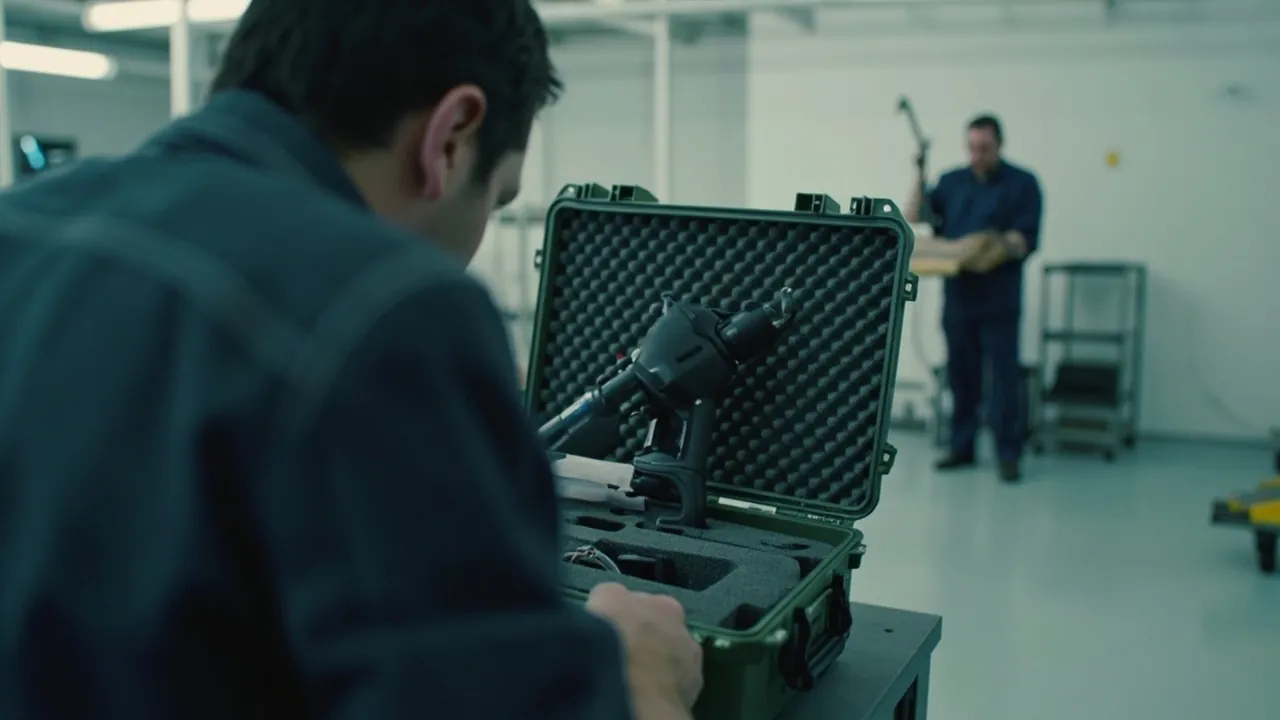
The core parts of stone processing equipment — diamond circular saw blades, gang saw blades, wire saw beads, polishing heads and abrasive wheels — share a common set of characteristics: heavy unit weight, high value, tight geometric tolerance, and acute vulnerability to point loading and mutual impact during transport. They therefore require purpose-built parts cases with heavy-duty load-bearing structure and high energy-absorbing inserts. What distinguishes stone processing from general machinery is its culture of heavy loads. A bridge saw spindle flange, a diamond blade over 1,600 mm in diameter, or a set of gang saw blades can weigh tens to hundreds of kilograms individually, and the kinetic energy generated in transit is orders of magnitude above that of precision instruments. Packing such parts in light foam and a cardboard box simply hands the risk forward to the moment the case is opened.
The pain points are tightly clustered. Diamond blades are thin, brittle items for which local loading is the worst possible condition: lift one by a single sling point, or stack two directly against each other, and after transport the body may show deformation, chipped segment edges or outright warping — and once mounted, run-out immediately exceeds tolerance. Gang saw blades are slender, thin and extremely high in length-to-thickness ratio; without full-length support, transport vibration produces permanent bending. Wire saw beads travel in strands, and bead-to-bead impact damages the diamond working layer. Polishing heads are cast or forged items: heavy, irregularly shaped, and easily damaged at the mounting datum face, which in turn degrades polishing flatness. Add the widespread use of water cooling in stone processing — components removed from service carry residual water that mixes with stone powder into slurry — and the stage is set for corroded blade bodies and seized threads.
This article sets out protection schemes in the order of sawing components, polishing components and heavy-load structure. It focuses on four logic sets: heavy-load vibration damping, thin-part support, moisture and rust control, and high-dust sealing. It includes material selection tables, a load-path design approach, transport test items and acceptance methods. JUNZHJIA serves stone machinery manufacturers, abrasives and tooling companies and stone processing plants with heavy-duty case structure design, high energy-absorbing insert customisation and OEM/ODM volume delivery, manufactured and shipped worldwide by Kexin New Materials (Guangdong) Co., Ltd.
Table of Contents
- 1. Why Stone Processing Parts Need Heavy-Duty Vibration-Damped Cases
- 2. Equipment Composition and Logistics Risk Profile
- 3. Protecting Sawing Components: Blades, Gang Saw Strips and Wire Beads
- 4. Protecting Polishing Components: Heads, Discs and Abrasive Wheels
- 5. Heavy Load and High Impact: Case Structure Design
- 6. Vibration Control: From Transport Spectrum to Insert Energy Absorption
- 7. Moisture and Rust: Handling Water-Cooling Residue
- 8. Stone Powder and Slurry: Abrasive Dust and IP Ratings
- 9. Custom Inserts: Different Strategies for Thin Parts and Heavy Castings
- 10. Seals, Latches and Lifting Accessories
- 11. Transport Testing: ISTA, GB/T 4857 and ASTM D4169
- 12. On-Site Circulation, Workshop Handling and Quarry Scenarios
- 13. Marking, Batch Management and Blade Life Traceability
- 14. Procurement Acceptance, AQL and Specification Selection Table
- Frequently Asked Questions
- Conclusion & Related Reading
1. Why Stone Processing Parts Need Heavy-Duty Vibration-Damped Cases
Stone processing is a classic heavy-equipment, high-wear industry. A bridge saw, an infrared bridge cutting machine or a CNC stone machining centre has a heavy spindle system, guideway system and worktable system, while blades, saw strips and polishing heads are consumables replaced continuously and far more often than general equipment components. Stone industry parts logistics therefore has two hallmarks: heavy unit weight and fast turnover.
Heavy weight translates directly into high kinetic energy. Transport vibration energy scales with mass, so a 200 kg cast-iron polishing head under the same acceleration generates shock energy two orders of magnitude above a 2 kg precision instrument. If case structure is too weak, the base cracks; if the insert absorbs too little, shock transmits straight into the component; if restraint is inadequate, the component shifts inside the case and impacts other items. The starting point for stone parts case selection is therefore not dust and water protection, but whether it can carry the weight and absorb the shock in the first place.
Fast turnover means frequent handling and management pressure. Blades and heads are mounted and removed constantly on site, so the case opens and closes often and latch and hinge fatigue life becomes critical. At the same time, model variety is high, which encourages wrong-item retrieval and mis-installation. The case must therefore carry a clear marking system and an efficient retrieval design.
One more underestimated risk is thin brittle parts. A diamond circular blade is large in diameter and thin in section; the body is high-strength steel with some toughness, but under point load or stacking pressure in transit it can deform plastically or buckle locally. A gang saw blade may be several metres long and only a few millimetres thick, with an extreme length-to-thickness ratio and very low bending stiffness. The protection logic for these two is the exact opposite of a cast-iron polishing head: the head must withstand impact, while the blade must experience no load at all.
Taken together, stone processing parts case design must distinguish three component classes — heavy energy-absorbing items such as heads and spindle parts, thin zero-load items such as blades and saw strips, and strung link items such as wire saw beads — and apply a different insert and restraint strategy to each. Later sections follow this classification.
2. Equipment Composition and Logistics Risk Profile
The stone processing chain typically runs from block extraction to primary sawing (gang saws, multi-blade saws, wire saws) to bridge cutting and shaping, then polishing and finally product packing. Every stage has removable, high-value parts.
| Process stage | Typical parts | Main risk | Protection focus |
|---|---|---|---|
| --- | --- | --- | --- |
| Block extraction | Wire saw beads, guide wheels, drive wheels | Bead-to-bead impact, working-layer damage | Individually fixed strands, isolation |
| Primary sawing | Diamond circular blades, gang saw strips, spacers | Body deformation, segment chipping, bending | Zero-load support, suspended or flat-supported |
| Bridge cutting and shaping | Spindle flanges, cutter shafts, positioning mechanisms | Heavy impact, mounting-face damage | Hard load bearing, mounting-face protection |
| Polishing | Polishing heads, discs, resin wheels, abrasive blocks | Impact, datum-face damage, moisture | Dedicated cavities, energy-absorbing support, moisture control |
| General | Bearings, gearboxes, motors, guideway carriages | Vibration loosening, dust ingress, corrosion | Dust sealing, moisture control, one part per compartment |
Four risk classes dominate. Heavy vibration and shock arise from road transport, rough quarry roads and lifting, and rank first. Localised loading of brittle parts arises from poor support and stacking. Dust and slurry ingress arises from the strongly abrasive nature of stone powder and water-cooling residue. Humidity and corrosion arise from residual water after cleaning and from damp environments.
The characteristics of stone powder deserve separate treatment. Dust from cutting and polishing is predominantly calcium carbonate and silicate minerals with a wide particle-size distribution, ranging from visible coarse grains to sub-micron fines. Its quartz content is hard and abrasive. Once this dust enters a case and settles on guideway surfaces, threads or bearings, it causes pronounced abrasive wear; mixed with water into slurry, it penetrates gaps and cures there, making cleaning difficult. Stone industry parts cases therefore demand high sealing performance and easy cleaning, just as much as precision industries do.
There is one further component-related risk: seized threads and mating faces. Stone processing uses water cooling extensively, so parts come off the machine with residual surface water that mixes with stone powder into a neutral or alkaline slurry. Without cleaning and rust protection before packing, threads can seize within weeks of transport, requiring cutting or heating on site to remove — damaging the part and delaying the schedule. Section 7 addresses this in detail.
3. Protecting Sawing Components: Blades, Gang Saw Strips and Wire Beads
Sawing components are the highest-value and hardest-to-pack class in stone processing, and their central contradiction is thin, large and brittle at once.
Diamond circular saw blades commonly range from 350 mm to over 1,600 mm in diameter, from a few millimetres to more than ten millimetres in thickness, with a high-strength steel body and diamond segments welded or sintered onto the rim. Three failure modes dominate: plastic deformation or warping of the body caused by local loading or stacking; segment chipping or detachment caused by edge impact; and arbor bore damage caused by improper lifting or restraint. The protection principles are unambiguous: no single-point lifting and no direct stacking; full-face or annular support is mandatory; blades must be separated from one another; and the arbor bore needs dedicated protection.
Specific practice: smaller blades can use a vertical slot insert with each blade in its own slot and the segment rim left unsupported; larger blades are better placed flat, one at a time, separated by soft spacer pads, resting on a flat rigid support plate to prevent local bridging. Either way the arbor bore should carry a protective sleeve so it cannot strike other items.
Gang saw strips are slender thin items, often 3 to 5 metres long and only a few millimetres thick, with an extreme length-to-thickness ratio. Protection centres on full-length continuous support: supporting only the two ends leaves the mid-span free to bend under vibration and take a permanent set. A full-length continuous soft support face plus multiple lateral restraint points keeps the strip flat but uncompressed along its whole length. When several strips share a case, each needs its own slot and stacking is prohibited.
Wire saw beads and wire saw assemblies are link structures. Beads are connected by steel cable or springs, and in transit the links strike each other, damaging the diamond working layer while the cable fatigues through repeated flexing. Each wire saw should be coiled or suspended separately, with a coiling radius not below specification and soft separators between beads. Guide wheels and drive wheels need dedicated cavities with the groove protected.
| Sawing component | Main failure mode | Insert strategy | Key prohibition |
|---|---|---|---|
| --- | --- | --- | --- |
| Circular blade (small diameter) | Body deformation, segment chipping | Vertical individual slots, rim unsupported | No stacking, no single-point lifting |
| Circular blade (large diameter) | Warping, arbor bore damage | Flat placement, soft spacers between blades | No local bridging, no direct stacking |
| Gang saw strip | Permanent bending | Full-length continuous support plus lateral restraint | No end-only support, no stacking |
| Wire saw beads | Working-layer damage, cable fatigue | Separate coiling, bead isolation | No tight coiling, no loose piling |
| Spacers and flanges | Mounting-face damage | Hard load bearing, face protection | No mixing with other parts |
There is also a process recommendation for sawing components: inspect and record appearance and deformation before packing. Blade and strip damage tends to be progressive. A single mild impact creates slight deformation; once mounted, it shows up as cutting run-out, kerf deviation or increased noise, and on site it is usually attributed to blade quality. Maintaining a pre-dispatch inspection record, including flatness sampling and photographic evidence of appearance, protects both parties commercially and surfaces transport scheme defects early.
4. Protecting Polishing Components: Heads, Discs and Abrasive Wheels
Polishing-stage parts are dominated by heavy castings and consumable abrasives, and the protection logic is entirely different from sawing components: here the key is load bearing and energy absorption.
Polishing heads are the core executing components of a polishing machine, usually a cast-iron or cast-aluminium body carrying abrasive blocks or resin wheels, with individual weight from tens to over a hundred kilograms. The main failure modes are damage to the mounting datum face and body cracking. Once the datum face is damaged, the head mounts out of flatness, producing waviness or uneven thickness in the polished slab that cannot be corrected on site — only replacement. The datum face must therefore be protected with soft isolation, load must land on non-functional body surfaces, and the case base must be reinforced to take concentrated loads.
Polishing discs and resin wheels are consumables, but not inexpensive, and they are numerous. They are relatively light, come in quantity, and have fragile edges. A high-density multi-position insert with each wheel in its own cavity, edges not touching, is recommended; group by specification and mark position numbers so that on-site retrieval follows a predictable sequence.
Abrasive blocks and grinding media are often small blocks or bars, and some contain resin bonds that are sensitive to humidity and temperature. Dedicated sealed cavities with desiccant are advisable, and they should not share a case with oil-bearing components.
Spindle and drive components — spindles, flanges, couplings and gearboxes — are precision heavy items. The spindle's critical features are its bearing seats and taper, which need rigid support and dust protection. Gearboxes must not carry a cantilever bending moment at the output shaft, exactly as with sanitaryware glazing robots. A support fixture built to the assembled attitude is recommended.
Rule of thumb: transit damage to polishing heads concentrates overwhelmingly at the mounting datum face. This damage is insidious — a head that looks perfect only reveals the problem once mounted — so "soft isolation at the datum face, hard load bearing at non-functional faces" delivers the highest return of any protection action.
Polishing components also raise the hygroscopicity of abrasive blocks. Resin-bonded abrasives absorb moisture in high-humidity environments, losing strength and softening the bond so that blocks fracture in service. Cases for these parts should prioritise sealing and dryness, with a replaceable desiccant compartment where needed, and the case should be marked as moisture-sensitive so the warehouse can manage it differently.
5. Heavy Load and High Impact: Case Structure Design
The case body is the skeleton of a stone parts case, and its structural strength determines whether it can absorb heavy impact at all. Design should start from the load path.
Four links in the load path:
First, how load enters the case. Component weight passes through the insert into the case base. The more distributed the path, the better: ideally load travels through a large flat contact area onto base ribs rather than through a few small support points. The insert base should therefore be designed for full-face contact, avoiding point support.
Second, how the base resists bending. A heavy-duty base needs ribs or a double-wall structure. Rotomoulded cases typically use recessed rib patterns; injection-moulded cases use grid ribs. The test is whether the base visibly deflects at rated load — deflection displaces the insert and loosens the component.
Third, how the walls resist lateral impact. Lateral impact comes from braking, collision and load shifting under stacking. Walls need adequate stiffness and corners need reinforcing columns. For very heavy items, a metal frame or metal corner pieces should be evaluated.
Fourth, how load reaches the floor or pallet. The contact area between base and floor determines pressure. Heavy cases should have a flat base and be compatible with standard pallets; where forklift handling is required, forklift pockets with reinforced openings must be provided.
| Structural element | Design requirement | Common error | Consequence |
|---|---|---|---|
| --- | --- | --- | --- |
| Insert contact face | Full-face contact, distributed load | A few support points | Localised base collapse |
| Case base | Ribs or double wall | Flat single-wall base | Deflection at load, insert displacement |
| Walls and corners | Reinforcing columns, adequate thickness | Thin walls, no reinforcement | Cracking under lateral impact |
| Base contact | Flat, pallet compatible, forklift pockets | No pockets or unreinforced openings | Handling damage, tipping |
| Lifting points | Defined positions and sling angles | Improvised slinging on site | Local crushing, dropped component |
On material selection: HDPE rotomoulded cases are seamless, impact resistant and low-temperature tolerant, making them the first choice for heavy stone parts, at the cost of higher self-weight. PP injection-moulded cases offer high accuracy and consistency for medium-sized parts in medium volumes. For very heavy items or frequent lifting, a metal-frame composite case is advisable. On flammability, UL94 is a material-level classification for plastics (HB, V-0, V-1, V-2 and others). Where welding or grinding sparks are present in a stone processing shop, procurement can request the UL94 rating of the case material; it should be understood clearly that UL94 is a material-level assessment, does not mean the assembled case holds any fire certification, and does not replace on-site fire management.
6. Vibration Control: From Transport Spectrum to Insert Energy Absorption
Vibration control is the second line of defence for a stone parts case. Understanding the principles is what allows correct insert density and thickness to be chosen.
Basic transport vibration characteristics. Road transport vibration is distributed from low frequency to mid-high frequency, with the main energy concentrated in the lower bands, superimposed on occasional large shocks from potholes and speed bumps. The design must therefore handle both sustained low-amplitude vibration, which mainly causes loosening and fatigue, and occasional high-amplitude shock, which causes instantaneous damage.
The principle of isolation is to make the insert behave as a spring plus damper. Under impact, the insert absorbs energy through controlled compression and reduces the peak acceleration transmitted to the component. The governing parameters are material density and thickness:
- Too low a density: the material is too soft, crushes under heavy load, loses cushioning travel and transmits shock directly.
- Too high a density: the material is too hard, absorbs little energy and barely attenuates shock.
- Insufficient thickness: not enough compression travel to absorb the energy.
- Excessive thickness: the component has more room to move, inviting secondary impact.
Insert density must therefore match component weight. Light parts take low density; heavy parts take high density. A single density for everything is never acceptable — which is precisely why stone parts case inserts almost always need to be custom.
The value of multi-layer composites is covering different conditions at once. A typical sandwich is a high-density PE or EPP outer layer carrying load and low-frequency shock, a medium-density EVA core absorbing mid and high frequency vibration, and a low-density soft foam or flocked contact layer preventing scratching. This balances weight, cost and protection, and suits the stone industry well because heavy items and precision faces often coexist. The principles and material comparisons are in Cushion liner design for protective cases and Shock and vibration protection case solutions.
On validation, an insert scheme cannot rely on calculation alone. Practical routes include full-case vibration and drop testing to ISTA or GB/T 4857 with accelerometers inside recording the peak acceleration experienced by the component, or fitting a dummy mass equal to the component and inspecting both dummy and insert after the test. For very heavy items, one physical validation shipment before volume production is advisable.
7. Moisture and Rust: Handling Water-Cooling Residue
Stone processing uses water cooling extensively, which means parts come off the machine carrying residual water. Rust control is the step that distinguishes a stone parts case from those in other industries.
Three conditions for corrosion: water, oxygen and an electrochemical path at the metal surface. All three are easily satisfied after packing — residual water supplies the electrolyte, trapped air supplies oxygen, and the metal surface supplies the reaction interface. Higher temperature accelerates the reaction, which is why corrosion progresses noticeably faster in summer transport and inside sea containers.
Four control routes:
First, clean and dry thoroughly after dismantling. This is the most important step and the most often skipped. A recommended sequence is high-pressure water rinse, removal of stone powder and slurry, compressed-air drying with particular attention to threaded holes, counterbores and grooves, application of corrosion protection, and only then packing. Threaded sections should receive corrosion-inhibiting grease and a protective sleeve.
Second, control humidity inside the case. The sealing class should meet the scenario, with desiccant and a humidity indicator card inside. The principles are covered in Waterproof cases and IP ratings explained.
Third, manage differential pressure. Large temperature swings create a breathing effect, and when a slight vacuum forms inside, external moisture is drawn in. A pressure equalisation valve with a hydrophobic breathable membrane equalises pressure while blocking liquid water; see How a case pressure equalisation valve works.
Fourth, prevent standing water inside the case. Insert materials should be non-hygroscopic and mould resistant, and the case base should have no water-trapping recesses, or should incorporate drainage and ventilation in non-sealed case types. Where a component genuinely cannot be fully dried, such as a casting with complex internal cavities, record this at packing and shorten the storage cycle.
On desiccant quantity, there is no universal formula. It is estimated from free air volume, transit duration, sealing class and destination humidity, then refined using measured humidity indicator card data. Desiccant is not a substitute for drying: if the component surface carries substantial free water, the desiccant is consumed rapidly and creates a false sense of security. The order — dry first, then seal — cannot be reversed.
8. Stone Powder and Slurry: Abrasive Dust and IP Ratings
The abrasiveness of stone dust comes from hard minerals such as quartz. Once inside a case, it acts differently from ceramic glaze mist or cement dust: it tends toward mechanical abrasion rather than chemical attack, but its damage to mating faces, threads and bearings is just as severe.
Selecting the ingress protection rating. IEC 60529, and its Chinese equivalent GB/T 4208, define dust protection at level 5 (dust protected, limited ingress permitted) and level 6 (dust tight). Stone processing shops and quarries combine high dust concentration with hard particles, so IP6X is the correct choice. Where rain, washdown or standing water is possible, the second digit follows the exposure: 5 for water jets, giving IP65, and 7 for temporary immersion, giving IP67.
The common misconceptions apply here too: the two digits cover different things; IP6X alone is not waterproof; and a rating describes the as-delivered condition, with long-term performance depending on whether the seal is cleanable and replaceable.
Thread and mating-face protection deserves separate emphasis in the stone industry. Threads are the features most likely to seize and suffer abrasive damage. Recommendations: fit protective sleeves in plastic or rubber, apply corrosion-inhibiting grease, avoid direct contact with other components inside the case, and provide dedicated hard support positions for large bolts and tie rods.
Cleaning convenience is easily overlooked in stone industry case selection but is critically important. Once cured, the mixture of stone powder and slurry is hard to remove. Selection should examine whether the seal channel is easy to clean in terms of width, depth and absence of dead corners; whether the insert can be removed for washing; whether the case interior has dirt-trapping recesses; and whether drainage and ventilation are sensibly designed. Maintenance methods are covered in How to clean and maintain a protective case.
9. Custom Inserts: Different Strategies for Thin Parts and Heavy Castings
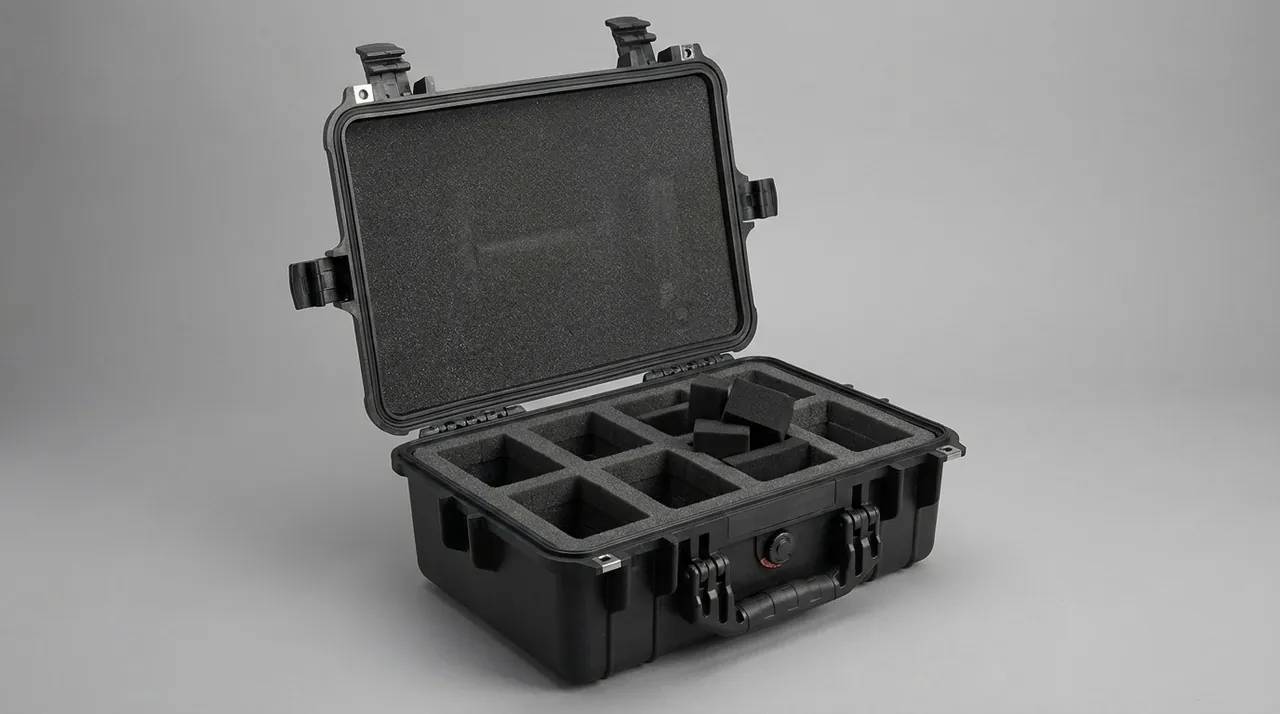
Insert design for stone parts cases must distinguish thin zero-load parts from heavy energy-absorbing parts, and the two strategies are nearly opposite.
Strategy for thin parts such as blades and saw strips: zero load. The goal is to keep thin parts free from any concentrated force. Design points:
- Support area should be as large as possible, ideally full-face or annular contact rather than point contact.
- The segment rim, meaning the working layer, should be unsupported and touch nothing.
- Each piece isolated individually, with soft spacer pads between pieces.
- Restrain lateral movement without applying clamping force, which would leave marks.
- Protect the arbor bore and mounting holes separately.
Strategy for heavy parts such as heads, spindles and flanges: energy-absorbing load bearing. The goal is to distribute load and absorb shock. Design points:
- Bearing points land on non-functional body surfaces; datum and mating faces are unsupported or soft-contacting.
- The insert base contacts the case base over its full area, avoiding point support.
- Higher-density material carries the load, with lower-density material as the energy-absorbing layer.
- Restrain all six degrees of freedom to prevent movement in transit.
- For items beyond manual handling capacity, design lifting points or handles.
| Component type | Insert objective | Density orientation | Key design action |
|---|---|---|---|
| --- | --- | --- | --- |
| Large circular blade | Zero load, prevent warping | Medium-low density contact layer | Flat support plate, soft spacer between blades |
| Small circular blade | Zero load, prevent chipping | Medium density slots | Vertical slots, rim unsupported |
| Gang saw strip | Prevent bending | Low density continuous support | Full-length continuous support face |
| Wire saw beads | Prevent bead impact | Medium-low density isolation | Separate coiling, bead isolation |
| Polishing head | Energy absorption, protect datum | High density bearing plus medium density absorbing | Full-face contact, soft datum isolation |
| Spindle and flange | Rigid location, dust protection | High density support | Attitude fixture, taper protection |
The development flow typically covers measuring component dimensions and weight, identifying centre of gravity and faces that must not be loaded, selecting material and density, structural design and sample production, physical trial fitting, revision and confirmation, then volume production. Trial fitting is especially critical for stone parts, because the actual dimensional deviation, coating thickness and lifting deformation of large castings cannot be fully represented by drawings. Cost structure is discussed in Custom case mould cost analysis, and material comparisons in Case foam material comparison.
JUNZHJIA develops inserts from component drawings or physical samples, supporting contoured support, multi-layer composites, removable dividers and lifting-point design, and can support several interchangeable inserts on one case platform — well suited to the wide size range and model variety found in stone plants.
10. Seals, Latches and Lifting Accessories
Stone parts cases operate under high dust, frequent opening and heavy handling, so accessory requirements exceed those of general industries.
Gaskets: EPDM offers good weathering and ageing resistance at moderate cost and is the general first choice. Silicone covers a wider temperature range, roughly −50 °C to 200 °C, suiting high-differential scenarios. TPE has good feel and rebound for frequent opening but only moderate durability in abrasive dust. Stone industry cases should prefer EPDM or silicone, and the gasket must be replaceable — a non-replaceable gasket means replacing the whole case when sealing fails.
Latches: stone parts cases open frequently because blades and heads are mounted and removed on site, making latches a wear item. Three selection points matter: material (engineering plastic or metal core), adjustability of clamping force, and whether fatigue life is supported by test data. Heavy cases should use multiple latches with even pressure distribution. Design detail is covered in Toolbox hinges, latches and sealing structure.
Hinges: heavy lids impose far higher torque than small cases. Metal-core hinges with self-lubricating bushings are recommended, avoiding early failure of all-plastic hinges under heavy load. Check that the hinge pin has an anti-escape feature so vibration cannot work it out.
Lifting accessories: any case beyond manual handling capacity needs a defined lifting method. Options include integrated lifting points with local reinforcement, dedicated slings matched to defined points, or a metal-frame case. Lifting point positions, permitted sling angle range and maximum load should be defined at the design stage. Improvised slinging on site is prohibited — it is a leading cause of dropped components and injuries.
Wheels and handles: for cases circulating frequently in a workshop, a larger wheel diameter crosses floor joints and accumulated stone chips more easily. Polyurethane wheels are soft, quiet and floor-friendly; nylon wheels are hard and wear resistant for rough surfaces. Stone workshop floors are often covered with powder and water, so sealed-bearing wheels are recommended. Heavy cases use four or six load-bearing wheels, with swivel castors as required. See Case wheels and trolley handle selection.
11. Transport Testing: ISTA, GB/T 4857 and ASTM D4169
A heavy-duty vibration-damped scheme must be validated. Stone parts have a high export share, since stone machinery and abrasives circulate globally, so at least one international system should be cited alongside domestic standards.
The ISTA series is graded by transport mode and weight: 1 Series for individual performance tests, 2 Series for partial simulation, 3 Series for general simulation with temperature and humidity preconditioning, and 6 Series for specific carriers. For heavy stone parts, ISTA 3A for parcel and 3E for unitised loads are common references, with 3E closer to palletised heavy freight. The flow is described in ISTA transport testing procedures explained.
The GB/T 4857 series is China's basic test method standard for transport packages, covering vibration, impact, stacking and drop, widely cited in domestic contracts. Stacking testing matters especially for stone, because heavy cases stored in multiple tiers impose substantial load on the lowest unit. See GB/T 4857 transport packaging testing explained.
ASTM D4169 designs test sequences by distribution cycle and assurance level, suiting sea-land and multi-modal journeys. See ASTM D4169 distribution cycle testing.
| System | Focus | Stone parts use case | Common procedures |
|---|---|---|---|
| --- | --- | --- | --- |
| ISTA | General simulation, carrier specific | Export case shipments, palletised heavy loads | 3A, 3E, 2A |
| GB/T 4857 | Domestic road and rail | Transfers between Chinese stone regions | Vibration, stacking, drop series |
| ASTM D4169 | Multi-modal distribution cycles | North American export, sea-land transport | DC12, DC13 and similar |
Additional tests for heavy items. Beyond standard testing, two specific validations are recommended. First, lifting and drop validation: simulate forklift handling and an accidental drop, then inspect the corners, base and insert for damage. Second, long-term stacking validation: apply a static load matching the real stacking tiers and storage duration, and check for permanent base deformation. Where a customer requests reference to MIL-STD-810H, it may be used as a source of environmental test methods for designing test conditions, but it must be stated clearly that this is a test-method standard and is not equivalent to military certification, and no military certification claim may be made. JUNZHJIA can help structure the test list, coordinate with third-party laboratories and provide inspection documents consistent with the shipped batch.
12. On-Site Circulation, Workshop Handling and Quarry Scenarios
Stone parts cases face harsher service conditions than general manufacturing, particularly in quarries and open stockyards.
Quarry and open stockyard scenarios: uneven ground, extremely high dust concentration, large diurnal temperature swings and possible rain exposure. Selection recommendations: rotomoulded case bodies for seam-free construction, low-temperature toughness and impact resistance; IP6X dust protection; EPDM or silicone gaskets; desiccant inside; large-diameter nylon wheels or, alternatively, no wheels at all with lifting and forklift handling. Metal parts need corrosion protection, and a light case colour reduces heat absorption.
In-workshop circulation: efficiency first. Wheels, handles and ease of opening dominate, but sealing cannot be abandoned, because stone workshop floors carry powder and water. A heavy-duty swivel wheel plus telescopic handle configuration works well, with a shortened gasket inspection interval for frequently opened cases.
Inter-plant transfer and storage: protection and stacking efficiency first. Standardising case specifications supports multi-tier stacking; the case top should have a stacking location face and the base a compression-reinforced structure. For long-term storage, include a humidity indicator card and check it periodically.
Shaping work and site scenarios: stone shaping often requires taking parts to a construction site, in a complex environment under time pressure. Choose cases that one person can handle — wheeled, splittable, with easily retrieved inserts — and organise common consumables such as blades and heads by specification to reduce searching on site.
On turnover efficiency, one practice worth spreading is to establish a fixed case-to-component relationship, one case per number, with equipment tag and component name marked on the case, preventing wrong-item retrieval. Where models are numerous, the standard-case-platform-plus-replaceable-insert model means only the insert changes while the case stays in service. See Removable divider system for cases.
13. Marking, Batch Management and Blade Life Traceability
Stone processing parts have a specific management requirement: life traceability. Diamond blades and polishing heads have finite service life, and that life is strongly influenced by the stone being processed — the difference between granite and marble can be several multiples. Without traceable records for each blade, it is impossible to tell whether an early failure is a product quality issue or a service condition issue.
A recommended marking and traceability system:
- Case marking: asset number, applicable equipment model, case specification, maximum load and lifting point identification. Use in-mould labelling, screen printing or engraving so nothing depends on an adhesive label.
- Position marking: each insert cavity labelled with component name and specification for verification.
- Batch marking: production batch number and receipt date so life can be assessed by batch.
- Usage record position: a card position inside the case recording each blade's or head's mounting date, stone type processed and cumulative running hours.
- Traceability code: a QR or barcode linking procurement batch to usage records for quality review and claims evidence.
For exported parts, destination labelling language and compliance requirements also apply. Where a component contains oil or a battery, hazardous goods transport regulations apply. A general framework is set out in ADR and IMDG hazardous goods transport cases.
Batch management pays off most on heavy items. If a batch of polishing heads shows multiple early failures, the investigation must quickly separate material batch problems, transport damage and misuse. Clear batch marking and packing records allow that investigation to conclude in days rather than becoming an unresolvable historical question.
14. Procurement Acceptance, AQL and Specification Selection Table
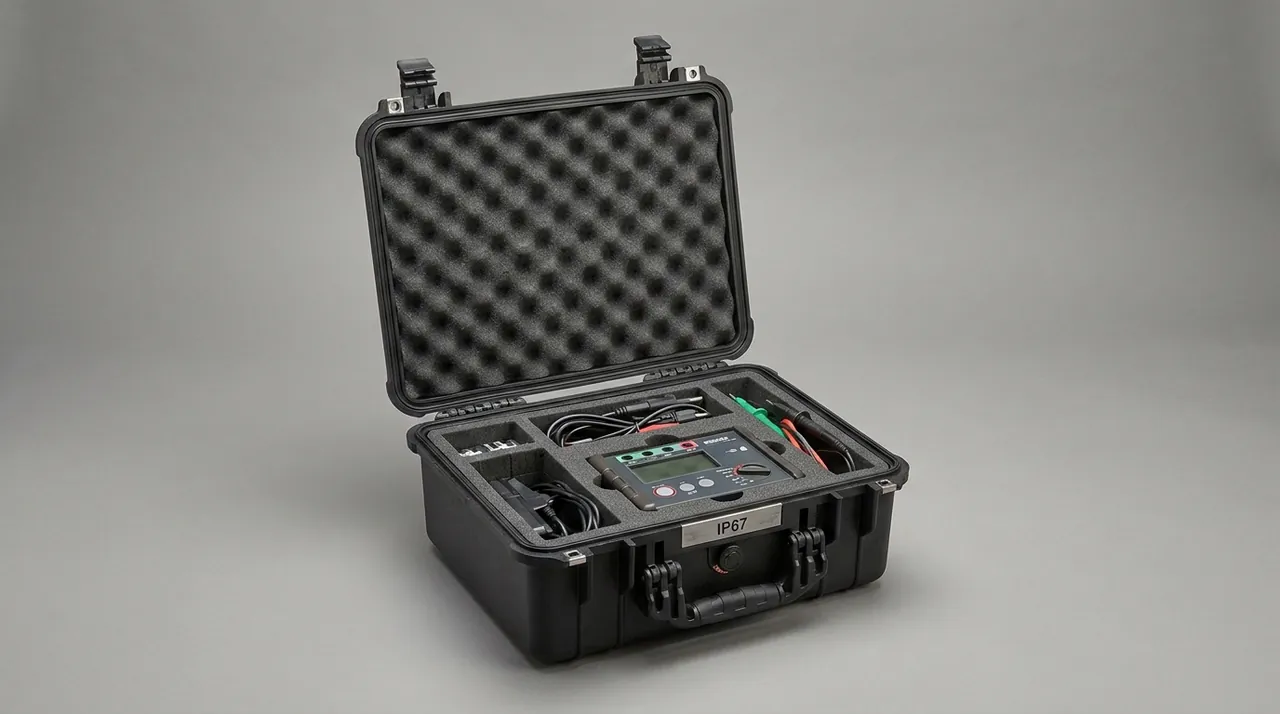
When buying stone parts cases in volume, acceptance criteria must be written into the contract. Heavy-duty case acceptance emphasises structural strength more than ordinary cases.
Recommended incoming inspection items:
- Appearance and dimensions: case and insert cavity dimensions against drawing; no cracks, sinks or flash; ribs complete.
- Structural strength: static load sampling at a multiple of rated load held for a specified period, confirming no permanent deformation and no cracking; corner drop or simulated drop sampling.
- Sealing and dust protection: sampling per the agreed rating, or a full-perimeter contact check using the paper-draw method as a field indicator.
- Latches and hinges: opening force, positive engagement, fatigue sampling; loaded opening cycles for heavy cases.
- Insert fit: trial fit with the actual part or a gauge, confirming no interference, no point support and smooth retrieval.
- Lifting and handling accessories: lifting point strength where applicable, forklift pocket position and opening reinforcement, wheel load capacity and swivel function.
- Marking and documentation: content, position, durability and completeness.
AQL sampling: lot size, inspection level and AQL value determine sample size and decision rules. For stone, a sensible allocation is a tighter AQL for critical defects such as case cracking, missing ribs, seal failure, inadequate lifting point strength and insert collapse, and a looser AQL for minor cosmetic defects such as colour deviation, minor flow marks and font weight variation. Methods and sampling tables are in Custom case acceptance and AQL sampling.
Specification selection table:
| Parts category | Recommended case type | Insert scheme | Suggested sealing class | Suggested transport test |
|---|---|---|---|---|
| --- | --- | --- | --- | --- |
| Large-diameter diamond blades | Large heavy-duty case | Flat support plate plus soft spacers | IP6X (IP65 for outdoor use) | ISTA 3E plus stacking |
| Small-diameter circular blades | Medium slotted case | Vertical individual slots, rim unsupported | IP6X | ISTA 2A |
| Gang saw strips | Dedicated long-item case | Full-length continuous support plus lateral restraint | IP6X | Vibration plus deflection assessment |
| Wire saw beads and guide wheels | Medium custom case | Separate coiling plus isolation | IP6X | ISTA 2A |
| Polishing heads | Heavy-duty case | High density bearing plus soft datum isolation | IP65 | ISTA 3A plus static load |
| Spindles and flanges | Medium heavy-duty case | Attitude fixture plus hard support | IP65 | ISTA 2A plus static load |
| Abrasive blocks and resin wheels | Multi-position case | High-density multi-cavity plus desiccant | IP65, moisture critical | ISTA 2A |
JUNZHJIA provides complete custom delivery capability across stone machinery, abrasives and heavy equipment: heavy-duty case bodies and inserts developed from drawings or physical samples, sealing class and lifting schemes matched to the scenario, colour and marking customisation, and OEM/ODM manufacturing with stable volume supply. Kexin New Materials (Guangdong) Co., Ltd. operates an integrated chain from tooling development and rotational or injection moulding through insert processing and final assembly, serving stone machinery manufacturers, abrasive and tooling companies, regional distributors and end-user stone processing plants. For first-time cooperation, a small trial batch with physical trial fitting is recommended before volume supply. Partner evaluation criteria are set out in How to choose a protective case OEM factory.
Frequently Asked Questions
Q: What is the most commonly overlooked damage to diamond circular blades in transport?
A: The most overlooked damage is a hidden change in body flatness. A blade can look perfect — correct colour, undamaged segments — and still be considered acceptable, yet if it was locally stacked, point-supported or contacted a hard object in transit, the body may have taken plastic deformation or local warping that is barely visible. The problem only surfaces after mounting, as cutting run-out, unstable kerf width, steps or patterns on the cut face, and increased noise and vibration. On site the first suspicion is usually blade quality or machine accuracy, and diagnosis takes a long time. Prevention rests on three rules: no single-point lifting or rope slinging, with lifting always by multi-point or dedicated lifting gear; no direct stacking, with every blade isolated on a flat support face; and flatness sampling with records before packing as evidence of dispatch condition. For large blades, flat placement with soft spacers between blades, the whole stack resting on a flat rigid support plate, avoids local bridging. Arbor bores and mounting holes should be protected individually so their edges cannot deform under pressure. These measures cost very little but prevent substantial on-site rework and quality disputes.
Q: Gang saw strips have an extreme length-to-thickness ratio. What is the key packaging design point?
A: Full-length continuous support with multiple lateral restraint points, not simply fixing the two ends. A gang saw strip can be several metres long and only a few millimetres thick, giving an extreme length-to-thickness ratio and very low bending stiffness. Supporting only the ends leaves the mid-span as a simply supported or cantilever span, and transport vibration generates alternating bending moments there; even at modest amplitude, cumulative cycling can leave a permanent set. A bent strip produces kerf deviation and uneven slab thickness when mounted, and in most cases cannot be straightened. The correct approach is a full-length continuous soft support face that keeps the strip flat but uncompressed along its entire length, plus multiple lateral restraint points to prevent sliding or bouncing, and controlled downward clamping force to avoid imprinting. When several strips share a case, each needs its own slot and stacking is forbidden. The case itself must be stiff enough that case bending does not transfer back into the strips. Inspect and record straightness before packing, and store and transport either vertically or horizontally with full-length support, never across a long unsupported span. For sea export, assess whether container stacking will press on the case sides.
Q: Stone processing parts carry water-cooling residue. How can rust protection actually be effective?
A: Effective rust protection requires four steps in sequence, and skipping any one sharply reduces the result. Step one is thorough cleaning: high-pressure water rinse to remove stone powder and slurry, with particular attention to threaded holes, counterbores, grooves and internal cavities where contamination collects. Step two is full drying: compressed-air drying and, where necessary, dry or oil-free warm air, ensuring no free water remains. This step is the one most often cut short for schedule reasons, yet it determines everything downstream. Step three is surface treatment: apply corrosion-inhibiting grease or inhibitor to exposed metal, apply corrosion-inhibiting grease plus a protective sleeve to threads, and apply peelable protective film to machined faces. Step four is packing control: a sealing class matched to the scenario, desiccant and a humidity indicator card inside, a pressure equalisation valve to handle the breathing effect from temperature swings, and non-hygroscopic insert materials. Desiccant cannot replace the drying step. If the component surface carries substantial free water, the desiccant is consumed quickly and creates a false sense of security. Where a component genuinely cannot be fully dried, such as a casting with complex internal cavities, record this at packing, shorten the storage cycle and prioritise it for use.
Q: How should the base of a heavy-duty stone parts case be designed so it does not deform?
A: Distribute the load and increase bending stiffness. First, the insert base should make full-face contact with the case base so load travels through a large contact area rather than a few support points; point support creates local high stress and, under long-term stacking, produces depressions. Second, the base needs reinforcement: rotomoulded cases typically use recessed ribs, injection-moulded cases use grid ribs, and very heavy items can use a double-wall base or an internal metal reinforcement plate. The acceptance test is simple: at rated load the base should show no visible deflection. Once it deflects, the insert shifts, the component loosens and the entire vibration design fails. Third, the contact area with the pallet or floor must be sufficient, because excessive contact pressure damages pallets and floors and makes handling unstable. Fourth, where forklift handling is required, provide forklift pockets with reinforced openings so forks cannot score or locally crush the base. Fifth, corners need reinforcing columns to resist drop and lateral impact, and wall thickness must match the load. Finally, run a static load validation at the design stage, applying a multiple of rated load for a specified period and checking for permanent deformation. This test is inexpensive and surfaces the great majority of structural problems.
Q: Can blades and polishing heads share one case?
A: In principle, no; if it is unavoidable, strict physical isolation is essential. The two component classes have opposite protection logic. Blades are thin zero-load items needing flat support and large contact area, where any concentrated load can deform the body. Heads are heavy energy-absorbing items needing high-density load bearing and some energy-absorbing travel in transit. Put them together and the head's weight and inertia act directly on the blade; relative movement of the head during vibration becomes an impact source against the blade, sharply raising risk. In addition, cast head surfaces are rough with hard edges, and contact with a blade chips the segment rim. Where freight cost makes shared loading unavoidable, take these measures: use a removable divider system or separate insert modules to create a rigid partition between the two; fix the head in a high-density bearing cavity restraining all degrees of freedom; place blades in an independent flat support plate slot with a hard barrier against the head; and keep the overall centre of gravity low and centred. Mark the case with a contents list and weight so handlers operate it correctly. Where conditions allow, the most economical approach remains one case for small heavy items and a separate case for precision thin items.
Q: Stone workshops are very dusty. How should sealing class and gasket material be chosen?
A: Choose IP6X for dust protection, prefer EPDM or silicone gaskets, and insist on a replaceable structure. Stone dust is hard, concentrated and abrasive, and the limited ingress allowed by IP5X would cause rapid wear on mating faces and threads, whereas IP6X requires complete dust exclusion. On gasket material, EPDM offers good weathering and ageing resistance at moderate cost and is the general first choice; silicone covers a wider temperature range, suiting large differentials or proximity to heat sources, at higher cost; TPE has good feel and rebound for frequent opening but only moderate durability in abrasive dust. The water digit follows the scenario: 5 for possible washdown or rain, giving IP65, and 7 for possible temporary immersion, giving IP67. The most important point is that the gasket must be replaceable. If an aged or worn gasket cannot be replaced separately, the whole case must be replaced, which is expensive over time. On daily maintenance: brush stone powder out of the seal channel before each closure, avoid solvent wiping of rubber, inspect gasket condition quarterly, and run a full-perimeter contact check every six months using the paper-draw method. High-dust shops should shorten the interval.
Q: For stone parts exported by sea, what should the packaging scheme prioritise?
A: The core sea-freight risks are high humidity, high temperature, long duration and stacking. First, rust protection: stone parts generally carry water-cooling residue, so cleaning, drying and corrosion protection must be completed before packing, with desiccant and a humidity indicator card inside; threads and machined faces need particular attention. Second, moisture control: a sealing class of IP65 or better, plus a pressure equalisation valve with a hydrophobic breathable membrane to handle temperature and pressure swings inside the container, preventing gasket deformation and difficult opening. Third, stacking strength: containers are usually loaded in multiple tiers, so the base and top of a heavy case must carry sustained static load. Validate with a static test at the actual tier count, and design a stacking location face on the case top to prevent sliding. Fourth, transport testing: validate to ISTA 3E or the relevant ASTM D4169 distribution cycle, covering vibration, shock, stacking and temperature and humidity preconditioning, choosing a cycle appropriate to the destination. Fifth, marking and compliance: confirm destination labelling language requirements, and apply hazardous goods marking where components contain oil or batteries. One final point: cargo near container walls and the ceiling sees the widest temperature swings and the highest condensation risk, so high-value parts should be stowed toward the middle.
Q: Why is static load testing more important than visual inspection in stone parts case acceptance?
A: Because most heavy-duty case failures are structural and invisible to visual inspection. A stone parts case experiences two load types in service: dynamic load and shock in transport, and sustained static load during storage stacking. Long-term static load causes base creep, rib yielding and insert compression set, none of which is visible externally, yet after dozens of use cycles it appears as a collapsed base, displaced insert and loosened components. A static load test applying a multiple of rated load for a specified period exposes these problems effectively: a compliant case should show no significant permanent deformation after unloading, no evidence of rib yielding and no insert compression set. Visual inspection, by contrast, only finds cracks, sinks, flash and colour deviation. The recommended acceptance combination is therefore appearance and dimension checks as the baseline, static load testing as the critical item, corner or simulated drop as a verification item, sealing and dust sampling as a functional item, and physical trial fitting as the fit item. Critical defects such as structural cracking, missing ribs, static load non-conformance, seal failure and inadequate lifting point strength should take a tighter AQL, while minor cosmetic defects can be relaxed. Writing these decision rules into the contract gives acceptance an objective basis.
Conclusion & Related Reading
The core of a stone processing parts case is doing two apparently contradictory things well at once: heavy load and precision. Sawing components are thin zero-load items requiring flat support, individual isolation and an unsupported segment rim. Polishing components are heavy energy-absorbing items requiring high-density load bearing, full-face contact and soft isolation at the datum face. And every component depends on the case body to carry weight and shock structurally, to exclude dust and moisture, and to be easy to clean and maintain. Hold to that thread and selection resolves into concrete parameters: determine the insert strategy from the component class, then the case structure and material density from the weight, then the sealing class and rust protection scheme from the environment, and finally validate with static load, vibration and stacking tests.
For stone machinery manufacturers, abrasives companies and stone processing plants, a sensible sequence is: inventory the parts list and classify into thin, heavy and precision categories; fix the case load rating and standard specifications; develop inserts for each component class and physically trial fit them; validate with static load and transport testing; and write acceptance criteria, the marking system and batch traceability into procurement and warehouse processes. JUNZHJIA supports this process from structural design and sample development through volume supply, with Kexin New Materials (Guangdong) Co., Ltd. manufacturing and delivering to customer drawings and scenario requirements, so that stone processing parts remain under control from dispatch to installation.
Related Reading