


Conclusion first: once the forming cavity surface of a blister packing machine or the face of its heat-seal roller takes a dent or a scratch in transit, the first thing that fails is not machine accuracy but the integrity of the drug or food package itself - a scored cavity produces uneven blister wall thickness and weak sealing, and a damaged roller face produces periodic seal gaps, and neither defect can be tuned out after start-up. JUNZHIJIA supplies transport protection for forming molds, heat-seal rollers, knurl rollers, PVC/PTP web-feed components and precision guides that meets the cleanliness expectations of GB 14881 and GMP, keeping the as-delivered integrity of ocean freight, factory return repair and whole-line relocation within a controllable range.
When a blister packaging line is relocated, expanded with an extra mold set, or rebuilt for an overseas plant, the losses that really hurt come from marks that "look harmless". A forklift tine grazes a forming cavity and the stretched wall of that one pocket runs thin, with sporadic sealing-test failures at start-up. A hard particle lands on the heat-seal roller face and presses a small pit that leaves a repeating seal gap once per revolution. A roll of PVC rigid film absorbs moisture during a rainy-season crossing and shows haze and whitened seal areas the moment it is fed into the machine. This article splits the key components of a blister packing machine along four axes - impact-sensitive, contamination-sensitive, moisture-sensitive and static-sensitive - and provides packaging, liner and acceptance methods that can be executed as written, so equipment builders, pharmaceutical packaging plants and distributors can push transport uncertainty down to a minimum.
Table of Contents
- Why Blister Packing Machine Parts Need Dedicated Cases
- Forming Molds: Zero-Contact Protection for Cavity Surfaces
- Heat-Seal Rollers: Roller Geometry and Temperature Control in Transit
- Knurl Rollers and Perforating Rollers: Matched-Pair Protection
- PVC/PTP Web-Feed Components: Moisture and Static Control
- Precision Guideways and Drive Components: Location and Fixation
- Cleanliness Grades and Packaging Material Selection (GB 14881 / GMP / ISO 14644)
- Liner Materials and Cushioning Structure Design
- Sealing, Moisture Control and Pressure Equalization
- Lifting, Handling and Center-of-Gravity Fixation
- Transport Environmental Testing (ISTA / GB/T 4857 / ASTM D4169)
- Selection Parameter Comparison Table
- Custom Liners and OEM/ODM Capability
- On-Arrival Unpacking and Cleanliness Re-Verification
- Common Questions FAQ
- Conclusion and Related Reading
Why Blister Packing Machine Parts Need Dedicated Cases
A blister packing machine serves unit-dose packaging of solid oral dosage forms, capsules and small food items, and more than half of its value sits in the forming station and the sealing station. The components of these two stations share one trait: their function depends on a *surface* rather than a *body*. A forming cavity does its job only when its inner wall is geometrically perfect and smooth, and a heat-seal roller seals reliably only when one continuous patterned face presses the film. Any local geometric damage shows up directly in the finished pack. A generic wooden crate guarantees that nothing is lost and that the outside is not smashed, but it cannot guarantee that cavity faces and roller faces stay untouched, dust-free and free of condensation.
Looked at through failure modes, damage to blister machine components follows a characteristic path of hidden onset, gradual accumulation and sudden exposure. A 0.03 mm score on a cavity surface shows nothing while the mold sits on a shelf, but once the machine runs continuously, that score becomes an anchor point for the film, producing thin walls and local ruptures. A shallow pit on a roller face is invisible during a dry run, yet in production it generates one weak seal per revolution until packs finally fail the seal-integrity check. A dedicated case therefore earns its cost by blocking invisible damage before it happens, rather than trying to rescue a mold afterwards with polishing or weld repair.
JUNZHIJIA treats transport protection for blister equipment as an extension of the equipment delivery chain, not as a disposable consumable. That thinking follows the general logic of industrial packaging selection covered in plastic protective box, refined afterwards for the specific behaviour of blister machinery. The next sections begin with the three faces most likely to be injured: the cavity face, the roller face and the web-feed channel.
Forming Molds: Zero-Contact Protection for Cavity Surfaces
A forming mold is normally built from an upper and a lower half plus cavity inserts, vacuum channels and cooling-water passages. PVC or PVDC rigid film is heated to roughly 110-140 degrees Celsius and then stretched against the cavity wall by compressed air or vacuum, which is why cavity surfaces are usually polished or PTFE-coated, often with a surface roughness below Ra 0.4 micrometer. The most dangerous event in transit is not a drop but hard-to-hard contact: mold stacked on mold, a mold sharing a case with steel tooling, or an uncovered mold loaded straight into a container.
JUNZHIJIA builds forming-mold cases in three layers: a rigid outer shell, a die-cut EVA liner with separate cavities, and an individual cleanroom bag. The mold goes into a clean bag first, then into an EVA pocket machined to the outline of the two halves, with a dedicated clearance pocket arranged above or beside the cavity face so that the cavity never touches anything, whatever attitude the case ends up in. To keep clamping force from concentrating on a cavity edge, elastic foam around the perimeter provides even preload, and permitted movement after latching is held under 2 mm.
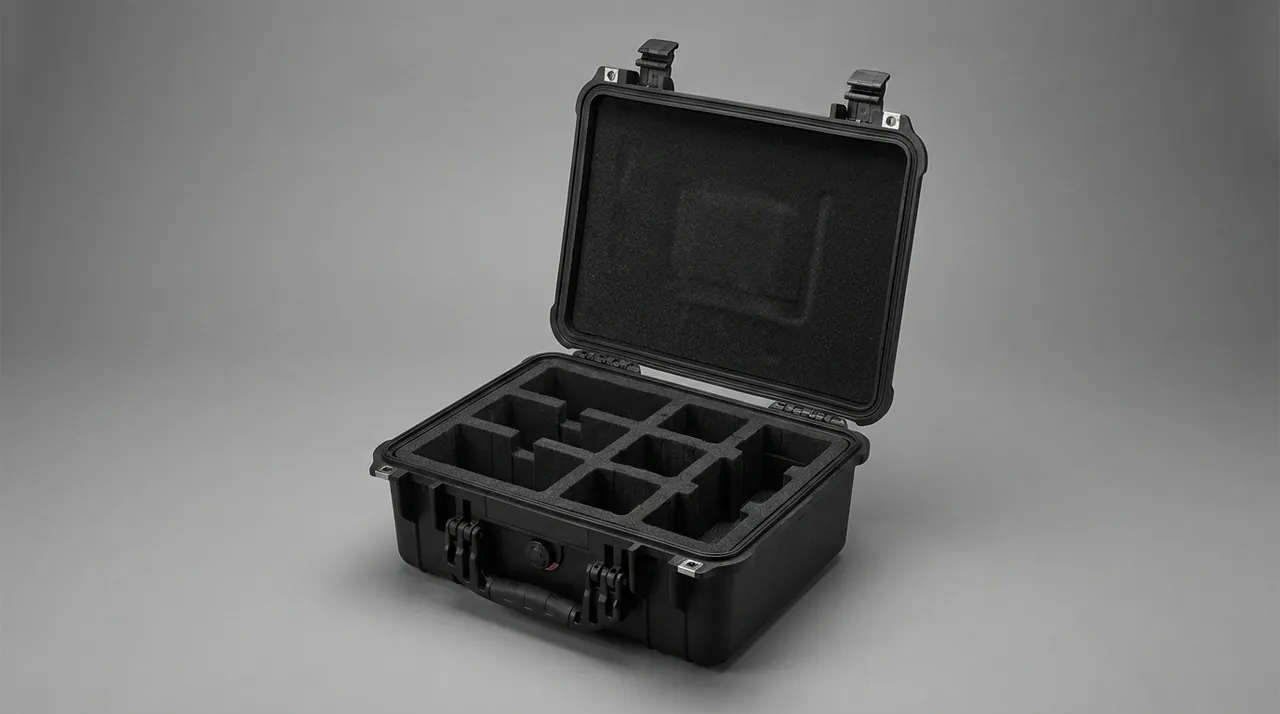
As a rule, the upper and lower halves are never stacked in the same pocket. Keep a separation layer of at least 20 mm between them, or ship them in separate cases; if they must travel together, insert a soft pad thicker than 5 mm between the parting faces and note the stacking attitude item by item on the packing list. Cooling-water ports and vacuum ports are all plugged with protective caps so that airborne dust cannot settle inside the passages and be drawn into the cavities at start-up. On multi-cavity molds fitted with inserts, remove each insert and pack it individually, otherwise transport vibration can loosen it and grind a score into the cavity wall.
Bare hands or cotton gloves must never touch a cavity face, and cotton cloth must never be used to wipe it, because cotton fibres lodge in the polished surface and become film-snag points during forming. The correct practice is powder-free cleanroom gloves, a lint-free wipe moistened with anhydrous ethanol applied in one direction, and immediate sleeving in a clean bag. This matters especially on pharmaceutical-grade lines, and the cleanroom handling details can be cross-referenced with the site discipline described for pharma filling line cases.
Heat-Seal Rollers: Roller Geometry and Temperature Control in Transit
The heat-seal roller is the heart of the sealing station. It presses aluminium lidding foil (PTP) onto the formed PVC blister using its own temperature and pressure, and the pattern or knurl engraved on its face produces the seal pattern. Protecting a heat-seal roller means handling two independent subjects: the geometry of the roller face and the heating system inside the roller body.
On geometry, a heat-seal roller is typically a steel core clad with silicone or PTFE and carries a regular knurl pattern, so roundness and cylindricity are its lifeline. Transport hazards include local dents from impact, permanent deformation of the silicone cladding under sustained load, and collapse of the knurl pattern from rubbing against hard objects. JUNZHIJIA supports the roller on two V-shaped cradles that carry the shaft journals at both ends so the roller face stays fully suspended and touches no flat surface; the face is covered with a soft non-woven sleeve and then wrapped in VCI film; the journals receive plastic guards to protect threads and keyways.
On the heating system, heat-seal rollers generally use cartridge heaters, hot oil or internal steam circulation. Before casing a roller with cartridge heaters, confirm every heater is firmly seated, then wrap the terminals in heat-shrink sleeving plus an anti-static bag so vibration cannot loosen wiring or short adjacent terminals. If the roller travels cold and the ambient temperature falls below 5 degrees Celsius, the silicone cladding becomes stiff and brittle and the probability of cracking on impact rises sharply, so winter shipments from northern regions should add insulation inside the case, and the roller should be allowed to stand at room temperature for 24 hours before unpacking and lifting.
Storage attitude matters just as much. A roller must never stand upright on the floor or lean against a wall, because the silicone cladding deforms irreversibly into an oval under its own weight, and once roundness drifts out of tolerance the machine produces periodic weak seals and uneven pattern depth that usually cannot be corrected without recoating. Always store the roller horizontally in its V-cradle or original liner. For a used roller, record current roundness and hardness figures before casing so they can serve as the reference for arrival inspection; without a baseline, a weak seal later cannot be attributed between transport damage and normal ageing.
Knurl Rollers and Perforating Rollers: Matched-Pair Protection
Besides the heat-seal roller, a blister line also carries knurl rollers (also called pressure or pattern rollers) and perforating rollers (also called tear-line or punch rollers). Both share one trait: a fine raised structure on the surface, typically 0.1-0.5 mm high, which is the first thing flattened by friction and compression in transit.
The knurl roller and the heat-seal roller are matched parts, and the matching tolerance determines how crisp the seal pattern appears. Ship them in the same case, side by side in two symmetrical pockets of one liner, so the pair is not separated into different containers where each half is exposed to different heat and humidity and deforms differently. If separate cases are unavoidable, place a pairing record card in each case stating the pair number, the original gap setting and the surface hardness, and restore the pair by number on arrival.
Perforating rollers have finer and sharper raised features, so their protection level should be one step above the knurl roller. JUNZHIJIA packs them as a rigid tube with end caps and suspended fixation: the roller goes into a tube of matching inner diameter, plastic caps close both ends, and the tube assembly then sits in a pocket with an even clearance to the tube wall. A side impact on the case is absorbed by the tube wall instead of loading the raised structure.
One point deserves emphasis: hardness differences mean the softer roller gets hurt first. Silicone cladding in cold conditions dents permanently far more easily than a steel roller face, so steel rollers must never touch a silicone face directly and a soft separation layer of at least 3 mm has to sit between them. The design principles behind pocket layout and isolation cavities are covered in more detail in the custom foam inserts guide.
PVC/PTP Web-Feed Components: Moisture and Static Control
The web-feed components of a blister machine include guide rollers, tension swing arms, edge-correction mechanisms, feed gears and the entry and exit guides around the heating and forming zone. None of these parts is expensive on its own, yet they determine how stably the film runs after start-up.
The moisture-absorption behaviour of PVC rigid film places special demands on feed components. PVC exposed for a long time to air at 80 percent relative humidity takes up water; when it is heated on the machine the water flashes off as haze, and sealing produces whitening plus reduced peel strength. If feed components are shipped in direct contact with wooden liner material, the moisture released by the timber intensifies local damp zones. JUNZHIJIA therefore recommends closed-cell PE or EVA liner material for feed components instead of undried solid wood or cardboard laid directly against metal parts.
Static is the other hidden risk. Nylon guide rollers and plastic gears in the web path accumulate charge as they run against foil, and that charge both attracts dust into the cleanroom and can discharge near sensitive electronics. For guide assemblies fitted with position sensors, use anti-static foam and place the sensor itself in a shielding bag, following the packaging requirements described for ESD shielding cases. For purely mechanical feed parts, static control matters mainly for dust attraction, so closed-cell materials that do not shed particles are the preferred liner choice.
There is one easily overlooked detail about feed components: tension swing arms and edge-correction mechanisms are moving assemblies, and if they swing freely in transit they strike their limit stops repeatedly and micro-damage the bearings. Before casing, tie each arm at the middle of its stroke with a cable tie, fit a soft pad under the tie, and cut the tie only after arrival and before power-up.
Precision Guideways and Drive Components: Location and Fixation
Precision guides include linear guideways, carriages, timing pulleys, cam indexing units and mold-lift guide columns. Drive components include gear reducers, servo motors and couplings. These parts share high fit accuracy and poor repairability: once the balls inside a guideway carriage are dented, the entire rail usually has to be replaced.
The protective priorities for a linear guideway are preventing the carriage from reciprocating along its stroke and preventing foreign matter from entering the carriage. Before casing, clamp the carriage at mid-stroke with a dedicated rail clamp or a wooden block, wrap the whole assembly in VCI paper, and fit dust covers at both ends of the carriage. Never bind a guideway with steel wire or bare copper wire, which presses marks into the raceway. If several rails travel together, place them in separate layers facing the same direction and never cross them.
Cam indexing units and servo reducers are vibration-sensitive rather than impact-sensitive, because their internal gears and bearings tolerate high-frequency vibration poorly. In the liner they need a combination of a hard base support and an elastic upper restraint: a load-bearing plate carries the weight from below while foam presses down from above, so vibration during carriage cannot produce relative micro-motion between the output shaft and the housing. The 5-15 Hz excitation typical of road transport can amplify into resonance if it approaches the natural frequency of the part, so on long road hauls lay rubber isolation mats on the trailer floor.
Couplings and timing pulleys are thin-walled rotating parts that deform easily and must never be used as load-bearing blocks inside a case. Keyways and taper bores are especially vulnerable and should be closed with plastic guards or rubber plugs. For guide and drive sets shipped as complete assemblies, JUNZHIJIA recommends grouping pockets by *function*: all parts of one motion assembly share a pocket and a single parts sheet, which shortens the pairing and installation work on arrival.
Cleanliness Grades and Packaging Material Selection (GB 14881 / GMP / ISO 14644)
The downstream users of a blister packing machine are pharmaceutical and food producers, so the transport packaging of the equipment components is itself part of cleanliness management. Food production references GB 14881, the general hygiene regulation for food production, regarding requirements for contact materials and packaging materials. Pharmaceutical production is governed by GMP, and where sterile or high-cleanliness areas are involved it also cites the ISO 14644 series for airborne particle and microbial classification.
The following table lists the cleanliness packaging grades JUNZHIJIA recommends for different blister machine components, so equipment builders and plant engineering teams can verify a packing plan item by item.
| Contact category | Typical components | Cleanliness packaging required | Recommended liner material | Grade |
|---|---|---|---|---|
| --- | --- | --- | --- | --- |
| Direct contact with tablets or capsules | Forming cavity surfaces, heat-seal roller faces | Cleanroom bag plus lint-free separation, powder-free gloves | Closed-cell EVA, no bare timber | Grade A |
| Contact with packaging material | Knurl rollers, perforating rollers, guide rollers | Cleanroom bag plus anti-static bag | Closed-cell PE/EVA | Grade B |
| No contact but inside cleanroom | Guides, swing arms, sensors | Anti-static bag plus dust cover | EVA plus anti-static foam | Grade B |
| Outside cleanroom | Reducers, frame parts, bases | Anti-rust plus dust protection | PE pearl foam | Grade C |
Three hard rules govern material choice. First, materials that shed particles, such as untreated wood wool, straw or newspaper, are forbidden as filling. Second, liner material touching stainless steel must contain neither sulfur nor chlorine, because in damp conditions such compounds promote pitting corrosion. Third, every package entering a cleanroom must have its outer layer removed in the airlock. The same requirements apply to the adjacent food packaging machinery case scenario.
If equipment is exported to markets with strict pharmaceutical regulatory expectations, the packing list should state the liner material and the cleanliness treatment method, so the customer can bring the packaging step into the documentation for installation and operational qualification. JUNZHIJIA can supply a liner material declaration and a cleaning record with each case as supporting evidence for the customer's validation file.
Liner Materials and Cushioning Structure Design
The liner is the last cushion between case and component, and it decides whether blister machine parts truly travel in zero contact. JUNZHIJIA mainly uses four materials for blister line components: EVA foam, which rebounds well and can be CNC machined to follow an irregular cavity outline; PE pearl foam, which is economical and suits large-area pads and heavy-part support; closed-cell PE, which handles moisture well and suits feed-path components; and anti-static foam for sensors and components carrying electronics.
The design logic is soft at the contact face, hard at the support face, and tightly filled in the void. Taking a forming mold as the example, the cavity faces rest against 8-10 mm closed-cell EVA for a soft, conforming contact, the mold base sits on 20 mm high-density PE for rigid support, and the gap between mold and pocket wall is filled with cut foam so the mold cannot creep while the vehicle moves. Taking the heat-seal roller as the example, support is carried by two V-cradles at the journals while the roller face is fully suspended, with a 3 mm soft foam wrap as secondary protection.
A liner design must be derived from real three-dimensional data. For custom work JUNZHIJIA asks the customer for cavity drawings and roller diameter and length data, or a physical scan, and generates the CNC toolpath from it. Complex molds with cooling-water and vacuum channels also need clearance pockets for the ports, so the liner never presses on a port and deforms a sealing face. A systematic material comparison is available in case foam material comparison.
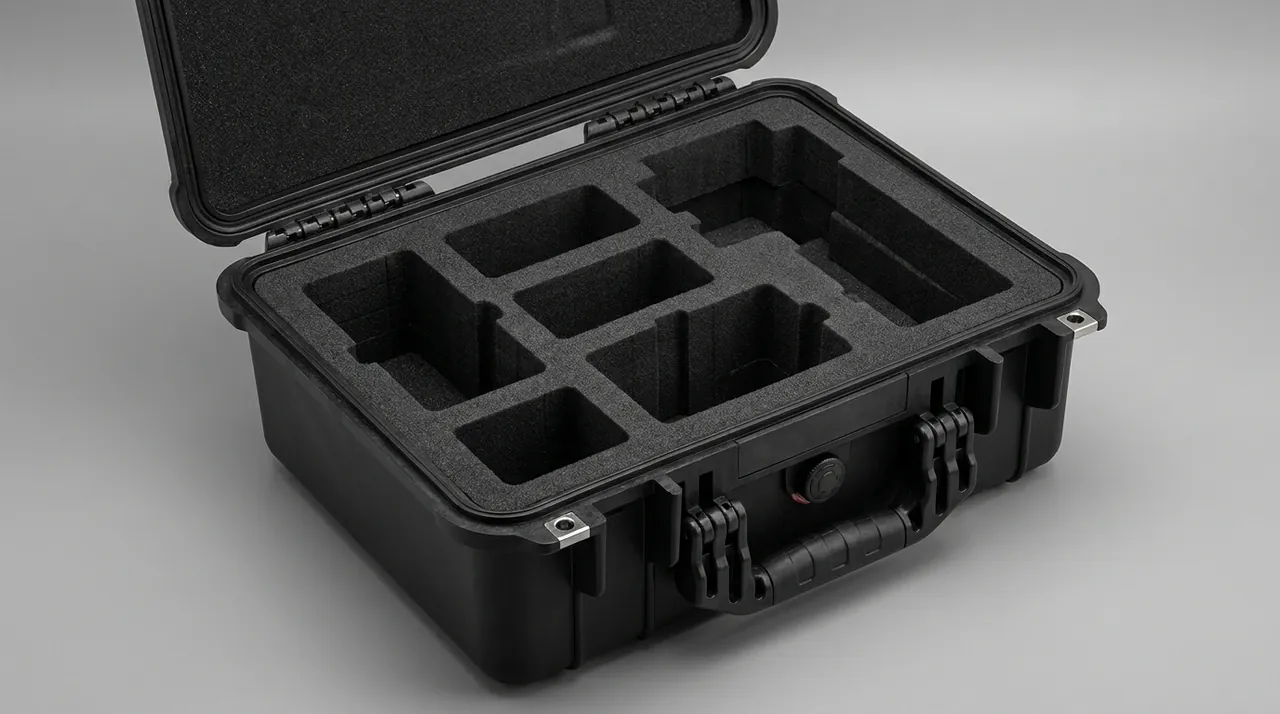
Thicker is not better. An over-thick liner eats the cushioning margin inside the case and drives up both tare weight and freight; a sound cushion design aims to keep the peak impact acceleration below what the part can tolerate under a standard drop, and for polished cavity faces the threshold should be taken conservatively from comparable precision parts and then verified by test rather than estimated by feel.
Sealing, Moisture Control and Pressure Equalization
Blister machine components often cross oceans through regions of high humidity, salt spray and large day-night temperature swings, so case sealing quality directly sets the internal micro-environment. JUNZHIJIA cases typically achieve IP67 under IEC 60529 / GB/T 4208, meaning fully dust-tight with short-term immersion protection, enough for deck spray, dock flooding and rain transfer. For coastal high-salt environments the metal parts of the case also receive anti-corrosion treatment matched to the GB/T 10125 salt-spray test.
The gasket itself must be selected against the part and the route. Silicone gaskets tolerate the widest temperature range and rebound well, making them suitable for ocean crossings and air freight with large temperature differences. EPDM gaskets stand out for weather and ageing resistance, suited to long outdoor storage. Foamed gaskets cost least and compress easily, but they take a permanent set quickly and are not recommended for reusable cases making multiple trips. Gasket material and structural selection is examined further in the toolbox hinge latch seal structure article.
A less obvious enemy of a good seal is differential pressure. When air freight or plateau transport drops outside pressure quickly, a fully sealed case pushes its gasket outwards from internal pressure and the lid can even bulge. On routes with meaningful altitude change, fit a pressure equalization valve that vents the pressure difference while still blocking water and dust. Before long-term storage, confirm the valve is serviceable and not clogged by dust or crystallised deposits.
Three practical points complete the internal environment. First, add desiccant, typically 50 g of silica gel per 20 litres of internal volume. Second, place a humidity indicator card plus an electronic temperature and humidity logger in a key pocket and read the curve after transport. Third, if the indicator card has changed colour beyond the threshold on arrival, inspect cavity and roller faces once for rust spots and water marks caused by condensation before the equipment goes into service.
Lifting, Handling and Center-of-Gravity Fixation
The heavy parts of a blister packing machine are the forming mold set, which can weigh several hundred kilograms as an assembly, the sealing station assembly and the machine base. Their transport risk is not precision-surface damage but overturning, sliding and lifting accidents. JUNZHIJIA heavy cases use a reinforced steel-and-timber composite frame, load-bearing skids and forklift slots on the floor, recessed lashing rings in the walls, and lifting points and centre of gravity marked on the front face.
Lifting follows the rule of four- point balance with slow raise and slow lower. A forming mold should be lifted from its pre-set eye bolts or mould-frame lifting lugs with an adjustable spreader beam, keeping the sling angle within 30 degrees of vertical; never pass a wire rope through a cavity or wrap it around a cavity face. A heat-seal roller must be lifted with a soft-sleeved sling cradling the journals; single-point lifting of the roller body is forbidden, because the roller face deforms under its own weight and the sling pressure.
Internal fixation happens in three steps: pre-tension the part against the limit blocks with straps, fill the remaining gaps with shaped foam wedges, and finally perform a shake test before closing the lid, in which small front-back and left-right movements produce no audible collision and no visible displacement. Straps must avoid cooling-water ports, vacuum channels and sensor connectors, so that long-term pressure cannot deform a sealing face or loosen a plug.
For warehouse storage, raise the case at least 100 mm off the floor against ground water, follow the rated stacking strength marked on the case wall rather than judging by appearance, and open each case once per quarter during multi-season storage to check that the VCI paper is still effective, the desiccant is not saturated and the silicone roller face has not deformed abnormally. These maintenance actions fit the recommendations in protective case service life, avoiding the situation where the case survives but the protection has silently expired.
Transport Environmental Testing (ISTA / GB/T 4857 / ASTM D4169)
A protection plan should be verified with data rather than judgement. JUNZHIJIA recommends graded verification of blister machine component cases against the following systems: domestic road transport based on the GB/T 4857 series, referencing its vibration, impact, drop and stacking methods; international distribution referencing the ISTA series and selecting the applicable procedure for the actual shipping mode; and where a fuller distribution cycle simulation is required for North American markets, citing the ASTM D4169 performance test method. For air and plateau transport, the low-pressure altitude and temperature variation methods in MIL-STD-810H may also be referenced, with the explicit note that this standard serves here only as a source of environmental test methods and does not indicate any military certification of the product.
The table below lists the recommended test combinations for different blister line component types.
| Component type | Vibration | Impact / drop | Stacking | Additional environment | Basis |
|---|---|---|---|---|---|
| --- | --- | --- | --- | --- | --- |
| Forming mold | Fixed frequency plus random | Face drop, one per corner | Static load 24 h | Temperature-humidity cycling | GB/T 4857 / ISTA |
| Heat-seal roller | Random vibration | Edge drop | Static load 24 h | Low-temperature soak | GB/T 4857 |
| Sensors and electronics | Random vibration | Low-height drop | Not applicable | Damp heat plus low pressure | ISTA / MIL-STD-810H method |
| Heavy base assembly | Random vibration | Not applicable | Static load 48 h | Not applicable | GB/T 4857 / ASTM D4169 |
Test conclusions should land on executable parameters, for example that cavity faces show no contact marks after 60 minutes of random vibration from 5 to 200 Hz at 1.04 grms. If a liner takes a permanent set beyond 15 percent, a part moves beyond the allowed displacement, or the cushioning structure cracks, the design is rejected and the pocket geometry and material combination have to be revised. A general test workflow and interpretation method is given in the ISTA transport testing procedure.
Selection Parameter Comparison Table
When specifying a case for blister machine components, break the requirement into case body, liner and sealing and benchmark each separately, rather than comparing price and external dimensions alone. The table below lists the parameters JUNZHIJIA confirms with customers at the selection stage.
| Parameter | Common options | Applies to | Selection note |
|---|---|---|---|
| --- | --- | --- | --- |
| Outer shell material | Injection-moulded PP / rotomoulded PE / steel-timber composite | Precision parts / heavy parts | Steel-timber for heavy, injection-moulded for precision |
| Protection rating | IP54 / IP65 / IP67 | All | IP67 or better for sea freight and outdoor transfer |
| Liner material | EVA / closed-cell PE / anti-static foam | By contact face | Closed-cell EVA preferred for cavity faces |
| Gasket material | Silicone / EPDM / foamed | All | Silicone for wide temperature swing, EPDM for long outdoor storage |
| Casters | None / fixed / swivel with brake | Medium-weight cases | Casters advised above 40 kg per case |
| Pressure equalization valve | None / standard | Air freight or altitude change | Mandatory when air freight is specified |
| Custom marking | Silk screen / nameplate / label | All | Include no-contact marks and centre-of-gravity symbols |
The parameter most often overlooked is the ratio of case tare weight to part weight. As a rule of thumb, a case for precision parts should not exceed 60 percent of the part weight, otherwise the combined centre of gravity shifts and handling becomes unstable; a case for a heavy base should instead reinforce the floor structure, where a higher tare ratio is acceptable. The relationship between case tooling investment and batch size is analysed in custom case mold cost analysis.
Custom Liners and OEM/ODM Capability
JUNZHIJIA offers complete liner customisation from single-piece prototyping to volume production: the customer supplies three-dimensional part data or a physical part, the engineering team completes pocket design, CNC machining and trial fitting, the sample is returned for a fit check, and volume production follows confirmation. For multi-component equipment such as a blister packing machine, JUNZHIJIA organises the case interior by *station*, so the mold, rollers, guides and sensors belonging to one station occupy different pockets of the same case and share one parts list and one packing diagram, which shortens the search-and-assemble time on arrival.
At the OEM/ODM level, case appearance can be customised to the equipment builder's brand colours and identity, with silk-screen positions and warning content set to compliance requirements. For exported equipment, a multilingual receiving sheet and unpacking sequence card can travel in the case so that overseas customers or distributors can execute the procedure on site. For pharmaceutical customers, the liner material declaration, cleanliness treatment record and packaging verification statement can be integrated into the delivery document pack for validation archiving.
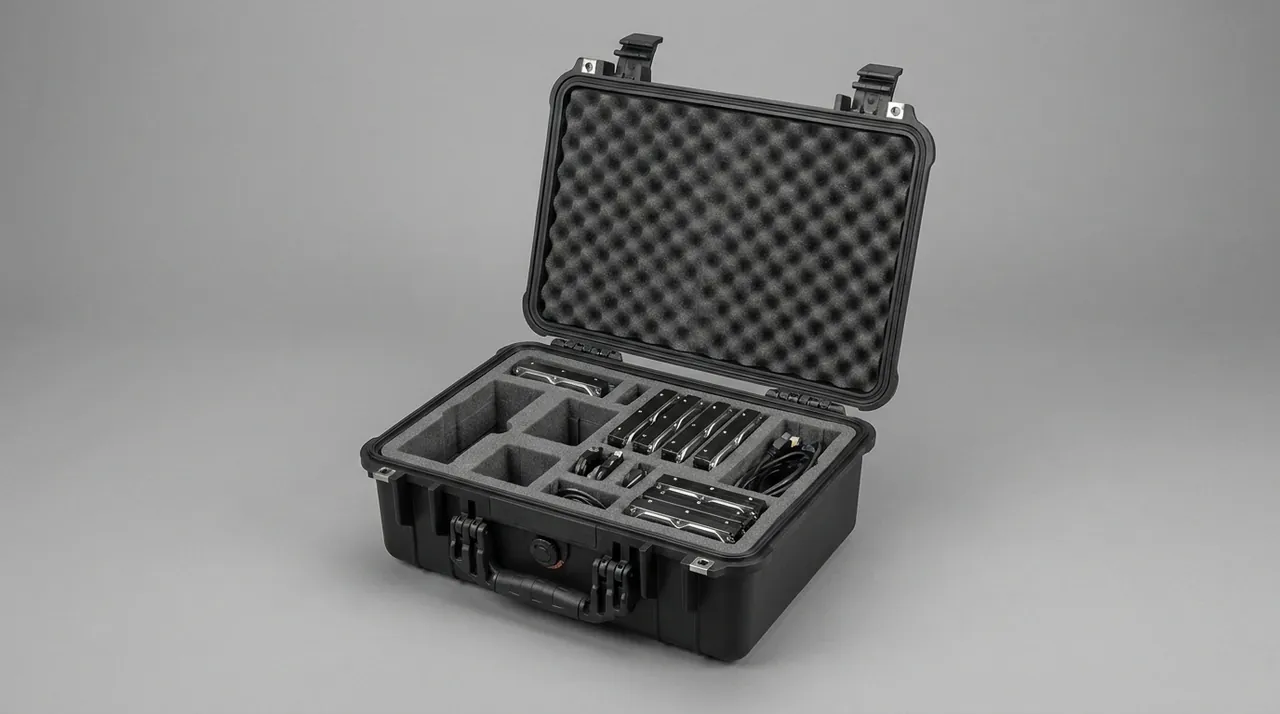
A protection case is not simply heavier and thicker for its own sake. Excessively thick liners reduce cushioning margin and raise both case weight and freight, and excessive sealing makes a case hard to open after air freight because of differential pressure. JUNZHIJIA works backwards from part fragility, transport route and stacking count to derive the minimum safe wall thickness and a sensible sealing grade, controlling unit freight while keeping protection intact. For lines that are returned for repair or transferred repeatedly, number the liner pockets and apply wear-resistant treatment so the same liner can be reused instead of remade each time. Related liner process detail appears in the EVA foam insert custom process article.
On-Arrival Unpacking and Cleanliness Re-Verification
Unpacking acceptance is the last link of the protection chain and the one most easily performed as a formality. JUNZHIJIA advises the receiver to complete appearance checks and document verification within 24 hours of arrival: first confirm the case is not badly deformed, the gasket is intact and the humidity indicator card has not exceeded its limit, then verify the packing list against part numbers for shortages and mis-shipment, and finally open each pocket for inspection.
The unpacking sequence runs light before heavy and precision before structure. Take out sensors and electronics first for appearance and insulation checks; then the knurl and perforating rollers, checking roller faces and protective sleeves; then open the forming mold pockets to inspect for scores and rust; and handle the heavy base and frame parts last. Cavity faces and heat-seal roller faces should be wiped in one direction with a lint-free cloth moistened with anhydrous ethanol and inspected under oblique white light; never rub them repeatedly with cotton yarn or a dry cloth.
Four items deserve specific re-verification on arrival: no contact marks on cavity faces, roller roundness and hardness within the recorded baseline, gaskets free of permanent compression set, and desiccant and humidity card in a normal state. If suspected damage is found, photograph it immediately and complete the evidence before unpacking further, then attribute it against the pre-shipment self-check report. Molds and rollers for blister lines normally need cleaning in a controlled environment before installation, and the cleaning and re-inspection routine can follow the principles in how to clean a protective case upgraded to cleanroom requirements.
For pharmaceutical plants, the unpacking acceptance record is best archived together with the equipment validation file: record the case number, part numbers, protection status and acceptance conclusion, so that if a sealing defect appears later the transport link can be traced as a possible cause. The documentation logic mirrors the judgement criteria in custom case acceptance AQL.
Common Questions FAQ
Q: Why can forming molds for a blister packing machine not be stacked during transport? A: A forming mold works entirely through its cavity surfaces, and stacking the two halves makes the upper half transfer its weight through the parting faces and cavity edges into the lower half, producing irreversible dents under long-distance vibration. A dent first disturbs wall-thickness uniformity during stretch forming and then shows up as thin blisters, local ruptures and sealing-test failures. Stacking also creates a semi-enclosed space between cavities where air cannot circulate, so any moisture that enters tends to form rust spots on cavity faces, and rust on a polished or PTFE-coated surface cannot be fully removed by wiping. JUNZHIJIA separates the two halves into different pockets or different cases; when they must share a case, a soft pad thicker than 5 mm goes between the parting faces and the stacking attitude is noted item by item on the packing list. Inserts in multi-cavity molds are always removed and packed separately, because otherwise vibration can loosen them and grind scores into the cavity walls.
Q: Why must a heat-seal roller always be stored horizontally? A: The face of a heat-seal roller is normally clad with silicone or PTFE, and these materials take a permanent compression set when loaded in one direction for a long time. If the roller stands upright on the floor or leans against a wall, the cladding deforms into an oval under its own weight and the contact stress, and once roundness drifts out of tolerance the machine produces periodic weak seals and uneven pattern depth that generally cannot be corrected without recoating the roller. The correct practice is to keep the roller horizontal at all times in its V-cradle or original liner, with the two shaft journals carrying the weight and the roller face fully suspended. Steel rollers must also never touch a silicone face directly, and a soft separation layer of at least 3 mm should sit between them. In cold weather the silicone becomes stiff and brittle and cracks far more readily on impact, so let the roller stand at room temperature for 24 hours before unpacking and lifting, and compare roundness and hardness against the baseline recorded at dispatch.
Q: Why is moisture control emphasised for the PVC/PTP web-feed components of a blister line? A: The feed components themselves are mostly metal and engineering plastic parts that appear indifferent to humidity, but their accuracy depends on clean, dry surfaces, and PVC rigid film is extremely moisture-sensitive. PVC exposed for long periods to air at 80 percent relative humidity absorbs water; when it is heated on the machine the water flashes off as haze, and sealing produces whitening and reduced peel strength. If feed components are shipped in direct contact with undried solid wood or cardboard, the moisture released by the timber creates local high-humidity micro-zones on the part surfaces, and that risk enters the cleanroom directly when the components are installed. JUNZHIJIA therefore uses closed-cell PE or EVA liner material for feed components, avoids exposed timber, and places desiccant with a humidity indicator card according to case volume. Tension swing arms and edge-correction mechanisms are moving assemblies and should be tied at mid-stroke with a soft pad under the tie, so they cannot strike their limit stops repeatedly and micro-damage the bearings.
Q: What needs attention regarding the heating system of a heat-seal roller in transit? A: Heat-seal rollers are normally heated by cartridge heaters, hot oil or internal steam circulation, and cartridge heaters carry the highest transport risk. A cartridge heater is inserted into the roller body, and vibration easily loosens its retaining feature, allowing relative movement that wears the bore; if the wiring terminals are not insulated and fixed, vibration can also short adjacent terminals or detach the wiring. JUNZHIJIA therefore confirms every heater is firmly seated before casing, wraps the terminals in heat-shrink sleeving plus an anti-static bag, coils the leads and ties them into a dedicated liner clip so they cannot be pulled for a long period. For rollers with hot oil or steam circulation, drain the internal medium completely before packing and plug the inlet and outlet so residual medium cannot solidify at low temperature or seep out and contaminate the liner, and mark the plugs prominently so the installer removes them before connecting the system rather than starting up against a blocked port.
Q: What hard cleanliness requirements apply to the transport packaging of blister packing machine components? A: Because the downstream users are pharmaceutical and food producers, the transport packaging of the equipment itself falls under cleanliness management. Food production references GB 14881, the general hygiene regulation, for contact and packaging material requirements; pharmaceutical production is governed by GMP and cites the ISO 14644 series for airborne particle and microbial classification where high cleanliness or sterile areas are involved. In packaging practice there are three hard rules: materials that shed particles, such as untreated wood wool, straw or newspaper, are forbidden as filling; liner material touching stainless steel must contain neither sulfur nor chlorine, which otherwise promote pitting in damp conditions; and every package entering a cleanroom must have its outer layer removed in the airlock. Components that directly contact tablets or capsules also need a cleanroom bag and powder-free gloves during handling, and cotton yarn must never be used on cavity or roller faces, because the fibres lodge in the polished surface and become snag points, the most common and most costly human defect on pharmaceutical-grade lines.
Q: Why are linear guideways and cam indexing units classed as vibration-sensitive rather than impact-sensitive? A: Both share high fit accuracy and poor repairability. A linear guideway carriage contains preloaded balls, so if the rail is not fixed for transport the carriage reciprocates along its stroke and the balls press small craters into the raceway, raising running resistance and degrading positioning accuracy; that damage cannot be removed by adjusting preload and usually means replacing the whole rail. Cam indexing units and servo reducers contain gear and bearing fits that tolerate high-frequency vibration poorly, and the 5-15 Hz excitation typical of road transport amplifies into resonance if it approaches the natural frequency of the assembly. The protection logic is therefore not impact resistance but location plus isolation: clamp the carriage at mid-stroke with a dedicated rail clamp, wrap the assembly in VCI paper with dust covers fitted, and for cam units and reducers combine a hard base support with an elastic upper restraint, laying rubber isolation mats on the trailer floor for long road hauls so the output shaft and housing cannot develop relative micro-motion.
Q: How should the gasket of a transport case be selected, and how do silicone and EPDM differ? A: Gasket selection is driven mainly by the transport route and the storage period. Silicone gaskets tolerate the widest temperature range, generally staying elastic from tens of degrees below zero to above two hundred degrees Celsius, with small compression set, which suits ocean crossings and air freight with large day-night temperature differences; the drawback is a higher cost. EPDM gaskets excel in weather and ageing resistance, standing up to ultraviolet light and oxidation, which suits long outdoor storage or reusable cases making multiple trips, though their rebound recovery in cold conditions is slower than silicone. Foamed gaskets cost least and compress easily with good conformity to imperfect case surfaces, but they take a permanent set quickly and lose sealing force after only a few open-and-close cycles, so they are not advised for high-value parts that transfer repeatedly. Note also that when a route involves significant altitude change or air freight, a good gasket alone is not enough: a pressure equalization valve is needed, otherwise internal pressure pushes the gasket outwards and can bulge the lid.
Q: What should be included in the packaging documentation when exporting equipment? A: For an exported blister packing machine, packaging documents serve not only customs clearance and parts counting but also equipment validation and liability allocation. A complete pack normally contains: a packing list that states each part number, quantity, pocket location and protection measure; a parts list plus packing diagram marking the unpacking sequence and forbidden actions for each item; a liner material declaration and cleanliness treatment record for the customer to file in installation and operational qualification documentation; a pre-shipment self-check report covering cavity and roller face condition, roundness and hardness baselines, and oil and gas path plugging records; reading instructions for the humidity indicator card and the temperature and humidity logger; and a centre-of-gravity and lifting diagram. For exports to regulated markets, add a multilingual version of the key warning card, and state clearly which transport test standards were referenced and which test items were actually completed, so the packaging step can be retained by the customer as a verifiable part of the evidence chain.
Q: Can JUNZHIJIA customise a complete liner and sealing package for our machine model? A: Yes. JUNZHIJIA customisation starts from part data: the customer submits drawings or physical scan data for the forming mold, heat-seal roller, knurl roller, perforating roller and feed components, and the engineering team completes pocket layout, clearance design, material selection and sealing grade confirmation before producing a single-piece prototype, returning it for a trial fit and moving to volume production after approval. For multi-station equipment the case interior can be organised by station, grouping one station's components into separate pockets of one case with a shared parts list, which shortens finding and assembly time on arrival. Gaskets can be pre-configured by machine model with spares supplied, so the customer can restore the protection rating after a gasket change. At the OEM/ODM level, case appearance, silk-screen marking and multilingual documentation can all follow the equipment builder's requirements. Liner thickness and sealing grade should be derived backwards from part fragility, route and stacking rather than simply increased, a point that matters particularly for precision civilian equipment.
Conclusion and Related Reading
Blister machine component protection extends the integrity of a surface from the factory to the customer's cleanroom: cavity faces untouched, roller faces suspended, the web path dry, guides and drives isolated. JUNZHIJIA delivers that through custom liners, model-matched gaskets and traceable acceptance documents.
Related Reading