

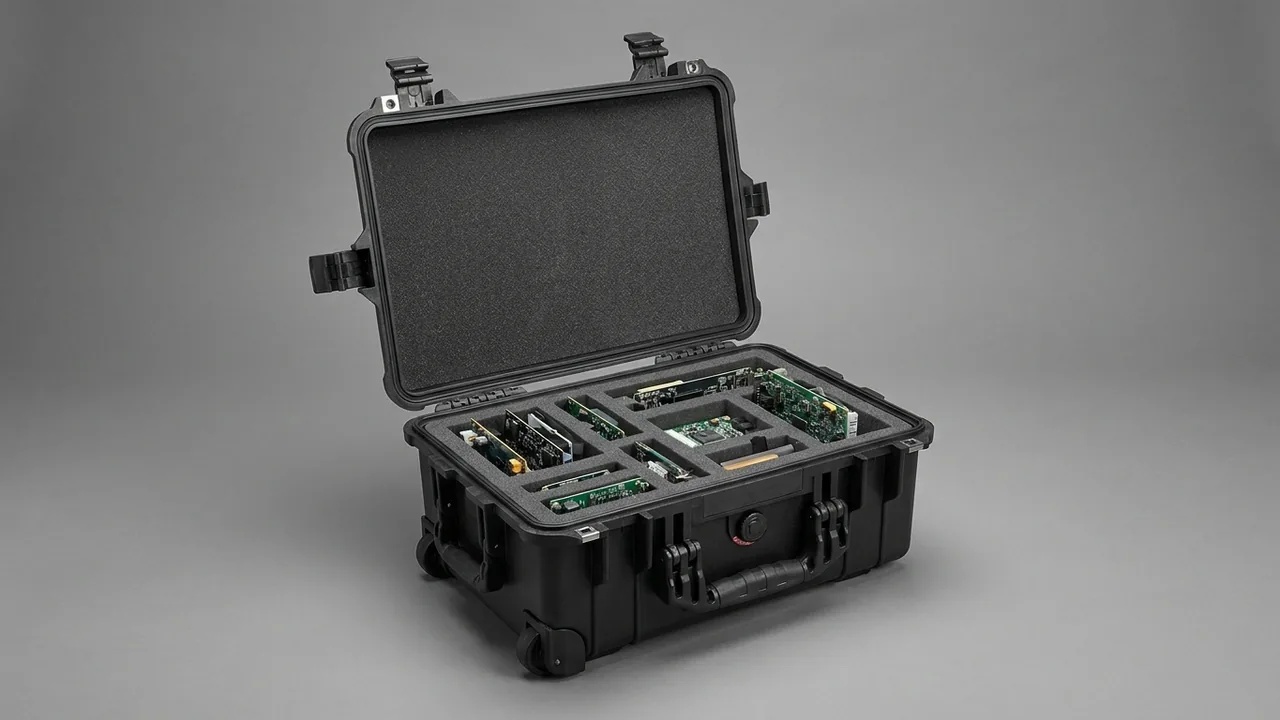
Filling line nozzles, dosing pumps, ceramic rotary valves and peristaltic pump heads on pharmaceutical lines demand extremely high surface finish. If these precision parts pick up particles, fibers or residue during transit, return service or cross-site transfer, filling volume can drift and entire batches may be contaminated. The key point up front: a protective case for pharma filling nozzles and dosing components must combine cleanliness, dust exclusion and impact protection, while holding a hygienic state through the handling chain. This article addresses selection and deployment for pharma filling line cases, filling equipment cases, nozzle shipping cases, dosing component cases and medical device cases, covering material, insert, sealing, cleanliness standards and acceptance methods so equipment makers, pharmaceutical engineering teams and third-party service providers can minimize environmental risk in the transport link.
In practice, filling line parts rarely ship with the whole machine. They move as spares, retrofit modules or dosing sub-assemblies. These parts are expensive, have long lead times and tolerate zero particulate contamination, so ordinary cartons or bare handling are no longer acceptable. Designing the shipping case as a mobile clean holding unit is now a consensus among pharmaceutical supply chain and quality functions.
Table of Contents
- Why filling nozzles and dosing parts need dedicated cases
- Particulate and microbial contamination risks in transit
- Hygienic and cleanliness standard basis
- Main case body material selection
- Insert and cushioning placement design
- Sealing, dust exclusion and IP rating
- Food contact material compliance
- Temperature humidity control and condensation prevention
- Handling, stacking and in-case fixation
- Transport environmental testing and verification
- Receiving inspection and AQL sampling
- Cleaning disinfection and periodic maintenance
- Custom inserts and OEM/ODM service
- Application scenarios and selection checklist
Why filling nozzles and dosing parts need dedicated cases
Filling nozzles are mostly 316L stainless steel or medical grade PEEK and ceramic, with tip geometry measured in microns. Dosing pump ceramic plungers, check discs and peristaltic tubing are highly sensitive to foreign matter. If such parts knock together in storage or transit, the result ranges from burrs and scratches on sealing faces to deformed dosing cavities that cause filling inaccuracy. To cut this loss, more engineering teams adopt the clean transfer thinking found in the aseptic filling case for nozzles and dosing parts.
Beyond damage, line downtime while waiting for a spare is extremely costly. A high speed line runs hundreds of bottles per minute, so a single shift of stoppage is significant. If a spare is damaged by poor packaging, a second shipment stretches the downtime window. A dedicated case with zoned placement and cushion isolation drives transit damage to a negligible level, protecting production continuity.
From a quality system view, transport packaging is itself a validated object. GMP and pharmaceutical quality risk management require traceable records for critical part supply chains. The clean state, material certificate and shipment record of the case belong in change control and supplier management files, which is why the pharma machinery parts case is frequently mentioned in the pharma machinery sector.
Particulate and microbial contamination risks in transit
Nozzle orifices, pump seats and pump cavities are the micro structures most prone to trapping dirt. Four common contamination sources appear in transit. First, ambient dust and fiber shedding from ordinary cartons, foam debris or unpurified trucks. Second, residual product such as uncleaned syrup or crystallized solution. Third, condensate when temperature differences cause inner wall sweating that feeds microbes. Fourth, cross contamination when different parts sit bare in one box and metal chips and particles transfer.
On the microbial side, filling zones usually require ISO 14644 cleanliness grades, for example local A at the fill point with B or C background. If transit loses control, surface colony counts at box opening can far exceed the workshop entry threshold, forcing re-cleaning and re-sterilization that actually raises contamination chance. The case must act as a clean barrier rather than a plain container.
To quantify risk, many pharma plants apply the hygiene logic of GB 14881 and GB 50687 to spare parts, performing surface particulate and microbial limit checks on drug-contact parts. A case that leaves the factory already in a controlled clean state markedly shortens pre-intake reprocessing time.
Stopper bowls and vibratory feeder tracks deserve separate thought. A bowl that has been in service carries a film of silicone oil and a fine layer of rubber particulate along its spiral track, and if it is shipped as loose metal that material will transfer onto neighbouring precision parts. Keep the bowl in its own cavity, strain-relieve the track entry, and bag the outlet chute so the dosing pins and blow-off jets stay covered. Caps or stoppers left inside a bowl will abrade against each other in transit, so empty the bowl, count the contents and record the number on the packing list before dispatch.
Hygienic and cleanliness standard basis
A pharma filling parts case must satisfy two threads: transport reliability and hygienic grade. Transport reliability references GB/T 4857 series, ISTA 3 series and ASTM D4169 distribution cycles for quantified vibration, drop and stacking. The hygienic grade anchors to GMP, ISO 14644 cleanliness classification, GB 14881 and GB 50687. We stress that the military standard MIL-STD-810H here serves merely as a reference method for environmental tests of temperature, humidity, vibration and shock, and the case carries no military certification.
In deployment, set box-opening-ready-for-entry as the design goal: the part leaving the case meets the minimum requirement for pre-entry treatment into the clean zone. The inner liner and insert should be wipeable or irradiable in a clean environment, and hinges and latches should avoid cheap hardware with flaking coatings. The structural thinking can borrow the low-outgassing and easy-clean requirements of the cleanroom equipment case.
For dosing pumps with fluid channels, consider post-transit online rinse and SIP/CIP compatibility. The case does not participate in cleaning, but its insert must not absorb or release particles or volatiles that disturb rinse validation, a point critical when selecting foam material.
Aseptic lines add one more constraint. Where nozzles work inside a RABS or an isolator, the background grade is set by the barrier rather than by the room, so a case that has to be opened within a grade A zone must arrive with surfaces that will not shed when wiped. Where the same parts are filled on a line without a barrier, the room carries the grade and the case may be opened in a grade C or D area. Confirm which of the two applies before the case is specified, because the wipeability and particle limits asked of the liner are set by the tighter of the two conditions.
Main case body material selection
Three main body routes exist: modified PP injection case, PP/PE rotomolded case, and aluminum frame with engineering plastic corner case. Injection cases have stable dimensions and smooth easy-wipe surfaces, suited to standardized nozzle trays. Rotomolded cases resist impact and can form large dosing module bays, but the inner wall needs a smooth finish to suppress bacterial attachment. Aluminum frame cases balance light weight and rigidity, suited to air-shipped precision dosing heads.
Whatever the body, food and drug contact surfaces should avoid mixed recycled material and provide a material declaration. The outer surface should use a non-porous, UV resistant, disinfectant tolerant coating. Latches and hinges follow the hygienic approach of case hinge latch seal using stainless or passivated hardware to reduce dirt traps. For cross-border shipments, packaging must meet ISPM 15 wood treatment; wooden liner supports need fumigation or heat treatment marks.
The table below gives the key trade-offs among three body materials for equipment makers and purchasers to weigh by part value and shipping radius.
| Case shell | Best for | Shock | Wipe | Mass | Remark |
|---|---|---|---|---|---|
| --- | --- | --- | --- | --- | --- |
| Modified PP molded | Nozzle tray, small dosing head | Medium | Excellent | Light | Grid can be custom carved |
| PP/PE rotomolded | Dosing pump module, ceramic valve | High | Good | Medium | Inner liner must be smooth |
| Aluminum framed | Precision dosing head, air freight | High | Excellent | Lighter | Hardware passivated |
Insert and cushioning placement design
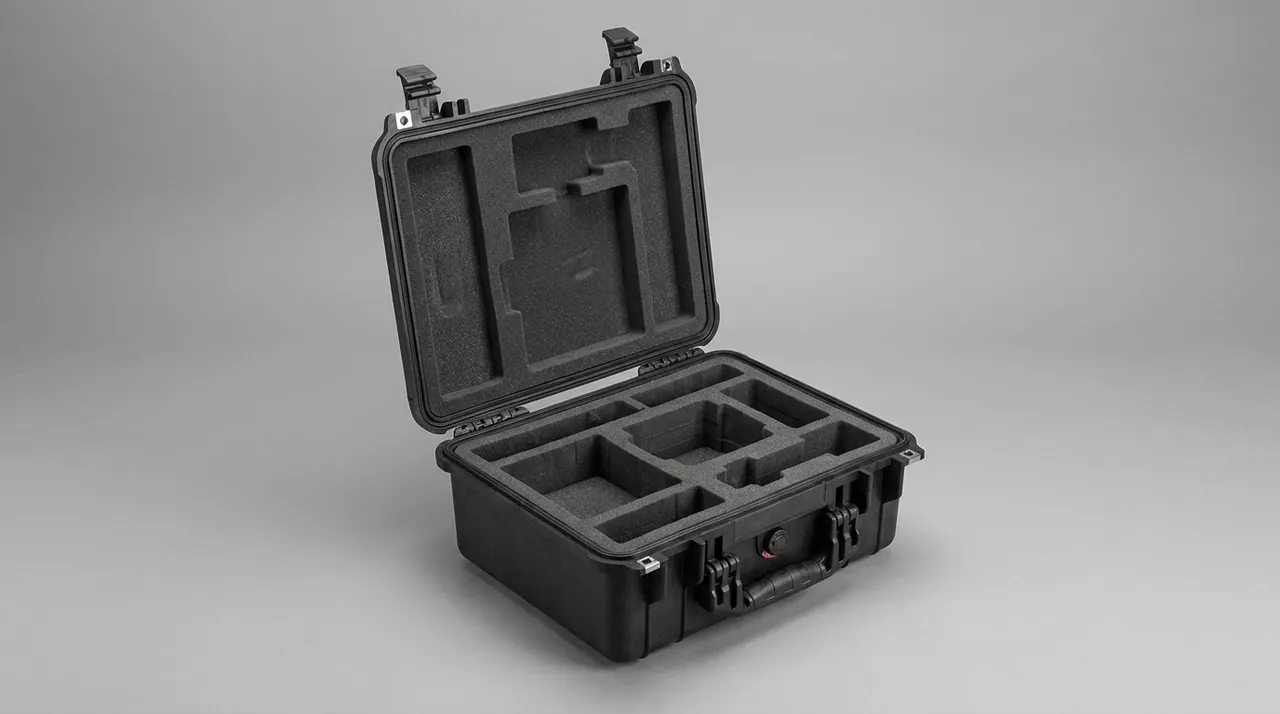
The insert is the clean cabin of the case. For nozzles, use CNC carved EVA or PE foam grid matrix, each needle in its own slot, tip down or suspended horizontally to avoid contact. For dosing pumps, use stepped foam to support the body and inlet/outlet flanges, covering flange faces with dust-free sleeves. Follow the cavity design principle of the custom foam inserts guide: part locks on placement, no wall scrape on removal.
Foam density and hardness must match part mass. Too soft lets the part sink and shift in transit; too hard creates excessive local pressure. Experience suggests 30 to 45 kg/m³ anti-static EVA for light precision needles, and 45 to 60 kg/m³ closed-cell PE foam plus a soft contact layer for metal-bodied dosing modules. All foam should be low outgassing and non-shedding, with third-party volatile testing where needed.
For easy cleaning and rotation, make the insert a removable module so the main bay and insert are sterilized separately. This extends case life and prevents foam from becoming a microbial habitat through long-term moisture absorption. A non-woven or lint-free paper separator between part and foam further absorbs trace residue and particles.
Peristaltic pump heads need a different treatment from ceramic parts. The rotor, the rollers and the pump head cover are usually separate items, and the tubing is a consumable that must not be left compressed inside the head. Ship the head with the cover removed or latched open, the rollers free to turn, and the tubing coiled in its own bag rather than pinched between roller and race. Mark the rotor rotation direction on the liner so a rebuilt head is not fitted backwards. Where the head carries a position sensor or a tacho pickup, protect the target wheel with a shallow counterbore and keep the sensing face clear of foam.
Sealing, dust exclusion and IP rating
Filling parts fear dust on opening most. The case adopts a two-step seal arrangement: a foamed silicone primary gasket running along the lid flange, together with a compression-type secondary gasket at the latch, aimed at IP67 under IEC 60529 and GB/T 4208 for dust exclusion and brief water immersion. For higher assurance, add a one-time dust cover or sterile breather bag inside.
The seal material must tolerate common disinfectants such as 75 percent ethanol, peracetic acid and hypochlorous acid, without releasing colored or oily substances. The seal should be replaceable for controlled maintenance cost. Beyond dust, air tightness slows inner micro-environment change during temperature swings, buying buffer time for dosing parts. On seal structure, see the selection logic of the IP67 protective case.
Note that IP rating measures enclosure protection, not sterility assurance. The case lowers the probability of ambient particle entry; final clean release still follows workshop cleaning and sterilization. This boundary must be written into quality files to avoid misreading transport protection as sterile packaging.
Sealing alone does not create a clean inner environment. A case closed in an ordinary warehouse seals ordinary air, so the inner bay should be cleaned and dried before the parts go in, and where the end user works to a classified area the case should be filled under the same gowning discipline as the cleanroom it serves. Add a desiccant or a breathable sterile bag for parts that cannot tolerate a damp microclimate, and check the gasket seating at every latch, because one lifted lip lets a surprising amount of particulate past an otherwise sound seal.
Food contact material compliance
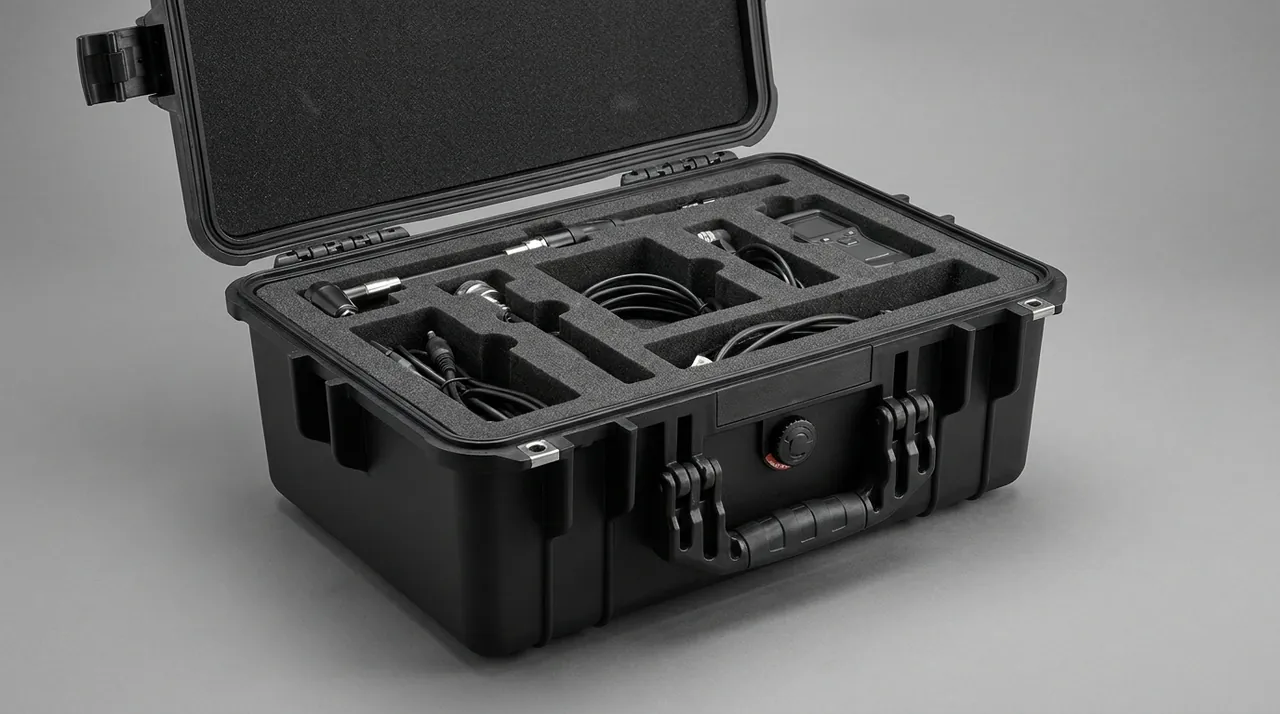
A nozzle tip, a dosing pump body and a peristaltic head all end up handling drug or food grade liquid, so every surface that touches them on the way, the liner compound, the sleeve fabric and the retaining supports, falls under food contact material safety. Which regime applies depends on where the case is sold: (EC) No 1935/2004 and (EU) No 10/2011 for the European Union, FDA 21 CFR chapters for the United States, and, inside China, the GB 4806 series, for example GB 4806.7 for plastic materials and GB 4806.11 for rubber, each of which fixes total migration, specific migration and sensory limits.
What the buyer should hold in hand is a declaration of conformity plus a third-party test report, with the test items and their limits written into the purchase contract rather than left to the supplier's judgement. Polymer foam and silicone are the two materials most likely to give off a smell or leach a plasticiser or a sulfide, so they deserve the closest scrutiny. The food packaging machine case treats the same question for another category and is worth reading alongside this one.
For nozzles contacting sterile product, use food grade certified PE or medical silicone as the liner contact layer rather than ordinary sponge. Purchasers should request batch material certificates at acceptance and file them for inspection and audit traceability.
Temperature humidity control and condensation prevention
Dosing parts are sensitive to temperature and humidity, especially time-pressure dosing heads with electronic drives. Crossing climate zones causes inner wall condensation that can rust stainless and feed microbes. Three countermeasures: a temperature humidity logger with alarm; a desiccant bay between liner layers keeping relative humidity under an empirical threshold; and a low-conductivity or insulated inner body to slow temperature swings.
For cold-chain linked modules, borrow the cold accumulation layout of the cold chain food case, but dosing parts usually cannot freeze, so prioritize temperature control over cooling to avoid condensation and freeze cracking. Before opening, rest the case in a clean buffer room until temperatures equalize, preventing sudden sweating.
The logger record should travel with the case and be filed as transit environment evidence; for high value pumps a Bluetooth unit that exports CSV supports trend review and extends transport validation into the supply chain.
Handling, stacking and in-case fixation
Even the best insert fails with rough handling. Nozzle cases forbid throwing and over-stacking; print the upward, fragile and rain-proof marks required by storage and transport signage. Stacking height follows case stacking test load, usually with a safety factor over GB/T 4857.3.
For in-case fixation, leave a buffer gap between insert module and wall, secured with hook-and-loop or straps to stop whole-module shift during hard braking. When multiple parts share a case, heavy parts below, light precision above, separated by partitions. Nozzle trays lie horizontally with tip slot end caps to avoid vibration friction generating particles.
For air-shipped precision heads, consider pressure change effects on sealed packaging; configure a case pressure equalization valve to stop outside dirty air being pressed in or liner bulging at altitude.
Transport environmental testing and verification
The case should be put through a test programme before the design is signed off. Treat MIL-STD-810H as a source of test procedure rather than a certification: start with a random vibration run, a drop series, a thermal cycle between hot and cold and a damp heat dwell, then follow with an ISTA 3E/3H profile or the ASTM D4169 level written into the contract. Examine insert movement, wear at the nozzle tips, dust collecting along the gasket line, and the appearance and function of the dosing parts when the case is opened.
The unit used as the sample should be the heaviest and most awkward build the plant expects to ship, loaded with a full set of nozzles and dosing pumps into the cavities that carry the highest stress. When the run is over, both cosmetic and functional results are graded against the custom case acceptance AQL. For a pharma customer the transport protocol is then attached to the packaging qualification and to the cleaning and sterilisation validation, closing the two evidence chains into a single loop.
Environmental testing is a design confidence tool, not a substitute for on-site management of each shipment. Approved models still keep loggers and opening checks in real dispatch to close the loop. On test method detail, read the GB/T 4857 transport packaging test.
Receiving inspection and AQL sampling
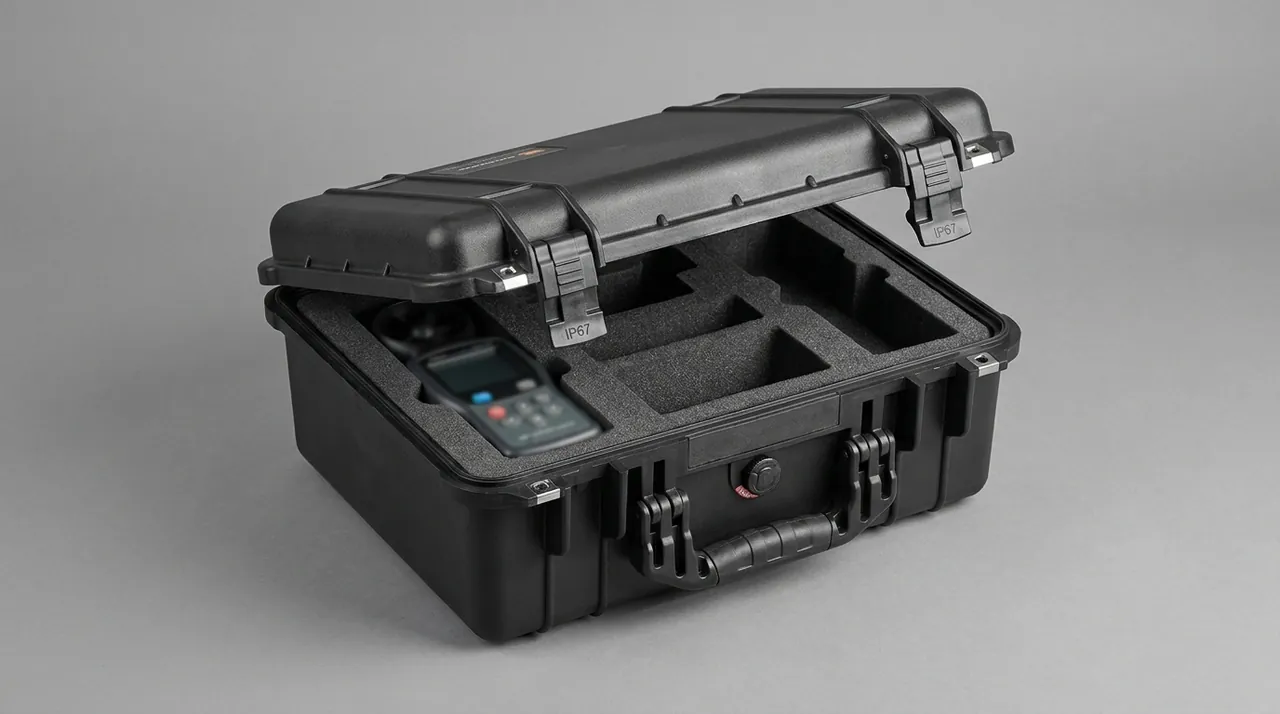
Unpacking is the final barrier between a long journey and the filling floor. Set a repeatable sequence: move the case into a controlled buffer zone, inspect the shell and the gasket line, then read the documents that came with it, the material certificate, the test report and the transit temperature and humidity log, and only afterwards examine and wipe the surfaces. A critical nozzle should be swabbed with a developer wipe or counted with a particle counter to confirm the cleanliness of the orifice and the seating cone.
Sampling follows an AQL plan in which the strictest band is reserved for critical appearance defects. The reprocessing rule in the protective case cleaning method applies when foam has shed or a bay has been contaminated: the insert cell is renewed and a judgement is recorded on whether the nozzle or the pump was affected, with every opening sheet, photograph and disposition kept in the traceability file.
For dosing parts, also do functional recheck after opening: manually turn the pump, check disc rebound, and pass a wire through the nozzle to confirm patency. Isolate anomalies and notify the shipper, using transport records to trace responsibility and avoid injured parts flowing into the line.
Cleaning disinfection and periodic maintenance
The case is reusable, so a written disinfection procedure is not optional. Work over the insert first: wipe the cavity walls and the nozzle slots with a lint-free cloth and 75 percent ethanol or another approved agent, and keep aggressive solvents away, because they attack the silicone foam and the sealing compound. Graded foam is rotated on a contamination cycle, with washable blocks dried at low temperature and disposable grades changed at the supplier's interval. Latch pivots and hinge pins are lubricated as the protective case cleaning maintenance note advises, so that they do not seize or drop particles onto a nozzle.
Service frequency follows how hard the case works. A case that travels every week is given a monthly look at its appearance and gasket plus a quarterly seal test, while one taken out of storage is cleaned again and its desiccant changed before it is loaded. Keep one file per case recording the cleaning date, the responsible person and the insert batch, so that an auditor can follow the chain. Working life is compared against the published protective case service life figure, and the shell is either scrapped or refitted with a new insert at that point.
One caution before the lid goes back on: let the disinfectant evaporate completely, because a chlorine-based agent left on a 316L nozzle attacks the passive layer and starts pitting that only shows up later in the filling result; finish with a purified water rinse and air dry the bay.
Custom inserts and OEM/ODM service
Nozzle pitch, dosing pump interfaces and rotary valve geometry differ so much between filling line brands that a universal insert fits none of them properly. The protective cases described here are developed by Kexin New Materials (Guangdong) Co., Ltd. for pharmaceutical transport needs, available through OEM/ODM customization and global wholesale distribution, with material and cleanliness test reports supplied under contract. Development starts from the customer's own CAD files of the nozzle bar and the pump bodies; a matching cavity set is machined from those models and a component list with a layout drawing is delivered with the case.
An equipment builder takes the OEM route and ships the case as part of the machine spare kit, which improves the delivery experience. A third-party service organisation takes the ODM route and standardises one needle-cassette case across the nozzle models it handles, reducing inventory complexity. Buying globally gives an overseas plant the same liner source, so transport conditions stay comparable. The customization route is set out in the custom foam inserts guide and in how to choose a case OEM factory.
At contract level, specify material grade, cleanliness grade commitment, test document list and non-conformance handling, turning hygienic transport from a verbal request into a written guarantee, which is what pharma supplier audits value most.
Application scenarios and selection checklist
- Pharma spare store: critical nozzles and dosing pumps sit in cases for instant pull on stoppage, shortening MTTR.
- Line retrofit transfer: metering modules removed from old lines move cross-site with in-case placement avoiding secondary damage.
- Metering return service: pumps back to factory for calibration, same case both ways for comparable state.
- Overseas project shipment: nozzle spares exported with machines use aluminum frame cases with desiccant and logger.
- GMP audit companion: complete material and clean files make the case visible evidence of supply chain hygiene management.
In these scenarios the case value lies not only in no breakage but in always holding a controlled clean state, supporting the pharma quality culture and compliance narrative.
Before fixing a filling line parts case, check these items: whether the part directly contacts drug and the contact surface meets GB 4806; whether the insert has independent grid placement and is removable for cleaning; whether the seal reaches IP67 and tolerates disinfectant; whether temperature humidity logging and desiccant are configured; whether the body material gives a declaration and avoids recycled mix; whether drop and random vibration verification passed; whether material and clean test files travel with the case; whether insert renewal and the tooling schedule fit the maintenance plan; whether any wood crossing a border carries ISPM 15 treatment; and whether the supplier genuinely runs OEM/ODM with a global spares channel.
Ticking those ten against the standards above is what locks a suitable nozzle and dosing component case. Where it is unclear, borrow the clean transfer experience of the lab equipment case.
FAQ
Q: Must a pharma filling nozzle shipping case be sterile? A: The shipping case itself need not be sterile packaging, but it should reach a clean barrier level. Nozzles directly contact drug, so the case core goal is to stop ambient dust, fibers and microbes from landing on the needle surface during transit, so that after opening only the workshop cleaning and sterilization flow is needed for entry, rather than taking on sterility assurance. In practice this is done through IP67 sealing, low-outgassing liner, cleanable inner bay and accompanying clean documents; final sterile release remains the responsibility of the user CIP/SIP and sterilization flow. It must be stressed that military standard MIL-STD-810H is used only as a methodological basis for temperature, humidity, vibration and shock environmental tests; this product is not a military certified device. Purchasers should require a material declaration and reference values for surface particulate and microbial limits in contract, setting box-opening-ready-for-entry as the acceptance goal and avoiding misreading transport protection as sterile packaging that creates responsibility gaps in the quality system.
Q: Which foam insert best fits a dosing pump module? A: A dosing pump has a metal body and ceramic plunger, with concentrated mass and a knock-sensitive valve seat, so use closed-cell PE foam at about 45 to 60 kg/m³ for main support, with a soft EVA or medical silicone thin layer at the contact face to spread pressure and avoid hard-point damage to sealing faces. The insert should be a stepped cavity with the pump lying down, inlet and outlet flanges up and covered by dust-free sleeves to prevent flange faces rubbing in transit. Foam must be low outgassing and non-shedding, with third-party volatile testing where needed, because the pump internal fluid channel will be online rinsed and SIP/CIP verified on arrival, and liner release of particles or volatiles would disturb that verification. Follow the cavity design principle of the custom foam inserts guide: part locks on placement, no wall scrape on removal. For return-service pumps, make the liner removable and rotatable so the main bay and liner are sterilized separately, extending case life and avoiding foam moisture becoming a microbial habitat.
Q: What treatment is needed for wooden supports in cross-border nozzle shipment? A: If the case interior or outer skid uses wood, it must be treated per ISPM 15 the International Standard for Phytosanitary Measures, usually methyl bromide fumigation or heat treatment, with the IPPC mark on a visible wood face stating treatment and country code. Destination customs may reject or destroy unmarked wood packaging in whole, so confirm support material and marks before shipment. Pure plastic or aluminum frame cases are outside ISPM 15, but an added outer wooden box still needs treatment. Attach a copy of the wood treatment certificate to the shipment file alongside the material declaration. Pharma supply chain audits often include wood compliance in supplier hygiene and biosafety assessment, so do not overlook it. For high value parts, prefer an all-plastic or aluminum frame solution to fully avoid wood risk while cutting case weight and freight. Whatever route is chosen, keep the treatment record with the shipping papers and photograph the stamped material before it is closed into the crate, since a disputed mark is far harder to prove after arrival.
Q: Does a nozzle case need a temperature humidity logger? A: For high value or electronically driven dosing heads, a logger with the case is strongly advised, especially when shipping crosses climate zones through sea, land and air legs. The logger captures whether the interior exceeded threshold high or low temperature or high humidity, giving objective evidence for condensation and microbial risk; if opening finds anomaly, data traces which leg lost control. Experience favors a logger exporting CSV for trend analysis by the quality team, extending transport validation into the supply chain. For ordinary stainless nozzles in a controlled truck over short lead time, a one-time temperature humidity card may substitute to control cost, but cross-border or long-cycle shipment still prefers an electronic logger. Either way, data travels and archives with the case as transport environment evidence, reflecting the pharma quality risk management requirement for traceability of critical part supply chains. Place the logger where it samples the same air the parts breathe rather than against the wall of the case, and calibrate it against a reference before each shipment campaign so the record stands up to review.
Q: What seal material resists disinfectants? A: Prefer foamed silicone or FKM fluororubber seals, both with good tolerance to 75 percent ethanol, peracetic acid, quaternary ammonium and low concentration hypochlorous acid, and unlikely to release colored or oily substances onto parts. Avoid ordinary NBR or natural rubber that hardens and cracks under long disinfectant exposure. The seal must be replaceable for controlled maintenance. Ask the supplier for seal-disinfectant compatibility notes and forbid strong solvents that corrode silicone in the cleaning SOP. Also, the seal should meet food contact material safety such as GB 4806.11 rubber, because although not directly drug contacting, its extractables may transfer to parts via condensation or wiping. Air-tight sealing besides dust control slows inner micro-environment change during temperature swings, buying buffer time for dosing parts, a key detail of hygienic cases. Where the case is autoclaved with the seal fitted, confirm the maximum cycle temperature the gasket tolerates, because a seal that survives wiping can still take a permanent set after repeated steam exposure and lose its rebound.
Q: How to accept a delivered batch of filling line cases? A: Set up a repeatable opening procedure before the case reaches the workshop floor. Move the case into a designated clean buffer zone, inspect the outer shell and the seal for any sign of impact or breach, then open and confirm the accompanying paperwork: material declaration, third-party test report and the temperature humidity log from transit. Only after that should the surface be visually scanned and wipe-checked for residue. Apply an AQL sampling plan with tightened limits on critical appearance defects, using the custom case acceptance AQL as the grading rule; for critical nozzles, run a developer wipe or a particle counter to verify the inner surface. Once opened, the dosing parts need a functional confirmation: rotate the pump by hand, confirm the check disc returns, and pass a wire through the nozzle bore to prove patency. When liner shedding or contamination appears, swap the liner and judge whether the part itself was touched, then file every opening record, photo and disposition for traceability. Lifting acceptance from a mere look at the outside to a triple check of document, surface and function is what makes hygienic transport real and gives pharma supplier audits the evidence chain they expect.
Q: What is the lead time for OEM custom nozzle cases? A: Custom lead time mainly depends on insert development: the supplier collects part 3D models, CNC carves a fitted foam cavity, then samples and batches. A simple grid insert samples in a few working days; a complex dosing pump cavity with seal and marking may take longer, and a new aluminum frame mold takes more. Kexin New Materials (Guangdong) Co., Ltd. supports OEM/ODM and global supply, and can agree material grade, cleanliness grade commitment, test document list and non-conformance handling in contract, clarifying delivery and quality control. Equipment makers should put the case into the machine project plan early to avoid unfinished liner at machine shipment; servicers can keep standardized needle-cassette cases in stock for common nozzle models to cut emergency transfer wait. When negotiating lead time, also ask liner spare supply rhythm to ensure transport consistency. Build a first article before the batch run and check it against the needle pitch and flange positions on the real line, because an insert that looks correct on a drawing can still be a few tenths out on a machined pump body.
Q: Can the case directly serve as a sterile holding cabinet? A: The two roles are not interchangeable. This case is a mobile clean holding unit and a transport barrier, yet its IP rating only describes enclosure protection and says nothing about sterility assurance, therefore the part still has to go through the workshop cleaning and sterilization flow before it can enter the line. When the case is kept inside the plant for a short interim stay, it must still satisfy several conditions: the inner bay can be wipe-disinfected, the liner can be rotated out, the case carries a label for fixed-location management, and the room itself meets the required cleanliness class. For storage that lasts longer, a validated clean cabinet remains the right choice and the case should go back to its transport and cross-zone job. Written quality procedures have to spell out this line so crews do not mistake transport protection for sterile packaging on the floor.
Conclusion and further reading
Transport protection for pharma filling nozzles and dosing components is essentially one link of the hygienic supply chain: right material, right insert, held seal and kept records drive transit contamination and impact risk to the minimum. Kexin New Materials (Guangdong) Co., Ltd. can develop such cases to pharmaceutical needs, offering OEM/ODM customization, global wholesale supply and contract-period material and clean test files, a partner worth adding to the supplier list of equipment makers and pharma engineering teams.
Related reading