

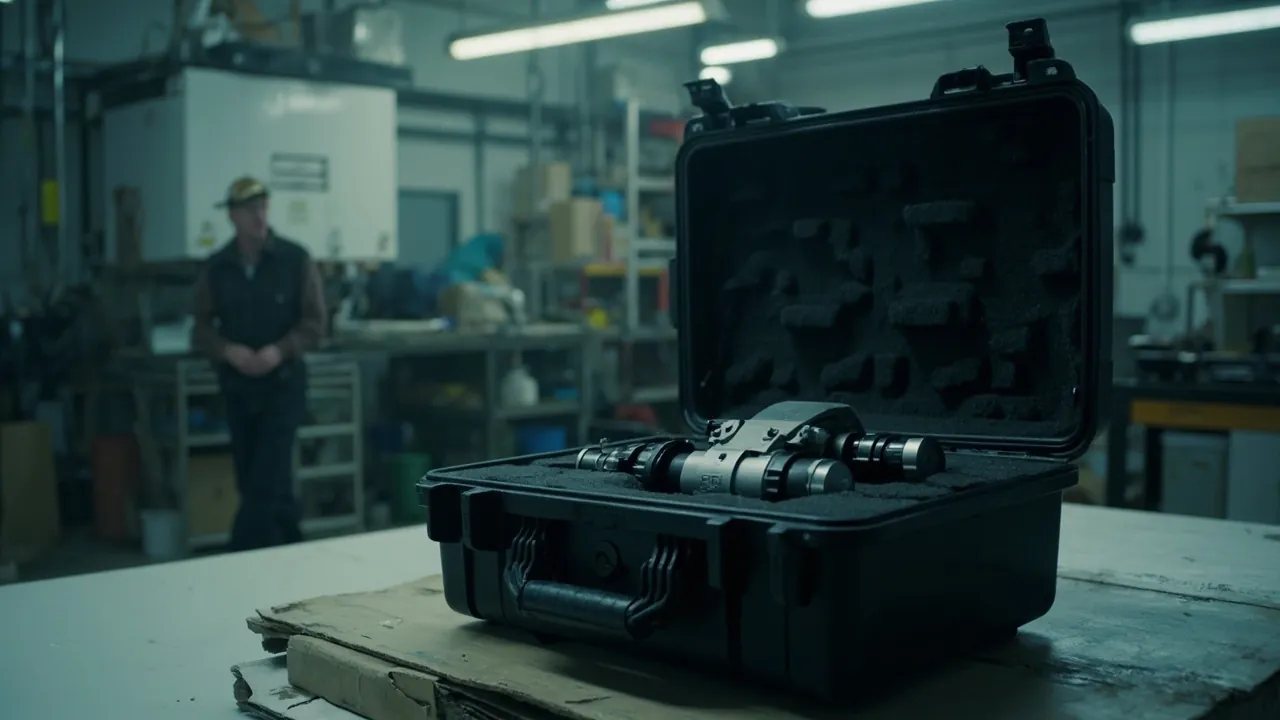
Cutlery and tableware production - table knives, forks, spoons, stainless chopsticks, kitchen shears, bottle openers - is built around three operations: one blanking stroke to define the outline, one bending stroke to set the form, and one polishing pass to establish the surface. The conclusion first: the value of cutlery tooling sits in two places, the cutting edge and the mirror cavity. These are composite sensitive items that combine hardness with brittleness and a polished finish with fragility. They must be shipped in dedicated die cases with rigid locating, isolated compartments, sulphur-free and chlorine-free rust prevention, and controlled humidity. The traditional wooden crate with loose fill cannot hold the arrival quality that cutlery tolerances require. The edge clearance and contour accuracy of a fork blanking die decides whether the tines are consistent and whether burrs stay under control. The cavity finish of a knife bending die decides whether the blade shows draw marks or orange peel. Neither condition is visible when the case is closed; both surface when the tool is mounted and the first part is tried.
Cutlery manufacturing has another distinctive trait: a dense product range, large volumes per die, and very frequent die changes. A single press may be changed over several times in a shift, and tools circulate repeatedly between the press line, the tool room, and subcontractors. Every one of those movements is a fresh exposure. This article is written for equipment engineering teams at cutlery manufacturers, tool and die shops, die distributors, and OEM/ODM buyers. It covers component grading, case and insert design, edge and mirror surface protection, rust prevention and cleanliness requirements, food-contact compliance boundaries, sealing and ingress protection levels, standard validation methods, and unpacking practice, and it explains how JUNZHJIA supports custom inserts and volume supply.
Table of Contents
- 1. Why Cutlery Dies Need a Dedicated Equipment Case
- 2. Component List and Sensitivity Grading
- 3. Failure Modes: Edge Chipping, Mirror Cavity Scoring and Loose Bending Inserts
- 4. Cleanliness Limits for Cutting Edges and Mirror Surfaces
- 5. Rust Prevention Logic for Stainless and Hardened Surfaces
- 6. Size and Weight Boundaries: Slender Knife Dies and Deep Cavities
- 7. Case Structure and Material Selection
- 8. Insert Design: The Hold-Clear Principle for Mirror Cavities
- 9. Isolated Compartments for Blanking Edges and Bending Inserts
- 10. Surface Grades and Packaging Material Compatibility
- 11. Sealing and Ingress Protection: An IEC 60529 and GB/T 4208 View
- 12. Transport Validation: GB/T 4857, ISTA and MIL-STD-810H
- 13. Labelling, Traceability and On-Site Unpacking
- 14. OEM/ODM Workflow, Acceptance and Reuse Management
- Frequently Asked Questions
- Conclusion & Related Reading
1. Why Cutlery Dies Need a Dedicated Equipment Case
The way cutlery is formed explains where die value sits: not in the mass of tool steel, but in the micrometre-level condition of the edge contour and the cavity surface.
First, the value of a blanking or tooth-forming die is in the edge contour. The tine form of a fork and the bowl outline of a spoon are frequently defined by a single blanking or fine-blanking stroke. Once the edge contour chips locally or dulls, the product shows inconsistent tines, higher burrs, and a torn shear band - defects that remain visible even after plating or polishing, and that constitute a hard appearance reject.
Second, the value of a bending or coining die is in the mirror cavity. The bending and coining cavities used on stainless blade bodies are normally mirror polished or hard chrome plated. Any scratch, bruise, or rust pit in the cavity leaves a matching mark on the formed bend face, and removing it later by polishing takes off a measurable layer of material, which changes blade thickness and contour consistency.
Third, combined edge and cavity accuracy governs assembly. Riveting a blade into a handle, over-moulding a fork, and spot welding all depend on the relative position accuracy that the die provides. A small distortion introduced in transport is amplified in the product as poor seating and uneven gaps.
Fourth, circulation frequency is very high. Cutlery product ranges are dense and each die spends little time in storage. At twenty movements a year, a die that serves its full life may be handled nearly two hundred times, and every one of those events must be repeatable and verifiable. The packaging therefore has to be standard tooling, not a consumable.
Practical note: the most under-estimated loss in a cutlery plant is not the purchase price of a die but the repeated adjustment needed when burrs come off the press out of tolerance. A large share of these cases trace back to micro-chipping of the edge and cavity scoring introduced in transport and storage, and chasing a fine-blanking shear-band problem costs far more than a proper die case.
For cutlery manufacturers and tool shops, the die case also acts as an asset-management platform. One insert architecture can be shared across a cutlery family, simplifying storage, circulation, and project kitting. Reuse assessment methods are described in protective case service life and reuse years.
2. Component List and Sensitivity Grading
Score each item on three axes - forming-precision sensitivity, shock fragility, and moisture and cleanliness sensitivity - to build the packing decision basis.
| Component | Typical material / structure | Critical sensitivity | Environment | Recommended protection |
|---|---|---|---|---|
| --- | --- | --- | --- | --- |
| Blanking die (blade or fork body) | Cr12MoV, SKD11, or carbide inserts | Edge contour, insert joint faces | Chipping, rust | Edge-up location, edge protection strip, VCI |
| Tooth-forming die (fork) | Alloy tool steel, many fine teeth | Tooth pitch, tooth tips, root radii | Tooth chipping, rust | Tooth face held clear, conformal bedding |
| Bending die | Alloy steel, mirror-polished or hard chrome cavity | Cavity roughness, bend radii | Scoring, rust, hand sweat | Cavity held clear, contour guard, sulphur-free packing |
| Coining die (spoon bowl) | Alloy steel or copper alloy, polished sphere | Spherical contour, blend radii | Bruising, rust | Individual slot, spherical cap |
| Fine-blanking die | Powder metallurgy steel, carbide | Close-clearance edges, guiding faces | Chipping, clearance drift | Whole-die location, end-face clamping |
| Guide post and bushing | GCr15 or bronze self-lubricating | Mating cylinder, perpendicularity | Scoring, rust | Paired fixing, anti-rust paper |
| Bending inserts and segments | Alloy steel, carbide | Joint faces, step fits | Loosening, misalignment | Numbered sequence, compartment location |
| Stripper plate and blank holder | Alloy steel, spring steel | Flatness, guide holes | Distortion, rust | Flat support, interleaving pads |
| Locating pins and stops | Alloy steel, bronze | Locating cylinders, threads | Impact, rust | Compartmented tray, oiled wrap |
| Polishing fixtures and jigs | Aluminium, copper, engineering plastic | Working faces, datums | Distortion, scoring | Dedicated case, working faces held clear |
| Gauges and templates | Tool steel, aluminium | Measuring faces, datums | Distortion, scoring | Dedicated case, datum faces held clear |
The pattern is clear: edge components and mirror cavities are the physical protection priority, fine-blanking dies and guide posts are the fit-accuracy priority, and segment inserts and gauges are the slow-failure items that are most often overlooked.
3. Failure Modes: Edge Chipping, Mirror Cavity Scoring and Loose Bending Inserts
Edge chipping. Blanking and tooth-forming edges are the hardest and least ductile regions of the die. When the die is struck laterally, or when an edge contacts another hard component, small chips form. A chip may be a fraction of a millimetre, yet it shows up immediately as out-of-tolerance burrs and a wider fracture band, and it propagates over subsequent strokes. A fine tooth profile is especially fragile: once a tooth tip chips, the whole die usually has to be reground.
Mirror cavity scoring. Once a bending or coining cavity is scored, friction rises locally as the stainless sheet forms, producing draw marks and local thinning at the corresponding position on the part. Worse, the score traps metal debris and hard particles from the lubricant, creating continuous abrasion, so the damaged zone grows with every stroke. Mirror defects on blades and spoon bowls often remain visible after polishing and become an unrepairable appearance reject.
Mirror corrosion and fingerprint etching. Stainless does not mean rust-free, and die cavities are usually alloy tool steel or chrome plated. Both are highly sensitive to humidity, chloride, and hand sweat. A sweaty fingerprint left on a mirror surface can produce an etched stain within days, and such damage is difficult to remove completely in the plating or polishing operation.
Loose bending inserts and segments. In compound and segmented dies, inserts are located by mating faces and fasteners. Transport vibration loosens fasteners slightly, the insert shifts by a small amount, and after assembly the bend position is offset and the product contour inconsistent.
Guide post and bushing scoring. The guide mating surface is the accuracy datum of the die. Scoring or corrosion destroys guiding accuracy, the blanking clearance fluctuates through the stroke, and the part shows misalignment and burrs.
Stripper plate and blank holder distortion. These plates are large in area and relatively thin. If supported only at the corners in transit, the centre deflects under self-weight and stacking load, and after assembly the blank-holding force is uneven and the part shows galling.
Safety note: a die is a heavy component. Lifting and handling must use dedicated lifting gear or symmetrical load points. Never pass a wire rope through a cavity, a tooth gap, a guide post bore, or a stripper screw hole to lift a die - edge chipping and mirror scoring usually happen at exactly this step.
4. Cleanliness Limits for Cutting Edges and Mirror Surfaces
A cutlery die is not itself a food-contact material, but it determines the surface condition of the food-contact face. Cleanliness requirements must be written into the packaging specification rather than left in a workshop rulebook.
Where the boundary sits. Under the logic of food-contact material regulation, stainless steel tableware is commonly assessed against the GB 4806.9 series, with separate parts covering plastics and coatings. The compliance obligation ultimately lands on the finished tableware surface, not on the die. However, corrosion products from the cavity, polishing paste residue, release agents, and emissions from packaging materials can all transfer to the finished surface through forming and polishing. The core packaging requirement is therefore: introduce no corrosion, no sulphur or chlorine bearing contamination, and no residue that cannot be removed.
Packaging material compatibility. Some foams, rubbers, and adhesives can release acidic species, plasticisers, or sulphides during long contact. Copper alloy coining punches and chrome plated cavities are especially sensitive to sulphur and chlorine. Specify the composition and compatibility from the insert material supplier, and run a small contact test where the risk is high. A comparison of materials is available in case foam material comparison.
Cleanliness control. Debris from CNC-cut foam is a classic contamination source. Inserts must be de-dusted and cleaned after machining; the assembly area must be free of airborne wood dust and cutting fluid mist; operators must wear clean gloves and must never touch a mirror cavity or a cutting edge with bare hands.
Sequence of cleaning and degreasing. The die should be cleaned, degreased, and dried before packing, then protected with rust-preventive oil or VCI. If cleaning is deferred until after unpacking, the corrosion risk is concentrated in exactly the transport and storage window where nobody is watching.
Cleaning before case reuse. Reusable cases and inserts must be wiped clean and fully dried before every cycle; the method is described in how to clean a protective case.
5. Rust Prevention Logic for Stainless and Hardened Surfaces
The material mix in cutlery tooling means rust prevention needs two strategies in one case: edges and cavities are hardened steel or chrome plated, guide posts are bearing steel, and coining punches may be copper alloy.
The chloride hazard. Stainless and chrome plated surfaces are prone to pitting in chloride-bearing environments, and once pitting starts it develops autocatalytically. Packaging materials, adhesives, cleaning residue, and hand sweat can all introduce chloride. Inserts and packaging consumables should therefore be specified chloride-free, and cleaning should use deionised water or a dedicated cleaner followed by thorough drying.
The sulphide hazard. Copper alloy punches and some plated surfaces are sensitive to sulphides and will discolour and lose lustre on contact. Sulphur-bearing rubbers, reclaimed rubber, and some low-cost foams are the main sources. Request composition declarations when selecting inserts and avoid sulphur-bearing formulations.
Suitability of vapour corrosion inhibitor (VCI). VCI materials continuously release inhibitor molecules that adsorb onto metal surfaces, which makes them particularly effective on cavities, edges, and guide posts - surfaces that are hard to oil reliably. Three cautions apply. First, compatibility: copper alloys and chrome plating need a product explicitly declared compatible. Second, effective distance: vapour concentration deep inside a narrow cavity may be insufficient, so add an emitter. Third, service life: choose a long-duration grade for ocean transit and long storage and state the replacement interval.
Oil film as a complement. For assembly fits such as guide posts and bushings, guide bores, and insert joint faces, apply a thin oil film first and then wrap with VCI. The film should be even, thin, free of free water, and compatible with the grease used at assembly.
Cleanliness and ISO 4406. ISO 4406 is the widely used method for coding solid particulate contamination in hydraulic and lubrication systems, expressing particle counts in size bands as a three-number code. Borrowing that logic for die packaging has real value: the particulate contamination level of a component surface can be specified as a cleanliness code plus a measurement method, rather than an unverifiable statement that the surface shall be clean. Specify in the technical agreement that surfaces are cleaned and degreased before packing; that inserts are de-dusted after machining to the point where no visible particles remain; and that critical mating surfaces are blown with clean compressed air and verified with a white-cloth wipe.
Storage environment. Even good packaging needs environmental support for long storage. Keep relative humidity below roughly 60 percent, avoid walls and floors, and never store alongside acids, alkalis, or salts. Vibration and stacking requirements are covered in GB/T 4857 transport packaging test methods.
6. Size and Weight Boundaries: Slender Knife Dies and Deep Cavities
Cutlery die geometry falls into two very distinct families: slender items such as blade blanking and bending dies, which may exceed a metre in length while being only one or two hundred millimetres wide, and deep cavity items such as spoon coining and deep bending dies, where cavity depth is large relative to the opening. The two families need completely different packing strategies.
| Type | Typical geometry | Main risk | Packing strategy | Insert requirements |
|---|---|---|---|---|
| --- | --- | --- | --- | --- |
| Slender blanking die | 800 - 1500 mm long, 150 - 300 mm wide | Mid-span sag, torsional twist | Horizontal, multi-point support | Support spacing no more than one third of span |
| Slender bending die | 600 - 1200 mm long, cavity runs full length | Cavity scoring, loss of straightness | Cavity up, rigid location at both ends | Continuous soft bedding along both cavity sides |
| Deep cavity coining die | Depth-to-width ratio above 1.5 | Cavity wall distortion, damage to release face | Cavity down or on its side | Annular end-face support, cavity mouth ring |
| Fine-blanking die (complete) | Medium size, high fit accuracy | Clearance drift, guiding damage | Whole-die rigid seat | Base support plus top clamping |
| Small insert set | 2 - 20 kg per piece, many pieces | Loss, impact, wrong assembly | Compartmented tray | Numbered slots, poke-yoke features |
| Gauges and templates | Thin plate components | Distortion, measuring face scoring | Dedicated case, upright or suspended | Datum faces held clear |
Design points.
- Support spacing is the governing parameter for slender dies. Too few supports let the mid-span sag slowly under self-weight and vibration, and the deformation is often irreversible. Space supports at one third of the span or closer.
- Slender dies also need torsional restraint. Base support alone cannot prevent rotation about the long axis. Add a side fence or use the cavity side wall for location.
- Deep cavity dies must not be loaded through the cavity wall. The wall is relatively thin, so support must land on the end face and outer rim, never on the mid-height of the wall.
- The centre of gravity must sit low. A high centre of gravity promotes rocking and a tip-over risk in transit; the heavy side should be as close to the case floor as possible.
- Print the stacking load on the label. Storage stacking heights usually exceed transport stacking heights, and that is the main source of case deformation.
Tip: for dies longer than 1000 mm, design the case and an internal rigid skeleton as one assembly. The skeleton carries support and torsion resistance while the case provides sealing and environmental isolation, and that division of labour markedly reduces the risk of losing straightness.
7. Case Structure and Material Selection
A cutlery die case has to balance stiffness, weight, sealing, and handleability, and slender dies are especially sensitive to stiffness.
Shell material. Common choices include high-impact copolymer polypropylene, modified engineering plastics, and glass-fibre reinforced composites. Copolymer PP offers good toughness, chemical resistance, and very low water absorption, which suits most tool room and warehouse environments. Above roughly 1200 mm in length or 500 kg in mass, a combination of steel skeleton and engineering plastic panels is normally required.
Flammability rating. Tool rooms contain oil mist, cleaning solvents, and electrical equipment, so an explicit flammability rating is worth specifying. UL94 is the widely used method for evaluating the burning behaviour of plastics, and the V-0, V-1, and V-2 classifications are commonly quoted in procurement specifications. Note that UL94 is a material-level evaluation and is not equivalent to a finished-case fire certification.
Wall thickness and ribbing. Case stiffness comes primarily from rib geometry rather than raw wall thickness. For a slender case, continuity of the longitudinal ribs matters more than transverse rib density, because bending stiffness is governed mainly by the second moment of area of the longitudinal section.
Hinges and latches. On a die case that opens frequently, hinges and latches are the first parts to fail. Structure, materials, and the sealing interface are covered in toolbox hinge, latch and seal design.
Seals. Gasket material must match the environment: nitrile rubber for oil resistance, silicone for a wide temperature range, and EPDM where weather and water vapour resistance dominate. Guidance is in case seal material selection.
Pressure equalisation valve. A sealed case develops a pressure differential under temperature change or air freight altitude, which makes the case hard to open and can crush the gasket. For slender cases that fly or cross climate zones, a pressure equalisation valve is necessary; the principle is explained in case pressure equalisation valve.
Internal partitioning. A single cutlery die often comes with several inserts and accessories, and a removable divider system allows one case to carry many items while remaining adjustable. The design logic is in case removable divider system.
Wheels and trolley handle. Below 150 kg, wheels and a telescopic handle markedly reduce manual handling strain, but the wheel structure consumes base volume and can affect stacking stability. Design points are in case wheels and trolley handle.
8. Insert Design: The Hold-Clear Principle for Mirror Cavities
Insert design is the technical core of a cutlery die case. The same shell with a different insert can deliver several times the protection, or almost none.
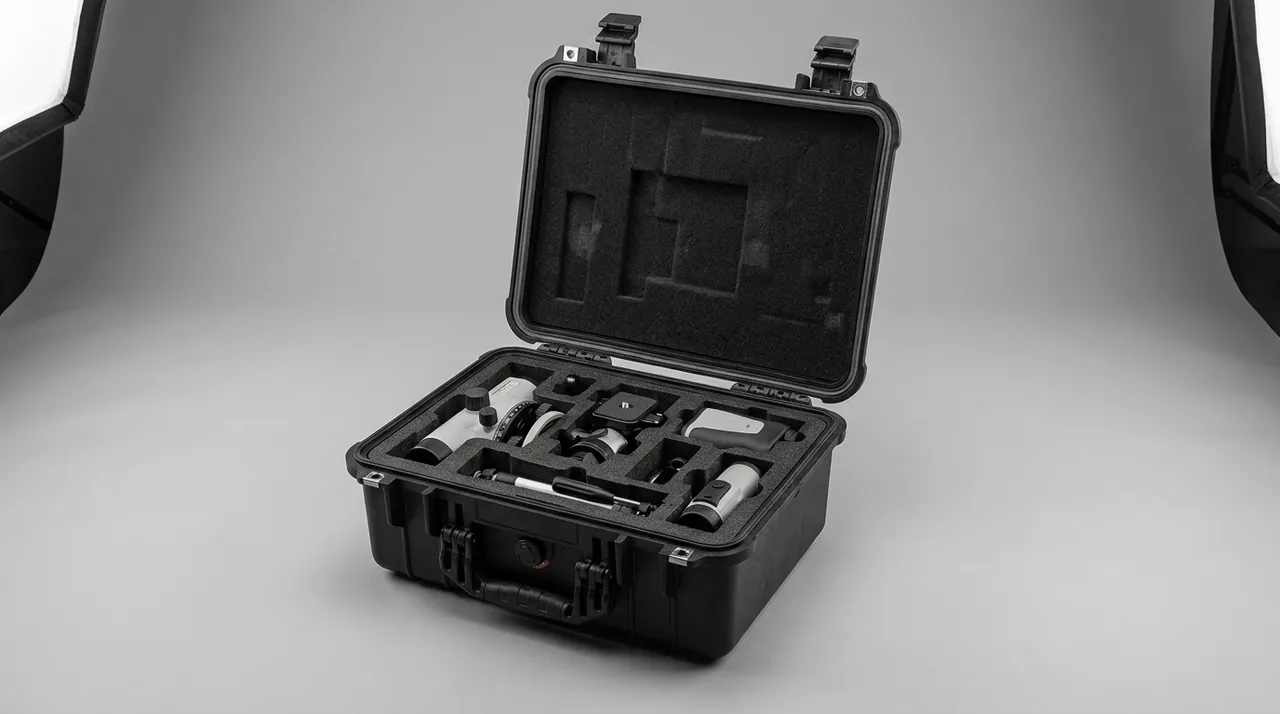
Principle one: no mirror surface touches anything hard. Mirror cavities, chrome plating, and polished spheres must be held clear, or touch only a validated clean soft material. Soft does not mean harmless - many foams stiffen significantly under compression and will take a permanent set in a mirror surface under static load. Keep a 0.5 to 1 mm gap between the mirror surface and the insert, and use a perimeter-supported, centre-clear layout.
Principle two: rigidity locates, elasticity cushions. Rigid members such as wood, engineering plastic, or metal framing restrain the six degrees of freedom, while elastic members such as foam, rubber, and air cushions absorb vibration and shock energy. Confusing the two roles is the most common insert design error. The underlying logic is set out in cushion liner design.
Principle three: separate load faces from function faces. Every die has non-functional surfaces - the base, side mounting faces, and the areas of the top face outside the datum. All support and clamping should land on those, so that functional faces such as cavities, edges, and guiding surfaces carry no load at all.
Principle four: the loading action must be repeatable. The insert should bring the die to the same location every time. Use locating pins, corner stops, colour coding, and poke-yoke recesses.
Principle five: provide a real hand access path. A mirror component should be lifted out with gloved fingers, not pried, picked, or dragged. Inadequate access forces operators to reach for a tool, and that is the leading cause of mirror scoring on the shop floor.
Choosing cavity orientation. For cutlery bending and coining dies:
| Option | Best suited to | Advantages | Risks |
|---|---|---|---|
| --- | --- | --- | --- |
| Cavity up | Full-length bending dies, wide cavity openings | Cavity visible, easy to inspect on opening, carries no load | Foreign objects can fall in, condensate can collect |
| Cavity down | Deep coining dies, spoon bowl dies | Cavity shielded by its own body, little chance of dropped objects | Inspection is harder, cavity mouth may take local load |
| On its side | Slender dies, double-sided cavities | Low height, good stacking stability | Needs dedicated lateral rigid support and anti-rotation |
Conclusion: full-length bending dies generally use cavity-up with a low-strength dust cover over the opening and desiccant inside the cavity; deep coining dies use cavity-down with annular end-face support. Whichever is chosen, the orientation must be marked on the outside of the case and the first inspection step after opening must be written into the procedure.
9. Isolated Compartments for Blanking Edges and Bending Inserts
Blanking edges. Edge blocks should be located edge-up or edge-sideways so that the edge contacts no hard flat surface. If an edge block must be placed edge-down, provide an annular rigid support face so the load lands on the plate outer rim rather than on the edge contour. Blocks must be separated from each other.
Fine tooth edges. The tooth tips of a fork tooth-forming die are the most fragile feature. Support the tooth face on conformal soft bedding with a low-pressure, face-contact design. Never use point or line contact support. Also protect the tooth root: if the root radius is pressed against a hard object it deforms plastically and the tooth pitch changes.
Bending inserts and segments. Segmented die inserts must be numbered and located in dedicated compartments, with the packing order matching the assembly order. The joint faces are high-precision mating surfaces, so interpose anti-rust paper rather than letting metal touch metal directly. List each insert number and its mounting position on the case manifest.
Guide posts and bushings. These should be fixed in pairs, coaxial, with mating surfaces facing out and wrapped in anti-rust paper. A guide post stored loose will inevitably pick up scratches from neighbouring parts. Bronze self-lubricating bushings are sensitive to sulphur and chlorine, so packaging materials must be explicitly sulphur-free.
Elastic elements. Polyurethane elastomers and die springs take a permanent set and age under sustained compression. Store them free or lightly preloaded, away from light, heat, and ozone sources.
Stripper plates and blank holders. These stack well, but require flat interleaving pads between layers and a limited stack height. Put the least flat component at the bottom of the stack.
Small parts and standard components. Locating pins, screws, springs, and inserts are small in size, dispersed in value, and the easiest things to lose. Use a compartmented tray and list quantities on the manifest.

10. Surface Grades and Packaging Material Compatibility
The surface grade of a cutlery die is a key input to insert design and packaging material selection.
| Surface grade | Typical locations | Permitted contact | Prohibited contact | Packing requirement |
|---|---|---|---|---|
| --- | --- | --- | --- | --- |
| Grade A mirror | Bending cavities, coining spheres, chrome plate | None (held clear) or validated clean soft bedding | Bare hands, wood dust, sulphur-bearing rubber, ordinary foam | 0.5 - 1 mm gap, dedicated dust cover |
| Grade B precision | Joint faces, guide bores, assembly steps | Anti-rust paper, thin oil film, clean soft bedding | Hard particles, corroded parts | Oil film plus anti-rust paper wrap |
| Grade C edge | Blanking edges, tooth-forming edges | Edge protection strips, conformal bedding | Flat steel plate, other edge components | Separate compartments, strips, VCI |
| Grade D general machined | Base, side mounting faces, non-mating areas | Rigid supports, wood or engineering plastic blocks | Sharp hard objects | May carry compressive load |
| Grade E as-cast | Cast skins, non-mating areas | Anything | None | May be used as a clamping face |
Packaging material compatibility risks.
- Sulphur-bearing and reclaimed rubber: releases sulphides that discolour copper alloy punches and chrome plated faces.
- Some low-cost foams: may retain foaming agents, plasticisers, or acidic species that induce pitting over long contact.
- Chlorine-bearing materials: including some PVC-based consumables and chlorine-containing adhesives, which are a pitting source for stainless and chrome plated surfaces.
- Wooden supports: wood absorbs moisture and can be acidic, and machining generates dust, so it needs drying and sealing treatment.
- Tapes and labels: adhesive residue can become a contamination source; specify low-residue types.
Recommended practice. Write into the technical agreement that packaging materials shall contain no sulphur, no chlorine, and shall not release acidic species, and require a composition declaration. For Grade A mirror surfaces and copper alloy parts, run a small contact test at 40 C and 90 percent relative humidity for several days and inspect for discolouration and spotting. A comparison of materials is available in case foam material comparison.
11. Sealing and Ingress Protection: An IEC 60529 and GB/T 4208 View
For a cutlery die case, sealing addresses three intruders: dust, water vapour, and condensate. The classification framework is defined in IEC 60529 and its Chinese counterpart GB/T 4208.
| Rating | Dust | Water | Meaning for cutlery tooling |
|---|---|---|---|
| --- | --- | --- | --- |
| IP54 | Limited dust protection | Splash | In-plant short moves, dry workshops |
| IP55 | Limited dust protection | Water jet | General machining and polishing shops |
| IP65 | Dust tight | Water jet | Polishing-shop dust, long road transit, common default |
| IP66 | Dust tight | Powerful water jet | High-pressure washdown or heavy rain exposure |
| IP67 | Dust tight | Short immersion | Flooded road sections or long open-air transhipment |
| IP68 | Dust tight | Continuous immersion | Special cases, specify depth and duration |
Selection logic. Do not chase IP67 by default. IP67 normally means a thicker gasket, higher latch preload, and more elaborate pressure equalisation, which affects ease of opening and case weight. Start from the worst credible case instead: will it be rained on, will it cross flooded ground, is the transhipment point under cover, is there high-pressure washdown in the polishing shop? Then set the rating.
The polishing shop consideration. Cutlery plants run heavy polishing and belt grinding, and the air carries fine polishing debris and polishing wax dust. These particles are small and cling strongly, and once inside a case they attach to mirror surfaces and cutting edges. Cases used in a polishing shop should therefore be at least IP65, and the practice should be to wipe the outside of the case before opening it, so that wall dust does not fall in at the moment the lid lifts.
Sealing versus pressure equalisation. A high sealing rating creates a significant pressure differential. A case cycling between 45 C by day and 10 C at night builds a marked negative pressure, opening becomes hard work, and the gasket is repeatedly compressed and released. A pressure equalisation valve allows gas to exchange slowly while blocking liquid water and dust, and is standard practice above IP65.
Gasket maintenance. The gasket is a wearing part. Inspect it periodically for hardness, rebound, and set, and replace it when it hardens, cracks, or takes a permanent compression set. Matching gasket material to environment is covered in waterproof case IP protection and seal design.
Documentation. Ask the supplier for a rating verification statement, type test report, or third-party conclusion, and put the sampling rule into the contract. Sampling and acceptance practice is described in custom case acceptance and AQL sampling.
12. Transport Validation: GB/T 4857, ISTA and MIL-STD-810H
The protection actually delivered by a die case has to be validated by transport testing, not by opinion.
The GB/T 4857 series. This is the basic Chinese test method system for transport packages, covering vibration, shock, stacking, and drop, and it suits domestic road transport scenarios. The stacking test matters especially, because storage stacking loads usually exceed transport loads. Key points are in GB/T 4857 transport packaging test methods.
The ISTA series. ISTA publishes transport packaging test procedures organised by distribution mode and package form. For die cases shipped as unitised loads, the ISTA 3 series unitised load procedures are the closest match. See ISTA transport testing procedure.
ASTM D4169. This standard uses a distribution cycle framework that combines handling, stacking, vibration, and shock into a complete test sequence, which suits export projects and situations where the acceptance basis must be common across parties. See ASTM D4169 distribution cycle testing.
Where MIL-STD-810H fits. This is a United States military standard for environmental test methods, frequently cited outside ISO-based industries as an environmental test basis. It must be stated clearly that citing MIL-STD-810H methods is an environmental test basis only. It does not indicate military certification, and it does not indicate compliance with any national military procurement requirement. For cutlery die cases, the thinking in Method 514 (vibration) and Method 516 (shock) is useful as design input, but the test conditions must match the project's actual transport profile rather than being copied.
Validation points for slender dies.
- Survey resonance first. A slender die usually has a low first bending frequency that readily couples with the low-frequency vibration of road transport. Run a modal or sweep survey to identify the dominant resonances of the case, insert, and die as one assembly.
- Recheck support positions. If straightness changes after testing, review the support spacing rather than simply adding insert thickness.
- Never skip the functional check. After testing, inspect edge contours, cavity surfaces, guide mating faces, and insert joint faces, and re-measure die geometry. Do not settle for whether the case itself survived.
- Keep traceable records. Test conditions, sample identity, inspection method, and verdict should all be retained.

13. Labelling, Traceability and On-Site Unpacking
External labelling. At minimum include: die number and name, applicable product model, gross weight including the die, centre of gravity, lifting point identification, stacking limit, moisture and tip-over symbols, and orientation (cavity up, cavity down, or on its side). Orientation and centre-of-gravity marks on heavy items should use high-contrast colours and remain readable in poor light. For slender cases, mark both ends so that a single-direction read cannot cause a misjudgement.
Internal manifest. Fix a manifest to the inside of the lid listing the component name, number, and quantity for each insert pocket. For segmented dies, the manifest should state the assembly order of each insert. Its value is that anyone can complete a count and prepare for assembly without leaving the case to look up a drawing.
Status label. Use a four-field label: packing date, rust prevention method, expiry, and inspector. Both VCI and oil films have a finite life, and a status label turns expiry into a decidable fact.
Unpacking procedure.
- Before opening, wipe the case exterior, check the case body, seals, and labels, and record anything abnormal.
- On opening, read the humidity indicator card and desiccant state before removing parts.
- Remove parts in manifest order, wearing clean gloves, never touching mirror surfaces or edges with bare hands.
- Inspect cavities, cutting edges, tooth faces, guide posts, and insert joint faces, then clean and re-oil or re-grease before use.
- Before mounting, verify shut height, clearances, guiding fits, and insert assembly order. Never assume the die is still at its as-shipped setting.
- Record any damage or deviation and feed it back to packaging and logistics so the loop closes.
Why traceability matters. Packaging and transport are where die damage concentrates and where the evidence chain is weakest. With a case number, a seal number, and an unpacking record, where the damage happened stops being a matter of argument.
14. OEM/ODM Workflow, Acceptance and Reuse Management
Customisation workflow.
- Requirement input. Die list with model, dimensions, weight, and centre of gravity; 3D models or physical samples; surface grade requirements; circulation mode (in-plant, inter-plant, export); transport modes; environmental conditions; compliance requirements.
- Design. Case size, insert architecture, locating and cushioning scheme, sealing rating, closure type, and labelling scheme.
- Prototype and verify. Trial fit the first insert, check clearances, ease of loading, and load paths on functional faces. For slender and deep-cavity dies, run vibration and drop tests.
- Pilot use. Run the case on the real circulation route for a period and collect unpacking records.
- Freeze and produce. Release the drawing and process, then move to volume supply.
- Reuse management. Establish case numbering, cycle counting, and replacement intervals for gaskets and inserts.
Acceptance points. Insert fit tolerance, locating repeatability, mirror clearance, gasket compression, latch preload, material flammability rating, sulphur-free and chlorine-free declarations for packaging materials, VCI expiry, and completeness of labelling. Build the sampling plan on AQL principles; the method is described in custom case acceptance and AQL sampling.
Reuse and life management. The hard shell normally lasts a long time, but inserts settle under repeated compression and gaskets age. Manage shell, insert, and gasket as three independent life items, and replace the whole case only when the shell cracks, distorts, or loses its closure function. The assessment approach is in protective case service life and reuse years.
Supplier selection. Cutlery die cases are a classic non-standard custom plus volume supply category, so the supplier needs die design, foam machining, case moulding or assembly, and test coordination under one roof. An evaluation framework is given in how to choose a protective case OEM factory.
What JUNZHJIA offers. As a brand of Kexin New Materials (Guangdong) Co., Ltd., JUNZHJIA supplies protective cases, tool boxes, and equipment cases to the cutlery and hardware tooling industries on an OEM/ODM basis. Capabilities include conformal insert design and CNC machining from 3D die models, dedicated perimeter-supported and centre-clear pocket geometry for Grade A mirror surfaces, matched sulphur-free gaskets and pressure equalisation valves per case model, documentation supporting IP rating, material flammability rating, and transport testing, and volume acceptance against AQL rules. For slender cutlery dies longer than 1000 mm, JUNZHJIA can supply an integrated case-and-rigid-skeleton structure.
Frequently Asked Questions
Q: How should a cutlery bending die cavity be located so that it cannot be crushed?
A: The governing principle is perimeter support, centre clear, and controlled clearance. The mirror cavity itself must never carry load; support has to land on the plate outer rim, the base mounting face, and other non-functional surfaces. A practical three-step approach works well. First, provide continuous or segmented rigid support faces around the cavity so that the clamping force forms a closed loop. Second, keep a 0.5 to 1 mm gap between the mirror surface and the insert, or use validated clean soft bedding for low-pressure face contact. Third, fit a low-strength dust cover over the cavity mouth to keep objects out and to discourage operators from touching the mirror directly. One caution matters a great deal: many foams stiffen noticeably after long compression and take a permanent set, so soft bedding must never be treated as a cushion that can simply be clamped down hard. On hard chrome surfaces, also ensure the insert is sulphur-free and chlorine-free to prevent discolouration and loss of lustre.
Q: Why must cutlery die packaging materials be explicitly sulphur-free and chlorine-free?
A: Because cutlery dies contain surfaces that are highly sensitive to sulphur and chlorine, and both contaminants typically come from the least conspicuous packaging consumables. Copper alloy coining punches, chrome plated cavities, and stainless accessories discolour and lose lustre on contact with sulphur-bearing substances, and they pit readily on contact with chlorine-bearing substances. Once pitting starts it develops autocatalytically and is very difficult to remove completely by simple polishing. Common risk sources include sulphur-bearing and reclaimed rubbers, residual foaming agents and plasticisers in some low-cost foams, chlorine-containing adhesives and some PVC-based consumables, plus cleaning residue and hand sweat. The engineering response is to state in the technical agreement that packaging materials shall contain no sulphur, no chlorine, and shall not release acidic species, and to require a composition declaration. Run a small contact test on mirror and copper alloy parts at elevated temperature and humidity for several days and inspect for discolouration and spotting. Complete cleaning, degreasing, and thorough drying before packing, and have operators wear clean gloves with no bare-hand contact with mirror surfaces.
Q: What is the most common problem with slender blade dies in transport?
A: The dominant risks are mid-span sag and torsional twist rather than surface impact damage. A die longer than about 800 mm with too few or badly distributed supports will bend slowly under its own weight combined with transport vibration, and that deformation is usually irreversible. After assembly it shows up as out-of-tolerance blade straightness and an offset bend position. Twist is the second, less visible risk: base support alone cannot restrain rotation about the long axis, so case sway during transport induces slight rotation and destroys cavity straightness. Three countermeasures apply. First, keep support spacing at no more than one third of the total span, and tighten to one quarter where necessary. Second, add a side fence or use the cavity side wall to restrain rotation. Third, for dies longer than 1000 mm, use an integrated case-and-rigid-skeleton structure in which the skeleton carries support and torsion resistance. For validation, start with a resonance survey to identify the dominant bending frequency of the assembly, then run vibration and stacking tests and re-measure straightness.
Q: Is IP65 enough for a die case, or does a polishing shop need a higher rating?
A: For most cutlery die circulation, IP65 - dust tight and protected against water jets - already covers the polishing shop dust environment and ordinary long-distance road transport, and it is the common default. Polishing and belt grinding generate fine polishing debris and polishing wax dust with strong adhesion, and once these particles enter a case they attach to mirror surfaces and cutting edges. Cases used in a polishing shop should therefore be at least IP65, and the working practice should be to wipe the case exterior before opening, so that dust on the walls does not fall in as the lid lifts. IP67 is needed only when short-term immersion is a credible risk, for example a route across sections prone to standing water or an uncovered transhipment point in heavy rain. Moving to IP67 has side effects: a thicker gasket, higher latch preload, more effort to open, and a mandatory pressure equalisation valve, because otherwise the differential from temperature change makes opening difficult and fatigues the gasket. The correct order is to define the worst credible condition, set the rating, then specify the matching gasket and pressure equalisation hardware.
Q: The tooth tips of a fork forming die damage most easily. What does packing need to do differently?
A: Tooth tips are fragile because they combine high hardness with a very small cross-section, so any point or line contact can chip them. Packing requirements therefore differ completely from flat plate components. First, support must be face contact at low pressure; use conformal soft bedding so that the tooth face rests on the pad rather than being pressed against it. Second, never run hard blocks or metal spacer bars through the tooth gaps, and never place the tooth face down directly on a flat steel plate. Third, protect the tooth root as well: if the root radius is pressed against a hard object it deforms plastically and the tooth pitch changes, which after assembly shows up as inconsistent tine spacing. Fourth, store multiple tooth-forming dies in separate compartments so that tooth faces never touch each other. Fifth, complete cleaning and rust prevention before packing and apply VCI protection to the tooth faces. Finally, when unpacking, wear clean gloves and lift the die by the die body or the plate edge; never pick it up by pinching a tooth tip, which is the most common cause of chipping on the shop floor.
Q: Can an equipment case replace a press safeguarding system, and how should changeover safety be understood?
A: No, and it should not be presented as one. A case protects die integrity while the die is not running. Press safety during operation belongs to machine safeguarding and work management, and requires photoelectric guards, light curtains, two-hand controls, lockout-tagout, and energy isolation as a complete set. Write this boundary into the technical agreement and the training material so that nobody concludes that a dedicated case makes the press safe. What a case can legitimately contribute is narrower but real: rigid locating and clear labelling cut the judgement time and trial-and-error moves during changeover; weight and centre-of-gravity marking give the lift plan a factual basis; status labels and an unpacking checklist turn die condition confirmation into a recorded, traceable step; and a common insert architecture with insert numbering removes the improvised handling caused by missing parts or wrong locations. Treating packaging as part of changeover standard work is where its safety value actually comes from, and that matters most on cutlery lines with many dies and frequent changes.
Q: Which transport tests actually validate a cutlery die case?
A: Choose a standard combination that matches the transport modes, and make sure a functional check follows every test. For domestic road transport and warehousing, build on the GB/T 4857 series and prioritise vibration and stacking, because stacking loads usually exceed transport loads and are the main cause of case deformation; for slender dies, pay additional attention to the vibration response in the bending direction. For export projects shipped as unitised loads, the ISTA 3 series unitised load procedures are a close match. Where the acceptance basis must be common across parties or the customer specifies a distribution cycle framework, ASTM D4169 applies. For air freight or extreme climate exposure, the environmental test thinking in MIL-STD-810H Method 514 for vibration and Method 516 for shock can be cited, with the explicit statement that this is an environmental test basis and not military certification. The design keys are: evaluate case, insert, and die as one system; after testing inspect edge contours, cavity surfaces, guide mating faces, and insert joint faces and re-measure die geometry; and record test conditions, sample identity, and verdict so the result is traceable.
Q: How long does a cutlery die case last, and do inserts and gaskets need scheduled replacement?
A: Manage shell, insert, and gasket as three independent life items, because their failure mechanisms and service lives differ substantially. The shell usually lasts longest; provided it shows no cracks, no obvious distortion, and no structural damage at the closure, it can serve for years, with life driven mainly by cumulative handling cycles and load level. On slender cases, also watch for fatigue cracking of the longitudinal ribs. Insert life depends on compression frequency and static load duration. Foam gradually loses rebound, which shows up as looser fits and reduced locating repeatability, and typically requires partial or full replacement after several years; mirror pocket clearance also changes as the foam settles. The gasket is a wearing part; ageing appears as hardening, cracking, loss of rebound, and permanent compression set, driven by ozone, ultraviolet, oil contamination, and thermal cycling. In addition, VCI and oil films have finite lives and must be renewed on the interval stated on the label. Recording all three in a case log alongside unpacking records produces a predictable maintenance rhythm.
Conclusion & Related Reading
The essence of cutlery die protection is turning invisible loss into a managed process. Micro-chipping of an edge, mirror scoring, tooth face bruising, and loose inserts do not announce themselves the way a cracked case does, yet their effect on production is more direct and more expensive: out-of-tolerance burrs, draw marks, polishing rework, and assembly misalignment all resolve into yield and delivery performance.
A competent cutlery die case has to solve five things at once: rigid locating to restrain the degrees of freedom, elastic cushioning to absorb vibration, sulphur-free and chlorine-free materials to protect sensitive surfaces, sealing and rust prevention to control the environment, and labelling with traceability to build the evidence chain. For engineering and procurement teams, the productive comparison is not unit price but total cycle cost: arrival pass rate, unpacking and dial-in time, polishing rework, die repair frequency, and case reuse cycles.
Related Reading