

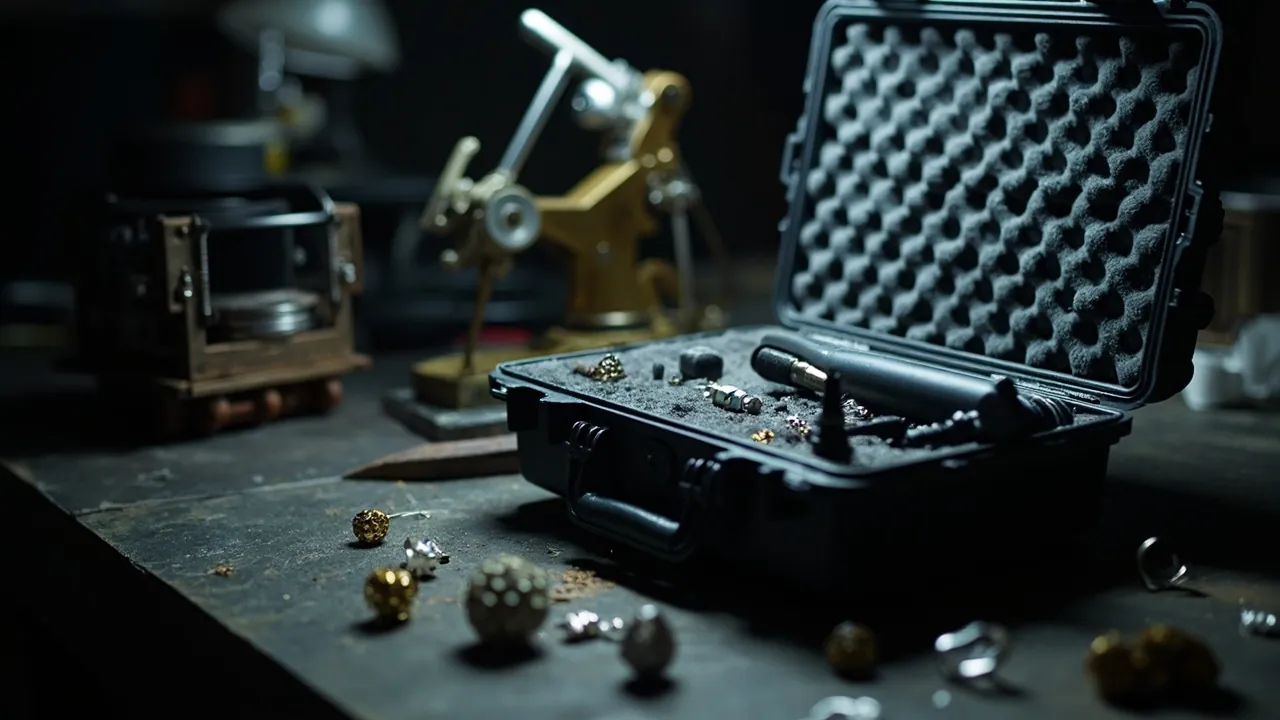
A jewelry making equipment case has to solve a contradiction: the equipment is small, expensive and extremely sensitive, while the transport leg is usually outsourced, involves multiple handoffs, and gets handled roughly. The headline conclusion is that protection for jewelry equipment is not about how hard the shell is. It is about four invisible damage vectors: vibration transfer, dust and precious-metal residue, temperature and humidity swings, and static charge and residual magnetism. The vacuum pump and temperature controller of a vacuum casting machine, the rotating magnetic field assembly of a magnetic polisher, and the optical resonator of a laser welder can all lose accuracy without a single scratch on the outside. The real value of a case therefore lives in the design precision of the liner-to-equipment interface, not in wall thickness.
This article is written for equipment engineers at jewelry manufacturers, purchasing managers at repair and service chains, and traders handling OEM/ODM orders. It breaks down casting, polishing, welding and cleaning equipment in turn, and gives executable selection parameters, standards cross-reference tables and acceptance criteria. The standards cited here - IEC 60529, GB/T 4208, the ISTA series, ASTM D4169 and UL94 - can all be quoted directly in a procurement technical agreement.
Table of Contents
- 1. Transport Risk Profile for Jewelry Making Equipment
- 2. Casting: Protecting Vacuum Casters, Centrifugal Casters and Melting Furnaces
- 3. Wax Patterns and Rubber Molds: The Temperature-Sensitive Boundary
- 4. Polishing: Dust and Vibration Control for Barrel, Magnetic and Buffing Machines
- 5. Humidity Requirements for Ultrasonic and Steam Cleaners
- 6. Laser Welding and Spot Welding: Dual Protection for Optics and Power Electronics
- 7. Precious-Metal Residue and Dust Recovery: Designing Internal Cleanability
- 8. Anti-Magnetic and ESD Considerations: The Two Most Overlooked Metrics
- 9. Liner Design: Choosing Between EVA, PE, PU and Divider Systems
- 10. Seals, Pressure Equalization and Latches: Matching IP Rating to Transport Reality
- 11. Standards Cross-Reference: From IEC 60529 to ISTA and ASTM D4169
- 12. Selection Workflow, Acceptance Points and AQL Sampling
- 13. Volume Supply and OEM/ODM Collaboration Models
- Frequently Asked Questions
- Conclusion & Related Reading
1. Transport Risk Profile for Jewelry Making Equipment
Jewelry equipment shares one characteristic: most units weigh between 5 kg and 80 kg, which places them in the "one person can lift it, but it will not survive a drop" band. That band is where misjudgment happens most often, because unlike a large machine tool the unit does not require rigging, so buyers hand the protection job to an ordinary tote box or even a cardboard carton. The actual damage modes are surprisingly concentrated.
The first vector is cumulative micro-vibration damage. Polishing machines, ultrasonic cleaners and centrifugal casters all contain rotating or reciprocating parts. Sustained transport vibration changes bearing preload, relaxes fastener torque, and drifts the zero point of balances and sensors. This damage does not show up immediately; it typically surfaces two weeks after installation and is very hard to trace back.
The second vector is dust and precious-metal residue. Polishing dust contains fine particles of gold, silver and platinum along with polishing wax, chromium oxide and diamond powder. Once that dust works into internal seams of a case, it both contaminates the next batch of equipment and represents a real loss of precious metal. For a workshop with meaningful daily throughput, the recovery value of polishing dust is not negligible.
The third vector is temperature and humidity swings. Wax patterns begin to soften above 30 C, certain resin molds become brittle in the cold, and iron-bearing parts on casting equipment corrode quickly above 70 percent relative humidity with repeated temperature cycling. Inside a sea container the day-night temperature delta can exceed 20 C, and relative humidity sits between 80 and 95 percent for long stretches.
The fourth vector is static charge and residual magnetism. Plastic shells and foam liners generate several kilovolts of static during friction and separation, enough to attract fine dust and to damage certain sensors. Residual magnetism, meanwhile, interferes with magnetic-material inspection and with precision balance readings.
Put those four vectors side by side and it becomes clear why a jewelry equipment case must be designed as an instrument case rather than a tote box. See the instrument case selection guide for more on that distinction.
2. Casting: Protecting Vacuum Casters, Centrifugal Casters and Melting Furnaces
The casting equipment list typically includes a vacuum casting machine with vacuum pump, quartz crucible and induction coil; a centrifugal casting machine with swing arm and counterweight; a melting furnace with graphite crucible and thermocouple; and a vulcanizing press or wax injector. Each item has a different protection priority.
Vacuum casting machines are most fragile at the pump and the chamber. If the pump tips during transport, pump oil can back-fill into the chamber and cause an oil contamination event. If the chamber sealing face, meaning the O-ring groove, takes a hard knock and develops a burr, the vacuum level will never return to the factory value. The protection strategy is to box the pump separately from the main unit, fix it in its factory orientation with a level mark, and cap the chamber opening with a dedicated plug.
Centrifugal casting machines have a detachable swing arm and counterweight that must be removed and fixed individually. If the assembly is boxed whole, the arm will swing under inertia and strike the case wall. Counterweights are high-density items and should be placed low and near the center of the case to lower the center of gravity.
Melting furnaces and graphite crucibles are classic fragile high-value items. Graphite crucibles resist compression but not impact, and crack on a drop; ceramic thermocouple sheaths are even more brittle. Both should get dedicated compartments with 1 mm to 2 mm of clearance per compartment.
Vulcanizing presses and wax injectors are mainly at risk from residual hydraulic or pneumatic pressure and oil seepage. Before packing, release pressure, drain the lines, cap the ports, and confirm the liner material tolerates hydraulic oil. Standard EVA will swell with prolonged exposure to mineral oil.
The table below gives reference protection parameters for casting equipment.
| Equipment | Typical weight | Primary risk | Recommended liner | Buffer layer thickness |
|---|---|---|---|---|
| --- | --- | --- | --- | --- |
| Vacuum caster main unit | 40-80 kg | Chamber seal face impact, oil back-fill | CNC-cut PE liner plus wooden skid base | 30-50 mm |
| Vacuum pump, separate case | 15-35 kg | Tipping, oil leakage | EVA 30D plus absorbent pad | 20-30 mm |
| Centrifugal caster | 25-60 kg | Arm swing, CG shift | Compartmented EVA 40D | 25-40 mm |
| Graphite crucible | 0.5-3 kg | Brittle fracture | PU foam individual cell | 15-20 mm |
| Melting furnace | 20-50 kg | Refractory lining cracking | PE plus heat-resistant separator | 30 mm |
| Thermocouple / controller | under 2 kg | Breakage, ESD | Anti-static EVA 25D | 10-15 mm |
3. Wax Patterns and Rubber Molds: The Temperature-Sensitive Boundary
Wax patterns and rubber molds are often treated as consumables and tossed into a paper box, which is the most common mistake jewelry workshops make when shipping samples. The softening point of casting wax typically falls between 55 C and 75 C, but the deformation threshold for thin-wall geometry is far lower. Field experience shows that sustained exposure above 35 C combined with light stacking pressure can induce an ovality deviation in thin-wall wax patterns that is invisible to the eye.
Rubber molds, whether silicone or natural rubber, are more sensitive to cold. Some formulations undergo glass transition below 0 C, and permanent deformation follows compression, so the parting faces no longer mate properly during wax injection.
There are three things a case can do for temperature-sensitive items:
- Insulation. Add a low-conductivity barrier between the liner and the shell, or reserve a dedicated bay for a phase-change cold or heat pack. Note that this only slows the rate of temperature change; it does not actively control temperature.
- Positional constraint. Give every wax pattern and mold its own compartment to prevent stacking pressure. A 0.5 mm to 1 mm gap is sufficient. An oversized gap is worse than a tight one because the item will rattle against its neighbors.
- Temperature indication. Apply an irreversible temperature label on the outside of the case, with typical thresholds at 40 C, 50 C and 60 C, so the receiver can tell at a glance whether the shipment exceeded limits.
One boundary must be stated clearly: a standard protective case is not a refrigerator and not an incubator. If the route genuinely requires temperature control, use an active thermal solution or a cold-chain system. A protective case serves only as the mechanical shell alongside it.
4. Polishing: Dust and Vibration Control for Barrel, Magnetic and Buffing Machines
Polishing shops run three shifts continuously, and equipment is most vulnerable to contamination during the stop, disassemble and pack sequence. The case design must account for the pre-pack condition as much as for the trip itself.
Barrel polishing machines center on the barrel and drive motor. The barrel usually still holds polishing compound, steel media and workpieces. Before packing, drain it completely and rinse with clean water, otherwise residual liquid seeps during transit, corrodes the liner and contaminates other equipment. A barrel is a large-diameter cylinder, so a half-round cradle liner is preferred: line contact rather than surface contact minimizes scratching of the barrel wall.
Magnetic polishing machines contain strong magnetic assemblies, and two precautions apply. First, keep distance from magnetic materials such as pre-magnetized workpieces or magnetic inspection instruments; put them in separate bays with at least 150 mm of separation. Second, magnetic polishing media, which are very fine stainless steel pins, lodge easily in latches and seal grooves, so clean thoroughly before packing.
Buffing machines and belt grinders are mainly at risk from spindle bending and buff contamination. Spindles are slender and bend easily under lateral load, and buffing wheels carry polishing wax that bleeds oil at elevated temperature. Remove the spindle and pack it in a rigid tube sleeve, wrap buffs in oil-resistant paper, and place them in dedicated compartments.
Containing polishing dust is the single most important design element of this stage. Dust particle size runs mostly from 1 to 50 microns, and ordinary gaskets cannot fully block ingress under long exposure. A rating of IP6X, meaning level 6 dust protection under GB/T 4208, is a reasonable threshold. For seal material selection, see protective case seal materials.
5. Humidity Requirements for Ultrasonic and Steam Cleaners
An ultrasonic cleaner consists of the tank, the transducers and the generator. The transducers and generator are the humidity-sensitive parts. If transducer lead terminals absorb moisture, insulation resistance drops and breakdown can follow on power-up. Power devices inside the generator are especially vulnerable to condensation.
The mandatory pre-packing step is to fully drain and air-dry the cleaning tank. As a rule of thumb, tilt the tank and let it stand for at least 30 minutes, then confirm there are no residual droplets. Seal the generator separately in a moisture-barrier bag with desiccant before it goes into the case.
Steam cleaners retain far more water vapor, and condensate in lines and nozzles keeps seeping. Blow out the lines with compressed air before packing, and place adequate desiccant inside the case. A working ratio is 100 g of silica gel desiccant per 50 L of internal volume, adjusted for route length and climate.
On sealing levels, IP65 resists water jets and suits road transport with a short rain-exposure risk. IP67 withstands short-term immersion and suits multimodal transport and open-air port storage. IP67 protective case covers sealing architecture in more detail.
Desiccant must be isolated from the equipment to avoid powder contamination. Use a breathable bag, fix it in a liner recess, and keep it from direct contact with metal parts.
6. Laser Welding and Spot Welding: Dual Protection for Optics and Power Electronics
A jewelry laser welder, typically a 60 W to 200 W Nd:YAG or fiber machine, contains two very different fragile systems: the optical resonator or fiber assembly and the switching power supply with chiller. Their protection requirements are nearly opposite.
Optical systems fear vibration, dust and condensation. A micron-scale shift of a resonator mirror forces a full optical realignment, and a contaminated fiber end face can burn out. The practical measures are:
- Keep the unit in its factory orientation and never store it inverted.
- Fit protective caps over optical windows.
- Use low-outgassing, silicone-free materials at the liner contact surface so volatile organics do not form a film on the optics.
- Hold internal relative humidity below roughly 60 percent using desiccant; this is passive, not active, humidity control.
Power supplies and chillers fear liquid and corrosion. Drain the chiller coolant before transport and cap the line ports; put the power module in a moisture-barrier bag.
A practical approach is to build the optical head or fiber and the main power unit as two separate compartments inside one case, with a divider between them. This shares the structural strength of the outer shell while keeping power-compartment humidity out of the optics bay. JUNZHJIA commonly uses this dual-bay layout in custom liner projects, positioning the divider according to the equipment center of gravity rather than the geometric center, which balances protection against carry ergonomics.
7. Precious-Metal Residue and Dust Recovery: Designing Internal Cleanability
For a jewelry manufacturer, precious metal in polishing dust and cleaning effluent is both a recoverable resource and an environmental compliance concern. Case design can address this in passing.
The core idea is to make the interior easy to clean and free of dead zones. In practice:
- Use one-piece CNC-cut or molded liners to minimize glue lines and seams where dust wedges in.
- Add a removable dust tray at the bottom so the tray can be lifted out and its contents recovered.
- Avoid open-cell foam such as standard PU sponge, which absorbs dust like a sponge and cannot be washed.
- Seal the liner surface to keep porosity low so it can be wiped with a damp cloth.
For high-value precious-metal items, such as finished pieces that have already been polished or scrap with high precious-metal content, the case itself should be sealable, with provisions such as lead-seal holes and a numbered plate. This connects to the safety design described in precious metals transport case.
One clarification: a protective case is not a dust recovery system. What it can do is reduce airborne dispersion and cross-contamination. Actual precious-metal recovery still depends on shop dust extraction and professional refining channels.
8. Anti-Magnetic and ESD Considerations: The Two Most Overlooked Metrics
Residual magnetism is unusual in jewelry because several process steps rely on magnetic methods, such as incoming inspection of iron-bearing findings and sorting of magnetic materials. Precious-metal balances and precision weighing modules are also sensitive to residual magnetism. If strong magnets sit near the case, including magnetic polishing media, magnetic fixtures or speaker-type components, they can cause measurement interference.
The countermeasure is to partition the interior into a magnetic zone and a non-magnetic zone with at least 150 mm of effective separation. Where genuinely needed, a high-permeability shield layer such as mu-metal foil can be embedded in the liner, but it adds weight and cost and should only be used on real demand.
Static charge is more widespread. Plastic shells and foam liners generate thousands of volts during friction and peeling, which attracts dust and can damage sensitive electronics such as the CMOS devices in a temperature controller or the signal conditioning circuit of a sensor. Liners that meet ESD requirements typically have a surface resistance between 10^6 and 10^9 ohms. See ESD shield case design for materials and structures.
One frequently missed detail: standard EVA and PE foams are insulators. Spraying an anti-static agent on the surface works only until it is wiped away. For stable long-term ESD performance, specify a modified material with conductive carbon black or anti-static masterbatch compounded into the polymer.
9. Liner Design: Choosing Between EVA, PE, PU and Divider Systems
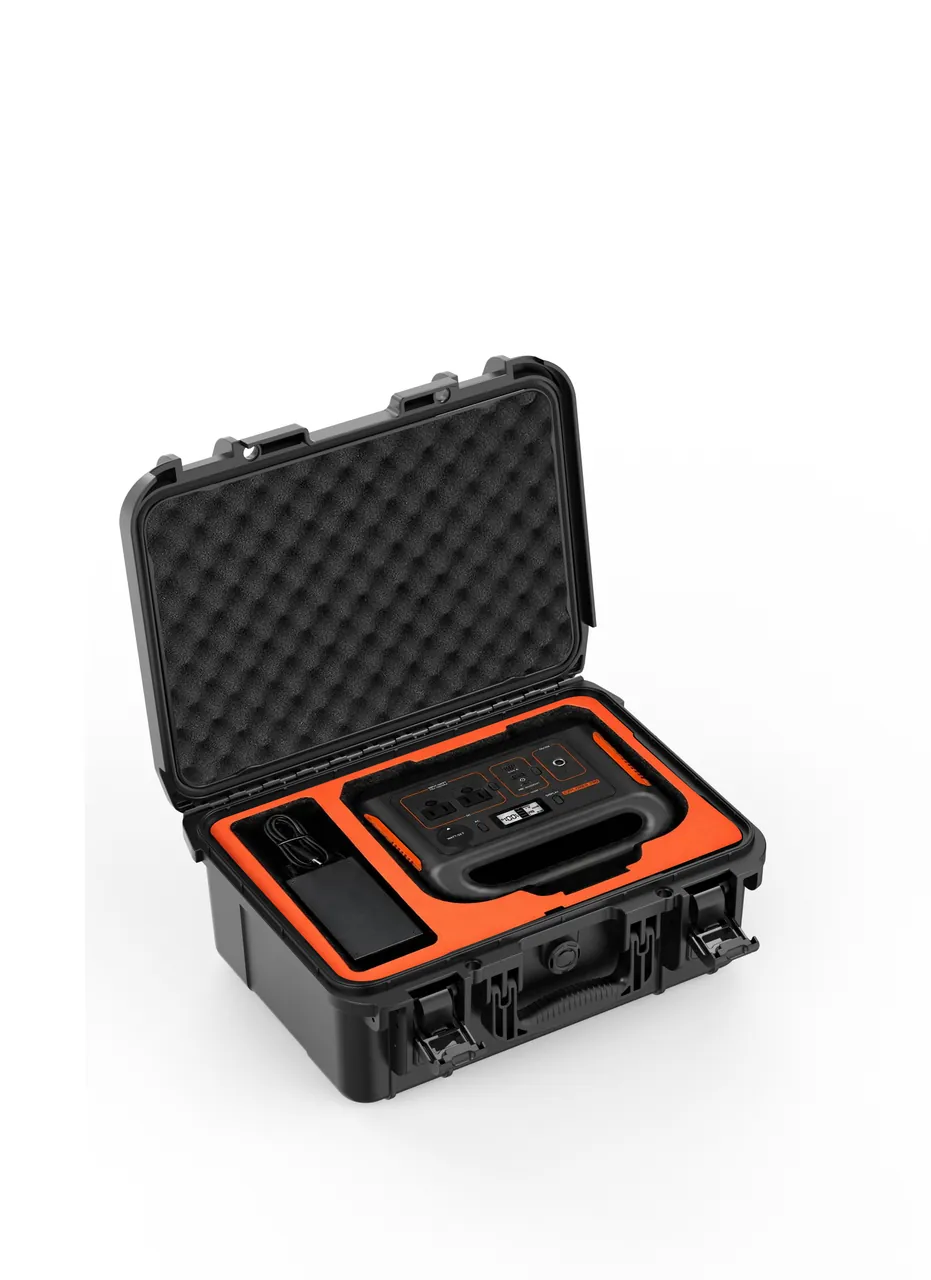
The liner is the technical core of a jewelry equipment case. The four mainstream materials trade off as follows.
| Material | Typical density | Resilience and cushioning | Processing | Best fit | Cautions |
|---|---|---|---|---|---|
| --- | --- | --- | --- | --- | --- |
| EVA | 25-45 D | Good rebound, resists repeated compression | CNC cutting, heat forming | Small and mid-size equipment, micro-tool dividers | Swells with prolonged mineral oil contact |
| PE | 30-90 kg/m3 | Hard, minimal deformation | CNC cutting | Heavy parts, cavities that must hold shape long term | Weaker cushioning than EVA; pair with a base skid |
| PU | 15-30 kg/m3 | Soft, good vibration absorption | Die cutting, lamination | Brittle parts, optics, scratch-prone surfaces | Open-cell structure traps dust; needs sealing |
| XPE / IXPE | 25-40 kg/m3 | Uniform density, closed cell | Die cutting, lamination | Large-area padding, lid-side cushioning | Limited cushioning per single layer |
Divider system design principles:
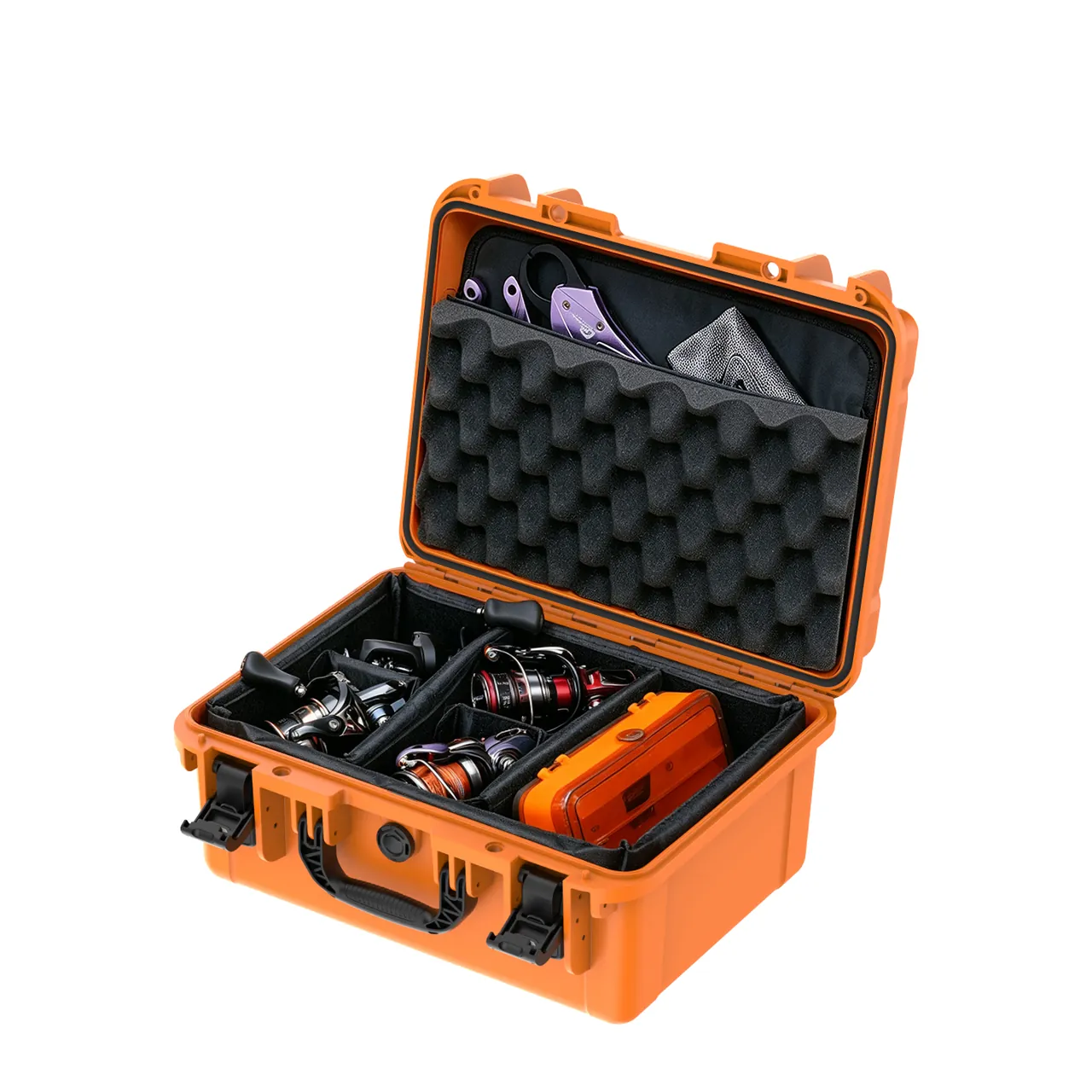
- One compartment per item, with 1 mm to 2 mm clearance, or 0.5 mm for micro-tools.
- Keep 8 mm to 15 mm of material between adjacent compartments to prevent vibration coupling.
- For high-vibration equipment such as polishers and ultrasonic units, add a dedicated 5 mm to 10 mm cushion layer under the compartment.
- Add a compression feature on the lid side, such as a soft pad or corrugated XPE, to suppress vertical bounce.
For a quantitative comparison and a selection decision tree, see case foam material comparison.
10. Seals, Pressure Equalization and Latches: Matching IP Rating to Transport Reality
The sealing system has three parts: the gasket, the latches and the pressure equalization valve. All three are required and each depends on the others.
Gaskets are commonly EPDM, silicone or TPE. EPDM has the best weathering resistance and suits sea freight and outdoor storage. Silicone covers a wider temperature range at higher cost. TPE sits in between. Target a compression set between 25 and 35 percent; below that the seal leaks, above it permanent deformation accelerates.
Latches are what generate sealing pressure. Plastic cases generally use draw latches, which should maintain uniform linear pressure when closed. Latch fatigue life directly determines how long sealing performance is retained. For latch and hinge selection detail, see toolbox hinge latch and seal structure.
The pressure equalization valve is mandatory on a sealed case. In air freight or under sharp temperature swings, the pressure differential across a fully sealed case can reach 20 kPa to 40 kPa, making the lid hard to open or even rolling the gasket outward. Case pressure equalization valve explains the mechanics: a compliant valve breathes once differential pressure crosses a threshold while retaining the water and dust resistance the IP rating requires.
The IP mapping needs to be stated precisely: IP65 means dust level 6 plus water level 5, protection against water jets. IP67 means dust level 6 plus water level 7, protection against short-term immersion. Dust performance is identical; the only difference is water. Jewelry workshops are mostly dry indoor environments, but the transport leg may encounter rain or open-air port storage, so export orders generally justify going straight to IP67.
11. Standards Cross-Reference: From IEC 60529 to ISTA and ASTM D4169
Citing standards in a procurement technical agreement is how a protection requirement becomes an auditable acceptance clause. The table below maps common standards to jewelry equipment case requirements.
| Standard | Scope | Application to jewelry equipment cases |
|---|---|---|
| --- | --- | --- |
| IEC 60529 / GB/T 4208 | Enclosure ingress protection, IP code | Defines IP65 and IP67 dust and water ratings and test methods |
| MIL-STD-810H | Environmental test methods, non-military | Used as a methods reference for vibration, shock, temperature and salt fog; it is a test-method reference only and does not constitute military certification |
| ISTA 2A / 3A | Packaged-product and LTL transport testing | Validates vibration and drop performance for single-case shipments |
| ASTM D4169 | Performance testing of shipping containers | Sets test intensity from distribution cycle and assurance level |
| GB/T 4857 series | Basic tests for transport packages | Drop, stack and vibration basis for domestic routes |
| UL94 | Flammability of plastic materials | Flammability rating for liner and shell materials, commonly HB, V-2 or V-0 |
| IEC 62262, IK code | Degree of protection against mechanical impact | Expresses external impact resistance, for example IK08 or IK10 |
An important warning: MIL-STD-810H is a test method standard, not a product certification standard. Saying a case "uses MIL-STD-810H test methods" is accurate. Saying a case is "MIL-STD-810H certified" is not. Technical agreements should make that distinction explicit.
The relationship between ISTA and ASTM D4169 is also frequently confused. ISTA leans toward concrete, directly executable procedures such as ISTA 2A, 3A and 3E, while ASTM D4169 provides a framework for designing a test plan around a distribution cycle. Export orders most often cite ISTA 3A. See ISTA transport testing procedure for the flow.
12. Selection Workflow, Acceptance Points and AQL Sampling
Six steps turn a requirement into an order:
- Inventory. List every piece of equipment with dimensions, weight, center of gravity, and whether it contains liquid, magnetic or optical components.
- Risk ranking. Sort by value multiplied by fragility to decide which items need dedicated compartments and which can share.
- Rating definition. Set IP, IK and flammability requirements from the transport route.
- Liner plan. Material, density, compartment layout, buffer thickness.
- Test requirements. Drop height, vibration spectrum, stacking load, temperature and humidity cycling.
- Acceptance rules. Appearance, dimensions, sealing, liner fit, marking, and sampling ratio.
Among acceptance points, sealing is the one most often reduced to a formality. Two field checks are useful: close the empty case and immerse it for 5 minutes, watching for continuous bubbles, or pressurize the interior to 20 kPa and observe the decay rate. Both are qualitative and cannot replace laboratory IP testing, but they screen out obvious defects.
For sampling, reference the AQL system: critical defects such as seal failure or latch breakage typically take AQL 0.65 or tighter, while major defects such as liner fit deviation or cosmetic flaws take AQL 1.5 or 2.5. See custom case acceptance and AQL.
13. Volume Supply and OEM/ODM Collaboration Models
There are generally three procurement models for jewelry equipment cases:
- Standard case plus custom liner. Shortest lead time and lowest cost, suited to packing one or two equipment types. Tooling is limited to a CNC program or a die-cutting rule.
- Modified case, semi-custom. Adjust latches, hinges, casters and nameplate provisions on an existing case size. Balances cost against differentiation and suits private-label programs.
- Full new tooling. For cases with specific brand identity requirements or equipment that exceeds standard case sizes. Mold cost and MOQ need separate calculation; see custom case mold cost analysis for the payback logic.
JUNZHJIA, manufactured by Kexin New Materials (Guangdong) Co., Ltd., serves B2B customers with wholesale, distribution, OEM/ODM and global supply. In the jewelry equipment vertical, typical capabilities include reverse-modeling liners from 3D scan data of the equipment, matching gaskets and pressure equalization valves to the case model, issuing test reports or third-party inspection documents to a customer-specified standard, and scheduling small-batch repeat orders. For workshops that iterate equipment models frequently, this matters more than unit price, because the liner drawing can be updated alongside the equipment revision without new tooling.
When evaluating suppliers, see how to choose a case OEM factory and focus on liner engineering capability, test resources and delivery stability rather than shell price alone.
Frequently Asked Questions
Q: Does a jewelry equipment case have to be IP67, or is IP65 enough? A: It depends entirely on the transport route, so there is no universal answer. IP65 combines dust level 6 with water level 5, meaning protection against water jets, while IP67 combines dust level 6 with water level 7, meaning short-term immersion. Dust performance is identical and the only difference is water. If the equipment travels entirely by road inside a covered vehicle and is never stored in the open, IP65 is sufficient and costs less. Export orders, multimodal transport, port transshipment and long-haul routes in the rainy season justify going straight to IP67, because standing water on a container floor and deck spray during loading are real, documented conditions. One often-missed point is that the IP67 immersion test has both a depth and a duration limit, typically 1 m for 30 minutes, so it must not be read as "can be submerged indefinitely." Write the worst realistic case into the technical agreement instead of a generic claim of water resistance. Also note that higher sealing levels raise cost and make the case harder to open, which can be inconvenient for repair workflows that need frequent access.
Q: Should the vacuum pump of a vacuum casting machine be boxed separately? A: Yes, strongly recommended, for two reasons. The first is oil back-fill risk. If a vacuum pump tips or sits at a steep angle for a long time during transport, pump oil travels down the line into the chamber, and cleanup is extremely difficult and can scrap the chamber and valve assembly. The second is weight and center of gravity. A vacuum pump is usually the densest component of the whole machine, and boxing it with the main unit shifts the center of gravity badly, which makes the case unstable to carry. Once separated, keep the pump in its factory orientation, mark the level position, and cap all ports. An EVA 30D liner with an absorbent pad underneath is a sensible choice so that any seepage stays local. On the main unit side, cap the chamber opening with a dedicated plug and protect the seal face, meaning the O-ring groove, with a sleeve. If a customer insists on single-case packing, at minimum the pump must be held by its own bracket that is rigidly connected to the case floor.
Q: What special requirements does polishing dust place on a case? A: Polishing dust runs mostly from 1 to 50 microns and contains polishing wax, chromium oxide, diamond powder and trace gold, silver and platinum particles. It threatens the case on three levels. First, ingress: under long exposure ordinary gaskets cannot fully block it, so at least level 6 dust protection per GB/T 4208 is advisable. Second, retention: open-cell foam absorbs dust like a sponge, cannot be cleaned, and creates cross-contamination, so specify closed-cell EVA or PE, or PU that has been surface-sealed. Third, recoverability: precious-metal dust has real recovery value, and a removable dust tray at the bottom plus one-piece liner cutting that reduces seams both raise recovery rates and simplify cleaning. Wax-bearing dust can also soften and adhere in summer heat, so a low-surface-energy finish on the liner helps wet-wipe cleaning. It is worth restating that a protective case is not a dust extraction or recovery device. What it can realistically do is cut airborne dispersion and cross-contamination between shipments.
Q: How should temperature be managed when shipping wax patterns and rubber molds? A: Start by accepting the boundary condition: a standard protective case is not a refrigerator and not an incubator. It can only slow the rate of temperature change; it cannot actively hold a set point. Within the case, three measures are practical. First, add a low-conductivity barrier between the liner and the shell, or reserve a dedicated bay for a phase-change cold or heat pack, which reduces the amplitude and rate of the swing. Second, constrain position rigidly, giving each wax pattern and mold its own compartment, because deformation from stacking pressure is usually more damaging than temperature itself; a 0.5 mm to 1 mm gap is right, and an oversized gap lets items knock against each other under vibration. Third, apply an irreversible temperature label on the outside, typically at 40 C, 50 C and 60 C, so the receiver can immediately see whether the shipment exceeded limits. As a rule of thumb, casting wax softens between 55 C and 75 C, but thin-wall geometry can develop an invisible ovality deviation above a sustained 35 C with light stacking pressure, which makes a short summer sample shipment a higher-risk scenario than it appears.
Q: What matters most when packing a jewelry laser welder? A: The key is managing the conflicting needs of the optical system and the power and cooling system. The optical resonator, fiber assembly and galvo head fear vibration, dust and condensation: a micron-scale mirror shift forces a full realignment, and a contaminated fiber end face can burn out outright. So keep the unit in its factory orientation, never store it inverted, cap optical windows, and choose low-outgassing, silicone-free liner materials so volatile organics do not deposit a film on the optics. The power supply and chiller, by contrast, fear liquid and corrosion: drain the chiller coolant and cap the line ports, and bag the power module with desiccant. A practical layout is to build both as separate compartments inside one case with a divider between them, which shares the shell strength while keeping power-bay humidity out of the optics bay. In custom liner projects JUNZHJIA often positions that divider by the equipment center of gravity rather than the geometric center, balancing protection against carry ergonomics.
Q: Do anti-magnetic and ESD measures genuinely affect jewelry production? A: Yes, and they are overlooked far more often than they should be. On the magnetic side, several jewelry process steps rely on magnetic methods, including incoming sorting of iron-bearing findings and inspection of magnetic materials, and precious-metal balances and precision weighing modules are sensitive to residual magnetism. If strong magnets sit near the case, such as magnetic polishing media, magnetic fixtures or speaker-type components, they can cause measurement interference or even magnetize workpieces. The countermeasure is to partition the interior into a magnetic zone and a non-magnetic zone with at least 150 mm of separation, and where genuinely needed, embed a high-permeability shield layer in the liner, accepting the added weight and cost. On the static side, plastic shells and foam liners generate thousands of volts during friction and separation, attracting dust and potentially damaging the CMOS devices in a temperature controller or a sensor signal-conditioning circuit. For stable long-term ESD performance, specify a modified liner material with conductive carbon black or anti-static masterbatch, targeting surface resistance between 10^6 and 10^9 ohms, rather than relying on a sprayed coating that wears off with wiping.
Q: How do you verify case sealing, and what can be checked on site? A: Two qualitative checks are practical on site. The first is immersion: close the empty case, submerge it for 5 minutes, and watch for continuous bubbles at seams and latch points. An occasional single bubble may just be trapped air, but a continuous bubble stream indicates seal failure. The second is differential pressure: pressurize the interior to 20 kPa through the equalization valve or a dedicated port and record the decay rate. Rapid decay points to insufficient gasket compression or a local gap. Three supporting checks are also useful: visually inspect the gasket for twisting, nicks or uneven compression marks; verify latch pressure uniformity by checking seam gaps at multiple points around the perimeter with a feeler gauge; and confirm the pressure equalization valve breathes freely, because a blocked valve makes the lid very hard to open after a temperature swing. It must be emphasized that these field methods only screen out obvious defects and cannot replace laboratory IP testing. Formal acceptance should cite the test methods in IEC 60529 or GB/T 4208 and apply an AQL sampling plan.
Q: What pre-packing steps are required for equipment that retains liquid, such as polishers and cleaners? A: Residual liquid is the most common self-inflicted failure in transport protection and must be handled systematically. Barrel polishers must be fully drained of polishing compound, steel media and workpieces, then rinsed with clean water and air-dried, or residual liquid will seep during transit, corrode the liner and contaminate other equipment in the same case. Ultrasonic cleaners must be drained and tilted to stand for at least 30 minutes to confirm no droplets remain; transducer lead terminals that absorb moisture suffer reduced insulation resistance and can break down, and the generator should be sealed separately in a moisture-barrier bag with desiccant before packing. Steam cleaners retain even more vapor, so lines and nozzles must be blown out with compressed air. Laser welders require the chiller coolant to be drained and the line ports capped. For all of them, place adequate desiccant inside the case, using the working ratio of 100 g of silica gel per 50 L of internal volume, adjusted for route and climate. Desiccant must be bagged in a breathable pouch, fixed in a liner recess, and kept away from direct contact with metal parts to avoid powder contamination.
Q: Is small-batch custom liner work expensive, and what company size does it suit? A: It is not expensive when the right path is chosen. Liner customization generally involves one of two investment models. The first is CNC cutting or die cutting, which needs only a drawing and a program with no steel mold, and suits runs of tens to hundreds of units where equipment models may still iterate. The second is heat-formed tooling, which carries a mold cost and suits larger volumes, complex geometry and stable long-term models. For most jewelry workshops and repair chains, standard case plus custom liner is the best value combination: the outer case uses a mature standard size with low amortized cost and short lead time, while the liner is reverse-modeled from the actual equipment geometry to hold fit tolerance. The case that genuinely needs cost evaluation is full new tooling, meaning equipment that exceeds standard case sizes or a program with specific brand identity requirements. There, amortize the mold cost over an assumed three-year volume before comparing, rather than looking only at the first order price. JUNZHJIA supports liner modeling from 3D scan data of the equipment, and small-batch repeat orders do not require new tooling investment.
Conclusion & Related Reading
A jewelry making equipment case is fundamentally an interface engineering problem for high-value, small-volume, high-precision equipment. The chamber seal face of a casting machine, the bearing preload of a polisher, the optical path of a laser resonator and the dimensional stability of a wax pattern will not improve because the shell is thicker. They improve because the clearance between liner and equipment, the buffer thickness, the humidity control and the zoning logic were designed deliberately. The practical order of work is: build the equipment inventory and risk ranking first, then fix the IP, IK and flammability ratings, then develop the liner plan, and finally write the test and acceptance rules into the technical agreement. Doing those four steps properly lowers both the transport claim rate and the rework rate at installation.
JUNZHJIA, manufactured by Kexin New Materials (Guangdong) Co., Ltd., supplies protective cases, tool cases and equipment cases to B2B customers worldwide through wholesale, distribution and OEM/ODM programs. To have a liner plan and protection rating assessed for a specific equipment model, send the equipment list and transport route and we will return structural recommendations with a document checklist.
Related Reading