

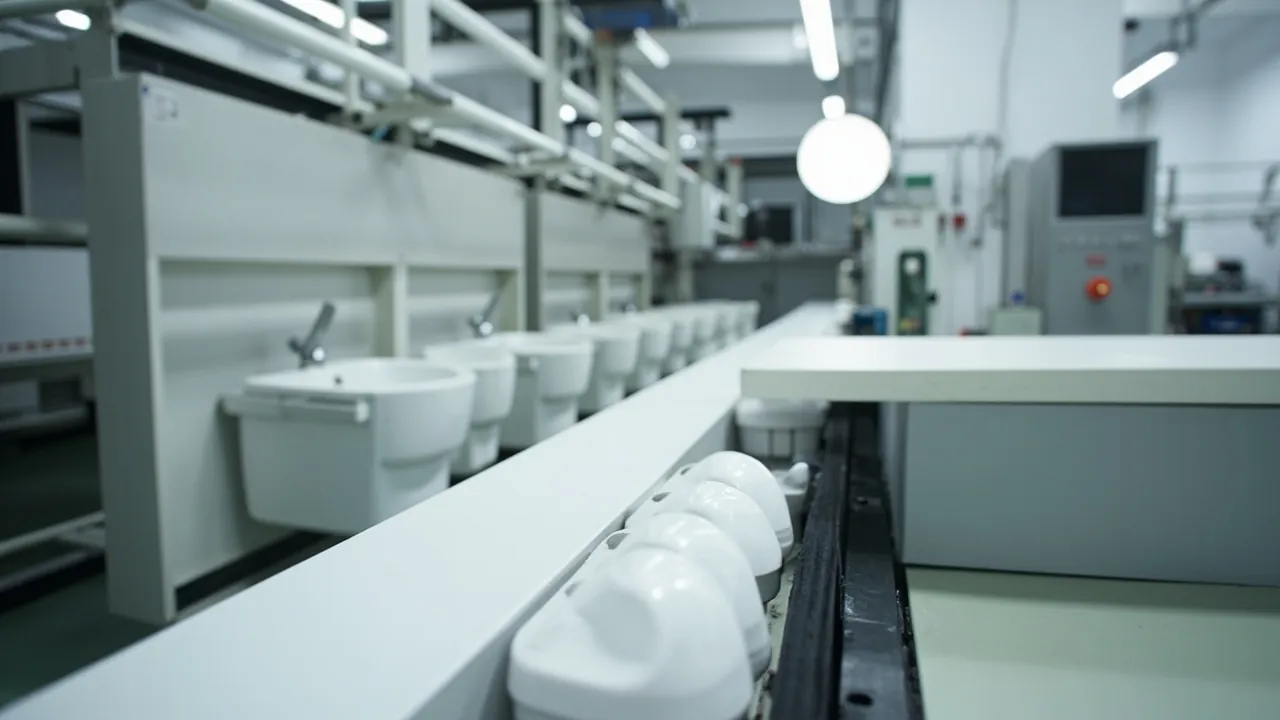
Forming equipment and glazing-line equipment in a sanitaryware plant operate under a triple burden: high precision, high humidity and heavy glaze mist. They must be moved and stored in purpose-built transport cases with moisture-resistant sealing and custom interior inserts, so that vibration, humidity and glaze dust are all held back during transfer, installation, line modification and spare-part circulation. The sanitaryware industry differs fundamentally from general machinery in one respect: the production environment is itself wet. Slip casting needs water, glazing generates airborne glaze mist, and drying and firing zones create temperature gradients. Equipment that has spent years in that atmosphere, once dismantled for transport, combines residual moisture with ambient humidity to create a saturated micro-climate inside the case — corroding guideways, dampening servo drives and emulsifying precision bearings.
The practical pain points cluster tightly. Moulds and mould frames removed from high-pressure casting machines can weigh several hundred kilograms and are often secured with nothing more than stretch film on a timber pallet; after a long road journey the parting faces show impact damage and the sealing strips are crushed flat. The arm and wrist assemblies of glazing robots are precision motion components, and without rigid support a gearbox output shaft can be knocked off-centre. Conveyor chains, pallets and position sensors that have worked for years in glaze mist carry a coating of glaze powder; packing them without cleaning turns that coating into an abrasive paste that slowly scores guideway surfaces. Sanitaryware plants exporting to Southeast Asia or the Middle East open containers to find condensation already formed inside.
This article breaks the protection logic down in the order of forming equipment, glazing-line equipment and electrical control components, then sets out executable schemes for moisture, glaze mist and vibration. It includes material selection tables, a method for judging sealing class, and acceptance criteria. JUNZHJIA serves sanitaryware equipment manufacturers and end-user plants with insert customisation, sealing scheme design and OEM/ODM volume delivery, manufactured and shipped worldwide by Kexin New Materials (Guangdong) Co., Ltd.
Table of Contents
- 1. Why Sanitaryware Equipment Needs Purpose-Built Transport Cases
- 2. Equipment Composition and Logistics Risk Profile
- 3. Protecting Forming Equipment: Casting Machines, Lines and Moulds
- 4. Protecting Glazing Equipment: Robots, Booths and Conveyor Parts
- 5. Moisture Control Comes First: Humidity, Condensation and Desiccant
- 6. Glaze Mist and Dust: Applying IEC 60529 and GB/T 4208
- 7. Custom Inserts: Fixing Irregular Structures and Precision Guideways
- 8. Electrical Components: Servos, PLCs, Sensors and ESD
- 9. Case Structure, Materials and Gasket Selection
- 10. Transport Testing and Export Compliance: ISTA, GB/T 4857, ASTM D4169
- 11. Handling, Circulation and Line Modification Scenarios
- 12. Marking, Spare Traceability and Consumable Management
- 13. Procurement Acceptance and Volume Delivery Management
- 14. Specification Selection Table and Custom Delivery Capability
- Frequently Asked Questions
- Conclusion & Related Reading
1. Why Sanitaryware Equipment Needs Purpose-Built Transport Cases
Capital intensity in sanitaryware is high. A complete high-pressure casting line, glazing line and firing kiln typically represents an investment in the tens of millions of yuan, and the key components within it — casting moulds, glazing robots, glaze pumps and glaze circuit systems, conveying and positioning mechanisms — are individually expensive with long lead times. Damage in transit costs far more than the repair: it costs line commissioning or restart time.
The value of a purpose-built transport case shows up in three specific situations. First, new line installation: equipment travels from the manufacturer to the sanitaryware plant, often across provinces or continents, encountering road vibration, port handling, container stacking and severe temperature and humidity swings. Second, line modification: sanitaryware products iterate quickly, from conventional closets to smart toilets and from standard glaze to antibacterial glaze, so lines are rebuilt frequently and equipment migrates between sites or workshops. Third, spare-part circulation: moulds, robot wrist assemblies, glaze pumps and sensors are high-frequency replacement items that shuttle between central and satellite warehouses.
All three situations demand the same outcome: usable immediately on opening. Once a motion component needs re-alignment, recalibration or bearing replacement, the maintenance window stretches from hours to days. The design objective of a protective case is therefore not simply to "contain" the part, but to hold its position, attitude, cleanliness and moisture state unchanged throughout the journey. That premise underlies every recommendation in this article.
One further point deserves emphasis. The sanitaryware workshop environment is inherently damp, with standing water on floors and persistent mist around the glazing area. A transport case that is not water and moisture resistant will absorb moisture even during short in-plant moves, simply by standing on a wet floor. Sealing class in sanitaryware must therefore be stricter than in general machinery — this is not over-design, it is alignment with the actual service environment.
2. Equipment Composition and Logistics Risk Profile
Understanding risk starts with the equipment map. A sanitaryware line has four main lines: forming, drying, glazing and firing. Transport protection focuses on the removable components of the first three.
| Process stage | Typical equipment or parts | Main risk | Protection focus |
|---|---|---|---|
| --- | --- | --- | --- |
| Forming | High-pressure casting moulds, frames, casting line fixtures | Heavy impact, parting-face damage | Hard support, working face unsupported |
| Forming | Gypsum and resin moulds, vacuum suction cup assemblies | Moisture softening, deformation, loss of suction | Moisture sealing, shape support |
| Glazing | Glazing robots, wrist gearboxes, arm bodies | Impact-induced eccentricity in precision parts | Rigid location, damping and absorption |
| Glazing | Glaze pumps, glaze circuit piping, nozzle assemblies | Cured glaze residue, blockage | Clean before packing, protect ports |
| Glazing | Conveyor chains, pallets, position sensors | Glaze powder abrasion, guideway scoring | Dust sealing, cleanable inserts |
| Electrical | Servo drives, PLCs, inverters, sensors | Moisture, insulation loss, static discharge | IP67, ESD protection, desiccant |
Four stress classes dominate. Vibration and shock arise from road transport and handling, and are most damaging to precision motion parts. Humidity and condensation arise from environment and sea freight, and are the leading risk that distinguishes sanitaryware from other industries. Glaze mist and dust form a combined contaminant that is both abrasive and chemically active, since glazes often contain alkaline constituents. Temperature gradients arise from storage near the firing zone and from transport between northern and southern regions.
One phenomenon deserves separate mention. Glaze mist contains large quantities of sub-micron particles with a degree of tackiness. Once these enter a case and settle onto a guideway or ball screw, they combine with lubricating oil into a paste whose wear efficiency far exceeds ordinary sand dust. At the same time, the alkaline constituents of glaze corrode aluminium components and accelerate corrosion on untreated steel. A sanitaryware parts case must therefore solve both problems at once: keeping contamination out, and making what does get in easy to remove.
3. Protecting Forming Equipment: Casting Machines, Lines and Moulds
Removable components in the forming stage are characterised by heavy weight and irregular shape, so the scheme revolves around load bearing, positive location and working-face protection.
High-pressure casting moulds and frames are the core consumables of the forming line. A high-pressure casting mould typically comprises an upper die, a lower die, a frame and seals. A single set can weigh several hundred kilograms, and the working faces — parting faces and cavity faces — are both precision features and sealing features. The core requirement is that working faces carry no load, contact no hard object, and are never compressed by case deformation. The recommended approach is a contoured support insert where the frame's rigid sections carry the load and the working faces remain unsupported; a soft contact layer against the parting face; and a reinforced case base to take concentrated loads.
Casting line fixtures and positioning mechanisms are medium-sized structural items with irregular shapes, locating pins and precision-machined bores. Locating pins need protective sleeves, and machined bores need soft plugs to keep dust out. These items are best arranged in layers with vertical restraint so they cannot strike each other in transit.
Gypsum and resin moulds are both common and awkward. Gypsum loses strength and changes dimension once it absorbs moisture; resin moulds take permanent set under sustained compression. Both need excellent moisture sealing and shape support. The recommendation is a dedicated compartment, low-rebound support, and desiccant with a humidity indicator card inside the case. They should not share a case with metal components, whose condensation can affect the moulds.
Vacuum suction cups and pneumatic assemblies contain rubber parts and precision air passages, and are vulnerable to moisture ageing, dust blockage and compression set. Cup components need shape-retaining support, pneumatic ports need dust caps, and rubber parts should not be stored under sustained compression.
Rule of thumb: in sanitaryware practice, transit rework on forming moulds concentrates in two categories — parting-face impact damage and working-face corrosion — and both are substantially reduced by the simple combination of an unsupported working face and moisture-tight sealing.
There is also a management recommendation for forming equipment: map each mould to a specific case and insert. When the product changes over, mould check-in and check-out become considerably faster while the risk of mis-pairing and impact damage falls. JUNZHJIA develops contoured inserts from actual mould dimensions and weight, and can support several interchangeable inserts on one case platform — well suited to sanitaryware plants with many product models and frequent changeovers.
4. Protecting Glazing Equipment: Robots, Booths and Conveyor Parts
The glazing line combines the heaviest contamination with high precision requirements, making equipment protection harder than on the forming line.
Glazing robots are the key to uniform glaze application. Their wrist assemblies contain precision gearboxes, servo motors and joint bearings, with repeat positioning accuracy typically at the 0.1 mm level or better. The transport requirement is unambiguous: rigid support, no cantilever loading, and no shock load transmitted to the gearbox output shaft. The recommended approach is a support fixture built to the robot's actual attitude, holding the arm in a fixed posture in transit; temporary limit blocks or support blocks at the joints; and axial and radial protection for the gearbox output shaft.
Glaze booths and spray chamber components include spray guns, glaze circuit piping, pressure regulating valves and filters. The main problem is glaze residue. Once dried, glaze forms a hard deposit inside pipes and nozzles, blocking passages and resisting removal. The correct procedure is to dismantle, clean thoroughly, blow dry and then pack; to give guns and nozzles their own soft cavities; and to fit blind plates or dust caps to pipe connections. Where thorough cleaning is impossible, record the residual condition before packing and design a liquid barrier into the case so that residual glaze cannot leak onto other components.
Conveyor chains, pallets and position sensors work continuously in glaze mist and carry a glaze powder coating. Two things matter: cleaning before packing, so that abrasive paste is not sealed in with the part, and sealing sufficient to prevent recontamination in transit. Photoelectric and proximity sensors have sensitive faces that must not be scratched or contaminated, so they need dedicated cavities with soft protection.
| Glazing component | Main contamination or damage | Pre-packing treatment | In-case protection |
|---|---|---|---|
| --- | --- | --- | --- |
| Glazing robot | Joint impact, gearbox eccentricity | Clean, fit temporary supports | Attitude-fixing fixture |
| Spray guns and nozzles | Glaze blockage, orifice damage | Full clean and blow dry | Dedicated soft cavities |
| Glaze piping and valves | Deposit blockage, port damage | Clean, plug ports | Blind plates, leakage barrier |
| Conveyor chains and pallets | Glaze powder abrasion, chain wear | Clean and lubricate | Dust sealing, separate compartment |
| Position sensors | Sensitive-face contamination and scratching | Wipe clean | Soft cavity, ESD safe |
One frequently overlooked need on the glazing line is that the temporary supports and limit blocks themselves need a home. If the transport support blocks, limit pins and fastening fixtures cannot be found at the installation site, the robot cannot be correctly restored. A dedicated tool compartment inside the case, holding these accessories alongside the component and labelled on the insert, markedly reduces on-site waiting time.
5. Moisture Control Comes First: Humidity, Condensation and Desiccant
If only one performance parameter could be chosen for a sanitaryware parts case, it should be moisture resistance. Sanitaryware equipment both operates in a damp environment and ships during humid seasons, and its components include many humidity-sensitive electrical items and hygroscopic materials.
The physics of condensation is worth stating clearly. Air inside a case holds water vapour; as temperature falls, the saturation capacity of air drops and the excess condenses as liquid water. For every 10 °C drop in temperature, saturation capacity falls by roughly one third to one half. A drop from 35 °C by day to 20 °C at night therefore drives relative humidity sharply upward; if the case is not well sealed, external moisture continues to enter and condensation becomes inevitable.
Three routes to control condensation:
- Reduce ingress: raise the sealing class. Where rain, washdown or immersion is possible, choose IP65 or better, and IP67 for immersion scenarios. The principles are set out in Waterproof cases and IP ratings explained.
- Reduce the reservoir: dry the component and insert thoroughly before packing, avoid packing during rain or peak humidity, and place desiccant with a humidity indicator card inside the case.
- Breathe without letting water in: for high-differential transport, fit a pressure equalisation valve so that differential pressure equalises slowly through a breathable membrane while liquid water and dust are blocked. See How a case pressure equalisation valve works.
Desiccant quantity has no universal formula. It is estimated from free air volume inside the case, transit duration, sealing class and destination humidity. Accepted engineering practice is to set an initial quantity from experience, then verify with a humidity indicator card after a real shipment and increase the quantity if the card changes further than expected. This is more reliable than a one-off calculation, because actual transport conditions cannot be predicted precisely.
Gasket material matters just as much. For rain and washdown, EPDM or silicone is preferred; for extreme or low temperature scenarios, choose a compound with better cold performance so the gasket does not harden and lose elasticity. Material comparisons are available in Choosing seal materials for protective cases.
One caution: sealing and breathing are in tension. Perfect sealing keeps water out but creates differential pressure; free breathing equalises pressure but admits moisture. The resolution is a pressure equalisation valve with a hydrophobic breathable membrane, achieving air permeability without water permeability. This is particularly worth considering for sanitaryware equipment export by sea.
6. Glaze Mist and Dust: Applying IEC 60529 and GB/T 4208
The glaze mist environment translates directly into an ingress protection requirement. In IEC 60529 and its Chinese equivalent GB/T 4208, dust protection is defined at level 5 (dust protected, limited ingress permitted) and level 6 (dust tight, no ingress). Glaze mist particles are fine, tacky and alkaline, so IP6X is the correct choice rather than IP5X.
Three high-frequency misconceptions should be cleared up:
- The two digits mean different things: the first covers solid foreign objects, the second covers water. IP65 means dust level 6 plus water level 5 (jetting); IP67 means dust level 6 plus water level 7 (temporary immersion). Dust performance is identical; only water differs.
- IP6X is not waterproof: if a case will stand on a wet sanitaryware workshop floor or may be washed down, the second digit matters. For sanitaryware, IP65 is a sensible floor.
- A rating describes the as-delivered condition: gaskets degrade with open/close cycles, ageing and contamination. Sustained performance requires a seal structure that is cleanable and replaceable.
Sanitaryware has one further peculiarity: the tackiness of glaze particles makes them stick to the sealing face. Unlike ordinary sand dust, glaze powder does not readily fall away once attached, and each closure presses it into the sealing surface. Beyond specifying a cleanable seal channel, the operator should brush or wipe the channel and gasket before each closure. This small action determines whether the case still holds IP6X in its second and third year. Structural design points are covered in Toolbox hinges, latches and sealing structure.
For cases containing electronic components, static should also be considered. Dry dust in a glaze mist environment readily generates static through friction, and where the contents are ESD-sensitive items such as servo drives or sensors, an antistatic insert material is advisable to prevent electrostatic discharge damage. See ESD shielding case solutions.
7. Custom Inserts: Fixing Irregular Structures and Precision Guideways
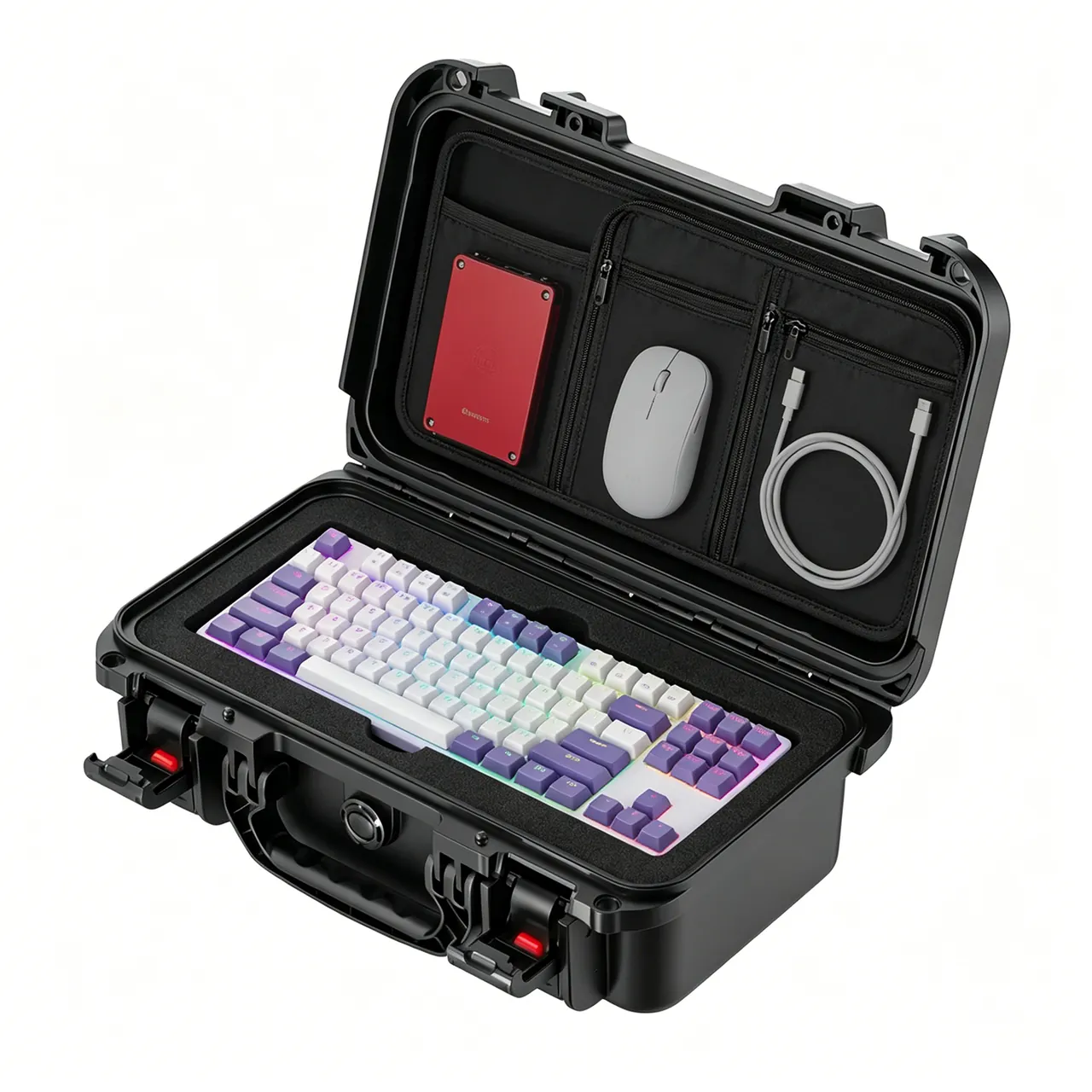
Sanitaryware components are highly irregular in shape: robot arms are slender cantilevers, mould frames are rectangular heavy items, nozzle assemblies are small precision parts, and sensors come with cables. A single generic insert cannot cover them all; each part needs its own design.
A four-step insert design method:
Step one: identify the faces that must not be loaded. Every component has faces that must be protected — parting faces, guideway faces, sensing faces, sealing faces. These must be left unsupported or touched only by soft material. Fixing this determines most of the support layout.
Step two: identify the primary load-bearing points. Choose the structurally stiffest locations, typically the casting body, a flange face or the thick-wall section of a mould frame. Bearing points should land on high-density material or hard support blocks, never on soft foam.
Step three: define the restraint directions. Analyse possible movement directions in transit and provide restraint in each. Slender cantilever parts particularly need axial and lateral restraint to avoid bending moments.
Step four: define the retrieval path. The insert must allow easy removal and replacement, especially for heavy parts. An over-tight insert makes operators pull hard, which paradoxically increases impact risk. For heavy items, design handle positions or finger clearance.
| Component type | Faces not to load | Primary bearing points | Insert strategy |
|---|---|---|---|
| --- | --- | --- | --- |
| High-pressure casting mould | Parting face, cavity face | Frame thick walls, rear face | Contoured support, working face unsupported |
| Robot arm body | Joint faces, guideway faces | Body casting flange | Attitude fixture plus lateral restraint |
| Nozzle assembly | Nozzle orifice, sealing face | Body outer diameter | Dedicated soft cavity |
| Sensors and cables | Sensing face, connectors | Housing | Dedicated cavity plus cable compartment |
| Gypsum and resin moulds | Cavity surface | Base and side walls | Low-rebound support plus moisture control |
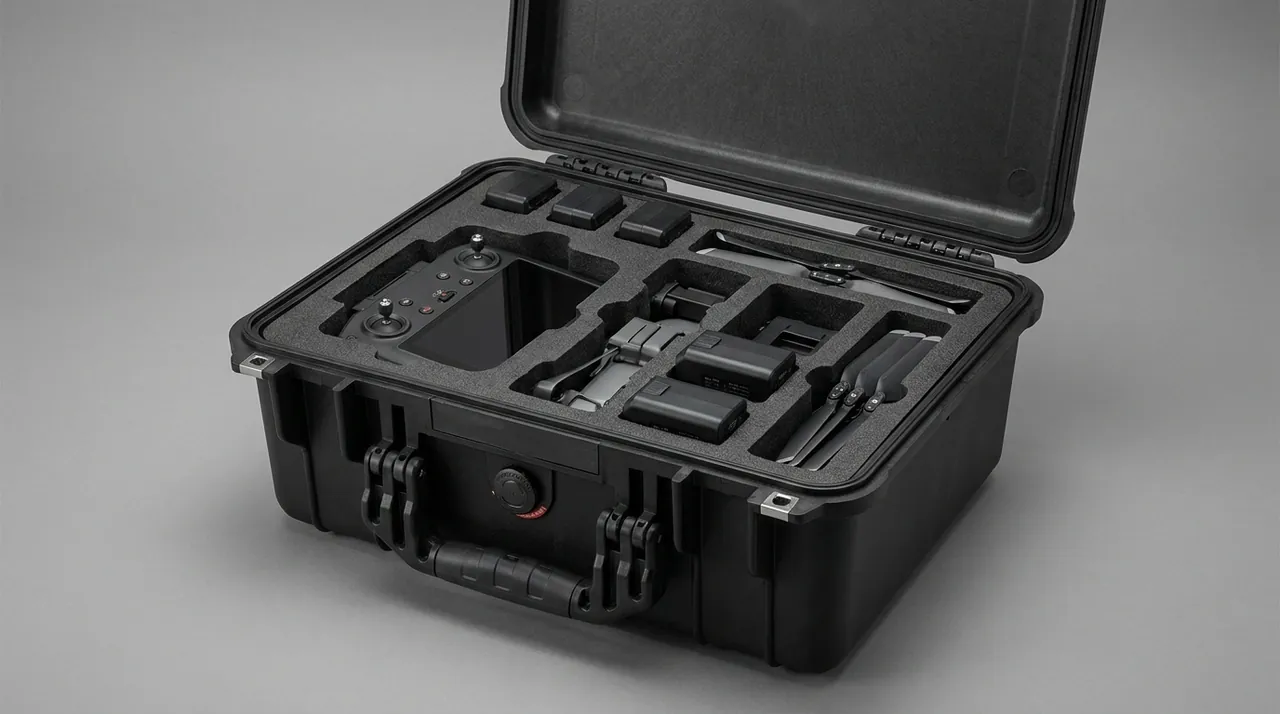
On material trade-offs, the general comparison framework applies. EVA offers high precision and a fine surface, suiting precision parts and contact layers against working faces. PE offers strong support at low cost, suiting load-bearing layers. EPP absorbs energy well and rebounds stably, suiting heavy parts and high-impact-risk items. For high-value precision components common in sanitaryware, a composite structure is recommended: a PE or EPP load-bearing outer layer, a medium-density EVA energy-absorbing core, and a soft foam or flocked contact layer. Comparisons are available in Case foam material comparison and Custom foam insert design guide.
8. Electrical Components: Servos, PLCs, Sensors and ESD
Glazing and forming lines are highly automated, so electrical control components make up a large share of spares. Their transport protection logic differs entirely from mechanical parts: the core requirements are moisture exclusion, static control and vibration-resistant connection integrity.
Servo drives and inverters contain electrolytic capacitors, power modules and circuit boards. The main risks are moisture causing insulation loss and component corrosion, and vibration loosening connectors. Recommendations: use an IP67 sealed case, include desiccant, retain original or equivalent ESD-safe cushioning packaging, and avoid sharing a case with heavy items.
PLCs and controller modules are highly static-sensitive. Antistatic insert materials are advisable, modules should remain in their original ESD bags or equivalent, and ordinary foam that readily generates static should not contact circuit boards directly. For long-term storage, include a humidity indicator card and check it periodically.
Sensors and proximity switches are small, numerous and easily lost. A multi-position insert is recommended, with each sensor in its own labelled cavity; cables stored separately with the specified winding radius; and protective caps on connectors.
Encoders and precision potentiometers sit between mechanical and electrical domains and are vulnerable to shock, moisture and axial loading. They need dedicated cavities with axial displacement limited.
A useful rule: any electrical component with meaningful unit value or safety-interlock involvement should retain its original ESD packaging and sit in its own sealed cavity. This adds a little packing labour but substantially reduces the open-the-case-and-it-is-dead rate.
For control cabinet assemblies moving between plants, a whole-case ESD design can be considered, including conductive lining, a grounding terminal and static warning marking. See ESD shielding case solutions.
9. Case Structure, Materials and Gasket Selection
The case body is the skeleton of the protection system. Three material families dominate in sanitaryware, selected by weight, size, volume and service scenario.
HDPE rotomoulded cases: seamless, impact resistant, low-temperature tolerant and available in large sizes, suiting heavy items such as forming moulds. Drawbacks are higher self-weight and relatively lower surface hardness.
PP injection-moulded cases: high dimensional accuracy, flat surfaces and excellent batch consistency, suiting medium-volume standardised delivery with easy colour and marking customisation. Drawback: large mouldings need large tooling and significant upfront investment.
Engineering-plastic composite and metal-frame cases: for very heavy items or lifting applications, usually with metal corner pieces, stiffening ribs and lifting points.
Gasket selection: EPDM offers good weathering and ageing resistance at moderate cost and is the general first choice. Silicone covers a wider temperature range, roughly −50 °C to 200 °C, suiting high-differential scenarios at higher cost. TPE has good rebound and feel for frequent opening but only moderate durability in abrasive dust. Sanitaryware should prefer EPDM or silicone, with a replaceable gasket structure.
Latches and hinges: case opening frequency is moderate in sanitaryware, but operation in damp and dusty conditions makes poor latches prone to clamping-force decay and corrosion. Choose engineering-plastic or metal-core latches, and hinges with metal cores and self-lubricating bushings. Padlock and security-seal compatibility also matters, since high-value moulds and robot components usually require issue control.
Wheels and handles: for cases that circulate frequently within a workshop, a larger wheel diameter crosses floor joints and standing water more easily; polyurethane wheels are soft and quiet while nylon wheels are hard and wear resistant. Sealed-bearing wheels suit damp floors. Selection guidance is in Case wheels and trolley handle selection.
10. Transport Testing and Export Compliance: ISTA, GB/T 4857, ASTM D4169
Sanitaryware equipment has a high export share, so packaging schemes must be validated rather than assumed. Three systems dominate, each with a different emphasis.
The ISTA series is graded by transport mode and weight: 1 Series covers individual performance tests, 2 Series partial simulation, 3 Series general simulation including temperature and humidity preconditioning, and 6 Series addresses specific carriers. For sanitaryware exports, ISTA 3A or 3E is a common reference, and humidity preconditioning matters especially here because it exposes weaknesses in moisture design. The flow is described in ISTA transport testing procedures explained.
The GB/T 4857 series is China's basic test method standard for transport packages, covering vibration, impact, stacking and drop, and is widely cited in domestic contracts. See GB/T 4857 transport packaging testing explained.
ASTM D4169 is the US transport packaging performance standard, designing test sequences by distribution cycle and assurance level, well suited to multi-modal journeys. See ASTM D4169 distribution cycle testing.
| System | Focus | Sanitaryware use case | Common procedures |
|---|---|---|---|
| --- | --- | --- | --- |
| ISTA | General simulation and parcel | Export case shipments needing humidity preconditioning | 3A, 3E, 2A |
| GB/T 4857 | Domestic road and rail | Inter-plant transfers in China | Vibration, stacking, drop series |
| ASTM D4169 | Multi-modal distribution cycles | North American export, sea-land combined transport | DC12, DC13 and similar |
Additional environmental test items: for electrical components and hygroscopic material parts in sanitaryware, damp-heat cycling, low-temperature storage and high-temperature storage should be added. Where a customer requests reference to MIL-STD-810H, it may be used as a source of environmental test methods for designing test conditions, but it must be stated clearly that this is a test-method standard and is not equivalent to military certification — no military certification claim may be made. JUNZHJIA can help customers structure the test item list, coordinate with third-party laboratories and provide inspection documents consistent with the shipped batch.
11. Handling, Circulation and Line Modification Scenarios
Case usage in a sanitaryware plant is more complex than in general machinery, because a case serves both as transport packaging and as a production-floor container.
Long-distance transport: protection takes priority, so structural strength and sealing class matter most and wheels can be sacrificed. Fixed heavy-duty cases or palletised solutions are more economical.
In-plant circulation: efficiency takes priority, so wheels, handles, ease of opening and retrieval speed dominate. The case can be somewhat lighter, but sealing cannot be abandoned, because sanitaryware workshops are damp with standing water on floors.
Line modification and equipment migration: the most typical sanitaryware scenario. Modifications are usually time-critical and equipment must be stored temporarily, so the case must both protect the equipment and allow stacking and movement in confined space. A standardised case platform with removable dividers and multiple inserts delivers one-case-many-models capability. See Removable divider system for cases and Portable transport box solutions.
The long-term value of a modular platform deserves separate emphasis. Sanitaryware products iterate quickly and moulds and tooling change frequently. Replacing packaging every time the product changes is expensive; the standard-case-plus-replaceable-insert model only replaces the insert while the case stays in service. In sanitaryware, the cost advantage typically becomes visible within two to three years.
12. Marking, Spare Traceability and Consumable Management
Sanitaryware plants face a specific spare-parts problem: equipment comes from multiple suppliers with inconsistent naming conventions, and cases are marked with supplier part numbers while maintenance staff work from equipment tag numbers. The result is a case full of parts whose installation position is unknown.
A recommended marking system:
- Permanent external marking: asset number, equipment tag number, applicable product model, case specification. Use in-mould labelling, screen printing or engraving so nothing depends on an adhesive label.
- Internal position marking: each cavity labelled with component name, part number and installation position for quick verification.
- Document pocket: holding the packing list, installation instructions, inspection report and calibration certificate.
- Status marking: distinguishing spare, awaiting inspection, calibrated and under repair.
- Traceability code: a QR or barcode linking the procurement batch to installation records so the origin of a failure can be traced.
Consumable management is a specific sanitaryware need. Spray gun nozzles, sealing strips, suction cups and sensors are high-frequency replacement items: numerous and relatively low-cost. A high-density multi-position insert holding several items per case, with position numbering, works well, and the case should be flagged as a consumables case so the warehouse can apply an appropriate stocking policy.
For high-value items such as moulds and robot components, a padlock or security seal with an issue log is advisable. Lock options are covered in Case lock customisation options.
13. Procurement Acceptance and Volume Delivery Management
When buying sanitaryware equipment cases in volume, acceptance criteria must be written into the contract.
Recommended incoming inspection items:
- Appearance and dimensions: case and insert cavity dimensions against drawing; no cracks, sinks or flash.
- Sealing performance: sampling per the agreed rating, or at minimum a full-perimeter contact check using the paper-draw method as a field indicator.
- Latches and hinges: opening force, positive engagement, fatigue sampling.
- Insert fit: trial fit with the actual part or a gauge, confirming neither interference nor excessive clearance.
- Antistatic performance where applicable: surface resistance within the specified range.
- Marking and documentation: content, position, durability and completeness.
- Load testing: sampling for static load or stacking tests, confirming no permanent deformation.
AQL sampling is the standard volume acceptance method, using lot size, inspection level and AQL value to set sample size and decision rules. For sanitaryware, a sensible allocation is a tighter AQL for critical defects such as seal failure, hinge play, insert collapse and antistatic failure, and a looser AQL for minor cosmetic defects. Methods and sampling tables are covered in Custom case acceptance and AQL sampling.
Trial fitting is the single most worthwhile investment in sanitaryware. Because component shapes are highly irregular, drawing dimensions often differ from the actual part due to casting tolerances, coating thickness and assembled geometry. A physical trial fit before volume production confirms no interference, no over-compression and smooth retrieval, and records the changes required. This step normally prevents substantial rework at the volume stage.
14. Specification Selection Table and Custom Delivery Capability
Sanitaryware component sizes vary widely. Fix the case type from the component category first, then the specification from dimensions and weight.
| Component category | Recommended case type | Insert scheme | Suggested sealing class | Suggested transport test |
|---|---|---|---|---|
| --- | --- | --- | --- | --- |
| High-pressure casting moulds and frames | Large rotomoulded heavy-duty case | Contoured support, working face unsupported | IP65 or better | ISTA 3A plus stacking |
| Gypsum and resin moulds | Medium sealed case | Low-rebound support plus desiccant | IP65, moisture critical | ISTA 2A plus damp heat |
| Glazing robot assemblies | Large custom case | Attitude-fixing fixture | IP65 | ISTA 3A plus vibration |
| Spray guns and nozzles | Small instrument case | Multi-position soft cavities | IP65 | ISTA 2A |
| Servo drives and PLCs | Medium sealed case | Antistatic insert plus desiccant | IP67 | ISTA 2A plus damp heat |
| Sensors and cables | Small instrument case | High-density positions plus cable compartment | IP67 | ISTA 2A |
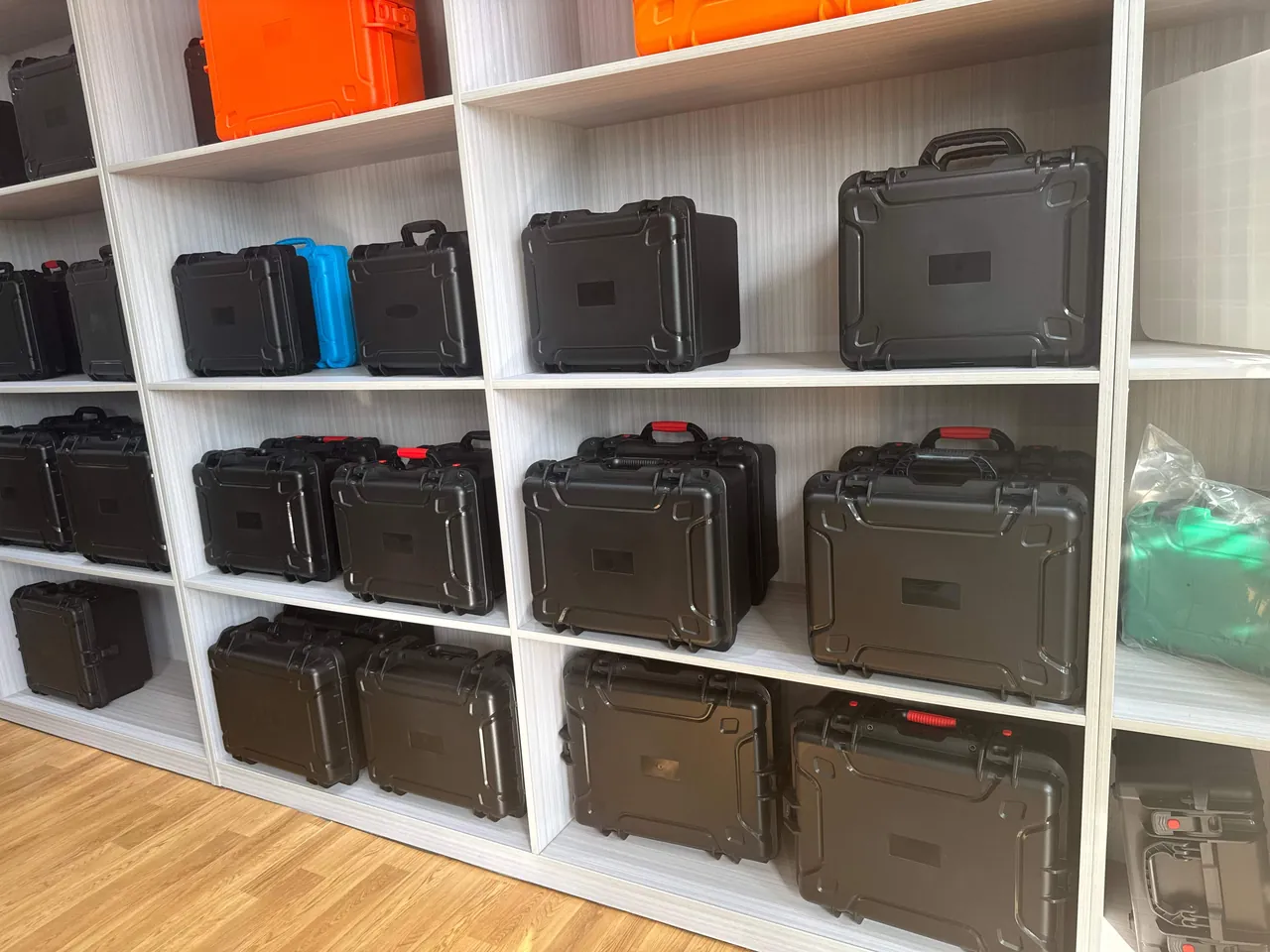
JUNZHJIA provides complete custom delivery capability across sanitaryware, ceramics and building-material equipment: insert development from drawings or physical samples, sealing class and lock schemes matched to the scenario, colour and marking customisation, and OEM/ODM manufacturing with stable volume supply. Kexin New Materials (Guangdong) Co., Ltd. operates an integrated chain from tooling development and rotational or injection moulding through insert processing and final assembly, serving sanitaryware equipment manufacturers, regional distributors and end-user plants. For first-time cooperation, a small trial batch with physical trial fitting is recommended before volume supply. Partner evaluation criteria are set out in How to choose a protective case OEM factory.
Frequently Asked Questions
Q: What is the most commonly overlooked risk when transporting a glazing-line robot?
A: Cantilever loading is the most commonly overlooked risk. In service, a glazing robot arm is supported by its base and joints, but during dismantling and transport, if the arm is secured only with stretch film or a timber frame supporting one end, it becomes a cantilever beam and transport vibration applies alternating bending moments at the joints and the gearbox output shaft. Damage of this kind is usually invisible when the case is opened and only appears after the robot is reinstalled, as reduced repeat positioning accuracy, joint noise or gearbox oil leakage, which is expensive to diagnose and repair. The correct approach is to build a support fixture matching the robot's actual attitude, with support points under and beside the arm so no joint carries a bending moment; to fit temporary limit or support blocks at the joints so they cannot rotate in transit; to protect the gearbox output shaft axially and radially; and to fix the assembly to the case base with all six degrees of freedom restrained. The temporary support blocks must also have a dedicated tool compartment in the case with position marking, otherwise installation is delayed when they cannot be found. Ask the supplier for support fixture drawings and verify them physically.
Q: For sanitaryware equipment exported by sea, where should moisture control start?
A: Sea-freight moisture control is a system problem requiring four layers working together. First, sealing: the case should reach IP65 or better, and where deck stacking or rain impact is possible, IP67 should be evaluated; specify EPDM or silicone gaskets and confirm they are replaceable. Second, desiccant and humidity indication: size the desiccant from free air volume and voyage duration, and include a humidity indicator card so that the arrival condition can be assessed; if the first estimate is imprecise, refine the quantity over several shipments using real data. Third, pressure equalisation: sea voyages involve large temperature swings, and differential pressure creates a breathing effect, so a pressure equalisation valve with a hydrophobic breathable membrane is recommended to allow air movement without water passage; neither pure sealing nor free venting is ideal. Fourth, pre-packing treatment: the component and insert must be thoroughly dry, packing should be avoided during rain or peak humidity, metal parts should receive corrosion protection, and highly hygroscopic insert materials should be avoided. Container position also matters: cargo near walls and the ceiling sees greater temperature swings and higher condensation risk. On arrival, check the humidity indicator card before opening and record the data for future improvement.
Q: How does glaze mist dust differ from ordinary sand dust, and how does that change case design?
A: Glaze mist dust differs in three fundamental ways, and each drives a design decision. First, particle size is finer: much of the mist is sub-micron, so it penetrates smaller gaps than sand dust. Dust protection must therefore be IP6X rather than IP5X, and sealing-face flatness requirements are higher. Second, particles are tacky: glaze contains binder constituents, so powder adhering to a sealing face or guideway does not readily fall away and is pressed into the sealing surface at every closure, gradually forming micro-channels. This requires a cleanable seal channel, a replaceable gasket, and a design that allows routine brushing. Third, the chemistry is active: glazes often contain alkaline constituents that corrode aluminium and accelerate corrosion on untreated steel, so metal parts inside the case need surface treatment, insert materials should resist weak alkalis, and cleaning should avoid solvents that react with glaze or damage gaskets. Taken together, a glaze mist environment demands that the case keep contamination out, allow it to be cleaned away, and survive the chemistry — all three are essential.
Q: A sanitaryware plant runs forming, glazing and firing equipment. Should spare-parts cases be standardised?
A: A hybrid strategy works best: a unified case platform plus a classified insert library, rather than total standardisation or total customisation. The case for unification is practical. Sanitaryware equipment comes from multiple suppliers, spares are numerous and mixed, and if every component needed its own case body the warehouse would hold dozens of specifications with difficult stacking, complex counting and fragmented purchasing. Converging on three to five standard case sizes covers the large majority of spares. The case for classification is equally practical: components in different process stages face different stresses. Forming moulds involve heavy impact, glazing components face glaze contamination, electrical items face moisture and static, and items stored near the firing zone face heat. These differences must appear in insert design, sealing class, material formulation and test items, and cannot be covered by one generic scheme. The implementation path is: inventory spares and grade them by risk; fix the number of case platforms accordingly; build and number an insert library by component category; then map case specification and insert number to spare-part model in the warehouse and procurement process.
Q: Why must a forming mould insert leave the working face unsupported instead of making full contact?
A: The key is transferring load from the precision face to the structural face. A forming mould's parting face and cavity face perform sealing and forming functions at accuracy typically in the micron to tens-of-microns range, and they are flat or curved mating surfaces. A single local indentation or impact mark prevents proper mould closure, causes flash on the product, and cannot be repaired on site. Making the working face contact the insert directly may look like better protection, but it actually applies the full transport vibration load to the most vulnerable surface, and the tighter the contact the higher the indentation risk. The correct approach is to let structurally rigid locations such as the frame thick walls, rear face or flange carry the load, leaving clearance or only soft contact at the working face so no concentrated stress develops. The insert should also provide lateral restraint to prevent relative movement and contact damage. Where extra protection is wanted for a parting face, apply a peelable protective film before packing and remove it before installation, rather than relying on insert compression. The case base must also carry the mould's concentrated load, so that case deformation does not in turn compress the mould.
Q: In a damp sanitaryware environment, how often should case gaskets be inspected?
A: A rhythm of quarterly routine inspection, semi-annual full-perimeter check and annual performance verification works well, tightened by one step in high-humidity, high-dust areas. Quarterly inspection covers gasket hardening, cracking or permanent compression set; glaze powder or dirt accumulated at the root of the seal channel; positive latch engagement; and hinge play. The semi-annual full-perimeter check can use the paper-draw method: place a thin sheet of paper inside, close and latch at several positions around the gasket, then pull the paper out and feel the resistance; a clear difference between positions means uneven pressure and dust will enter at the lowest-resistance point. Annual performance verification can be sent for testing per the agreed IP method or assessed with dust tracing. Measures that extend life include choosing EPDM or silicone, confirming the gasket is replaceable — the single most important point, since a non-replaceable gasket means replacing the whole case when sealing fails — brushing attached material out of the seal channel before each closure, avoiding solvent wiping of rubber, and avoiding long-term storage on wet floors or in high radiant heat zones. Keep gaskets on the spare-parts list with a small stock.
Q: What information is needed to develop a custom insert, and what does the development flow look like?
A: The more complete the input, the more accurate the scheme. An ideal list includes three-dimensional models or detailed drawings of the component marking critical tolerances and precision faces; physical samples or accurate measurement data; weight and centre of gravity; a description of faces that must not be loaded and vulnerable areas; transport mode and stacking tiers; storage environment temperature, humidity and contaminants; and whether antistatic or chemical resistance is required. Without drawings, physical samples can be sent for three-dimensional scanning or manual measurement, which suits the irregular castings and robot assemblies common in sanitaryware. The development flow is normally requirement confirmation and data review, material and structural design, insert sample production, physical trial fitting, revision and confirmation, then volume production with first-article inspection. Trial fitting is the most critical step because it reveals casting tolerances, coating thickness and assembled geometry that drawings cannot show. Lead time depends on structural complexity, whether tooling is required and how many fitting rounds are needed, so at least one revision round should be built into the project schedule. Removable dividers and standardised universal cavities significantly reduce long-term cost in multi-model scenarios.
Q: How can a buyer verify that a supplier's moisture protection really works?
A: Cross-check at four levels: documents, structure, verification and data. On documents, ask for the sealing structure design description, gasket material and specification, and a third-party test report including test method, sample condition and conclusion, rather than a single line claiming water and moisture resistance. On structure, a genuine moisture-resistant design normally shows a cleanable seal channel, a replaceable gasket, a latch layout applying even pressure, and verified sealing-face flatness; a gasket that is simply glued in and cannot be replaced will struggle to hold performance over time. On verification, require sampling per the agreed method and examine consistency across several units from one batch, since large variation usually indicates tooling or process control problems. On data, ask for arrival humidity data or customer feedback from actual export shipments, or at least the results of a full-case temperature and humidity preconditioning test. The contract should state the sealing class, test method, sampling ratio and non-conformance handling. For high-value mould or robot component cases, run one complete physical transport validation at the trial-batch stage, which is more convincing than any document.
Conclusion & Related Reading
The core tension in sanitaryware equipment cases is between precision motion components and a wet, contaminated environment. Forming moulds and frames require heavy-load handling and working-face protection. Glazing robots and spray guns require attitude fixing and glaze cleaning. Electrical control components require moisture and static control. And every component depends on the case body for sealing, dryness and pressure equalisation. Hold to that thread and selection stops going wrong: identify the faces that must not be loaded and the primary bearing points, then set the sealing class and drying scheme, then validate with transport testing, and finally lock acceptance criteria and the marking system into the procurement process.
For sanitaryware equipment manufacturers, distributors and end-user plants, a sensible sequence is: inventory spares and classify them by process stage; fix three to five standard case platforms; develop inserts for each component category and build a numbered insert library; validate with physical trial fitting and transport testing; and map case specification and insert number to spare-part model in warehouse management. JUNZHJIA supports this process from scheme design and sample development through volume supply, with Kexin New Materials (Guangdong) Co., Ltd. manufacturing and delivering to customer drawings and scenario requirements, so that sanitaryware spares remain under control from dispatch to installation.
Related Reading