

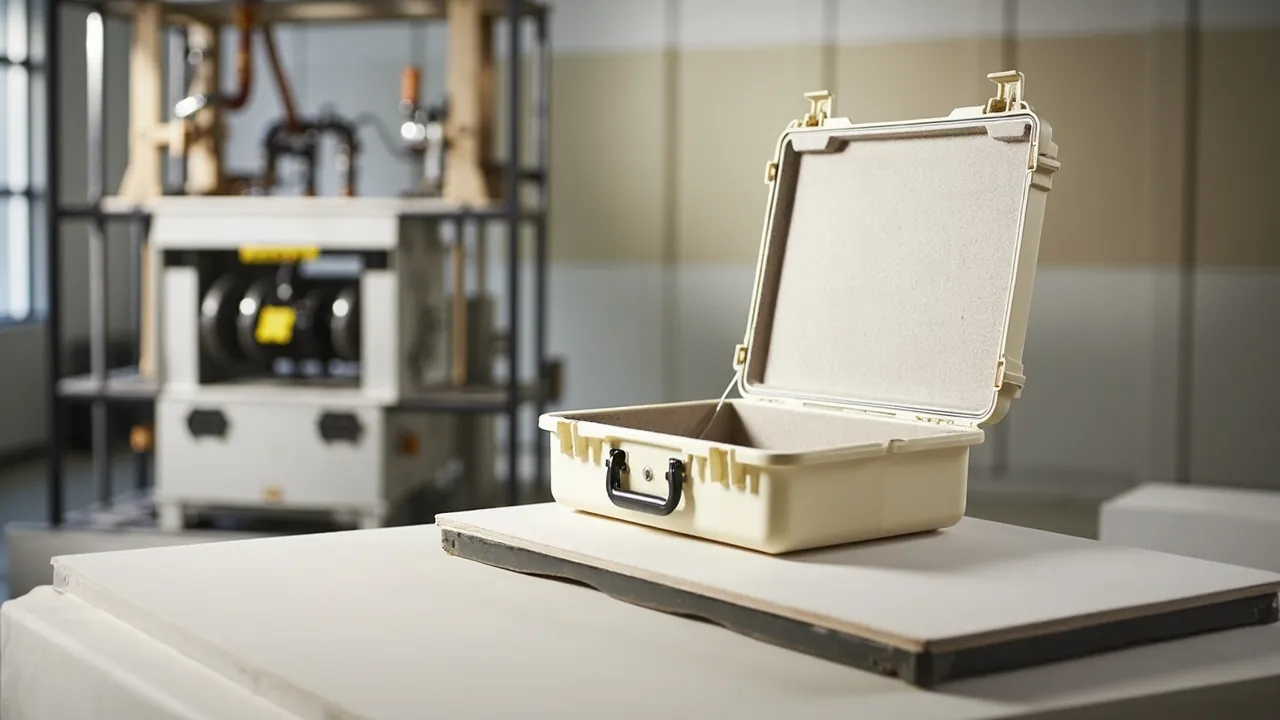
Spare parts for ceramic and tile production lines — press hydraulics, upper and lower dies, kiln rollers, burners, thermocouples and drive components — are high-value, high-precision, brittle or moisture-sensitive items. They must be shipped and stored in purpose-built protective cases with custom interior inserts in order to hold vibration, dust, thermal cycling and humidity risk inside a controllable range. A hydraulic valve block that loses its lapping geometry, a ceramic roller that develops a hairline crack, or a thermocouple whose compensating cable absorbs moisture does not simply get "fixed" later — it delays a production line that may be losing thousands of square metres of tile output per hour of downtime. In the ceramics industry, a parts case is not ordinary packaging; it is a piece of asset-lifecycle equipment.
The pain points are consistent and predictable. Press valve blocks removed for service are dropped into timber crates or woven bags, then arrive hundreds of kilometres away with sticking spools. Unopened kiln rollers are shipped with single-point support and arrive with fractured ends. Thermocouple assemblies absorb moisture in transit and drift out of calibration. In rainy seasons, or when exporting to humid Southeast Asian markets, condensation forms inside the crate and the working faces of a die begin to rust. Fine glaze and spray-dryer dust enters through case gaps, mixes with residual oil film and forms an abrasive paste that slowly scores mating surfaces. This article breaks protection logic down by component type, then gives executable selection methods for materials, structure, sealing and testing, and explains how to audit a supplier's real capability. JUNZHJIA supports the ceramic and building-material equipment sector with insert design, sealing schemes and OEM/ODM volume supply, manufactured and delivered by Kexin New Materials (Guangdong) Co., Ltd.
Table of Contents
- 1. Why Press and Kiln Components Need Purpose-Built Cases
- 2. Risk Profile of the Ceramics Logistics Chain
- 3. Protecting Press Components: Hydraulics, Dies and Moulds
- 4. Protecting Kiln Components: Rollers, Burners and Thermocouples
- 5. Dust Ingress and IP6X: Applying IEC 60529 and GB/T 4208
- 6. Kiln Thermal Cycling and How It Stresses Packaging
- 7. Custom Insert Design: Choosing Between EVA, PE and EPP
- 8. Case Materials, Wall Structure and UL94 Flammability
- 9. Long-Term Reliability of Seals, Latches and Hinges
- 10. Transport Testing: ISTA, GB/T 4857 and ASTM D4169
- 11. Handling, Lifting and Wheel Accessory Selection
- 12. Marking, Traceability and Batch Management
- 13. Procurement Acceptance and AQL Sampling
- 14. Specification Selection Table and Custom Delivery Capability
- Frequently Asked Questions
- Conclusion & Related Reading
1. Why Press and Kiln Components Need Purpose-Built Cases
Downtime in a ceramics plant is expensive. A line producing twenty thousand square metres of tile per day loses several thousand square metres of output for every hour stopped, and replacing a press upper die or a kiln roller typically requires several hours of line stoppage. The speed at which spares can be cycled determines whether the maintenance window can be compressed. The value of a purpose-built case therefore reduces to four words: open and install. No cleaning, no re-levelling, no recalibration before the part goes back on the machine.
Looking at failure mechanisms, ceramic equipment spares face four damage classes. Mechanical shock and vibration cause brittle fracture and impact damage on precision faces. Dust ingress produces abrasive wear on mating surfaces and poor contact on electrical interfaces. Humidity and condensation cause corrosion, insulation degradation and thermocouple drift. Thermal stress arises when kiln-side spares move from a hot zone into an ambient environment, producing thermal shock and dimensional recovery. Dust and humidity are the two most commonly underestimated categories, because they barely appear during short in-plant moves and only surface after long domestic or export shipping lanes.
A simple decision rule follows from this. A component belongs in managed protective packaging if its unit price exceeds a low threshold, if its lead time exceeds two weeks, if it requires calibration or levelling before installation, or if it belongs to the kiln hot zone. In ceramics, that captures kiln rollers, dies, hydraulic valve assemblies, precision gear reducers, thermocouples and infrared temperature-measurement components almost completely. For export business, the destination vibration spectrum and stacking conditions must be added on top; domestic short-haul experience does not transfer.
The conclusion is straightforward: a protective case is not a cost item, it is insurance on spare-part availability. Getting the packaging right moves downtime risk forward into the warehouse, where it can actually be controlled.
2. Risk Profile of the Ceramics Logistics Chain
Spare-part logistics in a ceramics plant has two very different legs. The first is internal: short forklift or pallet-truck moves from the warehouse to the press or kiln, over concrete or emery-hardened floors, where the dominant excitation is high-frequency impact. The second is external: long-haul road transport, where the dominant excitation is sustained low-frequency vibration with occasional large shocks. Export adds sea-freight stacking and container-level temperature and humidity swings.
| Chain stage | Dominant stress | Typical consequence | Protection focus |
|---|---|---|---|
| --- | --- | --- | --- |
| In-plant forklift transfer | High-frequency impact, localised point load | Case base cracking, insert collapse | Reinforced base, palletised bottom |
| Long-haul road freight | Sustained vibration 3–200 Hz | Thread loosening, weld fatigue | Positive location, separate compartments |
| Container sea freight | High humidity, condensation, stacking load | Corrosion, mould, case deformation | Sealing class, desiccant, top-load rating |
| Desert or high-dust regions | Fine dust, electrostatic attraction | Mating-surface scoring, contact contamination | IP6X dust protection, cleanable inserts |
| Northern winter dispatch | Low-temperature embrittlement below −20 °C | Insert cracking, seal hardening | Low-temperature materials, cold-grade seals |
The environmental characteristics of ceramic production regions deserve emphasis. Major production areas in Guangdong, Fujian and Jiangxi run at high year-round humidity, with relative humidity above 80 percent throughout the rainy season. Northern production regions reach −20 °C in winter. Export destinations in the Middle East and South Asia expose equipment to fine airborne dust and ambient temperatures above 50 °C. One case configuration cannot cover all of these, so selection must be differentiated by destination and season — which is precisely the argument for customised packaging rather than catalogue buying.
One frequently overlooked factor: ceramic plants generate glaze dust and spray-dryer emissions with particles that reach sub-micron sizes. Once this dust is carried into a case on air currents and settles onto a hydraulic spool or a guideway, it combines with lubricating oil to form an abrasive paste whose destructive rate far exceeds that of ordinary sand and dust. This is the fundamental reason the ceramics sector places more emphasis on dust ingress ratings than general machinery sectors do.
3. Protecting Press Components: Hydraulics, Dies and Moulds
The core spares of a ceramic press — commonly in the 1,500 to 7,800 tonne range — fall into hydraulics, tooling and structural categories, each with different protection logic.
Hydraulic components include proportional valves, servo valves, main cylinder seal kits, accumulators and high-pressure hoses. Their common characteristics are tight fits (some spool clearances are measured in microns), extreme sensitivity to contamination, and sensitivity to vibration-induced loosening. The case must provide one part per compartment, positive location in a vertical or horizontal orientation, and zero degrees of freedom in any direction. Valve blocks should be fitted with dust caps or blind plates before packing, and the case should include a replaceable desiccant compartment that holds relative humidity below 40 percent.
Dies and moulds include upper dies, lower dies, die frames, isostatic rubber moulds and textured working layers. Working-face accuracy is typically in the 0.02 mm class, often with fine texture, and the dominant risks are contact impact and corrosion. The recommended approach is a contoured insert cavity that leaves the working face unsupported and unstressed, with the die frame landing on hard structural supports. Rubber moulds must be protected against long-term compression set, so a low-rebound support structure and a no-stacking rule are appropriate.
Structural components include columns, crossbeams, tie rods and base plates. These are heavy — individual pieces can reach several hundred kilograms — so the protection focus is lifting safety and displacement control in transit, with the case acting mainly as a fixture that protects threaded surfaces. Tie-rod threads must carry protective sleeves so that transit contact cannot damage the thread form.
Rule of thumb: hydraulic and tooling spares shipped without tailored inserts show markedly higher rework rates than identically specified parts shipped with positive location. Ceramics plants commonly report a difference of several multiples. This is not a precise statistic but a frequently observed order of magnitude in practice.
One easily missed detail for press spares is the mixed-loading prohibition. Putting heavy structural items and precision hydraulic items in the same case creates relative displacement driven by mass difference; even an intact insert can then permit secondary impact. When JUNZHJIA develops schemes for ceramic equipment customers, the usual recommendation is one case for precision parts and one for heavy parts, or alternatively a removable divider system that creates a physical partition within a single case body, balancing freight economy against protection.
4. Protecting Kiln Components: Rollers, Burners and Thermocouples
Kiln-side spares are unusual because they come from heat. Ceramic and silicon-carbide kiln rollers, burner bricks, burner assemblies, thermocouples and compensating cables are frequently removed from high-temperature service or are themselves high-temperature materials, so they must survive both thermal shock and moisture uptake when they enter ambient transport.
Ceramic rollers and silicon-carbide rollers are classic brittle long items, typically 2,000 to 4,000 mm long. The protection core is bending and point-load resistance: full-length multi-point support, correctly spaced support positions, and an absolute prohibition on unsupported spans. The case should include longitudinal through-support beams. Roller end journals are precision features and need individual protective sleeves. If shipped as a single long case, an excessive length-to-width ratio requires an assessment of transport-time deflection.
Burners and burner assemblies contain precision-machined gas passages and nozzle orifices, which are vulnerable to dust blockage and impact deformation. Orifice protection should use soft plugs plus individual cavities; gas connections should carry dust caps; and direct metal-to-metal contact inside the case should be eliminated.
Thermocouples and compensating cables are electrical precision items sensitive to moisture, to bend radii below specification, and to reversed polarity in the compensating cable. The case should include a dedicated cable compartment with a minimum winding radius and separate connector protection. Humidity control matters greatly here: after moisture uptake, insulation resistance drops and measurement drifts, which directly disturbs the kiln temperature curve.
| Kiln component | Main failure mode | Insert recommendation | Key note |
|---|---|---|---|
| --- | --- | --- | --- |
| Ceramic roller | Bending fracture, end damage | Multi-point evenly spaced longitudinal support | Support spacing, no unsupported span |
| Silicon-carbide roller | Brittle fracture, corner chipping | Contoured soft cavity | Avoid edge loading |
| Burner assembly | Orifice blockage and deformation | Dedicated cavity plus soft plug | Dust caps on gas ports |
| Thermocouple | Moisture drift, cable damage | Dedicated cable compartment | Winding radius, polarity marking |
| Drive components | Bearing contamination, gear damage | Compartmented fixing | Dust, moisture and loosening control |
There is also a process recommendation for kiln hot-zone parts: cool and clean the part in-plant before it goes into the case. Many failures are not caused by transport at all. A hot part packed immediately creates a hot, humid micro-environment; as it cools, a slight vacuum forms and draws external moisture in, producing condensation. The correct sequence is natural cooling to near ambient temperature, removal of adhered dust, application of corrosion protection, and only then packing and sealing.
5. Dust Ingress and IP6X: Applying IEC 60529 and GB/T 4208
The ingress protection rating is the parameter most often misunderstood in ceramics. IEC 60529, and its Chinese equivalent GB/T 4208, define dust protection at level 5 (dust protected — limited ingress permitted that must not interfere with operation) and level 6 (dust tight — no dust ingress). Because ceramic plants operate with high concentrations of fine particulate, the practical choice is IP6X, not IP5X.
Several common misconceptions should be cleared up.
- The first digit covers solid foreign objects; the second covers water. Writing IP65 means dust level 6 plus water level 5 (jetting). IP67 means dust level 6 plus water level 7 (temporary immersion). Dust performance is identical; only water performance differs.
- IP6X alone is not waterproof. If rain, washdown or condensation is possible, the second digit matters and IP65 is a sensible floor, with IP67 for immersion or washdown exposure.
- Laboratory ratings are not lifetime field ratings. Seals degrade with open/close cycles, ageing and contamination accumulation. The rating describes the as-delivered condition, not a permanent guarantee.
In real ceramics use, a case usually fails at the seal, not at the shell. Dust first collects at the root of the seal channel; each closure compresses it into the sealing face and gradually creates micro-channels. Selection should therefore consider whether the seal channel is cleanable, whether the gasket is replaceable, and whether the hinges and latches distribute pressure evenly around the full perimeter. The toolbox hinge, latch and seal architecture documented in Toolbox hinges, latches and sealing structure is organised around exactly those three requirements — cleanable, replaceable, evenly loaded — which is what sustains performance in high-dust ceramic environments.
Where a case will move between differing ambient pressures, such as air freight or high-altitude mining support, a pressure equalisation valve should be fitted so that differential pressure cannot deform the gasket or make the case difficult to open. The underlying principle is explained in How a case pressure equalisation valve works. Further sealing detail is covered in Waterproof cases and IP ratings explained.
6. Kiln Thermal Cycling and How It Stresses Packaging
Kiln-adjacent spares are continuously exposed to thermal cycling, and while most attention goes to the equipment itself, the packaging materials experience it too. Understanding this drives material selection.
The first thermal stress layer comes from the part itself. Even after in-plant cooling, a component removed from the kiln hot zone may still be 20 to 40 °C above ambient. Packing it immediately creates a local hot zone that softens the insert, causes dimensional recovery, and then produces shrinkage gaps on cooling, so a previously mated insert loosens. The right response is to allow cooling time and to specify a higher-temperature insert material.
The second layer comes from the transport environment. For a ceramic plant in the Middle East, container interior temperatures can exceed 60 °C, while the destination warehouse may drop below 10 °C at night — a daily swing above 40 °C. Repeated cycling makes the air inside the case expand and contract, producing a breathing effect. As temperature falls, a slight negative pressure forms; if sealing is imperfect, external moisture is drawn in, and if sealing is perfect, the gasket may be held under continuous compression.
The third layer is cold. Dispatching from northern regions in winter exposes standard EVA and PE inserts to temperatures below −20 °C, where they harden and embrittle, crack more readily on impact, and lose cushioning function. These scenarios need better low-temperature formulations or a more temperature-stable structural approach.
Practical countermeasures include higher heat-deflection insert formulations, a pressure equalisation valve alongside proper sealing, humidity indicator cards and desiccant inside the case, avoiding repeated opening in high-differential environments, and dedicated drop pre-testing for cold scenarios. Material and scenario matching is discussed in Protective cases for extreme temperature environments and Choosing seal materials for protective cases.
7. Custom Insert Design: Choosing Between EVA, PE and EPP
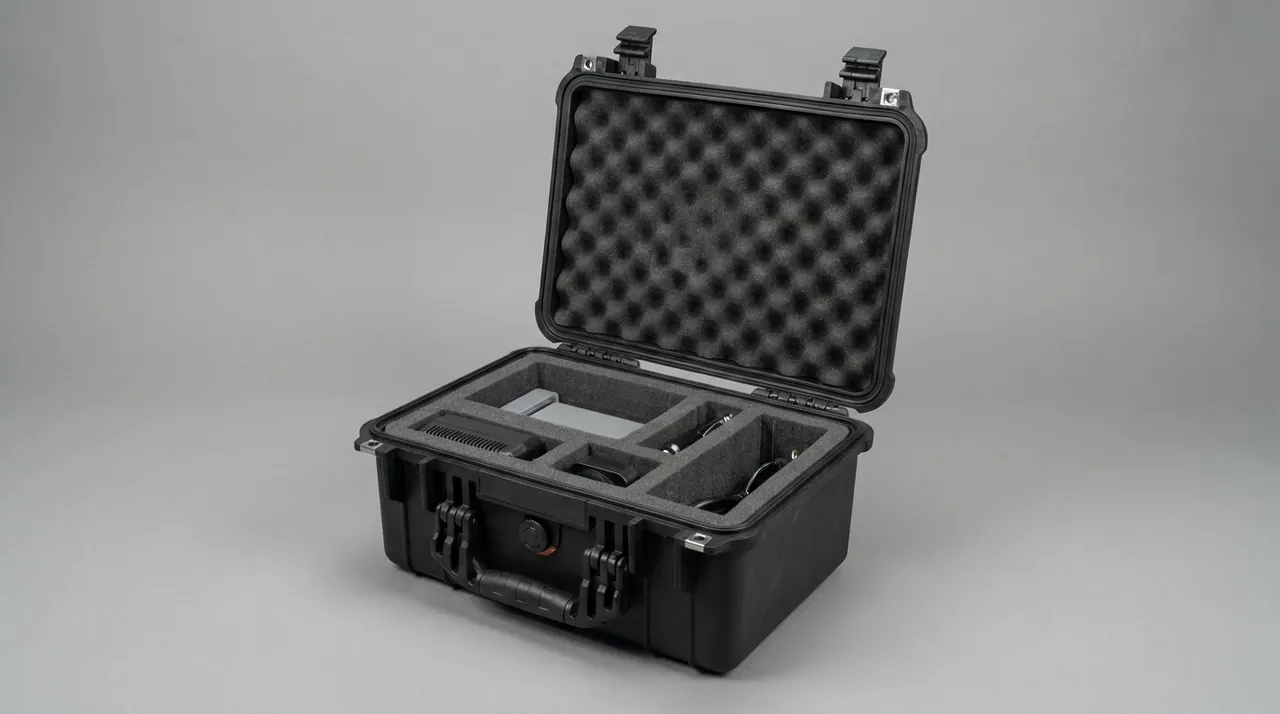
The insert determines more than 70 percent of real-world case performance. Ceramic equipment spares vary enormously in form — long rollers, block dies, irregular valve bodies, cable-bound sensors — and no single material covers all of them.
EVA foam offers good resilience, high cutting precision and a fine surface, making it suitable for precision parts and textured die faces. Density commonly ranges from 38 to 80 kg/m³. It supports fine contoured cavities, but it takes some permanent set under long-term compression and has only moderate dimensional stability at elevated temperature.
PE foam, including XPE and IXPE, is harder, offers good support and is cost-effective, suiting medium-sized components and applications needing firm location. Compressive performance exceeds EVA at equal density, but the surface is coarser, so a soft liner cloth is advisable where it contacts a precision-machined face.
EPP, expanded polypropylene, delivers high energy absorption, retains rebound performance after repeated impact, and has good temperature and chemical resistance, making it suitable for heavy, high-impact-risk parts such as press structural members and large valve assemblies. Its drawback is that moulding requires tooling, raising cost at low volumes.
Composite structures are the industrial norm: a high-density PE or EPP outer layer for load bearing, a medium-density EVA core for energy absorption, and a low-density soft foam or flocked fabric contact layer to prevent scratching. This sandwich approach balances weight, cost and protection.
| Material | Typical density kg/m³ | Advantages | Suitable parts | Limitations |
|---|---|---|---|---|
| --- | --- | --- | --- | --- |
| EVA | 38–80 | High cutting precision, fine surface | Precision valve blocks, die faces | Permanent set under long compression |
| PE / XPE | 25–60 | Strong support, low cost | Medium structural parts, general spares | Harder surface, needs liner |
| EPP | 30–60 | High energy absorption, stable rebound | Heavy parts, high-impact risk | Requires tooling, costly at low volume |
| Composite layering | Combined | Best overall performance | High-value precision plus heavy combinations | Complex process, longer lead time |
A typical insert development flow covers measuring component dimensions and centre of gravity, identifying load paths and faces that must not be loaded, selecting material and density, setting cavity tolerances, trial fitting and batch release. JUNZHJIA develops inserts from customer drawings or physical samples, including contoured cavities, multi-layer composites, removable dividers and label positions, so that ceramic plants can standardise on one case platform across multiple spare-part types. Process detail is covered in EVA foam insert custom process and Custom foam insert design guide.
8. Case Materials, Wall Structure and UL94 Flammability
The case body carries and resists external loads. Three material families dominate in ceramics: rotationally moulded high-density polyethylene (HDPE), injection-moulded polypropylene (PP), and engineering-plastic composite bodies, with metal-frame cases reserved for very heavy items.
HDPE rotomoulded cases are seamless, impact resistant, tolerant of low temperature and capable of large sizes, making them a common choice for heavy ceramic spares. Their drawbacks are higher self-weight and lower surface hardness than injection-moulded cases, with slight colour shift after prolonged outdoor exposure.
PP injection-moulded cases offer high dimensional accuracy, flat surfaces and excellent consistency, suiting medium-volume standardised delivery and simplifying colour and marking customisation. Their drawback is that large mouldings need large tooling, so upfront investment is significant.
Engineering-plastic and metal composite cases serve very heavy items or lifting applications, usually with metal corner pieces, stiffening ribs and lifting points.
On flammability, boundaries matter. UL94 is a material-level flammability classification for plastics, with common ratings including HB, V-0, V-1 and V-2. Ceramic plants have open flame and high radiant heat near kilns, so where a case will be stored long-term near a kiln, procurement can ask the supplier for the UL94 rating of the case material. It is important to be clear that UL94 is a material-level flammability assessment; it does not mean the assembled case holds any fire certification and it does not replace on-site fire management.
On wall structure, four features deserve attention: whether the base is reinforced (essential for load-bearing), whether the corners have reinforcing columns (drop resistance), whether there is a stacking location face (multi-tier storage), and whether lock and security-seal positions are provided (high-value spare control). A general evaluation framework for these parameters is set out in Instrument case selection guide.
9. Long-Term Reliability of Seals, Latches and Hinges
Ceramic plants combine dust, vibration and frequent opening, which places a triple demand on seals, latches and hinges.
Gaskets are commonly EPDM, silicone or TPE. EPDM offers good weathering and ageing resistance at moderate cost and is the general-purpose choice. Silicone tolerates a wider temperature range — on the order of −50 °C to 200 °C — suiting high-differential scenarios, but costs more and has moderate oil resistance. TPE feels good and rebounds well, suiting frequent opening, but is generally the least durable in abrasive dust. For high-dust ceramics environments, EPDM or silicone should be preferred, and the gasket should be a replaceable component.
Latches must deliver adjustable clamping force, adequate fatigue life and consistent feel. A ceramics spare-parts case might be opened a few times a month or several dozen times a year, which sounds modest, but when several shifts share a case and operate it in dust, a poor latch shows clamping-force decay within one or two years. Verify latch material (engineering plastic or metal core), the stated fatigue test count, and whether padlock and security-seal provisions are supported.
Hinges carry the opening torque. The common failure is wear in the hinge pin producing play, which lets the lid drop and prevents the sealing face from compressing properly. Metal-core hinges with self-lubricating bushings substantially outlast all-plastic hinges. JUNZHJIA matches hinge, latch and seal as a system so that even pressure distribution around the perimeter is maintained over time — the engineering basis for sustaining IP6X performance in high-dust duty.
A practical field check: place a thin sheet of paper inside the case, then close and latch it while placing the paper at several positions around the gasket. Pull the paper out and feel the resistance. If resistance differs noticeably between positions, sealing pressure is uneven and dust will enter at the lowest-resistance point.
10. Transport Testing: ISTA, GB/T 4857 and ASTM D4169
Whether a packaging scheme works cannot be decided by intuition; it must be tested. Three systems dominate internationally, and ceramic equipment exports often need a combination.
The ISTA series, from the International Safe Transit Association, is organised by transport mode and weight. ISTA 1 Series covers non-simulation performance tests such as drop and vibration; 2 Series covers partial simulation; 3 Series covers general simulation including temperature and humidity preconditioning; 6 Series addresses specific carriers such as 6-FedEx and 6-Amazon. For exported ceramic equipment spares, ISTA 3A or 3E is a common reference. The flow is described in ISTA transport testing procedures explained.
The GB/T 4857 series is China's basic test method standard for transport packages, covering vibration, impact, stacking and drop, and is widely cited in domestic transactions and domestic transport contracts. Detail is available in GB/T 4857 transport packaging testing explained.
ASTM D4169 is the US standard for transport packaging performance testing. It designs test sequences by distribution cycle and assurance level, making it well suited to multi-modal journeys. See ASTM D4169 distribution cycle testing.
| System | Focus | Ceramics use case | Common procedures |
|---|---|---|---|
| --- | --- | --- | --- |
| ISTA | E-commerce, parcel, general simulation | Export case shipments needing humidity preconditioning | 3A, 3E, 2A |
| GB/T 4857 | Domestic road and rail transport | Inter-plant transfers within China | Vibration, stacking, drop series |
| ASTM D4169 | Multi-modal distribution cycles | Sea-land combined transport, North American export | DC12, DC13 and similar |
Where a component is a kiln hot-zone item or a precision hydraulic part, environmental test items can be added: high-temperature storage, low-temperature storage, damp-heat cycling and vibration endurance. If a customer explicitly asks to reference MIL-STD-810H, it can be used as a source of environmental test methods when designing test conditions, but it must be understood that this is a test-method standard and is not equivalent to military certification — no claim of "military certified" may be made. JUNZHJIA can help customers structure a test item list, coordinate with third-party laboratories and provide inspection documents consistent with the shipped batch.
11. Handling, Lifting and Wheel Accessory Selection
Ceramic equipment spares are generally heavy, and the handling method directly determines structural requirements and operational safety.
Fixed heavy-duty cases suit single-shipment, long-term storage scenarios, relying on forklift or crane handling. The base must be reinforced with forklift pockets, and the corners need reinforcing columns to resist concentrated lifting loads. Where a single item exceeds 300 kg, lifting point positions and sling angles should be fixed at the design stage rather than improvised on site.
Wheeled cases suit frequent in-plant movement and on-site maintenance. Wheel selection turns on three factors: diameter (larger wheels cross floor joints and thresholds more easily), material (polyurethane wheels are soft and quiet; nylon wheels are hard and wear resistant), and load distribution (four-wheel support versus a two-wheel-plus-trolley configuration). Large wheeled cases usually need a telescopic handle, and its rigidity under full load must be verified. Selection guidance is in Case wheels and trolley handle selection.
Modular schemes are gaining popularity in ceramics: one case body platform paired with multiple interchangeable inserts, so that when the spare-part model changes only the insert is replaced. This approach substantially reduces long-term procurement cost and simplifies warehousing standardisation. Where several small items must share one case, a removable divider system can be used, as described in Removable divider system for cases.
12. Marking, Traceability and Batch Management
A recurring problem in ceramics spare-parts management is that items cannot be found, identified or matched. Labels fall off in transit, model numbers are obscured by grime, and same-name different-batch items get mixed, all of which wastes maintenance windows. A case marking system should therefore be part of the design.
Recommended marking layers:
- Permanent external marking: asset number, applicable equipment model, case specification, maximum load. Use in-mould labelling, screen printing or laser engraving so that no adhesive residue remains after a sticker fails.
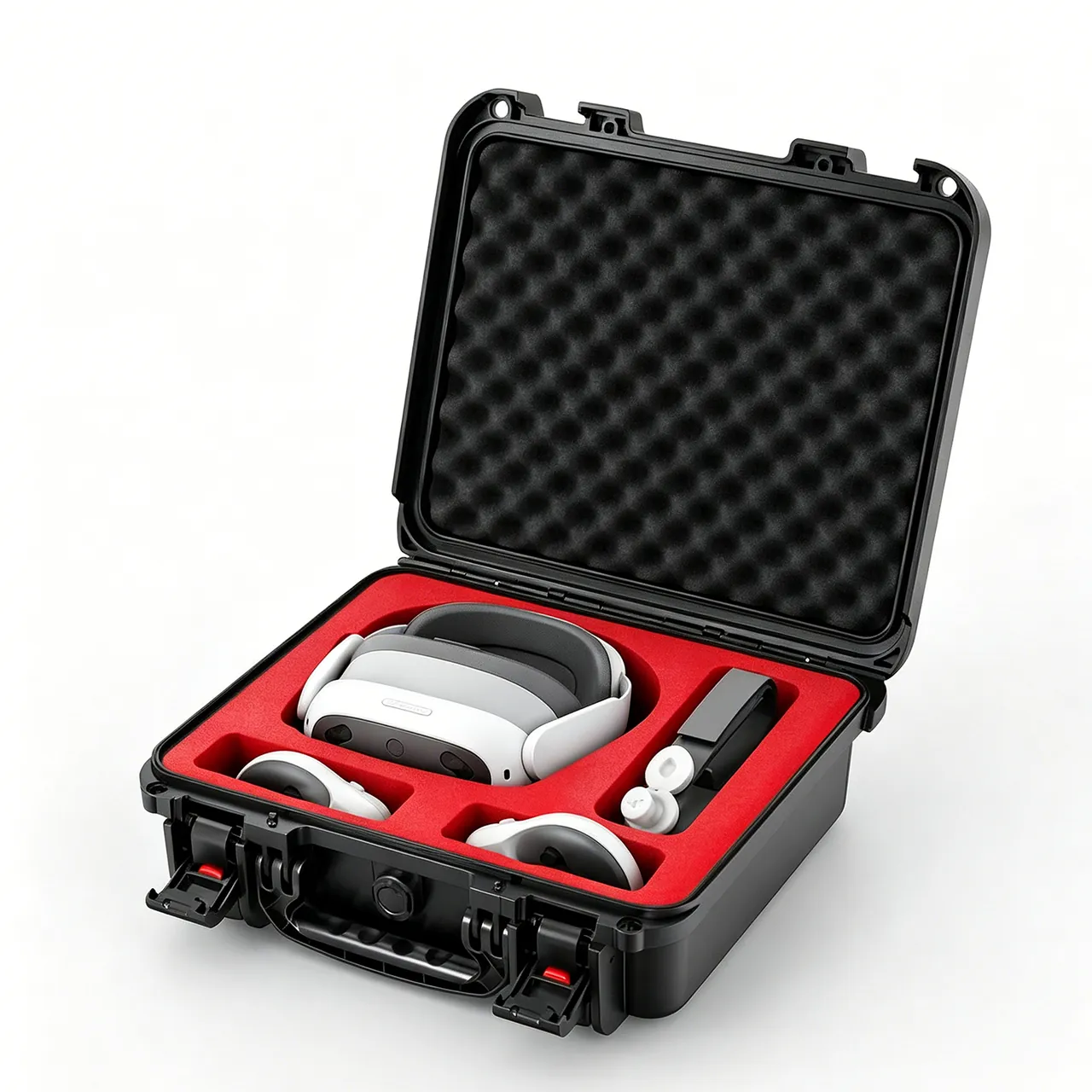
- Internal insert position marking: each cavity labelled with the component name and part number, so missing items are visible immediately.
- Batch and document pocket: a document pocket or slot for the packing list, inspection report and calibration certificate.
- Status marking: distinguishing spare, awaiting inspection, calibrated and under repair, using colour cards or insertable tags.
- Traceability code: a QR or barcode linking the spare-part procurement batch to installation records, so that the origin of a failure can be traced back through the chain.
For export business, destination language and compliance requirements also apply. Where labelling concerns dangerous goods, such as oil-containing or battery-containing components, the applicable transport regulations must be followed. A general compliance framework is outlined in ADR and IMDG hazardous goods transport cases.
The value of a marking system is error reduction. Experience shows that, at equivalent spare-parts management maturity, plants with clear marking systems record noticeably fewer wrong-item picks and mis-installations than plants without. This is the step that turns a protective case from packaging into a management platform.
13. Procurement Acceptance and AQL Sampling
When buying protective cases in volume, acceptance criteria must be written into the contract; otherwise later disputes cannot be resolved objectively.
Recommended incoming quality control (IQC) items:
- Appearance and dimensions: external dimensions and insert cavity dimensions against drawing; no cracks, sinks or flash on the shell.
- Sealing performance: sampling per the agreed rating, applying the corresponding IP test method, or at minimum a full-perimeter gasket contact check.
- Latch and hinge function: opening and closing force, positive latch engagement, and fatigue sampling at a specified cycle count per batch.
- Insert fit: trial fit with the actual part or a gauge, confirming neither interference nor excessive clearance.
- Marking and documentation: content, position and durability of marking; completeness of accompanying documents.
- Load testing: sampling for stacking or static load tests, confirming no permanent base deformation.
AQL sampling is the standard method for volume acceptance. It determines sample size and accept/reject criteria from lot size, inspection level and AQL value. A common approach uses general inspection level II with AQL values differentiated by defect class: critical defects that compromise protection, such as seal failure, get a tighter AQL, while minor cosmetic defects get a looser one. Sampling tables and decision rules are covered in Custom case acceptance and AQL sampling.
One caution: the definition of a "critical defect" for cases should reflect ceramics reality. For a ceramic plant, seal failure, hinge play and insert collapse are critical; colour deviation, minor flow marks and font weight differences in marking are minor. Writing these definitions into the acceptance document gives the supplier a clear quality target.
14. Specification Selection Table and Custom Delivery Capability
Ceramic and tile machinery spares span a very wide size range. Selection should start from the component category to fix the case type, then move to dimensions and weight to fix the specification.
| Spare category | Recommended case type | Insert scheme | Suggested sealing class | Suggested transport test |
|---|---|---|---|---|
| --- | --- | --- | --- | --- |
| Precision hydraulic valve assemblies | Medium-to-large hard case | Contoured cavity plus composite layers | IP65 or better | ISTA 2A / 3A |
| Press upper/lower dies, rubber moulds | Large rotomoulded case | Contoured support, working face unsupported | IP65 | ISTA 3A plus stacking |
| Kiln rollers (long items) | Dedicated long-item case | Multi-point evenly spaced longitudinal support | IP6X primary | Vibration plus deflection assessment |
| Burners and burner assemblies | Medium hard case | Dedicated cavities plus soft plugs | IP65 | ISTA 2A |
| Thermocouples and sensors | Small instrument case | Dedicated cable compartment, ESD-safe | IP67 | ISTA 2A plus damp heat |
| Heavy structural parts | Heavy-duty or metal-frame case | Hard supports plus thread sleeves | Scenario dependent | Lifting and stacking verification |
JUNZHJIA provides complete custom delivery capability across ceramics, building materials and general equipment: insert development from drawings or physical samples, sealing class and lock schemes matched to the scenario, colour and marking customisation, and OEM/ODM manufacturing with stable volume supply. Kexin New Materials (Guangdong) Co., Ltd. operates an integrated chain from tooling development and rotational or injection moulding through insert processing and final case assembly, serving ceramic equipment manufacturers, regional distributors and end-user ceramic plants at different volumes. For first-time cooperation, a small trial batch with physical trial fitting is recommended before moving to volume supply. Evaluation criteria for choosing a contract manufacturing partner are set out in How to choose a protective case OEM factory.

Frequently Asked Questions
Q: What sealing class does a ceramic press precision hydraulic valve assembly actually need?
A: Take IP6X as the dust floor, then determine the second digit from whether water contact is possible. Ceramic plant dust is fine and contains glaze particles, which makes it one of the most abrasive contamination types; the limited ingress permitted by IP5X is enough to score spools in this environment, so IP6X is the correct choice. Where the case may be stored outdoors, exposed to rain, or washed down, the second digit should be at least 5, giving IP65; where brief immersion or a wet washdown zone is possible, choose IP67. Three cautions apply. First, a rating describes the as-delivered condition, and gasket ageing or dust on the sealing face will degrade it, so a cleanable, replaceable seal structure is mandatory. Second, dust and water are separate digits, so IP6X alone does not mean waterproof. Third, long-term storage near a kiln accelerates seal ageing, so specify a higher-temperature silicone or specialised compound and shorten the inspection interval. Write the rating, test method and sampling ratio into the contract, and retain third-party test documents as acceptance evidence.
Q: What is the most common packaging mistake with long brittle items such as kiln ceramic rollers?
A: The most common mistake is treating a roller as ordinary long freight, supporting it only at both ends or lifting it from a single point, which creates mid-span bending stress in transit and leads to fracture. Rollers are brittle, strong in compression but weak in bending, and fracture usually propagates from a surface micro-crack or an end defect, so the design must be organised around eliminating point loads and bending entirely. Correct practice includes full-length multi-point evenly spaced support, with spacing calculated from diameter and wall thickness and usually requiring four or more points; soft contoured support surfaces to increase contact area and remove hard spots; individual protective sleeves on the end journals to isolate axial shock; a longitudinal through-support beam to give overall rigidity; and a deflection assessment when the length-to-width ratio is high. Rollers of different lengths should not be mixed, and rollers should never share a case with heavy metal items. Record surface condition before dispatch, because an existing impact mark may become the origin of a later fracture. A vibration and stacking validation before shipping is worth more than an after-the-fact claim.
Q: In a high-dust ceramics environment, how often should case gaskets be replaced?
A: There is no universal interval, because it depends on opening frequency, dust concentration, cleaning method and storage environment, but condition-based inspection works well. Gasket failure typically appears in three ways: hardening, cracking or permanent compression set with visibly reduced rebound; cured dust accumulated at the root of the seal channel forming micro-channels; and uneven resistance distribution around the gasket when the case is closed and latched. A sensible regime is a quarterly visual and feel inspection, a semi-annual full-perimeter paper-draw check, and an annual full sealing verification using dust tracing or the agreed IP method. High-dust shops with frequent opening should shorten this to a quarterly full check. Measures that extend life include specifying EPDM or silicone, ensuring the gasket is replaceable, brushing dust out of the seal channel before each closure, avoiding solvent wiping of rubber parts, and avoiding long-term storage in high radiant heat zones. Keeping gaskets on the spare-parts list is usually far cheaper than replacing whole cases.
Q: What should packaging schemes for ceramic plants in the Middle East and Southeast Asia consider?
A: The two regions differ in emphasis even though both are hot, so they should be assessed separately. Southeast Asian destinations are humid year-round, with container relative humidity above 85 percent for long periods during sea freight and daily condensation cycles from diurnal temperature swing, so the emphasis is moisture and mould control: higher sealing class, desiccant and humidity indicator cards inside, inserts made from non-hygroscopic and mould-resistant materials, and corrosion protection on metal parts. Middle Eastern destinations combine high temperature with fine, dry dust, so the emphasis is heat tolerance and dust exclusion: case and insert materials must resist container temperatures above 60 °C without softening, seal material temperature ratings must match, and dust protection should stay at IP6X. Both scenarios need stacking load and port handling impact assessment, ideally verified under ISTA 3 Series or the relevant ASTM D4169 distribution cycle. Destination labelling language requirements should also be confirmed, along with hazardous goods marking where spares contain oil or batteries.
Q: What information is needed to develop a custom insert, and how are lead time and cost assessed?
A: The more complete the input, the more accurate the scheme. Ideally provide three-dimensional models or detailed drawings including critical tolerances and precision faces; physical samples or accurate measurement data; part weight and centre of gravity; a description of vulnerable areas and faces that must not be loaded; transport mode and stacking tiers; and storage environment including temperature, humidity, dust and oil exposure. Without drawings, physical samples can be sent for three-dimensional scanning or manual measurement. The development flow generally covers requirement confirmation, material and structural design, sample production, physical trial fitting, revision and confirmation, then volume production. Cost has three components: insert processing cost, driven by structural complexity, material density and whether tooling is required; case body cost, driven by size, moulding process and volume; and development and trial-fitting cost. Removable dividers and standardised universal cavities can significantly reduce long-term cost in multi-model scenarios. Cost structure analysis is available in Custom case mould cost analysis.
Q: How can a buyer verify that a supplier's claimed ingress protection rating is genuine?
A: Cross-check at four levels. First, documents: ask for the sealing structure design description, gasket material and specification, and a third-party test report that includes the test method, sample condition and conclusion, rather than a single line stating compliance. Second, structure: a genuine IP6X design normally shows a defined seal channel, a replaceable gasket, a latch layout that applies even pressure, and a verified sealing-face flatness; a gasket that is simply glued in place and cannot be replaced will struggle to hold its rating over time. Third, consistency: require sampling, take several units from one batch and check gasket contact, and watch the spread; suppliers with large variation usually have tooling or process control problems. Fourth, logic: if a supplier labels every model with the same high rating but cannot explain how sealing pressure is maintained across different sizes, be cautious. It also helps to request application references and contactable customers, and to write the acceptance method, sampling ratio and non-conformance handling into the contract.
Q: Should a ceramic plant buy standard catalogue cases, or specify everything custom?
A: For most plants, the sensible answer is a hybrid: a standardised case platform plus customised inserts. Catalogue cases ship faster and cost less, and suit regular, high-volume general spares such as standard fasteners, common bearings and frequently used seals. Custom cases suit three situations: dimensions outside the normal size range, such as very long rollers or very large dies; unusual weight or centre of gravity that a standard body cannot safely carry; and strictly controlled protection or stacking requirements that catalogue cases cannot meet. Custom inserts, by contrast, pay off for almost every high-value spare, because insert cost is far below case tooling cost while protection and retrieval efficiency improve markedly. A further optimisation is making one case platform accept several interchangeable inserts, so that when a spare model is updated only the insert changes and the case continues in service. This works especially well where spare variety is high and models iterate quickly.
Q: What daily maintenance does a parts case need when it circulates internally within a ceramic plant?
A: Internal circulation involves short distances but high opening frequency, so the maintenance emphasis differs from long-haul transport. A simple routine works well. After each use, empty dust and debris from inside the case, especially the corners of the seal channel and insert cavities. Clean with a dry cloth or soft brush, avoiding solvents that attack rubber gaskets. Check the gasket for embedded foreign objects or deformation. Check that latches engage positively and that hinges have no play. Check inserts for collapse or tearing, particularly at load-bearing points. In storage, avoid prolonged exposure to high temperature or direct sun near a kiln, and avoid stacking heavy items on empty cases, which can deform the lid. A quarterly consolidated inspection recording sealing contact, structural deformation and marking integrity is worthwhile. For high-value spare cases, add a padlock or security seal and maintain an issue log. Writing these actions onto a single-page work instruction posted in the warehouse is often more effective than a complex policy. Expected case and insert service life is discussed in Protective case service life assessment.
Q: Can one parts case scheme serve ceramics, stone and cement equipment at the same time?
A: Partly, but it cannot simply be copied across, because the dominant stresses differ. Ceramics is characterised by very fine dust, high component precision and kiln thermal cycling, so the emphasis is IP6X dust protection, precision contoured inserts and temperature-tolerant materials. Stone processing equipment involves heavy components and high impact energy, so the emphasis is heavy-duty structure and impact-absorbing materials. Cement and building-material equipment faces coarser, larger volumes of more corrosive dust along with open or semi-open storage, so the emphasis is weathering resistance, structural strength and long-term sealing durability. A case platform can therefore be shared to some degree, for example the same rotomoulded body specification, but insert design, sealing class, material formulation and test items should be evaluated separately. Where a company operates all three equipment categories, a unified case specification system with a classified insert library preserves standardised management while retaining targeted protection, and also reduces procurement and inventory complexity.
Conclusion & Related Reading
The core of a ceramic and tile machinery parts case is not fitting a component inside a box. It is getting each protection detail right along four stress lines: dust, vibration, thermal differential and humidity. Press hydraulics and dies need precision contoured inserts and one-part-per-compartment segregation. Kiln rollers and burners need multi-point support with dust and moisture exclusion. Thermocouples and similar electrical items need a dedicated cable compartment and humidity control. Heavy structural parts need a reinforced base and thread protection. The long-term reliability of seals, latches and hinges determines whether IP6X performance survives into the second and third year, while ISTA, GB/T 4857 and ASTM D4169 provide the path from "we believe it works" to "we verified it works".
For ceramic equipment manufacturers, regional distributors and end-user plants, a sensible sequence is: inventory the spare list and classify by value, precision and environmental risk; decide the standard case platform and the insert customisation strategy; validate with a small trial batch and physical trial fitting; then write acceptance criteria, sampling methods and the marking system into procurement documents. JUNZHJIA supports this process from scheme design and sample development through volume supply, with Kexin New Materials (Guangdong) Co., Ltd. manufacturing and delivering to customer drawings and scenario requirements, so that spares remain under control from dispatch to installation.
Related Reading