

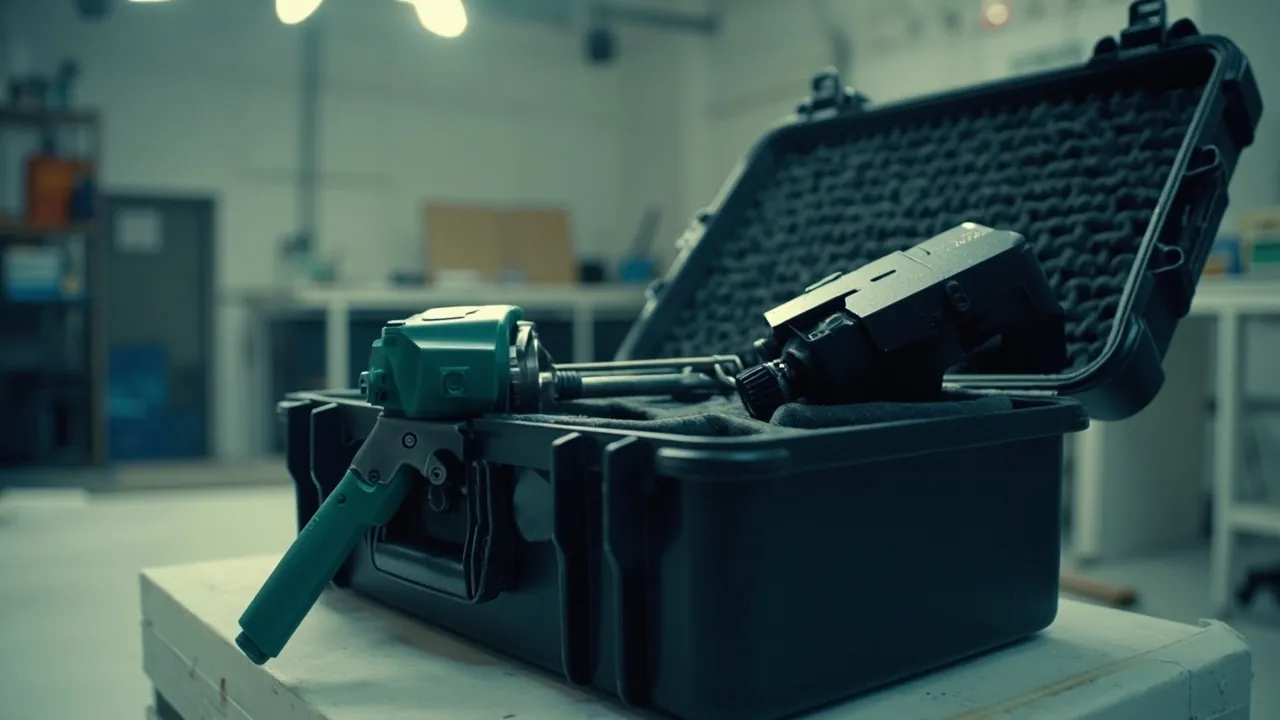
The final appearance of cookware - stainless pots, kettles, tableware, small appliance fascias - is largely decided at the polishing and surface finishing stage. The conclusion first: polishing wheels and surface finishing components combine shape sensitivity, moisture sensitivity, and cleanliness sensitivity. They are consumables and equipment parts that must be shipped in dedicated cases with rigid locating, isolated compartments, and combined moisture and dust control. A cardboard box with loose fill cannot hold arrival quality: wheel distortion, cloth-layer separation, damp abrasive belts, and bent spindles all rise sharply, and the first visible result is a delayed line start and reworked first-off parts. A polishing wheel of 300 to 400 mm diameter has a working layer built from tens to over a hundred compressed cloth discs. Any single-point load or sustained static pressure creates local collapse and degrades dynamic balance. Once mounted, the result is runout, chatter marks, and uneven polishing, which finally shows up as inconsistent gloss and a higher defect rate on the cookware surface.
Polishing is also a cleaning operation, and it is extremely sensitive to contamination. Once a polishing wheel, abrasive belt, or polishing wax picks up dust, oil, or moisture, it not only loses performance but can also carry the contamination onto the workpiece, producing black spots, haze, and loss of lustre after polishing. This article is written for equipment engineering teams and polishing shops at cookware manufacturers, surface finishing equipment builders, consumable distributors, and OEM/ODM buyers. It covers component grading, case and insert design, moisture and cleanliness requirements, dust and environmental boundaries, sealing and ingress protection levels, standard validation methods, and unpacking practice, and it explains how JUNZHJIA supports custom inserts and volume supply.
Table of Contents
- 1. Why Polishing Wheels and Finishing Components Need a Dedicated Equipment Case
- 2. Component List and Sensitivity Grading
- 3. Failure Modes: Wheel Distortion, Cloth Separation, Damp Belts and Bent Spindles
- 4. Moisture Limits for Polishing Wheels and Abrasives
- 5. Polishing Dust and the Boundary of What a Case Can Do
- 6. Size and Weight Boundaries: From 100 mm Wheels to Large Polishing Assemblies
- 7. Case Structure and Material Selection
- 8. Insert and Locating Design: Upright and Cradle Storage for Wheels
- 9. Separate Compartments and Leak Control for Wax, Fluid and Chemicals
- 10. Moisture Protection for Motors and Electrical Components
- 11. Sealing and Ingress Protection: An IEC 60529 and GB/T 4208 View
- 12. Transport Validation: GB/T 4857, ISTA and MIL-STD-810H
- 13. Cleanliness and the Food-Contact Boundary for Finished Cookware
- 14. OEM/ODM Workflow, Acceptance and Reuse Management
- Frequently Asked Questions
- Conclusion & Related Reading
1. Why Polishing Wheels and Finishing Components Need a Dedicated Equipment Case
The value of a polishing operation is not in the weight of the equipment but in the stability of the contact interface. That single idea explains why polishing wheels and finishing components need dedicated protection.
First, the value of a polishing wheel is in form accuracy and dynamic balance. A cloth or sisal wheel is built from many layers of cloth or sisal bonded and compressed with adhesive. Its outside diameter roundness, end-face parallelism, and overall dynamic balance together determine how contact pressure is distributed during polishing. Once a wheel deforms locally under pressure, rotation produces a cyclic pressure fluctuation that appears on the workpiece as chatter marks and local over-polishing. This class of defect cannot be compensated by adjusting polishing parameters.
Second, the value of an abrasive belt or flap wheel is in the integrity of the abrasive layer. A belt's abrasive grains are bonded to a backing with resin or adhesive. After moisture ingress, a cloth or paper backing swells and distorts, the adhesive softens, and the abrasive layer sheds and loads. Flap wheel leaves are equally vulnerable to compression, moisture, and oil.
Third, the value of a polishing spindle and head assembly is in geometric accuracy. Polishing spindles are typically slender and run at high speed, so straightness and bearing fit accuracy are demanding. Bending introduced in transit becomes runout and vibration after assembly, which is then amplified into the workpiece surface.
Fourth, polishing is a cleaning operation. Polishing wheels, belts, and waxes touch the workpiece directly. If they carry dust, oil, or moisture, they contaminate the surface and produce black spots, haze, and loss of lustre. Packaging is therefore not only protection but also contamination isolation.
Fifth, wheel changes and spare part circulation are frequent. Polishing wheels are high-turnover items, and a single polishing machine may see several wheel changes in one day. Spares circulate repeatedly between the warehouse, the shop floor, and the supplier, and every handling event is a fresh exposure.
Practical note: the most under-estimated loss in a polishing shop is not the purchase price of a wheel but a new wheel that runs out of balance the moment it is mounted. In many cases the root cause lies in transport and storage: local collapse from single-point loading, layer separation from moisture ingress, or a distorted bore that causes eccentric clamping. Chasing inconsistent gloss on a polishing line costs far more than a proper equipment case.
For cookware manufacturers and surface finishing equipment builders, the case also acts as a standardisation and consumable-management platform. One insert architecture can be shared across a polishing machine family, simplifying storage, circulation, and project kitting. Reuse assessment methods are described in protective case service life and reuse years.
2. Component List and Sensitivity Grading
Score each item on three axes - form accuracy sensitivity, compression and impact fragility, and moisture and cleanliness sensitivity - to build the packing decision basis.
| Component | Typical material / structure | Critical sensitivity | Environment | Recommended protection |
|---|---|---|---|---|
| --- | --- | --- | --- | --- |
| Cloth or sisal wheel | Layered cloth or sisal plus adhesive | Outside diameter roundness, end-face parallelism, bore | Compression collapse, moisture separation | Upright suspension or cradle compartments, desiccant |
| Flap wheel | Abrasive plus resin bond plus cloth backing | Flap angle, flap integrity | Compression, moisture, oil | Individual slots, flaps held clear |
| Abrasive belt | Cloth or paper backing plus abrasive layer | Abrasive layer integrity, joint strength | Moisture, creasing, oil | Coiled or laid flat, never folded |
| Bonded grinding wheel | Abrasive plus resin or vitrified bond | Diameter, bore, end faces | Edge chipping, moisture | Upright compartments, soft end pads |
| Polishing spindle | Alloy steel, precision ground | Straightness, bearing fits | Bending, corrosion | Horizontal multi-point support |
| Polishing head assembly | Spindle plus chuck plus drive | Chuck face runout, taper | Bruising, corrosion | Whole-assembly rigid seat, face guard |
| Polishing wax or paste | Wax or paste base plus abrasive | Consistency, contamination | Softening when hot, cracking when cold | Sealed compartment, drip tray |
| Polishing fluid or coolant | Water-based or oil-based liquid | Concentration stability, contamination | Leakage, freezing | Independent sealed cavity, secondary container |
| Motor and drive | Cast housing plus electrical parts | Bearings, insulation, terminals | Moisture, condensation, vibration | Separate cavity, desiccant, cushioning |
| Control and sensors | Plastic or metal housings | Connectors, sealing faces | Moisture, dust, vibration | Separate compartment, ESD packaging |
| Fixtures and tooling | Aluminium, steel, engineering plastic | Working faces, datums | Distortion, scoring | Individual slots, working faces held clear |
| Dust extraction media | Filter cartridges, bags, non-woven | Filter structure, sealing faces | Compression, moisture | Separate cavity, anti-crush support |
The pattern is clear: polishing wheels and bonded wheels are the form protection priority, belts and abrasives are the moisture and cleanliness priority, and motors, controls, and chemicals are the environmental and safety priority.
3. Failure Modes: Wheel Distortion, Cloth Separation, Damp Belts and Bent Spindles
Wheel distortion and local collapse. When a polishing wheel sits under stacking load or sustained static pressure, the cloth layers near the contact point compact and form a local collapse. Once mounted, contact pressure fluctuates cyclically as the wheel turns, producing chatter marks, local over-polishing, and uneven gloss on the workpiece. This deformation is essentially unrecoverable, because compacted cloth layers do not rebound to their original thickness.
Bore distortion. The bore is the clamping datum. If wheels are laid flat and stacked, the bore distorts or develops burrs, and clamping becomes eccentric, which shows up as whole-wheel runout. Even a fraction of a millimetre of eccentricity is strongly amplified at operating speed.
Cloth separation and adhesive failure. A polishing wheel holds its layers together with adhesive. After moisture ingress the adhesive softens, and long storage or transport vibration lets layers separate. Heat accelerates adhesive ageing. A separated wheel carries a flying-debris risk at high rotational speed and is a safety hazard, not just a quality problem.
Damp and creased abrasive belts. A cloth or paper backing swells with moisture and shrinks on drying, which cracks and sheds the abrasive layer. If a belt is folded for storage, the backing fibres are damaged at the crease and the belt is very likely to break in service. An oil-contaminated belt loads up and loses cutting ability.
Grinding wheel chipping and cracking. Resin and vitrified bonded wheels are brittle. Impact causes edge chipping and, in severe cases, internal cracks. A cracked wheel carries a burst risk at operating speed. It is a serious safety hazard and must be scrapped, never used.
Bent spindles and polishing heads. A slender spindle without adequate support will bend elastically or even plastically under vibration and stacking load. After assembly it shows face runout and vibration, which is amplified into the workpiece surface.
Motor moisture and condensation. Motors and drives dislike moisture, condensation, and dust. On cross-climate transport, day and night temperature swings create condensation inside electrical components, lowering insulation resistance and corroding terminals.
Safety note: polishing and belt grinding are high-speed rotating equipment operations and must follow the plant's established guard, interlock, lockout-tagout, and personal protective equipment rules. An equipment case preserves the form and performance of components on arrival; it cannot replace safeguarding devices or management measures. Any wheel found cracked, any polishing wheel found delaminated, and any belt found creased should be scrapped outright rather than run to failure.
4. Moisture Limits for Polishing Wheels and Abrasives
Polishing wheels and abrasives are far more moisture sensitive than ordinary hardware, so moisture design must be based on the worst credible case rather than the factory condition.
Moisture control targets. Fit adequate desiccant inside the case and place a humidity indicator card where it can be read. Estimate desiccant quantity from case volume, insert hygroscopicity, transit duration, and the climate zones crossed, then add margin. Cloth, paper, cotton, and sisal based inserts and consumables must be pre-dried so that they do not act as a moisture source.
What water does to the adhesive. The adhesive in a polishing wheel softens and hydrolyses as it absorbs moisture, reducing interlayer bond strength. This damage is usually invisible at the moment the case is opened, but it shows up after the wheel has been in service for a while, as separation and flying debris. The packaging specification should therefore treat adhesive moisture uptake as a failure mode in its own right, not merely as a corrosion issue for metal parts.
Belt protection against moisture and compression. From production through transport to storage, an abrasive belt must remain uncompressed, unfolded, and free of oil. When coiled, the coil inner diameter should not be too small, because an excessive curvature stresses the abrasive layer. When laid flat, stack height should be limited.
Polishing wax and paste. Wax-based compounds soften and distort at high temperature and become brittle and crack at low temperature. Paste products form a skin as moisture evaporates. Store these consumables in a temperature-stable environment and provide sealed compartments in the case so they are never mixed with metal parts or hygroscopic materials.
Environmental and outer packaging coordination. Even good inner packaging needs environmental support. Keep relative humidity below roughly 60 percent, avoid walls and floors, and never store alongside acids, alkalis, or salts. Stacking and vibration requirements are covered in GB/T 4857 transport packaging test methods.
Handling after opening. A polishing wheel that has been sealed for a long period should not be mounted immediately after opening. Let it stabilise in the workshop environment first, so that moisture and temperature in the packaging reach equilibrium and surface condensation is avoided. This matters most in winter and on cross-climate routes.
5. Polishing Dust and the Boundary of What a Case Can Do
Polishing and belt grinding generate large volumes of dust containing polishing debris, spent abrasive particles, wax dust, and cloth lint. This dust has several engineering-relevant properties: small particle size, high specific surface area, partial combustibility, and a tendency to accumulate static charge. Case design must respond sensibly to that reality while being explicit about its own limits.
What a case can do.
- Isolate contamination. A sealed case and insert keep polishing consumables from adsorbing shop dust and oil mist during storage and circulation.
- Control moisture and condensation. Sealing plus desiccant controls internal humidity and protects belt backings and wheel adhesive.
- Reduce static charge accumulation. For cases used in combustible dust environments, inserts with antistatic or conductive properties reduce electrostatic discharge risk. The principles are covered in ESD shielding case design.
- Preserve form. Rigid locating prevents wheel compression collapse and spindle bending.
What a case cannot do.
- It cannot remove combustible dust from the polishing shop air, and it cannot replace dust extraction systems, explosion-protected electrical equipment, or hot work controls.
- It cannot replace grinding wheel guards or speed limiting devices.
- It cannot eliminate the flying-debris risk from a delaminated wheel or a cracked grinding wheel.
- It cannot replace the plant's established dust cleaning and work permit system.
Safety note: the explosion risk classification, dust concentration limits, and hazardous area zoning for polishing dust should be assessed professionally by the plant safety function, based on material composition, particle size distribution, and process conditions. Case selection is not a basis for reducing that risk; it is one element of contamination control and static control.
6. Size and Weight Boundaries: From 100 mm Wheels to Large Polishing Assemblies
Component sizes on a polishing line span a wide range. A small flap wheel may be only 100 mm in diameter, while a large polishing wheel can exceed 400 mm. Polishing spindles can run beyond 1000 mm in length. Each class needs its own packing route.
| Component class | Typical size | Main risk | Packing approach | Insert strategy |
|---|---|---|---|---|
| --- | --- | --- | --- | --- |
| Small flap wheel | 100 - 150 mm diameter | Flap compression | Upright compartmented tray | Individual slot, flaps held clear |
| Medium polishing wheel | 200 - 300 mm diameter | End-face collapse, bore distortion | Upright suspension or upright compartments | Bore locating post, end faces held clear |
| Large polishing wheel | 300 - 450 mm diameter | Self-weight collapse, balance degradation | Upright dedicated cavity or cradle | Curved cradle below, top restraint |
| Abrasive belt coil | 50 - 300 mm width | Creasing, moisture, oil | Coiled and laid flat | Core support, anti-crush end caps |
| Bonded grinding wheel | 100 - 400 mm diameter | Chipping, cracking | Upright compartments | Soft end pads, side cushioning |
| Polishing spindle | 500 - 1200 mm long | Bending, bearing face damage | Horizontal multi-point support | Support spacing at or below one third of span |
| Polishing head assembly | Includes chuck and drive | Face runout, taper damage | Whole-assembly rigid seat | Face guard, shaft end sleeve |
| Polishing wax block | Block or bar | Hot softening, cold cracking | Sealed compartment | Insulating pad, drip tray |
| Polishing fluid container | 5 - 25 L | Leakage, freezing | Secondary container | Drip tray, absorbent layer |
| Extraction filter cartridge | Cylindrical | Compression distortion | Separate cavity | End ring guard, axial restraint |
Design points.
- The way a wheel is supported decides the outcome. Prefer bore location with end faces held clear, or a curved cradle with top restraint, and never let the entire wheel face carry pressure.
- Never stack wheels flat. Flat stacking of polishing wheels is the single biggest cause of end-face collapse and bore distortion, and must be avoided entirely.
- Spindle support spacing should be at or below one third of the span. A slender spindle with too few supports bends slowly under self-weight and vibration.
- The centre of gravity must sit low. Heavy parts belong close to the case floor to reduce sway and tip-over risk.
- Print the stacking load on the label. Storage stacking heights usually exceed transport stacking heights, and that is the main source of case deformation.
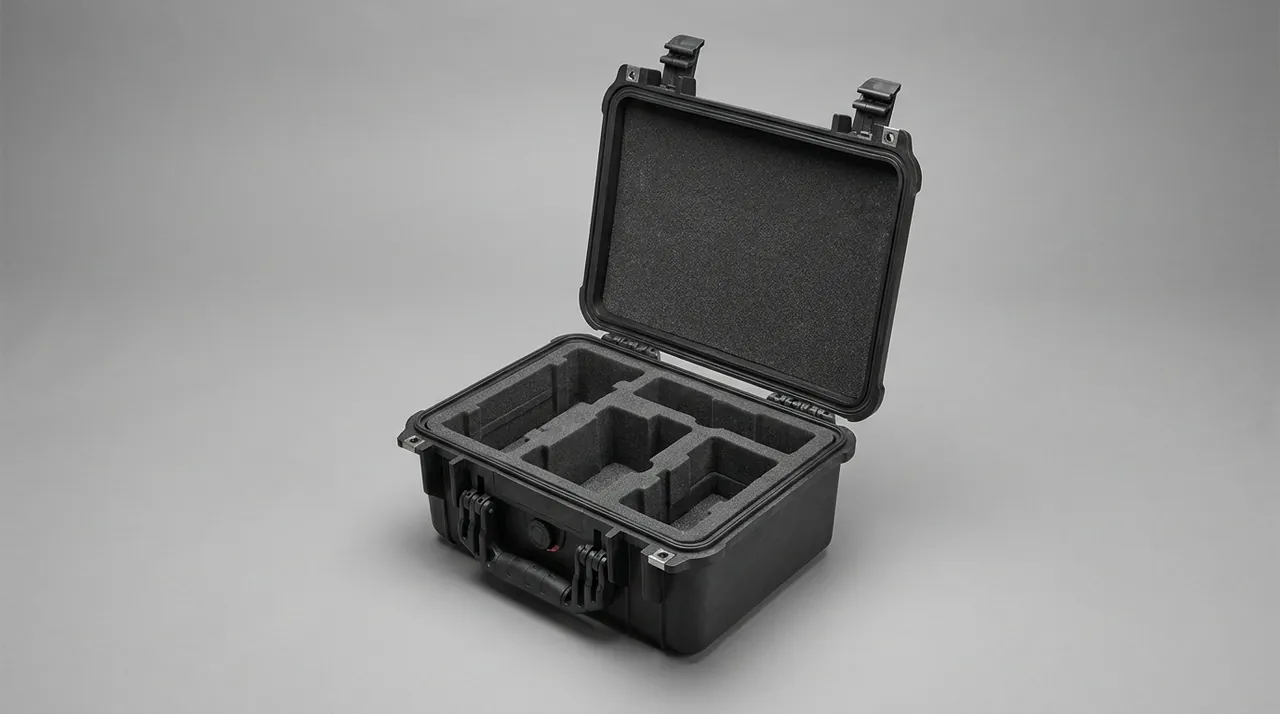
7. Case Structure and Material Selection
A polishing equipment case has to balance stiffness, weight, sealing, cleanliness, and static control.
Shell material. Common choices include high-impact copolymer polypropylene, modified engineering plastics, and glass-fibre reinforced composites. Copolymer PP offers good toughness, chemical resistance, very low water absorption, and easy cleaning, which suits polishing shops and warehouses. For assemblies above 500 kg or spindle cases longer than 1200 mm, a combination of steel skeleton and engineering plastic panels is normally required.
Flammability rating. Polishing shops contain wax dust, cloth lint, and electrical equipment, so an explicit flammability rating is worth specifying. UL94 is the widely used method for evaluating the burning behaviour of plastics, and the V-0, V-1, and V-2 classifications are commonly quoted in procurement specifications. Note that UL94 is a material-level evaluation; it is not equivalent to a finished-case fire certification and does not replace shop-level combustible dust management.
Cleaning and dust resistance. Polishing shops demand more of a case's dust-shedding and wipe-clean behaviour than general machining shops. External surfaces should be smooth with few recesses so that dust traps are minimised, and insert materials should be closed-cell so that they do not adsorb dust and polishing wax.
Hinges and latches. On a consumable case that opens frequently, hinges and latches are the first parts to fail. Structure, materials, and the sealing interface are covered in toolbox hinge, latch and seal design.
Seals. Gasket material must match the environment: nitrile rubber for oil resistance, silicone for a wide temperature range, and EPDM where weather and water vapour resistance dominate. Guidance is in case seal material selection.
Pressure equalisation valve. A sealed case develops a pressure differential under temperature change or air freight altitude, which makes the case hard to open and can crush the gasket. For polishing equipment cases that fly or cross climate zones, a pressure equalisation valve is necessary; the principle is explained in case pressure equalisation valve.
Internal partitioning. A polishing shop holds many spares across many batches, and a removable divider system allows flexible combinations and fast counting. The design logic is in case removable divider system.
Wheels and trolley handle. Below 150 kg, wheels and a telescopic handle markedly reduce manual handling strain, but the wheel structure consumes base volume and can affect stacking stability. Design points are in case wheels and trolley handle.
8. Insert and Locating Design: Upright and Cradle Storage for Wheels
Insert design is the technical core of a polishing equipment case. Wheel-type components are extremely sensitive to how pressure is applied, and the same shell with a different insert can deliver several times the protection, or almost none.
Principle one: a wheel must never be loaded across a full face. The end face of a polishing wheel is a working surface, and full-face loading compacts the cloth layers and collapses the end face. Locate the wheel by its bore with the end faces held clear, or use a curved cradle that contacts only a small part of the outer circumference.
Principle two: rigidity locates, elasticity cushions. Rigid members such as wood, engineering plastic, or metal framing restrain the six degrees of freedom, while elastic members such as foam, rubber, and air cushions absorb vibration and shock energy. Confusing the two roles is the most common insert design error. The underlying logic is set out in cushion liner design.
Principle three: separate compartments, not stacks. Multiple wheels in one case must occupy separate compartments, with enough clearance that faces never rub during loading and unloading. For flap wheels, orient all flaps the same way so that flaps are not crushed against each other.
Principle four: the loading action must be repeatable. The insert should bring the wheel to the same location every time. Use locating posts, corner stops, colour coding, and poke-yoke recesses.
Principle five: reserve space for desiccant and indicator cards. Moisture control depends on the desiccant being able to exchange with the air in the case. Reserve positions in the insert for desiccant and provide a viewing window for the humidity indicator card, rather than pushing the desiccant into a dead corner.
Upright versus cradle storage.
| Storage method | Suited to | Advantages | Risks and limits |
|---|---|---|---|
| --- | --- | --- | --- |
| Upright suspension on a bore post | Medium and large polishing wheels, flap wheels | End faces carry no load, best form retention | Needs height, locating post needs a clearance fit to the bore |
| Upright in compartments with side fences | Bonded wheels, medium wheels | Simple structure, easy loading | Needs anti-roll restraint and soft fence lining |
| Cradle (curved support) | Large heavy wheels | Controllable contact area, good stability | Cradle arc length must be limited to avoid full-face contact |
| Flat stacking | Nothing | High space utilisation | Prohibited: causes end-face collapse and bore distortion |
| Coiled and laid flat | Belts, non-woven rolls | Avoids creasing, easy to meter | Coil diameter must not be too small, stack height limited |
Special requirements for abrasive belts. Belts should be coiled or laid flat and must never be folded. When coiled, the inner diameter should not be too small, because excessive curvature cracks the abrasive layer. Different belt specifications belong in separate compartments so that abrasive layers do not rub together.
Spindles and polishing head assemblies. Slender spindles should be stored horizontally on multi-point supports spaced at no more than one third of the span, with axial end stops to prevent sliding. The chuck face and taper of a polishing head assembly are precision surfaces, so fit guards and sleeves and keep them away from other components.
9. Separate Compartments and Leak Control for Wax, Fluid and Chemicals
Chemicals used in a polishing shop include polishing wax, polishing paste, polishing fluid, coolant, and cleaning agents. The governing requirements in packaging are separation, leak containment, freeze protection, and contamination prevention.
The separation principle. Chemicals must be stored completely apart from metal parts, abrasives, and electrical components. A single leak causes three failures at once: it contaminates polishing wheels and belts, accelerates corrosion of metal parts, and damages the insulation of electrical components. Liquid containers belong in a dedicated compartment with a drip tray and an absorbent layer at the bottom.
Secondary containment. For containers above 5 L, use a container plus secondary containment arrangement. The secondary containment volume should exceed the container volume so that a total loss can be contained.
Temperature management. Water-based polishing fluids and coolants freeze and expand at low temperature, which can split a container, while wax-based compounds soften and distort at high temperature. Assess the temperature range on the route for cross-climate shipments, and use insulating pads or shift the shipping season where necessary.
Compatibility. Insert materials must be compatible with the chemicals carried. Some solvent-based polishing fluids attack ordinary foam and rubber, dissolving the insert and causing collapse. Request chemical compatibility data before selection and run an immersion test where needed.
Vapour and odour control. Solvent-based chemicals evaporate continuously and can build a noticeable concentration inside a sealed case. Ventilate when opening and avoid prolonged inhalation in an enclosed space. Label the case with the chemical name and hazard class.
Compliance note. If the chemicals being shipped are classified as dangerous goods, their packaging and transport must follow the applicable dangerous goods transport regulations. Good case sealing is not, by itself, a compliance basis. The framework is outlined in dangerous goods transport case compliance.
Labelling and documentation. Mark the chemical name, quantity, hazard class, and emergency contact on the outside of the case, and include a safety data sheet copy or a note stating where it is held.
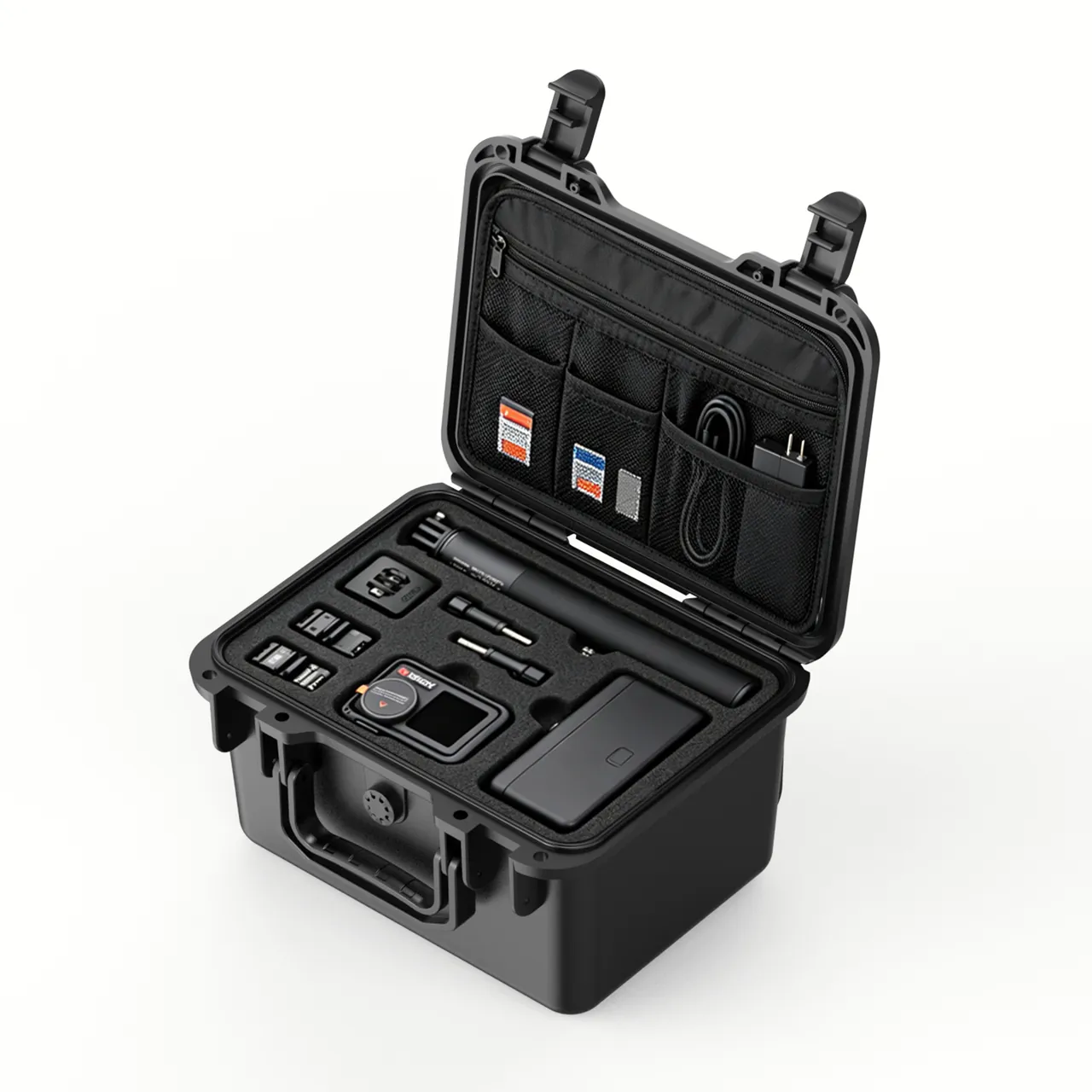
10. Moisture Protection for Motors and Electrical Components
Motors, drives, sensors, and control components on a polishing line are electrically sensitive items, and their protection priorities are completely different from mechanical parts.
Moisture and condensation come first. Moisture ingress into electrical components lowers insulation resistance, corrodes terminals, and creates short-circuit risk. On cross-climate transport, day and night temperature swings create condensation inside the case, and condensation forms preferentially on the cooler metal surfaces, which means the motor housing and the interior of the terminal box.
A combined approach.
- Sealed case plus desiccant. Use IP65 or higher sealing with adequate desiccant and a humidity indicator card.
- Pressure equalisation valve. A sealed case develops a differential under temperature change. A pressure equalisation valve allows gas to exchange slowly while blocking liquid water, and is a necessary fitting for electrical components.
- ESD packaging. Components containing circuit boards and sensitive devices should use antistatic packaging. The principles are covered in ESD shielding case design.
- Cushioning. Electrical components are usually housing structures containing fragile boards and connectors, so provide enough cushioning to limit acceleration.
Original packaging first. For bearings, encoders, and precision sensors supplied with factory rust-preventive or cleanroom packaging, keep the original packaging and place it in a separate case cavity, rather than stripping it and putting the part in with heavy components.
Handling after opening. Let electrical components reach room temperature before applying power, so that condensation cannot cause an instantaneous short. If the humidity indicator card has changed colour, carry out an insulation check before energising.
Vibration limits. Motor bearings and encoders are vibration sensitive, so acceleration levels in transit should be limited. For high-value electrical components, specify vibration and shock test conditions and acceptance criteria in the technical agreement.
11. Sealing and Ingress Protection: An IEC 60529 and GB/T 4208 View
For a polishing equipment case, sealing addresses four intruders: dust, water vapour, liquid leakage, and condensate. The classification framework is defined in IEC 60529 and its Chinese counterpart GB/T 4208.
| Rating | Dust | Water | Meaning for polishing equipment |
|---|---|---|---|
| --- | --- | --- | --- |
| IP54 | Limited dust protection | Splash | Dry shops, short moves, non-consumable parts |
| IP55 | Limited dust protection | Water jet | General machining shops with washdown |
| IP65 | Dust tight | Water jet | Polishing dust environments, long road transit, common default |
| IP66 | Dust tight | Powerful water jet | High-pressure washdown or heavy rain exposure |
| IP67 | Dust tight | Short immersion | Flooded road sections or long open-air transhipment |
| IP68 | Dust tight | Continuous immersion | Special cases, specify depth and duration |
Selection logic. Polishing shop dust is dense, fine, and strongly adherent, so consumable cases should be at or above IP65. IP67 is needed only when short-term immersion is a credible risk, for example a route across sections prone to standing water or an uncovered transhipment point in heavy rain. Moving to IP67 has side effects: a thicker gasket, higher latch preload, more effort to open, and a mandatory pressure equalisation valve, because otherwise the differential from temperature change makes opening difficult and fatigues the gasket.
Dust and the gasket. Polishing dust collects in the gasket groove, and over time that accumulation degrades sealing and accelerates gasket wear. Wipe the sealing face before every open and close, and clean the groove periodically. This is why polishing shops need more frequent gasket maintenance than general machining shops.
Sealing versus pressure equalisation. A high sealing rating creates a significant pressure differential. A case cycling between 45 C by day and 10 C at night builds a marked negative pressure, opening becomes hard work, and the gasket is repeatedly compressed and released. A pressure equalisation valve allows gas to exchange slowly while blocking liquid water and dust, and is standard practice above IP65.
Gasket maintenance and replacement. The gasket is a wearing part. Inspect it periodically for hardness, rebound, and set, and replace it when it hardens, cracks, or takes a permanent compression set. Matching gasket material to environment is covered in waterproof case IP protection and seal design.
Documentation. Ask the supplier for a rating verification statement, type test report, or third-party conclusion, and put the sampling rule into the contract. Sampling and acceptance practice is described in custom case acceptance and AQL sampling.
12. Transport Validation: GB/T 4857, ISTA and MIL-STD-810H
The protection actually delivered by an equipment case has to be validated by transport testing, not by opinion.
The GB/T 4857 series. This is the basic Chinese test method system for transport packages, covering vibration, shock, stacking, and drop, and it suits domestic road transport scenarios. The stacking test matters especially, because storage stacking loads usually exceed transport loads, and polishing wheels are highly sensitive to stacking load. Key points are in GB/T 4857 transport packaging test methods.
The ISTA series. ISTA publishes transport packaging test procedures organised by distribution mode and package form. For equipment cases shipped as unitised loads, the ISTA 3 series unitised load procedures are the closest match. See ISTA transport testing procedure.
ASTM D4169. This standard uses a distribution cycle framework that combines handling, stacking, vibration, and shock into a complete test sequence, which suits export projects and situations where the acceptance basis must be common across parties. See ASTM D4169 distribution cycle testing.
Where MIL-STD-810H fits. This is a United States military standard for environmental test methods, frequently cited outside ISO-based industries as an environmental test basis. It must be stated clearly that citing MIL-STD-810H methods is an environmental test basis only. It does not indicate military certification, and it does not indicate compliance with any national military procurement requirement. For polishing equipment cases, the thinking in Method 514 (vibration) and Method 516 (shock) is useful as design input, but the test conditions must match the project's actual transport profile rather than being copied.
Validation points.
- Survey resonance first. Polishing spindles and long cases readily couple with the low-frequency vibration of road transport, so run a modal or sweep survey to identify the dominant resonances.
- Never omit the stacking test. Polishing wheels and belts are highly sensitive to stacking load, and the stacking test is the key check on whether the insert support scheme is sound.
- Do a full functional check. After testing, inspect wheel roundness and end-face parallelism, bore distortion, belt creasing, spindle straightness, and the insulation condition of electrical components. Do not settle for whether the case itself survived.
- Keep traceable records. Test conditions, sample identity, inspection method, and verdict should all be retained.
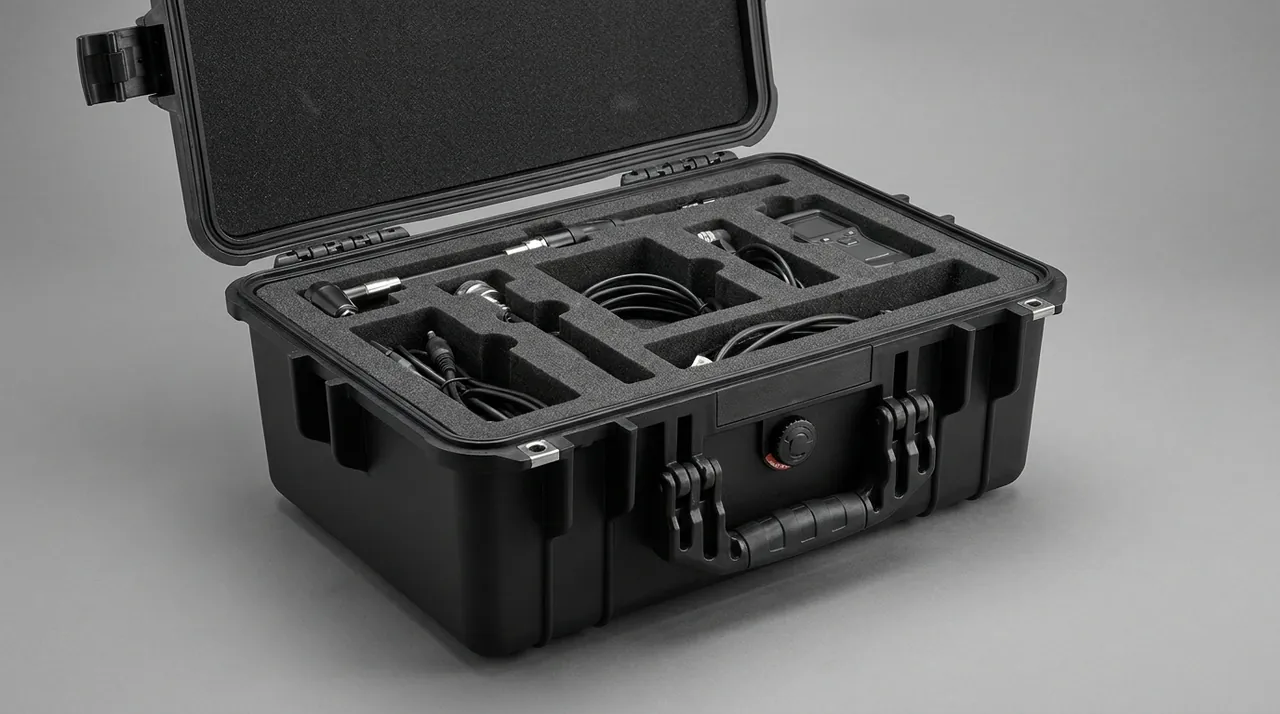
13. Cleanliness and the Food-Contact Boundary for Finished Cookware
Polishing consumables are not themselves food-contact materials, but they touch the final product surface directly. Cleanliness requirements must therefore be written into the packaging specification.
Where the boundary sits. Under the logic of food-contact material regulation, stainless steel cookware is commonly assessed against the GB 4806.9 series, with separate parts covering plastics and coatings. The compliance obligation ultimately lands on the finished cookware surface, not on the consumable. However, dust, oil, and metal debris carried by polishing wheels, belts, and waxes transfer to the finished surface through the polishing operation, producing black spots, haze, and loss of lustre. The core packaging requirement is therefore: introduce no dust, no oil, and no moisture, and ensure that the packaging materials themselves do not release transferable contamination.
Packaging material compatibility. Some foams, rubbers, and adhesives can release acidic species, plasticisers, or sulphides during long contact. Specify the composition and compatibility from the insert material supplier and run a small contact test where the risk is high. A comparison of materials is available in case foam material comparison.
Cleanliness control. Debris from CNC-cut foam is a classic contamination source. Inserts must be de-dusted and cleaned after machining; the assembly area must be free of airborne wood dust and cutting fluid mist; and operators should wear clean gloves.
Cleanliness and ISO 4406. ISO 4406 is the widely used method for coding solid particulate contamination in hydraulic and lubrication systems, expressing particle counts in size bands as a three-number code. Borrowing that logic for polishing consumable packaging has real value: the particulate contamination level inside the case and on the consumable surface can be specified as a cleanliness code plus a measurement method, rather than as an unverifiable statement that the insert shall be clean. Specify in the technical agreement that inserts are de-dusted after machining to the point where no visible particles remain; that no machining debris or adhesive dust is left inside the case; and that for the wheels and belts used on high-gloss cookware, surface particles are sampled and checked with a white-cloth wipe for visible residue. That turns cleanliness from a subjective impression into a decidable acceptance item.
Cleaning before case reuse. Polishing dust adheres strongly, so reusable cases and inserts must be thoroughly wiped and fully dried before every cycle. The method is described in how to clean a protective case.
Link to final inspection. Surface defect inspection on polished cookware typically relies on visual and lighting checks. The higher the gloss, the more readily it exposes the fine defects that polishing consumables introduce. Investment in packaging and cleanliness control therefore converts directly into a higher final inspection pass rate.
14. OEM/ODM Workflow, Acceptance and Reuse Management
Customisation workflow.
- Requirement input. Component list with wheel specifications, belt specifications, spindle dimensions, electrical component models, and chemical classes; 3D models or physical samples; circulation mode (in-plant, inter-plant, export); transport modes; environmental conditions; compliance requirements.
- Design. Case size, insert architecture, locating and cushioning scheme, chemical compartment scheme, sealing rating, static control requirements, and labelling scheme.
- Prototype and verify. Trial fit the first insert, check clearances, ease of loading, and how the wheel is loaded. For heavy wheels and spindle cases, run stacking and vibration tests.
- Pilot use. Run the case on the real circulation route for a period and collect unpacking records and mounting feedback.
- Freeze and produce. Release the drawing and process, then move to volume supply.
- Reuse management. Establish case numbering, cycle counting, replacement intervals for gaskets and inserts, and a cleaning procedure for chemical compartments.
Acceptance points. Insert fit tolerance, how the wheel is loaded (full-face contact or not), locating repeatability, gasket compression, latch preload, material flammability rating, static control requirements, VCI and desiccant expiry, and completeness of labelling. Build the sampling plan on AQL principles; the method is described in custom case acceptance and AQL sampling.
Reuse and life management. The hard shell normally lasts a long time, but inserts settle under repeated compression and gaskets age. Manage shell, insert, and gasket as three independent life items, and replace the whole case only when the shell cracks, distorts, or loses its closure function. The assessment approach is in protective case service life and reuse years.
Supplier selection. Polishing equipment cases are a classic non-standard custom plus volume supply category, so the supplier needs insert design, foam machining, case moulding or assembly, and test coordination under one roof. An evaluation framework is given in how to choose a protective case OEM factory.
What JUNZHJIA offers. As a brand of Kexin New Materials (Guangdong) Co., Ltd., JUNZHJIA supplies protective cases, tool boxes, and equipment cases to the cookware polishing and surface finishing industry on an OEM/ODM basis. Capabilities include conformal insert design and CNC machining from 3D wheel and spindle models, dedicated bore-located and end-face-clear pocket geometry for polishing wheels, sealed chemical compartments with drip trays, matched gaskets and pressure equalisation valves per case model, documentation supporting IP rating, material flammability rating, and transport testing, and volume acceptance against AQL rules.
Frequently Asked Questions
Q: What is the main form of damage to polishing wheels in transport?
A: The main forms are local end-face collapse and bore distortion. A polishing wheel is built from many layers of cloth or sisal bonded and compressed with adhesive, and the small voids between layers are exactly where its elasticity comes from. When a wheel is laid flat and loaded across its whole end face, or held under sustained static pressure, the cloth layers in the contact zone compact, the voids disappear, and a local collapse forms. This deformation does not rebound, and once the wheel is mounted it produces cyclic contact pressure fluctuation, which appears on the workpiece as chatter marks and local over-polishing. Bore distortion is the second common failure: flat stacking distorts the bore or raises burrs, and clamping becomes eccentric. Even a fraction of a millimetre of eccentricity is strongly amplified at operating speed. The correct approach is bore location with end faces held clear, or a curved cradle contacting only part of the outer circumference, and flat stacking must be prohibited.
Q: Why are abrasive belts so sensitive to moisture, and can a damp belt still be used?
A: A belt consists of a backing, an adhesive, and an abrasive layer, and all three are moisture sensitive. After moisture ingress the backing swells and then shrinks on drying, and that expansion and contraction generates internal stress between the abrasive layer and the backing, cracking and shedding the abrasive. The adhesive softens as it absorbs water, joint strength falls, and the belt is prone to breaking in service. A damp abrasive layer also loads up and loses cutting ability, which shows as reduced grinding efficiency and heat discolouration on the workpiece. Belts must therefore stay dry and sealed through the whole transport and storage chain. Deciding whether a belt can still be used cannot rely on appearance alone. Check whether the backing feels soft, whether the joint shows any lifting, and whether the abrasive layer has shed patches. If any of these signs are present, do not continue using the belt even if it looks normal, because a belt breaking at speed is a personal injury hazard. Fit desiccant and a humidity indicator card in the case, and check the indicator before releasing the belt to production.
Q: Can polishing wheels and bonded grinding wheels share one case?
A: Mixing is not recommended, especially between large polishing wheels and resin or vitrified bonded grinding wheels. There are three reasons. First, the loading requirement differs: a polishing wheel needs its end faces held clear, while a bonded wheel normally needs upright compartments with soft end pads, and one case cannot satisfy both locating requirements at once. Second, weight and hardness differ greatly. A bonded wheel is brittle, so contact with, or impact from, a heavier polishing wheel can cause edge chipping or internal cracking, and a cracked wheel carries a serious burst risk at operating speed. Third, the contamination path differs: abrasive debris from a bonded wheel attaches to the cloth layers of a polishing wheel and then scratches the workpiece. The engineering answer is to pack by component class, or to divide one case into fully independent chambers using rigid partitions and ensure no load path crosses between chambers. For small mixed batches, a removable divider system can be used, but it must be validated and each compartment clearly labelled with the component class it carries.
Q: How should polishing wax and polishing fluid be packed?
A: Four requirements govern: separation, leak containment, freeze protection, and contamination prevention. Separation means chemicals must be stored completely apart from metal parts, abrasives, and electrical components, because a leak contaminates polishing wheels and belts, accelerates corrosion of metal parts, and damages electrical insulation. Leak containment means liquid containers belong in a dedicated compartment with a drip tray and an absorbent layer, and containers above 5 L should use a container plus secondary containment arrangement whose volume exceeds the container volume so that a total loss can be contained. Freeze protection means water-based polishing fluids and coolants freeze and expand at low temperature and can split a container, so assess the temperature range on the route and use insulating pads or shift the shipping season. Contamination prevention means the insert material must be compatible with the chemicals carried, since some solvent-based polishing fluids attack ordinary foam, so request chemical compatibility data before selection. Finally, if the chemicals are classified as dangerous goods, packaging and transport must follow the applicable dangerous goods regulations, and good case sealing alone is not a compliance basis.
Q: Can an equipment case replace combustible dust management in a polishing shop?
A: No, and the two scopes must be kept clearly separate. Polishing and belt grinding generate polishing debris, spent abrasive particles, wax dust, and cloth lint, and some of this dust is combustible and prone to static accumulation. Its explosion risk classification, dust concentration limits, and hazardous area zoning should be assessed professionally by the plant safety function using material composition, particle size distribution, and process conditions, and then controlled through dust extraction systems, explosion-protected electrical equipment, hot work controls, and a dust cleaning regime. A case contributes to one part of that picture, namely contamination control and static control. A sealed case and insert keep polishing consumables from adsorbing shop dust and oil mist during storage and circulation. Sealing plus desiccant controls internal humidity and protects belt backings and wheel adhesive. Inserts with antistatic properties reduce electrostatic discharge risk in dust-laden environments. Rigid locating preserves wheel form. But case selection is not a basis for reducing dust explosion risk, and it cannot replace grinding wheel guards, speed limiting devices, or personal protective equipment rules.
Q: What do motors and electrical components on polishing equipment fear most in transport?
A: Condensation comes first, ahead of dust and vibration. On cross-climate transport, temperature swings inside the case cause water vapour to condense on the cooler metal surfaces, and the motor housing and the interior of the terminal box are exactly the cool places that are hard to wipe. Once condensation occurs, insulation resistance falls, terminals corrode, and a short circuit can occur at the moment power is applied. Use four measures together. First, specify sealing at IP65 or higher with adequate desiccant and a humidity indicator card. Second, fit a pressure equalisation valve so that gas can exchange slowly while liquid water is blocked and the differential from temperature change stays manageable. Third, use antistatic packaging for components containing circuit boards and sensitive devices. Fourth, provide enough cushioning to limit acceleration. Follow original packaging first as a rule: bearings and encoders supplied with factory cleanroom and rust-preventive packaging should keep that packaging and go into a separate cavity. After opening, let the component reach room temperature before energising, and if the humidity indicator card has changed colour, carry out an insulation check first.
Q: What ingress protection rating should a polishing consumable case have, and is IP65 enough?
A: For consumable cases in a polishing shop, IP65 - dust tight and protected against water jets - is normally the right starting point, and going below it is not advisable. Polishing shop dust is dense, fine, and strongly adherent, and a case with an ordinary rating struggles to keep it out. Once dust attaches to the cloth layers of a polishing wheel or the abrasive layer of a belt, it causes scratching and loading. IP67 is needed only when short-term immersion is a credible risk, such as a route across sections prone to standing water or an uncovered transhipment point in heavy rain. Moving to IP67 has side effects: a thicker gasket, higher latch preload, more effort to open, and a mandatory pressure equalisation valve, because otherwise the differential from temperature change makes opening difficult and fatigues the gasket. Note also that polishing dust collects in the gasket groove, where accumulation degrades sealing and accelerates wear, so wipe the sealing face before every open and close and clean the groove periodically. That is why polishing shops need more frequent gasket maintenance than general shops.
Q: How long does a polishing spare parts case last, and when do inserts need replacing?
A: Manage shell, insert, and gasket as three independent life items. The shell usually lasts longest; provided it shows no cracks, no obvious distortion, and no structural damage at the closure, it can serve for years, with life driven mainly by cumulative handling cycles and load level. Insert life depends on compression frequency and static load duration. Foam gradually loses rebound, which shows up as looser wheel pockets and reduced locating repeatability. Where wheels are carried on a curved cradle or soft pad, pad collapse directly changes the contact area, so that area deserves particular attention. The gasket is a wearing part; ageing appears as hardening, cracking, loss of rebound, and permanent compression set, and in a polishing shop it also wears faster because of abrasive dust. Desiccant and humidity indicator cards have defined service lives and must be replaced on the interval stated on the label, and the drip tray and absorbent layer in a chemical compartment should be inspected and replaced after each use. Recording these items in a case log alongside unpacking records produces a predictable maintenance rhythm.
Q: Can the insert material in a polishing equipment case affect food-contact compliance of finished cookware?
A: A polishing consumable case is not itself a food-contact material, and the compliance obligation ultimately rests on the finished cookware surface, typically assessed against the GB 4806 series for stainless steel products, with separate parts for coatings and plastics. However, there is an indirect link, and three risk categories need managing. The first is dust transfer: if the insert is open-cell foam or a friable material, its debris can attach to polishing wheels and belts and then transfer to the finished surface through polishing, producing black spots and haze. The second is oil and plasticiser transfer, since some foams and rubbers can release plasticisers or acidic species during long contact. The third is moisture transfer, where a hygroscopic insert carries water to belts and wheels and indirectly degrades polishing quality. The engineering response is to require the insert material supplier to declare composition and compatibility, to prefer closed-cell materials that do not adsorb dust, to complete cleaning and drying before packing, to have operators wear clean gloves, and to clean and fully dry cases and inserts before every reuse. A material comparison is available in the related reading below.
Conclusion & Related Reading
The essence of polishing and surface finishing case protection is turning invisible loss into a managed process. Wheel end-face collapse, cloth layer separation, damp belts, and bent spindles do not announce themselves the way a cracked case does, yet their effect on the line is more direct and more expensive: runout at start-up, chatter marks, rework, and even the safety risk of a belt breaking or a grinding wheel bursting.
A competent cookware polishing and surface finishing case has to solve five things at once: rigid locating to restrain the degrees of freedom, elastic cushioning to absorb vibration, sealing and desiccant to control moisture, separated and leak-contained compartments for chemicals, and cleanliness with traceability to build the evidence chain. For engineering and procurement teams, the productive comparison is not unit price but total cycle cost: arrival form-accuracy pass rate, mounting and dial-in time, rework and scrap volume, safety exposure, and case reuse cycles.
Related Reading