

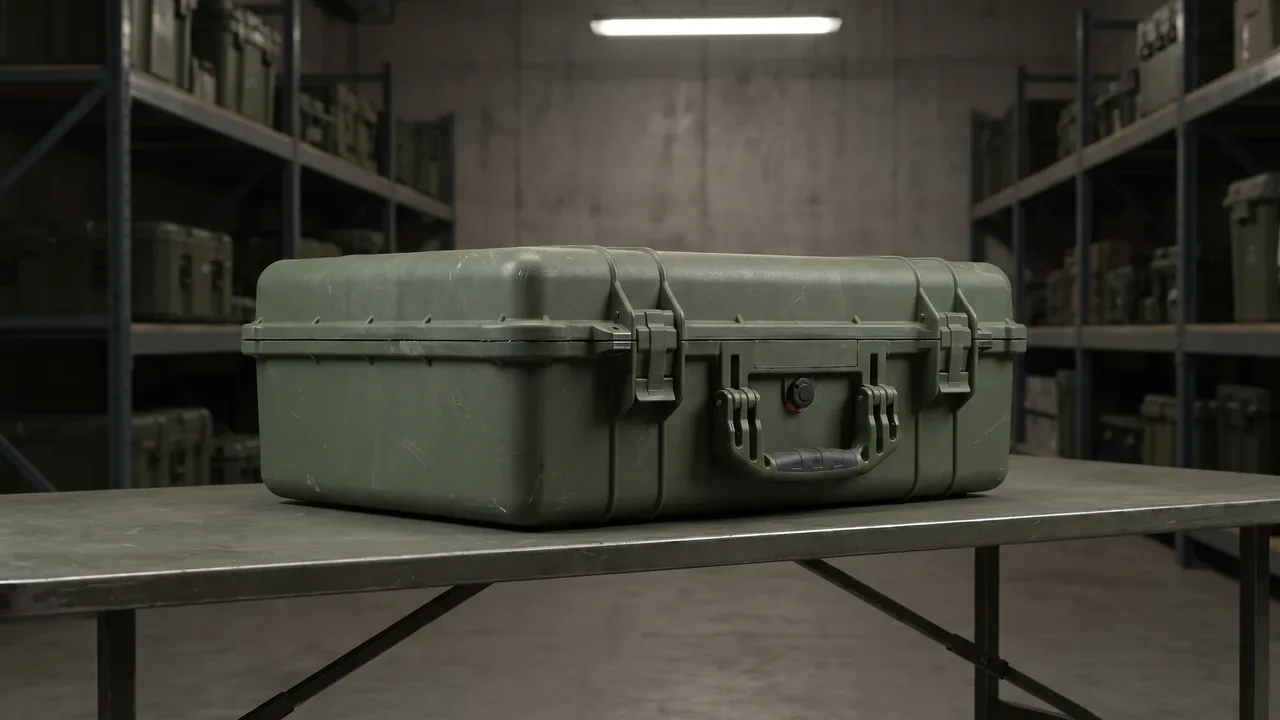
In the daily operation of the civil explosives industry, the explosive storage box and the explosive storage case are usually treated as supporting actors. Attention goes to registers, permits and operating procedures, while the container that actually holds the material is reduced in the mind to a "sturdy steel cabinet." As a protective case manufacturer serving civil explosives companies and engineering blasting contractors, JUNZHIJIA has observed a recurring pattern: once a container loses ground in structural design, even a well-built front-end compliance system can be defeated by a single episode of moisture ingress, static accumulation or seal failure. The value of an Explosive Storage Box is not that it "looks thick." It is that every structural feature maps to a verifiable risk-control requirement.
This article deals only with the engineering of the packaging container itself: static-dissipative and conductive structures, flame-retardant materials, blast mitigation and pressure-relief openings, sealing and moisture control, locks and tamper-evident seals, marking and traceability, and regulatory conformity. One point must be stated clearly at the outset. This article addresses compliant packaging containers for the civil explosives and engineering blasting industries, and its scope is strictly limited to the structure, materials and certification of the container. Local regulations and export control requirements prevail; this article discusses packaging containers only. Anything concerning the nature or handling of the material itself falls outside our scope.
Why Container Structure Becomes the Weakest Link in Compliance
From an engineering failure standpoint, container problems rarely announce themselves as a dramatic shell rupture. Far more common is gradual degradation: a gasket that hardens under ultraviolet light and ozone, letting trace moisture be drawn in and out with the day-night temperature swing; a conductive coating that wears away locally so that grounding resistance creeps upward; a latch that develops play after repeated cycling, costing a seal its uniqueness; a bottom case that creeps under a stack taller than it was designed for. None of these changes is visible in a single inspection, yet over months they accumulate into material risk.
The difficulty for civil explosives companies and blasting contractors is that containers are used daily by non-specialists, and inspection relies on eyes and hands. Design margin must therefore be pushed forward into the drawing stage. When JUNZHIJIA reviews requirements with a customer, we recommend breaking every container function into a measurable indicator: surface resistance, sealing class, number of lock points, seal positions, stacking limit, lifting-point locations. Only when these indicators reach the specification sheet does acceptance testing and periodic re-checking have a basis.
The container is the one link in the storage and transport chain that is touched every single day. It is both the easiest element to overlook and the easiest to make deterministic through design. Getting the container right is equivalent to transferring part of the risk from people to structure.
It is worth noting how this affects lifecycle cost, because procurement decisions are often settled on purchase price alone. A cheaper case that loses its seal after two seasons, or that must be replaced because a coating wore through, costs far more across its service life than a well-specified unit that survives a decade. The costs hide in places that never appear on a quotation: re-packing labour, repeated humidity checks, rejected shipments, audits that fail on documentation, and the indirect cost of an incident that a slightly better design would have prevented. When JUNZHIJIA helps a customer build a selection model, we separate first cost from service-life cost and treat the container as capital equipment rather than a consumable. That framing usually changes the answer, because the difference between a merely acceptable case and a genuinely compliant one is often a modest percentage of price spread over many years of use.
The Product Spectrum of Explosive Storage Boxes and Explosive Storage Cases
Chinese usage does not draw a strict line between "box" and "case," but in engineering terms the two correspond to different scenarios. What is generally called an explosive storage box leans toward a fixed or semi-fixed unit, larger in capacity, used indoors on shelves or in stacks, with emphasis on load bearing, stacking and long-term sealing. An explosive storage case, by contrast, tends toward a mobile container that one person can carry or move a short distance, with emphasis on handles, overall weight, cycling frequency and seal uniqueness. The trade-offs are not the same.
By material, the common spectrum includes steel containers, aluminum containers, rotomolded HDPE containers and injection-molded engineering plastic containers. Steel offers high strength and stiffness and suits load-bearing indoor units. Aluminum compromises between weight and rigidity, which helps where frequent handling occurs. Rotomolded HDPE is formed in one piece with no weld seams, resists impact and chemical attack, and is a common choice for outdoor and humid environments. Injection-molded engineering plastics suit standardized volume production with good dimensional consistency. The worst approach is to force one case to cover every scenario; define the environment first, then let it decide material and structure.
At project kickoff, JUNZHIJIA confirms three things with the customer: whether the container is fixed or travels with the job, the humidity and temperature range of the environment, and whether it must plug into an existing asset-register system. Those three answers determine almost every structural choice that follows.
Choosing Shell Material: Steel, Aluminum, Rotomolded HDPE and Engineering Plastics
Steel shells are usually cold-rolled sheet, bent and welded, stiffened with internal ribs, then powder-coated or galvanized against corrosion. Their advantage is load-bearing capacity per unit cost, plus easy integration of mechanical locks and hinges. Their weakness is weight, and the fact that a chipped coating at a dented corner becomes a starting point for rust. Aluminum shells, assembled from extruded profiles or sheet, cut weight substantially, but welding and riveting demand higher process control, and a scratched anodized layer also opens the door to corrosion.
Rotomolded HDPE is the fastest-growing category in recent years. Its one-piece process removes weld seams and joints by nature, wall thickness can be thickened locally, drop and impact performance is stable, and the material resists most acids, alkalis and salt spray. Its limits are stiffness below that of metal, so long unsupported walls rely on structural ribs and internal bracing to control deflection, and rotational molding tolerances are looser than injection molding, so precision liners need compensation allowance. Injection-molded engineering plastic cases suit small-to-medium sizes at high volume, achieving the lowest unit cost once tooling is amortized, at the price of higher upfront tooling and design-freeze cost.
Whatever the material, buyers should require the supplier to state the material grade, batch traceability and key mechanical indicators, rather than accept a vague adjective such as "high strength." For a detailed comparison of plastic systems, see engineering plastics versus metal case materials; for how wall thickness drives overall strength, see case wall thickness and structural strength.
Engineering a Static-Dissipative and Conductive Structure
In civil explosives and hazardous-goods storage, static control is the one element of container design that cannot be left vague. Engineering practice does not aim for a "conductive case"; it aims for a continuous, controlled and verifiable discharge path. Three approaches are common. A metal shell may be bonded directly, with a grounding terminal tying the case into the facility grounding network. A plastic shell may incorporate conductive filler into its surface or liner to create a controlled surface-resistance band. Alternatively, a conductive liner or conductive mat inside the case may keep the load and its bearing surface at equal potential.
The design point is continuity. If a conductive coating breaks at a hinge, latch or stacking face, the entire path becomes decorative, so those wear locations usually need extra conductive structure and abrasion treatment. The grounding terminal must be easy to inspect and clean, not buried under coating or hidden by the liner. Surface resistance should be an outgoing quality inspection item and should be re-measured periodically in service, because coating wear is a time-dependent process.
For how hardware and lock selection works alongside conductive structure, see the overall structural design of a military security case. Once again, this section addresses how the case dissipates static charge as a container-engineering matter and touches nothing at the material level.
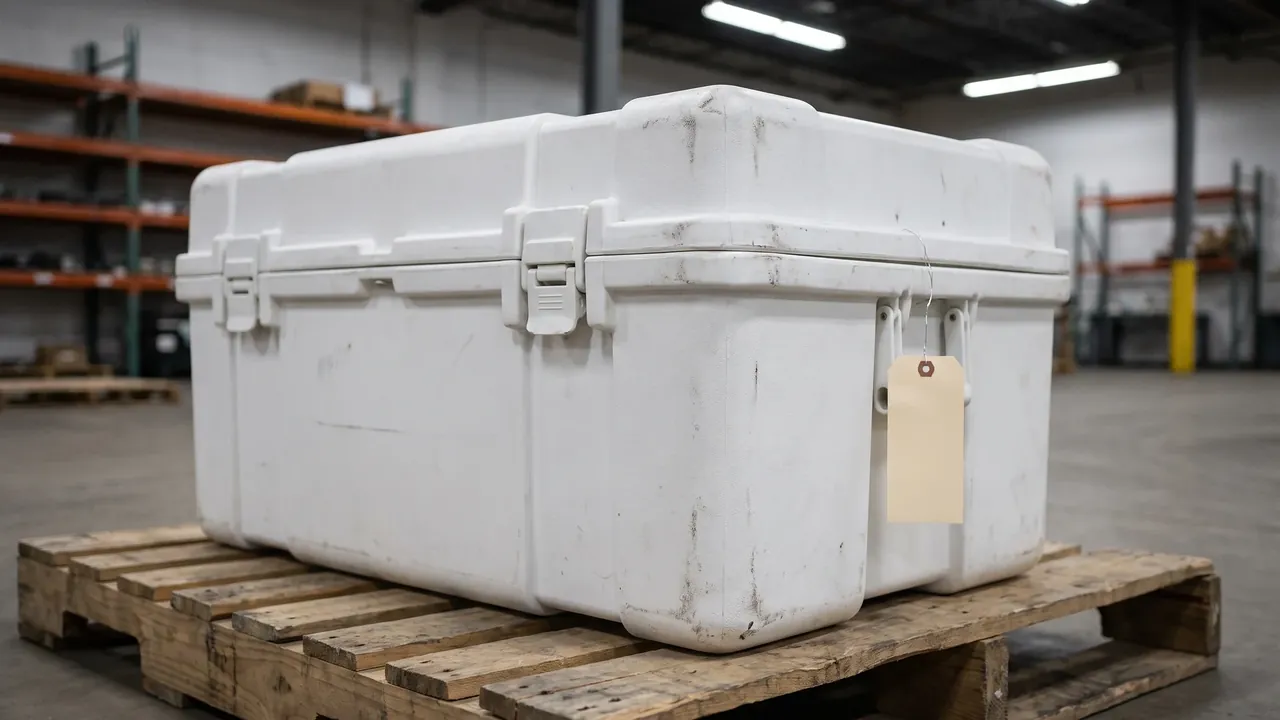
Mapping Flame-Retardant Materials and UL94 Ratings onto the Case
UL94 is the common method for rating the flammability of plastic materials, and V-0 and 5VA are frequently used as material entry thresholds. V-0 requires a specimen to self-extinguish within a short time after the flame is removed and not to drip material that ignites cotton. 5VA subjects a thicker specimen to a longer, more severe flame exposure and assesses whether the material is burned through. For a case, the material rating is only the starting point. Structure decides actual performance: wall thickness, rib distribution, internal cavities and ventilation paths all change how flame spreads.
A frequent procurement mistake is to read "material rated V-0" as "the whole case meets the flame requirement." In reality a case is made of many materials: shell, liner, gasket, handle, label. A gasket in ordinary rubber may fail before the shell does under heat; a liner in non-flame-retardant foam becomes a weak point as well. The specification should therefore list the material and flame rating of every component individually instead of a single blanket line stating "flame-retardant case."
There is also tension between flame retardancy and other properties. Adding flame retardants can lower impact strength and low-temperature performance, and introducing conductive filler can affect mechanical behavior. The mature approach is to demand a complete test report for the same material batch and to validate key components as an assembly, rather than clearing only the material level. For the general test framework applied to military-grade containers, see military standard case compliance.
The Design Logic of Blast Mitigation and Pressure-Relief Openings
In extreme situations a container must face a sudden internal pressure rise and external impact. The engineering response is not to make the case infinitely thick. It is to route pressure through a controlled relief path toward a safe direction. This includes relief openings, relief membranes or directed venting channels at specific locations, so that overpressure releases preferentially in a predetermined direction instead of accumulating chaotically within the structure and causing breakup.
Relief design must answer three questions: how the opening pressure is set, where the relief is directed, and whether the container still maintains overall restraint afterward. Too low an opening pressure defeats daily sealing and invites moisture; too high and the protection loses meaning. The relief direction must avoid personnel walkways and adjacent containers. And relief is not the same as breakup: the structure should remain broadly intact after venting, preventing flying components from causing secondary injury. These points require both finite-element analysis and physical testing.
Note that relief openings and sealing performance conflict by nature, so they are usually handled by zoning. The primary sealing zone maintains the IP rating, while an independent relief zone stays closed under normal conditions and actuates only at the set pressure. That division keeps the container dust-tight and moisture-resistant in daily use while giving it controlled release under abnormal conditions. For the related pressure-compensation concept, see the role of a case pressure equalization valve.
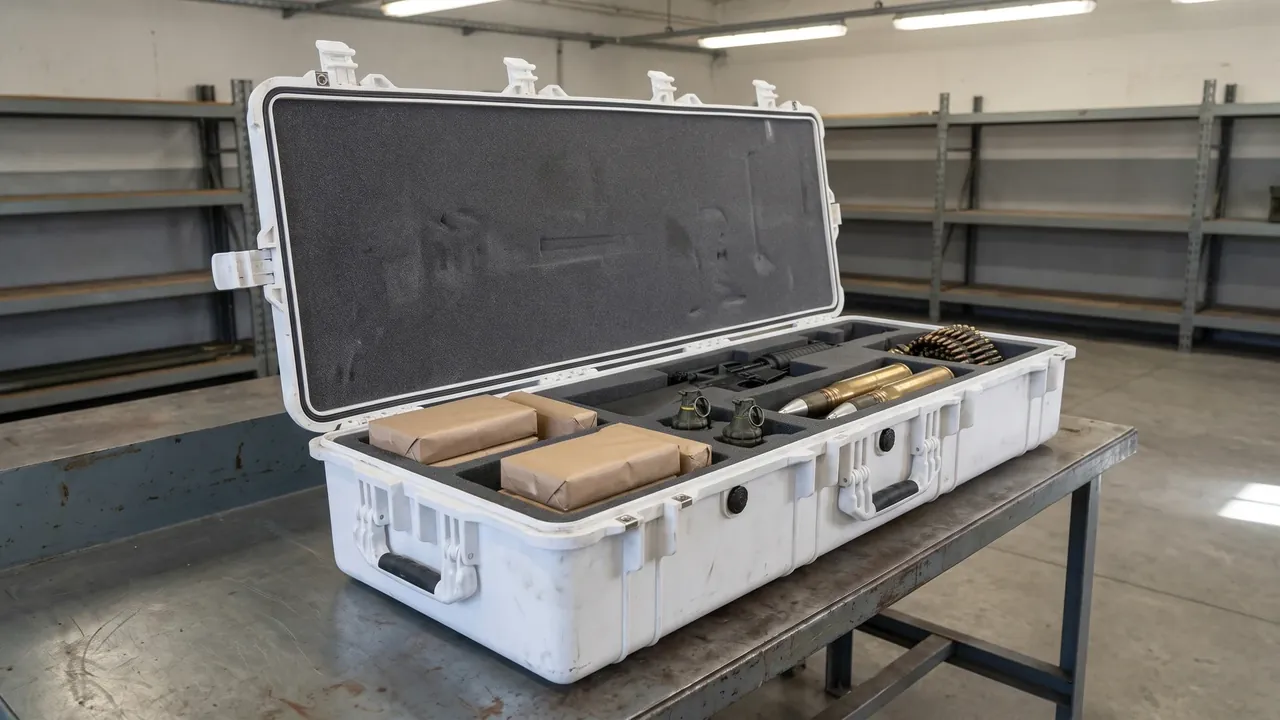
Sealing, Moisture Control and IP Protection Ratings
The IP rating is the common language of container protection. For a storage container used outdoors or in humid conditions, IP65 usually means dust-tight and resistant to water jets, while IP67 requires no water ingress after short immersion. Note that an IP rating describes enclosure protection, not internal humidity control. An IP67 case that seals moist air inside on a hot, humid day will still form condensation on inner walls as it cools.
The answer is to design external exclusion and internal dehumidification separately. External exclusion depends on gasket material and compression, sealing-groove machining accuracy and the distribution of latch clamping force. Gaskets are usually EPDM or silicone; the former excels in weather resistance, the latter in temperature range. Groove tolerance and lock-point count determine whether gasket compression is uniform; sparse lock points create a low-compression zone at the middle of a long edge, which becomes the entry point for leakage. For gasket selection logic, see case seal materials compared.
Internal dehumidification relies on the combination of desiccant and a pressure equalization valve. The valve permits gas exchange while blocking liquid water, preventing a negative-pressure condition that would suck the gasket inward when temperature or altitude changes; the desiccant adsorbs residual moisture, and its quantity and replacement interval should be calculated from internal volume and target humidity rather than guessed. At acceptance, gasket compression, lock-point count and desiccant configuration should all appear on the checklist.
Verifying a sealing claim requires more than a quick visual check. A hydrostatic or immersion test at the rated condition is the only way to confirm IP performance, and it should be done on a production sample rather than a hand-built prototype, because process variation is what makes real shipments fail. Compression can be measured with a gauge and recorded; lock clamping force can be checked with a spring scale at each point and compared against a target band. The reason to insist on numbers is that gasket performance degrades silently, and a case that seals perfectly on day one can begin to pass moisture after the first hot season. Periodic re-testing, recorded in a maintenance log, converts an invisible failure mode into a visible trend that a maintenance team can act on before a problem reaches the shelf.
Cushioning Liners and Retention Geometry: EVA, EPE and EPDM
Contents inside a container are not static; vibration and shock in transit travel through the liner. A liner serves two purposes: cushioning, absorbing energy through compressible material, and retention, constraining movement through geometry so contents do not repeatedly strike the interior. Cushioning without retention still lets contents shift and eventually suffer damage after repeated trips.
High-density EVA foam rebounds slowly and can be die-cut precisely, suiting stable support and long-term shape retention. EPE pearl foam is light and inexpensive with good cushioning, but rebounds quickly and tends to collapse under sustained load. EPDM rubber stands out in weather and temperature resistance and is often used alongside sealing or where long-term elasticity is needed. Real designs usually combine them: EVA as the structural support layer and retention blocks, EPE as the compliant cushioning layer, and EPDM locally where weather-resistant elasticity matters.
Liner design should be based on actual transport conditions, including drop height, vibration spectrum and stacking pressure. Where containers are shipped as full boxes, consider whether the liner will creep under long-term compression. JUNZHIJIA usually recommends a simulated transport test before liner delivery to validate the match between retention geometry and cushioning thickness. For military environmental test methods, see MIL-STD-810H compliance.
Locks, Seals and Tamper-Evident Design
A lock is the only physical proof that a container is switching between "in use" and "not in use." Civilian and industrial settings commonly use mechanical locks, padlocks and built-in cam locks. A mechanical lock is integrated into the case for convenient operation, but key management becomes complex. A padlock can be held by more than one person, supporting two-person control. A cam lock works with the gasket, compressing the seal while closing, and suits cases with airtightness requirements. Which to choose depends on on-site management rules, not strength alone.
Tamper-evident design extends the lock. Reusable numbered seals, one-time breakaway seals and serialized locks all leave a record of any abnormal opening. The key is uniqueness: the seal number must map one-to-one to the asset register, must be unrecoverable after breaking, and the seal position must be located so the case cannot be opened without destroying the seal. If a removable screw or hinge pin sits beside the seal position, the whole tamper-evident chain is meaningless.
High-value or high-sensitivity contents commonly use two-person, two-lock control plus a seal, a three-layer arrangement that requires independent lock points. Two locks must not share a single load-bearing member, or breaking one point would release both protections at once. For lock and seal customization options, see case lock customization options.
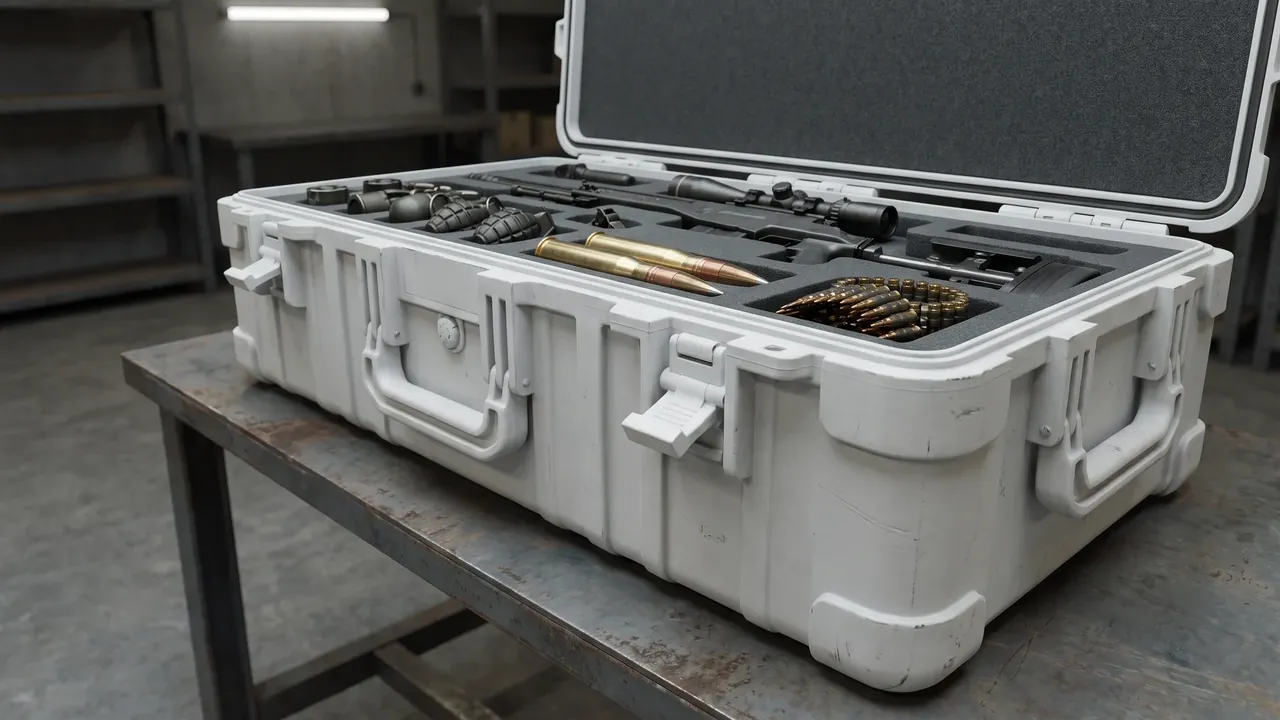
VCI Corrosion Protection and Desiccant Configuration
Metal components face corrosion risk during long storage, especially in containers that see day-night temperature swings and humid seasons. VCI (vapor corrosion inhibitor) technology releases inhibitor molecules that form a protective atmosphere inside a closed space, reaching gaps and cavities that are hard to coat. Its advantage is that it does not rely on oil films, and no cleaning is needed after opening, which suits cases that must be accessible while remaining free of grease.
VCI effectiveness depends heavily on enclosure tightness. If the case cannot maintain basic sealing, inhibitor molecules escape quickly with gas exchange and VCI becomes decorative. VCI and sealing class must therefore be matched. A common approach is to line the interior wall with VCI film or place VCI emitters, together with a desiccant to control humidity. Desiccant and VCI quantities should be calculated from internal volume, target relative humidity and storage duration, then verified by periodic humidity-indicator card checks.
Note that more VCI and desiccant is not always better. Excessive desiccant can embrittle some non-metallic materials, and VCI carrier materials must be compatible with the contents. The specification should state compatibility validation requirements rather than merely demanding that "VCI be installed."
Marking, RFID Traceability and Asset-Register Integration
In compliant storage and transport, "where is this case, what did it hold, when was it opened" must be traceable. Container marking is therefore no longer just a printed number; it is a data entry point linked to a register. A basic solution is a durable label carrying asset number, QR code and safety warning. An advanced solution is an RFID or NFC chip supporting bulk inventory and automatic check-in/check-out records, reducing manual entry error.
Marking design must consider durability and environmental adaptation. Ink-jet coding on a wear surface wears away quickly, and ordinary paper labels peel off in damp conditions, so label substrate, adhesive and lamination must be chosen for the environment. RFID on a metal shell must account for metal interference with radio frequency, usually via an anti-metal tag or isolation layer. A plastic shell is freer, though the contents inside can affect read range.
The value of a traceability system is the closed loop: the tag is only the entrance, and real compliance comes from recording every opening and handover. At procurement, confirm whether the container reserves a marking position, whether it accommodates electronic tags, and whether the numbering rule can connect to the existing asset system. For marking and register integration, see case asset QR code tracking.
Stacking, Lifting and Forklift Interfaces
Once a container leaves the warehouse and enters transfer, it meets stacking pressure and mechanical handling. The core of stacking design is load transfer: the upper weight should pass through corner posts or ribs directly into the lower case's load-bearing structure, not press on the lid or wall. If the load path is discontinuous, the lid deforms under stacking and sealing fails with it. Stacking tests must therefore be run at the maximum design layer count and maximum load, verifying the bottom case's deflection and sealing retention.
Lifting and forklift interfaces determine whether handling creates localized stress concentration. Lifting lugs, sling channels and forklift pockets must match on-site equipment in position and size, and load points need adequate reinforcement. Common problems include forklift pockets that do not match fork tines, letting the case be punctured or dropped during lifting, and lifting points offset from the center of gravity, tilting the case in suspension. The design stage should fix the maximum lifting load and center of gravity and mark them on the case.
Where palletized transport is required, container dimensions should align with standard pallet modules to improve fill rate and stability. For stacking and load planning methods, see case stackability and pallet planning; for validating stacking load, see stacking load testing for cases.
Regulatory Conformity and Export Packaging Certification
Container conformity is governed by several layers: domestic rules on civil explosives management, international packaging requirements for dangerous goods transport, and, on export, the destination country's market-access and control rules. These requirements are not unrelated; they tend to point at the same engineering attributes — sealing, strength, leakage protection and marking. Designing a container to a high standard therefore often yields commonality across several regulatory regimes.
For dangerous goods transport, the packaging performance test system established by the United Nations Recommendations on the Transport of Dangerous Goods, covering drop, stacking, airtightness and hydrostatic tests, is an important design reference; regional regulations such as ADR refine it further. Buyers should require the supplier to state the regulatory clauses and test levels the container is intended to meet, with third-party test reports. For dangerous goods container requirements, see hazardous goods transport case compliance; for export packaging certification details, see ammunition transport box certifications.
It must be stressed that regulations are continually updated and differ markedly by country and region. Local regulations and export control requirements prevail; this article discusses packaging containers only. Before signing, buyers should verify applicable clauses with legal and customs teams rather than copying someone else's old specification.
Supplier Auditing and Acceptance Criteria
Choosing a container supplier is essentially choosing a sustainable quality system. An audit should cover four levels: material traceability, meaning material certificates and batch traceability; process capability, meaning whether rotational molding, injection molding, sheet metal and welding are under in-house control; testing capability, meaning equipment and records for sealing, drop, stacking and static testing; and change management, meaning whether material or process changes are notified to the customer and re-validated.
At acceptance, key indicators should be converted into executable items: surface resistance and grounding continuity, gasket compression, lock-point count and clamping force, seal-position uniqueness, stacking-limit marking, lifting-point load marking, liner fit clearance. Visual inspection is only supplementary and cannot replace testing. For volume orders, there should also be a sampling plan defining sample size and acceptance rules.
A factory audit is most useful when it looks at evidence rather than capability claims. Ask to see the material certificates for the batch actually in production, not a generic datasheet. Ask how the sealing groove is machined and what tolerance is held, then ask to see the measurement record. Ask what happens when a test fails, and who signs the rework. A supplier that answers these questions with documents is very different from one that answers with adjectives, and the difference shows up years later when a replacement batch must match the original. Where possible, visit the line during a production run for your own order, because a factory that is clean, organised and instrumented on an ordinary day is a far better bet than one that stages a tour.
In practice, the most common procurement error is comparing only price and only thickness while ignoring the design-validate-record loop. JUNZHIJIA recommends bringing containers into a supplier quality management system and requiring first-article reports and periodic re-inspection records. For typical procurement pitfalls, see case procurement pitfall checklist; for writing tender documents, see writing a case tender specification.
Explosive Storage Boxes: Frequently Asked Questions (FAQ)
Q: What is the most fundamental design difference between an explosive storage box and an ordinary industrial toolbox?
A: The most fundamental difference is not wall thickness but verifiability. An ordinary toolbox aims to hold things and be carried, and its indicators are mostly dimensions and load. Every structural feature of an explosive storage box, by contrast, must map to a measurable, re-checkable risk-control requirement: a surface-resistance band, grounding continuity, gasket compression, lock-point count, stacking load. These indicators must reach the specification sheet, appear in outgoing inspection reports, and be re-measured periodically in service. Because such containers are used daily by non-specialists whose inspection tools are limited to eyes and hands, design margin has to be pushed forward into the drawing stage, replacing human judgment with structural certainty. A container can look thick and still fail, and it can look unremarkable and still pass, because acceptance rests on numbers rather than impressions. That single shift changes what the buyer must write down, what the factory must measure and what the inspector must record. When JUNZHIJIA takes on these projects, we first clarify the customer's usage scenario and inspection capability, then decide between steel, aluminum and rotomolded HDPE, avoiding both the over-engineered case that cannot be carried and the under-designed case that cannot be accepted.
Q: Why do plastic cases also need conductive and grounding design?
A: Because static control is about whether the discharge path is continuous, not whether the case material itself conducts. Most engineering plastics are insulators; contents shifting inside, or the friction of opening and closing a lid, can accumulate static charge, and without a controlled path that charge may discharge in an unwanted location. The common solution is to introduce conductive filler into the case surface or liner to create a controlled surface-resistance band, and to fit a grounding terminal that ties the case into the facility grounding network. Continuity is the key: conductive structure at hinges, latches and stacking faces wears through easily and needs extra reinforcement, and every wear point is a potential break in the chain. The grounding terminal must be easy to inspect and clean and must not be buried under coating or hidden behind a liner, because a terminal nobody can reach is a terminal nobody can verify. Surface resistance should be an outgoing inspection item, recorded per batch and re-measured in service, because coating wear is gradual over time and a case that passed at delivery may drift out of band after a year of heavy use.
Q: Does a UL94 V-0 rating mean the whole case meets the flame requirement?
A: No. UL94 rates the flammability of a material specimen, while a case is built from several materials, including shell, liner, gasket, handle and label. A V-0 shell only means the shell material meets that class. If the gasket uses ordinary rubber and the liner uses foam without flame-retardant modification, those components may fail before the shell does under heat, and the whole case's performance is set by its weakest part. The specification should therefore list the material and flame rating of each component and validate the assembly as a whole, rather than a blanket statement that "the case meets V-0." Flame-retardant modification also trades off against impact and low-temperature performance, and conductive filler can affect mechanical behavior, so a rating obtained on a neat resin pellet may not survive the modification actually used in production. The mature approach is to require a complete test report for the same batch and to validate key components as an assembly. Buyers should also check that the reported rating refers to the thickness actually used, since thin walls often rate lower than thick ones.
Q: Do blast mitigation and pressure-relief openings weaken sealing and moisture protection?
A: The two do conflict in design, so the engineering answer is usually zoning. The primary sealing zone maintains the IP rating, ensuring dust, moisture and immersion protection in daily use, while an independent relief zone stays closed under normal conditions by a relief membrane or element, actuating only when internal pressure reaches the set value and directing overpressure in a predetermined direction. That division keeps the container closed in ordinary conditions and gives it controlled release under abnormal ones. Design must answer three questions: how the opening pressure is set, where the relief is directed, and whether the structure keeps overall restraint after venting. Too low an opening pressure causes seal failure and moisture ingress; too high loses the protective purpose. The relief direction must avoid personnel walkways and adjacent containers, and relief is not breakup: the structure should remain broadly intact after actuation so that no component becomes a projectile. Because the two functions pull against each other, both should be demonstrated in testing, not assumed from a drawing.
Q: What are the separate roles of the gasket, the pressure equalization valve and the desiccant?
A: They solve three different problems — exclusion, equalization and dehumidification — and all three are needed. The gasket provides the physical barrier, usually in EPDM or silicone, with performance governed by weather resistance, compression and groove accuracy; the number of lock points determines whether compression is uniform, and sparse lock points create a low-compression zone at the middle of a long edge that becomes a leak path. The pressure equalization valve permits gas exchange while blocking liquid water, preventing a negative-pressure condition that would suck the gasket inward when temperature or altitude changes, which is especially important when a sealed case is transported between hot and cold climates. The desiccant adsorbs residual moisture and holds internal relative humidity within a specified band, its quantity and replacement interval calculated from internal volume and target humidity rather than guessed. Sealing without dehumidification still allows an IP67 case, sealed on a hot humid day, to form condensation as it cools. The three components are matched, so changing one without re-checking the others can quietly invalidate the whole arrangement.
Q: Why must stacking layer count and lifting points be fixed at the design stage?
A: Because stacking and lifting failures are both delayed and irreversible. The core of stacking design is passing the upper load through corner posts or ribs directly into the lower load-bearing structure, not onto the lid or wall; if the load path is discontinuous, the lid slowly deforms under long-term stacking and sealing fails with it — deformation nearly invisible in a single inspection and effectively impossible to reverse once it has set. Lifting and forklift interfaces decide whether handling creates localized stress concentration: forklift pockets that do not match the tines let the case be punctured or dropped, and lifting points offset from the center of gravity tilt the case in suspension and can shock-load one sling. The design stage must therefore fix the maximum stacking layer count, the maximum lifting load and the center of gravity, mark the limits on the case where operators can see them, and confirm the safety margin through stacking tests and lifting validation. Marks that live only in a manual are, in practice, marks that nobody applies on a busy site.
Q: How do you judge whether a case's locks and seals are genuinely tamper-evident?
A: The key is uniqueness and unavoidability. Uniqueness means the seal number maps one-to-one to the asset register and cannot be restored once broken; unavoidability means that with the seal intact, any attempt to open the case must destroy the seal. If a removable screw, hinge pin or spare opening sits beside the seal position, an attacker can open the case without breaking the seal, and the whole tamper-evident chain is meaningless. The seal position should therefore sit on the mandatory path of opening. For high-value or high-sensitivity contents, two-person, two-lock control plus a seal is common, and in that case the two locks must not share one load-bearing member, or breaking a single point releases both protections. Lock type should follow on-site management rules rather than strength alone, because a very strong lock with a confusing key regime can push staff toward shortcuts that defeat the design. Records matter as much as hardware, so the seal log must be as disciplined as the seal itself.
Q: What compliance matters should a buyer confirm in advance when a container is to be exported?
A: Export scenarios usually stack several layers of compliance, and they should be clarified before signing. First is the packaging performance test system the container is intended to meet, including drop, stacking, airtightness and hydrostatic levels, with third-party test reports. Second are the regional rules that refine dangerous goods transport requirements. Third are the destination country's specific rules on container market access, marking and materials, along with export control restrictions. Because regulations are updated continuously and differ by region, buyers should verify applicable clauses together with legal and customs teams rather than copy an old specification. Local regulations and export control requirements prevail; this article discusses packaging containers only. Designing a container to a stricter standard usually yields commonality across several regulatory regimes, lowering later redesign cost.
Related Reading