

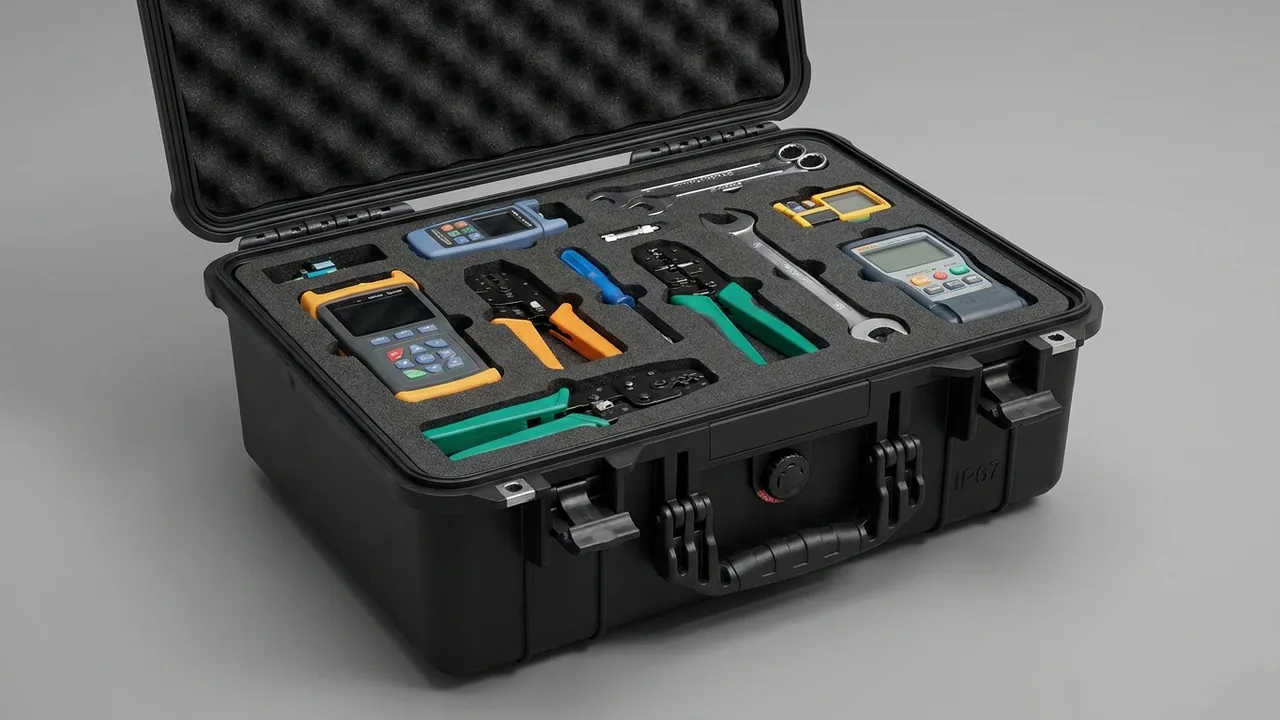
Skidders spend their working life on steep, waterlogged forest ground, and their winch assemblies, hydraulic motors, drive shafts, articulation pins, tires, tracks and grapples all travel long distances during fleet transfer, dealer stocking, export shipping and depot overhaul. The conclusion comes first: a case for skidder parts must be designed around three lines at once - a layered load path that carries single items from 200 kg up to 1.5 tonnes off-centre, an IP67 sealing strategy that keeps mud slurry and rain out, and a wet-state corrosion plan using replaceable vapour-phase rust film and desiccant units for humid forests and ocean freight. A timber frame with woven straps, chosen only to stop scratching, cannot solve these three failure classes at the same time.
Dealers and logging contractors report the same five arrival defects. Winch drum flanges carry strap bruises and the rope spools unevenly after refitting. Hydraulic motor ports are left open, grit reaches the spools and hydraulic fluid cleanliness measured to ISO 4406 goes out of specification. Grapple tines and links bend and need field straightening or rewelding. Tire beads and rim seats take hidden damage during stacking that only shows up on the machine. Articulation pin threads are battered and no longer screw in. The quieter problem is surface rust: a few weeks in high humidity is enough to strip the original precision from a pin or bearing seat. The same exposure pattern appears in the sawmill equipment case and the winch parts transport case, except that skidder parts are heavier, dirtier and more dependent on fast refitting in the field. The rest of this article turns those problems into concrete selection parameters and packing actions.
Table of Contents
- Skidder Component Set and Transit Vulnerability Classes
- Heavy-Load Case Structure and Layered Load Path
- Mud and Water Ingress Protection: IP67 under IEC 60529 and GB/T 4208
- Corrosion Mechanisms in Humid Forest Sites and Long-Term Rust Prevention
- Impact and Collision Resistance: IK Rating and MIL-STD-810H Test Methods
- Locating and Restraining the Winch Assembly, Grapple and Hydraulic Motors
- Cleanliness Management for Drive Shafts, Articulation Pins and Bearings
- Heavy-Load Packing for Tires, Tracks and Chain Plates
- Liner Material Selection and Custom Fabrication
- Seals, Latches and Hinges: Selection Points
- Transport and Unpacking Validation: ISTA, GB/T 4857, ASTM D4169
- Packing Workflow and Batch Traceability
- Component and Case Size Reference
- FAQ
- Closing Notes and Further Reading
Skidder Component Set and Transit Vulnerability Classes
Skidders divide into cable machines and grapple machines, and the parts that come off for transport cluster in six assemblies: the winch and wire rope system, hydraulic motors and pumps, transmission and drive shafts, articulation and steering pins, tires with half-tracks or chain tracks, and the grapple with its rotation gear. They share four traits - high density, irregular outline, critical mating surfaces left exposed, and a coating of forest soil, sap and resin. Movement scenarios cover new machine delivery, dealer stocking, inter-region fleet transfer, export sea freight and return to depot for overhaul. Of these, export sea freight plus long dealer storage is the most demanding, because humidity, chloride and thermal cycling all act on the case at the same time.
Sorting the parts into three protection classes by the consequence of failure works far better than simply thickening foam. The zero-damage class covers mating surfaces that cannot be refitted once scratched, contaminated or rusted, such as hydraulic motor shaft extensions and splines, drive shaft splines, and articulation pin to bore fits. The zero-distortion class allows light surface marks but no change in geometry, covering grapple links, winch drum flanges and the winch frame and base. The restraint class covers risks that are mainly movement and mutual collision, such as tires, chain plates, counterweights and guards. Once the class is fixed, the liner pocket profile, the clamping method and the number of packing layers all follow from it.
| Component | Typical unit weight | Main failure mode | Protection class | Fixing and liner method |
|---|---|---|---|---|
| --- | --- | --- | --- | --- |
| Winch assembly | 350 to 1200 kg | Drum flange bruising, seal weeping, base distortion | Zero-distortion | Bottom load pocket plus four corner stop blocks |
| Hydraulic motor | 40 to 250 kg | Shaft knock, port contamination, spline damage | Zero-damage | Dedicated cavity plus port plugs |
| Drive shaft | 30 to 120 kg | Spline wear, cross-journal shift, axial bending | Zero-damage | V-cradle plus spline sleeve |
| Articulation pins | 15 to 80 kg | Thread damage, plating scratch, loss in transit | Zero-damage | Compartment tray, upright, with sleeves |
| Tires and chain tracks | 200 to 600 kg each | Bead crushing, hidden cord damage, plate bending | Restraint | Upright placement plus bead ring |
| Grapple and rotation gear | 400 to 1500 kg | Tine edge rolling, link distortion, gear scoring | Zero-distortion | Tine grooved pallet plus adjustable supports |
The weights above are experience ranges for common construction machinery attachments and must be replaced by nameplate and packing list data. Keep the parts of one machine in one case where possible, because mixing models inside a shared liner leads to pockets that fit nothing. Dealers building a stock rotation programme for their regular models can borrow the zoning logic in the mining equipment parts case and split stock into assemblies, wear parts and standard parts so that picking each replenishment order takes the shortest path through the warehouse.
Heavy-Load Case Structure and Layered Load Path
The main difference between a skidder parts case and an instrument case is load density. In a case with a 1200 mm internal length, hydraulic motors may total 200 kg while a winch base approaches 1.5 tonnes, and that mass sits on one side rather than spread evenly. Structural design therefore has to be driven by the worst concentrated load rather than the average load.
In practice, keep the case plus contents under about 2 tonnes so that standard forklifts, pallet racking and manual container stowage all remain available. Above roughly 1.5 tonnes net, separate the steel pallet from the case body and strap the load to the pallet instead. The load path uses an 18 to 25 mm plywood deck over steel or aluminium beams spaced no more than 400 mm apart. Any single item over 500 kg needs a through beam directly below it; resting such a mass on the deck panel alone is the most common starting point for structural failure in heavy cases. A static safety factor of 1.5 to 2.0 is accepted industry practice and should then be confirmed by an actual stacking test.
For stacking, a three-high design is typical, with the top face rated for twice the weight above it and corner posts no smaller than 60 mm by 60 mm. The lid and base must form a continuous load column; without it, stacking stress migrates into the walls and the case racks out of square. Forklift openings should be at least 90 mm clear with wear strips at the entry, and lifting points belong only on the bottom load frame, never on the lid. Thickening the edges and the lid to body joint is the cheapest single step against rough forest-site handling.
Compared with the construction machinery parts case, a skidder case carries one extra requirement: the base must be washable and drainable. Parts arrive muddy, so the interior needs a sloped floor and a drain plug at the lowest point that empties standing water within about five minutes of washing, preventing slurry from sitting between the deck and the liner for weeks.
Mud and Water Ingress Protection: IP67 under IEC 60529 and GB/T 4208
IEC 60529 and its GB/T 4208 counterpart define the IP code with two digits: the first for solid particle protection and the second for water. IP67 means dust cannot enter at all, and after the specified short immersion test - IPX7, one metre for thirty minutes - no harmful water entry occurs. For skidder parts the real enemy is slurry rather than clean water, because slurry carries both solid grit and liquid. Once it dries it forms a crust on the sealing face, and repeated opening and closing grinds that crust into the gasket like lapping paste.
Three parameters decide whether a seal actually works: compression ratio, continuity and corner treatment. Keep the main gasket compression between 25 and 35 percent; less will not seal, more will take a permanent set and lose rebound. The gasket groove should be moulded in one piece rather than joined at the corners, since a spliced corner is the classic leak path. On material, silicone handles wide temperature swings, EPDM resists water and weathering better, and an oil-tolerant NBR composite suits interiors that see lubricant. The logic tracks the general principles in the IP67 waterproof case, but a skidder application raises the weight given to mud abrasion resistance.
Pressure difference across the wall is the overlooked cause of ingress. Crossing climate zones, hot container interiors and high-altitude forest transfers all create differentials that repeatedly squeeze the gasket and briefly make it breathe, pulling moisture inward. Fitting a case pressure equalization valve balances the differential while keeping IP67 intact and holds vapour exchange inside an acceptable band. Note that IP67 is a laboratory verdict; it is not a licence for long immersion and does not replace rust prevention. Wiping parts dry and cleaning the sealing face before closing the lid does more good than any repair after the fact.
Corrosion Mechanisms in Humid Forest Sites and Long-Term Rust Prevention
Corrosion in the forest combines three factors. Relative humidity stays above 80 percent for long periods, so a thin liquid film forms on every surface. Dissolved oxygen plus acidic substances from soil create the electrochemical cell. Export sea freight adds chloride. For articulation pins, shafts, bearing seats, threads and plated surfaces in the zero-damage class, even a light rust bloom means abrasive polishing and rework.
Surface treatment is the first layer of defence. Hot-dip galvanizing is normally specified above 60 micrometres average thickness and powder coating above 80 micrometres, with special attention to edges and welds, because that is where corrosion always starts. Fasteners should be unified to 304 or 316 stainless, but stainless must not touch aluminium directly, since the galvanic couple corrodes the aluminium; insert an insulating pad or apply an isolation compound at the joint. Salt spray performance can be assessed as a method check against the neutral salt spray method in GB/T 10125 at a 480 hour level, with the actual acceptance grade fixed by project agreement.
The second layer controls the micro-climate inside the case. Vapour-phase corrosion inhibitor film suits pins, splines and threads, because the vapour reaches recesses that grease cannot. Combined with silica gel or montmorillonite desiccant and a humidity indicator card, it holds internal humidity below roughly 50 percent. Indicator cards should be specified in six steps - 10, 20, 30, 40, 50 and 60 percent - so the receiving team can judge at a glance whether re-drying is needed. Make the desiccant a replaceable module rather than loose bags, so a dealer can regenerate or swap it during stock rotation without opening the liner.
The third layer is to stop packaging materials themselves from becoming a corrosion source. Ordinary recycled foam can carry sulfur and chloride residues that accelerate rusting of steel in damp conditions, so a liner touching metal parts should be specified as a low-residue grade and carry a flammability rating such as UL94 V-0 or HB. The same rule applies to the agricultural machinery parts case, since farm machinery shares the wet, muddy duty cycle of forestry equipment.
Impact and Collision Resistance: IK Rating and MIL-STD-810H Test Methods
Transit impact on skidder parts comes from three events: drops and knocks during forklift handling, compression during stacking, and the slow abrasion caused by random vibration on the road. Shell impact resistance is described by the IK ratings defined in IEC 62262, where IK08 corresponds to 5 joules and IK10 to 20 joules. Heavy-duty cases normally specify IK08 or above with locally thickened corners and edges. It is worth stating clearly that an IK rating describes the shell, not the protection given to the contents; content survival depends on the cushioning design.
For environmental test methods, the relevant clauses of MIL-STD-810H can be borrowed as references - Method 516.8 for shock, 514.8 for vibration, 507.6 for humidity and 509.7 for salt fog - with the appropriate excitation spectrum and duration chosen for design validation. This must be stated plainly: citing that standard is only a reference to test methods, the product is non-military-certified, and it neither holds any military certification nor has passed military qualification. Commercial case validation normally relies on the ISTA and GB/T 4857 families, and this method-borrowing position matches the explanation in the MIL-STD-810H environmental test conformity article.
Cushioning design is best controlled through peak acceleration. Judging from the tolerance of common construction machinery parts, holding the peak acceleration transmitted into a component in the 30 g to 50 g band is a widely used experience target, with the exact figure set by the fragility of the specific part and the maker's requirement. The practical means are wall thickness plus centre of gravity control: leave 15 to 25 mm of cushioning wall on all six faces of a part, and place heavy items low and near the geometric centre of the case so that off-centre mass cannot tip the case or cause a second collision.

Locating and Restraining the Winch Assembly, Grapple and Hydraulic Motors
Heavy parts should be restrained on the six-point principle: the base carries the load, four sides limit movement, and the top presses down. Omit any one face and the part will creep under vibration, eventually wearing through the liner and polishing a mating surface. A bottom pocket that encloses about one third of the part's lower height gives both location and easy lifting access. Side stop blocks should sit 2 to 5 mm off the part outline; a larger gap stops locating anything, and a smaller one makes loading and unloading impractical.
The winch assembly needs its drum flange and base mounting faces protected above all. When steel strapping is used, add corner protectors so the strap force spreads into the frame rather than biting the flange edge, and keep at least a 5 mm elastic pad between strap and part. Where the manufacturer provides lifting eyes or mounting holes, use them with bolts so that restraint force transfers into structural members. A grapple is a classic sharp edge plus long cantilever, so it belongs on a grooved pallet with every tine in its own groove, the tip floating no more than 30 mm, and the link supported underneath by an adjustable block so the cantilever never carries bending load.
Hydraulic motors follow one hard rule: never let the shaft extension carry weight. Place the motor shaft up or horizontal. Fit port plugs or dust caps before packing, matched to the thread or flange standard of the interface, and never use rags or paper as temporary plugs. After all restraint is fitted, do a manual shake check: apply roughly 20 kg of horizontal push and the part should barely move. Visible movement means restraint is insufficient and the layout must be revised.

Cleanliness Management for Drive Shafts, Articulation Pins and Bearings
Drive and transmission shafts usually fail at the spline and the universal joint, and the two transit enemies are rust and contamination. Wrap the spline in rust-inhibiting paper or VCI film first, then slide on a rigid plastic sleeve long enough to cover the whole spline with at least 20 mm of margin. Support the cross journal with a stop block to prevent axial creep that displaces the needle rollers. Put the shaft body in a V-cradle so the axis stays level; a long part left unsupported can take a slow permanent bend.
Hydraulic circuit cleanliness is the hidden qualification gate at refit. ISO 4406 describes fluid cleanliness with three numbers representing the particle counts above 4, 6 and 14 micrometres per millilitre, and construction machinery hydraulics commonly target -/18/15 at dispatch or cleaner. Any port left open during transit can push that number out of control, so every hydraulic motor, valve block and cylinder port must be individually plugged, with the plug locations and sizes marked on the packing list for the receiving team to verify.
Pins, shafts and bolts are too often thrown into a corner, and the result is battered threads, scratched plating and a short count. Use a compartment tray with one pin per cell, placed upright with the shaft end up and at least 3 mm of soft lining under each cell. Group bolts by size and length, bag them in sealed packs with labels showing machine model, assembly position and quantity. Number kits so that the pin, bushing, seal and retaining ring for one articulation point stay in the same cell; otherwise someone on site opens four cases looking for a single ring. The same kitting discipline is described in the bearing and gearbox parts case.
Heavy-Load Packing for Tires, Tracks and Chain Plates
Forestry tires are large and their sidewalls are soft, so the packing orientation decides whether they are usable on arrival. Flat stacking presses the lower sidewall for weeks, producing a flattened set that will not recover and that shows up on the machine as runout and uneven wear. For long-haul movement, stand tires upright with dividers between them, band the stack and fit bead rings that protect the bead and rim seat. If flat placement is unavoidable, keep stacks to three high at most and put rigid dividers between every layer to spread the load.
Chain plates and tracks are heavy and edged, so they damage themselves and their neighbours. Bundle weight should stay under about 1.5 tonnes per bundle, plates should face the same direction within a bundle, and bundle edges get rubber protection strips. Never mix chain tracks with tires or hydraulic parts in the same cavity, because mineral oil in prolonged contact with rubber accelerates ageing. Rubber parts should also be kept away from any electrical components that might generate ozone, and away from direct contact with sharp steel.
The packing logic in the wheel loader parts case is close, but skidder tires differ in carrying higher inflation pressure, deeper tread and grooves that trap crushed stone. Clear stone and mud from the tread before packing; otherwise the stone rolls inside the case and acts as grinding media on every other part. Fitting the bead ring after cleaning additionally keeps grit out of the bead seat.
Liner Material Selection and Custom Fabrication
The liner is the last link in the protection chain, and material choice follows part weight, surface sensitivity and required cushioning stroke. EVA foam is typically 45 to 70 Shore A, rebounds quickly and holds shape well, suiting precision mating faces and medium weight parts. PE foam at 30 to 45 kg per cubic metre absorbs energy well at lower cost and works as the lower layer of a load-bearing stack. XPE and IXPE are closed-cell and take up little water, so they suit moisture barriers in damp environments. PP honeycomb board is stiff, and using it as the divider between heavy items removes significant weight from the whole case.
Three fabrication routes dominate. Die cutting suits stable, simple pocket outlines in volume. CNC routing suits small batches with complex outlines and multiple depths. Thermoforming suits curved contact surfaces, such as the arc under a winch drum flange. One general rule in design: keep pocket depth under two thirds of the part height, then press the remaining part down with a soft top pad, which locates securely and still allows easy removal. When bonding layers, place the harder material below and the softer material against the part to create a hard-outside, soft-inside cushion gradient.
Flammability rating should be confirmed against the transport and storage scenario, with UL94 V-0 and HB being the common options, and it belongs in the technical requirement whenever indoor storage or a customer safety procedure applies. Liners are wear items: pocket walls compress and collapse over time, so design the contact layer as a replaceable skin to extend case life, as described in more detail in the protective case service life article. JUNZHIJIA works from the same load-path logic when proposing a liner layout, and issues a fitting record for each newly tooled machine model so the layout can be audited later.
Seals, Latches and Hinges: Selection Points
Hardware is the joint of a protective case, and it usually fails by loosening, rusting or jamming rather than by breaking. Hinges should be 304 or 316 stainless, with pin diameter and leaf thickness matched to lid weight; a heavy lid needs at least one hinge per 300 mm of hinge line. Specify a removable pin so a hinge can be replaced on site without damaging the case. Latches should use a two-point or multi-point arrangement, because a single latch on a large case lets the middle bow and admit water.
Skidder cases are usually large, so latch and gasket must work as a pair: the latch must press the lid onto the gasket to create even compression rather than bending the lid. Latch pull strength is selected from case size; large cases suit over-centre latches with take-up travel, and the instruction sheet should state the recommended adjustment interval, since gaskets take compression set over their service life and need periodic tuning. Treat the gasket as a consumable and either supply a spare with each case or state a replacement interval; the section profile must match the groove and cannot be substituted with a generic strip. A fuller comparison of hardware structures sits in the toolbox hinge, latch and seal selection guide.
Transport and Unpacking Validation: ISTA, GB/T 4857, ASTM D4169
Design completion is not validation. Transport testing reproduces the excitations of real logistics so that the case and its contents can be declared fit for the route at a defined severity. Three routes are commonly combined: the ISTA series, where 3A covers parcel shipment and 3E covers unitised and full-load distribution; the GB/T 4857 series, with 4857.5 as the drop test method and 4857.23 as the random vibration method; and ASTM D4169, where a distribution cycle grade is chosen for the route, for example one combining full truckload and less-than-truckload legs.
| Test item | Standard basis | Typical conditions | What is checked |
|---|---|---|---|
| --- | --- | --- | --- |
| Dust and water | IEC 60529 / GB/T 4208 | IP6X dust plus IPX7 short immersion | No dust, no harmful water entry |
| Drop | GB/T 4857.5 / ISTA 3A | Height graded by package gross weight | Parts and mating faces intact |
| Random vibration | GB/T 4857.23 | Spectrum and duration by transport mode | No creep, abrasion or loosening |
| Distribution cycle | ASTM D4169 | Sequence set by selected DC grade | Contents performance, package integrity |
| Neutral salt spray | GB/T 10125 | Method check, duration by project agreement | No red rust, plating intact |
| Shock (method borrowed) | MIL-STD-810H Method 516.8 | Not a military certification | No cracks, no permanent set |
| Liner flammability | UL94 | V-0 or HB | Material grade meets purchase spec |
| Hydraulic cleanliness | ISO 4406 | Target -/18/15 or cleaner | Ports effectively plugged |
Unpacking inspection should be matched against the packing record: verify the seal and case number, look for mud impressions on the sealing face, read the humidity indicator card, then check the list and inspect mating surfaces for rust spots and knocks. For volume purchasing, use an AQL sampling scheme with appearance, sealing, hardware and liner as key characteristics; the sampling level and acceptance rules are described in the custom case acceptance and AQL sampling article. Inspection records should return to the manufacturer as input for the next production batch.
Packing Workflow and Batch Traceability
Repeatable protection comes from a standard procedure rather than personal judgement. Eight steps are enough: clean the parts and remove mud and sap; inspect and photograph the critical mating surfaces; fit port plugs, spline sleeves and VCI film; load into the model-specific liner pockets and complete six-point restraint; record photographs showing stop blocks, straps and clamps; place the desiccant unit and humidity card and record the initial reading; clean the sealing face, close the lid, latch it and apply the security seal; and label the outside with machine model, total weight, centre of gravity, stacking orientation and lifting points.
Traceability works best in two layers. Put a QR code on the outside linking to the packing photographs and the list, and place a paper packing list inside in case there is no network on site. For dealer stock, keep a fixed case number per machine model and bind that number to a liner pocket layout, so that swapping case bodies during long-term use never produces a pocket mismatch. Empty cases should be cleaned, dried and stored closed to protect the gasket from compression set and UV ageing; handled this way, one set of cases can cover many transport cycles.
Component and Case Size Reference
The internal dimensions below are design reference ranges for an initial match against equipment drawings. Final sizes come from the part envelope, cushioning wall thickness and pocket depth together, not from adding a constant to the part outline. Net load figures are per case; above them, separate the steel pallet from the case body.
| Component group | Suggested internal size (L x W x H, mm) | Suggested net load | Recommended liner structure | Stacking |
|---|---|---|---|---|
| --- | --- | --- | --- | --- |
| Hydraulic motors and small valve blocks | 800 x 600 x 500 | up to 300 kg | EVA dedicated cavities plus top pad | 3 high |
| Drive and transmission shafts | 1400 x 400 x 400 | up to 250 kg | V-cradle plus spline sleeve pocket | 3 high |
| Pins and small part kits | 600 x 400 x 300 | up to 120 kg | Compartment tray with numbering | 4 high |
| Winch assembly | 1600 x 1200 x 900 | up to 1500 kg | Load pocket plus four corner stops | 2 high |
| Grapple and rotation gear | 1800 x 1300 x 1000 | up to 1500 kg | Tine grooved pallet plus adjustable blocks | 2 high |
| Tires and chain tracks | 1500 x 1200 x 800 | up to 1200 kg | Upright dividers plus bead rings | 2 high |
A size table only answers whether a part fits. Real protection depends on the load path, the restraint clearance and the cushioning thickness. Where one case must serve several parts, use a removable divider liner system so the internal layout can be reconfigured instead of building a new mould for every item.
FAQ
Q: A skidder winch assembly weighs close to or over one tonne. Can a protective case really carry it? A: The answer lies in structure and loading method rather than panel thickness. Capacity comes from three design decisions working together: bottom load beams that run continuously to the forklift contact points, a through steel beam placed directly under the single heavy item, and keeping the whole case plus contents under about two tonnes gross. Place a one-tonne part straight onto the liner and deck panel and even a 25 mm deck will creep and yield over a few journeys. In real projects the safer arrangement separates the case body from a steel pallet: the part is bolted or strapped to the pallet load layer, and the case provides sealing, dust protection and lateral restraint only. Ask for a load calculation whenever a single item exceeds 500 kg, and confirm it with stacking and lifting tests at the sample stage, because a calculation alone will not reveal a weak corner joint. Recording the sling angles actually used at the loading yard is worth doing as well, since an unexpected angle can load the frame in a direction the drawing never considered.
Q: If a case is IP67 rated, will it stay dry during long rain or short water crossings in the forest? A: Under IEC 60529 and GB/T 4208, IP67 means full dust protection plus no harmful water entry after thirty minutes at one metre depth, and it makes no promise about extended immersion or repeated water crossings. Real forest risk comes from three sources: mud trapped on the sealing face so the lid cannot close evenly, the breathing effect created by pressure differential during temperature swings, and gasket damage caused by sharp corners during loading. Clean and dry the sealing face before every close, fit a pressure equalization valve to balance differentials, and radius the corners that the gasket runs over. A useful field check is to run a low-pressure hose along the lid joint for several minutes, let the case stand, then open it and look for water traces on the inside of the gasket; that says more about assembly quality than the rating label does. Where a route genuinely includes water crossings or long rain exposure, state it in the technical requirement and select a case with additional external protection instead of relying on the standard rating.
Q: How are irregular items such as grapple tines and links fixed without distortion? A: Make the load path bypass thin walls and cantilevers. Each tine sits in its own groove with the tip floating no more than 30 mm and the root carried by the groove floor, so bending load never reaches the tip. Support the link from below with an adjustable block so the cantilever stops carrying its own bending moment. Give the rotation gear its own cavity so it never touches the case wall, and keep that cavity floor flat enough that the gear seats without rocking. Never strap across a tine tip or the middle of a link; strap over structural thickness with a soft pad underneath. On arrival, check tine edges for rolling, check link straightness against a reference, and confirm the rotation gear turns freely by hand. Where grapple sizes vary widely across a dealer's stock, use adjustable stop blocks with a recorded field setting, a customization pattern explained further in the custom foam insert guide. Keep a photographic record of the first grapple packed, because tine and link positions are the two details most often questioned when a second case is packed by a different crew at a different yard.
Q: Do hydraulic motor and drive shaft ports and splines need special capping? A: Yes, and this is the step most often skipped under time pressure at the yard. Hydraulic circuits are extremely contamination sensitive. ISO 4406 grades fluid cleanliness by the particle counts above 4, 6 and 14 micrometres per millilitre, and construction machinery hydraulics commonly leave the factory targeting -/18/15 or cleaner. Any port left open in transit lets grit and dust reach spools, clearances and piston pairs, producing sluggish or stuck operation after refitting and, in bad cases, a pump or motor rebuild. Fit metal plugs or dedicated plastic dust caps matched to the thread or flange standard of each interface, and never use rags, paper or tape. Wrap splines in VCI film, then slide on a rigid sleeve with at least 20 mm of margin so the wrap cannot work loose. Mark every plug location and size on the packing list, and instruct the receiving team to verify that list before removing any cap. For long storage at a dealer, replace plastic caps with metal plugs, since plastic can relax and drop out after several temperature cycles on a quay or in an unheated warehouse.
Q: How should rust prevention be handled for humid forest sites and sea freight? A: Treat rust prevention in three layers: surface treatment, micro-climate control, and packaging materials that do not themselves introduce corrosion. Surface treatment covers galvanizing or powder coating above the specified thickness, rust-inhibiting oil or film on critical mating faces, and 304 or 316 stainless fasteners with galvanic isolation where they meet aluminium. Micro-climate control covers VCI film wrapping for pins, splines and threads, silica gel or montmorillonite desiccant sized to the case volume, and a six-step humidity indicator card that the receiving team can read without opening the liner. The material layer requires a low-residue foam formulation, because sulfur and chloride residues in recycled foam accelerate rusting of steel in damp air. If salt spray performance needs verification, run it as a method check against the neutral salt spray method in GB/T 10125, with duration and acceptance grade agreed in the project, and avoid quoting figures borrowed from unrelated products or older shipments. Write the drying schedule into the maintenance sheet as well, so that a case stored through a wet season is dried again before it carries another load of machined steel.
Q: What information is needed to develop a custom liner, and how are tooling and lead time assessed? A: The best input is a 3D model or a 2D drawing of every part, with physical measurement as the next best option. The necessary information includes the outer envelope, weight, centre of gravity, which mating surfaces are most fragile, any protruding ports or flanges, and the orientation permitted during packing. If only physical parts exist, the manufacturer can measure them and issue a confirmation drawing for approval before any tooling is cut. The usual sequence runs from requirement and classification review, through liner structure and case size selection, sample fitting, drop and stacking validation, pilot production, to volume production. Cost depends on whether new case tooling is needed and on the liner process chosen - die cutting, CNC routing or thermoforming - with die cutting usually the cheapest to start and routing more flexible for complex multi-step profiles. JUNZHIJIA supplies liner structure proposals and fitting reports per machine model, and supports OEM and ODM branding plus shared-case designs across related models. For multi-model dealers the shared-case route usually pays back faster than separate tooling, because case bodies face similar external loads while only the liner changes between machine families.
Q: Which standards should transport validation follow, and can test documents be provided? A: Three routes are commonly combined so that the real risks are covered. The ISTA series provides 3A for parcel shipment and 3E for unitised or full-load distribution. The GB/T 4857 series supplies the fundamentals, including 4857.5 for drop and 4857.23 for random vibration. ASTM D4169 sets a distribution cycle grade matched to the actual route, so rail, truck, air and warehouse legs can be combined at the right severity. Dust and water protection follows IEC 60529 and GB/T 4208, shell impact resistance is described by the IK scale in IEC 62262, and liner flammability follows UL94. Where a project asks for MIL-STD-810H method clauses such as 516.8 for shock or 507.6 for humidity, state clearly that this is method borrowing rather than military certification, and never describe the product as military qualified in a report or on a label. Manufacturers normally supply design validation reports, material certificates and fitting records for the agreed project and batch. Compare the test conditions printed on the report with the conditions written in the purchase order, because a report issued for a light package proves very little about a case that leaves the loading yard at one and a half tonnes.
Q: How should volume purchasing be inspected, and can empty cases be reused? A: Inspect at three levels. The document level checks material certificates, design validation reports and the agreed technical requirement. The appearance level checks edges, the sealing face, hardware and liner pockets against the approved sample. The functional level uses randomly drawn cases for gasket and restraint checks such as a low-pressure water spray test, a manual shake check on heavy items, and a liner fit check with the real part. Sampling can follow an AQL approach with appearance, sealing, hardware and liner treated as key characteristics, and the acceptance rules written into the purchase order. Empty cases can be reused provided a maintenance routine exists: clean and dry after each return leg, inspect the gasket for compression set, verify latch take-up against the recommended adjustment, and replace the liner skin when pockets are worn. Gaskets and liners are consumables, and scheduled replacement is far cheaper than scrapping an otherwise sound case.
Closing Notes and Further Reading
A skidder parts case earns its value as a process rather than a product: classify parts by failure consequence, choose structure and liner from that classification, validate with ISTA, GB/T 4857 and ASTM D4169, and record every pack.
Further Reading