

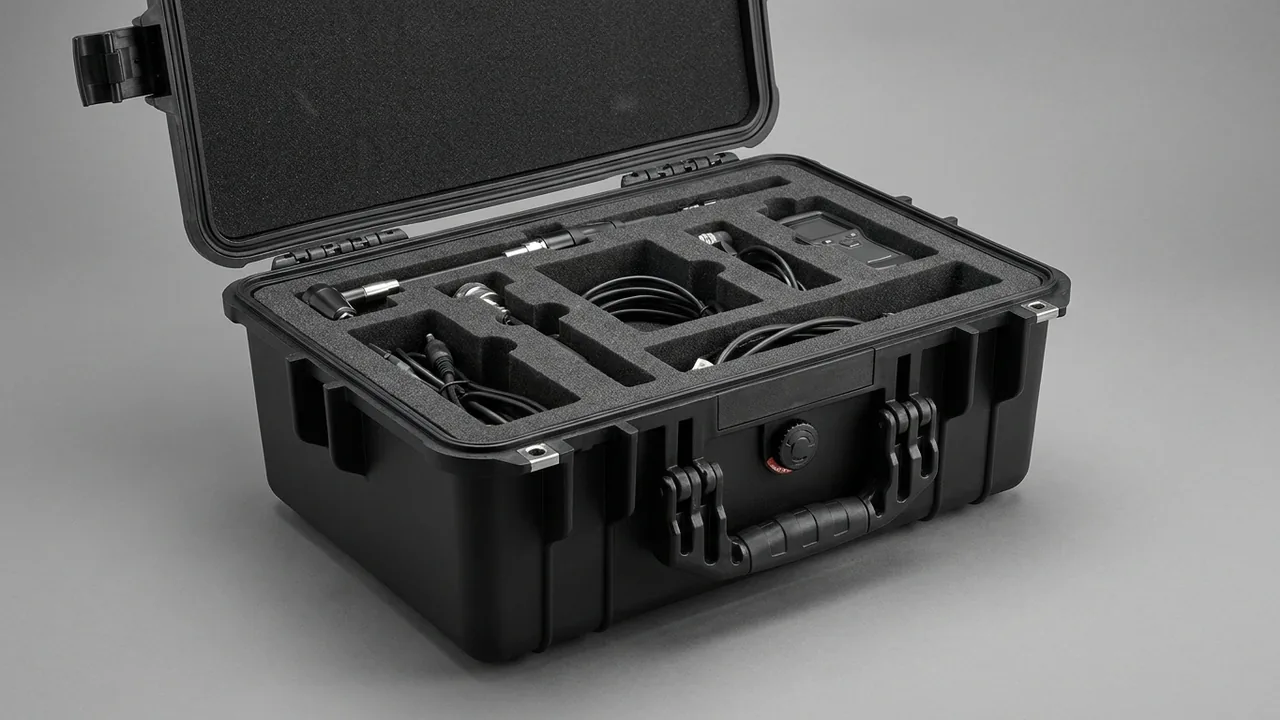
The marble gang saw, a frame-style reciprocating machine, performs the core task of converting stone blocks into slabs inside marble quarries and slab plants. Its most valuable and vulnerable parts, the saw frame and the abrasive supply system, are exactly the components that fear in-transit vibration, impact, and abrasive residue. The direct conclusion is that a compartmentalized custom protective case, positioning the frame vertically with limiter blocks and isolating abrasive parts in a sealed sub-compartment, dramatically reduces arrival deformation and contamination problems, making it a mandatory configuration for cross-border stone equipment relocation and spare-parts circulation. This article focuses on anti-vibration transport of the marble gang saw frame and abrasive system, breaking down the full process from liner compartmentalization, cushion material selection, dust isolation, transport testing, and acceptance delivery, helping procurement and equipment engineers build a workable protection plan.
A single unplanned stop of a marble gang saw costs hours, and a large frame that develops a slight bend during shipping will cause blade digging after installation, with repair cost far exceeding the price of one protective case. The more hidden risk comes from abrasive media: silicon carbide or quartz abrasive is fine and highly flowable, and once residue escapes inside the package and mixes into bearings, guides, or hydraulic ports, it causes early abrasive wear after assembly. Therefore "frame anti-vibration, abrasive anti-leak" must be designed as two main threads of the same packaging solution rather than patched afterward. Reading this article, you will gain component-level force analysis, liner material comparison, sealing and dust-proof grade selection, and citable transport test paths including GB/T 4857, ISTA, and ASTM D4169.
Table of Contents
- Core conflict in marble gang saw component transport
- Structural vulnerability and force analysis of the frame
- Residue and dust challenges of the abrasive system
- Compartmentalized liner design of the case
- Anti-vibration cushion material selection
- Abrasive collection shroud and residue isolation
- Sealing and dust-proof grade requirements
- Stacking and lifting adaptation markings
- Transport test basis and criteria
- Temperature, humidity, and salt fog response
- Custom liner and OEM/ODM service
- Acceptance and inspection document delivery
- Field use and maintenance recommendations
- Frequently Asked Questions FAQ
- Conclusion and Related Reading
Core conflict in marble gang saw component transport
The frame-style marble gang saw relies on dozens of parallel blades reciprocating in abrasive slurry to cut stone, and the whole machine frame is a welded steel structure often several meters long with a relatively slender cross-section. The most prominent conflict in transport is the clash between "large size, low stiffness" and "high flatness requirement": the frame endures multi-axis random vibration on road or at sea, and without continuous support, the mid-span produces permanent deflection under self-weight plus impact, which after installation shows as uneven slab thickness and blade path deviation. Meanwhile, residue inside abrasive supply parts such as hoppers, screw feeders, and slurry pump impellers escapes during jolts and contaminates adjacent precision parts.
Many buyers habitually ship frames in generic wooden crates or simple iron frames with padding only at both ends, ignoring the second-order bending mode caused by the suspended mid-span. In fact, the natural frequency of a gang saw frame often falls in the 5-30 Hz band where road random vibration energy concentrates, and resonance amplification multiplies local stress. It is recommended to treat the protective case as an "extended base of the equipment" during the planning stage, unifying support points, limiter points, and damping points from the perspective of a marble saw machine case, instead of treating packaging as a last-minute task before shipment.
From a supply-chain view, marble gang saws circulate between continents due to mine relocation, line upgrades, or after-sales repair, with long sea voyages and frequent handling. Similar to the concerns in a mining equipment parts case, such cargo packaging must satisfy triple requirements of stacking strength, moisture resistance, and anti-shift. Understanding this core conflict is the premise of all subsequent compartment and cushion design.
Structural vulnerability and force analysis of the frame
The vulnerable points of the frame concentrate in three types of locations: the long-side mid-span, with lowest stiffness and most prone to overall deflection; the end connection flanges and guide slider mounting faces, which are precision mating datums and once dented or deformed directly affect blade parallelism; and the weld heat-affected zones, where micro stress concentration exists and cracks may initiate after impact. The goal of transport protection is to convert the frame's "cantilever force" into "multi-point simply supported force" using in-case supports, keeping each span's deflection within allowable limits.
Engineering commonly uses an equivalent beam model to estimate deflection: under uniform gravity g and equivalent dynamic factor k (road transport empirical value 1.5-2.5, sea transport 2-4), mid-span deflection δ is approximately k·g·L⁴/(384·E·I). Since E (steel elastic modulus) is fixed, the only practical means to control deflection is to shorten support span L and raise section inertia I. The latter is structurally fixed, so the former is the responsibility of the liner: arranging continuous or densely spaced support pads under the frame to minimize the effective span. For frames longer than 4 meters, a support every 60-80 cm is suggested, plus adjustable limiter blocks at end flanges.
Unlike the crushing and screening parts case that handles thick heavy castings, the frame is a "long and thin" welded part, so the cushion strategy should lean toward "rigid positioning plus flexible isolation" rather than simply stacking thick foam. If positioning is inaccurate, even thick foam will be worn through by long-term vibration; if positioning is accurate, moderately thick EVA or PE foam absorbs high-frequency shocks. This force logic determines the overall direction of subsequent liner design.
Residue and dust challenges of the abrasive system
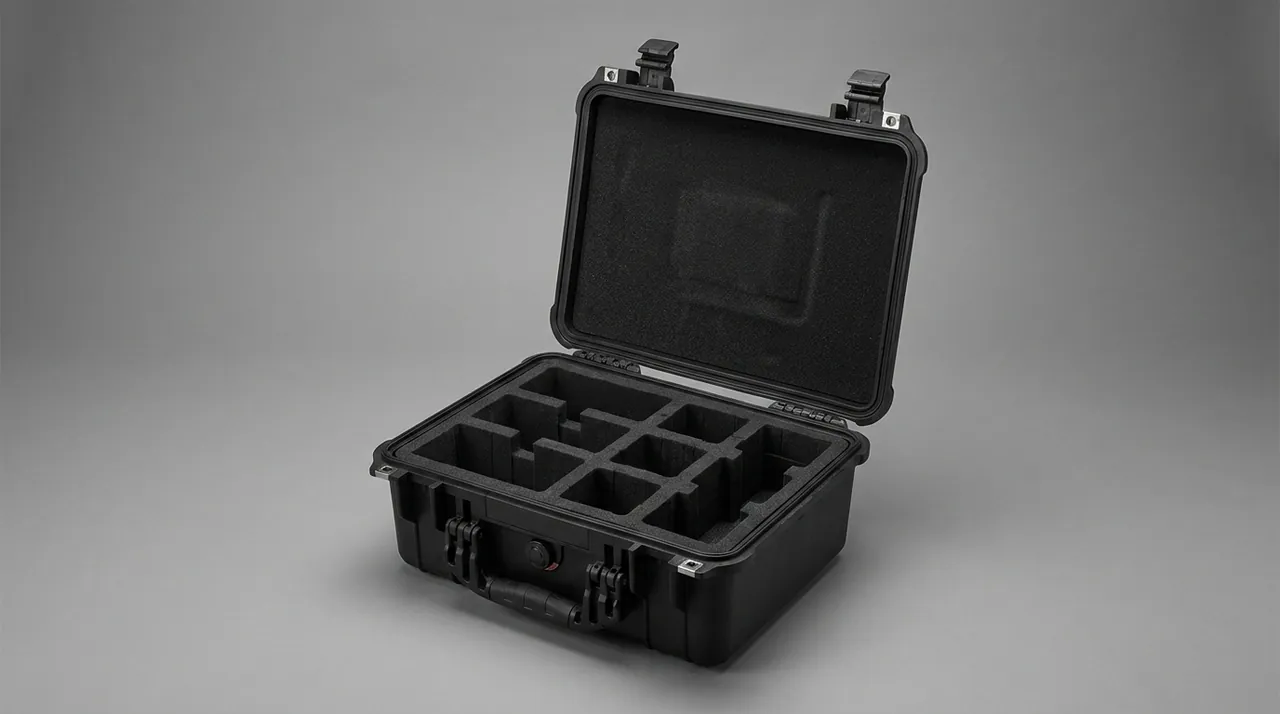
Abrasive media, silicon carbide, quartz sand, or mixed steel-shot, is the cutting medium of the marble gang saw, with particle size mostly 80-120 mesh, sharp edges, and high hardness. If hoppers, feed screws, and slurry pumps are boxed without thorough cavity cleaning after disassembly, residual abrasive acts like sandpaper during transport vibration, wearing seals, threads, and bearing raceways. Worse is the "permeability" of fine sand: it passes through ordinary carton seams, penetrates into foam micropores, and is extremely hard to fully clean at the installation site, becoming a hidden cause of early equipment failure.
The solution is "physical isolation first, cleaning second." On one hand, abrasive parts must be dry- or water-cleaned after disassembly, and blind threaded holes blown clear with compressed air; on the other hand, such parts should be placed in an independent sealed sub-compartment when boxed, with the sub-compartment lined with anti-static moisture-proof film and a self-adhesive sealing strip on the hatch, so that even slight residue will not leak and contaminate the frame and accessories. Unlike the quartz cutting line case that focuses on blade edges, the protection focus here is "abrasive does not escape, precision faces are not abraded," and the two logics complement each other.
Another dimension of dust-proofing is the external dusty environment. Stone production areas have high airborne dust, and packaging is exposed during storage and handling. Carton packaging quickly absorbs moisture and softens in stone powder environments, losing strength. Therefore the outer shell of the frame and abrasive case should use an engineering plastic case or film-coated plywood case, combined with the mature process of dust-proof sealed cushion liner, forming two barriers from outside to inside.
Compartmentalized liner design of the case
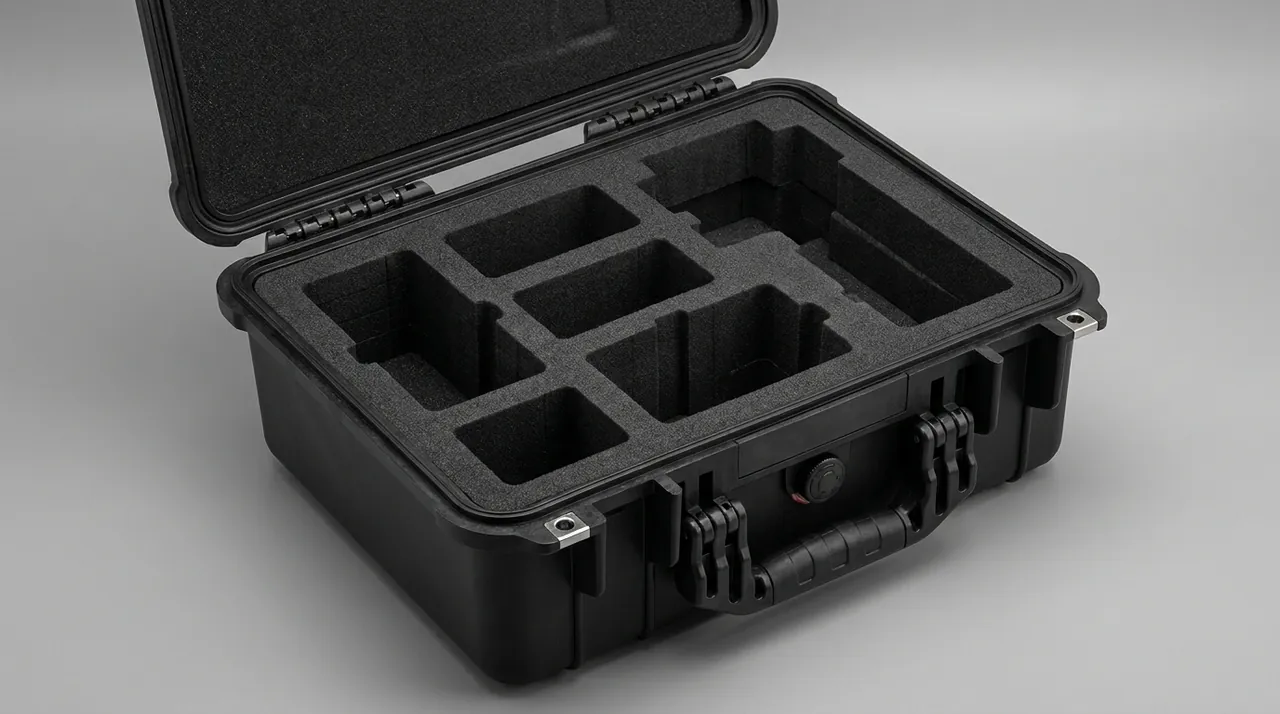
Compartmentalization is the core of this solution. A typical marble gang saw spare-parts case should divide at least three functional zones: the main frame compartment, the abrasive sealed sub-compartment, and the accessory and tool compartment. The main compartment occupies most of the volume, with continuous support beams and end limiters along the length; the sealed sub-compartment is an independent removable module placed on one side of the main compartment or at the case bottom, with its own sealing ring and buckles; the accessory compartment stores bolts, gaskets, and guide sliders to avoid collision with the main body.
The key to compartmentalization is "no mutual influence." The main frame compartment must stay clean and dry, never sharing with abrasive parts; the sub-compartment wall is suggested as a double structure, inner PE film bag and outer EVA-covered hard board, so even if the inner layer breaks, the outer layer still catches residual abrasive. For hydraulic hoses or electrical connectors shipped together, they should be individually wrapped in corrugated conduit sheaths and fixed in the accessory compartment to prevent crushing or sand ingress. Similar to the shaped coiling idea in a wire saw machine case, the essence of compartmentalization is "storing by hazard characteristic of the part."
In customization practice, the engineering team of JUNZHIJIA first virtually arranges each part's posture and interference relationship inside the case based on the assembly drawing provided by the customer, then determines support point coordinates and limiter block heights, and finally outputs the CNC-machined liner contour. This "simulate first, then mold" flow is more reliable than padding foam by experience and facilitates subsequent batch replication of the same model.
Anti-vibration cushion material selection
Cushion materials must balance isolation, load bearing, and durability. Three common types: EVA foam (good rebound, easy CNC carving, suitable for positioning grooves), PE cross-linked foam (small compressive creep, wide temperature range, suitable for heavy support), and PU self-skinning (hard surface, soft inside, suitable for wrapping irregular parts). Long parts like the frame mainly use PE support beams with EVA limiters; the abrasive sealed sub-compartment wrapping can use EVA; small accessories can use PU molded trays.
Beware the "thickness-only" fallacy when selecting. Over-thick low-hardness foam creeps under constant compression during long sea voyages, causing limiter failure. Empirically, the static compression of support pads should be controlled at 15%-25% of original thickness, with 2-3 times dynamic load margin reserved. If goods go by air, consider the gas expansion of closed-cell foam at low pressure, and prefer high cross-link density PE. For material hardness and density comparison, refer to measured data in foam liner material comparison to avoid blind selection.
The balance of cost and performance is also practical: EVA has low unit price and fast processing, suitable for small and medium batches; PE support beams have long life and reusability, suitable for high-frequency spare-parts cases. For the abrasive sealed sub-compartment that needs repeated opening, it is suggested to use tear-resistant PE composite film rather than disposable plastic bags, reducing the loss of each re-cleaning and re-sealing.
Abrasive collection shroud and residue isolation
For the "residue isolation" of abrasive parts, the most effective structure is a custom collection shroud: a zip-tieable anti-static canvas or PE-coated shroud over the hopper or screw feeder outer wall, with a collection pocket at the bottom, so any escaped abrasive falls into the pocket rather than scattering on the case floor. Keep a 5-10 mm gap between shroud and part to avoid friction damage to the working face. This structure shares the isolation concept of a dust-proof sealed case but emphasizes "collectable and traceable."
Another approach is to put the abrasive part entirely into a lidded sealed bucket (food-grade HDPE or 304 stainless steel), with a desiccant bag inside and a silicone sealing ring on the lid. For cavity parts like slurry pump impellers, the sealed bucket thoroughly blocks abrasive escape while being moisture-proof. Note that metal buckets in sea containers may become condensation accumulation points, so wrap the bucket with absorbent lining paper and place a humidity indicator card with the case to judge moisture on arrival.
Whether using a shroud or sealed bucket, a label "contains abrasive residue, wear protection when opening" should be pasted in an obvious position inside the case, reminding the receiver to prepare goggles and dust masks, and recover residual abrasive per local environmental rules instead of random dumping that causes soil pollution.
Sealing and dust-proof grade requirements
The sealing grade of a protective case can be expressed by referring to the IP code of GB/T 4208 (equivalent to IEC 60529). For a marble gang saw parts case, the main frame compartment reaching IP54 (dust-proof, splash-proof) is usually sufficient; the abrasive sealed sub-compartment is suggested IP65 (dust-tight, water-jet proof) because once abrasive enters the case air circulation it spreads. It must be pointed out that the IP grade describes the inherent protection capability of the case, not that the interior is already clean. Sealing only solves "external dust stays out, internal dust stays in," and cleaning before opening cannot be omitted.
The key to achieving IP65 lies in seam treatment: a continuous foamed sealing strip (EPDM or silicone) should be set at the joint between lid and body, paired with compression buckles rather than relying only on friction; wire holes and ventilation holes need PG connectors or waterproof breathable valves to block. This involves the application of a case pressure equalization valve. In sea transport with large day-night temperature differences, the pressure difference inside and outside the case repeatedly "breathes," and without an equalization valve the sealing strip is easily pushed open by pressure difference and moisture enters.
Dust-proof does not mean vacuum. Complete airtightness makes the lid hard to open under altitude change or temperature variation. The reasonable approach is "controlled breathability": use a waterproof breathable membrane (ePTFE) to balance pressure while keeping dust-tight, preventing both sand ingress and negative-pressure suction opening. This detail is especially important for gang saw parts cases transported across climate zones.
Stacking and lifting adaptation markings
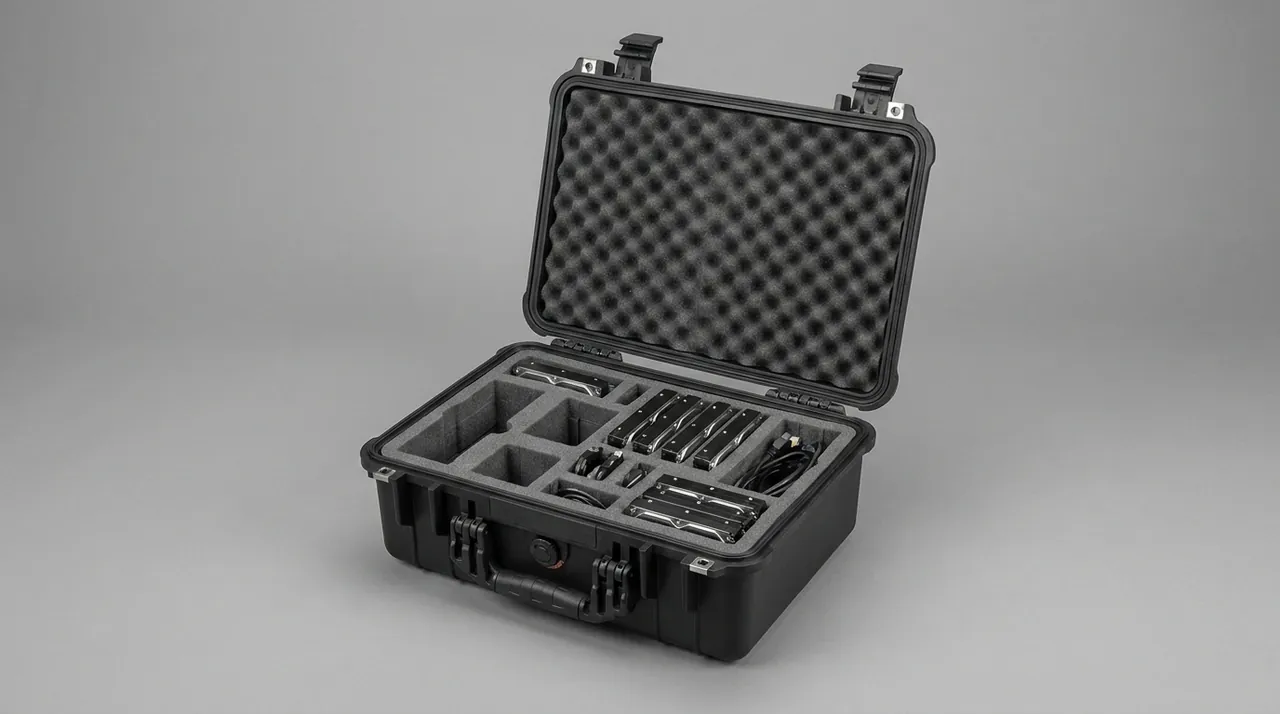
Marble gang saw frame cases are large and have an elongated center of gravity, so stacking and lifting must be standardized. The six faces of the case should carry transport markings per GB/T 191: center of gravity point, lift here, do not roll, stacking layer limit, keep dry, etc. The center-of-gravity mark is especially important because the frame's center of gravity often deviates from the geometric center, and wrong sling position causes internal parts to slide or the case to overturn.
Stacking layers must be reverse-calculated from the top-cover compressive strength and the allowable pressure of contents. Empirically, plastic protective cases should not stack over 3-4 layers, film-coated plywood cases can reach 4-5 layers, but the bottom case load increases approximately linearly with layers, so the maximum stacking layers must be marked on the top. Unlike heavy-load scenarios such as a paper roll transport case, the frame case fears "lateral instability" more than pure crush, so lashing fixation is more critical than stacking layers.
Lifting suggests a four-point balance beam sling, keeping the sling angle at 60-90 degrees to avoid lateral component force tearing the case from a too-small angle. For warehouses without lifting points, configure a case wheel and trolley handle with universal wheels for short-distance translation without frequent forklift insertion, reducing collision probability.
Transport test basis and criteria
Transport reliability must be backed by standard tests rather than feel. Domestic circulation can use the GB/T 4857 series (basic tests for transport packages) for drop, stacking, vibration, and pressure tests; international circulation can overlay ISTA 3 series (such as ISTA 3E for unitized loads) or ASTM D4169 distribution cycle risk assessment. It must be clear that these standards verify the tolerance of the "package-product" system, and passing tests does not mean zero damage, but reduces damage probability to an acceptable level.
For the "long thin welded part" characteristic of the frame, vibration tests should focus on 5-30 Hz sweep and random vibration, monitoring the acceleration transmissibility at key frame points to confirm the liner presses transmissibility below 1 (in-case vibration smaller than external excitation). Drop height is selected by mass grade, and it is suggested to do corner-drop special verification for vulnerable points like end flanges. Complete test design can refer to clauses mapping in ISTA transport test procedure and ASTM D4169 distribution cycle.
For environmental tests, MIL-STD-810H can be used as a reference method for high-low temperature, damp heat, and combined vibration environments, but it must be noted that it serves only as an environmental test basis and is not a military certification; the product does not claim military qualification. Stating the standard citation boundary clearly enhances credibility and avoids compliance risk, consistent with the emphasis in the MIL-STD-810H compliance note.
Temperature, humidity, and salt fog response
Marble gang saw parts include steel frames and possible stainless slurry pumps, and the high humidity, salt fog, and condensation during sea transport are main corrosion sources. The case interior should hold sufficient desiccant (silica gel or montmorillonite) with a humidity indicator card; for machined faces of the frame, apply temporary rust-preventive oil or water-displacing protectant before assembly, wiped off on arrival. For salt fog environments, refer to the test idea of GB/T 10125, and protect exposed metal parts (hinges, locks) with 304 stainless steel or dichromate-treated hardware.
Condensation from temperature change is often more hidden than direct rain. When containers cross between equator and temperate zones, the day-night temperature difference can exceed 20°C, and if the case is fully sealed without pressure balance, it inhales external moisture when cooling. Therefore the waterproof breathable valve and desiccant mentioned earlier must be used together. Consistent with the design principle of a waterproof case IP, this solution emphasizes the trinity of "drain condensation, control humidity, prevent salt corrosion."
For long-term storage (over 3 months) spare-parts cases, it is suggested to open and check the humidity card and desiccant status every 60 days, replacing desiccant or re-vacuumizing or nitrogen sealing as needed. This maintenance rhythm should be written into the equipment spare-parts management procedure rather than relying on the "once-and-for-all" at boxing.
Custom liner and OEM/ODM service
Drawing on transport protection experience for stone processing equipment, JUNZHIJIA develops compartmentalized custom protective cases for the marble gang saw frame and abrasive system, supporting OEM/ODM customization from customer assembly drawings and parts lists. Its engineering team first determines support and limiter coordinates by 3D arrangement, then CNC-carves EVA/PE liners to ensure fit and batch consistency for each frame model, supplying wholesale channels, regional agents, and global stone equipment projects. For special modules like the abrasive sealed sub-compartment, separate molding per contract achieves the flexible combination of "universal main compartment, dedicated sub-compartment."
The customization process usually contains four nodes: drawing and list confirmation, liner first-piece proofing, transport test verification, and batch delivery. In the first-piece stage, it is suggested that the customer send or provide a 1:1 physical part to calibrate limiter height and support span; if sending is impossible, virtual fitting based on a STEP model is acceptable but needs larger tolerance margin. Consistent with the evaluation dimensions given in how to choose a case OEM factory, the supplier's proofing response speed and small-batch flexibility are key to judging suitability for stone equipment spare-parts business.
It must be reminded that customization is not unlimited freedom. The external case size is constrained by container interior and forklift aisle, and no matter how exquisite the liner is, it must obey the hard constraint of "fits the container, can be lifted by forklift." Therefore the transport mode (sea/air/land) and handling equipment parameters should be locked in early customization to avoid a finished design that "cannot enter or be moved" on site.
Acceptance and inspection document delivery
Acceptance at case delivery can be divided into two levels: full inspection of appearance and dimensions, and sampling inspection of performance. Appearance checks cover marking completeness, sealing strip continuity, and liner fit; performance sampling sets the sampling plan per custom case acceptance AQL, doing batch verification of drop or vibration. It is suggested that both parties clarify the AQL grade in the contract (generally critical item AQL 1.0, minor item AQL 2.5) to avoid acceptance disputes.
For inspection documents, JUNZHIJIA can provide per contract a material certificate (case plastic grade, foam density, and UL94 flame-retardant grade), liner CNC machining records, and third-party or in-house transport test reports citing specific clauses of GB/T 4857 / ISTA / ASTM D4169. For projects exported to the EU or North America, IP grade test records and GB/T 10125 salt fog data can be added on request. These documents are both quality certificates and inputs for equipment makers' FMEA and spare-parts traceability.
It must be emphasized that inspection documents should correspond one-to-one with physical batches, preferably using "one code per case" or "one report per batch" traceability. Stone equipment circulates across many links internationally, and once a batch arrives with anomalies, traceable reports quickly locate whether it is a packaging problem or a handling problem, reducing the evidence cost for both parties.
Field use and maintenance recommendations
After arrival and opening, first check the humidity card and sealed sub-compartment status, confirming no condensation and no abrasive leakage before assembly. When taking out the frame, use the original case sling points or a sling consistent with the center-of-gravity mark, avoiding single-point lifting that causes uneven residual stress release. Residual abrasive in the sealed sub-compartment should be recovered centrally and handled per local solid-waste rules, never poured into sewers or soil.
The protective case itself is a reusable asset. After each return, clean stone powder on the liner, check whether the sealing strip is aged or cracked, and replace failed desiccant immediately. For high-frequency spare-parts cases, establish an "in-out registration plus liner life count" system, replacing the corresponding module when EVA limiter blocks show permanent dent exceeding 30% of original thickness. Maintenance details can also refer to the general rules in how to clean a protective case.
Finally, it is suggested to include the protective case solution in the technical agreement attachment of equipment procurement, making packaging part of the equipment delivery standard rather than a shipper's temporary decision. When frames and abrasive parts always circulate in a "protected state," the first-run qualification rate and overall life-cycle cost of the equipment will both improve significantly.
Frequently Asked Questions FAQ
Q: Why does shipping a marble gang saw frame in a common wooden crate easily cause problems? A: A common wooden crate usually only pads the frame at both ends, leaving the mid-span suspended or single-point supported for a long time, while the gang saw frame is a "long and thin" welded steel structure with relatively low stiffness. Under transport random vibration, especially in the 5-30 Hz energy concentration band of road transport, the suspended span develops a second-order bending mode, and resonance amplification multiplies local stress, leading to permanent deflection. After installation this shows as uneven slab thickness, blade path deviation, or even blade digging. In addition, wooden crates lose strength after absorbing moisture and cannot isolate abrasive residue, further amplifying risk. The correct approach is continuous support plus end limiter plus independent sealed sub-compartment, converting cantilever force into multi-point simply supported force and blocking abrasive escape from the source. A wooden crate also has no fixed limiter, so the frame slides lengthwise and strikes the crate wall, adding impact damage on top of the bending risk. This is the only reliable way to protect a slender welded frame through multi-mode transport.
Q: Why must abrasive parts be sealed separately instead of sharing the case with the frame? A: Abrasive media such as silicon carbide or quartz sand has 80-120 mesh particle size, sharp edges, and high hardness, with strong permeability that passes through carton seams and penetrates into foam micropores. If placed with the frame, transport vibration makes residual abrasive act like sandpaper, wearing the frame's machined faces, guide sliders, and threads, causing early abrasive wear that is extremely hard to fully clean at the installation site. Separate sealing, either an IP65 sub-compartment or a lidded sealed bucket, physically isolates residual abrasive within a collectable range, so even slight escape will not contaminate the main compartment. This aligns with the principle of "isolation first, cleaning second" and is the core means to reduce hidden early equipment failure. Sealing grade matters too: the abrasive sub-compartment is normally specified at IP65 while the main frame bay stays at IP54, because abrasive only becomes dangerous once it enters the general air circulation of the case. The cost of separate sealing is far lower than the cost of a scrapped precision face.
Q: Is EVA or PE foam better for the case liner? A: The two have different roles and cannot be simply compared. EVA has good rebound and is easy to CNC carve, suitable for positioning grooves and limiter blocks, with low unit price and fast processing, good for small and medium batches. PE cross-linked foam has small compressive creep and wide temperature range, suitable for continuous support beams of long frames, with long life and reusability, good for high-frequency circulation. Empirically, static compression of support pads should be controlled at 15%-25% of original thickness with 2-3 times dynamic load margin reserved, because over-thick low-hardness foam creeps under sea constant pressure and causes limiter failure. Practical schemes often use PE support as the main and EVA limiter as auxiliary, balancing positioning accuracy and long-term reliability without overspending on a single material. Above all, the foam choice should not be treated as a pure cost decision, because a wrong-density liner fails silently in service and the damage it allows only appears months later as a frame that will not cut parallel slabs.
Q: How to solve internal condensation of the case during sea transport? A: Condensation comes from day-night temperature difference causing the case to "breathe" and inhale external moisture. The solution needs a three-piece set: sufficient desiccant such as silica gel or montmorillonite with a humidity indicator card for monitoring; a waterproof breathable valve with ePTFE membrane to balance internal and external pressure difference, avoiding negative pressure sucking the lid open or drawing moisture in; and temporary rust-preventive oil on machined frame faces. Note that complete airtightness makes the lid hard to open and easily sucked open by negative pressure, so "controlled breathability" rather than vacuum is the right idea. When containers cross equator and temperate zones, the temperature difference can exceed 20°C, so these three must be used together; relying on sealing strips alone cannot cure condensation at all. A practical check before shipment is to place a humidity indicator card in each zone and log the reading at packing, so the container condition at loading is documented and any later moisture damage can be traced to the voyage rather than to the packing step.
Q: Which standard should transport tests follow, and can MIL-STD-810H be used? A: Domestic circulation should prioritize the GB/T 4857 series for drop, stacking, vibration, and pressure tests; international projects can overlay the ISTA 3 series such as ISTA 3E for unitized loads, or ASTM D4169 distribution cycle risk assessment. For the frame, do 5-30 Hz sweep and random vibration, monitoring acceleration transmissibility pressed below 1, and do corner-drop special verification for end flanges. MIL-STD-810H may be borrowed as a reference method where thermal cycling, damp heat and simultaneous vibration are combined, yet it serves only as an environmental test basis and is not a military certification, so the product does not claim military qualification, and the citation boundary must be written clearly to avoid compliance risk. Because a gang saw frame is long and slender, we also monitor acceleration transmissibility at several points along its length during the random vibration run, not only at the two ends, so a mid-span resonance cannot hide between measuring channels. Citing standards accurately is part of professional packaging engineering.
Q: What are the considerations for stacking layers and lifting of the frame case? A: The frame case is large with an elongated center of gravity, so both stacking and lifting need standardization. Per GB/T 191, affix center-of-gravity point, lift here, do not roll, stacking layer limit, and keep dry marks. Plastic cases stack no more than 3-4 layers, film-coated plywood cases can reach 4-5 layers, but bottom load increases approximately linearly with layers, so mark the maximum stacking layers. Lifting uses a four-point balance beam sling with sling angle 60-90 degrees to avoid lateral component force tearing the case; warehouses without lifting points configure a case wheel and trolley handle with universal wheels for short-distance translation, reducing forklift collision. Lateral instability is more dangerous than crush, so lashing fixation takes priority over stacking count. On a frame several metres long the sequencing also matters: lash the frame to the case base before the top liner is fitted, otherwise the slings cannot reach the mounting points once the foam closes over them.
Q: Can JUNZHIJIA customize the gang saw parts case according to our drawings? A: Yes. Drawing on transport protection experience for stone equipment, JUNZHIJIA supports OEM/ODM customization from customer assembly drawings and parts lists. The process contains four nodes: drawing confirmation, liner first-piece proofing, transport test verification, and batch delivery. It is suggested to send a 1:1 physical part to calibrate limiter height and support span; if impossible, virtual fitting based on a STEP model is acceptable but needs larger tolerance margin. The abrasive sealed sub-compartment can be molded separately to achieve "universal main compartment, dedicated sub-compartment." Early customization must lock the transport mode and handling equipment parameters to avoid a finished design that cannot enter the container or be moved on site, which is a common but avoidable failure. Confirm as well that the drawing revision you send is the one the frame was actually built to, because gang saw frames are often re-machined on site and the flange datums may have moved since the original design release.
Q: What documentation is handed over when the case is delivered? A: Per contract, JUNZHIJIA can provide a material certificate covering case plastic grade, foam density, and UL94 flame-retardant grade, liner CNC machining records, and transport test reports citing specific clauses of GB/T 4857, ISTA, and ASTM D4169. For EU or North America export, IP grade test records and GB/T 10125 salt fog data can be added on request. It is suggested to use "one code per case" or "one report per batch" traceability so documents correspond with physical batches, helping quickly distinguish packaging problems from handling problems during international circulation and reducing evidence cost. These documents are also inputs for equipment makers' FMEA and spare-parts traceability systems across the supply chain. Where the case travels with a machine into a bonded or customs-controlled area, keep a digital copy of the document pack with the shipment reference, because paper sets are frequently separated from the case during transhipment and a missing certificate at the border can delay a frame far longer than the transport test records it replaces.
Q: What servicing does a gang saw case need between shipments? A: After each return, clean stone powder on the liner, check whether the sealing strip is aged or cracked, and replace failed desiccant immediately. High-frequency spare-parts cases should build an "in-out registration plus liner life count" system, replacing the module when EVA limiter blocks show permanent dent exceeding 30% of original thickness. If the abrasive sealed sub-compartment shroud is torn, replace it with tear-resistant PE composite film rather than a disposable plastic bag. Case hardware such as hinges and locks should preferably use 304 stainless steel or dichromate treatment to resist salt corrosion. Keep a small spares kit with the case, holding replacement desiccant, spare sealing strip offcuts and a torque wrench for the shaping bolts, so a returned case can be put back into service on site without waiting for a parts order. Managing the case as a reusable asset rather than a disposable consumable significantly lowers the per-shipment cost of spare-parts transport over the equipment life cycle.
Conclusion and Related Reading
The marble gang saw frame and abrasive system, one fearing vibration and the other fearing leakage, must be treated separately within the same compartmentalized protective case. Resolving long-part deflection with continuous support, blocking abrasive escape with a sealed sub-compartment, and backing reliability with standard tests are the three steps that turn the "extended equipment base" idea into practice.
Related Reading