

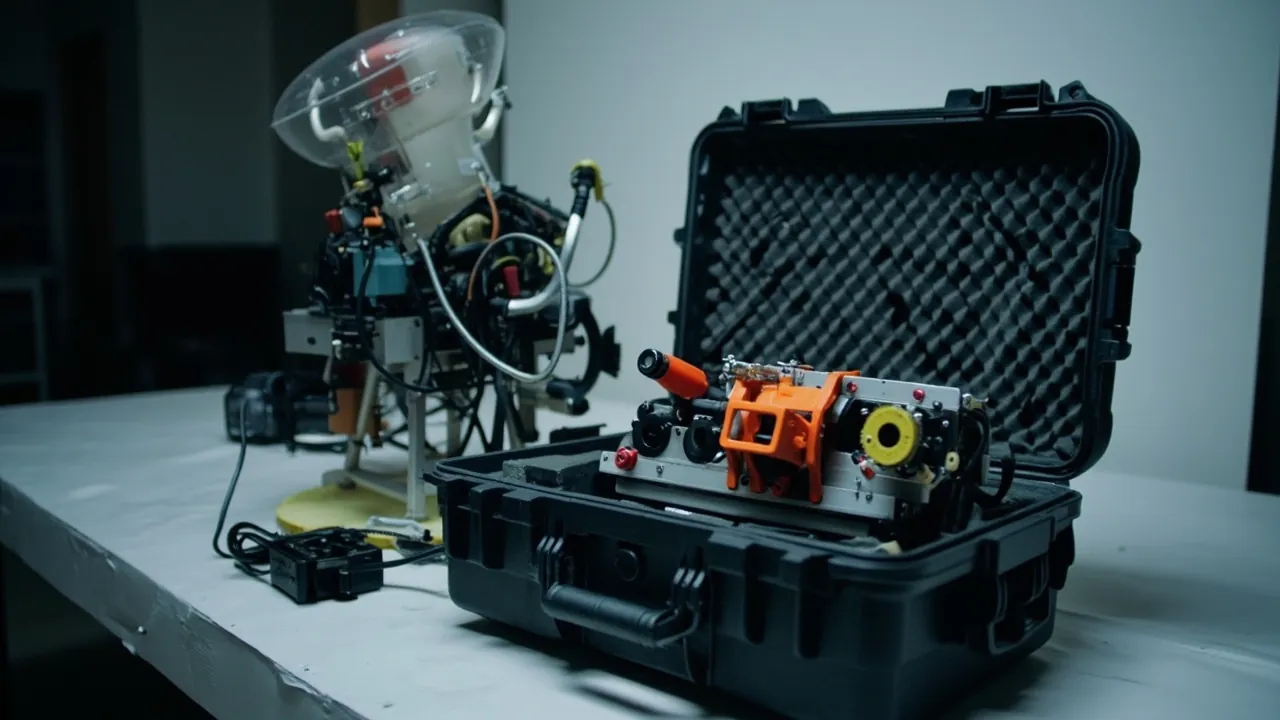
The design principle behind an ROV component and thruster case is to break the loose concept of "underwater robot spares" into three groups of protection targets that behave completely differently: rotating machinery that absorbs continuous vibration such as thrusters, hydraulic pumps and servo valve packs; electronic and signal components that fear moisture and static discharge such as electronic housings, camera and lighting modules and sensors; and flexible components that fear kinking and crushing such as tether terminations, hydraulic hoses and fibre optic assemblies. Because the failure mechanisms differ so much, the only reliable approach is one case layout per project and one compartment per component. Three threads drive selection: shell and seal specified against IEC 60529 and GB/T 4208 to fix the IP rating, with IP67 capability as the usual baseline for export and coastal service; inserts built around component mass and fragility with graded cushioning and modular compartmentation; and surfaces and hardware specified with ISO 9227 neutral salt spray thinking to control corrosion. One boundary must be drawn first: a transit case performs no pressure-retaining or subsea sealing duty. It does not replace a thruster shaft seal, it does not replace the pressure and oil compensation design of an electronic housing, and it confers no subsea certification. What it delivers is dry, clean, low-shock transfer between workshop, truck, container, quay and workboat deck. The sections that follow run through the component family, failure mechanisms, IP rating selection, material and corrosion choices, thruster-specific protection, electronics and hydraulics, insert compartmentation, standards and testing, transport and deck handling, a six-step selection process, and acceptance and maintenance.
The procurement rhythm of ROV projects is unusual. Whole vehicles are few, spare part types are many, and delivery windows are tight. A single campaign may need two thruster sets, a hydraulic power unit spare kit, a batch of subsea connectors, one spare electronic housing and a pile of consumables. The combined value is significant while the quantities are scattered, and the most common outcome of packing them loosely into a large case is not immediate breakage but an inability on arrival to confirm quickly which item is which, whether it is intact and whether it has absorbed moisture. Offshore operating windows are measured in hours, and the last thing a site engineer needs is to spend two hours inventorying a spare case before knowing whether a replacement can be fitted. That is why this article covers modular compartmentation, engraved component numbering, humidity indication and rapid inventory design alongside the protective parameters. These features do not look like protection, yet they determine whether a spare kit actually performs when it matters. On ROV and marine robotics spare kits, JUNZHJIA typically enters the process at the component list and insert layout drawing stage, supports OEM and ODM volume supply, and supplies seal parts configured by component model to reduce improvised substitutions in the field.
Table of Contents
- What an ROV component case has to protect: the full family from thrusters to electronic housings
- Work-class, observation-class and small ROVs: why spare kits differ so much
- Failure mechanisms in ROV components: vibration, seawater, shock and static
- Choosing the IP rating: IP65, IP67, IP68 against IEC 60529 and GB/T 4208
- Shell materials and salt spray control: ISO 9227 and the hardware material trade-off
- Thruster-specific protection: false brinelling, propeller blades and shaft seals
- Electronic housings, hydraulic power units and tether terminations
- Insert compartmentation: modular layout, engraved numbering and rapid inventory
- Standards and testing: ISTA, GB/T 4857, ASTM D4169, MIL-STD-810H (not a military certification), UL94
- Transport, lifting and deck transfer: classification-society awareness and operating practice
- A six-step selection process and volume spare kit configuration
- Incoming acceptance, routine maintenance and asset life management
- Frequently Asked Questions
- Conclusion & Related Reading
What an ROV component case has to protect: the full family from thrusters to electronic housings
The components found in an ROV spare kit span a wider range than most people expect, from a few tens of grams for a blanking plug to several tens of kilograms for a complete thruster assembly, and from purely passive structural parts to sensor modules containing precision optics and inertial navigation. Sorting out the family first is what makes hazard and protection requirements visible.
| Component class | Typical items | Dominant failure mode | Key packaging requirement |
|---|---|---|---|
| --- | --- | --- | --- |
| Propulsion and drive | Thruster assemblies, propellers, motors, gearboxes, actuators | False brinelling of bearings, blade deformation or chipping, shaft seal lip damage | Axial restraint, separate blade clearance, avoidance of sustained vibration |
| Hydraulic and power | Hydraulic pump sets, servo valves, cylinders, accumulators, hose assemblies | Spool sticking, seal extrusion, hose over-bending or inner layer damage | Vibration control, large bend radius support, contamination control |
| Electronic and signal | Electronic housing sections, communication modules, acquisition boards, inertial units | Moisture ingress, ESD damage, connector deformation, board flexing | Static control, desiccant, rigid support |
| Camera and lighting | Pan and tilt units, cameras, LED arrays, optical lenses | Lens scratching, optical path displacement, seal face contamination | Soft facing protection for lenses, dedicated compartments |
| Sensing and navigation | DVL, sonar heads, altimeters, conductivity sensors | Acoustic window scratching, diaphragm denting, calibration drift | Window faces left free, extremely low shock input |
| Tether and connection | Tether terminations, fibre optic assemblies, subsea connectors, penetrators | Microbend loss in fibre, pin corrosion, insulation loss | Large bend radius, individual wrapping, moisture control |
| Mechanical and tooling | Manipulator jaws, tool skids, buoyancy modules, frame parts | Coating scratching, distortion, thread damage | Interlayer separation, thread protection |
| Consumables and fasteners | O-rings, seal grease, bolts, plugs, cable ties | Ageing, contamination, loss, mixing of part numbers | Compartments, labels, countable layout |
One principle emerges immediately: components with different failure mechanisms cannot share the same compartment logic. Placing a thruster and an electronic housing section in the same open volume means the mass and vibration of the thruster act continuously on the housing seal face. Mixing fibre optic assemblies with mechanical tooling means a single burr on a tool edge can push attenuation out of specification. In engineering terms it is better to divide the case along two axes, mass class and sensitivity class, keeping heavy items low and central to carry load while giving sensitive items individual small compartments.
Work-class, observation-class and small ROVs: why spare kits differ so much
Spare kits differ enormously between ROV classes, and applying one case configuration across all of them produces either waste or under-protection.
- Work-class ROVs. High installed power, complex hydraulics and many thrusters, commonly six to eight. Spares usually include high-power hydraulic thrusters, hydraulic power unit parts, manipulator spares and large tool skids. These cases are characterised by heavy individual items, some exceeding 50 kg, and large envelope dimensions requiring lifting or forklift handling. Lifting points or a palletised base are essential and shell stiffness must be high.
- Observation-class ROVs. Predominantly electric propulsion and lighter components, but with a high proportion of electronics and camera modules. Spares typically include pan and tilt units, cameras, LED arrays, small thrusters and a large number of connectors. A many-compartment, lightweight structure suits these better, with weight control taking priority over ultimate strength.
- Small and pipeline inspection ROVs. Miniaturised components in high counts, where rapid inventory and loss prevention matter most. A small matrix insert with engraving of component name and quantity for each cell is the norm.
- Shared spares and shared cases. Where a fleet shares one spare kit across vessels, the case must carry a traceability function. A document pocket for the packing list and a humidity indicator card inside, plus a unique case number and QR position outside, are recommended.
A field observation worth keeping in mind: the value of a spare kit is not in how much it holds but in whether the item you need can be confirmed good and in its own compartment within thirty seconds on site. Every compartment and label decision should serve that goal.
Failure mechanisms in ROV components: vibration, seawater, shock and static
Vibration and cumulative fatigue. When a spare kit sails with the vessel, it absorbs shipboard vibration for days or weeks at a time, a load that is routinely underestimated. Hull vibration is dominated by low frequencies with higher-frequency content from diesel machinery and propulsion systems superimposed. For a thruster assembly, sustained vibration produces false brinelling of bearing raceways: balls oscillating through microscopic movements in an essentially stationary bearing break down the lubricant film and grind evenly spaced indentations into the raceway. The result is audible noise and vibration at particular speeds and, in severe cases, complete bearing replacement. For hydraulic servo valves, vibration can make the spool micro-reciprocate within a micron-scale clearance, generating wear particles that eventually cause sticking. Vibration resistance in an ROV spare case is therefore a core requirement, not an optional extra.
Seawater and salt spray. Deck storage, quay transfer, rain and wave splash keep case surfaces in a chloride-bearing environment for long periods. Aluminium alloy pits, carbon steel fasteners rust, and copper alloy connectors develop verdigris. The interior is affected too: every opening of the case exchanges a volume of humid air, and over many cycles internal humidity creeps upward, producing a state of slow moisture uptake inside a case that still looks sealed.
Shock and drops. Quay lifting, gangway carrying and deck movement are the typical shock sources. Propeller blades, optical lenses, acoustic windows and ceramic elements are highly shock sensitive. In practice the allowable cushion thickness and case drop height are derived backwards from component fragility, which is exactly what full-package transport testing to ISTA or ASTM D4169 is for.
Static discharge (ESD). Acquisition boards, communication modules and inertial units are sensitive to electrostatic discharge. In dry conditions such as winter workshops or air-conditioned cabins, human body charge can reach several thousand volts, enough to damage MOSFET gates and precision analogue front ends. Electronic compartments should use antistatic insert material or antistatic bags, and handling procedures should include grounding. For the practical detail, see design points for ESD shielding cases.
Choosing the IP rating: IP65, IP67, IP68 against IEC 60529 and GB/T 4208
IEC 60529 and its national counterpart GB/T 4208 define the two-digit enclosure protection code. Selection should follow real exposure rather than pay for redundancy.
| IP rating | Dust | Water | Typical ROV use scenario |
|---|---|---|---|
| --- | --- | --- | --- |
| IP65 | Dust protected | Protection against water jets | Workshop transfer, below-deck storage, covered container transport |
| IP66 | Dust protected | Protection against powerful water jets | Short-term open deck use, washdown impact |
| IP67 | Dust tight | Temporary immersion (typically 1 m for 30 min) | Open quay storage, wet loading, coastal laydown yards |
| IP68 | Dust tight | Continuous immersion (depth and duration by agreement) | Long-term deck storage, transfers with a risk of going overboard |
| IP69K | Dust tight | High-temperature high-pressure spray | Special processes requiring pressure washdown, rarely used for ROV spares |
The usual configuration for ROV spare cases is straightforward: a case with IP67 capability is sufficient for routine transfer from shipyard to workboat, moving to IP68 capability where a case will sit on an open deck long-term or faces a risk of going overboard. Remember that an IP rating only holds when the gasket is clean and intact, every latch is closed and the pressure equalisation device works. Most field water ingress traces back not to an inadequate rating but to a case closed with only two latches engaged, grit trapped in the seal groove, or a gasket that has already aged and deformed. For gasket material and ageing assessment, see seal material selection and ageing criteria for protective cases. For how hinges, latches and seals work together, see integrated design of hinges, latches and seals.
Shell materials and salt spray control: ISO 9227 and the hardware material trade-off
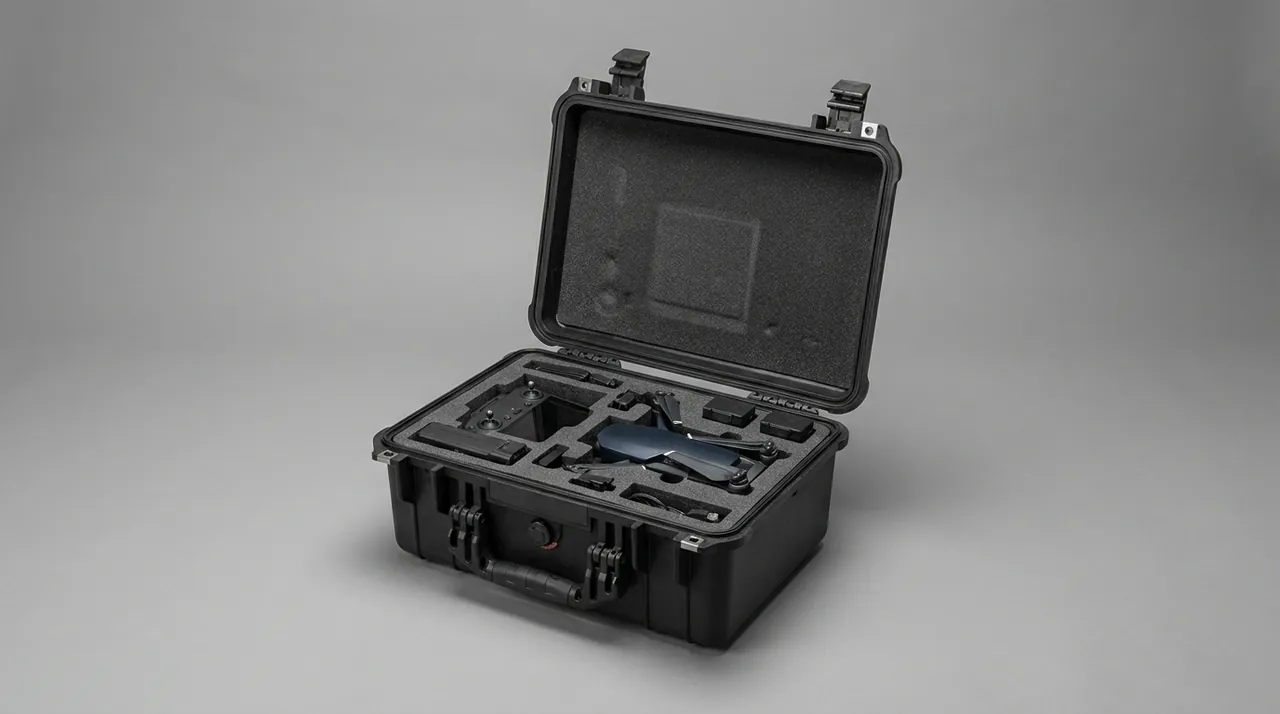
ROV spare cases are used in three environments, shipyard, quay and vessel, with increasing corrosion severity in that order. Shell material selection must balance weight, stiffness, corrosion resistance and handling convenience.
- Engineering plastic shells, typically copolymer polypropylene. Light, non-conductive, free from rust and chemically resistant, which suits observation-class ROV electronics and camera spares as well as medium and small cases carried by hand. The limitation is lower flexural stiffness than metal, so large cases depend on ribs and case mouth geometry for reinforcement, and long-term ultraviolet exposure requires a UV-stabilised compound.
- Aluminium alloy shells. Good stiffness and load capacity, suitable for heavy work-class thrusters and hydraulic parts. However, aluminium must be anodised or painted for marine shipping, and fasteners should be standardised to stainless steel, otherwise the outcome is a sound case with seized screws.
- Stainless steel shells. The best corrosion performance but the highest weight and cost, generally reserved for very small cases holding very high value items.
- Galvanic corrosion in hardware. Hinges, latches, telescopic handles and castors are frequently dissimilar metals, forming galvanic couples once assembled in a salt-laden environment. Standardising materials or adding insulating washers between interfaces is recommended, and this should be written into the purchase specification.
Corrosion capability is normally evaluated using ISO 9227 neutral salt spray testing. As a rule of thumb, plain carbon steel fasteners show visible red rust within tens of hours in a salt spray chamber, whereas suitably finished stainless hardware can remain free of red rust for several hundred hours. When supplying marine robotics customers, JUNZHJIA can provide technical documentation covering shell material grade, hardware surface treatment and structural notes on request, making it easier to bring transport packaging within the project quality management system.
Thruster-specific protection: false brinelling, propeller blades and shaft seals
A thruster is the most expensive and most delicate item in a typical ROV spare kit and deserves a purpose-designed compartment.
False brinelling is the classic transport damage. Its mechanism is that a bearing under sustained vibration while essentially stationary experiences repeated microscopic elastic deformation between balls and raceway, destroying the lubricant film and forming evenly spaced shallow indentations in the raceway. At an early stage the damage is almost impossible to identify visually, but once the thruster is back in service there is abnormal noise and temperature rise at particular speeds, and in severe cases the bearing must be replaced. Protective measures include restraining the thruster axially so it cannot shuffle inside the case, supporting it with medium-hardness foam around the circumference without over-compressing, keeping transport time as short as possible, and adding a damping layer between the insert and the component where necessary. The reasoning parallels shock and vibration resistant case design.
Propeller blades require attention to two things: blade tip distortion and edge chipping. Blades are usually thin-walled structures, and any point contact can distort them and upset dynamic balance. The insert must provide dedicated clearance cavities for the blades, roughly 3 to 5 mm larger than the blade outline on each side, with radiused edges. For thrusters that have already been dynamically balanced, it is worth keeping the same orientation throughout transport and engraving an arrow and transport orientation marking into the insert.
Shaft seals and end faces require that the lip is never squeezed and the shaft journal never knocked. The shaft should carry no axial load in the case; where a thruster has lifting lugs or a mounting flange, the load must pass through the flange or lug rather than through the shaft or blades.
Electronic housings, hydraulic power units and tether terminations
Electronic housings and circuit modules. The objects to protect are the pressure-rated end faces, penetrator connectors, internal boards and the electrical verification status already achieved. Three requirements apply. End faces must float, since no seal face should carry load. Static control is needed, using antistatic insert material or antistatic bags. Humidity should be managed with desiccant and a humidity indicator card inside the case. For the general logic of instrument compartment design, see the instrument case selection guide.
Hydraulic power unit components. These include pump sets, servo valves, cylinders, accumulators and hose assemblies. Servo valves are precision items sensitive to both contamination and vibration; wrapping them individually before placing them in the insert compartment prevents direct contact with metal parts. Hose assemblies are most at risk from insufficient bend radius: sustained small-radius bending causes inner rubber cracking and reinforcement fatigue, ending in burst failure under pressure. Packaging should support hoses at no less than the manufacturer's minimum bend radius and fit plugs or protective caps at the ports.
Tether terminations and fibre optic assemblies. This is the most frequently overlooked group. Optical fibre is extremely sensitive to microbending, and a single sharp bend can raise attenuation significantly or break the fibre outright. Requirements include no sharp edges anywhere along the fibre and cable path; bend radius controlled separately against the supplier's minimum dynamic and static radii, with the static radius usually larger; and cable assemblies packed in their own case or compartment, never mixed with tools, bolts or other hard items. Connector end faces should have protective caps to keep out dust and oil. For internal cable and accessory arrangement, see the removable divider system.
Insert compartmentation: modular layout, engraved numbering and rapid inventory
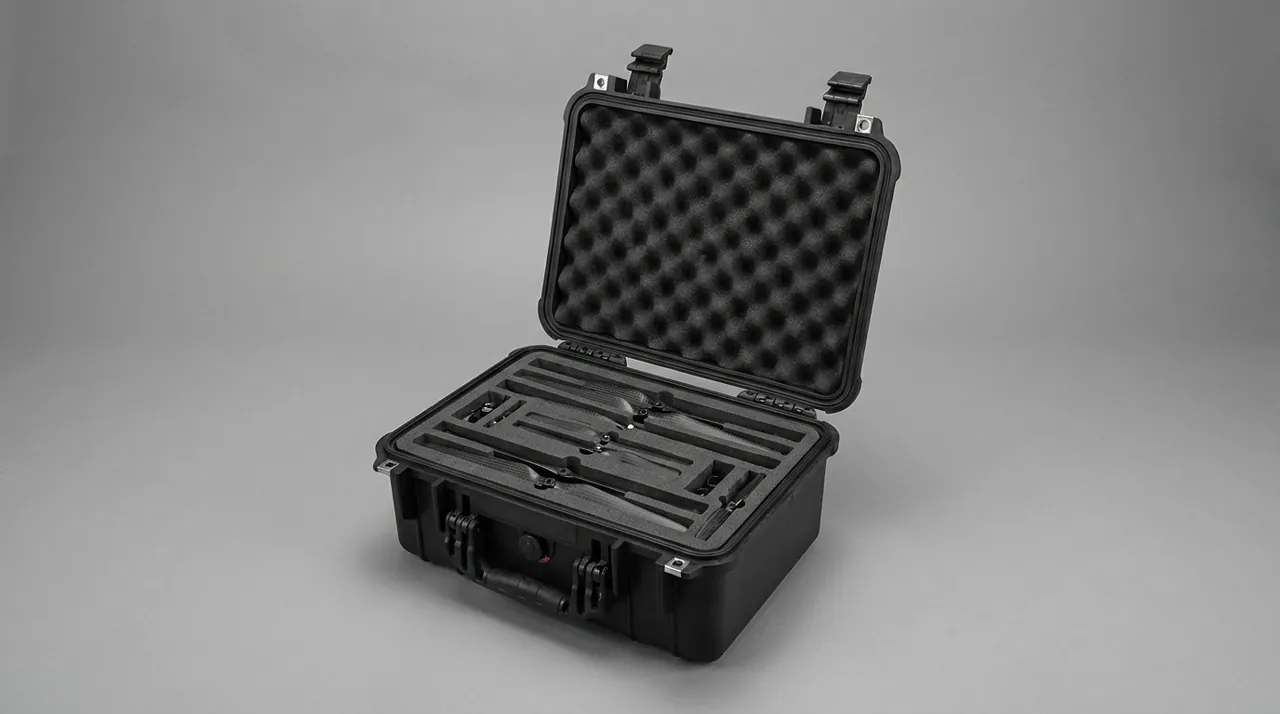
The insert is where engineering capability shows most clearly in an ROV spare case, and where operating efficiency can be improved most directly.
The basic method for modular compartmentation
- Divide by mass. Keep heavy items central and low so the centre of gravity stays low and centred; place light and sensitive items above and at the edges.
- Isolate by sensitivity. Optical surfaces, acoustic windows, diaphragms and seal end faces each get their own compartment, never adjacent to hard metal items.
- Zone by usage frequency. High-turnover items such as O-rings, seal grease, bolts and plugs go where they can be reached as soon as the case opens; low-frequency items go deeper.
- Engrave for inventory. Engrave component name, specification, quantity and part number into the insert, complemented by a packing list pocket, so that a glance at a cell confirms its contents.
- Leave room to grow. Spare kits change with campaign scope, so the insert should include adjustable empty cells or removable divider strips.
| Insert material | Characteristics | Suitable ROV components | Cautions |
|---|---|---|---|
| --- | --- | --- | --- |
| EVA (medium to high density) | Precisely machined, dimensionally stable, good rebound | Electronic housing sections, sensors, connectors, small modules | Higher cost, stiffens at low temperature |
| EPE (low density) | Light, long cushioning stroke, low cost | Buoyancy modules, frame parts, large light items | Rebound decays after repeated compression |
| PU foam | Firmness tunable by density, strong energy absorption | Thruster assemblies, hydraulic pump sets, heavy items | Relatively higher moisture uptake, needs sealing or desiccant |
| Cross-linked PE foam | Tear resistant, weather resistant | Returnable cases with frequent opening | Slightly harder to machine |
| Antistatic EVA or PE | Controlled surface resistivity | Boards, communication modules, inertial units | Surface resistivity requires periodic verification |
For a side-by-side comparison of foam materials and the selection logic, see the custom foam insert design guide and the case foam material comparison. In ROV spare case projects, JUNZHJIA typically works from the customer's component list and outline drawings, produces the insert layout drawing and case size recommendation, validates fit and ease of access in the sampling stage, and only then moves to volume production, supplying seal parts matched to component models.
Standards and testing: ISTA, GB/T 4857, ASTM D4169, MIL-STD-810H (not a military certification), UL94
Test requirements for ROV spare cases usually come from customer project documents and industry practice. The table below clarifies where each common standard applies. Note in particular that MIL-STD-810H is used here purely as a reference for environmental test methodology and is not a military certification.
| Standard | Content | Application in ROV spare cases |
|---|---|---|
| --- | --- | --- |
| IEC 60529 / GB/T 4208 | Enclosure protection ratings (IP code) | Defines dust and water ratings and test methods |
| ISTA series | Performance testing of transport packages | Full case drop, vibration and compression verification |
| GB/T 4857 series | Basic tests for transport packages | Common test and reporting basis for domestic projects |
| ASTM D4169 | Performance testing of shipping containers and systems | Distribution cycle simulation for North American customers |
| MIL-STD-810H | Environmental test methods (vibration, shock, temperature, humidity, salt fog and more) | Reference for test profile design (not a military certification) |
| ISO 9227 | Salt spray tests | Salt spray evaluation of shell and hardware |
| UL94 | Flammability testing of plastics | Flame retardance class for foams and plastics where required |
| ISO 13628 series | Design and operation of subsea production systems | Clarifies subsea component design boundaries and confirms a case has no pressure duty |
The recommended combination is: type verification of the IP rating to IEC 60529, drop and vibration testing of the fully packed case to ISTA or GB/T 4857, salt spray testing of the shell and hardware to ISO 9227, and UL94 classification of foam if flame retardance is required. For procedures, see the ISTA transport testing procedure, ASTM D4169 distribution cycle simulation and GB/T 4857 transport packaging testing. The general logic of environmental test profiles is covered in interpreting MIL-STD-810H environmental test compliance.
Transport, lifting and deck transfer: classification-society awareness and operating practice
The real journey of an ROV spare case is longer than ordinary industrial packaging: factory, road, port, sea freight, port of destination, quay warehouse, supply vessel, platform or workboat, deck storage, final installation. Each leg has a different dominant hazard.
- Sea freight. The dominant hazards are sustained high humidity, salt spray and internal temperature cycling. Place sufficient desiccant and a humidity indicator card inside; avoid direct contact with the container wall where condensation droplets can fall onto the case; and observe the manufacturer's stacking limit.
- Quay and supply vessel transfer. The dominant hazards are rough handling and occasional drops. Cases should carry clear lifting, centre-of-gravity and orientation markings, and heavy cases should have lifting points or a pallet base, with sling angle and load matched to lifting point strength.
- Deck storage. The dominant hazards are salt spray, ultraviolet radiation and wave splash. Use UV-stabilised shells and stainless or fully plated hardware, keep cases off the deck so they are not standing in pooled water, and inspect castors and telescopic handles periodically on wheeled cases; see wheel and trolley handle configuration.
Classification societies including DNV and ABS publish extensive rules and recommended practice on offshore transport, lifting and sea fastening, and project documents commonly cite their general principles to specify securing and stacking. It should be clear that a transit case is not itself a classification society certified item, but citing general principles on securing, stacking and lifting helps packaging documentation pass owner review. On supplier selection and batch consistency, see how to choose a protective case OEM factory.

A six-step selection process and volume spare kit configuration
- Build the component list. Record item name, envelope including protrusions, net mass, sensitive face locations such as lenses, acoustic windows, diaphragms and seal end faces, whether the item is static sensitive, and any minimum bend radius. The output should be a table, not prose.
- Define the transport route and exposure. Establish the sea, air and road split, whether open storage occurs, whether the case goes on deck, and whether it will endure long-term shipboard vibration. Set the IP target, usually from IP67 upward with IP68 capability for long-term deck use, and decide whether a pressure equalisation valve is mandatory.
- Define the insert concept and load path. Provide relief around sensitive faces, select foam density and thickness from mass and fragility, lay out modular compartments by component count, and design dedicated compartments for blades, lenses, acoustic windows and seal end faces.
- Define case type, volume and handling method. Choose hand-carry, shoulder-carry, wheeled trolley or vehicle-stacked format by unit mass, verify compressive capacity against the stacking requirement, and decide latch type and whether a tamper-evident seal position is needed.
- Define markings and accompanying documents. Lifting, centre-of-gravity and orientation markings, engraved component numbering, packing list pocket, humidity indicator card, desiccant and calibration certificate pocket. Volume spare kits should also standardise case numbering rules and QR positions for asset tracking.
- Define acceptance and documentation. Agree incoming inspection items covering appearance, dimensions, gasket condition, latch effort, insert fit and numbering accuracy, along with sampling level and acceptance rules, and require shell material notes, hardware surface treatment notes and optional test reports. For sampling scheme design see custom case acceptance and AQL sampling; for handling format trade-offs see portable transport case types compared.
Incoming acceptance, routine maintenance and asset life management
Incoming acceptance checklist
- Shell free of cracks, distortion or dents; case mouth flat and true.
- Gasket complete, not twisted and free of trapped foreign matter; seal groove clean.
- Latches fully engaged with consistent effort; hinges free of play and noise.
- Pressure equalisation membrane clean with the protective cap in place.
- Insert compartments match the drawing and engraved numbering is clear and correct.
- Desiccant and humidity indicator card present in the agreed quantity.
- Accompanying documents complete.
Routine maintenance recommendations
- Clean the seal groove and case mouth after each use with mild detergent and a soft cloth; never use solvent-based or strongly alkaline cleaners. See correct cleaning and care for protective cases.
- Inspect the gasket every 6 to 12 months and replace immediately on hardening, cracking or permanent flattening; shorten to 3 to 6 months in marine environments or with frequent opening.
- During long storage, leave latches slightly open or ventilate periodically so the gasket is not permanently compressed, and replace desiccant on schedule.
- Inventory spare kits quarterly, verifying counts and condition and updating the packing list.
- Maintain a case number to component to transport record log so high-value items remain traceable. On replacement timing, see protective case service life and replacement criteria.
Frequently Asked Questions
Q: Which components in an ROV spare kit are most easily damaged in transit, and why?
A: Field evidence points to three groups. The first is thruster bearings, through false brinelling: a bearing that is not rotating but is subjected to sustained shipboard vibration experiences microscopic friction between balls and raceway that destroys the lubricant film and forms evenly spaced shallow indentations. There is no visible external sign, yet once the thruster is reinstalled there is noise and temperature rise at particular speeds. The second group is optical and acoustic windows, including camera lenses, LED array optics and the acoustic matching layers of DVL and sonar transducers. These surfaces are soft and a single careless contact leaves a scratch that changes light transmission or acoustic impedance matching. The third group is fibre optic and cable assemblies, where optical fibre is extremely sensitive to microbending and one sharp bend can raise attenuation sharply or break the fibre, with no visible indication once the case is closed. What these three groups share is that the damage is either gradual or hidden rather than an obvious fracture, which is precisely why it is so easily overlooked.
Q: Can an ROV component case be fully sealed without a pressure equalisation valve?
A: It is not recommended. A fully sealed case is subjected to sustained pressure differential in three situations: reduced cabin pressure in air freight equivalent to 2,000 to 2,500 metres of altitude, low atmospheric pressure on high-altitude roads, and internal air expansion and contraction from day-night temperature swings. The differential acts continuously on the gasket and latches, driving the gasket compression ratio away from its design value; over time rebound capacity falls and leakage follows. Internal positive pressure also means a large initial force is needed to open the case, and the moment the lid releases it can eject components or damage the case mouth. A pressure equalisation valve uses a hydrophobic and oleophobic microporous membrane, commonly expanded PTFE, allowing gas to pass while blocking liquid water and oil mist, so its function is to relieve the differential rather than open an ingress path. When selecting, check membrane hydrophobic rating, air flow rate and protective cap design; installation is normally on the upper part of the case side wall so the valve cannot be submerged.
Q: A spare kit contains both heavy metal items and electronic modules. How can one case serve both?
A: The governing idea is separate by layer, separate by load path, and separate electrically. Separating by layer means placing heavy metal items low and central and electronics and sensitive items above, keeping the overall centre of gravity low and centred while ensuring that an upper heavy item cannot fall onto a lower sensitive item. Separating by load path means adding structural support columns or reinforced partitions so that heavy item loads pass directly into the reinforced case base rather than through foam into an adjacent electronics compartment; rigid partitions, not just foam, should separate neighbouring compartments. Separating electrically means using antistatic insert material or antistatic bags in electronics compartments and providing for static discharge inside the case, so that human body charge during handling does not reach the boards through the insert surface. Electronics should also be kept away from metal items that generate wear debris, with secondary packaging in an inner box where necessary. A separate humidity indicator card for the electronics compartment allows an immediate moisture assessment on opening.
Q: How should propeller blades and the shaft be handled when packing a thruster?
A: Neither should carry load. Propeller blades are usually thin-walled structures where any point contact can cause distortion and upset dynamic balance, so the insert must provide dedicated blade clearance cavities roughly 3 to 5 mm larger than the blade outline on each side, with radiused edges so no sharp corner presses directly on a blade face. The shaft and the seal lip must carry no axial load at all and must be protected from any radial impact; where a thruster has lifting lugs or a mounting flange, load should pass through those. For axial restraint, surround the unit with medium-hardness foam without over-compressing, because over-compression transmits impact directly into the housing on a drop. For thrusters that have been dynamically balanced, keeping a single orientation throughout transport is advisable, with an arrow and transport orientation marking engraved into the insert to prevent repeated flipping. Finally, keep transport time as short as possible, since this class of bearing damage accumulates with vibration exposure time.
Q: Should an ROV spare case be rated IP67 or IP68?
A: It depends on actual exposure rather than a preference for higher numbers. If the case is used mainly in shipyard workshops, below-deck storage or covered container transport, IP65 capability is sufficient and gives the best weight and cost balance. Where a case must sit in the open at a quay, be loaded in the rain or be stored temporarily in a coastal laydown yard, IP67 capability is the right choice and is the most common specification for marine robotics spare kits, handling temporary immersion and spray. Only for long-term open deck storage or transfers where the case could go overboard is IP68 capability worth the cost, which comes with heavier latches, a thicker sealing structure and less convenient opening. Two further points are worth remembering. An IP rating only holds when the gasket is clean and intact, all latches are closed and pressure equalisation works, and most field ingress is a usage issue rather than a rating issue. Higher ratings also mean heavier cases, so specifying IP68 for a frequently hand-carried case actually reduces efficiency.
Q: What matters when packing fibre optic and tether termination assemblies?
A: Bend radius and separation are the critical factors. Optical fibre is extremely sensitive to microbend loss, and one sharp bend is enough to raise attenuation notably or break the fibre, with no visible indication once the case is closed. No sharp edges may exist anywhere along the cable path, and bend radius must be controlled against the supplier's minimum dynamic and static radii separately, with the static radius usually larger. Coiling should use a large-diameter radiused spool or curved support rather than a cable tie pulled into a small loop. For separation, tether terminations must have their own compartment or inner box and must never be mixed with tools, bolts or structural metal parts, since a single burr or a rolling bolt can crush the fibre. Connector end faces should be fitted with protective caps to keep out dust and oil, and where the customer requires it, insert materials with controlled antistatic and flame retardance properties can be specified, together with a humidity indicator card to reveal any moisture exposure.
Q: What role can MIL-STD-810H play for an ROV spare case?
A: Its role is to provide a public, reproducible set of methods and profile design thinking for environmental testing, covering how random vibration, mechanical shock, temperature and humidity cycling and salt fog tests are performed, how levels are set and how long they last. It should be emphasised that MIL-STD-810H itself issues no certification and confers no military qualification, and the correct form of statement is that environmental testing was conducted in accordance with the relevant methods of MIL-STD-810H together with the specific test conditions, rather than a broad claim of compliance with a military standard. For an ROV spare case, the more valuable exercise is aligning the test profile with the actual transport route: where sea transit is long and vibration is dominated by low frequencies, extend low-frequency vibration duration accordingly; where there is a deck drop risk, verify against the drop height requirements of ISTA or GB/T 4857. Conclusions obtained this way reflect real protective capability far better than chasing a standard's name.
Q: Why should volume spare cases use standardised case numbers and packing lists, and how does that affect operations?
A: Because the biggest cost in ROV spare management is not the case itself but the three problems of not finding, not distinguishing and not judging. A standardised numbering rule, for example ship, system and function in three levels, combined with a QR code on the outside, lets the warehouse locate a specific case directly in the asset system. A packing list pocket inside plus engraved numbering in the insert enables inventory at a glance, so a site engineer can confirm in thirty seconds whether a required item is present and whether quantities are sufficient. A humidity indicator card and an opening record solve the judging problem, since the card colour before opening reveals whether the interior has absorbed moisture and prevents a damp component from being installed on the ROV. These management actions do not look like protection, yet in a reality where offshore operating windows are measured in hours they influence project outcomes more than adding another millimetre to the case wall.
Q: What maintenance points deserve particular attention when spare cases live aboard a vessel?
A: The distinctive feature of a vessel environment is that salt spray, humidity, ultraviolet radiation and sustained vibration occur simultaneously, so maintenance priorities differ from a land-based warehouse. Gasket inspection should be more frequent, every 3 to 6 months, replacing immediately on hardening, cracking, permanent flattening or surface tackiness. Hinges, latches, telescopic handles and castors should be checked quarterly for corrosion and smooth operation, with marine-appropriate grease applied where needed. Cases should not be exposed to prolonged direct sunlight or placed directly on the deck where the base sits in pooled water. Latches should be closed again promptly after each opening so internal humidity does not accumulate, and desiccant should be replaced on the agreed schedule rather than after it has failed. A spare case should also carry an opening and inventory record, logging each opening time, items withdrawn and remaining quantities, which matters especially for kits shared across vessels. For overall case condition and replacement timing, see the protective case service life and replacement criteria article.
Conclusion & Related Reading
The essence of an ROV component and thruster case is treating underwater robot spares as an asset pack that needs systematic management rather than a pile of parts waiting to be boxed. Its logic reduces to three statements: protect different failure mechanisms with different layouts; use modular compartmentation, engraved numbering and humidity indication to make condition assessment automatic on opening; and quantify protective capability into acceptance clauses through IP ratings, salt spray testing and full-package transport testing. In execution that means setting the IP rating against IEC 60529 and GB/T 4208, defining corrosion requirements against ISO 9227, selecting transport tests against ISTA, GB/T 4857 and ASTM D4169 with MIL-STD-810H used only as an environmental test method reference and not as a military certification, and designing dedicated compartments for thrusters, optical and acoustic windows, electronic modules and fibre optic and tether assemblies. JUNZHJIA supplies custom protective cases, EVA, EPE and PU insert design with compartment layouts, seal parts configured by component model, and OEM and ODM support with volume supply for ROV and marine robotics customers, and can provide shell material and structural documentation as projects require.
Related Reading