

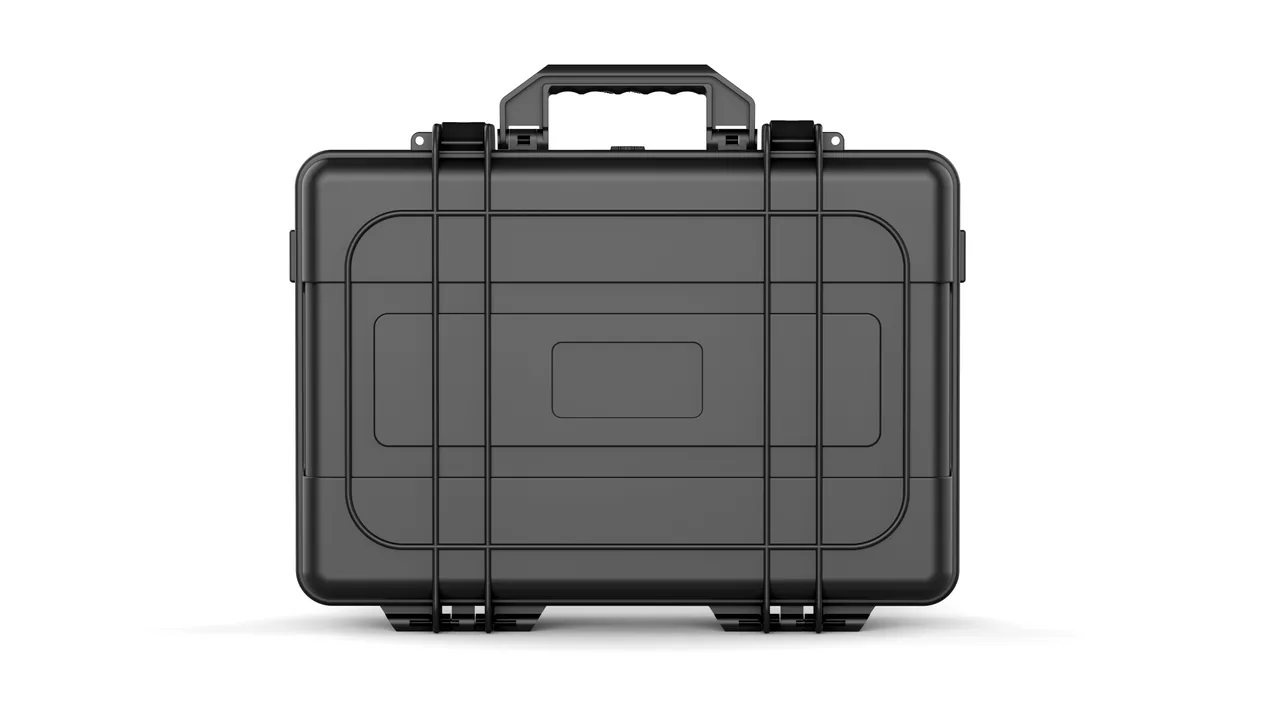
Soil moisture profiling, salinity mapping, root-zone observation and farmland microclimate research all depend on the same kind of field instrument set: probes pushed into the ground, a data logger recording them, a solar panel keeping the system alive and a communications module pushing readings back to a server. These systems carry a built-in contradiction. They are engineered to run unattended in a field for months or years, yet on the way there — leaving the factory, moving between project sites, relocating between research plots, or shipping overseas — they are handled far more roughly than they will ever be in service. Ceramic filters and stainless probe shafts crack or bend on impact. Logger circuit boards lose insulation to moisture. Tempered glass on solar panels develops hairline fractures nobody sees. Antenna connectors deform under a side load. These faults usually surface in the second week after the instrument is buried, long after anyone can trace them back to the journey. As a protective-case manufacturer, JUNZHIJIA has supplied transport and storage protection to soil instrument builders, research institutes and agricultural IoT integrators for years. Working from that side of the bench, we have assembled a set of practices — compartment architecture, anti-static liners, IP67 sealing, humidity and condensation control, and vibration isolation — shaped around the precision-electronics character of field instruments. This article maps how each element of a soil sensor system actually fails in logistics, and how a purpose-built case pushes those risks back into an acceptable band.
Why Soil Probes Are the Weakest Item in the Case
A soil probe is fragile because of the premise it is designed around: it must be thin and stiff at the same time. To drive into compacted soil and hold stable contact, the shaft is kept slender — usually a stainless or carbon-fibre tube with limited wall thickness. To measure moisture and salinity, the same probe has to carry a ceramic filter, a porous clay head, electrode rings and often a temperature element. Those requirements together make the probe the least rigid and among the most expensive items in the shipment. The dominant risk is not a single break but slow deformation. If the probe is unsecured, sustained trailer vibration lets both ends micro-move against the liner and the shaft accumulates a bend along its middle. On arrival the bow is hard to judge against the allowed deviation by eye, but the contact geometry in the soil has already changed, and moisture readings begin to drift systematically.
Ceramic filters and clay heads form the second hazard zone. These porous parts are brittle: strong in compression, poor in impact, and they crack along micro-fissures the moment a point load touches them. A fracture is almost invisible while dry, then expands as the material takes up water after burial, until the whole element breaks apart and the probe stops working. JUNZHIJIA designs a longitudinal locating channel for probes so the shaft bears against a formed surface along its full length, with an elastic tolerance ring at each end, so the shaft neither spans unsupported nor takes axial squeeze. For clay-headed probes we cut a slightly oversized floating cavity at the head, keeping the brittle element clear of both the liner and every neighbouring part. Loaded this way the probe is surrounded rather than point-loaded.
The tapered insertion tip needs its own treatment. Tips are ground to a thin keen edge so the probe can enter soil, and any scrape against a hard object changes the cone angle, raising insertion resistance or preventing entry altogether. We leave a clearance pocket at the tip and fit a soft sleeve at the channel mouth so neither a hand nor a tool touches the edge during packing. For probe sets shipped together we separate by length and layer by model, so a short probe tip cannot press against the shaft of a longer one. Comparable liner practice for delicate instruments is set out in our precision instrument protective case guide.
The Protection Logic for Logger Electronics
A data logger is the brain of a soil sensor system. Inside sit the main microcontroller, analog-to-digital conversion circuitry, clock and memory chips, a power management stage and multi-channel input terminals. What these parts share is sensitivity to static and moisture, and a surprisingly high tolerance for mechanical shock. That single observation sets the protection priority: the logger needs electrical and humidity stability, not a thicker shell. It determines liner material, cavity architecture and accessory selection.
Static is the quietest killer. A plastic housing rubbed repeatedly inside a dry trailer or an air-conditioned room accumulates charge, and when a technician opens the case and touches the input terminals or the commissioning port directly, several thousand volts can punch through the input protection network. What makes this damage so unpleasant is its delay. Electrical testing at the factory passes, the first two weeks of data look normal, and then one channel simply stops recording. The user suspects the probe first, then the cable, and spends far more time than the fault deserves. JUNZHIJIA lines logger chambers with anti-static EVA and laminates conductive foam onto the cavity wall so the whole volume sits at equal potential. The commissioning port gets its own recessed clearance, and we reserve a small lidded pocket for memory cards or batteries swapped in the field, so a used part is never dropped back beside new stock and hit by a second static event.
Thermal drift is another problem that transport quietly amplifies. The ADC stage depends on a voltage reference, and precision reference chips react to thermal cycling. After repeated swings between a sun-baked trailer and a cold depot, the reference can shift slightly, showing up as every channel offset by the same fixed amount. JUNZHIJIA confirms the temperature range of the transport chain with the customer at the scoping stage, uses a composite liner with an insulating layer for high-accuracy loggers, and fits a temperature record label so the full profile can be read on arrival. General principles for shell material and thermal range are covered in our outdoor case material selection article.
It is worth separating two failure modes that customers often conflate. A logger that arrives dead is obviously a transport problem. A logger that arrives alive but drifts is far more expensive, because the fault only appears as anomalous field data weeks later and is routinely misread as a sensor problem. That is why we treat the logger cavity as an electrical environment rather than a mechanical one: liner grade, cleanliness and terminal protection matter more than wall thickness, and the verification work at sampling focuses on surface resistance and internal potential rather than drop height alone.
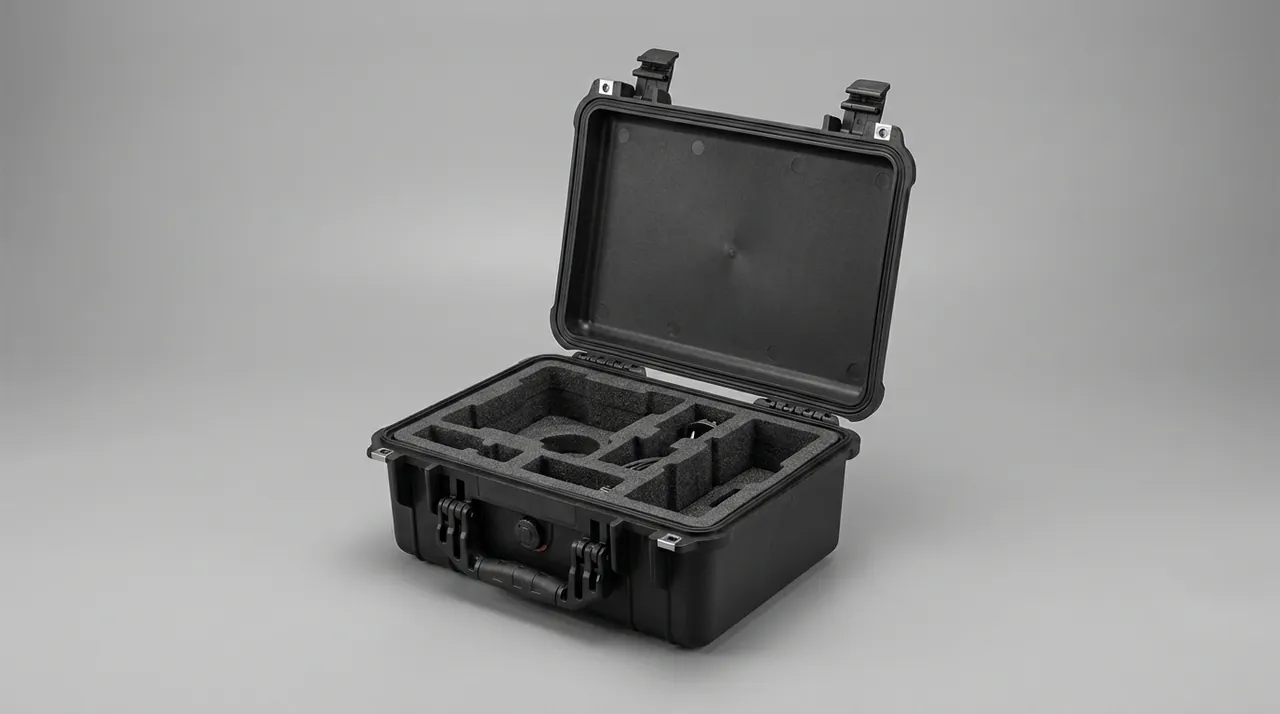
Hidden Damage to Solar Panels and Power Modules
Remote stations are normally powered by a solar panel plus a battery, which makes the panel the largest and least stiff component in the case. Tempered glass has limited bending capacity, so stacking pressure or a tilted case produces micro-cracks on the back face; more commonly, the encapsulant layer between cells and glass delaminates locally, leaving the panel looking perfect while conversion efficiency falls. The awkward part is that the causal link to transport is very hard to prove. The panel generates correctly at the site, degrades a month later, and the user blames product quality instead of the journey.
Point loading through the lid is a further aggravating factor. A panel lying flat has no support under its centre, so if another case sits on top, bending stress concentrates near the cell busbars and micro-cracking becomes almost inevitable. JUNZHIJIA designs a contoured channel with mid-span support: beyond the four edges, flexible support posts are distributed under the panel face according to cell layout so pressure spreads across many points rather than concentrating at the centre. The upward face keeps enough clearance that the closed lid never touches the panel. For frames in aluminium we also relieve all four corners, because assembled corner joints concentrate stress and a knock can open a gap that lets water into the laminate.
Battery packs follow different logic. Lead-acid or lithium iron phosphate units are heavy with a low centre of gravity, but their housings are usually plastic and turn brittle in cold. If they move freely inside the case, an impact against the wall can crack the shell or short the terminals. JUNZHIJIA gives the pack its own cavity with locating blocks so it cannot shift in any attitude, and fits an insulating shroud over the terminals to prevent an accidental tool bridge. For lithium chemistries we add transport markings and a fire-retardant liner as required, consistent with the management approach described in our lithium battery transport case article.
Connector and Antenna Protection on Comms Modules
Getting data off a field station requires a communications module: a 4G modem, a LoRa gateway, an NB-IoT terminal or a satellite link. These modules are small and light, which makes them look easy to ship, yet their failures concentrate at two places — the connector and the antenna. RF connectors are usually SMA or Type N, whose centre conductor is a thin pin that bends under very little side load. Once the pin is off-axis the connector still threads on, but the standing-wave ratio degrades, showing up as weak signal and rising packet loss. Field teams usually check base-station coverage first, so the real cause is found very late.
Antennas are the other underestimated weak point. On fibreglass, suction-cup or whip types, the base is where stress concentrates. Without a dedicated cell, an antenna gets its base crushed by neighbouring parts, or its shell is scraped and then takes in water, corroding the internal radiator. JUNZHIJIA machines a full-length support channel so the antenna lies horizontally with its base resting on a soft pad. For comms assemblies already mounted in an enclosure, we relieve the connector area and fit protective caps that come off at installation.
Module boards need moisture control too. Field stations are often deployed in the rainy season, and crews frequently work in the rain. If a module is packed while still damp, water vapour inside the sealed cavity acts continuously on the RF circuitry, oxidising microstrip lines and corroding solder joints. JUNZHIJIA advises confirming the module surface is dry before packing, and fitting desiccant sachets plus a humidity indicator card inside the cavity. For export orders to humid regions we laminate a moisture barrier film into the module chamber as well. General practice for this equipment class is described in our communication electronics protective case article.
Moisture and Condensation Control as a Combined System
For soil sensor equipment, moisture usually causes more loss than mechanical damage, because mechanical damage is visible and moisture damage only shows up once power is applied. When an instrument moves from cold storage into warm humid air on site, the cavity wall is below the dew point, and water condenses on the wall and on metal surfaces. If a logger housing already holds a little moisture, condensation forms next to the circuit board and creates a creepage path, eventually reducing insulation resistance or drifting the channels. JUNZHIJIA treats humidity control as equal in importance to waterproofing, using sealing, desiccant and indication together. Reusable silica gel or montmorillonite packs sit inside the case and change colour when saturated, while a humidity indicator card lets the receiver judge exposure history before opening the lid.
Desiccant quantity cannot be guessed. We calculate the required mass from cavity volume, intended transit duration, climate zones crossed, the total hygroscopic material inside the case and the shell's own water-vapour transmission rate, then add margin for ocean freight and multi-zone road legs. Loggers with a high electronics content also get an aluminium-foil moisture barrier on the inner layer. The quantified method is set out in our condensation control in cases article, which gives workable ranges for desiccant provision by climate zone.
There is one more condensation source that is easy to overlook: water carried in by the equipment itself. Probes and loggers recovered from the field usually come back with soil and dew on them, and if they go straight into the case uncleaned, that moisture releases slowly inside the sealed volume. Even with perfect sealing, internal humidity keeps climbing. JUNZHIJIA recommends a fixed recovery sequence — clean, dry, then pack — plus a removable debris tray for wiping cloths and cleaning tools. For large solar panels that genuinely cannot be dried completely, we note it on the packing record and raise the desiccant allowance accordingly, so any later claim has evidence behind it.
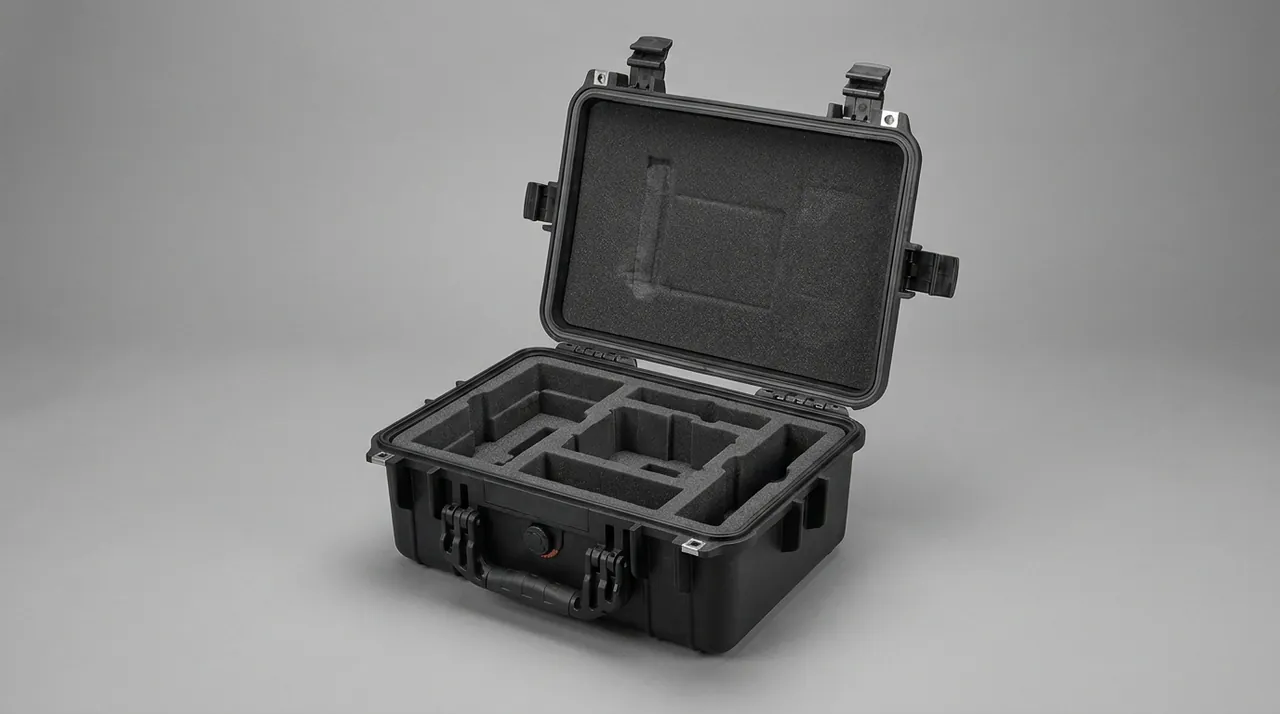
IP67 Sealing and Dust Control
Soil monitoring sites sit in farmland, orchards, slopes and saline ground, so dust and fine sand are unavoidable. Seed-raising substrate, silt and fertiliser dust have very small particles that drift and settle on every exposed surface. If the case seals poorly, dust enters the cavity and deposits on probe threads, connectors and heat-dissipating surfaces — harmless in the short term, but over time it accelerates terminal corrosion and degrades thermal performance. JUNZHIJIA IP67 cases use a one-piece moulded shell with an inset gasket and compression latches, forming a continuous sealing band when the lid closes. The boundary conditions for the dust and water tests are explained in our what is IP67 rating article.
Seal reliability depends on even pressure distribution. A distorted lid, too few latches or inconsistent gasket groove depth leaves some sections under-compressed and creates a leakage path. JUNZHIJIA runs a stiffness analysis on the lid at the design stage, sets latch count and position from the case dimensions, and adds a secondary seal at the corners. Latches carry a locking indicator so field staff can confirm full compression visually. For cases opened and closed repeatedly in the field, we also form a sand lip at the edge of the gasket groove to keep fine grit off the sealing face, since a grain trapped in the groove abrades the gasket on every cycle.
Temperature change belongs in the same design review. When a case moves from a cool store into a sun-exposed trailer, trapped air expands, internal pressure rises and can lift the lid or squeeze the gasket. Moving the other way, from heat into cold, creates negative pressure that pulls the lid tighter and makes opening harder. JUNZHIJIA fits a pressure equalisation valve with a waterproof breathable membrane on cases facing long transit or wide temperature swings, letting gas pass slowly while blocking water and dust. The valve sits away from areas that may take direct spray, and the shell is marked to warn against pressure washing it head-on. The structural principle is discussed further in our pressure equalisation valve guide.
Compartment Architecture and Precision-Part Location
The component spread in a soil sensor system is unusually wide: slender probes and antennas, flat solar panels, small high-value loggers and comms modules, plus cables, mounting brackets, ground stakes, tools and spare desiccant. Packed into one undivided case, heavy parts crush light ones, metal scrapes plastic, and cables tangle around probes. JUNZHIJIA works to a rule of a compartment per part type and a defence per risk, dividing a soil sensor case into five zones — probe, electronics, power, communications and accessories — separated by reinforcing ribs and dividers.
Compartment sizing follows the actual packing list rather than a fixed ratio. At order intake we ask for a complete parts list, each item's dimensions and weight, and a description of vulnerable areas, then model each part's placement in 3D and generate contoured liner drawings. For probe families with widely different lengths we use adjustable locating blocks so one case serves both short and long variants. Dividers are plug-in and removable, so a customer can re-proportion the cavity layout for the current configuration. Related liner processes are described in our EVA thermoformed liner process article.
Compartment architecture also makes loading density verifiable. Because each cavity has a designed volume, a packer can see whether a part is missing simply by checking for an empty pocket, which matters greatly on kit deliveries for research projects. JUNZHIJIA routinely binds the cavity map to the packing list on batch orders so quality control can verify pocket by pocket instead of tracing a shortage after the customer complains.
Vibration Isolation Matched to Transport Conditions
Transport conditions for soil sensor equipment vary widely. Short in-vehicle transfers by research institutes are dominated by accumulated vibration. Cross-province road freight for an agricultural IoT integrator adds stacking load. Ocean freight brings salt fog, long-term high humidity and repeated container handling. The last mile to a remote site is often on someone's back or strapped to a motorcycle, where instantaneous shock is actually the highest of the whole journey. Case design has to match these conditions rather than simply adding another layer of foam.
The core of vibration isolation is controlling the natural frequency of the system so it avoids the main energy band of transport vibration. If the spring system formed by shell and liner has a natural frequency close to the trailer's dominant frequency, resonance amplifies motion — and the softer the foam, the larger the amplitude becomes. JUNZHIJIA selects liner density and thickness from part mass and transport mode: medium-density EVA with local soft pads for electronics, high-density EVA with base damping posts for heavy battery packs, and heavy items placed low in the case to bring the centre of gravity down. The mechanism is explored in our shockproof case approach article.
For the last-mile manual carry case we add two targeted features: four lifting points with recessed handles so two people can carry the case without hugging it, and anti-slip feet underneath so it does not slide on a motorcycle rack or hand trolley. Cases stored outdoors long-term benefit from a UV-resistant coating and stainless hardware. Where export is involved, case certification and document packages are covered in our export packaging compliance article.
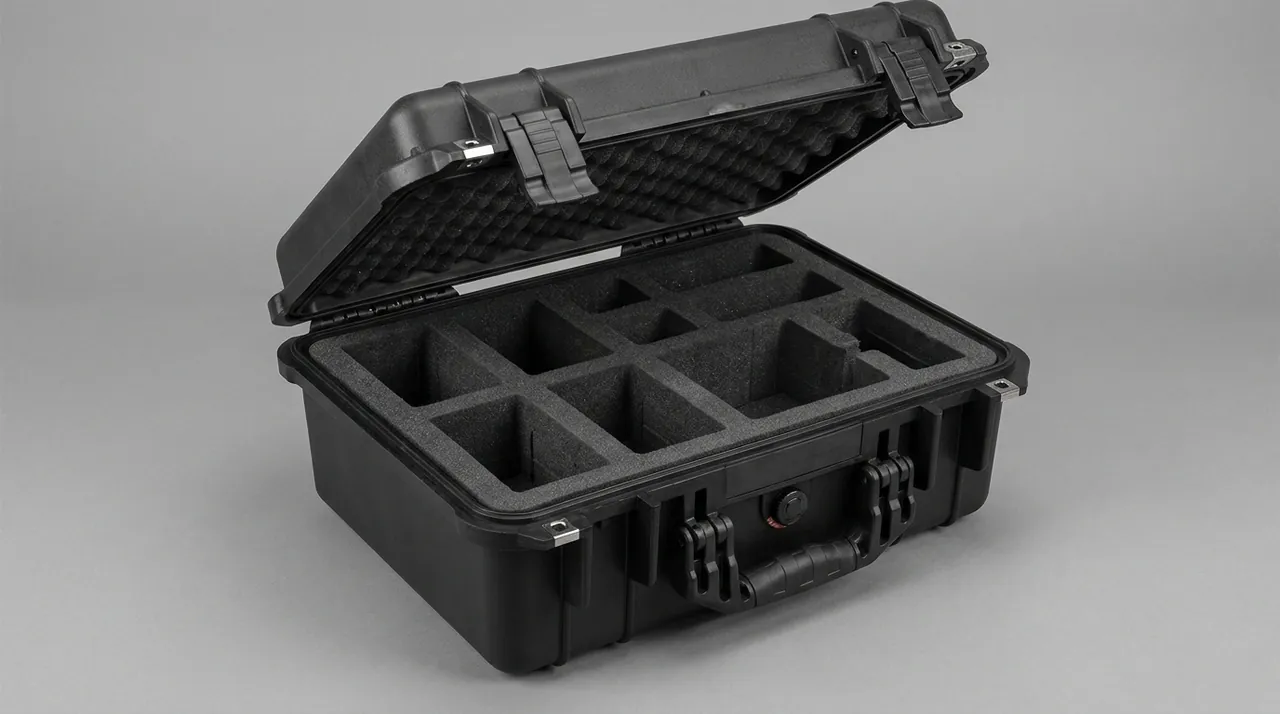
Packing Rules and Workflow for Research Deployments
Even a well-designed case depends on correct packing. JUNZHIJIA supplies an illustrated packing instruction with every custom case, specifying which cavity each part returns to, liner opening orientation, desiccant and indicator card placement, latch closing sequence and pressure valve check points. Field work follows heavy-first, bottom-up, verify-each-pocket logic: batteries and brackets go in first and are restrained, probes and loggers follow into protected cavities, cables are coiled by signal type in separate cells, antennas lie in their dedicated channel, and every completed cavity is checked against the list.
Research deployments demand more traceability than industrial ones, because the same kit may rotate between several groups and several trial plots, and both usage history and responsibility boundaries need to be clear. After packing, a unique serial label and a tip-over label go on the outside, and an optional QR asset tag delivers end-to-end traceability from factory to trial plot. Inside the case we suggest a record card listing the equipment numbers, the current load list, the packing date and the responsible person. For long field deployments we recommend recording the desiccant fitment date and the next replacement due date, since desiccant degrades gradually and without a record it is hard to judge whether topping up is needed.
A disciplined packing routine also reduces transport claims directly. JUNZHIJIA advises photographing three things after packing: gasket compression, desiccant and indicator card position, and latch locking indicators. These are the three points most often disputed after transit. We also encourage customers to write the routine into their internal work standard, because the case's designed protection only becomes real protection through a person following the procedure.
Selection Factors and Whole-Life Cost
Selecting a soil sensor equipment case means answering four questions together: what goes in, how it travels, how long it is stored, and where it is used. Contents determine compartment count and liner forming method; transport mode determines wall thickness, damping grade and stacking strength; storage duration determines desiccant allowance and rust protection; the usage location determines shell weatherability and seal specification. JUNZHIJIA works through all four at the scoping stage rather than quoting an off-the-shelf model, because part combinations in the soil instrument industry vary so much between customers and even between one customer's site projects.
Common shell materials are PP, ABS and modified engineering plastics. PP is tough, low-cost and cold-resistant, suited to rotation through cold regions or high-altitude sites. ABS is rigid with a good surface finish, suited to frequent opening or appearance-sensitive use. Modified engineering plastics balance impact resistance and weather resistance for long outdoor service or harsh conditions. Material selection should weigh liner life, rework rate, transit loss and reuse cycles alongside unit purchase price, as discussed in our total cost of ownership article.
The most commonly overlooked item in whole-life cost is the hidden cost of damage. When a probe bends and biases its readings, the direct loss is the probe price, but the indirect losses include research data interrupted, labour and travel to re-establish a monitoring point, and the possibility that already-published analysis needs correction. Field station maintenance is particularly expensive because a round trip to a remote site can consume a full day while the part swap takes ten minutes. JUNZHIJIA lays these costs out during scoping so procurement decisions rest on complete information.
For customers with genuine budget limits we offer a tiered scheme: loggers, comms modules and probes go into high-specification cases, while brackets, stakes and spare batteries go into standard cases with local reinforcement at critical points. Differentiated resourcing usually beats lowering the protection grade across every part.
Acceptance Criteria and Quality Traceability
Every case JUNZHIJIA ships passes an outgoing inspection covering gasket seating, latch locking force, liner fit, cavity dimensions and pressure valve airflow. Batches with an IP67 requirement are spray-tested and immersion-tested to the sampling plan to confirm no water or dust ingress, and anti-static liners have surface resistance measured batch by batch. Shells and liners both carry a batch number so raw material lots and moulding parameters can be traced later.
On receipt we suggest four simple checks: confirm the gasket is continuously compressed around the closed lid; shake the case and listen for a loose liner; verify that desiccant, humidity indicator card and record card are present and in date; and confirm the pressure valve is clear and unobstructed. These take very little time yet cover the faults most often found after transit. For research customers we add a fifth step — read the temperature and humidity labels immediately on opening, because that action links the transport environment to any equipment anomaly that later appears.
Traceability is about improvement as much as accountability. When the same class of part fails the same way across several projects, JUNZHIJIA treats it as design input, re-evaluating liner density, cavity size or seal geometry, and moves the fix into the standard configuration of later orders. General supplier qualification methods are described in our custom case acceptance AQL article.
Field Results and Application Experience
One agricultural IoT integrator had been packing complete station kits in wooden crates with bubble wrap. The problem on arrival was not a broken case but channels failing within a month of installation. Investigation showed most faults came from static and moisture during transit: oxidised logger input terminals, a comms connector centre pin pushed off-axis, and a probe clay head cracked by mixed-part contact. JUNZHIJIA redesigned the kit around five zones — probes in full-length support channels with floating head protection, loggers on anti-static liners, solar panels on multi-point flexible support, comms modules and antennas in separate cells, and accessories consolidated — with desiccant and humidity cards throughout. After a full deployment season, arrival failures and early-life faults fell markedly and field rework dropped.
A research group produced a similar result. Probes and loggers had been co-packed in an instrument case for long road journeys. The case itself was robust, but repeated transfers progressively bowed the probes, and repeat measurements on the same trial plot became unusually scattered. JUNZHIJIA supplied a probe-specific long channel liner with adjustable blocks so every probe length received full-length support, plus an anti-static chamber for the logger. After the change, post-transport probe acceptance rose noticeably. For research equipment, transport protection ultimately shows up as data comparability, not just equipment survival.
An export case is also worth recording. A supplier of soil instruments serving Southeast Asia had been using cartons with pearl foam, and arrived at port with solar panel power loss and comms module signal faults. Switching to JUNZHIJIA IP67 cases with a combined moisture strategy stabilised arrival acceptance. Because the destination is hot and humid, we added reinforced desiccant provision and moisture barrier film, plus a rain cover recommendation for the open-yard staging phase.
What these projects show is that protection for soil sensor equipment is not about a thicker shell. It is about identifying the failure mechanism of each part class and answering it with compartments, liners and moisture control. A field station runs unattended for months, so any weakness buried during transport will surface at an unpredictable moment, and field maintenance costs far more than a factory rework.
Frequently Asked Questions
Q: Why do soil probes damage so easily in transit, and how does the case address it?
A: A probe is fragile because it must be thin and stiff at once. The shaft is kept slender to drive into compacted soil and hold stable contact, while carrying a ceramic filter, a porous clay head and electrode rings. The dominant risk is not a break but slow deformation: an unsecured probe micro-moves against the liner under sustained trailer vibration, accumulating a bend along the middle, and the bow is hard to judge on arrival against the allowed deviation even though the contact geometry in soil has already changed and readings begin to drift. Clay heads are brittle — strong in compression, poor in impact — and crack along micro-fissures on any point load, invisible while dry and expanding after burial until the whole element breaks apart. JUNZHIJIA cuts a longitudinal locating channel so the shaft bears along its full length, with elastic tolerance rings at both ends, and a floating cavity at the head so the brittle element touches neither the liner nor neighbouring parts. The tapered insertion tip gets its own clearance pocket and a soft sleeve so neither hand nor tool touches the ground edge during packing, and probe sets shipped together are separated by length so a short tip cannot press on a long shaft.
Q: Why is a logger's protection priority static control rather than impact resistance?
A: Because a logger's failure distribution is completely unlike that of a mechanical part. Inside sit the microcontroller, ADC stage, clock and memory chips and power management, all sensitive to static and moisture and comparatively tolerant of mechanical shock, so money spent thickening the shell buys little. Static damage is particularly unpleasant because of its delay. A plastic housing rubbing in a dry trailer accumulates charge, and a technician touching the input terminals or commissioning port on opening can push several thousand volts through the input protection network. Factory electrical testing passes, the first two weeks of data look normal, and then a channel stops recording — after which the probe is suspected, then the cable, at great diagnostic cost. JUNZHIJIA lines logger chambers with anti-static EVA and laminates conductive foam on the cavity wall so the volume sits at equal potential, recesses the commissioning port so nobody reaches into a tight corner, and reserves a lidded pocket for cards and batteries swapped in the field so a used part never sits beside new stock and gets hit by a second discharge event. High-accuracy reference chips are also sensitive to thermal cycling, so we fit a temperature record label that lets the receiver read the whole profile on arrival.
Q: A solar panel looks undamaged, so why does output sometimes fall after arrival?
A: This is classic hidden failure, essentially invisible to visual inspection. Tempered glass has limited bending capacity, so stacking pressure or a tilted case produces micro-cracks on the back face, and more commonly the encapsulant between cells and glass delaminates locally — the panel looks perfect while conversion efficiency drops. Point loading through the lid makes it worse: a flat panel has no support under its centre, so when another case sits on top, bending stress concentrates near the cell busbars and micro-cracking becomes almost inevitable. The difficulty is that the causal link is very hard to prove, because the panel generates correctly on site and degrades a month later, so users usually blame product quality rather than the journey. JUNZHIJIA designs a contoured channel with mid-span support, distributing flexible support posts under the panel face according to cell layout, keeps enough clearance so the closed lid never touches the panel, and relieves all four corners on aluminium-framed units where stress concentrates at the corner joints and a knock can open a gap that lets water into the laminate. Because the fault appears late, we treat the panel as a part whose damage must be prevented rather than detected.
Q: Comms modules are tiny, so what actually needs protecting in transit?
A: The connector and the antenna, not the module body. RF connectors are usually SMA or Type N, whose centre conductor is a thin pin that bends under very little side load. Once that pin is off-axis the connector still threads on, but the standing-wave ratio degrades, showing up as weak signal and rising packet loss, and field teams typically check base-station coverage first, so the real cause is found very late and the wrong hardware gets replaced. Antennas are the other underestimated weak point: on fibreglass and whip types the base concentrates stress, and without a dedicated cell it gets crushed by neighbouring parts or scraped and then takes in water, corroding the internal radiator. JUNZHIJIA machines a full-length support channel so the antenna lies horizontally with its base on a soft pad, and for comms assemblies already mounted in an enclosure we relieve the connector area and fit protective caps that come off at installation. Module boards also need moisture control, since packing a damp module seals water vapour against the RF circuitry and oxidises microstrip lines and solder joints. Confirming the module is dry before packing, and adding desiccant plus a humidity card, closes that route.
Q: If IP67 already blocks dust and water, what does extra dehumidification achieve?
A: For soil sensor equipment, moisture causes more loss than mechanical damage, and IP67 only addresses ingress from outside, not water vapour already inside the cavity. When an instrument moves from cold storage into warm humid air, the cavity wall falls below the dew point and water condenses on the wall and on metal surfaces. If a logger housing already holds a little moisture, that condensation forms beside the circuit board and creates a creepage path, eventually lowering insulation resistance or drifting the channels. JUNZHIJIA treats humidity control as equal to waterproofing, using sealing, desiccant and indication together: renewable silica gel or clay-based absorber packs that shift colour once spent, together with a card the receiving team reads before the lid comes off to judge how much damp the shipment met. We calculate desiccant mass from cavity volume, transit duration, climate zones crossed, hygroscopic material inside and the shell's vapour transmission rate, then add margin for ocean freight, and laminate a moisture barrier film into electronics-heavy chambers. Water carried in by the equipment itself is the other source worth controlling: probes and loggers recovered from the field come back with soil and dew, so a fixed clean-and-dry routine before packing matters as much as the desiccant itself.
Q: Why divide a soil sensor case into five compartments instead of using fewer?
A: Compartment count follows how differently the parts need to be treated, not complexity for its own sake. The component spread is unusually wide: slender probes and antennas need full-length support against bending, flat solar panels need multi-point support against micro-cracking, small high-value loggers and comms modules need static and humidity control, battery packs concentrate weight and need restraint and insulation, and cables, brackets, stakes and tools all need stowing. Those requirements pull in conflicting directions — electronics want static and humidity control, power parts want impact and fire protection, probes want anti-bend and anti-point-load treatment — so squeezing them into one cavity forces a compromise, and the part that gets compromised is usually the most expensive or hardest to replace. JUNZHIJIA applies a rule of a compartment per part type and a defence per risk, separating probe, electronics, power, communications and accessory zones with reinforcing ribs and dividers. Compartment sizing follows the actual packing list, dividers are plug-in and removable, and adjustable blocks let one case serve probes of widely different lengths. Dividers also make loading verifiable, because a packer can spot a missing part by finding an empty pocket instead of checking the list item by item.
Q: Why specify anti-static EVA instead of ordinary foam for the liner?
A: For loggers and comms modules, ordinary foam fails on two counts — static and cleanliness. On static, ordinary foam readily accumulates charge through vibration and friction, and because it touches the part directly, the charge can discharge onto terminals or the board, which is more dangerous than having no liner at all. Anti-static EVA forms a charge drainage path through conductive additives, and combined with conductive foam on the cavity wall and an optional earth terminal it keeps the cavity potential inside a safe band. On cleanliness, lower-grade foam sheds fine fibres and particles under sustained vibration, and once those fragments reach connectors, RF ports or cooling passages they cause faults that are extremely hard to trace and completely invisible to outgoing inspection. JUNZHIJIA specifies low-outgassing anti-static EVA grades for electronics chambers and avoids sulphur- or halogen-bearing additives, because those can react with terminal plating inside a sealed cavity and build a high-resistance compound that shows up as slowly rising contact resistance. Anti-static performance also declines with handling, so whitened areas should trigger a re-check, and cleaning should use a neutral agent rather than a solvent that dissolves the conductive additives. Ordinary foam may look cheaper on the quotation, but the faults it creates are invisible at outgoing inspection and expensive in the field.
Q: What information is needed to customise a soil sensor equipment case, and how long does it take?
A: The intake package we ask for covers four blocks. First, the inventory itself: every probe, logger, panel, module, cable and accessory, with dimensions and mass for each item. Second, fragility notes, meaning which parts are brittle, which are calibration-sensitive and which carry electronics, since those drive liner grade and cavity isolation. Third, the journey profile, including departure climate, how many times the consignment changes hands, whether it travels by road, sea or air, how high it will be stacked and where it will sit before installation. Fourth, the ingress requirement the site actually needs. A 3D model or dimensioned drawing from the customer compresses our modelling stage substantially; without one we work from photographs and measured samples, which adds a round of trial fitting. JUNZHIJIA then reproduces each part's resting attitude in 3D, draws a matching contoured liner and produces a first sample for drop and vibration checks. On multi-part research kits we also ask for the installation order, so cavities can be arranged to follow the workflow and the seal sees fewer lid cycles. Allow a few weeks for a single case and longer for a kit where every pocket is sampled separately.
Q: How do we justify the spend on protective cases to management or a project lead?
A: The most effective approach is to make hidden costs visible. When a probe bends and biases its readings, the direct loss is the probe price, but the indirect losses include research data interrupted, labour and travel to re-establish the monitoring point, and the possibility that analysis already published needs correction. Field station maintenance costs are especially high because a round trip to a remote site can consume a full day while the part swap takes ten minutes. The same logic applies to solar panel power loss and comms module packet loss: diagnosis usually needs several trips while the probe, then the cable, then base-station coverage are eliminated in turn, and every trip carries real labour and vehicle cost. JUNZHIJIA lays these costs out during scoping and calculates cost per trip against expected reuse cycles, since a well-built case typically runs for dozens of trips. For customers with genuine budget limits we suggest tiering: high-specification cases for loggers, comms modules and probes, standard cases with local reinforcement for brackets and spare batteries.
Related Reading: sensor transport case, precision instrument protective case, meteorological station case, field inspection equipment cases, environmental detection box.