

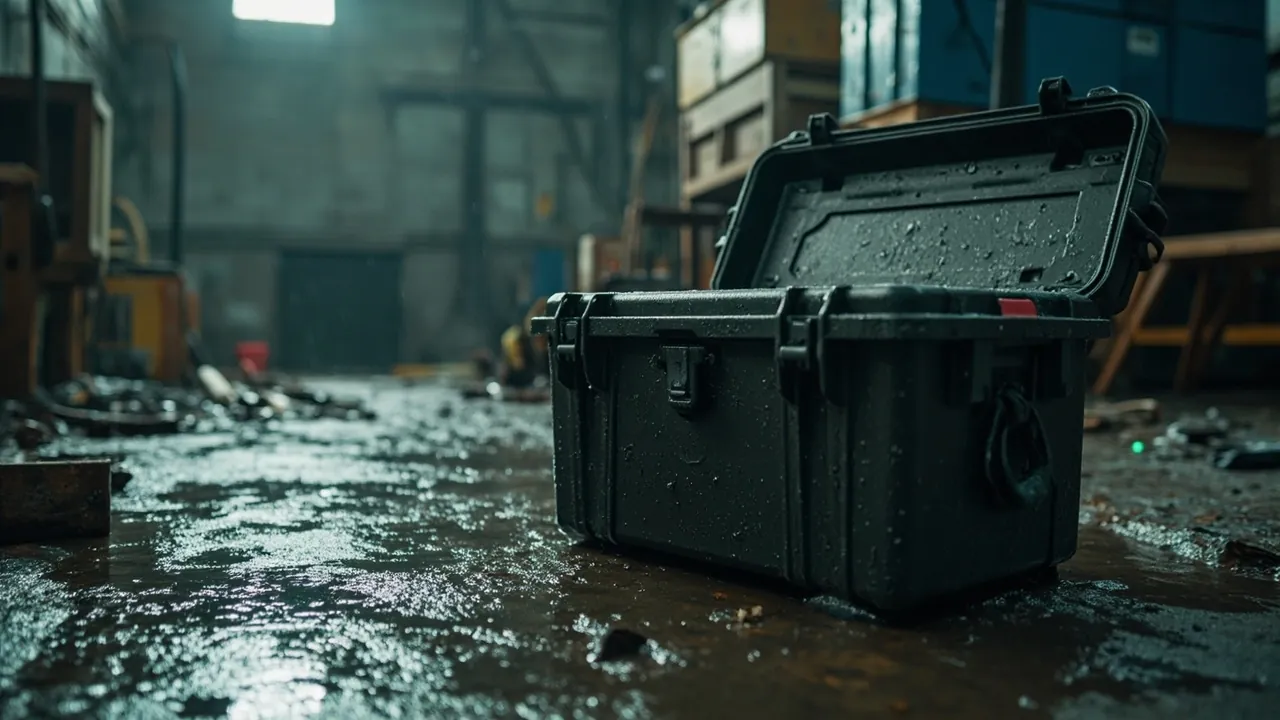
Start with the conclusion: yes - but "yes" is a conditional sentence. A waterproof toolbox works in the rain only when four things hold at the same time: the enclosure rating matches the form and intensity of the water you actually face; the sealing system still works after hundreds of open-close cycles; the crew follows a handling routine that prevents the box from being defeated during the seconds it is open; and the contents have a second line of moisture defence. Get those four right and working outdoors in moderate to heavy rain is entirely practical - power utility repair crews, municipal works teams, telecom base station technicians and geological survey parties do exactly that all year round. But one thing needs saying plainly: a waterproof toolbox keeps water out while it is closed. It cannot keep water out while you are holding it open. The large majority of water ingress incidents in wet-weather work do not happen during the hours the lid is latched; they happen during the thirty seconds someone is reaching for a tool. Rain runs down the inside face of the lid and drips over the opening, or a wet glove carries water in. That is an operating problem, not a product defect, but it has to be part of the specification and the training.
From the standards side, IEC 60529 (mirrored in China by GB/T 4208-2017, Degrees of protection provided by enclosures (IP Code)) defines the second digit from 3 to 6 as dripping, splashing, jetting and powerful jetting water. IPX3 roughly corresponds to "rain resistant," while IPX5 already survives a close-range nozzle. That means ordinary natural rainfall is not a serious threat to any toolbox rated IP54 or better. The real challenges are ground splash, standing water, and transporting a wet box at the end of the shift. This article works through the problem in field terms: the four forms water takes on a wet site, how IP digits map onto rainfall, the three elements of a sealing system, controlling the open-close risk window, a seven-step operating routine, an incoming inspection you can run in your own warehouse, maintenance, and emergency response after ingress - closing with selection guidance by duty.
Table of Contents
- The Short Answer: Yes, Given Four Conditions
- What Wet-Weather Work Actually Tests: Four Forms of Water
- Mapping IP Ratings Onto Rainfall: IPX3 Through IPX6 in Practice
- The Biggest Risk Window: The Seconds the Lid Is Open
- Three Elements of a Sealing System: Groove, Compression, Recovery
- Drainage, Shedding and Pressure Equalisation: Three Overlooked Details
- Condensation: Why Better Sealed Boxes Sweat More
- Operating Latches with Wet Hands and Gloves
- Second-Line Protection: Liners and Tools in Damp Conditions
- Field Reviews: Utility Repair, Municipal Works, Survey Parties
- A Seven-Step Routine for Working Outdoors in Rain
- Incoming Inspection: A Water Spray Check You Can Run in the Warehouse
- Routine and Annual Maintenance Checklist
- Emergency Procedure After Water Gets In
- Frequently Asked Questions
- Conclusion and Further Reading
The Short Answer: Yes, Given Four Conditions
Here are the four conditions expressed as things you can actually check, so that both purchasing and training can act on them.
Condition one: the rating matches the environment. The question is not "is it raining" but "in what form and with what kinetic energy does water reach the case?" Moderate rain falls vertically with low energy - IPX3 or IPX4 is enough. Heavy rain driven by wind arrives with horizontal velocity, closer to the IPX4 splash condition. Site washdown, wheel spray and mud splash fall into IPX5 and IPX6 territory. A working rule for outdoor duty: specify no lower than IP54 for general wet-weather work, IP65 or better where vehicles or washdown are involved, and only go to IP67 where immersion is genuinely possible. The distinction is spelled out in IP54 versus IP65 toolbox ratings.
Condition two: the sealing system has margin. Passing an incoming inspection once does not mean passing it in two years. Gaskets age, take compression set, and get scored by grit. Three things to look for: whether the gasket still has compression headroom once latched (it should not be squashed flat); whether the gasket is replaceable rather than foamed or bonded in place; and whether there are enough latches to compress the sealing face evenly all the way round.
Condition three: there is a routine for opening and closing. This is the underrated one. The correct sequence is to place the case out of the wind, tilt it slightly so water runs off the lid, shield the opening with your hand or a cloth while the lid is up, and relatch immediately after withdrawing the tool. That routine cuts ingress probability by roughly an order of magnitude - but only if it is written into the work instruction and trained.
Condition four: the contents have a second line of defence. Precision instruments, electronic tools, gauges, spare batteries and paperwork should never sit directly on the floor of the case. An EVA or EPE liner, desiccant, and individual dry bags form a second barrier so that even a small amount of water does not destroy the contents. Liner selection is covered in choosing toolbox internal foam.
Conditions one and two are solved by specification. Condition three is solved by management. Condition four is solved by configuration. Miss any one of them and wet-weather risk climbs steeply.
What Wet-Weather Work Actually Tests: Four Forms of Water
Break "rain" apart and you get four genuinely different forms of water, with completely different failure mechanisms and a clear ranking of severity.
| Form of water | Typical situation | How it arrives | Severity | Suggested rating |
|---|---|---|---|---|
| --- | --- | --- | --- | --- |
| Vertical rainfall | Working outdoors in light to moderate rain | Free fall under gravity, low energy | Low | IPX3 or above |
| Wind-driven rain | Heavy rain with wind, exposed sites | Horizontal velocity, attacks from the side | Medium | IPX4 or above |
| Splash and mud | Passing vehicles, foot traffic, wheel spray | High-speed impact from below and the side | Medium-high | IPX4 to IPX5 |
| Standing water | Placed in a dip, water in a truck bed | Static pressure immersion, sustained | High | IPX7 required |
Vertical rain is the easiest to stop. Natural raindrops have a limited terminal velocity, and their energy is far below that of a standard test nozzle. A structurally sound box with an intact gasket and latched lid essentially does not leak under these conditions. That is why so many users report "left it outside in the rain and it was fine."
Wind-driven rain is where it starts to get interesting. Wind turns rain into a horizontal jet that strikes the side walls and the lid seam directly. If the seam lies on a horizontal plane with no shroud - as on some flat-lid toolboxes - water can track sideways into it. Better designs place the joint on a vertical face, put an overhang above it, or use a labyrinth. This is exactly why protective cases with a boxy shape and a proud lid rim perform noticeably better outdoors than flat, flush-lid toolboxes.
Splash and mud are the killers nobody plans for. A vehicle hitting a puddle on site throws muddy water at speed against the lower sides and the base, around wheel bosses and feet. Those are precisely the areas that carry openings - drain holes, axle holes, foot mounting holes - and they are rarely the focus of the sealing design. To judge whether a box handles this duty, look at how the openings in the base and lower side walls are protected.
Standing water is immersion, and that means IPX7. The IPX7 condition in IEC 60529 is normally stated as immersion at a defined depth (of the order of 1 m) for a defined time (of the order of 30 minutes). It sits in a different family from the jet tests. So a case that is excellent in a downpour may still take water after half an hour in a flooded truck bed. If standing water is possible on your site, write both the jet and the immersion requirement into the specification. See field testing an IP65 toolbox for the related discussion.
Mapping IP Ratings Onto Rainfall: IPX3 Through IPX6 in Practice
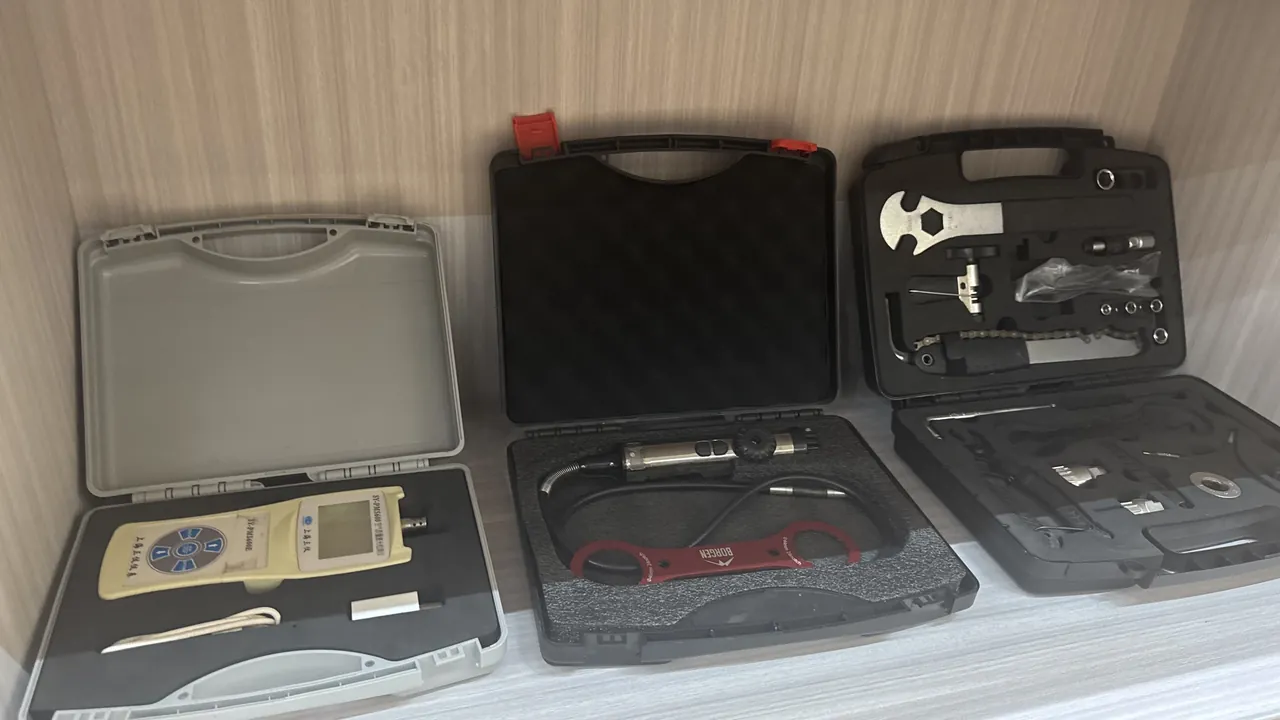
Both GB/T 4208-2017 and IEC 60529 define each digit precisely. The summary below is for fast mapping onto real conditions.
| Rating | Standard definition (summary) | Typical test condition | Real-world equivalent |
|---|---|---|---|
| --- | --- | --- | --- |
| IPX3 | Protected against spraying water | Oscillating tube or spray head, up to 60 degrees from vertical | Moderate rain, no wind, left outdoors |
| IPX4 | Protected against splashing water | Oscillating tube through 180 degrees, or hand-held spray, all directions | Heavy rain with wind, splash nearby |
| IPX5 | Protected against water jets | 6.3 mm nozzle at defined distance and flow rate, all directions | Hose-down, high-speed wheel spray |
| IPX6 | Protected against powerful water jets | 12.5 mm nozzle, substantially higher flow | Pressure washing, deck work |
| IPX7 | Protected against temporary immersion | Defined depth and time (commonly 1 m / 30 min) | Flooded truck bed, brief immersion |
Four misconceptions that need clearing up.
First, the water ratings are not a simple nesting hierarchy. IEC 60529 states explicitly that a specimen passing IPX7 has not necessarily passed IPX5 or IPX6. The failure mechanisms differ: a jet defeats a seal through dynamic pressure, while immersion works by slow static-pressure penetration. So do not assume "IP67 is better than IP65." Specify both, according to the form of water on your site.
Second, ratings apply to a new product in as-delivered condition. Ageing gaskets, worn latches and a case that has been dropped and distorted all reduce real performance. Passing on arrival is not the same as passing in three years, which is why annual re-verification is worth doing.
Third, ratings assume no additional openings. Cable glands, external handles, pressure equalisation valves and drain holes all change the situation, and the perforated variant should be tested separately. This matters enormously on custom products: backing a perforated custom version with a report for the plain base model does not hold up under audit.
Fourth, the first digit matters just as much. Outdoor sites are dusty and muddy, and an inadequate dust rating (IP5X dust-protected / IP6X dust-tight) lets grit in, where it wears latch threads and contaminates the sealing face - which then destroys the water seal indirectly. For outdoor duty, insist that both digits are stated; do not accept an X.
For the wider design picture, see waterproof design of outdoor protective cases and what the IP67 rating really means.
The Biggest Risk Window: The Seconds the Lid Is Open
Every supervisor of an outdoor crew should read this section twice.
Sort through enough water ingress reports and you find a counter-intuitive pattern: most ingress does not happen while the box is latched. It happens while someone is taking a tool out. There are four mechanisms.
- Water running off the lid. When the lid opens, water sitting on it runs down the inner face, over the lip, and drips inside. The closer to vertical you open it, the faster it runs; the larger the lid, the more water is available.
- Direct entry. With the lid up, the interior is fully exposed. Thirty seconds of heavy rain is enough to leave visible water in the bottom of the case - and thirty seconds is a realistic time to find one tool.
- Wet hands. Wet gloves and wet fingers transfer water onto tools and liners every time something is handled, and over weeks that keeps the interior permanently damp.
- Wet tools going back in. A tool used in the rain carries water. Putting it straight back is adding water by hand.
The corresponding controls:
- Position and attitude. Move the case somewhere sheltered from the wind before opening - behind a vehicle, under a temporary canopy, into a recess in a building. Tilt it slightly so water runs off the lid first.
- Two-stage opening. Crack the lid a few centimetres and let the trapped water run down the gap - at that angle it runs to the outside, not into the box. Pause a second or two, then open fully. This costs nothing and works remarkably well.
- Shielding. Put your body, a raincoat or a waterproof cloth over the opening. On a two-person job, one person can hold the shield.
- Shorten exposure. Decide what you need before you open the case, take it all in one go, and reduce the number of open-close cycles. This is the hidden value of a well-laid-out interior: if you can find it, you open for less time.
- Dry tools before they go back. Wipe down tools, paying attention to recesses and threads on metal parts.
- Keep a dry cloth in the case. Use it for wiping, and swap or dry it once it becomes damp.
These look trivial, but in practice they reduce ingress reports by an order of magnitude. Write them on an A5 card and stick it inside the lid.
Three Elements of a Sealing System: Groove, Compression, Recovery
Back to the product itself. Waterproof performance ultimately comes down to three elements.
Element one: groove geometry, the form of the seal. Three types dominate.
| Seal type | Description | Strengths | Limitations | Typical application |
|---|---|---|---|---|
| --- | --- | --- | --- | --- |
| Flat compression | Flat strip on a flange face, compressed by the lid | Simple, low cost | Sensitive to flange flatness, leaks if compression is uneven | General toolboxes |
| Labyrinth groove | A rib on the base enters a channel in the lid, forming a folded path | Long path, excellent against splash, tolerant of flatness error | Complex tooling, higher cost | Mid to high-end protective cases |
| Lip seal | Gasket with a projecting lip that beds down under pressure | Concentrated contact pressure, reliable | Lip wears, sensitive to grit | Professional and military cases |
The labyrinth earns its keep in the rain. It does not depend on a single compression line; water has to travel a folded path with several direction changes and gravity traps. Even if a trace gets past the first stage, the rest of the path stops it. That is why labyrinth cases outperform flat-compression boxes outdoors by a visible margin.
Element two: compression. The gasket has to be compressed to its designed proportion to seal at all. Too little compression and contact pressure is inadequate; too much and permanent set accelerates and service life shortens. A commonly used engineering band puts compression at a fixed proportion of the free cross-section height - of the order of 20% to 30% - with the exact figure supplied by the gasket maker based on hardness and profile. The most useful field check: place several short strips of thin paper or feeler stock around the sealing face, latch the lid, and pull them out one at a time. Any spot with noticeably less resistance is under-compressed.
Element three: recovery and resistance to compression set. Rubber gradually loses its ability to spring back under long-term compression. Compression set is the number one cause of seal failure, especially on cases that sit latched for months. Materials differ a lot:
| Gasket material | Weathering | Compression set | Low temperature | Cost | Recommendation |
|---|---|---|---|---|---|
| --- | --- | --- | --- | --- | --- |
| EPDM | Excellent | Good | Good | Medium | First choice for general outdoor use |
| Silicone | Excellent | Excellent | Excellent | Higher | Wide temperature range, food and medical |
| Foamed PU / foamed EPDM | Fair | Fair (fails once cells collapse) | Fair | Low | Light duty, indoor |
| NBR | Fair | Good | Fair | Medium | Oil-exposed applications |
For cases that live outdoors, specify a solid EPDM or silicone profile and avoid foamed seals that flatten out within a couple of seasons. More detail is in toolbox hinges, latches and sealing structures.
Drainage, Shedding and Pressure Equalisation: Three Overlooked Details
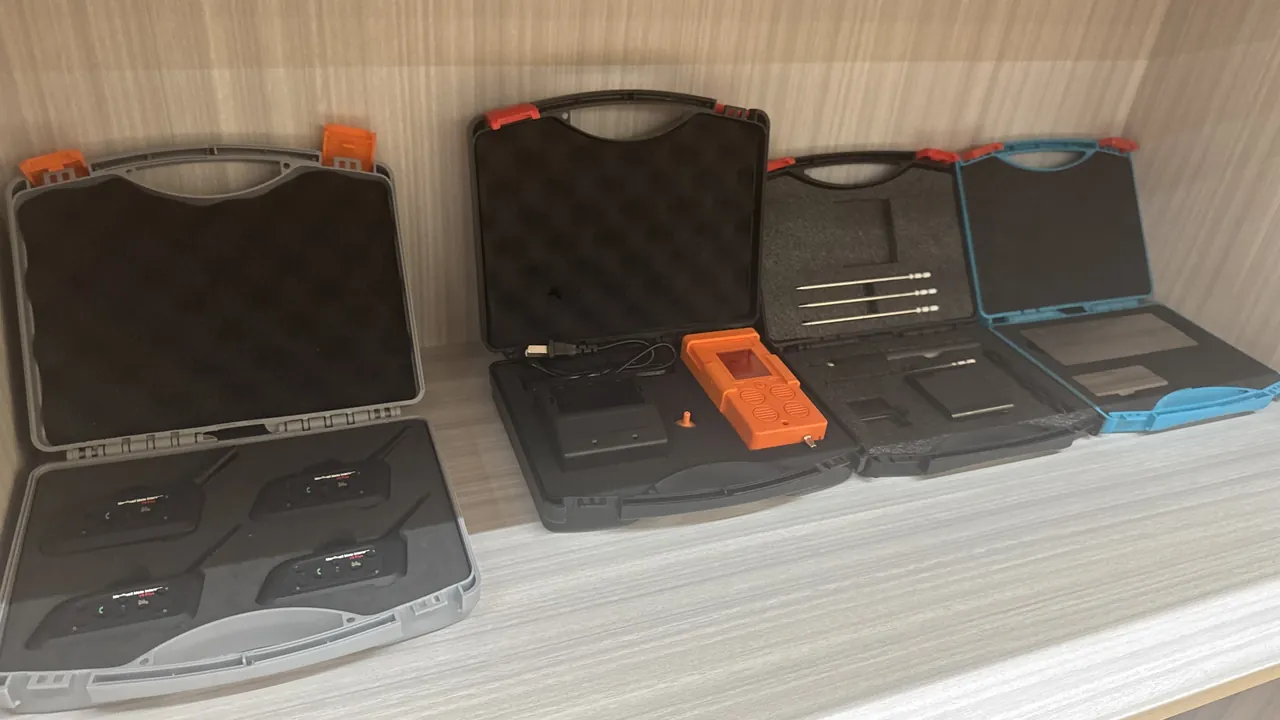
Should a case have a drain hole? The honest answer is that it depends on the duty.
The argument for: if water does get in - carried in on hands or on tools - a drain lets it out instead of sitting there causing corrosion and mould. The argument against: a drain hole is an unambiguous entry path. Water enters through it during immersion or splash, and a drained case cannot claim a high water rating.
A practical split by scenario:
| Scenario | Recommendation | Reasoning |
|---|---|---|
| --- | --- | --- |
| Wet-weather work, case not set on the ground | No drain needed; choose a higher rating | Water does not get in, so there is nothing to drain |
| May be set on flooded ground | Do not rely on a drain; raise the case on a stand | A drain becomes an inlet when standing in water |
| Wet tools routinely go back inside | Drained model plus an internal tray is an option | Removes carried-in water, but accept the lower rating |
| IP67 immersion performance required | Must not have a drain hole | Directly conflicts with the immersion requirement |
A better compromise for most crews is an internal tray with no drain hole: a removable tray catches water off tools, the main body stays sealed, and you tip the tray out at the end of the shift. Telecom and utility crews use this widely.
Shedding. Well-designed outdoor cases carry a drip edge on the lid so that water running down the lid face drips off at the perimeter instead of tracking back toward the seam. The check is simple: look for a proud lower lip or a channel along the lid edge. Vertical ribs on the side walls help too, steering water downward rather than letting it work sideways into the joint.
Pressure equalisation valves. A small part with an outsized effect. A sealed case moved from an air-conditioned vehicle into a hot outdoor site, or carried from low altitude to high altitude, develops a pressure differential across the shell. That differential makes the lid hard to open and can pull the gasket out of shape. A pressure equalisation valve - typically a waterproof, gas-permeable membrane element - lets air through while blocking liquid water, balancing the pressure and reducing condensation.
But note this carefully: fitting a valve means putting a hole in the shell. That hole needs its own protection (membrane elements usually carry a high rating themselves), and the valved variant should be IP tested on its own. Ask for a test report for the valved version; do not assume it shares the rating of the plain version.
Condensation: Why Better Sealed Boxes Sweat More
Users ask this constantly: the box is obviously well sealed, so why are there droplets on the inside?
The answer is condensation, not leakage. Air holds water vapour, and its capacity falls as temperature falls. When the air inside the case cools below its dew point, the excess vapour condenses on the coldest surfaces - the inner wall, or a steel tool.
Why do well-sealed boxes suffer more? Because sealing stops moisture exchange with the outside. A ventilated box tracks ambient humidity and never accumulates much. A sealed box is stuck with whatever humidity was inside when the lid last closed. If that happened in the rain, at dawn, or beside water, you locked in a charge of humid air, and the next temperature swing produces droplets.
Four ways to control it:
- Close it when dry. Do the packing and closing in a low-humidity moment - mid-afternoon, indoors, somewhere air conditioned. Packing in the rain is sealing wet air in.
- Use desiccant. Silica gel or calcium chloride packs absorb moisture continuously. They need periodic replacement or regeneration (indicating silica gel can be baked and reused). Size the charge to the internal volume and shorten the change interval in the wet season.
- Reduce dead volume. More empty space means more humid air. Fill the surplus with liner, which protects the tools and cuts condensation at the same time.
- Consider a pressure equalisation valve. A breathable membrane allows slow vapour exchange, lowering absolute humidity over the long run while still blocking liquid water. It is a genuine compromise between sealing and ventilation.
Telling condensation from leakage matters, because the response is completely different. Leakage leaves a directional trail - a water mark running inward from a seam or opening, often with grit - and water collects at the lowest point of the base. Condensation is an even distribution of droplets over inner walls, liner and tool surfaces in all orientations, with no grit. Diagnose first, then treat.
Operating Latches with Wet Hands and Gloves
One practical pain point of wet-weather work: hands are wet, gloves are on, and the latches will not cooperate. This belongs in the selection stage, not as a field complaint.
How latch types compare for operability:
| Latch type | One-handed | With gloves | With wet hands | Reliability | Best for |
|---|---|---|---|---|---|
| --- | --- | --- | --- | --- | --- |
| Press-fit snap | Good | Fair (needs pinch grip) | Fair | Medium | Light boxes, household |
| Over-centre draw latch | Good | Good (can be hooked) | Good | High | Industrial, outdoor |
| Butterfly / rotary | Fair | Fair | Fair | Medium-high | Where clamp force matters |
| Metal hasp with padlock eye | Fair | Good | Good | High | Where theft is a concern |
The working recommendation: choose over-centre draw latches for outdoor wet-weather duty. Three reasons. The opening action is "hook and pull outward," which works in thick gloves. The closed position is an over-centre mechanical lock with high clamp force that vibration will not release. And most draw latch designs include a padlock eye for security.
The other thing that matters is whether clamp force is perceptible. A good latch gives a definite click and a clear tactile stop when it seats. In poor visibility with numb fingers, that feedback is what tells the operator the case is actually closed. Test it at the point of purchase: put on a wet pair of gloves and operate it ten times, and see whether you can confirm it is seated every time.
Corrosion resistance of latches. Wet work is hard on metal. Springs, pins and rivets with inadequate material or finish will rust after a few storms and then seize. For outdoor cases, specify stainless pins and corrosion-protected springs, or an all-plastic latch structure. See stainless versus plastic toolboxes outdoors and aluminium versus stainless steel toolboxes for the wider discussion of metal in outdoor service.
Second-Line Protection: Liners and Tools in Damp Conditions
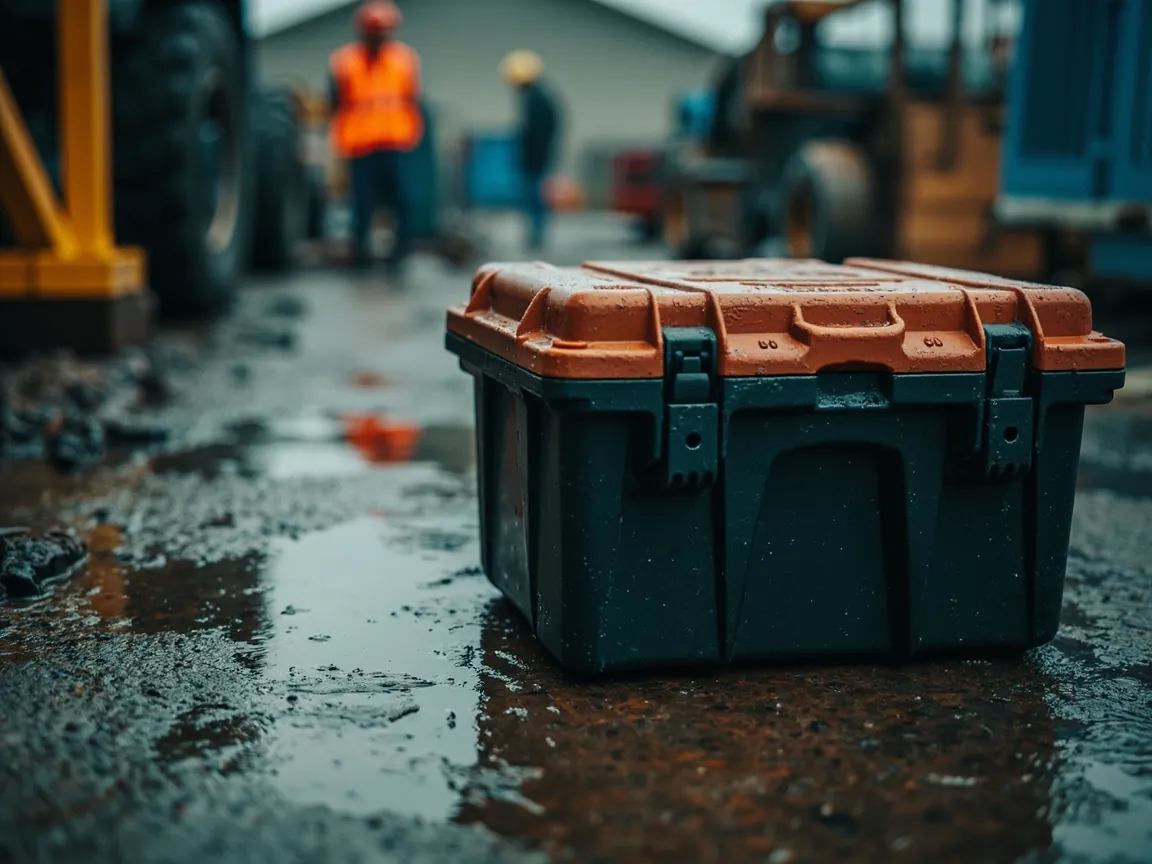
Even with an excellent enclosure, second-line protection has independent value, because it addresses the three paths that actually dominate in wet weather: carried in during opening, brought back on tools, and condensation.
Three layers.
Layer one is the liner. EVA and EPE are the mainstream choices; the differences are set out in EVA versus EPE toolbox foam. In damp conditions the selection rules are: closed-cell beats open-cell (closed cell does not absorb water); removable and washable beats bonded in place; and a routed cavity with drainage paths beats flat sheet. Closed-cell EVA generally outperforms EPE on water resistance and durability, which suits long-term outdoor use - see the advantages of EVA foam liners.
Layer two is desiccant and humidity indication. Size the desiccant to the volume, and use an indicator card so the humidity state is visible and you know when to change it. For cases carrying electronics, this layer is effectively mandatory.
Layer three is individual packaging for the critical items. Precision instruments, spare circuit boards, documents, medicines and batteries get their own dry bag or small sealed container. The cost is trivial and it removes the worst-case loss.
Treating the tools themselves matters just as much. Dry metal tools after use and give them a thin film of rust-preventive oil or wax. On power tools, pay attention to battery contacts and cooling vents. Wipe gauges - callipers, micrometers - clean before they go back in their dedicated case. These habits matter more than any enclosure.
A well-divided liner brings one more hidden benefit: fixed tool positions mean shorter open time, which directly reduces wet-weather exposure. That is explored in internal compartment design for toolboxes.
Field Reviews: Utility Repair, Municipal Works, Survey Parties
Three scenarios drawn from common industry practice, with names and models removed. The point is the failure pattern and the response.
Scenario one: utility repair, outdoor work on a stormy night. Characteristics: short, intense jobs with very frequent opening, standing water on the ground, and cases often set straight down in mud. Main risks: frequent opening multiplies ingress probability; setting the case in mud soaks and abrades the base; and poor visibility makes it hard to confirm the latches are seated. What works: a case rated IP65 or better with a labyrinth seal and draw latches; a waterproof ground sheet so the case never touches mud directly; a fixed slot for a headlamp and for the tools used most, so everything can be retrieved in one reach in the dark; and wiping the exterior and the sealing face before the case goes back in the vehicle.
Scenario two: municipal works, long-term outdoor storage through a wet season. Characteristics: the case sits on site for weeks, alternating between sun and rain. Main risks: gasket under sustained compression plus UV exposure accelerates compression set; high temperature and humidity drive heavy condensation; and site dust and mud contaminate the sealing face. What works: EPDM or silicone gasket with a scheduled annual replacement; siting the case somewhere shaded and ventilated, or throwing a cover over it - shade matters more than rain protection here; opening and airing it at least monthly and checking the sealing face is clean; and rinsing the seal with clean water and drying it - never pointing a pressure washer directly at the seam.
Scenario three: survey parties, wading, high humidity, rough transport. Characteristics: sensitive equipment - survey instruments, sensors, batteries - complicated transport by vehicle, boat and on foot, with a real chance of brief immersion or dropping in water. Main risks: immersion outweighs rainfall; vibration and impact arrive together; and the instruments are extremely humidity sensitive. What works: raise the requirement to IP67 and ask specifically for the immersion test report; a liner cut to the instrument so it cannot shift in transit; desiccant with an indicator card; and for water transport, consider buoyancy or a floatation collar. The full discussion is in IP67 protective case applications.
What all three have in common: the outcome is usually decided not by the rating printed on the case but by gasket maintenance, opening discipline and second-line protection - the three "soft" items.
A Seven-Step Routine for Working Outdoors in Rain
Everything above, compressed into something you can post and train against:
- Check before departure. Gasket intact and free of debris; latches moving freely; lid compressing evenly all round when latched (quick check with the paper-strip method).
- Pack it dry. Tools go in dry, and packing and closing happen in a dry environment wherever possible. Arrange by frequency of use, with the most-used items easiest to reach.
- Choose the spot on site. Higher ground, out of the wind, under cover if possible. Put a ground sheet or stand underneath - never let the case sit in mud or water.
- Shed water before opening. Tilt the case so water runs off the lid. If you can, wipe the standing water off the lid first.
- Open in two stages. Crack the lid so residual water runs down the gap and out, pause one to two seconds, then open fully. Shield the opening with an arm or a coat if possible.
- Move fast. Take everything you need in one go and keep the open time short. Do not lay retrieved tools down in puddles.
- Handle it after the shift. Wipe down the exterior and the sealing face, open the case to air and dry it, check whether the liner is damp, and change the desiccant if needed. Make sure the interior is completely dry before long-term storage.
Three accompanying "do nots": do not put wet tools straight back in; do not store a damp cloth or wet gloves inside; and do not latch the case for long-term storage while it is still wet - leave it slightly open to ventilate.
The value of this routine is that it is repeatable. A new team member can follow the card without relying on experience. For companies buying cases in volume, have it printed as a sticker and applied inside the lid.
Incoming Inspection: A Water Spray Check You Can Run in the Warehouse
You do not need a calibrated spray rig to run a meaningful incoming check.
What you need: a hand-held shower head or garden sprayer with an even output, clean white paper or tissue, a dry cloth, a torch, a timer and a record sheet. Draw at least three samples from important batches.
Procedure:
- Visual and sealing-face check. Is the gasket continuous, with no misaligned joint, crushing or damage? Is the flange flat, free of sink and warp? Are openings at the latches, hinges and handle seats protected?
- Compression uniformity. Place six to eight short strips of thin paper evenly around the sealing face, latch the lid, and pull each one out, recording resistance. Any strip that pulls out easily marks a weak point.
- Spray test. Set the case level and spray from above continuously for 5 to 10 minutes to simulate moderate to heavy rain. Then spray from each of the four sides at roughly 45 degrees for 3 minutes each to simulate wind-driven rain.
- Open and inspect. Dry the outside first - carefully, so external water does not run in as you open - then open the lid and wipe the interior faces and the inside of the sealing face with white paper, looking for moisture. Pay particular attention to the base corners and the area directly below the seam.
- Record and judge. Any visible droplet or film counts as a failure. For failed samples, record the location of the water mark and photograph it for the supplier conversation.
Optional harder version: stand the case in a shallow tray of water so that a few centimetres of the base is submerged, hold for 30 minutes, and check for ingress. That simulates standing water and is harsher than the spray test. One caution: this is close to an IPX7 condition, so if the product only claims IPX5, ingress is the expected result and should not be treated as a rejection.
Temperature: if the product will be used in the cold, run a second group after cold conditioning, because gaskets stiffen and lose elasticity at low temperature.
Routine and Annual Maintenance Checklist
Waterproofing is a consumable capability. It needs maintenance.
After every use (5 minutes): dry the exterior; open the case to air and dry the liner; check whether the gasket has picked up grit - grit is the number one enemy of a sealing face, because it scores the rubber and breaks the contact.
Monthly (15 minutes): clean the gasket with clean water and a soft cloth to remove grit and salt, then apply a thin film of a silicone-based conditioner - avoid petroleum grease, which can swell some rubbers. Check latch and hinge pins for rust and lubricate lightly if needed. Look for new cracks or distortion. Check the desiccant.
Quarterly (30 minutes): run the full spray check from the previous section. Look for permanent indentation in the gasket - a dent that does not spring back is an early warning of compression set. Check that the lid flange is still flat by laying the lid on a surface plate and seeing whether all four corners touch.
Annually (1 hour): decide whether the gasket needs replacing, judging by the degree of compression set, surface cracking or hardening, and any non-recovering dent. For high-frequency or permanently outdoor cases, treat the gasket as a scheduled replacement item - it is cheap and the effect is large. Check all metal parts for corrosion and replace with stainless where necessary. On stacked cases, check the stacking features for wear.
Storage points: clean and dry before long-term storage. Leave the latches engaged but not at maximum compression - first notch is fine, to avoid keeping the gasket at full compression for months. Store out of direct sun and away from heat. Keep the case upright; long-term side storage can deform the lid under load.
Emergency Procedure After Water Gets In
Even with everything done right, water sometimes gets in. Speed of response is what usually decides whether electronics are recoverable.
- Cut power immediately. If there are electronics or batteries inside, remove them and disconnect the battery first. Do not try switching anything on to test it.
- Pour the water out. Open the lid, tip out standing water, and blot up what remains with a dry cloth.
- Strip and dry. Remove the liner and everything in it and dry the items separately. Wash removable liners and air-dry them; for bonded liners, blot repeatedly with a dry cloth and leave in a ventilated place.
- Dry the shell. Invert the case in a ventilated area and let it air-dry; a fan speeds things up. Do not use a hot air gun or put it directly against a heater - high temperature can distort the plastic and accelerate ageing.
- Electronics. Clean the board with high-concentration anhydrous alcohol to remove water marks and contamination, let it dry fully, and only then power it up. Precision instruments should go to a professional repairer rather than being opened on site.
- Rust prevention for tools. Dry them and apply rust-preventive oil or wax straight away, especially to threads, hinges and cutting edges.
- Find the cause. Once dry, use the spray check to locate the entry point and decide whether it was seal failure, water carried in during handling, or condensation. Seal failure means inspecting the gasket and flange; carried-in water means going back to training on the routine.
- Record it. Log the incident, cause and response in the equipment register. If the same model fails the same way repeatedly, the specification or the supplier needs review.
One point worth emphasising: correct action in the first hours keeps the loss small, while the wrong first reaction - powering up immediately, blasting with hot air, or simply putting it away wet - turns a minor incident into a total loss. Keep an emergency card in a fixed position inside every case.
Frequently Asked Questions
Q: If I leave a waterproof toolbox outside in the rain all day, will it really stay dry inside? A: For a case rated IPX4 or better with a healthy gasket, a full day of ordinary rain is normally fine, and there is plenty of field evidence for that. But separate out three conditions. First, rain and standing water are different problems: rain arrives from above and runs off, while standing water means the lower part of the case sits under static pressure. IPX4 handles the first; the second needs IPX7. Do not expect IP54 or IP65 to cope if the case sits in a dip or a flooded truck bed. Second, gasket condition is the key variable: standards test new products, and after two or three years the gasket may have aged and taken compression set, so performance drops. Third, opening frequency matters: a case that stays shut all day is basically safe, but fifteen open-close cycles changes the odds substantially. So the practical advice is that leaving it out in rain is fine, but pair it with four habits - raise it off the ground, keep it shaded, minimise openings, and replace the gasket on schedule. Also note that for long-term outdoor storage the damage is usually not water ingress but UV ageing making the plastic brittle. Shade is the priority.
Q: Can I submerge an IP65 toolbox? What about IP67? A: This needs a common misunderstanding cleared up first: the water ratings are not a simple ladder. IEC 60529 states explicitly that passing IPX7 does not imply passing IPX5 or IPX6. The mechanisms differ - a jet defeats a seal with dynamic pressure, while immersion works by slow static-pressure penetration - so they test different aspects of the sealing system. That means an IP65 case should not be submerged: it is designed to resist jets from all directions, and under sustained static pressure water can creep in through microscopic paths at the sealing face. IP67, on the other hand, explicitly includes temporary immersion, normally stated as 1 m for 30 minutes, so brief submersion within the stated conditions is acceptable. Three caveats. IP67's "temporary" means 30 minutes, not overnight. Before immersion, confirm every latch is seated and the gasket is clean and undamaged. And if your site has both driving rain and standing water, write both IPX6 and IPX7 into the specification rather than a bare "IP67." The detail is covered in field testing an IP65 toolbox and IP54 versus IP65.
Q: There are droplets inside my sealed case. Is it leaking? A: Probably condensation rather than a leak, and the two need distinguishing. Condensation happens because air holds less water vapour as it cools; once the air inside falls below its dew point, the excess condenses on the coldest surfaces - the inner wall, the liner, a steel tool. A better-sealed case is more prone to it, because sealing blocks moisture exchange with the outside. If the last closing happened in the rain or somewhere humid, you trapped a charge of moist air, and the next temperature swing produces droplets. How to tell them apart: leakage leaves a directional trail running inward from a seam or opening, usually with grit, and water pools at the lowest point. Condensation is an even scatter of droplets over surfaces in all orientations, with no grit. A quick test: dry the interior, add desiccant, close it in a dry environment and leave it a few days. No droplets means condensation; droplets recurring in the same place means a leak. Control it by closing in dry conditions, sizing desiccant to the volume, filling dead space with liner, and considering a pressure equalisation valve to allow slow vapour exchange.
Q: How often should the gasket be replaced, and how do I know when? A: There is no universal interval, because life depends on opening frequency, compression level, temperature and UV exposure. As a working guide, assess high-frequency outdoor cases every 12 to 24 months; cases that sit closed for long periods can go longer between assessments but should still be inspected annually. Four signals say it is time. The dent does not recover - after opening, a healthy gasket's compression mark fades over minutes to hours; if the dent stays sharp or has taken a permanent set, compression set is advanced. Cracking or hardening - press with a finger; healthy rubber is springy and smooth, aged rubber shows fine cracks, stiffness or tackiness. Visible thinning of the cross-section - compare against a spare. Water marks in the spray check - that is the end-result signal, and it means replace now. Use the same material as the original specification (solid EPDM or silicone for outdoor use), and clean old adhesive residue and grit out of the groove first. Companies running fleets should carry gaskets as a normal spare item, stocked as a proportion of case count, so a worn seal never grounds a crew.
Q: For wet-weather work, should I choose a plastic or a metal toolbox? A: It depends which risk you care about more. Engineering plastics - PP, ABS, PC blends - win on several counts in the wet: they do not rust, which is decisive in rain and mud; they are light, which matters when people carry them; they are electrically insulating, a safety advantage on live work; they achieve high sealing ratings easily because labyrinth grooves and gasket channels come out of the mould in one piece; and they absorb impact energy and spring back. Metal - steel, aluminium, stainless - wins on: structural strength and puncture resistance for heavy tools or where theft is a concern; abrasion resistance; and tolerance of high local loads. But metal's weaknesses in the wet are equally clear: once the coating is breached it corrodes, and hinges and latches become maintenance items; it is heavy; and it conducts, which is a hazard near live conductors. Practically: choose an engineering plastic protective case when the contents are instruments or electronics and the case is carried by hand; consider metal for heavy tools, theft resistance or fixed locations, but pay close attention to corrosion protection. The comparison is developed in stainless versus plastic toolboxes outdoors and plastic versus metal toolboxes in full.
Q: How should I dry a case out after a wet day, and is it safe to leave it in the sun? A: The correct sequence: wipe down the exterior, especially around the sealing face and latches; open the lid and take out the liner and contents to deal with separately; invert the shell in a ventilated place and let it air-dry, using a fan to speed things up and desiccant to help absorb moisture. Direct sun is not recommended, for three reasons. UV is the main driver of plastic ageing, so repeated baking embrittles and discolours both shell and gasket. Heat can distort the case, particularly if it is loaded or under load. And a case that has been baked and then carried into a cold air-conditioned space will condense heavily inside. If you need to speed things up, use a shaded ventilated spot with a fan, or low-temperature warm air from a distance, staying below the material's permitted temperature. If the liner has absorbed water, take it out and dry it separately, and confirm it is completely dry before refitting; closed-cell EVA absorbs little and dries quickly, while EPE and fabric liners hold more water and take longer. A habit of airing the case open overnight and latching it the next morning goes a long way toward preventing mould and rust.
Q: Does fitting a pressure equalisation valve reduce the waterproof rating? A: It needs a specific answer rather than a general one. The heart of the valve is a waterproof, gas-permeable membrane that passes air molecules while blocking liquid water, and the membrane itself usually carries a high water rating. So a well-designed pressure equalisation valve does not significantly reduce the waterproof performance of the case. Its value is balancing internal and external pressure, which solves hard-to-open lids and gasket distortion during high-altitude transport and rapid temperature change, and it helps reduce condensation. Three cautions. Any opening changes the enclosure's protection state, so the valved version should be IP tested and reported separately - you cannot assume it matches the plain version. Membrane performance depends on the film staying intact; punctures, oil fouling and salt crystallisation all degrade it, so add it to your inspection list. And if the duty involves sustained immersion or close-range pressure washing, the membrane can be the weak link, so state the duty in the specification and ask for the corresponding test report. The most useful purchasing move is to ask for the IP report for the valved version and confirm how the valve is maintained and replaced. JUNZHJIA documents the tested configuration and maintenance requirements by model when supplying valved cases.
Q: On a dusty site, should I prioritise dust protection or water protection? A: On many sites, dust deserves higher priority than water, which surprises people. Three reasons. Dust ingress is progressive and effectively irreversible - once grit reaches latch threads, hinge pins and the gasket contact face, it keeps wearing and binding until the seal fails, so dust failure causes water failure. Dust also contaminates instruments, gauges and electronic contacts in ways that are harder to diagnose than a puddle. And dust ratings are easier to defeat, because particles are small and wind-borne and a static case simply accumulates them. So: for outdoor and site duty, require both IP digits to be stated and do not accept an X, and prefer IP6X dust-tight. Structurally, a labyrinth groove works far better against dust than flat compression, because the folded path lets particles settle; and latches and hinges should be simple shapes that are easy to clean. In maintenance, cleaning the sealing face matters more than anything else - one minute with a soft cloth after every use multiplies gasket life. See the purpose and selection of dustproof toolboxes for more.
Conclusion and Further Reading
Back to the original question: can a waterproof toolbox be used outdoors in the rain? Yes - conditionally. The conditions are four: the rating matches the form of water on site (IPX4 and above for ordinary rain, IPX5 and above for splash and washdown, IPX7 only where immersion is possible); the sealing system has margin (a labyrinth groove, a replaceable solid EPDM or silicone gasket, and latches that compress evenly); the crew follows a routine for the open-close window (two-stage opening, shielding, short exposure); and the contents have a second line of defence (closed-cell liner, desiccant, individual dry bags for critical items).
For users, the most useful sentence is this: a waterproof toolbox keeps out the water outside; it cannot keep out the water you let in while it is open. Document the routine, stick it in the lid, and train people on it. That is more effective and far cheaper than moving up a rating.
For buyers, the recommendation is to put four things into the technical agreement rather than just the words "IP65": the test conditions, the gasket material specification, a separate test report for any perforated variant, and gasket replaceability.
JUNZHJIA is manufactured by KeXin New Materials (Guangdong) Co., Ltd. at its Zhongshan facility, supplying protective cases, toolboxes, military and ammunition cases and IP67 waterproof enclosures to wholesale, distribution and OEM/ODM customers worldwide. Sealing systems, liners and opening configurations can be specified to duty, with test documentation available by model. Describe your operating conditions clearly and you will get a better answer than comparing specification sheets alone.
Further Reading