Home / Boxknow / Coffee & Barista Equipment Cases: Move the Gear Clean
Coffee & Barista Equipment Cases: Move the Gear Clean
Published 2026-09-05
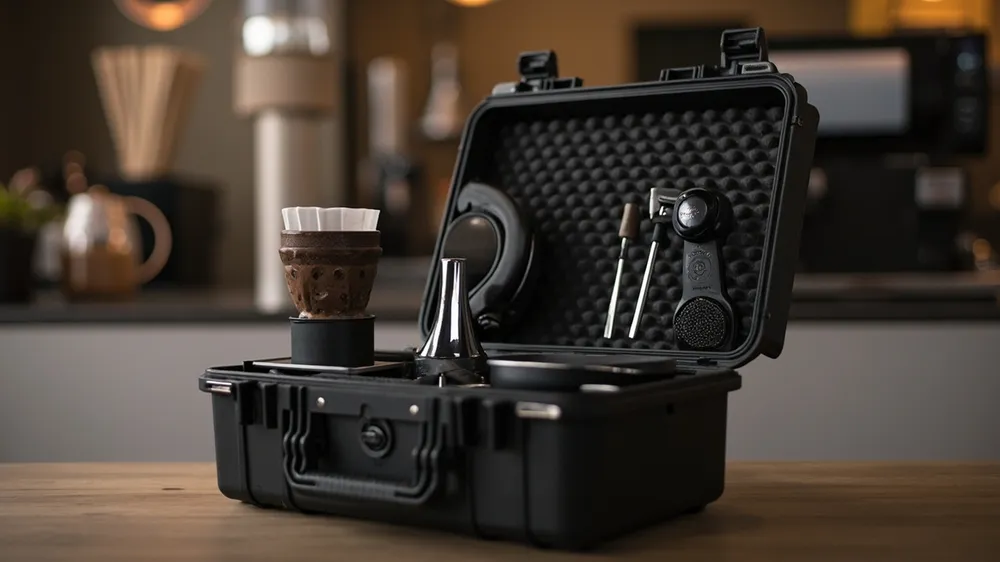
Coffee gear is 'precise and hygiene-sensitive' bar gear. A portafilter fears bump, a tamper fears knock, a scale fears shake and a hand grinder fears damp. A soft bag resists dust but not drops; bare gear is both damaged and cross-contaminated. A qualified coffee case fixes the portafilter, separates tools, stays clean and protects gear through mobile events. This guide covers choice and use from a vendor's view.
Three Kinds of Coffee Risk
Portafilter loss: threads fear bump.
Scale loss: electronics fear shake.
Germ harm: unclean gear crosses flavors.
Priority: portafilter care > scale care > hygiene control.
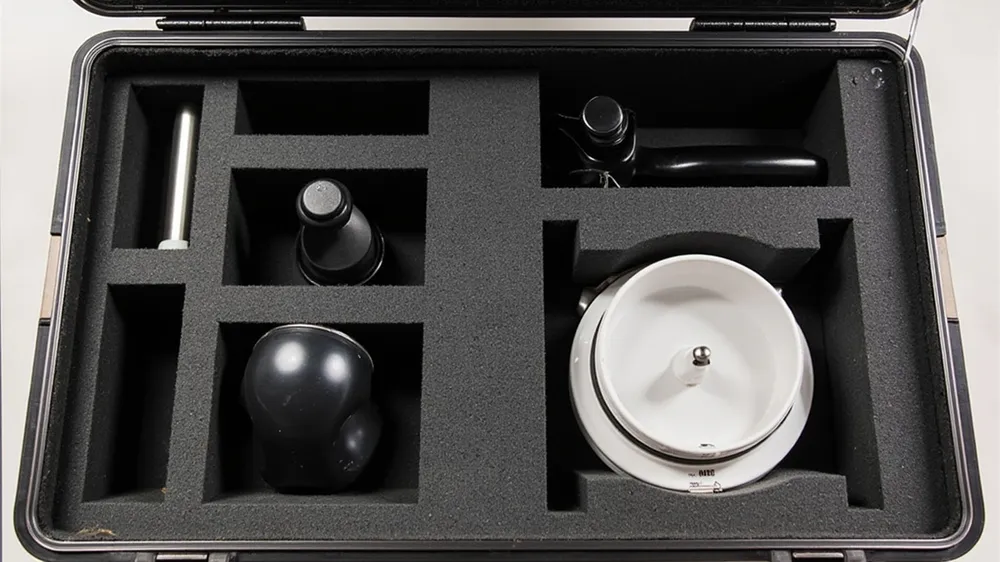
Cutouts fix the portafilter and isolate each tool from crush.
The portafilter thread is the risk point and must float in a hard cavity, not bottoming or bumping. The idea follows drone foam design floating; the cavity method is in custom foam. In transit the portafilter is fixed alone and ports get caps.
First, portafilter bottoms out hurts threads. Second, scale crushed loses accuracy. Third, not clean crosses flavors. Fourth, no metal pin loosens after thousands of cycles. Fifth, recycled resin, see virgin vs recycled. Sixth, no humidity control dams gear.
Summary
The key to a coffee and barista case is 'care for the portafilter, protect the scale, control hygiene, stay clean': floating cavities protect threads and electronics, separate slots keep tools from crushing, easy-clean liners let gear wipe down, and metal latches survive event bumps. At order time, write the kit list (with portafilter spec) and travel mode as clauses, then ask the supplier to show material and test proof. With the habit of 'portafilter floating in place, tools alone, wipe after event, desiccant replaced regularly', coffee gear stays precise across many events. For floating and separation, cross-read drone foam design and custom foam guide.
Coffee cases reuse the same rigid discipline as pro cases.
Q4: How to clean? A: Easy-clean liner, see cleaning.
Q5: How to size? A: Measure the longest item and tool count, see how to size.
What is the essential difference between a barista equipment case and an ordinary toolbox?
The essential difference is the precision of the payload and the flavor requirement. An ordinary toolbox holds durable hand tools, while a barista case carries an espresso machine with its boiler and pressure gauge, a grinder with precision burrs, a scale, a temperature-controlled kettle and glass or ceramic pour-over gear. The machines have an offset center of gravity and fear point shock, moisture and dust, while the vessels are fragile and may have food-contact surfaces, so shock protection, compartmentalized fixing, moisture control and cleanability must be designed as a system and validated by drop and vibration testing.
What preparation is needed before shipping an espresso machine?
Drain the boiler and pipework before shipping so low temperature cannot frost-crack them and the interior does not corrode, and secure the group head, portafilter and steam wand so they cannot swing and strike during transport. Protect the pressure gauge and knobs with relief or separate cushioning. The center of gravity sits toward the boiler, so the liner should provide locating at the base and let the feet take the load rather than deforming the shell. Validate drop and random vibration per the GB/T 4857 or ISTA procedures and state the permitted acceleration range.
How should grinder burrs be protected in transit?
Burr clearance directly determines grind uniformity, and axial shock or sustained compression in transit causes clearance drift. Lock or remove the burrs for the transport state and pack them separately with cushioning. Use a cut EVA liner that suspends the body so the burrs take no axial load, mark the adjustment dial, and on arrival check whether recalibration is needed. For high-precision espresso grinders, add a locating ring to the liner to constrain body movement and reduce the risk of drift.
How do I fix glass and ceramic pour-over gear safely?
Glass drippers, servers and ceramic vessels are fragile and should be separated from heavy items such as the machine so they cannot be crushed. Use divided compartments with independent cushioning so the vessels do not touch each other, wrap them in lint-free paper or soft padding where needed, and cut the liner slightly larger than the vessel with a cushioning allowance rather than a snug fit. Validate the shock design with drop testing, covering corners and the side away from the center of gravity.
What protection rating does a coffee equipment case need?
It depends on the scenario. For indoor shops and warehouse handling, IP54 is enough for dust and splash protection; for coffee markets, outdoor stalls or humid environments, IP65 is recommended against dust, rain splash and moisture; and for wading or heavy-rain setups, IP67 is advised. Ratings are judged per GB/T 4208, equivalent to IEC 60529, so require a test report with a defined sampling plan rather than a verbal claim of dust and water resistance. Also check the gasket, latches and desiccant periodically, because a rated case that is never inspected can still leak in service.
How should the liner material be chosen for both shock protection and coffee gear?
Common choices are cut EVA, EPE and thermoformed trays. EVA suits support and relief and can be precisely cut to the equipment outline, EPE is lighter and cheaper and suits filling and separation, and thermoformed trays suit small parts and vessel compartments. Surfaces that touch coffee beans, vessels or food should be odorless, low-outgassing and easy to clean so they cannot taint flavor. For areas holding ESD-sensitive scales or temperature modules, use a dissipative liner with a grounding terminal. Where the case is opened and closed often, a replaceable liner insert keeps the fit tight and the cleaning routine simple.
How should a case be configured for coffee markets and outdoor stalls?
Market and stall use emphasizes mobility and fast access. Use a hard case with casters or a fitted wheel set, keep frequently used vessels in an upper tray and the machine and heavy items in the lower layer near the center. The case should provide IP65 or better protection for outdoor conditions, and hardware should be corrosion resistant. Add a checklist card and numbering so that packing up is easy to audit and several people can work together without leaving items behind or mixing them up.
What should be checked most carefully when accepting a coffee equipment case?
Check that the liner fits the equipment, that the cut relief is correct and that the machine is supported by its feet or frame on the first article. Then verify the sealing rating, representative drop and vibration items, liner dimensional consistency and hardware corrosion resistance on sampled units, and for configurations with electronic gear spot-test static dissipation and grounding continuity. Also verify material certificates, test reports and the sampling plan, and write critical metrics into the technical specification so that verbal promises can be verified at acceptance.