

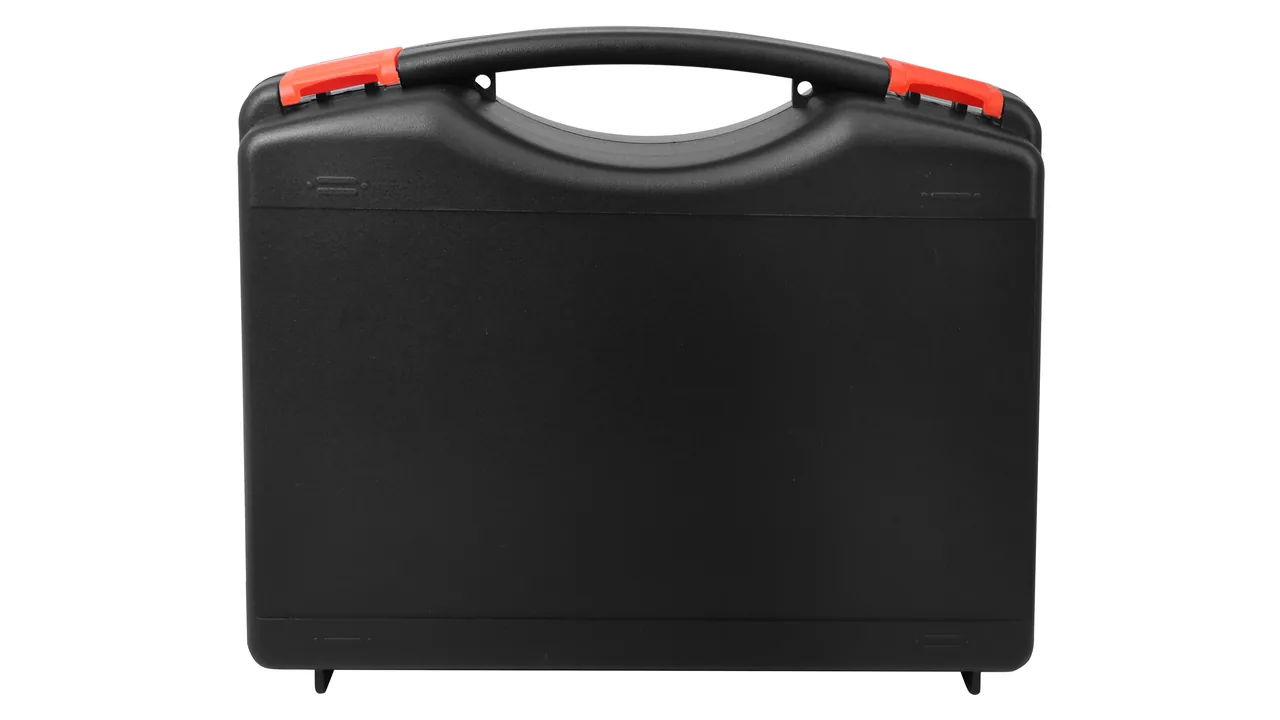
On compound fertilizer, urea, potassium chloride and ammonium sulfate lines, rotary drum granulators and cooling drums run permanently in wet, dusty and mildly corrosive conditions. When a plant performs a major overhaul, relocates a production line or ships a skid overseas, the tyres, thrust rollers, slurry pipes, steam nozzles, flights, screens and support rings must travel hundreds or thousands of kilometres to site. Most of these parts carry machined or dynamically balanced features: tyre outer diameters are often held to 0.05 mm, slurry orifice diameters run as small as 1.5 to 3 mm. Moisture, a knock or a permanent bend in transit means realignment on site, or scrap and rework.
Protection principle: every granulation and cooling part should still hold its factory geometry and surface condition at the moment the case is opened, and that is exactly the starting point for JUNZHIJIA fertilizer equipment cases. Protection is not about dropping a part into a strong box. It means separating five risk families, moisture uptake, corrosion, impact, stacking load and identification, and resolving each one through case structure, liner material and shipped documentation.
Table of Contents
- Transport Risk Map of the Granulation Line: Cascading Damage from Tyres to Caking
- Rotary Drum Granulator Part List and Protection Grading
- Precision Protection for Slurry and Steam Nozzle Parts
- Cooling Drum Flights and Supports: Length-to-Diameter Ratio and Deflection Control
- Screening and Coating Drum Parts: Vibration Sources and Bearing Housing Isolation
- Moisture Uptake and Caking: Urea, Potassium Chloride and Ammonium Sulfate
- Corrosion Failure Modes and Internal Material Selection
- Sealing Level Trade-offs: IP65 / IP67 with IEC 60529 and GB/T 4208
- Cushioning Liner Systems: EPE, EVA, PE and IXPE Combinations
- Compartments, Latches, Hinges and Pressure Equalization Valves
- Environmental and Transport Validation: Temperature, Salt Spray and ISTA / GB-T 4857 / ASTM D4169
- Customization, OEM / ODM Process and Acceptance Criteria
- Frequently Asked Questions FAQ
- Conclusion and Related Reading
Transport Risk Map of the Granulation Line: Cascading Damage from Tyres to Caking
Fertilizer plants present regional risk profiles that differ sharply. Coastal and southern sites carry airborne salt with annual average relative humidity above 75 percent, and urea dust absorbs moisture into a mildly alkaline film with free ammonia that attacks both carbon steel and aluminium. Northern and north-western sites swing more than 25 degrees Celsius between day and night, so condensation inside a closed case is a more common problem than external rain. A component travels from workshop loading through warehouse stacking, road vibration and port lifting, three completely different load spectra.
Split those stages apart and the damage stops looking isolated. A dent pressed into a tyre outer diameter causes axial wander of the drum shell once assembled, which then loads the thrust roller with an axial force it was never sized for. A slurry pipe bent by a fraction of a degree throws slurry outside the falling curtain and lowers granulation efficiency. A distorted flight destroys curtain uniformity in the cooling drum, the outlet granule temperature fluctuates, and downstream screening takes the extra load. Small geometric deviations created in transport are therefore amplified into system-level problems during operation.
The first design task is to separate irrecoverable items from tolerable ones. Irrecoverable means any plastic deformation, pitting, scratched sealing face or coating damage. Tolerable means cosmetic scuffs on packing and light marks on non-mating surfaces. JUNZHIJIA asks for the mating relationship of every part at proposal stage, so irrecoverable items get their own cavity and their own cushioning instead of sharing space with parts that can take a hit.
Rotary Drum Granulator Part List and Protection Grading
A rotary drum granulator shipment list commonly holds more than ten part families, spanning from a 0.3 kg nozzle core to a tyre assembly above 400 kg. The grading rule is simple: the closer a part sits to a mating surface and the harder it is to replace, the higher its grade.
| Part | Typical weight | Critical feature | Grade | Protection approach |
|---|---|---|---|---|
| --- | --- | --- | --- | --- |
| Tyre assembly | 180-450 kg | Outer roundness, bearing seat | A | Timber skid plus steel strapping, IXPE wrap |
| Thrust roller | 60-120 kg | Conical rim face | A | Separate cavity, PE protective sleeve |
| Girth and pinion gear | 90-600 kg | Tooth flank, keyway | A | Rust-preventive grease plus VCI film, keyway plug |
| Slurry pipe assembly | 25-70 kg | End flange face, orifices | A | Custom EVA cradle, both ends plugged |
| Steam distributor head | 15-40 kg | Sealing face, threads | A | Thread cap plus desiccant, small cavity |
| Shell liner plate | 8-25 kg each | Mounting holes, contact face | B | EPE interleaves, strapped into a stack |
| Drive shaft | 40-150 kg | Bearing seat, keyway | A | Suspended support, axial end stops |
| Fastener kit | 5-20 kg per pack | Threads | C | Compartment bags, marked by size and quantity |
| Instruments and sensors | 1-5 kg | Probe, terminal block | A | Antistatic bag plus dedicated cushioning |
Only after grading does case count make sense. The practical approach puts parts of one assembly unit in the same case to cut search time on site. But when a tyre assembly shares a case with precision nozzles, the cushioning compresses straight through under the weight. Grade A parts and overweight parts must therefore be separated. JUNZHIJIA usually recommends numbering cases by assembly sequence and printing the workstation layout inside the lid, so the site crew opens cases in order and feeds the line directly.
For comparable heavy machinery, the packing logic in Agricultural Machinery Parts Protection and Bearing and Gearbox Parts Protection is directly transferable; the suspended shaft support described there matches granulator drive shafts closely.
Precision Protection for Slurry and Steam Nozzle Parts
Nozzle parts are the most underrated components on a granulation line. Orifices on a slurry pipe are typically 1.5 to 3 mm with chamfered and polished mouths, and the spray angle of a steam nozzle sets how deep the jet penetrates the falling curtain. Once such an orifice is blocked or crushed, the plant can only strip, inspect or replace it, and a replacement needs the spray pattern recalibrated.
The first barrier is orifice plugging. Silicone caps or dedicated protective plugs isolate the mouth from dust and moisture while also keeping liner debris out of the internal passage. The second barrier suppresses relative movement. Nozzle parts are slender, and if they are only wrapped in foam they will micro-move as the foam fatigues, polishing the orifice edge and shifting flow rate. A custom EVA cradle at 60 to 90 kg per cubic metre, thermoformed to the part outline, clamps the part in a fixed position and holds its grip through dozens of open-and-close cycles.
The third barrier covers rust and condensation. Stainless nozzles can still pit in chloride-bearing air, and carbon steel fittings need vapour corrosion inhibitor film. Pack nozzle parts and desiccant, silica gel or montmorillonite, in the same sealed cavity, and leave a moisture path along the cavity wall so the desiccant is not crushed into uselessness.
| Failure mode | Trigger | Site consequence | Case countermeasure |
|---|---|---|---|
| --- | --- | --- | --- |
| Orifice blockage | Dust ingress, foam debris | Distorted spray, lower yield | Silicone plugs plus debris-free liner |
| Orifice crushing | Stacking load, part collision | Higher flow, local over-wetting | Formed EVA cradle plus compartments |
| Sealing face scratches | Micro-movement, hard particles | Leakage, lapping rework | Face film plus locating pins |
| Thread seizure | Condensation, salt spray | Cannot be dismantled on site | VCI film plus desiccant |
| Bracket distortion | Unsupported cantilever | Misaligned mounting holes | Support blocks and limiting ribs |
One practical note: nozzles are consumables, and many customers ship spares at roughly 10 percent of the installed count. Spares and new parts should occupy different cavities, and the outer label should state that a cavity holds spares, so the site team never mixes a worn part back into the new-part case.
Cooling Drum Flights and Supports: Length-to-Diameter Ratio and Deflection Control
Cooling drums carry flights arranged along a helical lead, usually 1.2 to 2.6 m long, with an L or U section formed from thin plate. The problem with these parts is not mass but slenderness. Deflection under self-weight on a thin plate is negligible, yet resonant displacement during long road vibration makes the plate tip slap repeatedly against neighbouring parts, and a crack eventually initiates at the bend root.
Three controls address this. First, when several flights are stacked in the same direction, an EPE interleaf of 3 to 5 mm at 25 to 35 kg per cubic metre goes between every layer; the compression and rebound of the interleaf absorbs high-frequency vibration and stops coating from rubbing against coating. Second, the stack is strapped in a cross pattern, keeping strap lines away from bend radii and hole positions to avoid stress concentration. Third, the stack sits on a timber skid with an anti-slip pad between skid and case floor, which stops the whole stack from creeping inside the case.
Supports such as riding rings, reinforcement rings and saddles are stiff parts, so the risk shifts to mounting holes and machined datum faces. If a machined face rests directly on the case floor, the entire stacking load concentrates on the datum and crushes it locally. The correct arrangement puts the non-machined face down, or adds equal-height spacer blocks so the load path runs through ribs rather than through a finished surface.
| Part | Slenderness / stiffness | Main risk | Structural countermeasure |
|---|---|---|---|
| --- | --- | --- | --- |
| Helical flight | High slenderness | Crack at bend root | EPE interleaves plus cross strapping |
| Straight flight | Medium | End impact damage | EVA corner guards |
| Riding ring | Stiff, thin wall | Ovality change | Internal spreader plus vertical placement |
| Reinforcement ring | Stiff | Weld toe micro-cracking | Cushion pad at weld toe |
| Saddle | Stiff | Datum face crushing | Non-machined face down, equal-height blocks |
Flight coatings, usually epoxy or polyurethane, lose far more than appearance when they are scratched in transit. Field touch-up adhesion is normally below factory spray adhesion, and in a granule abrasion environment the patch fails early. A recoverable PE protective film on flights costs less than repainting later.
Screening and Coating Drum Parts: Vibration Sources and Bearing Housing Isolation
Screens and coating drums act as the vibration sources on the line, so their parts are packed in two separate streams: with bearings and without bearings. Parts with bearings, exciters, bearing housings and bearing-fitted rollers, are highly sensitive to shock, and a Brinell dent on a raceway grows quickly into spalling once the machine runs.
The purpose of isolating packaging is to stop shock energy before it reaches the bearing. The method wraps the part in medium-density EVA at 70 to 90 kg per cubic metre, then adds an outer layer of low-rebound PE foam. Two materials of different stiffness create a two-stage filter that attenuates high and low frequency components separately. The other half of the job is avoiding a false fixing. If a bearing housing is only squeezed by foam, the foam takes a permanent set over a long trip and the housing starts moving and striking the case wall. Axial restraint should therefore come from a hard stop, a timber block or a dedicated clamp, while radial support comes from foam.
Coating drum atomising heads and metering pump parts are liquid-path components, so they must be fully drained and blown dry before they enter a cavity with desiccant. Residual coating liquid inside a closed cavity creates a corrosive atmosphere far more aggressive than outside humidity. If the customer cannot guarantee drainage, flush with an inert solvent before packing and confirm with pH paper.
Screens and screen frames are thin-walled large flat parts, and their dominant failure is loss of flatness. Every layer in a stack needs a full-sheet EPE interleaf, and stack height should stay below roughly twelve layers so the bottom frame cannot bend plastically under the stacking load.
Moisture Uptake and Caking: Urea, Potassium Chloride and Ammonium Sulfate
The same granulator shipped to different fertilizer plants does not get the same internal protection, because raw material hygroscopicity and corrosivity differ markedly. Urea has a critical relative humidity near 72 to 75 percent, and its dust absorbs moisture into an ammonia-bearing alkaline film. Potassium chloride absorbs moisture and releases chloride ions, giving it the highest pitting risk for stainless steel. Ammonium sulfate is comparatively stable, but its dust is acidic and unfriendly to zinc coatings and aluminium.
| Raw material | Critical RH | Dust pH trend | Main corrosion target | Internal countermeasure |
|---|---|---|---|---|
| --- | --- | --- | --- | --- |
| Urea | About 72-75% | Mildly alkaline | Carbon steel, aluminium | Doubled desiccant, VCI film, avoid aluminium fittings |
| Potassium chloride | About 80-84% | Neutral to alkaline | Stainless steel pitting | Wrap stainless separately, chloride-free liner |
| Ammonium sulfate | About 79-81% | Mildly acidic | Zinc coatings, aluminium | Anti-rust grease on zinc, pH buffer paper |
| Compound blend | Depends on recipe | Varies | Mixed mode | Set strategy by the most sensitive component |
| Organic or bio fertilizer | High | Acidic, microbial | General corrosion, mould | Sealing plus drying plus anti-mould treatment |
The chloride content of cushioning materials is widely overlooked. Some low-cost PE foams retain chlorides from the blowing process, and when they sit against stainless steel for weeks they can initiate pitting. For potassium chloride service JUNZHIJIA requires liner suppliers to submit leachable chloride data and prefers low-emission IXPE or EVA.
More desiccant is not automatically better. Silica gel holds roughly 20 to 30 percent of its own weight in moisture, montmorillonite about 15 to 20 percent. The charge is calculated from free volume inside the case, typically 300 to 600 g per cubic metre, with enough exposed face area to work. When the case sees a temperature swing above 20 degrees Celsius, night-time condensation releases captured moisture back into the air, so desiccant must be designed together with the sealing level. If the seal fails, desiccant only delays moisture ingress, it does not prevent it.
Corrosion Failure Modes and Internal Material Selection
The material of the part itself sets the difficulty. On carbon steel, the coating or plating is the main barrier, and a transit scratch punches straight through it. Stainless steel suffers pitting and crevice corrosion. Aluminium corrodes generally under an alkaline film. Engineering plastics and rubber face swelling, plasticiser migration and ageing cracks.
The materials inside the case that touch the part also belong to the corrosion design. Timber skids need drying and anti-mould treatment with moisture content below 12 percent, otherwise the skid becomes a moisture source. Foam liners should be low-emission grades, so plasticisers do not migrate onto part surfaces at high temperature and leave an oily film that is hard to clean.
| Part material | Dominant corrosion form | Sensitive environment | In-case protection |
|---|---|---|---|
| --- | --- | --- | --- |
| Carbon steel, zinc coated | Red rust after coating damage | Salt spray, condensation | Anti-rust grease, VCI film, desiccant |
| Carbon steel, painted | Under-film corrosion | Scratches, humid heat | Corner guards, protective face film |
| 304 stainless steel | Pitting, crevice corrosion | Chlorides, standing water | Chloride-free foam, stay dry |
| 316L stainless steel | Slower pitting | High chloride, heat | Separate wrapping, desiccant |
| Aluminium alloy | Alkaline film corrosion | Urea dust, moisture | Isolate alkaline dust, oxide film |
| Engineering plastic, rubber | Swelling, ageing | Oils, heat | Avoid oil and heat, block light |
| Ceramic, hard alloy | Brittle edge chipping | Impact, point loads | Full wrap plus compartments |
One step is routinely skipped: cleaning. Packing a part that still carries fertilizer dust means the dust absorbs moisture inside the case and forms a corrosive liquid film far more damaging than outside humidity. Cleaning and drying records before packing should be filed as part of the shipped quality documentation, and they become the most valuable evidence in any later quality dispute.
Sealing Level Trade-offs: IP65 / IP67 with IEC 60529 and GB/T 4208
Case sealing level is often treated as a number where higher is always better, but the real question is how the case is actually exposed during transport and storage. IEC 60529 and the Chinese standard GB/T 4208 use the same two-digit code. The first digit covers dust, the second water. IP65 means dust-tight and protected against water jets from any direction. IP67 means dust-tight and protected against short immersion under defined conditions. IP66 sits between them and withstands powerful jets.
| Rating | Dust | Water | Typical application | Structural cost |
|---|---|---|---|---|
| --- | --- | --- | --- | --- |
| IP54 | Limited dust | Splash | In-plant transfer, indoor storage | Standard gasket |
| IP65 | Dust-tight | Water jets | Road transport, short outdoor storage | Full gasket plus flatness control |
| IP66 | Dust-tight | Powerful jets | Open port areas, washdown | Thicker gasket plus ribs |
| IP67 | Dust-tight | Short immersion | Sea freight decks, rainy intermodal | Dual seals plus pressure valve |
| IP69K | Dust-tight | Hot high-pressure jets | Food-grade washdown | Special seals plus metal structure |
For fertilizer equipment parts, IP67 earns its cost in sea freight and rainy intermodal moves. If the whole route is enclosed box truck with warehouse at both ends, IP65 is sufficient, and the extra budget is better spent on liner and compartment design. IP65 vs IP66 vs IP67 gives a fuller comparison, and IP67 Submersion Test Methods explains why any claim of passing IP67 must state test duration and water depth.
There is also a structural conflict. A fully sealed case develops a pressure differential during temperature cycling. As internal air warms, pressure rises and lifts the gasket. As it cools at night, a negative pressure draws outside moisture in. The answer is a breathable waterproof pressure equalization valve, which passes air while blocking droplets and dust. The selection points for this component are covered in Pressure Equalization Valve for Protective Cases.
Cushioning Liner Systems: EPE, EVA, PE and IXPE Combinations
Cushioning selection is not about picking the softest material. It is about matching the stress-strain curve of the material to the fragility and allowable acceleration of the part. Design input normally has three numbers: part mass, allowable peak acceleration in g, and drop height determined by the transport mode.
| Material | Density range | Rebound behaviour | Typical use | Caution |
|---|---|---|---|---|
| --- | --- | --- | --- | --- |
| EPE foam | 20-35 kg/m3 | High rebound, multi-impact | Layer interleaves, large part wrap | Takes permanent set under sustained load |
| EVA foam | 60-90 kg/m3 | Low rebound, holds shape | Precision part cradles | Higher cost, needs thermoforming tooling |
| PE foam | 25-45 kg/m3 | Low rebound, high absorption | Heavy part bases | Poor rebound, not reusable |
| IXPE foam | 30-60 kg/m3 | Closed cell, low emission | Stainless parts, cleanrooms | Higher unit price |
| Composite build | Varies | Two-stage filtering | Bearing-class sensitive parts | Requires layered design |
Thickness can be estimated with a simplified energy method: the energy absorbed by the cushion equals the drop potential energy, and the specific energy absorption of the material multiplied by the effective compressed volume must exceed that value. In practice, engineers combine rules of thumb with testing. Precision parts under 20 kg commonly use 40 to 60 mm of static thickness. Parts above 200 kg use 60 to 100 mm combined with hard stops that carry the primary load. Cushion and hard stop must have clearly divided roles: the cushion controls peak shock, the hard stop controls extreme displacement. Remove either one and you either exceed the peak or exceed the displacement limit.
Case Foam Material Comparison and Case Internal Foam Types provide finer grade data and compression set figures that can be used directly for selection. Foam moisture uptake varies widely, and closed-cell materials behave more consistently in humid conditions, which matters a great deal at a fertilizer plant warehouse.
Compartments, Latches, Hinges and Pressure Equalization Valves
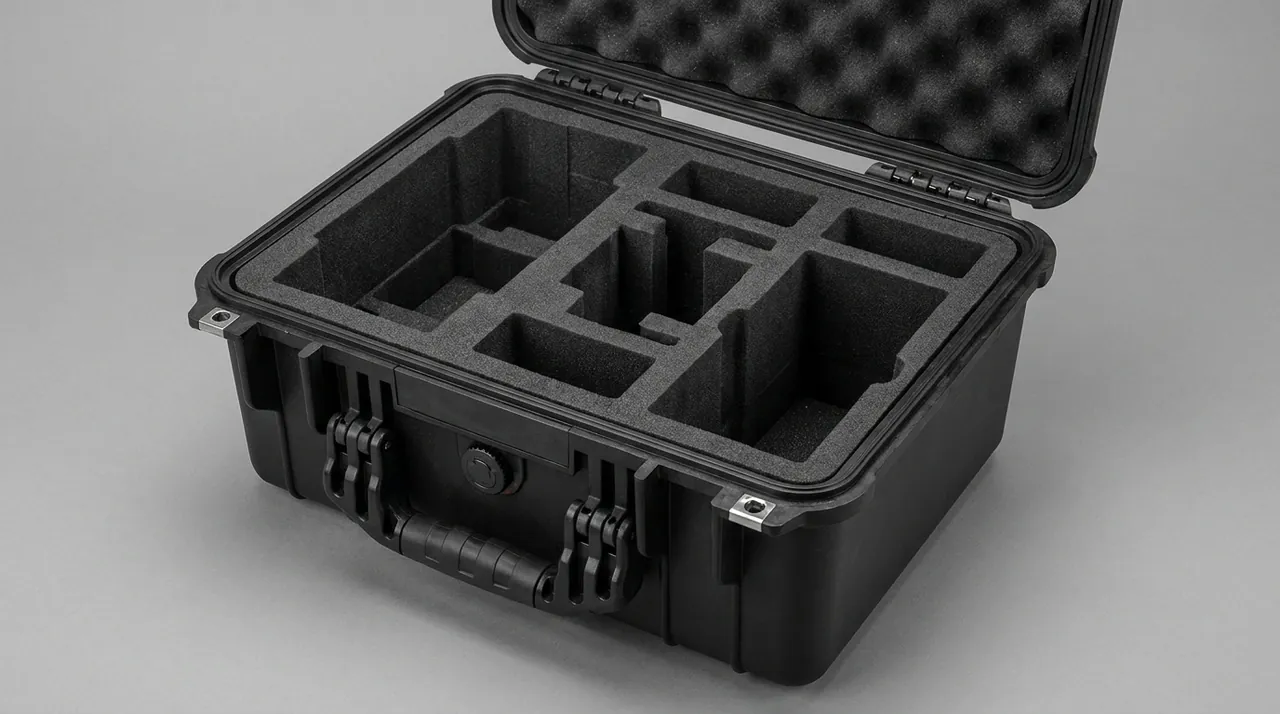
Compartments do two jobs: they stop parts from hitting each other, and they route weight into the case structure rather than into the liner. Partition material follows the load. Light parts can use EPE or corrugated composite board. Heavy parts need timber or engineering plastic partitions aligned with the case ribs, so the load travels a structural path.
Latches and hinges are the durability items for repeated use. Fertilizer plants often expect cases to come back with failed parts for repair, which can mean hundreds of open and close cycles. Metal latch fatigue life, hinge pin wear, and the decay of latch preload over time all need to be specified at selection stage. Case Latch Selection and High-Strength Hinge Design give quantified references for load and life on these two component families.
Stacking capacity is another underestimated figure. For export stuffing, cases are stacked two or three high, and the bottom case carries the upper weight plus a dynamic amplification factor that can reach 1.5 to 2.0 in road transport. Capacity comes from the base structure, corner reinforcement and wall ribs, not from wall thickness alone. Case Stackability and Pallet Planning sets out how pallet footprint and stack height should be matched, which is directly relevant to choosing between a 1200 x 1000 mm and a 1100 x 1100 mm pallet.
Environmental and Transport Validation: Temperature, Salt Spray and ISTA / GB-T 4857 / ASTM D4169
A paper design needs test evidence behind it. For fertilizer equipment parts, three test families are worth running: environmental, corrosion and transport.
Environmental testing centres on temperature and humidity cycling, whose purpose is to expose condensation and material ageing. A common cycle runs between minus 20 and plus 60 degrees Celsius with 12 to 24 hours per cycle for five to ten cycles, with interim checks for condensation inside the case, hardening of foam and permanent set of the gasket.
Corrosion testing centres on salt spray. ASTM B117 is the international reference and GB/T 10125 the Chinese equivalent; both use essentially the same neutral salt spray condition of 5 percent sodium chloride at 35 degrees Celsius. It must be stated clearly that there is no universal conversion between salt spray duration and real service years. The result supports comparison between materials and processes, not a claim that a case is equivalent to a certain number of years. Acceptance should name the standard, duration, rating method and pass threshold, for example no base metal rust on metal parts after 480 hours of neutral salt spray to GB/T 10125.
Transport testing in China follows the GB/T 4857 series, covering vibration, shock, stacking and drop. Internationally, the ISTA series and ASTM D4169 are common. They differ in focus: GB/T 4857 reproduces domestic road conditions more closely, ISTA suits parcel and small-item logistics, and ASTM D4169 offers assurance levels assembled around a distribution cycle. The right choice follows the actual logistics route rather than which standard happens to be more familiar.
| Test family | Common standard | Typical condition | Observation focus |
|---|---|---|---|
| --- | --- | --- | --- |
| Temperature and humidity cycle | Customer spec / IEC 60068-2-30 | -20 to +60 C, 5-10 cycles | Condensation, material ageing |
| Neutral salt spray | GB/T 10125 / ASTM B117 | 5% NaCl, 35 C, 48-480 h | Base metal rust, coating blistering |
| Vibration | GB/T 4857.7 / ISTA 3A | Random or fixed frequency | Liner shift, fastener loosening |
| Drop and shock | GB/T 4857.5 / ISTA 3A | Drop height by mass | Permanent cushion set |
| Stacking | GB/T 4857.3 | Static load plus dynamic factor | Case deformation, base collapse |
| Full distribution | ASTM D4169 | Assurance level by cycle | Combined failure modes |
For standard applicability, GB-T 4857 Transport Packaging in Practice and Export Packaging Compliance Essentials explain how to combine tests for intermodal routes in a practical way.
Customization, OEM / ODM Process and Acceptance Criteria
There is almost no fully standard fertilizer equipment case, precisely because the part lists differ so much. The customization process usually runs through six gates: requirement collection of part list, drawings and logistics route; concept design of cavity layout, materials and sealing level; prototype case build; packing validation; customer sign-off; volume production with documentation.
| Stage | Input | Output | Common risk |
|---|---|---|---|
| --- | --- | --- | --- |
| Requirement collection | Part list, drawings, route | Technical specification | Missing items, weight estimation error |
| Concept design | Specification | Layout drawing, BOM, cost | Poor cavity split, over budget |
| Prototype build | Layout drawing | Physical prototype | Liner dimensional deviation |
| Packing validation | Actual parts | Packing record and photos | Interference, case will not close |
| Customer sign-off | Validation result | Signed sample, change order | Verbal approval with no record |
| Volume delivery | Signed sample | Batch product, shipped documents | Batch-to-batch variation |
OEM and ODM differ in design ownership and branding. Under OEM the customer supplies drawings and specification, JUNZHIJIA manufactures to drawing and prints the customer mark. Under ODM, JUNZHIJIA develops the structure and liner design and the customer only supplies parts and usage scenarios. Both models need contract clarity on tooling ownership, drawing confidentiality and intellectual property, as covered in Custom Case Contract and IP Clauses and How to Choose a Case OEM Factory.
Acceptance criteria should be written as a graded checklist, avoiding statements such as "meets requirements" that cannot be executed.
| Acceptance item | Example criterion | Inspection method |
|---|---|---|
| --- | --- | --- |
| External dimensions | Within plus or minus 3 mm of drawing | Tape measure, calliper |
| Case flatness | Sealing face gap no more than 0.5 mm | Feeler gauge, surface plate |
| Liner fit | Part loads without force, no rattle | Trial packing |
| Sealing rating | Passes re-test to GB/T 4208 | Water jet or immersion test |
| Latch function | 200 open-close cycles without failure | Cycle test |
| Appearance | No visible scratches, colour within sample range | Visual comparison |
| Marking | Case number, part name, quantity, orientation | Visual plus document check |
| Shipped documents | Packing list, packing drawing, desiccant record | Document check |
Sampling inspection can follow Custom Case Acceptance and AQL, which sets out how critical, major and minor defects are graded and how sample sizes are chosen.
Frequently Asked Questions FAQ
Q: A granulator tyre assembly is very heavy. Can it ship in the same case as precision parts such as slurry pipes?
A: Shipping them together is not advisable. A tyre assembly commonly weighs 180 to 450 kg, and once packed, the foam compresses through under self-weight and stacking load. Once compression exceeds the design value, the cushioning layer loses its energy absorption and the precision parts in the same cavity take the full shock transmitted by the case. The correct approach is separation. The tyre assembly is fixed to the case floor structure on a timber skid with steel strapping, so load travels through the skid into the base ribs. Slurry pipes and other grade A precision parts get their own case, clamped in a formed EVA cradle at 60 to 90 kg per cubic metre. If case count forces mixed loading, place the heavy part at the bottom, add a rigid partition between it and the precision parts, and align that partition with the case ribs to create an independent load path, while double-wrapping the precision parts. Any mixed arrangement must be measured during packing validation to confirm that peak acceleration at the precision part location stays within its allowable limit, and the result recorded.
Q: Slurry pipe orifices are only 1.5 mm. What usually goes wrong in transit and how is it prevented?
A: The two main risks are blockage and orifice collapse. Blockage comes from dust and foam debris, while collapse comes from stacking load and part collision. Prevention works in three layers. Plug the orifice with a silicone cap or dedicated protective plug so dust stays outside and liner debris cannot enter the internal passage. Locate the pipe body in a thermoformed EVA cradle matched to its outline, so micro-movement during transport cannot polish the orifice edge and shift the flow rate. Cover the end flange face with protective film and add locating pins so the sealing face cannot be scratched. Slurry pipes are slender, so any unsupported span needs a support block and both ends need axial restraint, otherwise repeated bending under vibration leaves residual deformation. Before packing, record the orifice count and diameter of every pipe and check passability with a go gauge. Repeat the same check on arrival. Any diameter change beyond tolerance is then documented transport damage and usable as a claim basis. Keep the gauge record with the packing list for traceability.
Q: Do urea, potassium chloride and ammonium sulfate need different internal protection?
A: Yes, because their hygroscopicity and corrosion targets differ. Urea has a critical relative humidity near 72 to 75 percent and its dust forms an ammonia-bearing alkaline film that threatens carbon steel and aluminium most. Potassium chloride sits near 80 to 84 percent and its released chloride ions create the highest pitting risk for stainless steel. Ammonium sulfate dust is mildly acidic and mainly attacks zinc coatings and aluminium. The differences drive three actions. Desiccant charge follows the hygroscopicity of the raw material, taking the upper value for urea service. Liner materials in potassium chloride service must be checked for leachable chloride, preferring low-emission IXPE or EVA. Aluminium fittings should not be left exposed in urea or ammonium sulfate service; switch to stainless or wrap them. If one line runs several recipes, set a single common specification based on the most sensitive raw material so nobody on site can mix up the wrong case. The chosen specification should also be printed on each case label and repeated on the packing list, so receiving inspection checks the same criteria the design assumed.
Q: Is an IP67 case always better than an IP65 case?
A: Not necessarily. The decision depends on real exposure. IP65 already provides full dust protection and resistance to water jets from any direction, which covers enclosed box truck transport with warehouse storage at both ends. IP67 adds short-term immersion, and that only earns real value on sea freight decks, in rainy open transfer or where falling into water is credible. A fully sealed case also creates a pressure differential problem. Internal pressure rises during daytime warming and lifts the gasket, while night-time cooling creates a negative pressure that draws outside moisture in, so after long cycling the internal humidity can be worse than an IP65 case fitted with a breathable valve. An IP67 design therefore normally requires a pressure equalization valve that passes air but blocks droplets and dust. The method is to map the logistics route and exposure duration first, then choose the rating, and put the saved budget into liner and compartment design for a better overall result. Whenever a rating is quoted, ask the supplier to state the test duration and depth behind the claim.
Q: How should cushioning foam thickness be determined, and is there a simple reliable estimate?
A: Two routes can cross-check each other. The rule-of-thumb route works by mass bands: parts under 20 kg use 40 to 60 mm of static thickness, 20 to 100 kg uses 50 to 80 mm, and above 100 kg or for bearing-class sensitive parts, 60 to 100 mm combined with hard stops that carry the main load. The energy route uses a simplified calculation: the drop potential energy equals the energy absorbed by the cushion, and the specific energy absorption of the material multiplied by the effective compressed volume must exceed it, which yields a minimum thickness. Both routes need test confirmation, normally a full-case drop and vibration test to verify no permanent set and no functional failure. It is important to stress that cushion and hard stop have distinct roles. The cushion controls peak shock and the hard stop controls extreme displacement. A cushion alone allows excessive displacement, while a hard stop alone allows excessive peak shock. Because parts sit under sustained stacking load, foam also takes compression set, so selection should weigh that property rather than initial density alone.
Q: How much desiccant belongs inside a case, and where should it be placed to work?
A: The charge is calculated from the free volume inside the case, with a common figure of 300 to 600 g of silica gel or montmorillonite per cubic metre, taking the upper value where moisture control is critical. Placement must satisfy two conditions: the desiccant shares the cavity with the parts but is not pressed against any mating surface, and it sits near the internal air circulation path. In practice, fix desiccant bags to the cavity wall or partition with enough exposed face area, and never let foam crush them, because that cuts effective absorption area sharply. More importantly, understand the boundary of what desiccant can do. It only absorbs the initial moisture inside the case and vapour that slowly seeps in. Once the seal fails and outside moisture keeps entering, desiccant delays wetting rather than preventing it. Desiccant must therefore be designed together with sealing level and the pressure equalization valve. When transport involves temperature swings above 20 degrees Celsius, night condensation releases moisture absorbed during the day, so grades with high capacity and slower low-temperature desorption should be preferred.
Q: If a salt spray test runs 480 hours, does that equal a certain number of years of coastal service?
A: No. Salt spray is an accelerated corrosion test and its corrosion mechanism differs from real atmospheric corrosion. There is no universal conversion between test duration and service years, and the conversion factor varies with material and surface treatment, so no claim of equivalence to a given number of years can be supported. The value of salt spray testing lies in comparison: comparing plating processes, sealing structures and liner materials under identical conditions to support a selection decision. Acceptance should state the standard number such as GB/T 10125 or ASTM B117, the duration, sample condition, rating method and pass threshold, for example no base metal rust on metal parts after 480 hours of neutral salt spray. Salt spray results should also be assessed together with temperature cycling and transport vibration results, because real failures usually combine several factors and a single test dataset is not enough to support a conclusion. Re-testing production samples also matters, because drift in plating thickness or gasket moulding can move results away from the prototype baseline.
Q: What information does a customer need to provide to move a custom case from requirement to volume production?
A: Completeness of input directly determines design accuracy and rework frequency. Mandatory items include the full part list with individual weights, a description of critical mating faces and areas that must not deform, maximum outline dimensions including protrusions, the logistics route and transport modes such as road, rail, sea or intermodal, storage conditions including whether there is a warehouse, open storage and stacking height, plus the target sealing rating and test requirements. Helpful extras include part drawings or 3D models, assembly sequence notes, and site conditions for lifting and unpacking such as forklift, crane and height limits. Under ODM the customer supplies only the parts and the usage scenario, and JUNZHIJIA develops the structure and liner design. Under OEM the customer must supply full drawings and branding requirements. All inputs should be fixed in a technical specification and confirmed by signed samples from both sides, so no disagreement arises at volume production from a verbal description. Keep a single revision number per specification so every later change stays traceable.
Conclusion and Related Reading
Protection proves itself after unpacking. JUNZHIJIA, made by Kexin New Materials (Guangdong) Co., Ltd., delivers compartmentalized liner design, OEM/ODM service and shipped documentation matched to each part list and route.
Related Reading