

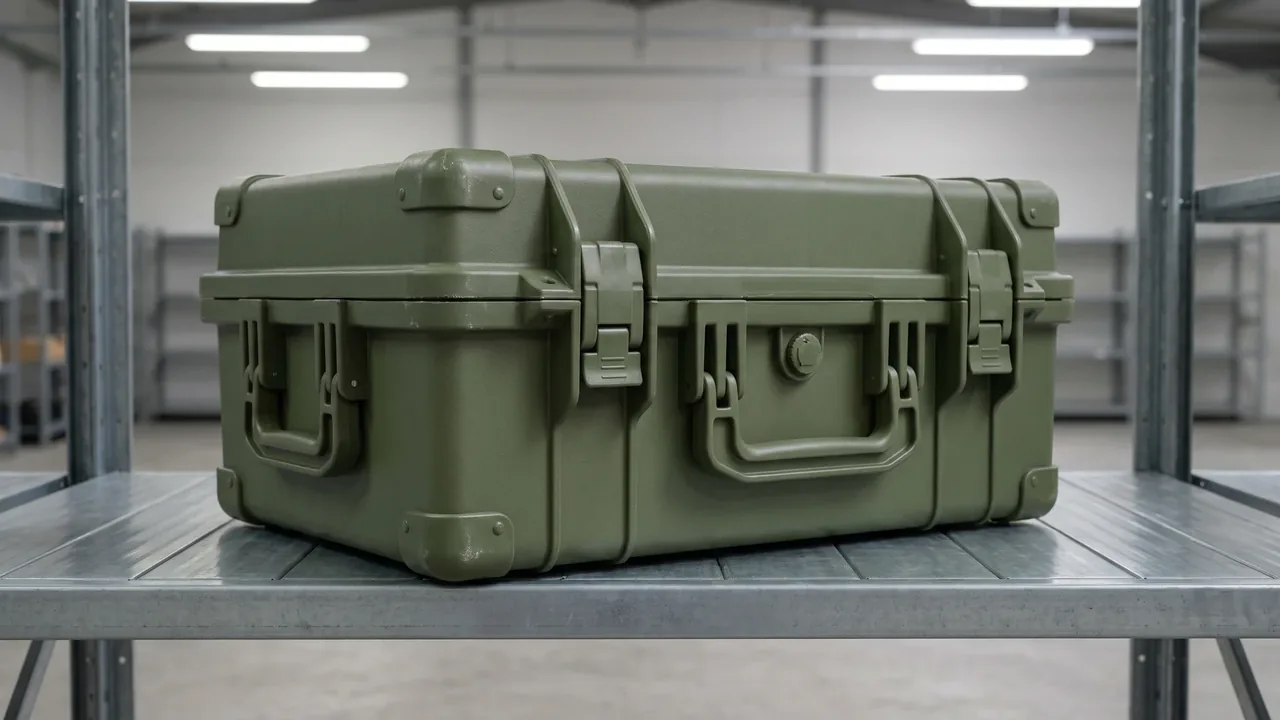
A wilderness first aid case is not an ordinary storage box. It is a professional protective container built for outdoor rescue teams, field work units and scenic-area medical points, and it must shield bandages, cold packs and temperature-sensitive medicines from rain, dust, impact and sharp temperature swings when no fixed medical facility is nearby. The key conclusion is simple: a qualified wilderness first aid case must be built on three foundations - an IP67 seal, an independent temperature-controlled compartment and a clearly sorted interior - so that medicines stay effective, separated and uncontaminated at the remote site. This article explains, from material selection and sealing through temperature control, sorting, leak protection, shock absorption, marking, locking, certification, customization and maintenance, how to specify and configure a protective case for wilderness first-aid scenarios. For the broader positioning of medical containers, see the medical first aid case overview.
1. Definition and Use Scenarios
A wilderness first aid case is a hard-shell protective container designed for environments far from fixed medical points. Its primary job is to isolate dressings, disinfectants, cold packs and temperature-sensitive emergency medicines from moisture, sand, shock and rapid temperature change. It does not diagnose or treat; it provides a clean, organized and quickly accessible supply base for on-site responders. Unlike a light urban first-aid pouch, the wilderness version stresses three things: sealing so rain and mud cannot enter, structure so the case survives carrying and dropping, and organization so responders can identify medicine categories under low light and stress.
From the user perspective, outdoor rescue teams move supplies across mountains, canyons and river valleys, often on backpacks or vehicles, so weight reduction and anti-vibration matter most. Field work units such as geological survey, pipeline inspection and forest patrol may stay out for weeks, so medicines must remain valid across large day-night temperature gaps, making the temperature compartment essential. Scenic-area medical points face high foot traffic and random requests, so the case must be easy to station, hand over and open for quick inventory. These three groups share one condition: there is no on-site thermostat or refrigerator, so the case itself must act partly as a mobile pharmacy. For the general logic of outdoor containers, read the outdoor gear case guide.
It must be clarified that the wilderness first aid case is only a carrier of supplies, and its design boundary is clear. It improves storage safety and retrieval efficiency, but it never replaces professional medical judgment. Any decision about dosage, indication or contraindication should be made by qualified medical personnel. Procurement and equipment departments should focus on the container attributes - material, sealing, temperature control, sorting and certification - rather than printing any treatment guidance on the case. This boundary keeps the following technical discussion firmly on the engineering structure of the case.
2. Shell Material and Engineering Plastic Selection
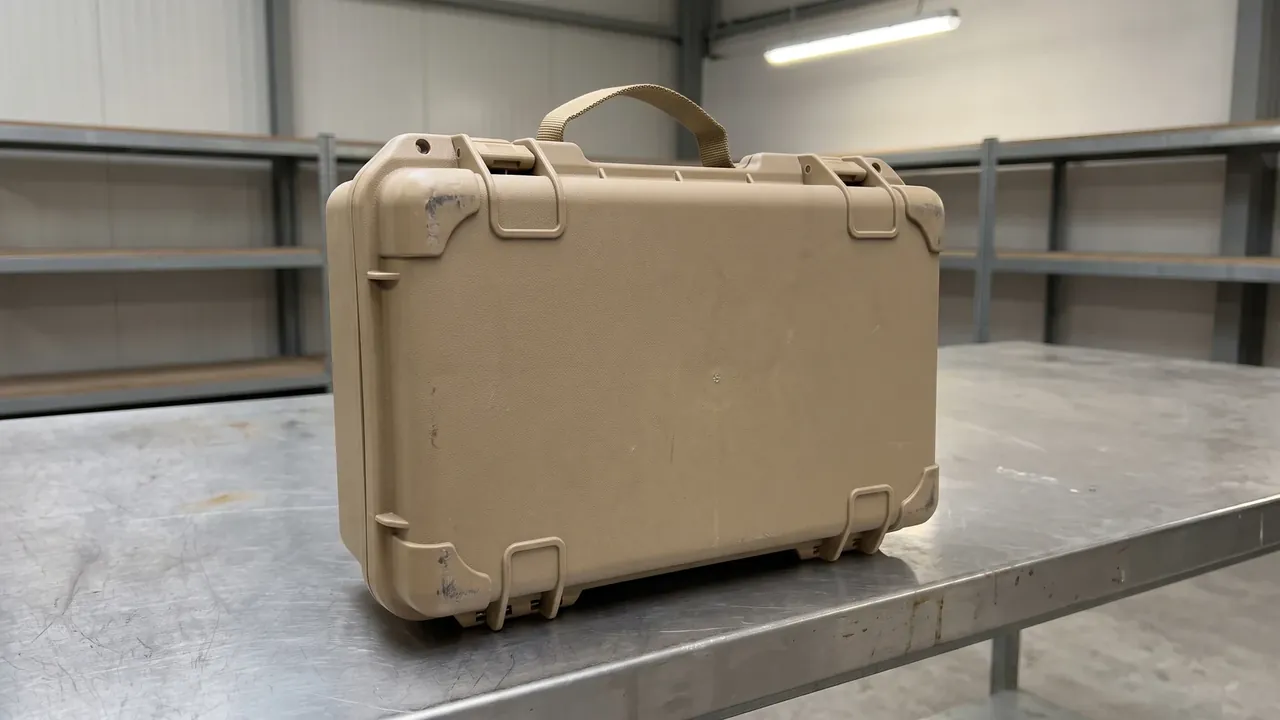
Shell material directly determines weight, impact resistance and weather durability. The dominant shell materials for wilderness first aid cases are modified polypropylene, copolymer polypropylene and acrylonitrile-butadiene-styrene copolymer, usually made by rotational molding or injection molding. Modified polypropylene offers good low-temperature toughness and low density, and it resists brittle cracking in cold zones; its typical density is around 0.9 grams per cubic centimeter, far lighter than metal at equal strength. Copolymer polypropylene balances rigidity and fatigue resistance, performing steadily under frequent opening and stacking. Acrylonitrile-butadiene-styrene copolymer is stiffer and glossier but weaker in low-temperature impact, so it normally needs a modified formula to compensate.
When selecting material, buyers should watch three quantified indicators. First is the match between wall thickness and reinforcing ribs: the corners and edges should carry recessed ribs that raise bending stiffness without creating external protrusions that strike the ground first during a fall. Second is notched impact strength; experience suggests choosing a material with an Izod notched impact strength no lower than about 40 joules per centimeter to cope with accidental knocks in the field. Third is weather grade; the shell should carry enough ultraviolet stabilizer and antioxidant so it does not powder or discolor under long sun exposure. For cases used across extreme temperature spans, check the glass transition and low-temperature brittle points to confirm structural integrity from minus 20 to plus 60 degrees Celsius.
Besides plastics, a few heavy models use aluminum frames with engineering-plastic panels. Such cases resist compression and torsion better but gain weight and cost, and metal parts need anodizing or powder coating against salt spray. For most rescue and scenic-point uses, an all-plastic shell already meets strength needs while keeping the case within a carryable weight. For a deeper comparison of case body materials, see the first aid case material analysis.
3. Sealing Structure and the IP67 Rating
Sealing is the core competence of a wilderness first aid case. Once water enters, dressings get wet, labels blur and the liner molds. The industry uses the IP code to express dust and water protection, and IP67 is the most common target for field medical containers: the first digit 6 means full dust protection, and the second digit 7 means the case can survive brief immersion at one meter depth for thirty minutes without ingress. This level is judged against IEC 60529 and the equivalently adopted GB/T 4208, so procurement documents should cite both standard numbers and ask the supplier for matching test records.
Achieving IP67 depends on a continuous gasket around the lid and a firm closing compression. A common approach lays a closed-cell foam rubber or thermoplastic elastomer gasket along the lid inner edge; when closed, the case lip compresses the gasket evenly into a continuous seal line. Compression is typically kept at 15 to 25 percent of the gasket free height: too little leaves the line broken, too much spikes opening force and accelerates permanent set. Gasket material must resist ozone, low temperature and medicine contact, and both thermoplastic elastomer and EPDM are mature choices. Remember the gasket is a consumable that hardens and cracks under long ultraviolet exposure, so the case should not sit in direct sun while idle. For gasket material selection, see the case seal materials guide.
Beyond static sealing, consider pressure equalization. At high altitude or during air transport, internal-external pressure differences can push the gasket open or make the lid hard to open, so advanced models fit a manual or automatic pressure equalization valve on the side, balancing pressure through a breathable waterproof membrane while keeping the dust and water ratings. For wilderness first aid cases the valve is optional, but if the altitude span exceeds two thousand meters or air transport is involved, it is worth specifying. For the general waterproof design, also see the waterproof case guide. Finally, sealing is not permanent after leaving the factory; every opening and every grain of sand in the gasket groove slowly weakens it, so periodic seal checks belong in the maintenance routine.
4. Temperature Compartment and Insulated Liner Design
Temperature control is what separates a wilderness first aid case from an ordinary tool box. Some medicines, biological agents and specific cold packs are temperature sensitive; inside a summer vehicle or beside sun-heated rock, the case temperature can climb fast and exceed the recommended storage range. Therefore the case needs an independent temperature compartment with insulated liner walls that isolate sensitive supplies from the hot shell. A typical method carves a lidded cold chamber beside the main bay and fills its walls with expanded polyethylene foam or vacuum insulation panels, used together with cold accumulators to hold a low-temperature window for several hours without power or active cooling.
The insulated liner needs three coordinated parameters. First is thermal conductivity: expanded polyethylene board has an experience value around 0.035 watts per meter-kelvin, while vacuum insulation panels are about an order of magnitude lower but cost more and fear puncture, suiting fixed sites. Second is liner thickness; within the limited volume, the cold chamber wall is usually 15 to 30 millimeters, balancing hold time against usable space. Third is cold source matching: the phase-change temperature of the accumulator should match the medicine storage range. For example, medicines kept at 2 to 8 degrees Celsius pair better with an accumulator whose phase-change point sits near plus 5 degrees, rather than a minus 18 degrees frozen gel pack that could freeze the medicine.
At this stage, JUNZHIJIA can supply custom die-cut insulated liners planned from the medicine list, with slots shaped to vials, ampoules and accumulators so the cold source contacts the medicine while nothing rattles in transit. The custom liner also separates the cold chamber from the ambient chamber, so room-temperature consumables like bandages and scissors are not dampened by the cold source. It must be stressed that an insulated liner only delays warming; it is not active refrigeration. When on-site stay exceeds the cold source capacity, the case should move to shade or get a fresh cold source. For temperature-sensitive logistics, also read the temperature controlled case guide and the cold chain case guide.
5. Medicine Sorting and Internal Divider Layout
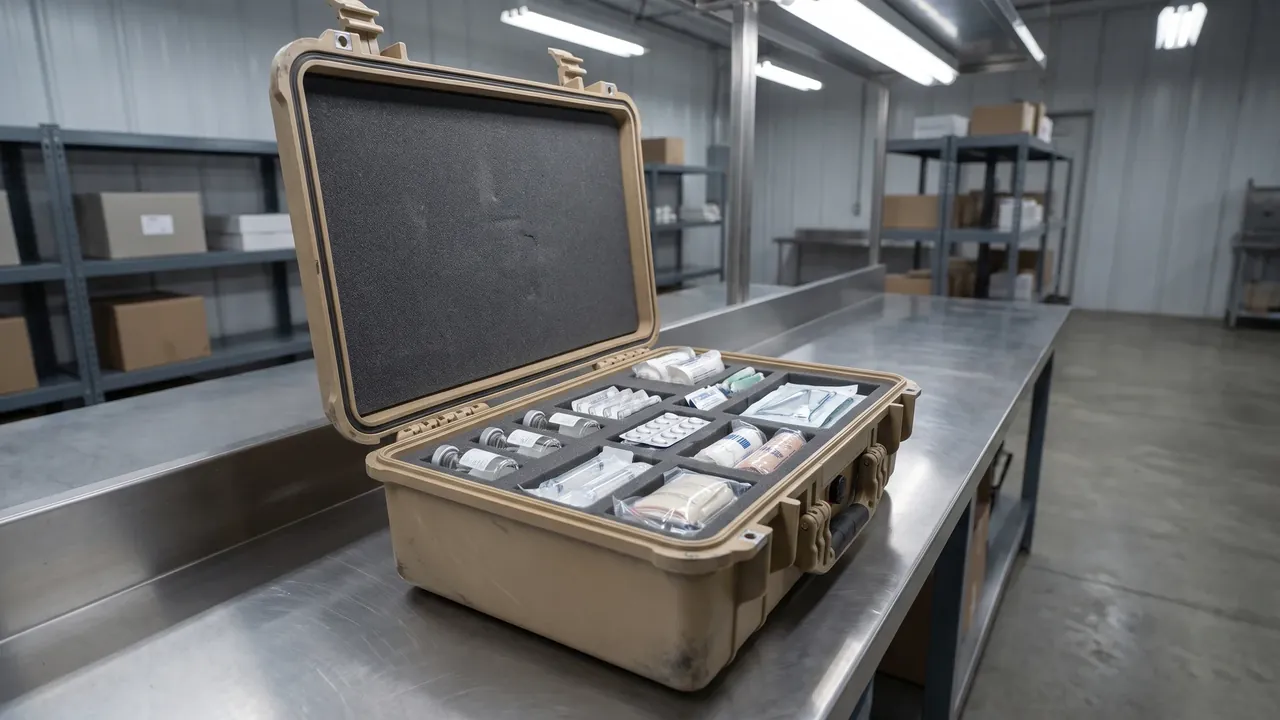
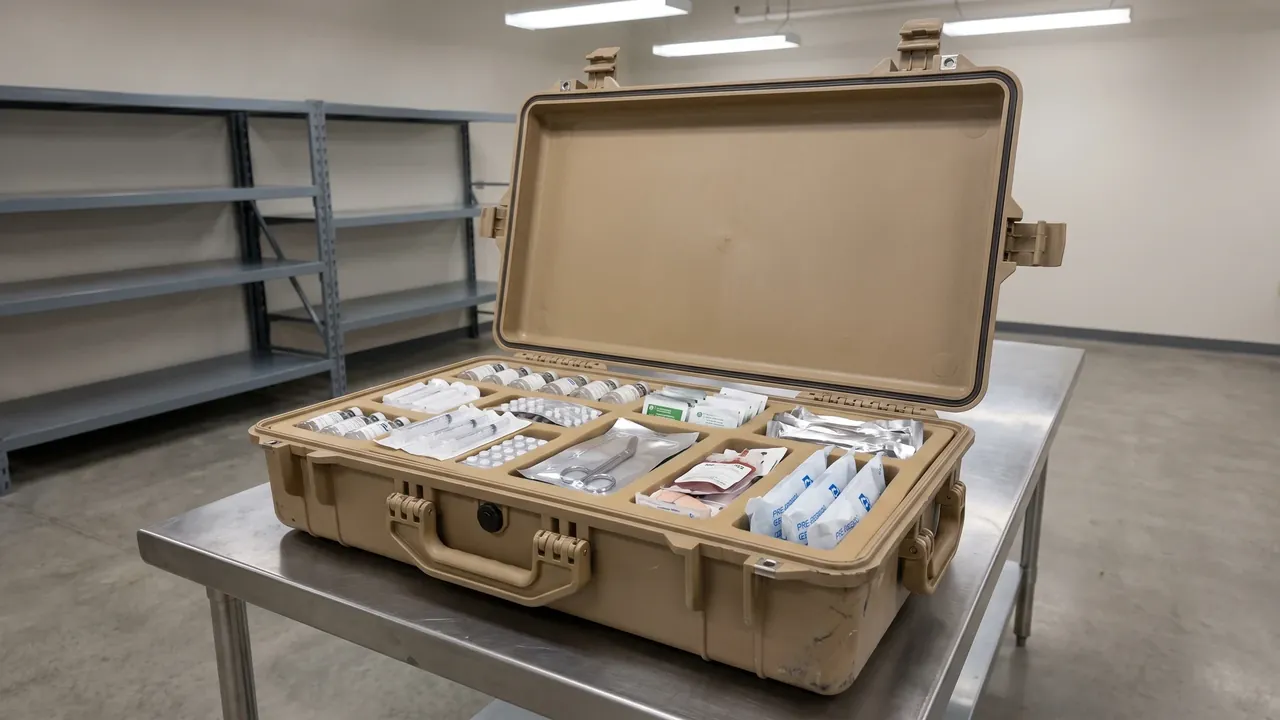
Clear internal sorting lets responders grab the right item in panic and prevents mixing, cross-contamination and misuse. The interior of a wilderness first aid case follows three principles: zone, layer and color. Zoning puts supplies into clean, dressing, medicine and instrument areas. Layering stacks different forms of supplies on trays or dividers. Coloring uses color tags to mark hazard level or priority. A common layout places cold and temperature-controlled medicine in the independent chamber, external dressings and disinfectants on the upper tray, oral and injectable medicines in lidded cells, and scissors or hemostatic forceps under elastic straps in the middle.
Internal dividers come in two main forms. Removable partition boards slot into bottom grooves and can be recombined freely; they adapt to changing kits but may loosen under heavy vibration. Die-cut foam or thermoformed liners mill slots to the exact item shape, giving each object a dedicated recess; they locate precisely and resist shock but need re-milling when the kit changes. For teams with stable kits, die-cut liners are the safer choice; for units with shifting supplies, a hybrid of fixed frame plus movable inner cells works better. For more on liner selection, see the foam lining guide.
For labeling, each cell should carry a Chinese item name and an expiry prompt, and key medicines can get an index diagram on the inside lid so the whole layout appears at opening. Avoid forcing different storage-condition medicines into one cell, such as mixing refrigerated medicine with ambient consumables, which ruins temperature control and raises retrieval error. The goal of sorting is to confirm, within thirty seconds, what is where, how much remains and when it expires. This thinking aligns with the field medical case standard, and the sorting list can be written into the contract as a technical appendix.
6. Leak Protection and Corrosion-Resistant Liner
The interior of a wilderness first aid case often contacts iodine, alcohol, saline and ointments. A leak can corrode the liner, glue supplies together and breed bacteria, so the inner surface needs leak and corrosion resistance. A mature solution uses seamless one-piece molding or a food-grade polypropylene inner liner so liquid cannot seep into the shell sandwich; seams should be rounded and smooth to avoid dirt traps. For liners wiped with disinfectant often, the surface should reach a chemical resistance that tolerates repeated medical disinfectant wiping without swelling or fading.
In leak-control detail, liquid supplies should sit in small sealed bottles fixed inside independent cells, and the cell bottom can carry a tiny sump so a single leak stays contained instead of spreading across the case. The liner color should be light rather than dark, making stains and residue easy to spot. For coastal scenic points and wetland sites with salt spray or high humidity, metal fittings like hinges and latches should be stainless steel or coated alloy, with salt-spray corrosion checks written into maintenance. For the overall shock and protection design, see the shockproof case guide.
The other side of corrosion resistance is material safety. The liner and gasket should not release substances harmful to the human body, so buyers can ask for compliance notes on food or medical contact and confirm the material meets hazardous-substance restrictions. Although the case does not touch wounds directly, indirect contact outside medicine packaging still matters. In sum, leak and corrosion protection aims to contain a small spill at minimum impact rather than relying on a perfect later cleanup. For disaster-scene container protection, also compare the disaster relief case design.
7. Shock Absorption and Drop-Resistant Structure
Field transport means the case endures backpack jolts, vehicle braking, accidental drops and stacking compression. The shock structure dissipates external impact energy layer by layer between shell and liner to protect glass vials and precision instruments. The shell itself absorbs energy through thickened, rounded corners that deform locally on impact. The liner buffer layer leaves foam gaps between items and the hard shell; common closed-cell expanded polyethylene elastically deforms under load and reduces peak acceleration to a safe range.
Drop resistance usually links to international safe-transit norms. The ISTA series simulates handling, stacking and dropping to assess packaging reliability, and its drop training for single-parcel transport helps estimate breakage probability at typical handling heights. The military environment-engineering standard MIL-STD-810H gives a broader environmental profile - drop, vibration, humidity and temperature shock combined - often used as a design reference for high-reliability containers. It must be clear these standards provide test methods, not a guarantee of invincibility; whether a case fits a task still depends on real drop height, load weight and ground material. For transport vibration and drop testing, see the ISTA test guide.
Another point of shock design is limiting internal movement. Items sliding inside collide and scatter when the lid opens, so beyond foam location, elastic straps or nets should press the upper tray and lid-side supplies. For the cold chamber holding glass ampoules, add independent limit slots so no accumulator or vial can roll freely. In short, shock protection is not a single material but the synergy of hard-shell energy absorption, soft-liner buffering and strap limitation. The rescue case guide also stresses this multi-layer thinking.
8. Marking System and Color Visual Management
In low light, rain and emergencies, whether the case is found fast decides rescue efficiency. The marking system should include a bright exterior color block, a top orientation mark, an inside-lid sorting index and a side inventory card. Color visual management is low-cost and high-return: an orange-red or bright-yellow main color stands out against vegetation, and red-yellow-green tags mark hazard level or priority so responders judge order without reading. Avoid confusing color meanings; one scheme should be unified across the whole unit and written into the operation manual, so the English description is simply to unify the scheme in that manual.
Surface markings must also be durable and readable. Screen printing and in-mold labeling resist friction and solvent wiping better than plain stickers, fitting frequently used field cases; for unit numbers or batches, laser etching or metal nameplates prevent the label from peeling off in mud. The top should hold a transparent, moisture-proof pocket with the latest inventory and expiry summary for easy handover. For general color management, see the case color visual management guide.
Beyond visibility, markings must be understandable. Inside the lid or on divider faces, post a zone diagram showing clean, dressing, medicine and instrument areas and the cold chamber location with a cold-source swap reminder. For multi-case teams, number each case so commanders track status by number from base. The essence of marking is turning individual experience into a process anyone can execute, reducing dependence on a few skilled people. This idea echoes the emergency kit case organization.
9. Latch Selection and Stacking Plan
The latch of a wilderness first aid case has two duties: prevent accidental opening in transit and prevent unauthorized access to medicines. Common latches include press snap, butterfly latch and lockable security latch. The press snap opens fastest for one-hand operation but resists misopening weakly; the butterfly latch closes firmer for bumpy vehicles; the lockable security latch suits scenic points and fixed sites needing access control. Balance quick access against misopening: rescue carry cases lean to the former, storage cases to the latter.
Stacking is a real need for multi-case field carry. The top and bottom should carry aligned stacking ribs or corners so stacked cases limit each other and will not slide during turns or side tilt. Stack height combines case compression capacity with base friction; experience keeps a single stack under four layers with the bottom on a flat load-bearing surface. For long-term reserve storage, add a floor moisture barrier and wall gap to prevent bottom aging. For stacking engineering, see the case stacking structure guide.
Latches and hinges are the most frequent and stressed parts, so their material and life deserve scrutiny. Hinges should be stainless or reinforced nylon, and latch springs need enough cycle life; procurement can ask for experience values or test data on latch open-close cycles. Also, the latch must not become a water weak point: lockable models need sealed keyholes to avoid a leak channel. In sum, latch and stacking aim to keep the case secure in motion and orderly at rest, supporting the whole field supply chain. Compare the emergency command case design for carry planning.
10. Certification Standards and Test Documents
Certification and test documents let buyers judge whether a case lives up to its claims. For wilderness first aid cases, the core standards include IP rating per IEC 60529 and GB/T 4208 for dust and water proofing; MIL-STD-810H for environmental test methods covering temperature, vibration and drop combined; ISTA transport test procedures for packaging integrity in distribution; and UL94 for plastic flammability grade. Each standard has a focus, so buyers should combine them by scenario rather than view one number alone.
The value of test documents is traceability. A qualified report covers sample description, test condition, method and result with a qualified lab seal. For volume purchase, write incoming sampling and key-item retest into acceptance: for example, draw some cases per batch for IP67 water immersion and latch cycle checks to ensure production consistency. Here JUNZHIJIA can supply, per order, sealing, drop and temperature-control related test documents and material compliance notes to support incoming acceptance and archive retention. For the meaning of military compliance, see the MIL-STD-810H compliance note.
Beware the standard-stacking trap: some suppliers list many standard numbers without matching reports, or the reported sample differs from the production model. Buyers should demand one-to-one mapping and confirm the reported specification, material and seal structure match the supplied goods. Also, IP67's digit 7 means brief immersion, not long diving or high-pressure washing; if the site needs pressure washing, choose a higher grade and verify the test condition. For IP67 detail, read the IP67 protective case analysis. Certification is not decoration but turning a verbal promise into verifiable evidence.
11. JUNZHIJIA Custom Liner and OEM/ODM Capability
For units with fixed kits and special scenarios, standard liners rarely fit the real equipment, so customization matters. JUNZHIJIA offers one-stop OEM/ODM from requirement review and liner die-cutting to case color and marking: engineers first plan zones, layers and the cold chamber from the customer's medicine and instrument list, then use CNC milling or thermoforming to make a dedicated liner so every item has a fixed slot. This made-to-measure approach raises space use and shock resistance and eases repeat ordering from the same drawing.
On seal consistency, JUNZHIJIA can match original-spec gaskets and pressure equalization valves to the case model, avoiding leaks from wrong-size replacements during later maintenance. Customization can also integrate unit marks, numbers and color tags into the shell so appearance and management align. For rescue goods exported or transferred across regions, the service can coordinate packaging and documents to meet destination-market material and compliance requirements. For the overall custom and contract process, see the OEM/ODM custom case note.
Customization does not relax general quality. Whether standard or custom, the case must still pass material, sealing, shock and marking basics; customization only serves a specific list better. Buyers should give the supplier the full kit list, temperature range, operating altitude and expected drop height, and keep a first-article acceptance step to confirm liner slots match real items before volume production. Only then does customization become field efficiency instead of moving problems to the wilderness.
12. Field Maintenance and Daily Care Routine
Even the best case needs disciplined maintenance, whose goal is turning sudden damage into predictable replacement. Daily care includes at least five actions: ventilate and wipe the liner after each task to prevent residue and moisture; periodically check the gasket for hardening, cracking or deformation and replace it when failed; check medicine and consumable expiry and rotate near-expiry items forward with a record; inspect hinge, latch and lock tightness and smoothness, adding a little neutral lubricant if needed; clean exterior mud but avoid strong solvents that harm shell and markings.
Maintenance should also keep a cycle record. Give each case a card or electronic ledger recording purchase date, last service, gasket change and drop damage, moving management from impression to data. For long-term reserve cases, do a quarterly open inspection and function confirmation unrelated to power, and keep temperature-humidity logs in the storage room to avoid premature aging in stuffy warehouses. For the general process, see the protective case maintenance guide.
Finally, maintenance must land on people and responsibility. A unit should name a case administrator, define who counts, who reports repair and who reclaims idle cases, and write the routine into the manual rather than leaving it verbal. After a severe drop or immersion, even if the case looks fine, arrange a special inspection to confirm internal dividers and seals have no hidden damage. Make maintenance a system so the case will not fail at the critical moment. The emergency relief supplies case guide also relies on such a traceable maintenance loop.
FAQ
Q: What is the main difference between a wilderness first aid case and a ordinary home medicine box? A: The fundamental difference lies in the use environment and the protection goal. A home medicine box is used in a stable indoor setting where the focus is classification and dust prevention, with almost no hard requirement for sealing, shock resistance or temperature control. A wilderness first aid case targets outdoor rescue teams, field work units and scenic-area medical points, and it must protect supplies under rain, sand, drops, vibration and large temperature swings. Therefore it needs an IP67 dust and water seal, a temperature compartment that holds cold accumulators, shock-locating liner and clear sorting marks, none of which a home box needs. From a procurement view, the wilderness model stresses standard compliance and verifiable test documents rather than mere appearance or capacity. Also, the wilderness case often moves on backpacks and vehicles, so its sensitivity to weight and ergonomics is clearly higher than that of a home model. Recognizing this difference prevents evaluating field gear with indoor thinking and helps select a case that truly fits the site.
Q: Can the temperature compartment replace active refrigeration for long medicine storage? A: No, the temperature compartment delays warming rather than actively refrigerates, and this must be stated clearly in procurement and use. Its principle embeds an insulated liner in the wall and pairs it with phase-change cold accumulators to hold a low-temperature window for several hours without power or compressor, suiting field transfer and short storage. Once the stay exceeds the cold source capacity, the chamber temperature rises, and the case must get a fresh cold source or move to shade. For biological agents needing continuous 2 to 8 degrees Celsius over several days, passive insulation alone is unsafe; plan cold-source rotation or use dedicated active cooling. Buyers should ask the supplier for typical warming-curve experience values instead of a vague "stays cold for hours" claim, and confirm the accumulator phase point matches the medicine range to avoid freezing damage. Treat the compartment as a buffer, not a refrigerator, and the field medicine plan becomes realistic.
Q: How can I verify that a case IP67 seal is genuinely effective? A: Judging real IP67 needs three angles: standard, structure and evidence. On standard, IP67 follows IEC 60529 and GB/T 4208, meaning full dust protection and brief immersion at one meter for thirty minutes without ingress, so cite both numbers in the document. On structure, check a continuous closed gasket around the lid, weather-resistant gasket material, reasonable compression and latches that press the gasket into a continuous line. On evidence, demand a test report for the exact model and confirm the sample matches production; for volume arrival also run sampled immersion checks rather than trusting brochures. In daily use, gasket aging, sand in the groove or loose latches all weaken the seal, so self-checks matter. Note IP67 is not long diving or high-pressure washing; if the site needs that, verify a higher grade and its test condition. Combine standard, structure and evidence to avoid being misled by empty rating labels. A practical habit is to perform a simple water-tray test during incoming inspection, because a thirty-minute immersion at shallow depth already reveals most sealing defects before the case ever reaches the field.
Q: Is a removable partition better or a die-cut foam liner better for internal dividers? A: Each method fits different tasks, so the choice should follow the mission. Removable partitions adjust freely as the kit changes, cost less and modify easily, suiting field units with shifting supplies, but they may loosen under high vibration and locate less precisely. Die-cut foam or thermoformed liners mill a dedicated slot for each item, locating precisely and resisting shock so the status is clear at opening, suiting rescue teams and scenic points with stable kits, but changing the kit needs re-milling, reducing flexibility. A compromise uses a fixed outer frame for structure with replaceable inner cells for flexibility. Whatever the method, glass vials and accumulators must be independently limited to avoid rolling collisions inside the chamber. For a systematic material comparison, consult foam liner selection references and weigh buffer coefficient, chemical resistance and machinability together before deciding. If the kit changes more than twice a year, lean toward partitions; if it is frozen for a season or longer, invest in a die-cut liner and keep a spare set of inserts as backup.
Q: What elements must a case marking system contain? A: A qualified marking system contains at least four elements. First, an exterior main color and orientation mark using orange-red or bright yellow to stand out against vegetation, with a top number for distant identification and return. Second, an inside-lid zone index showing clean, dressing, medicine and instrument areas so anyone sees the layout at opening. Third, a side inventory card in a moisture-proof pocket holding the latest list and expiry summary for handover. Fourth, color-grade tags using red-yellow-green to mark hazard or priority, lowering the dependence on reading text. Marking material should prefer screen print, in-mold label or laser etch to survive friction and solvent wiping, avoiding plain stickers that peel in mud. Uniform color and legend should be written into the unit manual to prevent meaning confusion across cases. Systematizing marks essentially turns individual experience into an executable process that any member can follow. It also helps during audits, because a reviewer can confirm at a glance whether the case matches the approved layout without opening every cell and handling sterile items.
Q: Which test documents should a buyer require from the supplier to be reliable? A: Reliable procurement should request documents around traceability rather than judging by brochures. First, demand an IP rating test report for the exact model per IEC 60529 and GB/T 4208 and confirm the sample matches production. Second, ask for shell flammability grading per UL94 and a hazardous-substance restriction compliance statement for materials. Third, for high-reliability scenes, request environment test records referencing MIL-STD-810H methods or transport packaging reports referencing ISTA procedures as combined reliability references. Fourth, custom orders should attach liner drawings and first-article acceptance records confirming slots match real items. Finally, write incoming sampling into the contract, such as drawing cases per batch for immersion and latch cycle checks to ensure production consistency. Beware standard stacking without matching reports; standards and files must map one to one, and the reported specification must equal the supplied goods, so certification becomes verifiable evidence instead of decoration. Keeping a master file that links each report to its batch number further simplifies later reorders and lets quality teams trace any field complaint back to a specific production run.
Q: What special treatment do long-stored reserve cases need in the field? A: Long-stored cases fear moisture, aging and forgetting most, so they need more emphasis on environment and inspection than carry cases. The storage site should be ventilated, shaded, away from heat, with a moisture barrier under the case and a wall gap to stop bottom dampness from aging shell and gasket. Stack height should stay safe because the bottom layer bears the most pressure, avoiding tall stacks that crush lower cases. A quarterly open inspection should confirm no liner mildew, no hardened gasket and smooth latches, and should check medicine expiry to rotate near-expiry items out. Keep temperature-humidity logs in the room to trace the climate the cases experienced. For the cold chamber with accumulators, remove and store them separately off-task per instructions to avoid leakage corrosion. Build a ledger of each check and replacement so long storage stays controlled instead of revealing problems only at emergency call-up. A simple reminder cycle, such as a calendar alert each quarter, prevents the box from being forgotten in a storeroom until the moment it is urgently needed.
Q: After a severe drop or immersion, if the case looks fine can it keep being used? A: No, do not judge safety by intact appearance; a case after severe drop or immersion deserves a special inspection. A drop may cause hidden cracks in internal dividers, delamination of the insulated liner or deformed latches that are not obvious outside but will show in the next impact or transport. Immersion may let liquid enter the sandwich or contaminate the liner, and medicine residue could corrode material or breed bacteria, so merely wiping the outside is insufficient. The special check should open the case to see whether liner and dividers are loose or unglued, confirm the gasket groove has no sand or damage, run a short immersion sample on previously wetted cases to verify sealing, and inventory whether internal supplies shifted or were contaminated. If hidden damage appears, repair or replace the relevant parts, especially the gasket and limit structures. Treat any impacted case as an object needing review so hazards are not carried into the next field task, truly protecting the storage and transport safety of on-site medicines and instruments.