

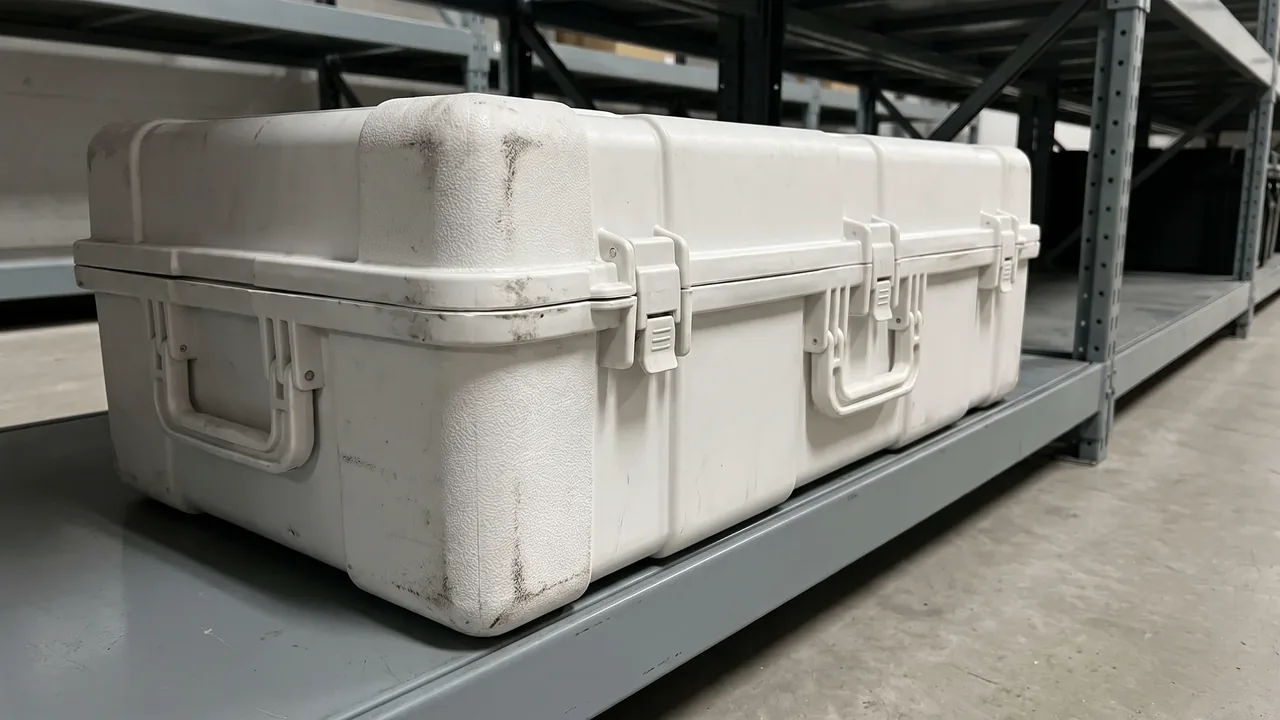
"Bullet box" is a heavily overused umbrella term. In real procurement, people describe a long-term ammunition storage box, a transit box built around logistics handling, and a compact Bullet Safety Box for short trips and controlled access as if they were the same product, then receive a case whose structure does not match its job. All three are boxes, yet their design goals, shell stiffness, sealing method, handling interface and compliance paperwork differ completely: the storage box solves stacking and long-term barrier protection while sitting still, the transit box solves repeated loading and vibration, and the safety box solves small quantity, short distance and controlled opening.
This article is written for procurement and equipment managers at ammunition dealers, law enforcement units and shooting ranges. It breaks down the differences between the three types of bullet storage box from a packaging-engineering standpoint, and gives selection guidance on shell material, lining, sealing, rust prevention, stacking, lifting, locks and traceability. JUNZHIJIA explains, from a manufacturer's viewpoint, why each feature is designed the way it is, so that readers can settle three questions before asking for a quotation: what goes in, how it moves, and who manages it. Note that this article discusses packaging containers only; for projects involving military trade or export, local regulations and export-control requirements prevail, and only the packaging container is discussed here.
Three Forms of Bullet Box: Storage Box, Transit Box and Safety Box
An ammunition storage box is defined by staying still for a long time. It serves warehouses, equipment rooms and fixed storage points, usually as a large-volume, multi-tier stackable case with independent compartments and a sealing structure. The emphasis is holding the internal environment steady over a long period and letting staff complete an inventory without opening the case. Because it is often loaded once and left alone, its design centre is compression resistance, barrier protection and clear marking, not the convenience of frequent opening.
A transit box is defined by always moving. It meets loading, stacking, vibration, repeated handling and even mid-route inspection, so the structure stresses shell rigidity, latch durability, handling interfaces and cushioning limits. Transit boxes usually carry forklift pockets or lifting points, and the lid-to-body locating structure must still compress the seal after many open-close cycles; their compartment design must also allow a quick spot check and fast reset rather than one long sealed closure.
A Bullet Safety Box is defined by controlled opening and small quantity. It appears most often in range issue, duty draw and short handover, is generally small in volume, and highlights single-hand carry, definite locking and a visible open-state indicator. It does not chase extreme stacking but the certainty of the lock and the recognisability of an opening trace: who opened it, and when, and whether a checkable mark was left, is the core value of this product class.
The boundaries are not absolute, and real projects often cross over, for example a medium storage box with forklift pockets that also travels. The simplest way to classify a bullet storage box is to ask three questions: how many times a year is it opened, does it leave the fixed storage point, and who is responsible for counting it.
How the Three Design Goals Differ
Putting the differences of the three types into one table makes procurement conversations far smoother. The table below compares their priorities across five dimensions and can serve as a starting point for a requirement description.
| Dimension | Ammunition storage box | Transit box | Bullet Safety Box |
|---|---|---|---|
| --- | --- | --- | --- |
| Core task | Long static storage and barrier | Repeated handling and vibration | Portability, short trips, locking |
| Shell priority | Compression and stacking | Rigidity and impact resistance | Low weight and grip |
| Sealing priority | Long-life seal | Tolerates repeated opening | Rain and dust protection |
| Handling interface | Forklift pockets, pallet seats | Forklift pockets, lifting points | Carrying handle, hang point |
| Management focus | Inventory and marking | Seals and handover | Opening trace |
The important point is that these three goals trade off against each other. A thicker wall for stacking raises dead weight and reduces portability; a thinner shell for portability weakens compression and drop resistance. There is no universal bullet storage box that does everything, only a specific design that converges once the intended use is stated clearly.
Shell Material: PP, ABS, PC and Metal Housings
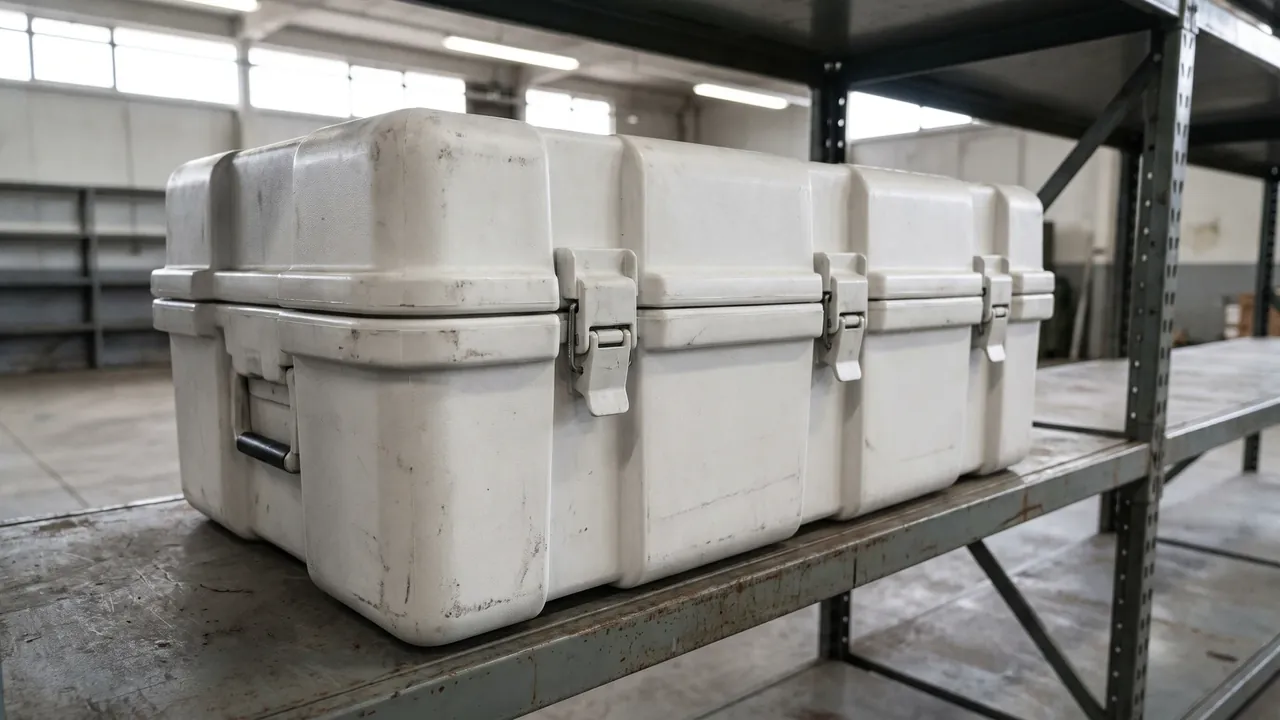
Shell material decides the stiffness, toughness, weather resistance and dead weight of the case, and it is the first fork in the selection path. Injection-moulded engineering plastics dominate today, commonly PP, ABS and PC, while metal housings in steel or aluminium retain value in specific settings.
PP, or polypropylene, offers good toughness, stable chemical and low-temperature performance and controllable cost, making it a common choice for storage and transit box bodies. Its weak points are modest surface hardness and gloss, so long ultraviolet exposure calls for weathering additives or shaded storage. ABS offers better hardness and surface feel, suited to branded delivery where appearance and silk-screen quality matter, though toughness and weathering are slightly below modified PP. PC, or polycarbonate, is known for high impact resistance and suits small safety boxes and transparent window parts, at the cost of higher price and notch sensitivity, so abrupt transitions and stress concentration must be avoided in design.
Metal housings bring high stiffness, strong compression resistance and heat tolerance, suited to heavy storage and fixed sites. The price is greater dead weight, easy paint chipping, a need for surface treatment in salt-spray environments, and attention to contact isolation from internal metal parts.
No material is inherently better, only better matched. Selection should first fix the weight ceiling, drop height requirement, service environment and appearance requirement, then balance material against wall thickness, rather than choosing a material first and justifying the use afterwards. For a cross-comparison of engineering plastics, see engineering plastic case materials compared.
Lining and Compartments: Turning a Box into a Management Unit
The lining and compartments are what turn a bullet storage box from a container into a management unit, and they are where the three product types diverge most easily. The lining does three jobs: cushioning, positioning and isolation. Cushioning absorbs drop and vibration energy, positioning stops contents shifting in transit, and isolation keeps separate zones from interfering with each other.
Common foam linings are EPE, EVA and IXPE. EPE is elastic, low-cost and easy to form, suited to large cavities where cushioning dominates; EVA is dense, can be precision-cut and holds dimensions well, suited to compartments needing accurate positioning; IXPE has a fine surface and even rebound, often used where appearance and feel matter. The three can be combined, for example an outer EPE layer for cushioning and an inner EVA layer for positioning. Compartment forms are generally three: fixed die-cut, removable dividers, and tear-out grid foam. Fixed die-cut is consistent and suits volume products; removable dividers are flexible and suit contents that change; tear-out foam suits small batches and the trial stage.
Compartment design must correspond to the packing list. Each cell maps to one category or batch, and the cell count and layout are frozen at the drawing stage so that later counting can match on opening. If a lining must serve several configurations, modular dividers let one case adapt by swapping inserts. For the trade-off between dividers and foam, see dividers versus foam, and for forming see custom foam insert process.
Sealing Rating and Pressure-Equalisation Valve: Reading IP Codes
Sealing is the basis for keeping a bullet storage box dry outdoors and in humid conditions. The industry describes dust and water resistance with the IP code of IEC 60529 and GB/T 4208, the first digit for solids and the second for liquids. IP65 means dust-tight and protected against water jets; IP67 means dust-tight and protected against short immersion. Two points matter when reading an IP code: it describes the whole case under specific test conditions, not one gasket parameter, and the two digits are read together, so a "6" for dust does not automatically bring a "7" for water.
The sealing result is decided by the whole case system: gasket section and material, groove dimensions and continuity, latch clamping force and count, and the parting line and moulding quality. A single latch often leaks where the centre lifts, while several evenly spaced latches compress the gasket to its working set. For a storage box that must seal long-term, gasket aging and rebound deserve attention, and periodic inspection matters more than a one-time choice.
A pressure-equalisation valve is a companion part of a sealed case. A well-sealed case develops a pressure difference across a temperature swing or altitude change; without a valve the lid may be hard to open, or the seal may be forced. The valve uses a waterproof breathable membrane to equalise pressure slowly while blocking liquid water. Note that it is not a drain: its job is pressure, not drainage, and its position should avoid possible pooling zones. For the practical limits of a waterproof rating, see ammo box waterproof rating explained, and for valve selection, see case pressure-equalisation valve.
VCI Rust Prevention and Barrier Packaging for Metal Parts
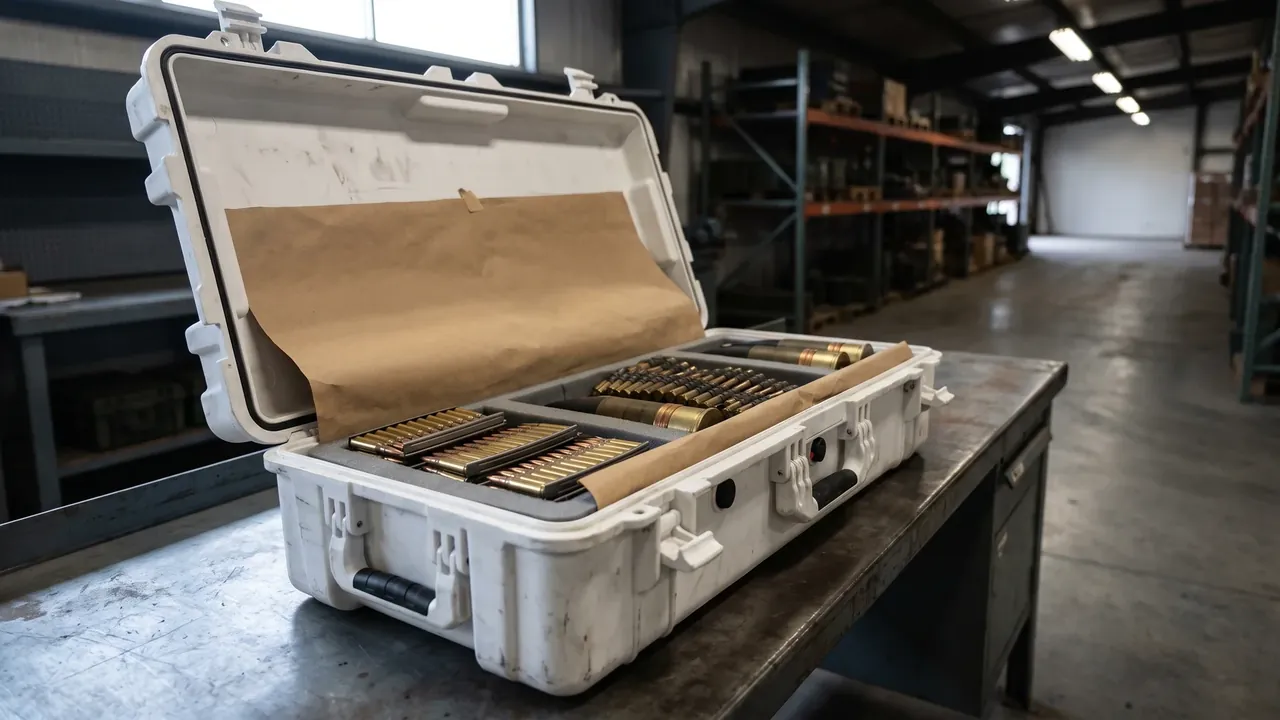
In long-term storage, the hardware, metal fittings and shipped tools inside the case also need protection. VCI, or vapour corrosion inhibitor, forms a protective layer on metal surfaces through volatile inhibiting compounds and is often used for rust prevention in enclosed spaces. VCI requires a relatively enclosed space and stable temperature, so it matches a sealed case naturally; if the case is open for long periods or the seal fails, VCI effectiveness drops noticeably.
Barrier packaging is another route. Aluminium-plastic film bags, vacuum bags or nitrogen-filled barrier bags separate the internal environment from the outside over long periods, suited to high-value or long-storage metal parts. Note that a barrier bag and a case seal work together rather than substituting for each other: however good the bag interior, if the case takes on moisture long-term, the bag surface itself becomes a place where moisture collects.
Either way, a humidity indicator card is worth adding so a manager can judge the internal state without opening the case. The card reading should enter a periodic checklist, and if it goes out of range, check the seal and latches first before replacing desiccant or rust-prevention consumables. For the pairing of sealing and rust prevention, see the importance of ammo storage box sealing.
Cushioning, Stacking and Palletisation
Cushioning and positioning solve the problem of movement, while stacking and palletisation solve the problem of pressure; together they decide how a case behaves in logistics. Cushioning spreads drop and impact energy into the shell and lining rather than letting contents take it directly; positioning keeps contents stable in the cell, so they cannot cross a divider and strike each other. Engineering practice often uses a cushion layer plus a confined cavity: the outer layer absorbs energy, the inner layer constrains position.
The core of stacking is transferring upper weight evenly to the lower layer rather than concentrating it at corners. A stackable case should have mating locating features so tiers do not shift, with corresponding load-bearing structures on base and top and a clear maximum tier count marked on the case. The tier count should follow case strength, contents weight and the storage environment, and be verified by a stacking test rather than estimated from experience.
Palletisation turns individual cases into a transport unit. Pallet size, case layout and restraint should be designed together: case dimensions should match the pallet module to cut voids, the pallet needs anti-slip and strapping, and edge protectors and stretch film can raise overall stability when needed. For cross-border batches, the pallet must also meet the destination's phytosanitary rules for wood packaging. For stacking and pallet planning, see case stackability and pallet planning, and for loading, see case shipping and loading precautions.
Lifting and Forklift Interfaces for Heavy Boxes
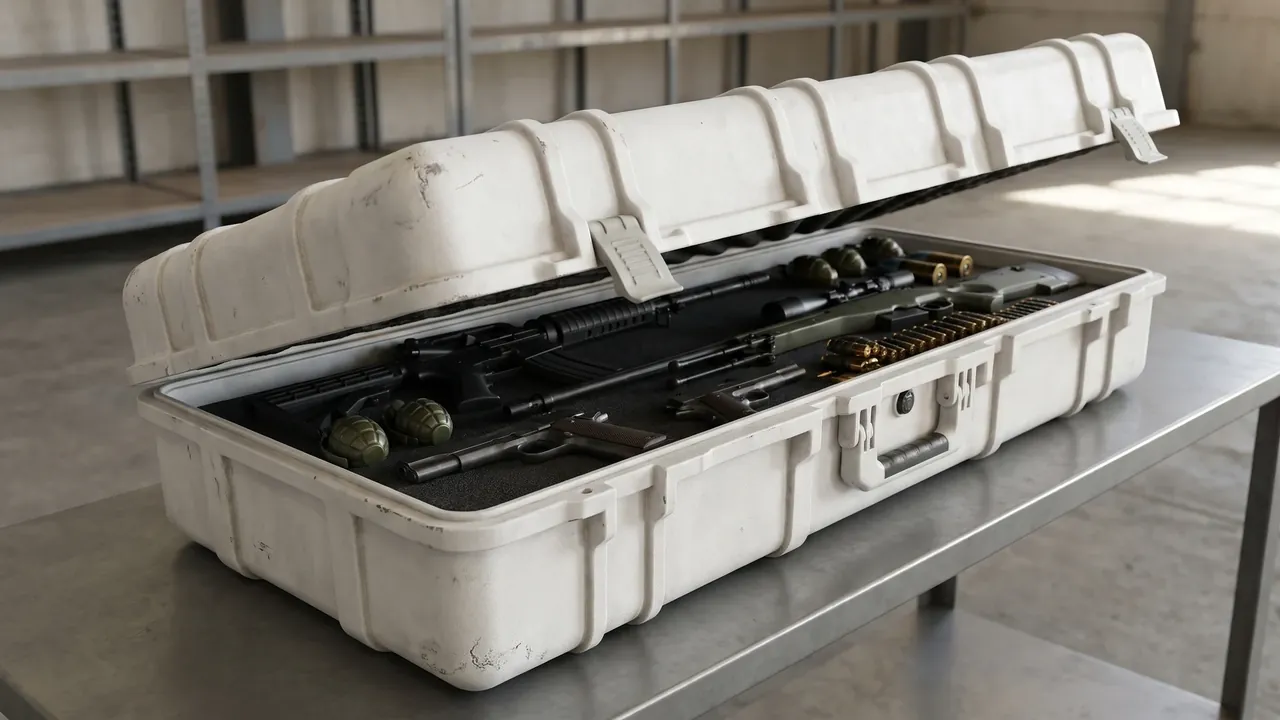
The handling risk of a heavy box is not the case itself but a human slip. To cut manual handling, storage and transit boxes usually need forklift pockets, lifting points or dedicated handles. Forklift pocket spacing and height should match common forklift specifications, and the pocket mouth should be reinforced so fork tines do not wear through the wall over time; lifting points should sit near the centre-of-gravity plane so the case stays level in a lift.
Handle design matters equally. A handle should sit near the centre of gravity and join the wall through through-bolts or a reinforced pad rather than relying on a single wall thickness; for cases that are heavy when full, two-sided or four-point handles are preferable, avoiding an offset single-person lift. For light products such as a safety box, the handle must also consider grip comfort and anti-slip design.
Handling interfaces must match the use scenario. Where a warehouse relies on forklifts, case height and pocket position should be optimised for pallet work; where vehicle loading is a person-machine mix, handle count and position come first. The handling method should be fixed at the design stage, not patched in after moulding.
Locks, Seals and Tamper-Evident Management
Locks and seals are the management core of a Bullet Safety Box and a transit box, and the focus of compliance inspection. The lock should be a scheme that withstands repeated opening and inspection, avoiding a single latch or a soft lock; where batch management is needed, use a uniform lock specification and keep a lock record for handover and accountability. Once locked, the case should have no hatch or side door openable by hand, so the locked state can be confirmed.
A seal answers the question of whether the contents were touched. A one-time seal cannot be restored after opening, so it shows whether contents were accessed without opening the case, which suits transport and handover. Tamper-evident management links the seal number, the issue record and the handover sheet into a closed loop; if the seal number does not match the record, treat it as an anomaly and pause the handover.
Note that the locking and sealing design serves safety and compliance, while final security depends on the user unit's management system. For selection, compare with ammo box lock selection, and for custom options see case lock customisation options.
RFID and QR Traceability: Asset Management in Batch Delivery
Once case counts rise into the dozens or hundreds, copying numbers by hand becomes a bottleneck fast, so a traceability system should be designed in advance. A common two-level scheme is an external QR code plus internal RFID: the external code carries a unique number for quick manual scanning, while RFID tags inside the case or at pallet level support batch reading for stock counts and automated sorting.
The key to traceability is not the tag but the numbering rule and data fields. The rule should be frozen at first-article approval, containing product model, batch, production date and serial number, and stay consistent across later deliveries; data fields should cover case number, owning unit, content category, seal number and handover record, so any query can reconstruct the whole process. Tag fixing must consider weather and abrasion: for outdoor cases, use weather-resistant material and avoid corners that are easily struck.
For dealers and law enforcement, traceability also sharply cuts handover cost. With unified numbers and QR codes, counting moves from opening every case to scanning first and verifying second, and only data anomalies require an actual opening. For traceability schemes, see case asset QR-code tracking and case labelling and asset tracking.
MIL-STD-810H and GJB Testing: Writing the Tender Document
Tenders and government procurement often require products to pass specific test standards, and common bases for bullet box projects include MIL-STD-810H and the GJB series. Understanding what these standards do is what allows them to be written into a technical document correctly, rather than lumped into a vague "meets military standard".
MIL-STD-810H is a standard for environmental engineering considerations and laboratory test methods; it provides a method framework, not a single pass line. Whether the same product "passes" depends on the combination of test item, severity level and criteria. The technical document should therefore state the method number and test conditions, for example the specific method number, temperature range, vibration spectrum or drop height, together with the criteria. The GJB series is the domestic military standard system and connects more closely to equipment testing and acceptance; when cited, the standard number and specific clause should also be given, avoiding a bare "meets GJB".
When writing a tender, use a four-part description of item, method, condition and criterion, and require the bidder to supply original test reports or a verifiable number. It should be stated honestly that any test verifies behaviour under given conditions and cannot be converted directly into an absolute guarantee for all real logistics. For a general approach to military-standard compliance, see MIL-STD-810H case compliance and GJB military standard cases.
UN Packaging and Export Certification: A Cross-Border Checklist
A bullet storage box crossing a border needs a whole set of packaging documents beyond the product itself. International transport sets classification and marking requirements for dangerous goods packaging, and UN packaging marks and codes describe the category and performance level of a container; export projects may also involve destination certification and labelling rules for imported containers. These requirements vary with category, transport mode and destination, so the user unit should confirm them against its own qualifications and regulations; this article only lists the materials needed from the container side.
From the container maker's side, the materials usually available include shell material certificates, sealing-rating test reports, stacking and drop test records, lock specifications and a compartment configuration table. If a project involves military trade or export control, the corresponding procedures must be handled under local regulations and export-control requirements. Collecting these materials into a file at first-article approval significantly reduces later customs and shipping friction.
Transport test bases usually fall into three groups: whole-case performance testing such as the ISTA series, domestic transport package test methods such as the GB/T 4857 series, and distribution cycle testing such as ASTM D4169. Their applicable scenarios differ, and the choice should match the actual logistics route. For export certification and transport packaging specifics, see ammo transport box certifications, US import case certifications and cross-border case logistics guide.
Buyer Perspectives: Dealers, Law Enforcement Units and Ranges
Ammunition dealers, law enforcement units and ranges want different things from the same bullet storage box, and stating the differences before purchase avoids a case that matches the specification sheet but works poorly in practice.
A dealer cares about batch consistency and brand. Batch means dimensional tolerance, colour consistency and a numbering rule must be stable, or mixed batches look chaotic on a shelf; brand means silk-screen, nameplate and packaging notes must be unified, and the case itself must carry the brand image. Dealers also often need stackable display and easy pallet dispatch, so the fit between case dimensions and the pallet module is a key metric.
A law enforcement unit cares about management and compliance. Cases need unified numbering, seals and handover records, locks must withstand inspection, and the traceability system must support accountability. For this customer, product value lies less in shell strength than in every case being traceable. Procurement should ask the supplier for a complete numbering rule and document template.
A range cares about turnaround and capacity. A range issues and returns frequently, so cases must open easily, compartments must be obvious at a glance, and the handle-to-weight ratio must suit repeated carrying; capacity should match the usual batch. For capacity planning, see 50 cal ammo box capacity, and for how these differ from ordinary boxes, see military ammo box versus ordinary box. Whichever customer is served, container design should follow the real turnaround method, not the catalogue parameter.
Frequently Asked Questions (FAQ)
Q: What is the most fundamental difference between a storage box, a transit box and a Bullet Safety Box?
A: The most fundamental difference is opening frequency and whether the case leaves its fixed storage point. An ammunition storage box is loaded once and left still, so its design centre is compression resistance, stacking and long-life barrier protection; it tends to be large and thick-walled, and inventory relies on external markings rather than frequent opening. A transit box is always in turnaround and meets repeated opening, vibration and multiple handlings, so it stresses latch durability, handling interfaces and cushioning limits. A Bullet Safety Box serves small-quantity, short-distance and duty issue, so it highlights portability, a definite locked state and a recognisable opening trace. The three are not a matter of capacity but of use pattern. In practice the consequences of mixing them up are concrete: a storage box pressed into transit duty wears its latches quickly and stops sealing, while a safety box used as a store is opened far more often than its lock and gasket were designed for. Classifying a case is simple. Ask how often it is opened, whether it leaves the fixed point, and who counts it; those three answers settle the category and prevent buying a case whose structure does not match the real workflow.
Q: When choosing a box, should material or structure be decided first?
A: Decide the use and turnaround pattern first, then structure and material. Material serves a structural goal, and the structural goal comes from the use: if the case will be stacked for a long time, fix the tier count and load requirement first, then choose wall thickness, ribs and material; if it will be carried repeatedly, fix the single-lift weight and handle form first, then decide how light the shell can be. Choosing material first often forces rework later when dead weight or strength turns out wrong, because the same plastic can be a good or poor choice depending on thickness and rib layout. In practice, write a one-page requirement note covering content category, box weight, turnaround frequency, storage environment, handling method and compliance needs, then discuss structure and material with the supplier. A useful next step is to agree which requirements are fixed and which are targets, so the supplier can propose an alternative wherever two goals conflict. After the structure is set, verify with a sample through stacking, vibration, drop and sealing tests to confirm the design boundary, keeping the risk at the sample stage rather than in volume production.
Q: Is an IP67 box always better than IP65 for ammunition?
A: Not necessarily; it depends on whether the scenario needs short immersion. IP65 means dust-tight and protected against water jets, IP67 means dust-tight and protected against short immersion; both protect equally against dust and differ in water tolerance. If the case is used only in outdoor rain or spray, IP65 is enough; if it may sit in standing water or be dropped in water, choose IP67. More importantly, the rating describes the whole case under specific test conditions, while the real sealing result is decided by gasket material, groove dimensions, latch clamping force and moulding quality. A single-latch case can leak away from the latch point even when marked with a high rating, because the gasket is only pressed near the latch and lifts elsewhere. Compare options by checking the sealing design and latch count instead of the number alone, and do not overlook whether the groove is continuous through the corners, since a bridged or pinched corner is where a sealed case most often fails first. For a case that is opened often, the more useful question is how the seal survives hundreds of cycles, not how deep it can go once.
Q: Should the lining foam be EPE, EVA or IXPE?
A: The three suit different priorities. EPE is elastic, low-cost and easy to form, suited to large cavities where cushioning dominates; EVA is dense, dimensionally stable and precision-millable, suited to compartments needing accurate positioning; IXPE has a fine surface and even rebound, suited where appearance and feel matter. Real projects often use a combination, for example an outer EPE layer for cushioning and an inner EVA layer for positioning, balancing cost and precision. Start by naming the lining's main job: absorbing drop energy, constraining position, or isolating zones. If cushioning dominates, prefer EPE; if positioning dominates, prefer EVA; if contents change, choose removable dividers rather than fixed die-cut so one case can serve several configurations. Material choice also affects the drawing, because a foam with low compression set holds a cut pocket shape over years while a soft foam slowly relaxes and lets contents move. Once the material is chosen, verify closed-cell ratio and durability so the lining does not collapse in long service and lose both cushioning and positioning at the same time, and keep a sample of the approved foam for later comparison.
Q: Is a pressure-equalisation valve necessary?
A: It depends on whether the case meets noticeable temperature or altitude swings, and whether it must stay sealed long-term. A well-sealed case develops a pressure difference across a temperature swing or altitude change; without a valve the lid may be hard to open, or the seal may be forced. For cases that cross climate zones, travel by air, or sit long-term in a temperature-changing environment, a valve helps keep the seal effective over the long run. Conversely, if a case is used only in a constant-temperature room and is opened frequently, the pressure difference is limited and a valve can be omitted. Note that the valve equalises pressure slowly through a waterproof breathable membrane; its job is pressure, not drainage, so avoid positioning it in a possible pooling zone. It also needs protection from paint and dust during finishing, because a blocked membrane stops working and the case then behaves as if it had no valve at all. No single protective part replaces the sealing and latch design of the whole case, and the valve only addresses pressure difference.
Q: How should the traceability numbering for a bullet storage box be designed?
A: Freeze the numbering rule at first-article approval and keep it consistent across all later deliveries, so that different batches do not each invent their own. A practical rule contains four segments: product model, production batch, production date and serial number; the front segments allow grouping by model and the last guarantees uniqueness of each unit. Put the QR code on the outside for quick manual scanning; where batch counting is needed, add RFID tags inside the case or at pallet level for batch reading. Data fields should cover case number, owning unit, content category, seal number and handover record, so any query can reconstruct the whole process. Fix the tag for weather and abrasion resistance; outdoor cases should use weather-resistant material and avoid corners that are easily struck, so long-term readability is preserved and a lost tag does not break the entire traceability chain at once. It also helps to print the human-readable number beside the code, so the record survives a scanner failure or a scratched label during a busy handover.
Q: Is it enough to write "meets military standard" in a tender?
A: Usually not. MIL-STD-810H provides a framework of environmental test methods, not one uniform pass line; whether a product passes depends on the combination of test item, severity level and criteria. The technical document should therefore state the method number and specific test conditions, such as method number, temperature range, vibration spectrum or drop height, with clear criteria. The GJB series is the domestic military standard system, and when cited the standard number and specific clause should also be given. A four-part description of item, method, condition and criterion is recommended, together with a requirement for original test reports or a verifiable number. It should be stated honestly that any test verifies behaviour under given conditions and cannot be converted directly into an absolute guarantee for all real logistics; procurement should set requirements against the actual storage and transport route and place the test records into acceptance documents. A short comparison table of the offered methods and their severity levels also makes bid evaluation faster and reduces the chance of two suppliers quoting against subtly different conditions.
Q: How should the handling interfaces of a heavy box be planned?
A: Handling interfaces must match the actual handling method rather than being added after moulding. Where a warehouse works mainly with forklifts, provide forklift pockets whose spacing and height match common forklift specifications, with a reinforced mouth so tines do not wear through the wall in long contact. Where vehicle loading is a person-machine mix, prioritise two-sided or four-point handles positioned near the centre of gravity and joined to the wall through through-bolts or a reinforced pad, avoiding load on a single wall thickness. A lifting scenario also needs lifting points near the centre-of-gravity plane so the case stays level in a lift. Settle who carries what at the design stage, validate full-load carrying by test, and keep every interface clear of the seal line so a handle never interrupts the sealing path.
Conclusion and Related Reading
An ammunition storage box, a transit box and a Bullet Safety Box differ because three use patterns make three demands: static storage asks for compression resistance and barrier life, turnaround asks for rigidity, issue asks for portability and controlled opening. Settle the pattern first and material, lining, sealing and traceability converge. Validate full-load carrying by test and buy for the duty. JUNZHIJIA, produced by Kexin New Materials (Guangdong) Co., Ltd., customises structure, lining, locks and marking from the drawing stage.
Related Reading