

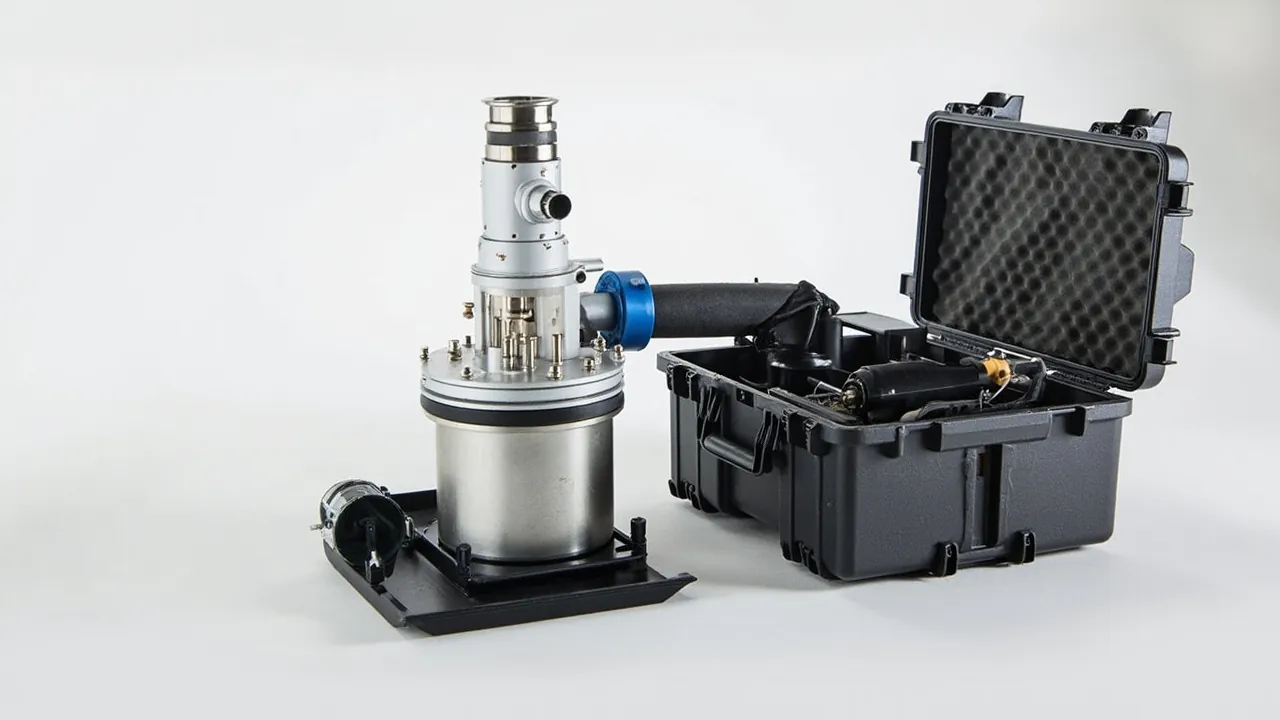
Mill components and conveyor components in cement and building-material production lines work continuously in high dust, strong abrasion and open or semi-open storage. The primary threat to these spares during transport and storage is not loss of precision but dust ingress, moisture corrosion, heavy-load impact and open-air stacking deformation. The selection logic for cement equipment parts cases must therefore follow three threads: ingress protection class, load-bearing structure and weathering life — not the logic of a precision instrument case. What separates a cement plant from a ceramics or stone plant is the quantity and chemistry of the airborne particulate: cement dust is generated in large volumes over long periods, spans a wide particle-size distribution, and is distinctly alkaline, corroding metal, accelerating seal ageing and abrading mating faces. A spare-parts case left in an open plant stockyard for six months without targeted dust and weather protection is typically found on opening to contain a layer of secondary dust and threads that have already seized.
The pain points are highly characteristic. Ball mill liners and grinding media are high-manganese steel or alloy cast-iron castings: heavy, irregularly shaped and sharp-edged. Packed in ordinary timber crates or woven bags, they arrive after a long road journey with broken case bases, chipped liner corners and deformed bolt holes. Vertical mill rollers and roller press tyres are high-value precision heavy items; without rigid location, transport vibration damages bearing seats. Conveyor belts travel in rolls and must not be compressed, creased or allowed to absorb moisture and mould — and local deformation from stacking cannot be recovered. Idlers and water-cooled conveyor components are numerous and easily knocked; bulk shipping produces a high damage rate. Gearboxes and large bearings are precision items where dust ingress causes early wear. Cement plants also widely practise open-air spare-parts storage, so cases must tolerate ultraviolet radiation, rain and temperature swings over years — a weathering requirement higher than for general industrial packaging.
This article sets out protection logic in the order of mill components, conveyor components and drive components, focusing on four schemes: high-dust sealing, material compatibility with alkaline dust, heavy-load load bearing, and long-term weathering. It includes material selection tables, a method for determining sealing class, transport test items and acceptance criteria. JUNZHJIA serves cement machinery manufacturers, building-material equipment companies and cement plants with dust-proof heavy-duty case design, weathering material schemes, custom inserts and OEM/ODM volume delivery, manufactured and shipped worldwide by Kexin New Materials (Guangdong) Co., Ltd.
Table of Contents
- 1. Why Cement and Building-Material Parts Need Dust-Proof Cases
- 2. Logistics Risk Profile: Dust, Heavy Load and Open Storage
- 3. Protecting Mill Components: Liners, Grinding Media and Diaphragms
- 4. Roller Press and Vertical Mill Parts: Tyres, Table Liners, Cylinders
- 5. Protecting Conveyor Components: Belts, Idlers, Chains and Buckets
- 6. Protecting Drive Components: Girth Gears, Gearboxes and Bearings
- 7. Sealing Class in High-Dust Environments: IEC 60529 and GB/T 4208
- 8. Alkalinity and Abrasiveness: Matching Materials Chemically
- 9. Heavy Load and Lifting: Case Structure, Lifting Points and Stacking
- 10. Custom Inserts: Large Castings Versus Long Bar Components
- 11. Moisture, Rust and Open-Air Storage Schemes
- 12. Transport Testing: ISTA, GB/T 4857 and ASTM D4169
- 13. Marking, Spare Traceability and Maintenance Plan Alignment
- 14. Procurement Acceptance, AQL and Specification Selection Table
- Frequently Asked Questions
- Conclusion & Related Reading
1. Why Cement and Building-Material Parts Need Dust-Proof Cases
Cement industry equipment management has a distinctive characteristic: short maintenance windows and a high requirement for spare availability. When a rotary kiln, mill or clinker cooler stops, the entire line's output falls to zero immediately, and starting and stopping a cement kiln is expensive in terms of heating curves, refractory thermal stress and clinker quality variation. Cement plants therefore run planned maintenance programmes in which spares must be in place and serviceable before the window opens. That means a spare may sit in the warehouse for months and still have to be installable straight out of the case.
Dust damage is continuous and gradual. Cement dust deposits continuously on case surfaces and in gaps; once inside, it settles on shafts, bores, threads and bearing seats. For large castings the effect is limited, but for gearboxes, bearings, hydraulic cylinders and sensors, its abrasive action causes rapid wear and leakage after installation. Cement dust frequently contains free lime and other alkaline constituents; once damp, it creates an alkaline environment that visibly corrodes aluminium, accelerates steel corrosion and speeds the ageing of ordinary rubber seals.
Open storage is the other reality. Site layout constraints mean many case and rack positions sit in open stockyards or under semi-open shelters. The case must then tolerate long-term ultraviolet exposure, which causes polymer chain scission in plastics and shows as surface chalking, colour fading and reduced impact strength; diurnal and seasonal temperature swings, which cause repeated expansion and contraction and internal condensation; rain and ground moisture, which cause metal corrosion; and dust deposition, which clogs seal channels. Cement industry cases must therefore be assessed in terms of years of service life rather than number of trips, making material weathering a key selection parameter.
In summary, the three core requirements for cement and building-material parts cases are effective dust sealing starting at IP6X, sufficient load-bearing and lifting capability for heavy castings, and excellent weathering and chemical resistance for open storage and alkaline dust. Missing any one of these shows up within six to twelve months. A general selection framework is set out in Instrument case selection guide.
2. Logistics Risk Profile: Dust, Heavy Load and Open Storage
Cement plant spare logistics has a more complex structure than most industries: frequent short in-plant moves, long inter-provincial or international shipments, and an intermediate state of long-term open-air storage.
| Chain stage | Dominant stress | Typical consequence | Protection focus |
|---|---|---|---|
| --- | --- | --- | --- |
| In-plant forklift and crane transfer | Heavy impact, local point load | Broken base, collapsed insert | Reinforced base, defined lifting points |
| Long-distance road and rail | Sustained low-frequency vibration, occasional large shock | Casting displacement, precision part loosening | One part per compartment, rigid restraint |
| Long-term open storage | UV, temperature swing, rain, dust | Case ageing, seal failure, corrosion | Weathering materials, UV stabilisers, seal durability |
| Use in high-dust workshops | Alkaline fine dust, static | Mating-face abrasion, contact contamination | IP6X sealing, cleanable seal channels |
| Overseas project shipments | Sea-freight humidity, repeated handling, stacking | Condensation, case deformation, lost marking | Sealing plus desiccant plus stacking strength |
The effect of open storage deserves emphasis. Outdoors, a case faces not a single stress but a combination. Ultraviolet radiation breaks polymer chains at the surface, producing chalking, colour fade and reduced impact strength. Temperature swings make the trapped air expand and contract repeatedly; with good sealing this creates alternating positive and negative pressure, and with poor sealing it draws moisture in. Dust accumulates in the seal channel and combines with rain into a paste that accelerates gasket wear. Layered together, these three can visibly age within two years a case that would last five years indoors.
Another underestimated risk is lifting operations. Heavy cement spares generally depend on overhead cranes, mobile cranes or forklifts, and poorly positioned lifting points cause local crushing of the case. Improvised on-site slinging is a leading cause of dropped components and injuries. The lifting scheme must therefore be fixed at the design stage: lifting point positions, permitted sling angle range, maximum lifting load and whether dedicated lifting gear is required.
One further management risk is spares becoming disconnected from the maintenance plan. Cement plant spares often arrive in batches matching a maintenance programme, and if marking is unclear and batches are mixed, the site cannot find the right part within a limited window — leaving the situation where the spare is in the warehouse but the machine still cannot be repaired. This is addressed by the marking and traceability system in Section 13.
3. Protecting Mill Components: Liners, Grinding Media and Diaphragms
The mill is the core equipment of a cement line, and its spares are heavy, large, hard and numerous.
Shell liners, including lifting liners, classifying liners and end liners, are typically high-manganese steel, alloy steel or high-chromium cast iron, with individual weights from tens to hundreds of kilograms. Failures concentrate in three places: edge chipping, since the liner edge and bolt holes are the most vulnerable features; bolt hole deformation, which after compression makes installation difficult; and working-surface impact damage, since a corrugated or stepped working face that is damaged reduces material lifting efficiency. The protection points are edge and hole protection, one part per compartment, no stacking, and a reinforced base to take concentrated loads.
Grinding media — steel balls and cylpebs — are a classic heavy, small, numerous item; a single case may carry several hundred kilograms to over a tonne. Their packaging requirement is direct: the base must withstand very high surface loading without permanent deformation. Piled balls apply an approximately uniform heavy load to the base, and insufficient base stiffness produces slow creep and settlement. Because balls are numerous and regularly shaped, packing efficiency is high, making a large-capacity heavy-duty case with dividers suitable; compartment by specification (for example 60 mm, 80 mm, 100 mm) so that on-site retrieval follows the charge grading.
Diaphragms, grate plates and discharge grates are perforated plate items whose hole accuracy directly affects material throughput. Protection focuses on hole protection and plate flatness: large flat support surfaces, no loading at holes, and soft spacer pads between plates.
Trunnions, mill head liners and feed and discharge assemblies are large precision heavy items with bearing seats and mating faces. Their requirements are the highest: mating faces need rigid support or soft isolation, bearing seats need dust protection because cement dust entering a bearing seat causes severe wear, and lifting must use dedicated gear.
| Mill component | Main failure mode | Protection strategy | Key prohibition |
|---|---|---|---|
| --- | --- | --- | --- |
| Shell liners | Edge chipping, hole deformation | One part per compartment, hole protection, soft edge isolation | No stacking, no bulk shipping |
| Grinding media | Base creep, grade mixing | Large heavy-duty case plus divider compartments | No unreinforced base, no mixed grades |
| Diaphragms and grates | Hole damage, plate deformation | Large flat support, soft pad isolation | No point support, no compression |
| Trunnions and liners | Bearing seat damage, mating-face corrosion | Rigid support, dust protection, corrosion treatment | No load on mating faces |
| Discharge assemblies | Deformation, internal dust accumulation | Shape support, sealed cavities | No open shipping |
An important engineering recommendation for mill components: inspect and record bolt holes and mating faces before packing. If a deformed hole on a liner or grate, or a scratch on a trunnion bearing seat, is only discovered on site, installation fails and the part must return to the works — a loss far larger than the packaging cost. Recording dispatch condition clarifies responsibility and surfaces transport scheme defects early.
4. Roller Press and Vertical Mill Parts: Tyres, Table Liners, Cylinders
The roller press and vertical roller mill are key grinding equipment in modern dry-process cement lines. Their spares are high in value and precision, often involve hydraulic systems, and require a noticeably higher protection class than ordinary mill components.
Roller press tyres and shafts are classic heavy-plus-precision combinations. The tyre surface carries a hardfacing overlay or inserted tungsten-carbide studs, and working-face accuracy and surface integrity directly determine grinding performance and service life. Failure risks include working-face impact damage, which causes uneven compression; bearing seat damage, which causes vibration and temperature rise; and mating-face corrosion. Protection points: soft protection of the working face with no load on it; rigid support and dust protection at bearing seats; overall corrosion protection; and a case load capacity calculated from actual weight with margin.
Vertical mill rollers and table liners are also high-value heavy items. Rollers are usually cast or hardfaced, conical or cylindrical, with a pronounced offset centre of gravity that makes them prone to rolling. Protection focuses on support shaped to the actual attitude, restraint against rolling, and protection of the wear face and mounting face. Table liners are curved plate items assembled in segments, so curved-surface protection and position numbering matter — liners for different positions may differ in shape, and mixing them causes installation problems on site.
Hydraulic cylinders and power unit components are precision items with closely fitted barrels, piston rods and seals, vulnerable to dust, impact and coating damage on the rod. The piston rod is the weakest feature: once the coating is scratched or dented, seal failure and leakage follow. Recommendations: a rigid protective sleeve over the rod; dust caps and plugs on hydraulic ports; oil ports facing upward so leakage cannot contaminate the insert; and dedicated cavities with no contact with other parts.
Separator and classifier components include rotors, blades and wear liners. Blades are thin plate items prone to deformation; rotors are precision items needing rigid support.
| Roller press / vertical mill part | Main failure mode | Protection strategy | Key prohibition |
|---|---|---|---|
| --- | --- | --- | --- |
| Tyres and shafts | Working-face damage, bearing seat damage | Soft working-face protection, rigid bearing support | No load on working face, no rolling |
| Vertical mill rollers | Wear-face damage, rolling from offset centre | Contoured support, rolling restraint | No unrestrained placement |
| Table liners | Curved-surface deformation, position mixing | Curved support, position numbering | No mixing positions |
| Hydraulic cylinders | Rod coating damage, dust ingress | Rod sleeve, port sealing | No load on rod, no sun exposure |
| Separator blades and rotors | Blade deformation, rotor misalignment | Flat support, rigid location | No local loading of blades |
One further recommendation for roller press and vertical mill parts: separate hydraulic items from castings. A hydraulic cylinder and a large casting differ greatly in mass, and in a shared case the casting's relative movement becomes an impact source against the cylinder. Hydraulic items are also extremely dust-sensitive, and sharing with dusty castings increases contamination risk. See Removable divider system for cases.
5. Protecting Conveyor Components: Belts, Idlers, Chains and Buckets
Conveying systems run throughout a cement plant, from raw material crushing to clinker transport and cement dispatch, so conveyor components are numerous and replaced often.
Conveyor belts are the classic item that must not be compressed, creased or dampened. When shipped in rolls, the main risks are core crushing from heavy pressure or long stacking, which deforms the roll; creasing from too small a radius or folding, which creates permanent marks that cause belt misalignment; moisture and mould, since fabric-carcass belts lose strength after absorbing water and the rubber and fabric layers may separate; and ultraviolet ageing, which accelerates in open storage. The scheme: fix the roll on a dedicated vertical or horizontal support; add a core support to maintain roundness; keep the coiling radius above specification; wrap the whole roll in moisture-barrier material with desiccant; avoid stacking other loads directly on the roll; and provide shade if stored outdoors.
Idlers are extremely numerous, inexpensive individually, but have a high damage rate. The failure points are the bearing and the seal: cement dust entering an idler bearing rapidly causes seizure. Transport protection focuses on preventing impact that deforms the tube and damages the seal. A multi-position insert or divider grid keeps idlers from touching each other; shaft ends are protected individually; and the case is dust-sealed so no dust enters in transit.
Chains and bucket elevator chains are heavy items vulnerable to moisture corrosion and link deformation. Fix individually or in groups, apply corrosion-inhibiting grease, and include desiccant.
Bucket elevator buckets and chain assemblies are plate or chain items with irregular shapes and sharp edges. Compartment and separate them to avoid scratching, with soft protection on bucket edges.
| Conveyor component | Main failure mode | Protection strategy | Key prohibition |
|---|---|---|---|
| --- | --- | --- | --- |
| Conveyor belt (rolled) | Core deformation, creasing, moisture | Core support, moisture wrap, shade | No heavy stacking, no folding |
| Idlers | Tube deformation, bearing dust ingress | Multi-position separation, shaft-end protection, dust sealing | No bulk mixed shipping, no impact |
| Chains and elevator chains | Corrosion, link deformation | Group fixing, corrosion grease, desiccant | No open rain exposure |
| Elevator buckets | Edge scratching, plate deformation | Compartmenting, soft edge protection | No edge-to-edge contact |
| Belt accessories and cleaners | Rubber ageing, metal corrosion | Moisture sealing, avoid compression | No long-term compression set |
Roll core support is the point in this section most worth expanding. If a belt roll lies on its side under other cargo, the core is pressed into an ellipse, and when unwound the belt shows periodic misalignment that cannot be corrected on site. The correct approach is a dedicated roll support, in metal or high-density plastic, that engages the roll's inner diameter so that the weight is carried by the core rather than the outer wraps. Alternatively, a horizontal cradle carries the roll evenly along its length. Either way, stacking other loads directly on the roll is not permitted.
6. Protecting Drive Components: Girth Gears, Gearboxes and Bearings
Drive components are the most precise and most dust-sensitive spare category in cement equipment, with protection requirements approaching those of precision instruments.
Mill girth gears and pinions are very large precision items, usually split in halves, with diameters reaching several metres. Tooth accuracy directly determines transmission smoothness and noise. Protection points: the tooth flanks must have soft protection and must not suffer impact contact; the split faces must have rigid support to prevent distortion; and the whole assembly requires dedicated fixturing. Given their size and weight, these items are usually packed and shipped to a bespoke scheme developed alongside the lifting plan.
Gearboxes are among the most critical drive spares in a cement plant, containing precision gears and bearings and extremely sensitive to dust. Main risks: cantilever bending moment at the input and output shafts, as with many equipment types already discussed; dust entering the shaft extension; moisture drawn in through the breather; and seal damage. Protection points: rigid protection and a dust cap on the shaft extension; temporary sealing of the breather; overall corrosion protection; a dust-sealed case; and no cantilever load in transit.
Large bearings, including main and support roller bearings, are high-precision items vulnerable to dust, moisture and impact brinelling. Once a raceway brinell mark forms, the bearing produces vibration and noise after installation and fails rapidly. Protection points: retain the original packaging or equivalent moisture and static protection; dedicated cavities with no compression; desiccant inside; and a high sealing class.
Couplings and drive shafts are medium-sized items where keyways, splines and mating faces are the focus.
Rule of thumb: in cement industry practice, a significant share of early gearbox and large-bearing failures is linked to dust ingress and moisture during transport and storage. Retaining original packaging, a high-class dust-sealed case and desiccant are the three lowest-cost protection actions available.
Drive components also warrant a higher case sealing class than other parts. Because they are the most dust-sensitive, they should have their own case or an independent sealed cavity, and should not share with liners, grinding balls or other strong dust sources. See Choosing seal materials for protective cases and Toolbox hinges, latches and sealing structure.
7. Sealing Class in High-Dust Environments: IEC 60529 and GB/T 4208
Sealing class is the most critical and most often misunderstood parameter in cement industry case selection. IEC 60529, and its Chinese equivalent GB/T 4208, define dust protection at level 5 (dust protected, limited ingress permitted that must not interfere with operation) and level 6 (dust tight, no ingress). Cement plants combine high dust concentration, continuous generation and particles that are less hard than stone dust but alkaline, so IP6X is the correct choice.
Four high-frequency misconceptions must be cleared up:
- The two digits mean different things: the first covers solid foreign objects, the second covers water. IP65 means dust level 6 plus water level 5 (jetting); IP67 means dust level 6 plus water level 7 (temporary immersion). Dust performance is identical.
- IP6X is not waterproof. Open cement stockyards see rain, so the second digit must reflect that: IP65 or better for rain exposure, and IP67 where standing water immersion is possible.
- A rating describes the as-delivered condition. Gaskets degrade with opening cycles, ageing and dust accumulation, so long-term performance depends on whether the seal is cleanable and replaceable.
- A high rating does not mean good weathering. IP ratings assess dust and water only, not UV resistance, temperature tolerance or mechanical strength. Open-air use requires separate assessment of material weathering.
The seal failure mechanism in cement resembles ceramics and stone but is harsher. Dust first deposits at the root of the seal channel; each closure presses it into the sealing face and gradually forms micro-channels. Meanwhile alkaline dust and rain form a paste that accelerates gasket ageing. Selection should therefore examine whether the seal channel is easy to clean in terms of width, depth and absence of dead corners; whether the gasket is replaceable; whether the latches distribute pressure evenly around the perimeter; and whether the hinges can keep the lid from sagging under sustained heavy load.
On pressure equalisation valves, a case stored outdoors in a cement plant experiences pronounced differential pressure across a diurnal cycle. With good sealing, alternating positive and negative pressure makes the case hard to open or imposes extra stress on the gasket. A valve with a hydrophobic breathable membrane equalises pressure while blocking liquid water and dust; see How a case pressure equalisation valve works. A full explanation of water protection is in Waterproof cases and IP ratings explained.
Daily maintenance: brush dust out of the seal channel before each closure; avoid solvent wiping of rubber parts; inspect quarterly for hardening, cracking or permanent compression set; and run a full-perimeter contact check every six months. Because cement dust conditions are harsh, inspection intervals should be one step shorter than in general industries. Methods are covered in How to clean and maintain a protective case.
8. Alkalinity and Abrasiveness: Matching Materials Chemically
Cement dust is not only abrasive but chemically active, and that makes material selection a distinct consideration in this industry.
Source and effect of alkalinity. Cement clinker and cement dust contain free lime and other alkaline constituents. Once in contact with water or moisture they form an alkaline solution of calcium hydroxide. This environment: corrodes aluminium and aluminium alloys, producing a white, blistered surface and weight loss; accelerates steel corrosion, especially where chlorides are also present; accelerates ageing in ordinary nitrile and natural rubber gaskets; and hydrolyses polyester fibres and some coatings.
Material matching recommendations:
| Contact area | Risk | Recommended direction | To avoid |
|---|---|---|---|
| --- | --- | --- | --- |
| Case body | Long-term alkaline contact, UV ageing | HDPE, PP (excellent alkali resistance) | Ordinary ABS for prolonged outdoor use |
| Gasket | Accelerated alkaline ageing | EPDM, silicone | Natural rubber, ordinary nitrile |
| Insert | Alkaline dust adhesion, cleaning | Closed-cell PE, EVA, EPP | Open-cell hygroscopic foam |
| Metal parts (bolts, hinge cores, plates) | Corrosion | Stainless steel, or galvanised plus coating | Untreated carbon steel |
| Marking | Alkaline attack, detachment | In-mould label, engraving, weather-resistant print | Ordinary adhesive labels |
| Desiccant packaging | Bag rupture and contamination | Alkali-resistant breathable film | Low-grade paper packaging |
On flammability, boundaries matter. UL94 is a material-level flammability classification for plastics, with ratings including HB, V-0, V-1 and V-2. Cement plants carry fire risks from coal grinding, waste-heat power generation and welding during maintenance, so where a case will be stored long-term in a coal mill area or near a heat source, procurement can request the UL94 rating of the case material. It must be understood clearly that UL94 is a material-level assessment, does not mean the assembled case holds any fire certification, and does not replace on-site fire management.
One frequently overlooked parameter for outdoor use is UV stability. A case stored outdoors long-term without sufficient ultraviolet stabiliser will show surface chalking, colour fade and reduced impact strength within one to two years. Selection should explicitly ask about the material's outdoor service validation, and the contract should specify acceptance criteria for colour change and impact strength. Alternatively, provide shade over the storage position to reduce UV stress at the source.
9. Heavy Load and Lifting: Case Structure, Lifting Points and Stacking
Cement and building-material parts are generally heavy, so case structure design and the lifting scheme matter more than in other industries.
The load path in structural design: (1) how load enters the case — heavy items should transfer load through a large flat contact area onto base ribs rather than a few support points; (2) how the base resists bending — ribs, a double-wall base or an internal metal reinforcement plate are mandatory, and no visible deflection is permitted at rated load; (3) how the walls resist lateral impact — corner reinforcing columns, adequate wall thickness, and a metal frame for very heavy items; (4) how load reaches the pallet or floor — a flat base, standard pallet compatibility and reinforced forklift pockets.
Lifting scheme design: any case beyond manual handling capacity needs a defined lifting method. Design points include lifting point positions that produce reasonable sling loading without excessive case bending; the permitted sling angle range, since a flatter angle greatly increases point loading; maximum lifting load and safety factor; whether dedicated gear or a spreader beam is needed; and local reinforcement at the lifting points to prevent crushing. Improvised on-site slinging is prohibited — it is a leading cause of dropped components and injuries.
Stacking design: warehouse space in cement plants is tight and multi-tier stacking is normal. Design points include a stacking location face on the case top, in the form of a recess or boss, to prevent the upper case sliding; a compression-reinforced base able to carry the long-term static load of the upper case and its contents; explicit maximum stacking tiers and gross weight per case; and for very heavy cases, no stacking or single-tier storage with a safety marking.
Stacking validation is essential. Stacking damage is long-term creep rather than instantaneous failure; visual inspection usually reveals nothing, but after a year of service it appears as a collapsed base, yielded ribs and compressed inserts. A static stacking test should be run at the design stage, applying a load corresponding to the real tier count and storage duration for a specified period, then checking for permanent deformation after unloading. Related ageing assessment methods are in Protective case service life assessment.
10. Custom Inserts: Large Castings Versus Long Bar Components
Cement and building-material spares span an enormous shape range, so insert design must be classified.
Strategy for large castings such as liners, grates, rollers and tyres: compartmentalised load bearing plus edge protection. Bearing points land on non-functional surfaces, typically the rear face or side wall; working and mating faces get soft isolation or remain unsupported; edges and holes receive priority protection; one part per compartment with no stacking; and for items with a pronounced offset centre of gravity such as vertical mill rollers, a contoured cavity shaped to the actual attitude with rolling restraint.
Strategy for long bar components such as trunnions, drive shafts, split girth gear halves and chains: full-length support plus multiple restraint points. Full-length continuous support avoids the mid-span bending caused by end-only support; multiple lateral restraint points along the length prevent movement; mating faces and keyways get individual protection; and for curved items such as split girth gear halves, the support must match the curvature to avoid distortion.
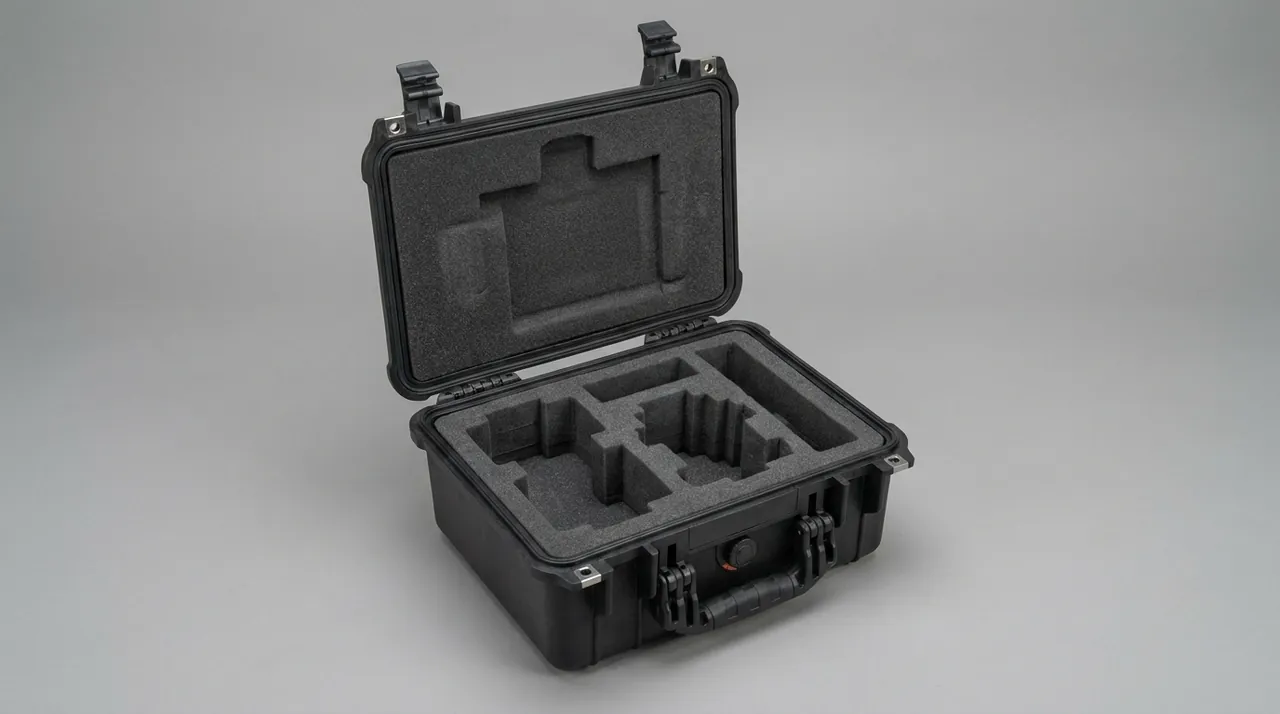
Strategy for numerous small and medium items such as grinding balls, idlers and buckets: high-density multi-position plus compartmental grading. Use divider plates or a grid insert with compartments by specification; a fixed quantity per compartment simplifies counting and retrieval; soft padding inside each compartment reduces mutual impact; and case load capacity is calculated from compartment count and unit weight.
Strategy for precision items such as gearboxes, large bearings and hydraulic cylinders: dedicated sealed cavities with dust protection first. Dedicated cavities with no contact with other parts; original packaging or equivalent moisture and dust protection retained; desiccant inside the cavity; and where necessary an independently sealed cavity with a cover to isolate dust.
| Item class | Insert strategy | Density orientation | Key design action |
|---|---|---|---|
| --- | --- | --- | --- |
| Large castings | Compartmental bearing plus edge protection | High-density bearing plus soft isolation | Load on non-functional faces, protect holes |
| Long bar components | Full-length support plus restraint | Medium-high density support | Continuous support face, curvature matching |
| Numerous small items | High-density multi-position plus grading | Medium-high density grid | Compartments by specification, easy counting |
| Precision items | Dedicated sealed cavities | Medium density plus antistatic | Original packaging, desiccant, isolation |
| Rolled items (belts) | Core support plus moisture wrap | Hard support core | No heavy stacking |
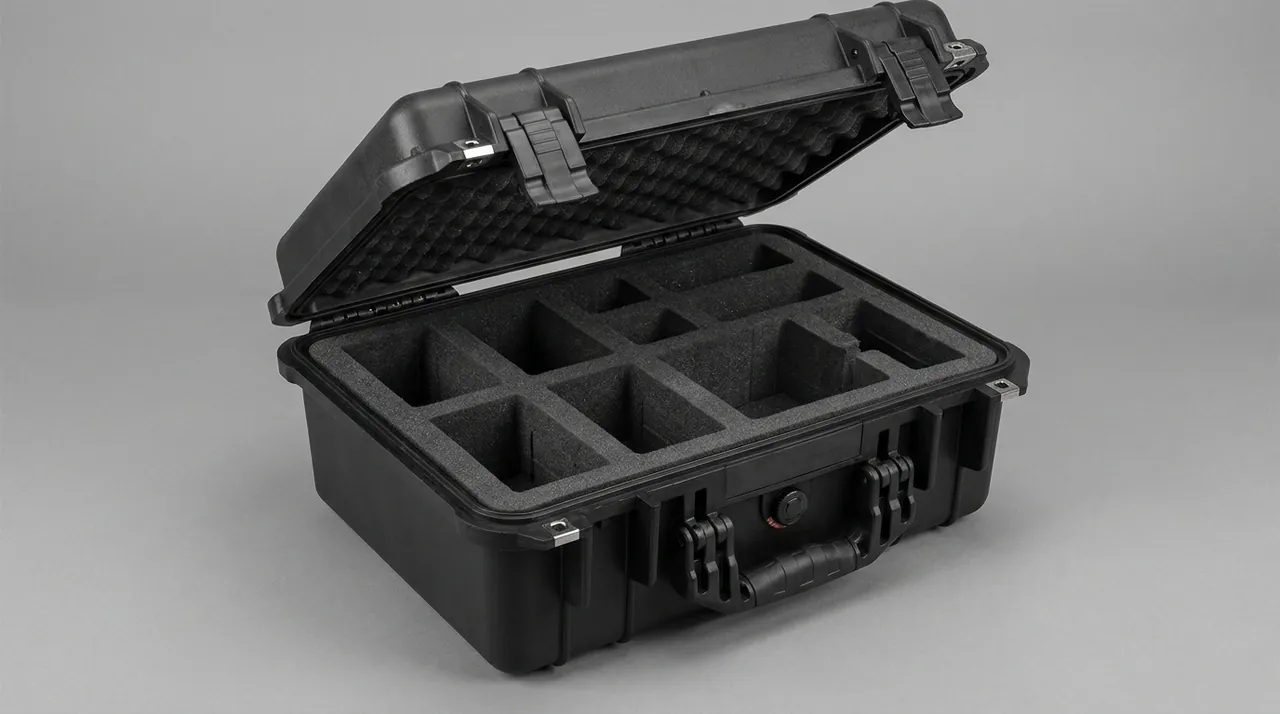
On material selection, cement industry practice favours chemical resistance and weathering: closed-cell PE, EVA or EPP inserts rather than open-cell hygroscopic foam, and inserts that can be removed for cleaning in damp or washed-down scenarios. Comparisons are in Case foam material comparison, and custom development flows in Custom foam insert design guide and EVA foam insert custom process.
The development flow typically covers measuring component dimensions and weight, identifying centre of gravity and faces that must not be loaded, material and structural design, sample production, physical trial fitting, revision and confirmation, then volume production. For very heavy items, one static load and vibration validation before volume production is advisable. JUNZHJIA develops heavy-duty inserts and case schemes from drawings or physical samples, supporting contoured support, multi-layer composites, removable dividers, lifting points and stacking faces, and can support several interchangeable inserts on one case platform.
11. Moisture, Rust and Open-Air Storage Schemes
Storage conditions in cement plants are generally less controlled than in precision manufacturing, so moisture, rust and weathering must be addressed directly.
The physics of condensation deserves clarification. Air inside a case holds water vapour; as temperature falls, the saturation capacity of air drops and the excess condenses as liquid water. For every 10 °C drop, saturation capacity falls by roughly one third to one half. Outdoors, with large diurnal swings, internal relative humidity fluctuates sharply and condensation risk far exceeds indoor conditions. With imperfect sealing, external moisture continues to enter and condensation is unavoidable.
Four control routes:
- Reduce ingress: raise the sealing class, with IP65 or better for outdoor use and IP67 where standing water is possible, and ensure the gasket is replaceable and the channel cleanable.
- Reduce the reservoir: dry components and inserts thoroughly before packing, avoid packing in rain, and include desiccant and a humidity indicator card.
- Equalise pressure: fit a pressure equalisation valve with a hydrophobic breathable membrane to prevent sustained negative pressure drawing moisture in.
- Prevent standing water: avoid water-trapping recesses in the base, use non-hygroscopic insert materials, and incorporate drainage in non-sealed case types where appropriate.
Corrosion protection: cement plant spares are mostly cast steel, cast iron or alloy steel, and unprotected surfaces corrode readily. Apply corrosion-inhibiting grease or inhibitor to machined faces; apply corrosion-inhibiting grease plus a protective sleeve to threads; apply peelable protective film to precision-machined faces; and include desiccant and a humidity indicator card. For spares stored beyond six months, open and re-inspect annually and replace the desiccant.
Open-air storage schemes: where outdoor storage cannot be avoided, take the following measures. Specify case materials with proven weathering performance including ultraviolet stabilisers. Choose a light case colour to reduce heat absorption. Provide a shade cover or a double-layer top. Raise the case off the ground, using a timber or plastic pallet, to avoid direct contact with ground moisture. Inspect gasket condition periodically and clear dust from the seal channel. Mark the case as moisture and dust sensitive so the warehouse manages it appropriately. Where conditions allow, a shade shelter or relocation indoors remains the best solution; packaging can slow outdoor ageing but cannot prevent it entirely.
12. Transport Testing: ISTA, GB/T 4857 and ASTM D4169
The export share of cement and building-material equipment has grown year on year, through complete plant exports and overseas cement plant spare supply, so packaging schemes must be validated.
The ISTA series is graded by transport mode and weight: 1 Series for individual performance tests, 2 Series for partial simulation, 3 Series for general simulation including temperature and humidity preconditioning, and 6 Series for specific carriers. For heavy cement equipment spares, ISTA 3E for unitised loads is closer to palletised heavy freight, while 3A suits smaller export parcels. The flow is described in ISTA transport testing procedures explained.
The GB/T 4857 series is China's basic test method standard for transport packages, covering vibration, impact, stacking and drop, widely cited in domestic contracts. Stacking testing matters most for cement, since heavy cases stacked in multiple tiers impose substantial sustained load on the lowest unit, and long-term creep failure is more common than instantaneous failure. See GB/T 4857 transport packaging testing explained.
ASTM D4169 designs test sequences by distribution cycle and assurance level, suiting sea-land and multi-modal journeys and commonly cited for North American exports and overseas complete-plant projects. See ASTM D4169 distribution cycle testing.
| System | Focus | Cement and building materials use case | Common procedures |
|---|---|---|---|
| --- | --- | --- | --- |
| ISTA | General simulation, carrier specific | Export case shipments, palletised heavy loads | 3E, 3A, 2A |
| GB/T 4857 | Domestic road and rail | Transfers between plants of a cement group | Stacking, vibration, drop series |
| ASTM D4169 | Multi-modal distribution cycles | Overseas complete-plant projects, sea-land transport | DC12, DC13 and similar |
Additional test recommendations. Beyond standard testing, three specific validations are advisable. First, static stacking validation: apply a load corresponding to the actual tier count and storage duration for a specified period, then check the base and ribs for permanent deformation. Second, lifting and drop validation: simulate overhead crane lifting and an accidental drop, then inspect lifting points, corners and base. Third, weathering validation: for open-air storage schemes, run ultraviolet ageing and damp-heat cycling tests to assess material ageing rate and seal durability.
Where a customer requests reference to MIL-STD-810H, it may be used as a source of environmental test methods for designing test conditions such as high-temperature storage, low-temperature storage, damp-heat cycling and vibration endurance, but it must be stated clearly that this is a test-method standard and is not equivalent to military certification, and no military certification claim may be made. JUNZHJIA can help structure the test item list, coordinate with third-party laboratories and provide inspection documents consistent with the shipped batch.
On packaging marks, domestic shipments can follow the general requirements of GB/T 191 for pictorial marking for handling of packages and GB/T 6388 for transport package shipping marks, specifying keep-dry, do-not-stack, centre-of-gravity and lifting-position symbols. This matters especially in cement plants, where overhead crane handling is routine.
13. Marking, Spare Traceability and Maintenance Plan Alignment
Cement plant spare management has a distinctive feature: demand is driven by the maintenance plan. Planned maintenance has a defined time window and parts list, so if marking is unclear and batches are mixed, the site cannot find the right part inside a limited window — producing the situation where the spare is in hand but the machine cannot be repaired. The case marking system must therefore align with the maintenance plan.
A recommended marking system:
- Permanent external marking: asset number, applicable equipment tag number such as mill number 2, component name and specification, case gross weight, maximum stacking tiers and lifting point identification. Use in-mould labelling, screen printing or engraving so nothing depends on an adhesive label.
- Pictorial marks: keep-dry, do-not-stack, centre-of-gravity and lifting-position symbols following general packaging mark practice.
- Internal position marking: each cavity labelled with component name, part number, quantity and installation position.
- Document pocket: packing list, material certificates, inspection reports, installation instructions and bolt and accessory lists.
- Status marking: distinguishing spare, awaiting inspection, inspected and released, and reserved for a specific maintenance scope.
- Traceability code: a QR or barcode linking procurement batch, arrival date, inspection records and installation records for life assessment and quality review.
Aligning with the maintenance plan: build case groups by maintenance scope, for example a scope covering mill liner replacement on a specific mill, with one case group per scope and the scope name and planned date marked on the case. Receive against the scope and shelve the group as a unit; issue the whole group before the maintenance window. This substantially shortens maintenance preparation and simplifies counting and gap identification.
For exported spares, destination labelling language requirements also apply. Where spares contain oil, batteries or hydraulic fluid, hazardous goods transport regulations apply; a general framework is set out in ADR and IMDG hazardous goods transport cases.
14. Procurement Acceptance, AQL and Specification Selection Table
When buying cement and building-material parts cases in volume, acceptance criteria must be written into the contract. Heavy-duty dust-proof case acceptance emphasises structural strength and seal durability more than ordinary cases.
Recommended incoming inspection items:
- Appearance and dimensions: case and insert cavity dimensions against drawing; no cracks, sinks or flash; ribs complete; stacking location face correctly formed.
- Structural strength: static load sampling at a multiple of rated load held for a specified period, confirming no permanent deformation and no cracking; corner or simulated drop sampling.
- Sealing and dust protection: sampling per the agreed rating, or a full-perimeter contact check using the paper-draw method as a field indicator.
- Latches and hinges: opening force, positive engagement, fatigue sampling; loaded opening cycles for heavy cases.
- Insert fit: trial fit with the actual part or a gauge, confirming no interference, no point support and smooth retrieval.
- Lifting and handling accessories: lifting point strength where applicable, forklift pocket position and opening reinforcement, wheel load capacity and swivel function.
- Weathering and material verification: material certificates, ultraviolet stabiliser declaration, and comparison against the approved colour and appearance standard.
- Marking and documentation: content, position, durability, conformance of pictorial marks, and completeness of accompanying documents.
AQL sampling: lot size, inspection level and AQL value determine sample size and decision rules. For cement, a sensible allocation is a tighter AQL for critical defects such as case cracking, missing ribs, static load non-conformance, seal failure, inadequate lifting point strength, insert collapse and non-replaceable gaskets, and a looser AQL for minor cosmetic defects such as colour deviation, minor flow marks and font weight variation. Methods and tables are in Custom case acceptance and AQL sampling.
Specification selection table:
| Parts category | Recommended case type | Insert scheme | Suggested sealing class | Suggested transport test |
|---|---|---|---|---|
| --- | --- | --- | --- | --- |
| Mill shell liners | Large heavy-duty case | Compartmental bearing plus hole protection | IP6X (IP65 outdoors) | ISTA 3E plus stacking |
| Grinding media | Large-capacity heavy-duty case | Divider compartments by grading | IP6X | Static load plus vibration |
| Diaphragms and grates | Large flat-pack case | Large flat support | IP6X | ISTA 2A |
| Roller press tyres and mill rollers | Large custom heavy-duty case | Contoured rigid support plus rolling restraint | IP65 | ISTA 3E plus static load |
| Hydraulic cylinders and components | Medium sealed case | Dedicated cavities plus rod sleeves | IP67 | ISTA 2A plus damp heat |
| Conveyor belts (rolled) | Dedicated roll support case | Core support plus moisture wrap | IP65 | ISTA 2A |
| Idlers and chains | Multi-position grid case | High-density compartments plus shaft-end protection | IP6X | ISTA 2A |
| Gearboxes and large bearings | Medium sealed case | Dedicated sealed cavities plus desiccant | IP67 | ISTA 2A plus damp heat |
JUNZHJIA provides complete custom delivery capability across cement machinery, building-material equipment and heavy industry: heavy-duty case bodies and inserts developed from drawings or physical samples, sealing class and lifting schemes matched to the scenario, material formulations selected for weathering requirements, colour and marking customisation, and OEM/ODM manufacturing with stable volume supply. Kexin New Materials (Guangdong) Co., Ltd. operates an integrated chain from tooling development and rotational or injection moulding through insert processing and final assembly, serving cement machinery manufacturers, building-material equipment companies, regional distributors and end-user cement plants. For first-time cooperation, a small trial batch with physical trial fitting is recommended before volume supply. Partner evaluation criteria are set out in How to choose a protective case OEM factory.
Frequently Asked Questions
Q: Cement plants are very dusty. What sealing class should a parts case use?
A: Take dust level 6, IP6X, as the floor, then set the second digit from the water exposure. Cement dust is generated continuously in large volumes, spans a wide particle-size range and contains alkaline constituents; the limited ingress allowed by IP5X would deposit continuously on mating faces, threads and bearing seats, causing abrasive wear and corrosion, whereas IP6X requires complete dust exclusion. For the second digit, indoor storage and use can accept IP64 or IP65; open stockyards exposed to rain should reach IP65 or better; and locations where standing water immersion is possible should use IP67. Three misconceptions matter here. First, the digits cover different things, so IP6X alone is not waterproof. Second, a rating describes the as-delivered condition, and gasket ageing or dust in the seal channel degrades it, so a cleanable, replaceable seal structure is mandatory. Third, IP ratings assess dust and water only, not ultraviolet resistance or temperature tolerance, so open-air use requires a separate weathering assessment. Write the rating, test method and sampling ratio into the contract and retain third-party test documents as acceptance evidence.
Q: Grinding media such as steel balls are very heavy. How does the case avoid deforming?
A: Distribute the load, increase base bending stiffness, and control stacking. Steel balls apply an approximately uniform high surface load, creating sustained pressure on the base; insufficient base stiffness produces slow creep and settlement that is invisible in the short term but clearly visible after a year of use. Practically: first, the base must use ribs, a double-wall construction or an internal metal reinforcement plate, never a flat single-wall base. Second, the insert or divider base should make full-face contact with the case base so load is distributed, rather than having the grid frame create local high stress. Third, define and mark the maximum load per case to prevent overloading on site. Fourth, control stacking tiers; heavy cases should not be stacked, or should be stored single-tier, and any stacking must be statically validated. Fifth, reinforce the corners and provide reinforced forklift pockets for mechanical handling. For acceptance, run a static load test by applying a multiple of rated load for a specified period and checking after unloading for permanent deformation and rib yielding. This test costs little but surfaces most structural problems. Using divider plates to separate grades also helps on-site retrieval and prevents mixing.
Q: Why does cement dust corrode case materials, and what materials should be chosen?
A: The main reason is that free lime and other constituents in cement dust form an alkaline environment once damp. This affects materials in four ways: it corrodes aluminium and aluminium alloys, showing as a white, blistered surface and weight loss; it accelerates steel corrosion, especially where chlorides are also present; it accelerates ageing in ordinary nitrile and natural rubber gaskets, causing hardening, cracking and loss of elasticity; and it hydrolyses some coatings and polyester fibres. Material matching: prefer HDPE or PP for the case body, since both have excellent alkali resistance; specify EPDM or silicone for gaskets, avoiding natural rubber and ordinary nitrile; use closed-cell PE, EVA or EPP for inserts, avoiding open-cell hygroscopic foam; use stainless steel or galvanised plus coated metal for bolts, hinge cores and plates; use in-mould labels, engraving or weather-resistant screen printing rather than ordinary adhesive labels; and use alkali-resistant breathable film for desiccant packaging to prevent bag rupture and contamination. Clean alkaline dust deposits with water or a neutral detergent, avoiding solvents that react with alkaline material or damage seals.
Q: Cement plant spares are often stored outdoors. How should the packaging scheme respond?
A: Outdoor storage is a combined-stress problem requiring action on materials, structure and management together. On materials, specify weathering-grade HDPE or PP with ultraviolet stabilisers, explicitly ask about the material's outdoor service validation, and write acceptance criteria for colour change and impact strength into the contract; a light colour reduces heat absorption. On structure, provide a shade cover or a double-layer top; raise the case off the ground with a timber or plastic pallet to avoid direct ground moisture contact; avoid water-trapping recesses in the base; fit a pressure equalisation valve with a hydrophobic breathable membrane to handle the breathing effect from diurnal temperature swings; and specify EPDM or silicone gaskets with a replaceable structure. On management, inspect gasket condition periodically and clear dust from the seal channel; include desiccant and a humidity indicator card, and for storage beyond six months open and re-inspect annually and replace the desiccant; and mark the case as moisture and dust sensitive so the warehouse manages it appropriately. Be clear that packaging can slow outdoor ageing but cannot prevent it; a shade shelter or relocation indoors remains the most effective solution, with packaging acting as an interim and buffering measure.
Q: Can precision items such as hydraulic cylinders and gearboxes share a case with liners and steel balls?
A: In principle, no; where it is unavoidable, strict physical isolation is required. There are two reasons. The mechanical reason: hydraulic cylinders and gearboxes are precision items sensitive to impact and cantilever bending moments, while liners and steel balls are heavy items generating large inertia forces and large relative displacements in transit. In a shared case, the movement of the heavy items becomes an impact source against the precision items, sharply raising risk. The contamination reason: liners and steel balls used in a cement plant carry heavy alkaline dust deposits that are difficult to remove completely, while hydraulic cylinders and gearboxes are extremely dust-sensitive; dust ingress causes piston rod coating damage, seal leakage and early bearing wear. Where freight cost makes shared loading unavoidable: use a removable divider system or separate insert modules to create a rigid partition; place precision items in dedicated sealed cavities retaining original or equivalent moisture and dust packaging with desiccant; fix heavy items in high-density bearing cavities with all degrees of freedom restrained; and keep the overall centre of gravity low and centred. Mark the case with a contents list and weight so lifting and handling are performed correctly. A separate case for precision items remains the most economical approach.
Q: What should be considered in the lifting design for a heavy-duty parts case?
A: Lifting design must be completed at the design stage and not left to on-site improvisation, because improvised slinging is a leading cause of dropped components and injuries. Six points matter. First, lifting point positions should produce reasonable sling loading without excessive case bending, typically placed symmetrically about the centre of gravity and clearly marked. Second, the permitted sling angle range must be stated, since a flatter angle relative to horizontal greatly increases point loading; the scheme should be checked at the worst permitted angle. Third, maximum lifting load and safety factor should be defined from the gross weight per case with margin. Fourth, lifting points need local reinforcement to prevent crushing; for rotomoulded cases, metal reinforcement inserts are usually moulded in. Fifth, dedicated gear or a spreader beam may be required for very long cases or those with an offset centre of gravity, to prevent tilting. Sixth, lifting points, forklift pockets and the stacking location face must not conflict with one another. Validate with a simulated lifting test and inspect lifting point areas for deformation or cracking. The case should also mark centre of gravity and lifting positions following general pictorial mark practice.
Q: How should a cement plant case marking system be designed to align with the maintenance plan?
A: The key is to make the marking system serve the real workflow of retrieving parts by maintenance scope, rather than merely naming components. Six layers work well. The first is permanent external marking: asset number, applicable equipment tag number such as mill number 2, component name and specification, case gross weight, maximum stacking tiers and lifting point identification, applied by in-mould label, screen printing or engraving so nothing depends on an adhesive label. The second is pictorial marks covering keep-dry, do-not-stack, centre-of-gravity and lifting-position symbols. The third is internal position marking, with each cavity labelled with component name, part number, quantity and installation position. The fourth is a document pocket holding the packing list, material certificates, inspection reports, installation instructions and the bolt and accessory list. The fifth is status marking distinguishing spare, awaiting inspection, inspected and released, and reserved for a specific maintenance scope. The sixth is a traceability code linking procurement batch, arrival date, inspection records and installation records. In practice, build case groups by maintenance scope, one group per scope, with the scope name and planned date marked on the case; receive and shelve the group as a unit; and issue the whole group before the maintenance window. This shortens preparation substantially and simplifies counting and gap identification.
Q: For cement plant spares exported overseas, what additional packaging considerations apply?
A: Five considerations apply beyond standard packaging requirements. First, sea-freight moisture control: long voyages, large temperature swings and high humidity mean the sealing class should be IP65 or better, with a pressure equalisation valve using a hydrophobic breathable membrane, desiccant and a humidity indicator card inside, corrosion protection on metal parts, and components and inserts thoroughly dried before packing. Second, repeated handling: export cargo typically goes through factory loading, port storage, vessel loading, discharge and inland transport, far more handling steps than domestic shipping, so the scheme should be designed to a more severe distribution cycle, validated to ISTA 3E or the relevant ASTM D4169 cycle. Third, stacking strength: containers are usually loaded in multiple tiers for extended periods, so the base and top of a heavy case must carry sustained static load; provide a stacking location face on the case top to prevent sliding and validate statically at the actual tier count. Fourth, marking and compliance: confirm destination labelling language requirements; apply hazardous goods marking where spares contain oil, batteries or hydraulic fluid; and use internationally recognised pictorial marks. Fifth, differences in site conditions: overseas sites may have weaker lifting and storage capability than domestic ones, so lifting points, stacking tiers and handling methods should be specified more conservatively, with clear handling and opening instructions supplied with the case.
Conclusion & Related Reading
The core of a cement and building-material parts case is establishing a reliable balance between heavy load and high dust. Mill components are heavy castings requiring compartmental bearing, hole protection and a reinforced base. Roller press and vertical mill parts are heavy precision items requiring contoured rigid support and rolling restraint. Conveyor components are numerous and varied, requiring compartmenting, roll core support and moisture wrapping. Drive and hydraulic components are the most dust-sensitive, requiring dedicated sealed cavities and a high sealing class. And every component depends on the case body to carry weight and lifting loads structurally, to exclude alkaline dust and rain, and to resist open-air ageing. Hold to that thread and selection resolves into concrete parameters: determine the insert strategy from the item class, then the case structure and lifting scheme from the weight, then the sealing class and corrosion and weathering scheme from the environment, and finally validate with static load, stacking and transport testing.
For cement machinery manufacturers, building-material equipment companies and cement plants, a sensible sequence is: inventory maintenance spares and classify them by item type; define case load rating, sealing class and weathering requirements; develop inserts for each component class and physically trial fit them; validate with static load, stacking and transport testing; and write acceptance criteria, the marking system, traceability codes and maintenance scope mapping into procurement and warehouse processes. JUNZHJIA supports this process from structural design, material selection and sample development through volume supply, with Kexin New Materials (Guangdong) Co., Ltd. manufacturing and delivering to customer drawings and scenario requirements, so that cement and building-material equipment spares remain under control from dispatch and storage through to installation.
Related Reading