

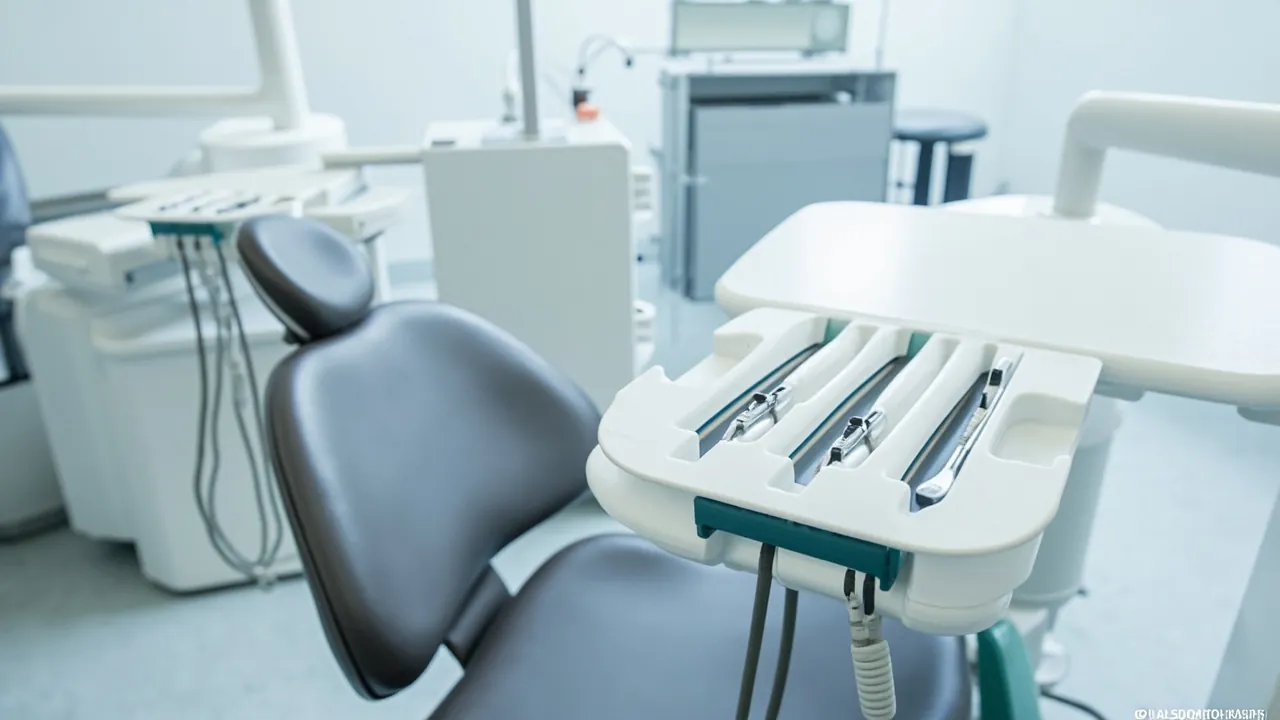
The hard part of protecting dental equipment in transit is not fitting it into a box. It is keeping precision parts in calibration, keeping upholstered parts free of compression marks, and keeping fluid lines free of residue. A dental unit is a classic integrated machine combining electrical, mechanical, water and air systems: chair lift and backrest recline are driven by electric actuators or hydraulics, handpieces and motors run on compressed air, the water circuit supplies cooling and rinsing, the suction system removes waste fluid, and the whole assembly carries lighting, a control panel and a foot control. If any one of those chains is damaged in transit, the failure surfaces after installation as sluggish chair movement, unstable handpiece speed, abnormal water delivery or weak suction. The most awkward case is the high-speed and contra-angle handpiece. These precision instruments depend on miniature bearings running at several hundred thousand revolutions per minute, and once an axial shock leaves a raceway dent, the first symptom may be nothing more than slightly louder noise and a modest temperature rise, followed by rapid failure. That kind of damage is completely invisible during an arrival inspection.
This article is written for packaging and supply-chain engineers at dental equipment manufacturers and distributors, procurement and maintenance staff at dental chains, equipment managers at clinics and hospital dental departments, and export trading firms and after-sales spare-parts operations. It covers dental units, high-speed and contra-angle handpieces, dental imaging equipment including intraoral sensors and flat panel detectors, micromotors and ultrasonic units, and upholstery, paint and glazing protection, together with standards references, a selection matrix, a packing SOP and arrival acceptance methods. All figures are typical industry values or empirical ranges; the governing inputs are the equipment drawing, the manufacturer's technical manual, the customer acceptance specification and destination regulations. JUNZHJIA supplies model-specific custom inserts, component zoning and locking structures, sealing and moisture-control configurations, OEM and ODM programmes, and supporting test documentation for dental equipment cases.
Table of Contents
- 1. Why Dental Equipment Presents a Triple Challenge: Vibration, Moisture and Cleanliness
- 2. Dental Units, Handpieces, Imaging and Instruments: Failure Modes Compared
- 3. Dental Unit Cases: Load Path, Chair Locking and Line Draining
- 4. High-Speed and Contra-Angle Handpiece Cases: Bearing Precision and Axial Shock
- 5. Dental Imaging Cases: Intraoral Sensors, Flat Panel Detectors and Tube Heads
- 6. Micromotors, Ultrasonic Scalers and Curing Lights: Precision Electromechanical Protection
- 7. Upholstery, Paint and Glazing: Surface Protection and Migration Control
- 8. Instruments and Small Parts: Compartments, Trays and Count Logic
- 9. Infection Control and Cleaning: Disinfectant Resistance and Cross-Contamination
- 10. Sealing, Moisture Control and IP Ratings: IEC 60529 and GB/T 4208
- 11. Transport Test Basis: ISTA, GB/T 4857, ASTM D4169 and MIL-STD-810H
- 12. Packing SOP, Arrival Inspection and Pre-Installation Preparation
- 13. Sea Export, After-Sales Parts Circulation and OEM/ODM Customisation
- Frequently Asked Questions
- Conclusion and Further Reading
1. Why Dental Equipment Presents a Triple Challenge: Vibration, Moisture and Cleanliness
The packaging requirement for dental equipment resolves into three interacting chains.
The vibration chain. Dental equipment concentrates a large number of high-precision, small-volume, shock-sensitive moving parts: the miniature bearings and chuck mechanism in a high-speed handpiece, the rotor and gears in an electric motor, the piezoelectric transducer in an ultrasonic scaler, the sensitive panel of a flat detector, and the electric actuators and limit switches in a dental unit. What these share is low shock tolerance combined with poor visibility of damage. Take the high-speed handpiece: bearing radial clearance is measured in microns, and a single drop from 60 centimetres is enough to leave a raceway dent through axial shock. That dent does not cause immediate failure. It shows up afterwards as noise, vibration and temperature rise, and it compresses service life from years into months. The boundary between transport damage and wear damage therefore becomes blurred, which is precisely why dental after-sales disputes are so common.
The moisture and corrosion chain. Dental equipment is a mixed assembly of stainless steel, aluminium alloy, brass, chromium-plated parts and circuit boards. A 30 to 45 day sea crossing in high humidity and salt fog creates three problems: rust on carbon steel parts and fasteners; galvanic corrosion where aluminium alloy meets stainless steel; and moisture on circuit boards and connectors causing insulation loss and intermittent contact. More insidious still is residual fluid in the water circuit. If water or disinfectant remains in the unit's tubing, cuspidor drain or suction lines, high humidity accelerates corrosion and the fluid may leak in transit and contaminate other components.
The cleanliness and infection-control chain. Dental equipment contacts the patient's oral cavity, blood and saliva, making it a priority item for infection control. Packaging has to answer two questions: whether the case and inserts can be effectively cleaned and disinfected before use without rapid ageing, and whether transport and unpacking introduce cross-contamination. A case previously used to carry contaminated instruments or waste fluid must not be transferred to new equipment or clean instruments without assessment. For disinfectant compatibility and cleaning methods, see the materials discussion in how to clean a protective case; note that this reference addresses general-purpose cases and disinfectant tolerance must be confirmed separately for clinical use.
A field observation: in arrival complaints for dental equipment, the proportion of "looks fine but does not function" cases is normally clearly higher than "visibly damaged" cases. Packaging validation for dental equipment must therefore include functional checks, with acceptance criteria led by functional indicators and supported by appearance. An appearance-only acceptance step simply transfers the risk into the first week after installation.
The priority order is: solve vibration and restraint first, which determines whether precision parts stay in calibration; then solve moisture and residual fluid, which determines electrical and hydraulic reliability; then solve cleanliness and infection control, which determines whether the equipment can be used compliantly.
2. Dental Units, Handpieces, Imaging and Instruments: Failure Modes Compared
| Component | Primary failure mode | Trigger | Typical consequence | Priority countermeasure |
|---|---|---|---|---|
| --- | --- | --- | --- | --- |
| Dental unit, complete | Sluggish chair movement, structural distortion | Unrestrained movement, single-point lifting, stacking overload | Actuator damage, limit misalignment | Split packing, chair locked in transport position, load-bearing blocks |
| Unit water and air circuits | Residual fluid leakage, internal corrosion and biofilm | Not drained, not blown dry, humid environment | Abnormal water delivery, odour, corrosion | Drain, blow dry, cap, desiccant |
| High-speed handpiece, turbine | Bearing raceway denting, unstable speed | Drop, axial shock, no individual location | Noise, temperature rise, early failure | Individual compartment, low-rebound pad, axial restraint |
| Contra-angle and straight handpiece | Gear damage, chuck deformation | Mutual collision, hard contact | Low torque, chuck slipping | Individual cavity per instrument, anti-collision separation |
| Intraoral sensor, digital imaging | Image artefacts, pixel failure | Shock, squeeze, moisture | Degraded image quality | Low-rebound floating wrap, moisture barrier |
| Flat panel detector | Panel cracking, dead pixels | Local point contact, bending, squeeze | Complete loss of the panel | Full-surface support, point contact absolutely prohibited |
| X-ray tube head and arm | Tube insert displacement, insulation loss | Severe shock, moisture | Unstable output, reduced withstand voltage | Dedicated cavity, damping, moisture control |
| Micromotor and air motor | Rotor eccentricity, bearing damage | Axial shock, free rotor movement | Vibration, speed fluctuation | Axial restraint, individual location |
| Ultrasonic scaler handpiece | Transducer performance drift | Shock, stacking pressure | Reduced output power | Individual compartment, soft pad |
| Curing light and light guide | Broken light guide, battery damage | Impact, squeeze | Output attenuation | Long-format cavity, separated accessories |
| Chair upholstery and leather | Compression marks, creasing, distortion | Sustained load, friction | Permanent appearance defect | Formed support, zero-pressure contact, barrier film |
| Paint and chromium plate | Scoring and scuffing | Hard contact, friction | Appearance defect | Conforming pad, corner guards, non-woven separation |
| Instruments and small parts | Loss, mixing, impact | Free movement inside the case | Missing parts on site, wrong assembly | Compartment box, labelling, checklist |
All these modes share concealment and delay: damage forms in transit and appears at installation or during the first weeks of clinical use. Failure priority depends strongly on transport mode. Short-haul road transport is dominated by handling shock; sea export is dominated by humidity, salt fog and cumulative vibration; airfreight is dominated by repeated transhipment and abrupt temperature and humidity change. A packaging design must therefore be configured for the worst credible route, not the most common one.
3. Dental Unit Cases: Load Path, Chair Locking and Line Draining
The dental unit is the largest, most complex and most expensive single item in dental equipment, and it is the item that most needs whole-system thinking in packaging design.
Why shipping complete is often not optimal. A dental unit normally leaves the factory in a state where the chair is raised, the backrest is reclined, and the foot control and instrument tray hang from their supports. In that state the centre of gravity is offset from the geometric centre, the envelope is large, there are many cantilevers, and loads concentrate locally. Shipping it complete creates three problems. Volume utilisation is poor, raising freight cost. Cantilevered structures, such as the tray bracket, light arm and monitor arm, act as levers during vibration, amplifying shock before passing it into joints and fixings. And the case must be very large, which multiplies the difficulty of surviving drop and stacking loads. The industry answer is normally to break down the critical assemblies, pack in zones and install on site: the light arm, monitor, instrument tray, foot control, cup filler and tubing assemblies are removed and packed separately, while the chair body keeps only the minimum necessary structure.
Chair locking is the core operation. Whether or not the unit is broken down, the chair body must be locked in the transport position inside the case. The transport position normally requires the backrest to be near vertical with a slight recline so that the hydraulic cylinder or actuator is not at its travel limit; the seat lowered close to its lowest position; the headrest removed or lowered fully; and the armrests folded or removed. Locking is achieved with mechanical limit blocks wedged between the chair frame and base, dedicated support pillars under the seat, and adjustable supports that share the load. The governing principle is that the actuator or hydraulic cylinder must not carry a sustained load in transit. These are dynamic working elements, and prolonged static loading causes internal leakage and position drift, which shows up after installation as a chair that slowly sinks or moves sluggishly. This is the same principle described in cushion liner and case base interaction, where loads should be carried by structural blocks rather than elastic materials.
Load path. The weight of a dental unit concentrates in the base and chair frame. The correct path is base, then load-bearing block, then case floor, then pallet. It is not seat, then foam, then case floor. Using soft foam to carry the whole machine causes collapse under long stacking, which lets the chair drop, releases the limit blocks and squeezes adjacent components. The design must therefore state which points are load-bearing, the height and hardness of the blocks, and how the blocks are fixed to the case floor. Upholstery must never be used as a load-bearing surface.
Draining the lines and treating the air circuit. This is the step most often skipped and the one that most often causes trouble. The unit's water circuit includes the inlet hose, handpiece cooling water line, rinse line, cuspidor flush line and suction line. Before transport, drain all residual fluid; blow the tubing dry with clean compressed air; fit blind plugs or dedicated caps to the water inlet, drain outlet and suction port; seal the cuspidor and drain openings; and confirm that no disinfectant or cleaning agent remains. If the lines are not drained, residual fluid migrates in transit, pools in low points, accelerates corrosion in humid conditions and may leak on opening to contaminate other components. The air circuit, meaning compressed air lines and handpiece supply tubing, should also be drained and capped so that debris cannot enter.
Zoning recommendations.
| Zone | Contents | Insert approach | Key constraint |
|---|---|---|---|
| --- | --- | --- | --- |
| Main cavity | Chair body and base | Load blocks, limit blocks, top clamp | Chair locked in transport position, actuators unloaded |
| Side cavity one | Light and arm assembly | Long-format cavity, surface-contact support | Joints unloaded, glass face upward |
| Side cavity two | Instrument tray, tray bracket, hangers | Compartments plus soft pads | No stacking, no sharp edge contact |
| Accessory cavity | Foot control, cup filler, tubing | Compartment box with numbering | Cables coiled separately, connectors capped |
| Document pouch | Packing list, certificate, installation manual | Waterproof pouch fixed inside the lid | Waterproof, fixed, accessible |
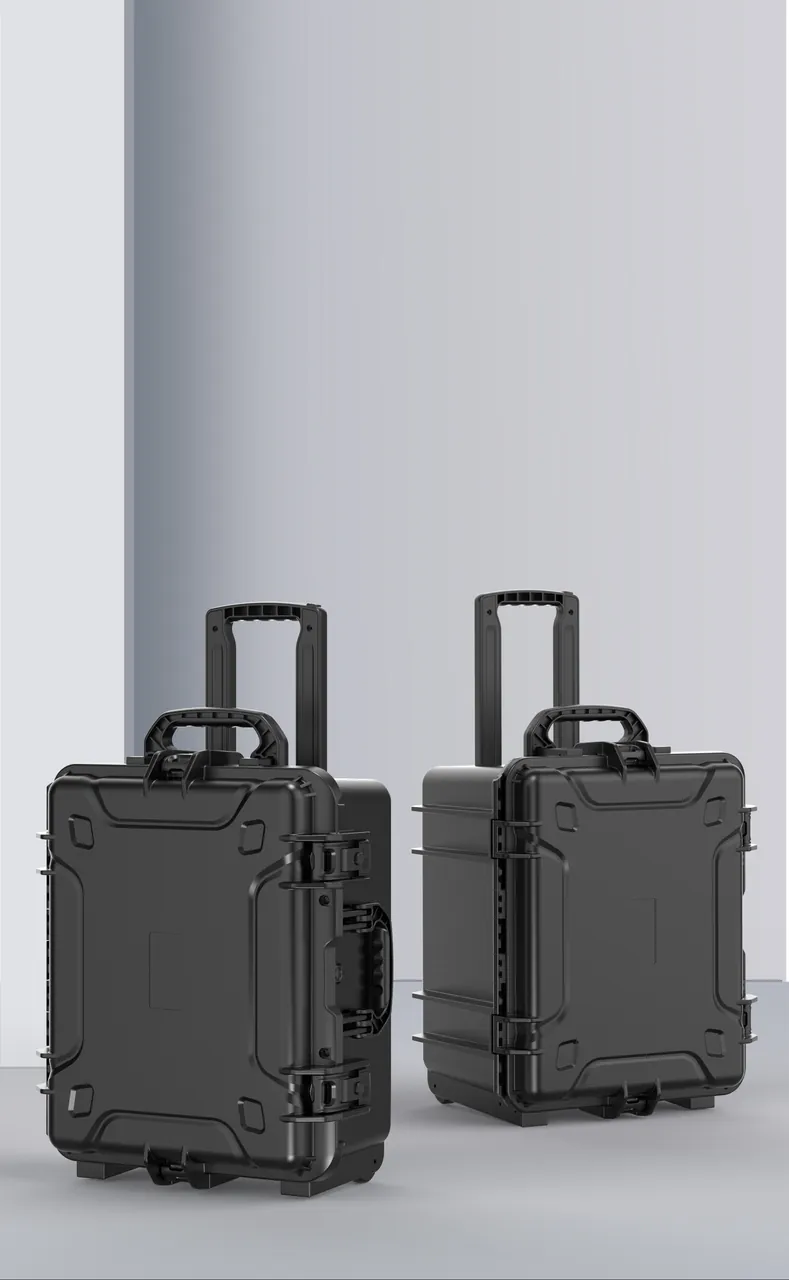
Choosing the case format. A dental unit normally calls for one of two routes: a heavy-duty frame case on a pallet base, or a reinforced plastic returnable case with custom inserts. The first suits one-way export shipments; the second suits domestic distribution and after-sales circulation. With a plastic case, confirm the reinforcement of the base and corners and impact performance at low temperature. With a timber case, comply with ISPM 15 heat treatment or fumigation and seal the internal surfaces to prevent splinters and dust from contaminating the equipment. For a general comparison of case materials, see plastic protective box materials and construction.
4. High-Speed and Contra-Angle Handpiece Cases: Bearing Precision and Axial Shock
High-speed and contra-angle handpieces are the highest-value, smallest-volume and most invisibly damaged category in dental equipment. Their packaging logic is completely different from a complete unit: they do not need compression resistance, they need absolute shock isolation.
Why handpieces are so sensitive to shock. A high-speed turbine handpiece typically runs at 300,000 to 400,000 revolutions per minute, and its core is a miniature ball bearing or an air bearing. The oil film between raceway and ball is submicron, so any raceway dent or ball bruise formed during impact destroys the film. The result is increased idling noise, speed fluctuation, higher temperature rise and reduced cutting efficiency. The awkward part is that such damage often presents at installation as "it turns, and it looks normal", while failures cluster weeks later in clinical use. The goal of transport protection is therefore not "do not break it" but "do not let shock reach the bearing".
Three damage pathways.
- Direct drop: falling from a worktop or tray, with shock transmitted axially through the head into the bearing. This is the most common mechanism.
- Mutual collision: several handpieces sharing one cavity, touching repeatedly under vibration until cumulative wear and surface marking appear.
- Single-point support loading: a handpiece resting diagonally on foam with only one or two contact points, so the head takes a bending moment under vibration, deforming the chuck and ovalising the bur hole.
Design points.
- Individual cavity per instrument: each handpiece has its own locating cavity touching no other handpiece or hard object. This is the simplest and most effective measure. For zoning approaches, see case removable divider system.
- Surface or line support: support should run along the body length in two points or a line rather than a point, so no bending moment forms.
- Low-rebound materials: handpieces are precision instruments, so use low-rebound EVA or PU and never high-rebound foam, which returns energy to the instrument. See shock and vibration case design.
- Axial restraint: provide stops at both the head and the tail so the instrument cannot slide axially inside the cavity.
- Do not rely on magnetic fixing: magnetic holders and strips slide under vibration and may affect certain metallic components, so they are not recommended as primary restraint.
- Separate the fragile accessories: burs, chuck wrenches, O-rings and tail tubing go into a separate compartment box, never in the same cavity as the handpiece.
Contra-angle, straight and low-speed handpieces. These depend on gear trains and chuck mechanisms. Gear failure modes are surface pitting and tooth breakage, again shock-driven; chuck failure modes are deformation leading to bur slip or difficult insertion and removal. Requirements resemble those for high-speed handpieces, with one addition: the tail cable of a low-speed motor fatigues under repeated bending, so it should be coiled separately with a defined minimum bend radius written into the work instruction.
Why not ordinary bubble wrap. Bubble wrap and ordinary expanded polyethylene do provide cushioning, but they have two drawbacks: high compression set, so they flatten under long stacking and lose support; and no deterministic positional constraint, so the handpiece can move inside the package. "Wrapped" and "located" are different objectives. For high-value instruments, the cost of a custom insert is normally far below the cost of a single after-sales replacement. On material selection, see case foam material comparison and custom foam insert design guide.
Combining packaging with infection control. Handpieces contact patients directly, so they are normally sterilised before shipment and packed in a sterile barrier system. The transport case is tertiary packaging, and its duty is to protect the sterile barrier from puncture, crushing and moisture. The interior must be free of sharp corners, nail heads, splinters and shedding materials, because any puncture can breach the sterile barrier. For packaging system requirements, refer to the international framework for terminally sterilised medical device packaging, such as the ISO 11607 series covering sterile barrier systems and packaging processes; applicability is governed by the manufacturer's technical documentation and registration requirements.
5. Dental Imaging Cases: Intraoral Sensors, Flat Panel Detectors and Tube Heads
Dental imaging equipment is the small, high-value, local-load-sensitive category in dental equipment, and its packaging requirements differ noticeably from other components.
Intraoral digital sensors. An intraoral sensor, whether CMOS or CCD, is about the size of a card, with a sensitive photoelectric array and scintillator layer inside and a cable or wireless module outside. Three risks apply: squeeze, meaning pressure along the bite surface or point contact during transport, which cracks the encapsulation and kills pixels; shock, meaning a drop causing internal solder joint cracking and image artefacts; and moisture, meaning a compromised seal that produces increased noise and non-uniform images. The countermeasures are a low-rebound floating wrap, no contact with rigid surfaces on any side, separate coiling of the cable with a coil diameter larger than the minimum bend radius, and a desiccant. Where the sensor includes a wireless charging module or lithium battery, battery transport compliance also applies.
Flat panel detectors. The flat panel detector is among the most fragile and most expensive components in imaging equipment. Its sensitive panel is built on a glass substrate with a scintillator layer, and it is extremely sensitive to bending and localised point contact. If it is supported only at the four corners with the centre spanning free, self-weight plus vibration produces bending that can cause micro-cracking and dead pixels. Conversely, a hard object touching the panel at one point concentrates stress at that point. The correct support method is full-surface support across the entire back face: the insert's support surface should conform to the rear of the detector as a continuous, flat, bump-free surface. Detectors also normally carry explicit "do not stack" and "do not invert" requirements, so the case must carry prominent markings. Where the detector forms part of medical electrical equipment, its basic safety and essential performance should satisfy the general requirements of the GB 9706 series. It must be stressed that transport packaging does not alter the equipment's type test conclusions; packaging validation and electrical safety validation are two independent evaluation systems.
X-ray tube heads and arms. The tube head contains a vacuum insert and high-voltage insulating oil. Shock can displace the insert, breach the oil seal or reduce withstand voltage. Countermeasures are a dedicated cavity, multi-point damped support, strict compliance with the manufacturer's limits on inversion and tilt, and moisture control, since insulation performance is humidity-sensitive. Arms, including columns, cross-arms and rotating joints, are long members that should be broken down into the shortest units for transport, with independent support at the cantilevered end so that joints do not carry bending moments.
Software and accessories. Imaging equipment normally ships with a workstation, monitor, cabling and calibration phantoms. Monitors are fragile, since the panel is sensitive to pressure and twisting, and should use the original packaging or an equivalent rigid protector. Calibration phantoms and cables go into a compartment box. A specific warning: cables and connectors look minor but cause major problems on site, so connectors should be capped and numbered to prevent mixing. Where the workstation includes a hard disk or other storage medium, back up the data before shipment so that impact damage to the medium does not destroy configuration and calibration data.
6. Micromotors, Ultrasonic Scalers and Curing Lights: Precision Electromechanical Protection
This category sits between complete units and hand instruments in size and technical density, and its failure modes lie between the two.
Micromotors and air motors. The core failure mode for a dental micromotor, which includes the rotor, reduction gearing and supply cable, is rotor eccentricity and bearing damage caused by axial shock. Motor shaft axial play is normally specified precisely, and shock in transit makes the shaft strike the bearing face. Countermeasures are axial restraint, with supports at the shaft extension and the rear, individual location, and avoiding any situation where the cable becomes a load path. Air motors need dust protection at the air inlet, because debris accelerates vane wear; fit a dust cap. Any debris entering the motor will also accelerate wear.
Ultrasonic scaler handpieces and transducers. A piezoelectric transducer is a stack of ceramic discs held under preload, and it is sensitive to shock and stacking pressure: impact can micro-crack the ceramic or reduce preload, which appears as reduced output power and a changed vibration mode. Countermeasures are individual compartments, soft pads, no stacking, and never sharing a cavity with hard items such as instrument trays. Scaler handpiece cables are usually integral to the handpiece, so coil radius must be controlled.
Curing lights and light guides. A light guide, whether glass or a quartz fibre bundle, is the classic fragile, slender component: any load can fracture it or break internal fibres, which appears as reduced light output. The answer is a long-format individual cavity with support at both ends and the middle spanning free so no mid-span load is applied, and never sharing a cavity with hard objects. Curing light bodies contain lithium batteries, so battery transport compliance applies.
Integrated motor handpieces and endodontic motors. These combine torque control and speed feedback. Transport protection still centres on axial restraint and individual location, with the addition of protection for the control panel and display. Displays are fragile, and any point contact pressure can produce bright spots or dead lines.
A general principle. For this class of medium-value, medium-volume equipment, packaging design follows four rules: individual cavity, surface-contact support, low-rebound material, separated accessories. In practice a significant share of after-sales disputes in this category originates from mixing components in one cavity, and mixing usually happens because the case had spare room. Turning "just drop it in" into "it only fits here" using a compartmented insert is the cheapest available improvement.
7. Upholstery, Paint and Glazing: Surface Protection and Migration Control
Appearance parts on dental equipment, meaning upholstery leather and foam, painted surfaces, chromium and stainless steel trim, and lamp lenses and covers, are not high-value in themselves, but appearance defects are greatly amplified in a clinical setting: clinics tolerate equipment appearance far less than industrial users do, and a single compression mark or paint chip frequently triggers a return.
How upholstery and leather fail. Three mechanisms dominate: permanent compression marks from sustained load, where the foam loses resilience and the leather shows a dent; creasing and distortion where the load direction differs from the design direction and the leather stretches unevenly; and friction and colour migration where prolonged contact with another material transfers colour or abrades the surface. Design points:
- Formed support: the support surface should conform to the original curvature of the upholstery rather than simply pressing it flat with a board. Curved support requires tooling and falls within the scope of custom inserts.
- Zero-pressure contact: upholstered areas must not be pressed by other components or by the top clamp; loads should be transmitted through structural members such as the chair frame.
- Barrier film: place a barrier between upholstery and any dark or plasticiser-containing material to prevent colour and plasticiser migration. A specific warning: some flexible PVC materials contain plasticisers that migrate into leather on prolonged contact, so direct contact must be avoided.
- Temperature: upholstery stiffens and embrittles at low temperature, and compression then produces creases that cannot be recovered. Where a route crosses cold regions, no load should be applied to upholstered areas at all.
Paint and chromium plating. Paint damage comes mainly from hard contact and friction. Apply conforming pads, such as non-woven fabric, polyethylene sheet or low-rebound EVA, between all hard surfaces that could touch; add corner guards at case corners and protrusions; never place tools or accessories on painted areas in transit; and never apply adhesive tape directly to painted surfaces, since residue removal damages the coating. For surface protection materials in packaging, see the related process notes alongside case seal materials, though in practice the more useful criterion is whether the supplier can provide a compatibility and low-migration declaration.
Lamp lenses and transparent parts. Dental operating light lenses, covers and viewing mirrors are glass or acrylic. Glass fails by fracture, with the origin usually at an edge or mounting hole; acrylic fails by scratching and stress crazing. Support requirements are: glass face upward, one cavity per item, edges touching nothing hard, and no point-contact pressure. Acrylic also needs stress-crazing control: certain cleaning agents and solvents initiate crazing, so both packaging and cleaning must avoid contact.
Marking. Appearance-part areas should be marked both inside the case and on the exterior with "this way up", "do not invert" and "do not stack or step on". A significant share of appearance complaints originates from secondary handling on site rather than from transport itself, and clear marking reduces that risk substantially.
8. Instruments and Small Parts: Compartments, Trays and Count Logic
A distinctive feature of dental equipment is the large number of small parts: burs, drills, polishing wheels, trays, impression materials, chuck wrenches, O-rings, seals, spare tubing, connectors, screws, manuals, installation media and dedicated tools. Unit prices are low, but a missing or mixed part directly delays installation.
Three common problems.
- Free movement causing impact and loss: small parts rattle around the case, damaging equipment and scattering on opening.
- Specification mixing causing wrong assembly: screws and O-rings of the same size but different type end up in one bag, forcing item-by-item comparison on site.
- Quantity mismatch interrupting installation: the checklist does not match the contents, requiring a second shipment.
Design logic for a compartment box. An effective approach is layered compartments with numbering correspondence: build a lidded compartment box into one side of the case or into the lid, assign one part number per compartment, and print the number and quantity on the compartment floor or lid. The packing list is then ordered by compartment number so the site count can be verified compartment by compartment. Where a removable divider system is used, the number of compartments can be adjusted between load configurations; see case removable divider system.
Trays and instrument trays. Stainless steel trays and impression trays are thin-walled and deform easily under load. When stacking, place a separator between layers, add edge protection, and never place a heavy object on top. Where a tray is already inside an instrument set or sterile pack, the pack must not be crushed or punctured.
Cables and connectors. Dental equipment uses many cable types, including handpiece tubing, motor cable, sensor cable, foot control cable and mains cable, and connectors are often similar in appearance. Handle them on a "one cable, one bag, one number" basis: bag each cable individually and label its number and function, and cap the connectors. Coil radius must not be less than the manufacturer's stated minimum bend radius, and this should be written explicitly into the work instruction.
Documents and data. Installation manuals, calibration records, certificates and warranty documents go into a waterproof pouch fixed inside the lid rather than loose in the case. Where equipment requires on-site calibration, such as imaging and ultrasonic units, back up configuration files before packing so that a damaged storage medium does not greatly extend on-site recovery time.
9. Infection Control and Cleaning: Disinfectant Resistance and Cross-Contamination
Dental equipment carries stricter infection-control requirements than general medical equipment because it contacts oral mucosa, blood and saliva. The packaging responsibility covers three areas.
First, cleanliness and disinfectant tolerance of the case and inserts. A returnable dental equipment case normally requires cleaning before each use and disinfection where indicated. This imposes clear material requirements:
- Resistance to common disinfectants, such as 75 percent ethanol, chlorine-based agents, hydrogen peroxide products and quaternary ammonium compounds, without significant ageing, cracking, discolouration or tackiness;
- No residual odour or migratable constituents after disinfection;
- Insert materials that do not shed, do not absorb water and do not support microbial growth, since hygroscopic materials carry a mould risk in humid conditions.
A specific warning: chlorine-based disinfectants carry corrosion risk for stainless steel and some metal parts, and stress-crazing risk for certain plastics. Where the case contains metal components or the insert is a specific polymer, confirm compatibility rather than following habit. Regulatory references for disinfection methods in healthcare settings include standards such as WS/T 367; the specific agent and concentration should follow the instrument manufacturer's instructions and the institution's infection-control policy.
Second, prior-use management. This is the most commonly overlooked and highest-risk item. A case previously used to carry contaminated instruments, used handpieces, waste fluid, sewage samples or other potentially contaminated items may retain adsorbed constituents or microorganisms in its insert and gasket even when the surfaces look clean. A strict multi-track policy is therefore recommended:
| Track | Purpose | Permitted contents | Prohibited contents |
|---|---|---|---|
| --- | --- | --- | --- |
| Clean track | New equipment dispatch, after-sales new parts | New equipment, sterilised instruments, imaging equipment | Any used instrument, waste fluid, contaminated item |
| Service track | Warranty returns, used parts back to factory | Used equipment after preliminary cleaning | New equipment, sterile instruments |
| Disposal track | Scrap parts and consumables recovery | Waste items | Anything intended for clinical use |
Cases, inserts and gaskets are not shared between tracks. If a track change is unavoidable, replace all inserts and gaskets, complete cleaning and residue assessment, and obtain infection-control or quality sign-off.
Third, contamination control at unpacking. Unpacking is a high-risk step. The exterior of the case has touched cargo terminals, vehicle floors and the ground; the interior may contain desiccant and packaging debris. The recommended sequence is: unpack in a clean area; remove documents and accessory bags first, then the equipment; keep the case exterior out of the clean area; clean the equipment surface once, using methods permitted by the manufacturer; and remove packaging materials from the clean area immediately. For instruments already sterilised in a sterile barrier system, inspect the barrier, and treat any puncture, crush deformation or sign of moisture as a sterile barrier failure requiring handling under the institution's infection-control policy.
A note on sterilisation packaging systems. Terminally sterilised medical devices have an international packaging framework, such as the ISO 11607 series covering sterile barrier systems, packaging materials and packaging processes. The transport case is tertiary packaging and protects the sterile barrier rather than replacing it. This article does not cover regulatory determination for sterile barrier systems.
10. Sealing, Moisture Control and IP Ratings: IEC 60529 and GB/T 4208
What an IP code means. The IP code defined in IEC 60529 has two digits: the first covers protection against solid foreign objects, 0 to 6, and the second covers water, 0 to 9K. China's equivalent standard is GB/T 4208. Typical dental equipment choices:
- IP54: limited dust protection and splash resistance, suitable for covered domestic short-haul transport and indoor storage;
- IP65: dust-tight and resistant to water jets, suitable for most domestic and near-sea shipments and the mainstream choice for dental equipment;
- IP67: dust-tight and protected against short immersion, typically 1 metre for 30 minutes, suitable for sea freight, open-air transhipment and rainy regions;
- IP68: continuous immersion, needed only in extreme duty.
For the trade-off logic between levels, see IP67 protective case design points and the practical meaning of IP ratings.
The real moisture priority for dental equipment is humidity control, not waterproofing. An IP rating addresses water entering from outside, but the genuine risk for dental equipment is humidity inside the case. Corrosion, insulation loss, mould growth and fogging of optical components all relate directly to internal humidity. A dental equipment case should therefore treat sealing, desiccant and humidity indicator as a standard combination.
Desiccant quantity cannot be decided by tossing in a few packets. It should be calculated from free volume inside the case, the hygroscopicity of packaging materials, the number of transit days and the target humidity. A 30 to 45 day sea shipment requires substantially more than domestic short haul, and paper manuals, timber pallets, leather and textile upholstery all absorb moisture and consume desiccant capacity, so they must be included in the calculation. Checking the humidity indicator colour before deciding to open the case is an extremely low-cost, high-value practice.
A frequently overlooked detail: a well-sealed case cannot easily expel internal moisture across a day-night temperature cycle, so condensation can form. For dental equipment containing precision metal parts, condensation is a greater risk than external water ingress. Where the route involves large temperature swings, fitting a pressure equalisation valve that passes gas but not liquid is more effective than pushing the IP rating higher; see case pressure equalisation valve.
Flammability performance of case materials. Where the customer or the facility imposes requirements on the flammability performance of case materials, for example hospital requirements for plastic articles, the UL94 test methods for flammability of plastic materials are a common reference. Note that UL94 characterises the flammability classification of the material itself; it is not equivalent to a fire certification of the finished case, and it does not replace the fire safety requirements of the facility. The applicable classification should follow the customer specification and procurement documents.
Gasket selection. Common gasket materials are silicone, EPDM and TPE foam. Silicone offers the best temperature and weather resistance plus good low-temperature elasticity; EPDM is balanced and suits outdoor duty; TPE foam has low compression set and suits frequent opening and closing. The gasket profile must match the case groove and the compression ratio should be confirmed by design. Selection guidance is set out in case hinge, latch and seal selection. Gaskets are consumables and should be on the spare parts list with a defined replacement criterion. Gasket failure is the main source of invisible sealing failure: it is usually undetectable by appearance and shows up only as faster desiccant consumption.
A boundary note on electrical safety. Dental units, imaging equipment and curing lights are medical electrical equipment, and their basic safety and essential performance normally have to satisfy the general requirements of the GB 9706 series and the relevant particular standards. It must be stressed that vibration, shock, drop and water ingress testing of transport packaging, and the electrical safety and electromagnetic compatibility validation required by the GB 9706 series, are two independent evaluation systems. Passing a transport test does not mean the GB 9706 requirements are met, and passing a GB 9706 type test does not mean the equipment can survive transport shock. On arrival, installation inspection and functional confirmation should still follow the manufacturer's instructions, and any item touching electrical safety must be performed by qualified personnel.
11. Transport Test Basis: ISTA, GB/T 4857, ASTM D4169 and MIL-STD-810H
"Our case is very strong" is not an acceptable qualification statement. An acceptable statement is "it passed this test sequence under this standard, judged against this set of criteria."
ISTA programmes. The International Safe Transit Association defines test procedures graded by package format and weight. Medium-sized dental equipment cases commonly use ISTA 3E for unitised loads or ISTA 3B for less-than-truckload, with single packages referencing ISTA 2A and 2B and parcel networks referencing ISTA 3A. The value of ISTA lies in sequencing: preconditioning, shock and drop, vibration, temperature and humidity, then re-inspection as a complete chain. See ISTA transport testing procedure explained.
GB/T 4857 series. China's basic test methods for transport packages cover vibration, shock, stacking, drop and compression as separate items, and this family has the highest citation rate in domestic tender and acceptance documents. Application guidance is in GB/T 4857 transport packaging application.
ASTM D4169. This standard assigns test intensity by distribution cycle and is frequently used for packaging validation for North American export markets. See ASTM D4169 distribution cycle testing.
MIL-STD-810H. Its vibration, shock, temperature and humidity, salt fog and low-temperature methods are often cited for environmental test design. It must be stated clearly: citing MIL-STD-810H is a reference to environmental test methods only and does not mean the product has obtained any military certification. See MIL-STD-810H environmental test compliance.
| Test type | Common standard | Example parameters | Significance for dental equipment |
|---|---|---|---|
| --- | --- | --- | --- |
| Random vibration | ISTA 3A/3B/3E, ASTM D4169 | Power spectral density, duration | Checks handpiece bearings, sensors and cables |
| Shock and drop | GB/T 4857, ISTA | Drop height, peak acceleration | Checks chair frame, light arm and case |
| Stacking | GB/T 4857.3 | Load, duration, temperature and humidity | Checks case compression and upholstery loading |
| Temperature and humidity cycling | MIL-STD-810H method 507 | Temperature range, cycle count | Checks corrosion, insulation and optical fogging |
| Low-temperature test | MIL-STD-810H method 502 | Low temperature value, duration | Checks plastic embrittlement and upholstery stiffening |
| Salt fog | ISO 9227 / ASTM B117 | Concentration, duration | Checks chromium plate, aluminium and fasteners |
| Water ingress | IEC 60529 / GB/T 4208 | IPX5 / IPX7 | Checks open-air transhipment and rain exposure |
| Pressure change | Company protocol including the valve | Differential, cycle count | Checks gaskets and ease of opening |
On functional checks. Transport validation for dental equipment must include functional items, which is what distinguishes it from general industrial goods. After vibration and temperature and humidity testing, check that: chair lift and backrest movement is smooth with no abnormal noise; handpiece idling noise and speed are normal, verified with a tachometer where available; ultrasonic handpiece output is normal; imaging equipment produces normal images with no artefacts or dead pixels; cables and connectors are secure; water and air circuits are clear with no leakage; and paint and upholstery show no compression marks or colour migration. Acceptance criteria must be led by functional indicators, supported by appearance.
On test documentation. The contract technical annex should specify test items, standard numbers, sample quantities, load condition, whether complete or broken down and whether full or minimum load, acceptance criteria, the report issuer, and responsibilities for corrective action and retest in the event of failure. For export customers, also specify whether the report must come from a third-party laboratory and whether an English version is required.
12. Packing SOP, Arrival Inspection and Pre-Installation Preparation
- Confirm the plan: check model, configuration list including options, packing format, complete or broken down, transport mode and destination, and confirm the correct case type and insert drawing number.
- Pre-treat the equipment: lock the chair into the transport position; remove and separately pack the light arm, monitor, instrument tray and foot control; drain and blow dry the water and air circuits; cap the water inlet, drain outlet and suction port; seal the cuspidor and drain openings; handle batteries according to transport requirements.
- Clean and inspect: clean the equipment surfaces using permitted methods; inspect paint, chromium plate and upholstery for incoming defects and photograph for the record; verify the accessory and small-part list.
- Pre-fit the insert: place load blocks, limit blocks, compartments and pads according to drawing, and confirm no misalignment or omission. Run a first-article trial fit and record it.
- Seat the components: load components in drawing number order; never drag or lift by a single point; confirm upholstered areas are under no pressure; confirm precision parts touch no rigid surface.
- Restrain and limit: fit the top clamp and axial stops; straps are for assistance only and must use corner guards, never tightening directly on upholstery, cables or paint; confirm that hand pressure produces no significant movement, with an empirical criterion of no more than 2 millimetres of displacement.
- Accessories and documents: place small parts into the compartment box by number and verify each compartment; bag and number cables individually; place shipping documents into a waterproof pouch fixed inside the lid.
- Seal and dry: add desiccant calculated from volume and days, plus a humidity indicator card; confirm the gasket is intact with no trapped foreign matter; close latches evenly; where a security seal or single-use tie is used, record the seal number.
- Mark and record: apply centre-of-gravity, lifting, rain protection, this way up, do not invert, precision instrument and temperature-sensitive markings; photograph the packed case for the record; on handover, record the time and the case condition.
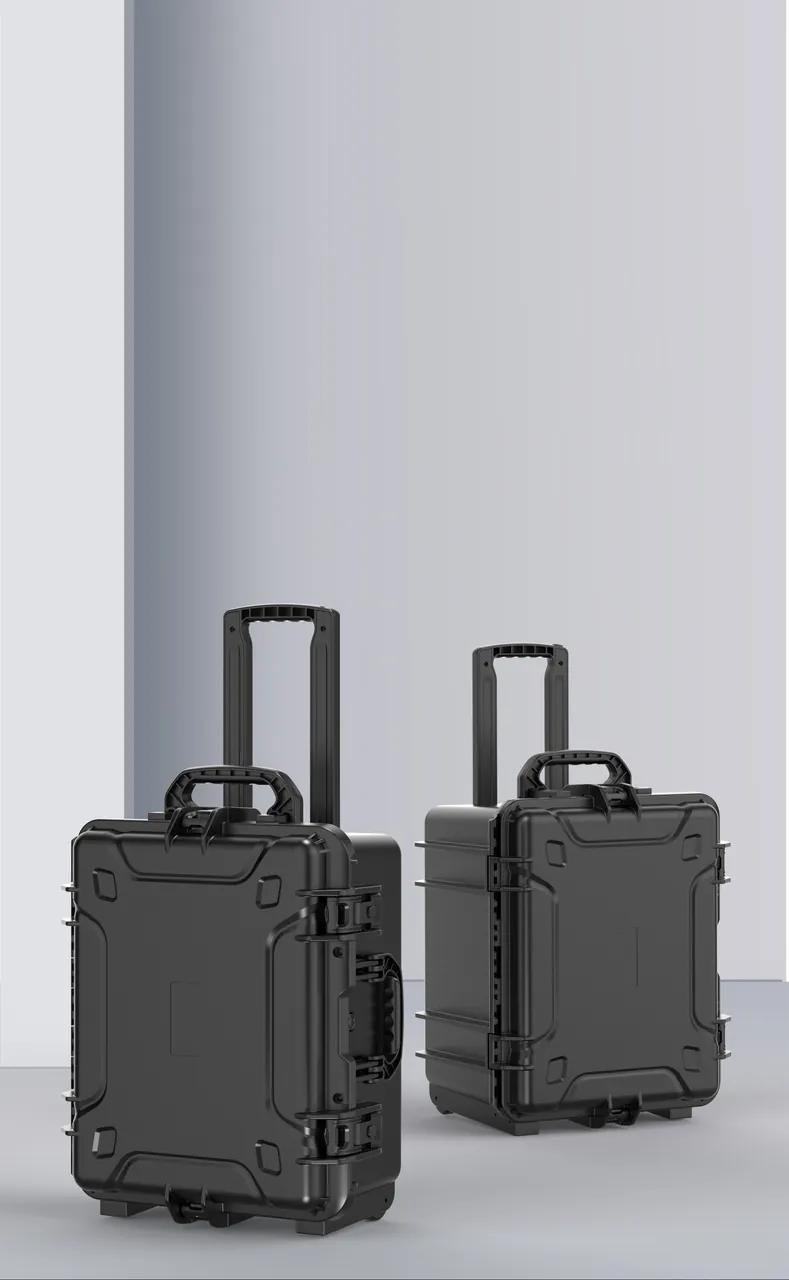
Arrival inspection checklist, to be signed item by item.
- Case exterior: cracks, deformation, signs of moisture; latches and hinges intact;
- Humidity indicator: colour within the permitted range, checked before opening;
- Desiccant: condition and quantity as expected;
- Markings: no tilt or shock indicator triggered;
- Precision instruments: handpiece idling noise and speed normal; ultrasonic handpiece output normal;
- Imaging equipment: normal imaging with no artefacts or dead pixels;
- Structural parts: chair movement smooth with no abnormal noise; load and limit blocks not displaced;
- Surfaces: no scoring, compression marks or colour migration on paint, chromium plate or upholstery;
- Small parts: compartment box verified compartment by compartment against the list;
- Documents: manual, certificate, warranty documentation and calibration records complete.
A field practice: use three-point comparison. Record key functional baseline values before packing, for example handpiece idling noise, chair movement and an imaging check; photograph the packed case; then re-measure the same set of indicators on arrival. The three data sets form a complete chain of responsibility and cleanly separate incoming issues, packaging issues and transport issues.
Pre-installation preparation. After arrival and before installation: remove all packaging materials and clear the installation area; check for transport restraints that must be removed, as forgetting to remove a transport restraint is a frequent cause of abnormal chair movement; check that lines and connectors are clean with no foreign matter; complete installation and first power-up according to the manual; have any electrical safety items performed by qualified personnel; and complete and file the installation record.
13. Sea Export, After-Sales Parts Circulation and OEM/ODM Customisation
Five key variables in sea export. First, route duration of 30 to 45 days means desiccant must be calculated from internal free volume and days, with the hygroscopicity of paper manuals, timber pallets, leather upholstery and textiles all counted. Second, day-night temperature differences inside the container cause condensation, so a pressure equalisation valve is recommended. Third, deck carriage and open-air storage bring salt fog exposure, so the corrosion protection class of chromium plate, aluminium parts, fasteners and metal hinges must be raised, and galvanic corrosion where stainless and carbon steel touch must be addressed. Fourth, sea freight usually stacks higher, so compression strength must be calculated for the worst stacking case, and chair upholstery and light arms are the weak points in compression and should not carry stacking loads directly. Fifth, wooden export packaging must meet ISPM 15 heat treatment or fumigation; plastic cases avoid this issue but raise questions about destination-country requirements for packaging materials and recyclability. Finally, sea freight normally connects to local truck delivery, and the handling shock in that last short leg is often the most severe of the entire route.
After-sales parts and warranty returns. Dental after-sales operations move large volumes of spare parts, including handpieces, motors, sensors, lights and panels, together with warranty returns. This circulation has three characteristics: small batches, high frequency and tight deadlines. Recommended practice: build a "standard returnable case plus replaceable insert" system, covering most parts with two or three standard case sizes; customise inserts by part type, with one set each for handpieces, sensors and lights; operate separate tracks for new parts, service parts and disposal to avoid cross-contamination; and apply an "incoming protection" standard to warranty returns so that returned items are not damaged a second time in transit. That last point is frequently overlooked and is a common source of responsibility disputes.
Returnable re-use and criteria. Six checks before reissue: cracks, deformation and delamination in the case, with particular attention to corners and base; gasket hardening, cracking, debonding or permanent compression set; latches and hinges that close reliably with even perimeter load distribution; insert collapse, fracture, contamination or shedding; compartment box damage or missing compartments; and wear on castors and trolley handles where fitted. Any failed item means replacement before reissue, with criteria along the lines of protective case service life assessment. A specific warning: a case previously used for waste fluid, contaminated instruments or chemicals must have all inserts and gaskets replaced and complete cleaning assessment before being used for new equipment.
OEM and ODM customisation. Dental equipment cases fall into a category with many models, small and varied components, and high appearance requirements. A sensible procurement strategy is built around "standardised case, customised insert": cover most models and spare parts with two to four standard case sizes, then adapt specific components with custom inserts, spreading tooling cost. For tooling cost structure, see custom case mould cost analysis.
Six dimensions for evaluating a supplier.
- Tooling and design capability: can they produce a zoned insert proposal from 3D data or physical patterns, especially curved support for chair upholstery and full-surface support for thin flat panel detectors?
- Materials and process: foam density and batch consistency, compression set of low-rebound materials, gasket profile and hardness, low-migration surface protection materials, and disinfectant tolerance.
- Infection-control support: can they provide statements on insert cleanability and disinfectant tolerance, and a track identification and colour scheme, since colour-coding clean, service and disposal tracks is the most visible management control available?
- Test capability: can they provide records for vibration, drop, stacking, water ingress and temperature and humidity cycling?
- Capacity and delivery flexibility: peak-season elasticity, schedule reliability, and response speed on small spare-part orders.
- Quality system and sampling rules: defined sampling rules and nonconforming product handling, along the lines of the sampling logic in custom case acceptance and AQL sampling.
Enquiry checklist. A practical enquiry should include: model and configuration list with options and dimensions; single-unit weight and centre of gravity; packing format, complete or broken down, with a breakdown parts list if applicable; transport mode and route including transhipment; re-use cycles; storage environment; target IP rating; infection-control and disinfection requirements; surface protection requirements; test requirements; marking requirements; annual volume and delivery cadence. The more complete the input, the closer the proposal comes to being ready for production. For supplier selection method, see how to choose a protective case OEM factory.
JUNZHJIA's standard approach for dental equipment cases is: accept 3D data or physical tooling patterns, produce a zoned insert proposal with chair locking and load-bearing configuration recommendations, confirm with a first-article trial assembly, move to volume production with sampling inspection, and supply material declarations and test documentation alongside. For customers with recurring demand, a model file can be established so that repeat orders for the same model re-use the approved configuration directly.
Frequently Asked Questions
Q: Why does dental equipment look undamaged on arrival yet show functional faults after installation?
A: This is the most typical failure pattern in dental equipment, and it comes from the concealment and delay of the damage. Three mechanisms dominate. The first is bearing damage: the radial clearance in a high-speed handpiece bearing is measured in microns, and axial shock in transit leaves a raceway dent that destroys the oil film. At installation the instrument turns and appears normal, but within weeks of clinical use noise increases, speed fluctuates, temperature rises and cutting efficiency falls. The second is electrical and connector damage: vibration produces micro-cracks in board solder joints or intermittent connector contact, and the fault may not appear until after a period of operation with thermal cycling and vibration. The third is accumulated stress damage: flat panel detectors, acrylic parts and glass components that experienced bending or point-contact pressure in transit develop micro-cracks that then propagate under load or temperature change after installation. The answer is to change the acceptance criterion from "visually intact" to "functionally intact". Use a three-point comparison: record key functional baseline values before packing, such as handpiece idling noise and speed, chair movement, an imaging check and ultrasonic output; photograph the packed case; then re-measure the same indicators on arrival. The three data sets form a complete responsibility chain and separate incoming issues, packaging issues and transport issues, which removes most of the grounds for dispute.
Q: Should a dental unit be shipped complete or broken down?
A: In most cases breaking down the critical assemblies, packing in zones and installing on site is better than shipping complete, though the decision depends on the specific model and transport distance. Shipping complete has three drawbacks. The centre of gravity is offset from the geometric centre and there are many cantilevers, so the tray bracket, light arm and monitor arm act as levers during vibration, amplifying shock before it reaches joints and fixings. Volume utilisation is poor, raising freight cost significantly. And the case must be very large, which multiplies the difficulty of surviving drop and stacking loads, raising both case cost and risk. Breaking down allows long members and precision parts to be packed separately, greatly reducing lever amplification and volume. A typical breakdown list includes the operating light and arm assembly, the monitor, the instrument tray and tray bracket, the foot control, the cup filler and some tubing assemblies, while the chair body keeps the minimum necessary structure locked in the transport position. The trade-off is additional on-site installation work, so on-site installation capability and labour hours must be assessed. For short transport, such as distribution between dealers within one city, shipping complete is workable, but the chair must still be locked in the transport position and load-bearing blocks must carry the weight; upholstery and actuators must never carry the static transport load.
Q: Why can a high-speed handpiece not simply be wrapped in bubble wrap and put in a carton?
A: Bubble wrap in a carton can meet the basic requirement of not breaking the housing, but it has three structural shortcomings for high-speed and contra-angle handpieces. First, it provides no deterministic positional constraint. Once wrapped, the instrument can still move inside the carton and repeatedly touches the carton walls under vibration, producing cumulative wear and surface marking; mutual collision between several instruments in one carton is a primary damage pathway. Second, compression set is high. Bubble wrap flattens under prolonged stacking and loses support, leaving the instrument only half-restrained, so shock passes straight into the bearing. Third, there is no control over the direction and form of loading. When an instrument rests diagonally or on only one or two contact points, vibration applies a bending moment to the head, deforming the chuck and ovalising the bur hole, and fatiguing the tail connection. The correct approach is individual cavity per instrument, surface or line support, low-rebound material and separated accessories: each handpiece in its own locating cavity touching no other instrument or hard object; support running along the body in two points or a line so no bending moment forms; low-rebound EVA or PU rather than high-rebound foam, since high-rebound foam returns energy to the instrument; and burs, chuck wrenches, O-rings and tail tubing in a separate compartment box. For high-value instruments, the cost of a custom insert is normally far below a single after-sales replacement plus the cost of a dispute.
Q: What is the most common and most expensive mistake in flat panel detector transport?
A: The most common and most costly mistake is incorrect support, and it appears in two extremes. The first is four-corner support with the centre spanning free: only the corners or edges of the detector are supported, the large central area is unsupported, and self-weight plus vibration creates bending stress that can micro-crack the glass substrate and scintillator layer. The resulting damage usually appears as artefacts at fixed positions in the image, cannot be repaired, and means replacing the entire detector. The second is central point contact: a hard protrusion, screw head or stray small part inside the insert or on the case floor creates a local point contact, concentrating stress and again damaging the panel. The correct method is full-surface support across the entire back face: the insert's support surface should conform to the rear of the detector as a continuous, flat, bump-free surface so the load is distributed evenly. Beyond support, three other common errors apply. Stacking, whether placing other components on the detector or stacking the case itself. Inversion and tilt, since some detectors have explicit attitude requirements, so the case should carry prominent marking and the insert should be mistake-proofed so that the detector only fits in the correct orientation. And moisture, since the detector contains precision electronics and optical layers, so a desiccant and humidity indicator card should be fitted and the indicator checked before deciding to open the case.
Q: Besides conventional vibration and drop tests, what else should dental equipment packaging validation include?
A: Add three specific items to the conventional physical tests of random vibration, shock and drop, stacking, temperature and humidity cycling, salt fog and water ingress. First, functional checks, which are what distinguishes dental equipment from general industrial goods. After vibration and temperature and humidity testing, check that chair lift and backrest movement is smooth with no abnormal noise; that handpiece idling noise and speed are normal; that ultrasonic handpiece output is normal; that imaging equipment produces normal images with no artefacts or dead pixels; that cables and connectors are secure; that water and air circuits are clear with no leakage; and that paint and upholstery show no compression marks or colour migration. Acceptance criteria must be led by functional indicators and supported by appearance. Second, a low-temperature test to validate plastic embrittlement and the compression behaviour of stiffened upholstery, using methods along the lines of MIL-STD-810H method 502; citing that method does not mean any military certification has been obtained. Third, a pressure change test to validate gasket behaviour under differential pressure from temperature change and the ease of opening the case, which matters especially where a pressure equalisation valve is fitted. If the product is exported, also confirm whether the test report must come from a third-party laboratory with an English version, and state sample quantities, load condition and acceptance criteria in the contract technical annex.
Q: How should infection control be managed for returnable dental equipment cases?
A: Three things matter: separate tracks, cleanability by design, and records. First, separate tracks. Divide cases into a clean track for new equipment dispatch, after-sales new parts and sterilised instruments; a service track for warranty returns and used parts going back to the factory; and a disposal track for scrap parts and consumables. Cases, inserts and gaskets are not shared between tracks. The most visible implementation is to use different case colours or colour bands and to print the track name on the case, so the packing line does not have to rely on memory. If a track change is unavoidable, replace all inserts and gaskets, complete cleaning and residue assessment, and obtain infection-control or quality sign-off. Second, cleanability by design. Choose materials that resist common disinfectants, such as 75 percent ethanol, quaternary ammonium compounds and hydrogen peroxide products, without significant ageing; use inserts that do not shed, do not absorb water and do not support microbial growth; and avoid complex crevices and recesses, because areas that cannot be cleaned become contamination reservoirs. Note that chlorine-based disinfectants carry corrosion risk for stainless steel and some metals and stress-crazing risk for certain plastics, so compatibility should be confirmed first. Third, records. Keep a register of case serial number, cycle count, each use, cleaning records and inspection results. Dental equipment contacts oral mucosa, blood and saliva directly, and the completeness of infection-control records is usually an explicit item in institutional audits.
Q: How should the IP rating be chosen for a dental equipment case, and is higher always better?
A: No, choose by actual exposure, and understand what the rating does and does not do. For domestic road transport, covered storage and indoor circulation, IP54 to IP65 is usually sufficient. For sea freight, open-air transhipment, rainy regions or high salt fog, IP67 is recommended. Three points to note. First, an IP rating guarantees only that external water does not enter; it does not mean condensation will not form inside, and the genuine risk for dental equipment is often internal humidity causing corrosion, insulation loss, optical fogging and mould. The combination of sealing, desiccant and a humidity indicator card is therefore more effective than raising the IP rating alone. Second, a higher sealing class means a larger differential pressure as temperature changes, which makes the case harder to open and can draw the gasket inward and deform it; in that situation a pressure equalisation valve is more practical than a higher IP rating. Third, desiccant quantity must be calculated from internal free volume, the hygroscopicity of packaging materials, transit days and target humidity, and cannot be decided by tossing in a few packets; paper manuals, timber pallets, leather upholstery and textiles all absorb moisture and consume desiccant capacity and must be included. If a tender document specifies an IP rating, follow the document and require the supplier to provide the corresponding test record, and remember that IP rating and GB 9706 electrical safety validation are two independent systems.
Q: We distribute complete units, spare parts and warranty returns. How can packaging cost be controlled?
A: The core approach remains standardised cases, customised inserts, separate tracks and part numbering. First, standardise cases into two to four sizes by volume and load, covering most models and spare parts and spreading tooling cost across many SKUs. Second, customise inserts by component while keeping the internal cavity common so inserts are interchangeable, reducing inventory and switching cost; high-frequency spare parts such as handpieces, sensors and lights can each have a dedicated insert ordered by drawing number. Third, operate separate tracks for clean, service and disposal so cases and inserts are not shared, with colour coding as the most direct management control. Fourth, build a packaging file for each model containing 3D data, insert drawing number, breakdown parts list, packing photographs and test records, so repeat orders for the same model can reuse it without re-tooling. Fifth, include re-use cycles in cost accounting: single-trip packaging is costed per unit, while returnable packaging is costed as unit price divided by cycle count plus maintenance, with consumables such as gaskets, desiccant, inserts and compartment boxes included. Sixth, a specific note on warranty returns: the incoming packaging standard for a returned item must not be lower than for a new item, because second damage to a returned item in transit is harder to attribute and this cost is routinely underestimated.
Conclusion and Further Reading
Dental equipment transport protection is fundamentally about protecting precision that cannot be seen: the oil film inside a handpiece bearing, the pixel array in a sensor, the glass substrate of a flat panel detector, and the fitted surfaces of chair frame joints. None of these shows damage in an appearance inspection, yet all appear at installation or early in clinical use as noise, temperature rise, artefacts, dead pixels and sluggish movement. A dental equipment packaging plan must therefore be designed along three parallel chains: use individual cavities and surface-contact support first to isolate precision parts from shock; then use draining, capping, desiccant and pressure equalisation to control humidity and corrosion; then use separate tracks, cleanable materials and record registers to satisfy infection-control compliance.
The implementation path compresses into five steps: define the component list and the fragile points; determine the breakdown plan and locking method; design the case, insert and restraint structure by zone; close the loop with transport testing plus functional checks; and manage circulation with separate tracks and a register. Follow these five steps and the risk of "arrives intact, fails after installation" is reduced to a minimum.
If you need a zoned insert proposal with chair locking and load-bearing configuration recommendations for a specific model, provide the 3D data, component list and transport mode to JUNZHJIA, and we will produce a model-specific drawing package and arrange a first-article trial assembly so that the packaging plan can go directly into production.
Further Reading