

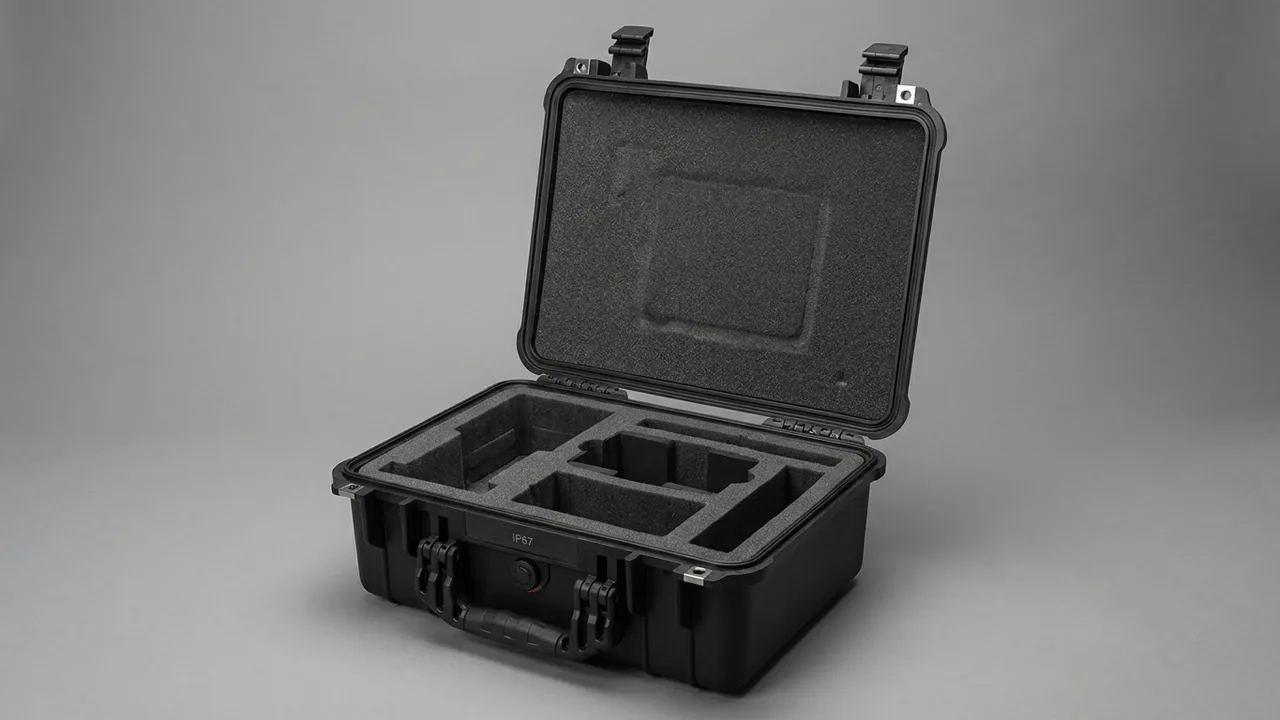
Under the pharmacy automation wave, the six-axis arms, servo modules, vision cameras and drug cassette trays of dispensing robots have become high value and fragile transfer objects. The core conclusion: a protective case for dispensing robot arms and cassettes must simultaneously satisfy clean contamination exclusion and impact-vibration protection, and add electrostatic protection for electronic modules, so parts can move safely among hospitals, pharma plants and service centers. This article follows the thread of dispensing robot case, pharmacy automation case, arm shipping case, cassette component case and medical automation case to explain transport protection design for arm joints, cables, encoders and cassettes, helping purchasers and engineers build a deployable selection standard.
Dispensing robots rarely ship whole with the line. Spares and retrofit parts move as loose items: a single stoppage may replace only a wrist module or a set of cassettes. These parts integrate optics, electronics and precision mechanics, so bare handling or ordinary cartons easily cause encoder zero loss, cable jacket wear and cassette grid deformation through vibration. Configuring the case as a mobile clean cabin for precision parts is a key step in lowering pharmacy automation operation cost.
Table of Contents
- Fragile points of arm and cassette transport
- Dual requirement of cleanliness and impact protection
- Arm joint and cable protection
- Cassette tray placement design
- Main body material and lightweighting
- Electrostatic discharge considerations
- Insert zoning and cushion structure
- Sealing dust exclusion and rating
- Temperature humidity and condensation
- Handling stacking and fixation
- Transport environmental test verification
- Receiving inspection and cleaning maintenance
- OEM/ODM and global supply
- Application scenarios and selection checklist
Fragile points of arm and cassette transport
The fragility of a six-axis arm concentrates in the wrist harmonic reducer, encoder and brake holding mechanism. If transit vibration exceeds tolerance, the harmonic tooth face may suffer micro plastic deformation, causing repeatability deviation after homing. Encoder cables if crushed cause signal jitter or even open circuit. The cassette is a thin-wall injection or aluminum grid whose cell tolerance is tight; compression causes jamming or scratches the drug box barcode, directly hurting dispensing accuracy.
On electronics, servo drives, vision cameras and main boards are static sensitive; charge from ordinary foam friction can damage sensitive devices. Thus the protection thinking of the pharma machinery parts case must cover both mechanical impact and electrical static lines, which is what distinguishes a dispensing robot case from an ordinary tool case.
From operation view, spare transport damage directly lengthens pharmacy downtime. A dispensing robot down during outpatient peak affects real patient pickup, so the case should target box-open-and-install, minimizing post-arrival calibration and commissioning time.
Dual requirement of cleanliness and impact protection
Dispensing scenes sit in hospital IV rooms or pharma clean zones, where part surfaces if stained with fiber or dust need re-wiping or even sterilization before entry. The case acts as a clean barrier: wipeable disinfectant inner bay, low-outgassing non-shedding liner, double seal at the mouth. Meanwhile metal arm joints fear impact and need hard foam cavity constraint. The two demands seem contradictory but resolve through outside-hard-inside-soft and zoned isolation.
At standard level, hygienic grade references GMP, ISO 14644 cleanliness and the hygiene logic of GB 14881; transport reliability uses GB/T 4857, ISTA and ASTM D4169 for quantified verification. Note that MIL-STD-810H, a military standard, is borrowed in this plan only as a method reference for temperature, humidity, vibration and shock trials; the product is not military certified.
For cassettes directly contacting drug, also note food contact material compliance, borrowing the contact surface management of the food packaging machine case to avoid liner extractables contaminating drug boxes. Balancing cleanliness and impact is the master line of every following section.
Arm joint and cable protection
During transport, fix the arm at neutral or the maker specified lock posture to stop joints swinging and amplifying shock. Support the wrist module with stepped foam, add a soft contact layer on the harmonic reducer shell to spread pressure; route cables in a tray after coiling, forbid sharp bends, and cap connectors with dust-moisture covers. The encoder and brake area can be locally wrapped with conductive foam from the ESD shield case to bleed transport friction charge.
For arm-end vision cameras, give the lens a hard shell sleeve placed inward to avoid coating pressure damage. Servo drive boards deserve an independent small bay, static shielded and separated from metal joints. The whole arm insert becomes a removable module so the main bay and liner are cleaned separately, extending case life.
Experience suggests 45 to 60 kg/m³ closed-cell PE foam for arm class parts with an EVA thin layer at contact; cable trays use open-cell soft foam. All foam should provide low outgassing and ESD surface resistance tests, important where hospital electromagnetic environments are complex.
In practice a wrist module rarely travels on its own. It ships with an alignment gauge, a zero-position pin and a small set of shim plates, and a replacement arm that arrives without that tooling cannot be commissioned on site. Cut a shallow tray for the calibration set into the same liner block so the gauge lies flat and the pins sit in drilled sockets instead of rolling loose among the cables. If the robot carries a tool changer or end flange, give it a separate recess with the mating face upward under a capped sleeve. Keeping the gauge with its matching arm module in one case also stops a multi-site spare pool from splitting the pair.
Cassette tray placement design
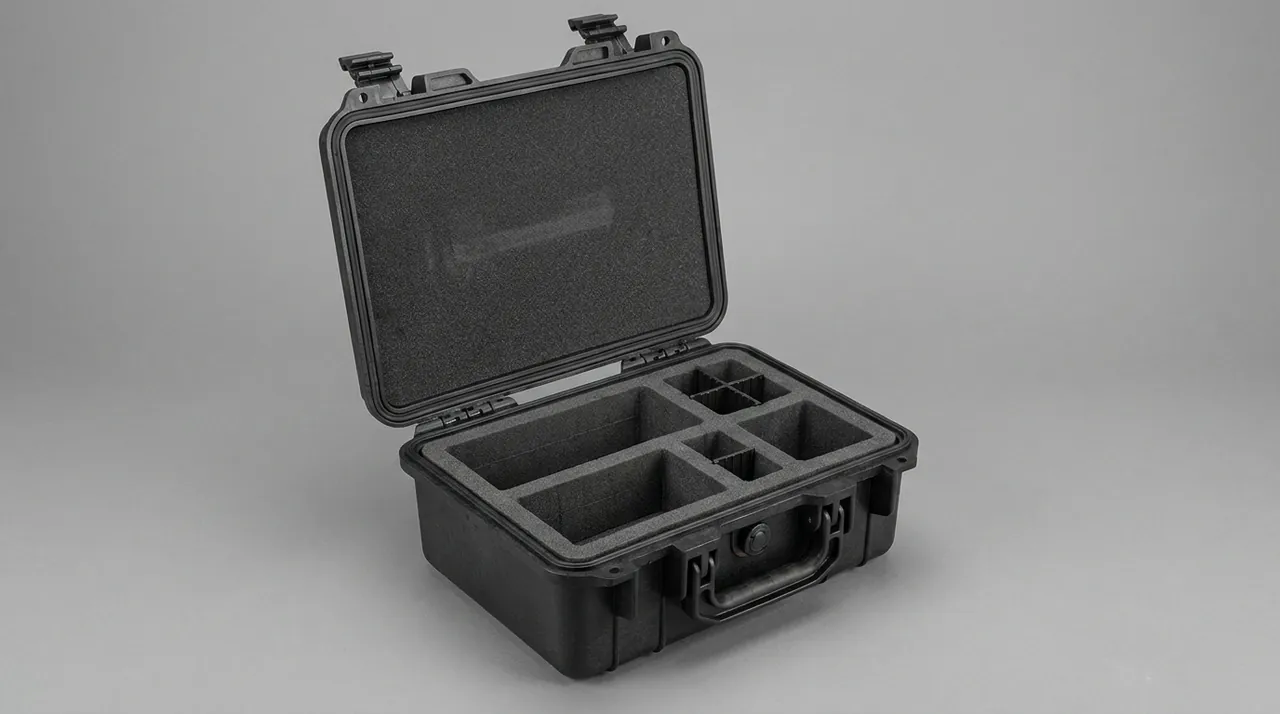
The cassette is the ammo library of a dispensing robot; cell precision decides dispensing accuracy. The transit liner should give each cassette an independent slot, slot walls lined with anti-static velvet or medical silicone to prevent mutual scratch of barcodes; stacked cassettes get interlayer partitions to avoid creep from weight. The photoelectric sensor window on the cassette needs a relief hole, forbidding foam coverage that blocks later self-check.
For irregular cassettes, use CNC carved EVA shaped cavities, achieving lock-on-placement. Borrow the cavity design of the custom foam inserts guide: removal without wall scrape, return without misalignment. Cassettes directly contacting drug packaging need a food grade certified contact layer, with batch material certificates requested at acceptance.
For rotation, make the cassette liner a pull-out tray so hospitals keep several sets rotating for disinfection. This shortens single turnover and avoids one foam set absorbing moisture as a microbial habitat, fitting IV room hygiene management.
Cassette families vary more widely than the arms that serve them. Trays differ in pitch, cell count, cell depth and in where the latch or retention finger that holds the consumables sits, so a liner cut for one tray can leave another rocking on its base. Measure the tray footprint and the tallest cell wall before cutting foam, and leave clearance so the gripper fingers can reach the retention clip without scraping the liner. Where a tray carries an RFID label or a laser-etched code, keep that face open and shallow-relieved so the code stays readable through the case window. When one robot rotates several tray types, cut one cavity per type and mark each with the tray part number.
Main body material and lightweighting
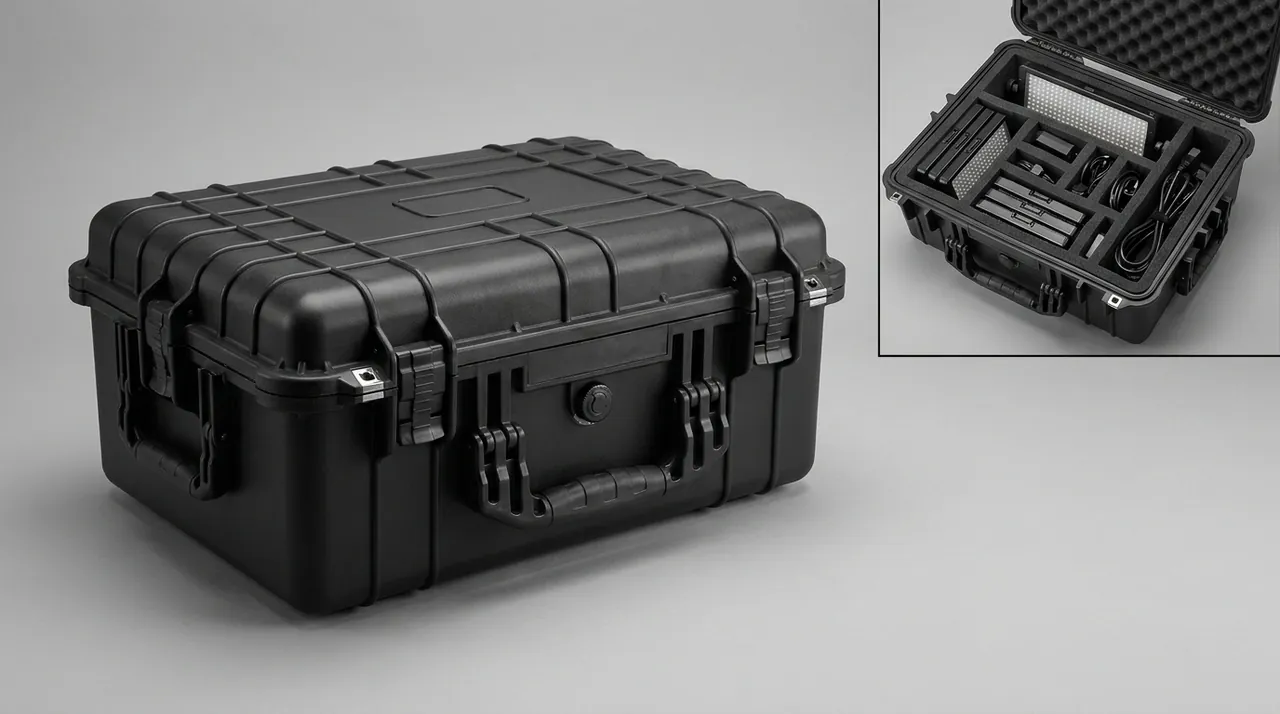
Dispensing robot parts move short high-frequency trips inside hospitals and between plants, so case weight directly affects caregiver handling. Modified PP injection cases have smooth wipeable surfaces and stable dimensions, suited to standard cassette bays. Aluminum frame engineering plastic cases balance light weight and rigidity, suited to heavier modules with arms for air travel. Rotomolded cases resist impact and form large arm-section bays but need a smooth anti-bacteria inner liner.
Whatever the body, contact surfaces avoid recycled mix and provide a material declaration; the outer surface uses a disinfectant tolerant non-porous coating. Latches and hinges follow the hygienic approach of case hinge latch seal using passivated stainless hardware to reduce dirt traps. Cross-border shipments with wooden liner supports must meet ISPM 15 treatment and carry the IPPC mark.
The table compares three bodies in the dispensing robot scenario for equipment makers to weigh by part mass and transfer radius.
| Shell type | Fits | Mass | Clean | Shock | Note |
|---|---|---|---|---|---|
| --- | --- | --- | --- | --- | --- |
| Modified PP molded | Cassette bay, small arm | Light | Excellent | Medium | Pull-out tray |
| Aluminum framed | Wrist module, servo | Lighter | Excellent | High | Latch passivated |
| PP/PE rotomolded | Large arm, loose parts | Medium | Good | High | Liner smoothed |
Case mass matters more than it appears. Staff move spares by hand or on a trolley between a store, a lift and the clean zone, so a loaded case above roughly 20 to 25 kg tends to be dragged rather than lifted, and dragging is what breaks latches and tears liners. Agree a target mass per case with the end user, then pick the body and trim the foam to meet it; when the payload itself is heavy, split the shipment into two lighter cases instead of building one large one. Molded handles should sit near the balance point of the loaded case, and a shallow rib under the base protects the shell when it is set down on a concrete dock.
Electrostatic discharge considerations
Dispensing robots contain many electronic devices; transport static comes from foam friction, dry air and fast opening. Four countermeasures: first, liner uses anti-static foam or conductive cloth at 10^6 to 10^9 ohm surface resistance; second, the case configures a conductive inner bay with ground braid from the ESD shield case; third, put anti-static wipes or humidity cards when air is dry; fourth, operators wear wrist straps and discharge before opening.
Servo drives and boards deserve an independent shielded small bay with conductive foam walls and conductive dust caps on connectors. All ESD materials should provide surface resistance and decay time tests noted in files. For hospital IV rooms, parts install on opening, so ESD failure often shows later as intermittent communication errors, making transport static control a must in incoming inspection.
Note that anti-static and cleanliness do not conflict: low-outgassing anti-static foam serves both. Avoid carbon-coated sponge that sheds powder for static control, which sacrifices cleanliness and breaks the medical hygiene baseline.
Static behaviour changes inside a clean zone. Low humidity plus fast air from a laminar flow unit raises charge generation, while the gowning worn in the area stops the wearer from acting as a natural ground path, so an operator who would be safe in a workshop can carry a damaging charge to the case. Specify liner foam with a documented surface resistance range under IEC 61340-5-1 rather than a general anti-static claim, and ask for the dissipation time as well, because a material that bleeds charge slowly is of little use if the module is unpacked within seconds. A grounding braid bonded from the inner bay to the outer shell gives the charge a defined route away from the electronics.
Insert zoning and cushion structure
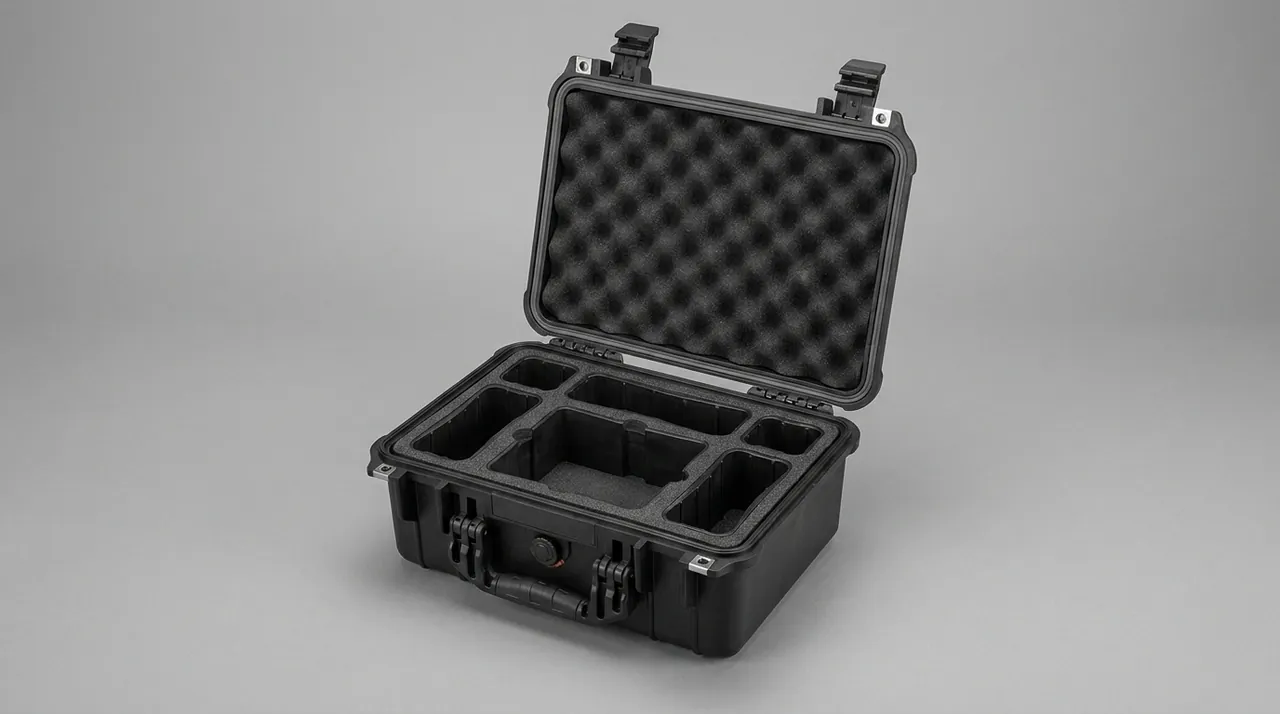
The dispensing robot case should give one cavity per object: arm, cassette, cable and electronic module each zoned, heavy parts below and light precision above. Zoning uses removable foam modules: the main bay splits into cells, each CNC carved to the part model. Cushion uses density gradient: hard support layer, soft contact layer, limiting yet decompressing.
Cable trays use soft foam and tie-downs to stop whipping against metal joints. Cassette bays use pull-out trays with velvet walls. Modular liner lets you replace only one contaminated or aged cell instead of scrapping the whole case. The structure references the gradient cushion thinking of the cushion liner case.
Zoning also aids traceability: each cell tags the part label and serial position for instant check on opening, avoiding mix-up. For multi-cassette orders, zoning prevents different-spec cassettes pressing each other deformed, protecting the core dispensing accuracy metric.
Sealing dust exclusion and rating
Hospitals and pharma are clean, but transit suffers ordinary trucks, freight elevators and warehouses where dust is inevitable. A paired sealing scheme is used: a foamed silicone main gasket seated at the lid, plus a compression gasket pressed by the latch, with the IP67 goal per IEC 60529 and GB/T 4208 against dust and short-time soaking. High assurance batches may add a one-time dust cover inside.
The seal must tolerate 75 percent ethanol and peracetic acid without releasing contaminants; it should be replaceable. Beyond dust, air tightness slows inner micro-environment change during temperature swings. On seal selection see the IP67 protective case.
State clearly that IP rating is enclosure protection not sterility assurance; the case lowers particle entry probability, and final clean release still follows the user cleaning and sterilization flow, avoiding quality files misreading transport protection as sterile packaging.
Temperature humidity and condensation
Arm lubrication and electronic modules are humidity sensitive; cassette barcodes blur with water. Cross-climate transport causes inner wall sweat that rusts joints and shorts boards. Countermeasures: a temperature humidity logger with alarm inside; a desiccant bay between layers for humidity control; a low-conductivity or insulated inner body to slow temperature change. For cold-chain linked modules, borrow the cold accumulation layout of the cold chain food case, but electronics fear freezing, so prioritize temperature control.
Before opening, rest the case in a clean buffer room until temperatures equalize to prevent sudden sweat. The recorded log stays with the case as proof of transit conditions; for valuable modules a Bluetooth logger that writes CSV lets the team review trends and pulls transport validation deeper into the supply chain.
Handling stacking and fixation
A dispensing case must never be thrown or stacked deep. The top face carries the usual handling pictograms plus the centre-of-gravity symbol agreed with the courier, because a loaded arm case turns top-heavy the moment a wrist module is aboard. The tier limit is taken from the compression figure measured in the GB/T 4857.3 stacking test and then reduced by a working safety factor. Inside, the foam block is cut slightly smaller than the bay and strapped down so that a hard brake cannot walk the whole insert, arm included, towards the lid; when an arm section, a cassette set and a servo bay share one shell, the heavy joint blocks go to the bottom, the cassettes sit above them behind dividers, and the light camera and board trays ride on top. Cassettes are laid flat with the cells facing up.
Arm modules that fly are the ones most exposed to cabin altitude, so fit a case pressure equalization valve: without one, the pressure difference across the shell can draw unfiltered air past the gasket or bow the foam until it presses on a lens or a card edge. A case shuttled between two departments on one campus sees no such gradient, but a goods lift or a hospital cart still delivers a sharp jolt, so the foam has to hold the module rigidly and the technician should still glance at every latch and at how the wrist block sits in its pocket before the case leaves the store.
Transport environmental test verification
Prove the design before it is released. Use MIL-STD-810H purely as a laboratory method, never as a military qualification: a random vibration sweep, a drop sequence, a hot-cold thermal cycle and a damp heat soak form the base run, after which the case goes through the ISTA 3E/3H profiles or an ASTM D4169 assurance level agreed with the buyer. The points to watch are foam creep, the appearance of each wrist joint, the condition of the encoder and power cables, any distortion of the cassette cells, whether the servo cards still power up and how clean the bay is at the first opening.
Validation samples take the worst-case configuration, fully loaded with parts at critical placement. After testing, do appearance and function sampling per the custom case acceptance AQL with grading. For pharma or hospital clients, transport validation can join packaging qualification and cleaning sterilization verification for a closed loop.
Testing buys confidence in the design, and it does not replace control of an individual consignment. A released pattern is still despatched with a logger and still gets an opening inspection on arrival. The method itself is described in the GB/T 4857 transport packaging test.
Receiving inspection and cleaning maintenance
Opening the case is the last point at which a contamination or a transport injury can still be caught. Standardise it: park the case in a controlled buffer, examine the shell and the seal for damage, then work through the travelling papers, the material certificate, the test report, the temperature and humidity log and the ESD record, before looking at and wiping the surfaces. A wrist module is wiped with a developer swab or measured with a particle counter, while cassettes go under a light so that the cell walls are seen to be straight and the barcode still reads.
Sampling is run on an AQL plan whose tightest band covers critical defects. Follow the reprocessing rule set out in the protective case cleaning method: if foam has shed or a bay is contaminated, the cell is replaced and the team records whether the module itself was touched. Every opening sheet, photograph and disposition is filed.
Electronic modules get functional recheck on opening: power self-test, encoder homing, cassette self-check pass. Isolate anomalies and notify the shipper using transport records to trace, avoiding injured parts installed and affecting dispensing.
A reusable case carries a cleaning SOP as well. Start inside the bay: wipe the liner walls with a lint-free cloth and 75 percent ethanol or an approved disinfectant, and never reach for an aggressive solvent, which will attack the silicone foam and the conductive coating. Foam is renewed on a contamination cycle, with washable anti-static blocks dried at low temperature and the non-washable grades exchanged on the interval the supplier sets. Latch pivots and hinge pins take the lubricant described in the protective case cleaning maintenance so that they neither seize nor shed metal debris into the bay.
Service intervals follow transfer volume rather than the calendar. A case in daily hospital rotation gets a monthly look at its appearance and seal plus a quarterly seal test, while a case coming back from storage is cleaned again and its desiccant replaced. Keep one file per case with the cleaning date, the custodian and the foam batch. Expected life is taken from the published figure for protective case service life, with the shell scrapped or the liner rebuilt at the end of it.
Let the disinfectant evaporate fully before the lid is closed. Chlorinated products are the ones to control, because free chloride eats into the passive layer on stainless joints and shows later as pitting; air the bay dry and finish with a purified-water rinse.
OEM/ODM and global supply
Arm interfaces, cassette footprints and servo bay dimensions differ so widely between dispensing robot brands that no catalogue liner fits them all. Drawing on its experience supplying medical automation equipment, Kexin New Materials (Guangdong) Co., Ltd. provides configurable cases for dispensing robot parts under OEM/ODM and agency wholesale programmes, shipping worldwide and delivering material compliance and cleanliness verification files per purchase contract. Work begins with the customer's own 3D data for the arm joints and trays, from which a fitted pocket set is machined and a part list with a placement drawing is issued alongside the case.
An equipment maker uses OEM mode to include the case in the machine spare kit so that the robot and its spare modules ship together, shortening handover at the hospital. A service provider uses ODM to standardise one tray case across the cassette models it supports, cutting the number of lines it stocks. Global supply gives an overseas hospital the same liner source, so a replacement block matches the one it replaces. The development route follows the custom foam inserts guide together with how to choose a case OEM factory.
At contract level, specify material grade, cleanliness and ESD grade commitment, test document list and non-conformance handling, turning hygienic anti-static transport into a written guarantee, the focus of hospital and pharma supplier audits.
Application scenarios and selection checklist
- Hospital IV room: wrist modules and cassettes sit in cases as spares, swap on stoppage, shortening downtime.
- Pharma automation retrofit: old line arm loose parts move cross-site with in-case placement avoiding secondary damage.
- Return service calibration: servo and vision modules use the same case both ways for comparable state.
- Overseas project shipment: cassette spares exported with machines use aluminum frame cases with desiccant and logger.
- Audit companion: complete material and ESD files make the case visible evidence of supply chain hygiene and static control.
The case value lies not only in no breakage but in always controlled clean anti-static state, supporting medical automation quality culture.
Before fixing a dispensing robot parts case, check item by item: whether the part contains electronic modules and the contact surface meets GB 4806 and ESD; whether the liner is zoned independent and pull-out cleanable; whether the seal reaches IP67 and tolerates disinfectant; whether temperature humidity logging and desiccant are configured; whether an ESD inner bay and surface resistance test exist; whether body material declares and avoids recycled mix; whether drop and random vibration verification passed; whether material, clean and ESD files travel with the case; whether foam replacement and the tooling lead time match the maintenance rhythm; whether any wood crossing a border carries ISPM 15 treatment; and whether the supplier genuinely operates OEM/ODM with a worldwide spares channel.
Checking those eleven against the standards above is what locks a suitable arm and cassette case. Where an answer is unclear, borrow the clean transfer experience of the lab equipment case.
FAQ
Q: Must a dispensing robot arm be fixed at neutral for transport? A: It is strongly advised to fix the arm at the maker specified lock posture or neutral, not letting joints swing free. Three reasons: first, the wrist harmonic reducer of a six-axis arm, when swinging free, lets transit shock amplify to the tooth face and may cause micro plastic deformation, bringing repeatability deviation after homing and hurting dispensing accuracy; second, encoder cables if swung with the joint are easily crushed by metal edges causing signal jitter or open circuit; third, a fixed posture lets the liner cavity use minimal containment, less foam and harder limiting. The exact lock angle should follow the equipment maintenance manual, some models require brake hold powered or a mechanical stop pin inserted. Inside the case, support arm sections with stepped foam, add a soft contact layer on the harmonic shell to spread pressure, coil cables into a tray forbidding sharp bends, and cap connectors with dust-moisture covers. This makes box-open-and-install possible, compressing arrival calibration to the shortest, a top operation metric for hospital IV rooms.
Q: Why does a cassette need an independent slot for transport? A: The cassette is the dispensing accuracy carrier of a robot, with tight cell tolerance; once compressed creep or wall scratch blurs the drug box barcode, it directly causes jamming or scan failure affecting real patient pickup. An independent slot lets each cassette stay in place, slot walls lined with anti-static velvet or medical silicone to prevent mutual scratch, and stacked cassettes get interlayer partitions against weight creep. Irregular cassettes use CNC carved EVA shaped cavities, achieving lock on placement and removal without wall scrape. Cassettes directly contacting drug packaging need a food grade certified contact layer with batch material certificates requested at acceptance, referencing the contact surface management of the food packaging machine case. For hospital rotation, make the cassette liner a pull-out tray with several sets disinfected in turn, shortening turnover and avoiding one foam set absorbing moisture as a microbial habitat. Independent slots also aid traceability: each cell tags label and serial for instant check, preventing mix-up, a key detail in pharmacy automation cost control.
Q: Must a dispensing robot case be anti-static? A: Whenever the case contains servo drives, vision cameras, encoders or main boards, anti-static treatment is mandatory because transport foam friction, dry air and fast opening accumulate static, and ordinary foam friction charge can damage sensitive devices, with failure often not showing on opening but later as intermittent communication errors hard to trace. Means include liner anti-static foam or conductive cloth at 10^6 to 10^9 ohm, a conductive inner bay with ground braid, anti-static wipes in dry environments, and operators wearing wrist straps before opening. Servo and boards deserve an independent shielded bay with conductive foam walls and conductive dust caps, providing surface resistance and decay time tests. Note anti-static and cleanliness are compatible using low-outgassing anti-static foam; avoid carbon-coated shedding sponge that sacrifices medical hygiene. Static control should enter hospital incoming inspection rather than rely on site luck, because the cost of a hidden ESD fault appears months later as mysterious reboot.
Q: How to fix cables inside an arm case safely? A: Safe cable fixation forbids sharp bends, free whipping and crushing by metal joints. In practice, before transport coil cables at the original minimum bend radius into a loop, place into the liner reserved cable tray, limit with open-cell soft foam; cap connectors with dust-moisture covers clicked into dedicated slots to avoid loosening. Encoder and brake thin wires can be locally wrapped with anti-static conductive foam to bleed friction charge. Multiple cables should be slotted and layered, separating power from signal lines to reduce interference and mutual wear. After opening, first visually check the cable jacket for crush marks or cracks, then power self-test and encoder homing, isolating anomalies. Cable tray material must also be low outgassing and non-shedding, removable with the liner module for replacement. Treating cables as the nerve of the arm is one essential difference of a dispensing robot case from an ordinary tool case, and hospital operation should put it in the opening checklist.
Q: How to treat wooden skids for cross-border robot part shipment? A: If the case interior or outer skid uses wood, it must be treated per ISPM 15 the International Standard for Phytosanitary Measures, usually methyl bromide fumigation or heat treatment with the IPPC mark stating treatment and country code, or destination customs may reject or destroy the whole wood packaging. Shells moulded in plastic, or built on an aluminium frame, already sit outside the reach of ISPM 15; it is the solid-wood crate added around them that restores the duty. Keep the treatment certificate with the shipping papers next to the material declaration, and remember that hospital and pharma supply chain audits fold wood compliance into their biosafety review. For high value arm modules, prefer an all-plastic or aluminum frame solution to fully avoid wood risk while cutting weight and freight. If heavy parts force a wood skid, confirm bark-free wood and clear marks, photograph before packing. Check that every visible wood face carries a legible mark, since a stamp hidden under a stacking batten is treated as missing at the border. Wood compliance looks like a minor detail, yet at the border it is an absolute gate for a rejection-free record, and it should never be left to chance.
Q: How to accept a delivered dispensing robot case? A: Create a fixed opening routine before the case enters the clean area. In a clean buffer, first inspect the outer case and the seal for damage, then confirm the paperwork that travels with it: material certificate, test report, temperature humidity record and the ESD report, and only then do a visual and wipe check of the surface. Critical arms are checked with a developer wipe or a particle counter; cassettes get a light-pass check of cells and barcode clarity. Apply AQL sampling with strict limits on critical defects, grading by the custom case acceptance AQL. Electronic modules need a functional check on opening: power self-test, encoder homing and cassette self-check should all pass. If the liner sheds or shows contamination, change it and decide whether the part was affected, then file every opening record, photo and disposition. Lifting the check from a quick look at the outside to a triple verification of document, surface and function is what makes hygienic anti-static transport real, and it gives hospital and pharma supplier audits the evidence chain they rely on, while keeping injured parts from being mounted and hurting dispensing accuracy.
Q: What is the lead time for OEM custom robot cases? A: The schedule is set by how quickly the arm and cassette pockets can be developed. The supplier takes the part 3D models, machines a fitted foam cavity and samples it; a simple cassette pull-out tray turns round in a few working days, a cavity that has to carry arm joints and a shielded servo bay takes longer, and a new aluminium frame tool takes longest of all. Drawing on experience in medical automation, Kexin New Materials (Guangdong) Co., Ltd. runs OEM/ODM and agency wholesale with worldwide shipping, and can fix material grade, cleanliness and ESD grade, the test document list and the non-conformance route in the contract. Equipment makers should feed the case into the machine project plan early so that an unfinished liner does not block the shipment, and service organisations that keep standard cassette cases for the common models shorten the wait when a unit goes down at an awkward hour. When the lead time is discussed, ask also how the supplier repeats a foam spare, because a hospital able to reorder an identical block years later avoids revalidating its transport method, and that repeatability is the practical face of global supply capability.
Q: Can the case serve as a clean holding cabinet for long-term cassette storage? A: Not equivalent, and the distinction matters here. The case is a mobile clean cabin and a barrier against shock and static on the road; an IP figure only describes how well the shell keeps dust and water out, so it says nothing about sterility. Once the lid is lifted, a cassette still has to pass the workshop cleaning and sterilisation route before it is loaded. If the case is parked in the department for a short interval it must meet several conditions: the bay can be wiped with disinfectant, the anti-static foam set lifts out, the shell is labelled to a fixed storage position, and the room already holds the required cleanliness class. Anything longer belongs in a validated clean cabinet, with the case returning to transport duties. Quality files have to state that boundary so ward staff do not read road protection as sterile packaging, and because a cassette touches the drug path its contact layer should be food grade PE or medical silicone.
Conclusion and further reading
Transport protection for dispensing arms and cassettes is one link of the medical automation hygienic supply chain: right material, zoned anti-static, held seal and kept records push transit contamination, impact and static risk to a minimum. Kexin New Materials (Guangdong) Co., Ltd. engineers such cases to demand, offering OEM/ODM customization, global agency wholesale and contract-period material and cleanliness verification files.
Related reading