


Grain drying equipment works continuously under a triple burden: high humidity, large temperature swings, and heavy dust. Those same three factors define the transport protection problem for its spare parts. The conclusion first: grain dryer parts are a mixed load of dynamically balanced parts, precision shaft system parts, and electronic parts. They must be packed with moisture control as the core and vibration control as the frame, using sealed cases, rigid locating inserts, and desiccant together. Ordinary packaging cannot stop condensation during transit, and the damage condensation does to impellers, chains, and control components usually only appears after the machine is powered up. Once a fan impeller blade distorts or a balance weight falls off, dynamic balance is lost, vibration and noise exceed limits, and bearing life collapses. Once an elevator chain corrodes, it elongates, jumps the sprocket, and may eventually break. Once an online moisture meter or temperature and humidity sensor takes on moisture, its readings drift and the control logic of the whole drying line loses accuracy.
The transport pain points are very concrete. A fan impeller is large in diameter with concentrated mass and thin, brittle blades, so any design that makes a blade a load path distorts it. Buckets are numerous and dimensionally similar, and plastic buckets are brittle. Long shafts and chain runs are long and flexible, so too few support points let them bend or whip under vibration. When equipment ships in the plum rain season in southern China or crosses climate zones by sea, the day-night temperature swing inside a container drives repeated condensation cycles and keeps internal relative humidity in a dangerous band for long periods. This article is written for grain dryer manufacturers, engineering departments of grain depots and drying centres, grain machinery distributors, and OEM/ODM buyers. It covers component grading, case and insert design, moisture control and dehumidification, sealing levels, standard validation methods, and on-site unpacking practice, and explains how JUNZHJIA supports custom inserts and volume supply.
Table of Contents
- 1. Why Dryer Parts Need Cases That Balance Moisture Control and Vibration Control
- 2. Component List and Sensitivity Grading
- 3. Failure Modes: Balance Loss, Chain Corrosion, Bearing Failure and Electrical Moisture Damage
- 4. Humidity and Temperature Difference: How Condensation Happens
- 5. Size and Weight Boundaries: Impellers, Head Pulleys and Long Shafts
- 6. Case Structure and Material Selection
- 7. Insert and Locating Design: Supporting Impellers and Buckets
- 8. Dedicated Protection for Electrical Parts and Sensors
- 9. Rust Prevention and Grain Contact Hygiene Requirements
- 10. Dust Explosion Awareness: What a Case Can and Cannot Do
- 11. Sealing and Ingress Protection: An IEC 60529 and GB/T 4208 View
- 12. Transport Vibration and Shock Validation: GB/T 4857 and ISTA
- 13. Labelling, Traceability and On-Site Unpacking
- 14. OEM/ODM Workflow, Acceptance and Reuse Management
- Frequently Asked Questions
- Conclusion & Related Reading
1. Why Dryer Parts Need Cases That Balance Moisture Control and Vibration Control
The biggest difference between a grain dryer and other industrial equipment is that the machine itself manufactures moisture.
First, the equipment lives in a humid environment. Drying is, by definition, the process of driving water out of grain into the air, so the fans, elevators, and dust collectors operate continuously alongside humid air streams and temperature gradients. The spare parts of such equipment also face a high-humidity test during the storage period between dispatch and installation.
Second, dynamically balanced parts are extremely sensitive to transport shock. A centrifugal fan impeller is a rotating part that has been balance corrected, normally controlled to a balance grade under ISO 1940-1 or the equivalent Chinese standard GB/T 9239.1. The impeller consists of a hub, blades, and front and back plates. Blades are thin with long overhangs, and if a blade becomes a support point in transport or takes load at a single point during lifting, it deforms plastically in a way that is barely visible. Once a blade distorts or a balance weight falls off, the residual unbalance is amplified, vibration and noise exceed limits, and the bearings enter an early failure path.
Third, chains and shafts are extremely sensitive to corrosion. An elevator chain and sprocket form a kinematic pair. Corrosion raises friction in the hinge joints and changes the pitch, which shows up as elongation, chain jump, and noise. Once a shaft mating face rusts, assembly accuracy is lost.
Fourth, electronic parts are sensitive to moisture and ESD. Online moisture meters, temperature and humidity sensors, variable frequency drives, and programmable controllers are electronic parts sensitive to humidity, condensation, and electrostatic discharge. Moisture damage usually does not present as total failure but as reduced control accuracy, and that class of problem is extremely hard to localize during commissioning.
Practical note: the most time-consuming part of drying line commissioning is usually not mechanical installation but readings that will not agree. Drift in an online moisture meter or bias in a temperature sensor is often traceable to moisture exposure during transport and storage, and troubleshooting costs far more than the packaging investment.
For grain dryer manufacturers and grain machinery distributors, the parts case also acts as standard tooling. One insert architecture serves one dryer model, and buckets and chain runs are stored by specification, which reduces mis-assembly and simplifies storage and circulation. Reuse assessment methods are described in protective case service life and reuse years.
2. Component List and Sensitivity Grading
Score each part on three axes - balance and precision sensitivity, shock fragility, and moisture and ESD sensitivity - to build the packing decision basis.
| Component | Typical material / structure | Critical sensitivity | Environment and hygiene | Recommended protection |
|---|---|---|---|---|
| --- | --- | --- | --- | --- |
| Centrifugal fan impeller | Welded carbon or stainless steel, balance corrected | Blade form, hub mating face, balance weights | Corrosion, condensation | Rigid hub seat, blades free, desiccant |
| Fan bearing housing | Cast iron or cast steel | Bearing bore, register, oilways | Corrosion | End covers, isolated cavity, anti-rust film |
| Pulleys and couplings | Cast iron or steel | Grooves, keyways, registers | Corrosion | Separated cavities, end padding |
| Elevator head or boot pulley | Casting plus hub | Tooth or groove form, shaft bore | Corrosion, impact | Upright seat ring, bore protection |
| Buckets (plastic or steel) | Engineering plastic or carbon steel | Lip, mounting holes, walls | Brittle fracture, distortion, contamination | Upright compartments, lip guards |
| Elevator chain or belt | Alloy steel or rubber fabric | Hinge joints, pitch, belt body | Corrosion, ageing | Coiled and fixed, anti-rust film, isolated cavity |
| Drive and tension shafts | Alloy steel | Journals, keyways, threads | Bending, corrosion | Long-part case, multi-point V supports |
| Gearbox | Cast iron plus gears | Output shaft, flange register | Moisture, corrosion | Flange cover, moisture barrier bag |
| Burner and gas valve train | Castings plus precision spools | Nozzle, spool, sealing faces | Corrosion, contamination | Port capping, isolated rigid cavity |
| Hot air furnace and heat exchanger | Welded steel plate | Welds, flange faces | Corrosion | Flange covers, multi-point support |
| Online moisture meter and sensors | Electronic components | Sensing face, cabling, calibration state | ESD, moisture | Isolated cavity, ESD bag, desiccant |
| VFD and control modules | Electronics plus sheet metal | Terminals, heat sink | Moisture, ESD | Moisture barrier bag, damped base |
| Dust collector bags and cages | Fabric plus steel wire | Bag surface, cage straightness | Moisture, mould, distortion | Moisture-proof pack, flat cage support |
The pattern is clear: impellers and bearing housings are the physical and moisture priority, chains and buckets are the corrosion and brittle fracture priority, and electrical parts and sensors are the moisture and ESD priority, while grain contact hygiene requirements cut across every component that touches the grain stream.
3. Failure Modes: Balance Loss, Chain Corrosion, Bearing Failure and Electrical Moisture Damage
Impeller blade distortion and loss of balance. This is the most serious and most hidden failure in grain dryer parts transport. The distortion may be only a fraction of a millimetre yet is enough to put dynamic balance out of tolerance. Symptoms are vibration, noise, reduced air volume, and abnormal bearing temperature, and early on they are hard to distinguish from installation problems.
Balance weight loss. Balance weights are usually welded or riveted to a non-functional face. If impact in transit or prolonged vibration fatigues the fixing point, the weight falls off, balance is lost, and the original weight position cannot be determined on site.
Bearing housing bore and register corrosion. The housing bore is a mating surface; corrosion destroys fit accuracy, the bearing outer ring micro-moves after assembly, and noise and temperature rise.
Chain and sprocket corrosion. Once chain hinge joints rust, friction rises and pitch elongates, producing chain jump, tooth climb, and noise. In severe cases the chain breaks, which risks equipment damage and personal injury.
Bucket brittle fracture and distortion. Plastic buckets become more brittle at low temperature and crack easily under impact; steel buckets suffer lip rolling and distortion. Damaged buckets leak material and cut throughput.
Long shaft bending. Drive and tension shafts bend if under-supported in transit and show runout and abnormal bearing behaviour after assembly.
Electrical moisture and ESD damage. The sensing faces of online moisture meters and sensors drift after moisture exposure. VFDs and control modules can suffer reduced insulation and short circuits. ESD damage may not be immediate and only appears once power is applied.
Safety note: heavy items such as impellers and head pulleys must be lifted from the hub or a dedicated lifting point. Never use blades, spokes, or buckets as load paths. Damage to a balanced part is usually irreversible.
4. Humidity and Temperature Difference: How Condensation Happens
Understanding how condensation forms is the prerequisite for designing moisture control into grain dryer parts packaging.
The physical process. When air inside a case drops below its dew point, water vapour condenses as liquid on the colder surfaces. The typical transport scenario is this: during the day the temperature inside a container rises, and the air holds a large amount of water vapour; at night the outside temperature falls, the case walls and metal parts cool first and reach the dew point before the air does, and vapour condenses on case walls, impellers, chains, and control boxes. The cycle repeats every day for the whole journey, and the accumulated water is significant.
Why a sealed case still needs desiccant. Sealing only stops external vapour from entering, but the case already contains a certain amount of vapour when it is closed, coming from the internal air, the insert material, and residual moisture on part surfaces. Driven by the day-night temperature swing, that vapour repeatedly evaporates and condenses inside the case, forming an internal cycle. The desiccant absorbs that initial moisture and holds internal relative humidity at a low, stable level. Sealing, desiccant, and a humidity indicator card therefore form one integrated scheme; none can be omitted.
Moisture uptake of insert materials. Some foams and fibrous materials absorb moisture readily and release or take up vapour as temperature changes. Choosing low-uptake, low-outgassing insert materials significantly reduces humidity fluctuation inside the case; material comparisons are given in case foam material comparison.
Sea freight and cross-climate transport make it worse. A sea container crossing climate zones sees a wider external temperature range and a correspondingly higher condensation risk. For export projects, set the moisture control scheme for the worst combination of a hot, humid loading port and a cold destination port, and agree the humidity indicator card acceptance criterion in the contract.
How to size desiccant. In engineering practice the required desiccant mass is estimated from internal case volume, insert moisture uptake, part surface area and residual moisture, transit duration, climate zones crossed, and the temperature swing amplitude, with margin added. For long sea voyages, place desiccant in layers at different heights inside the case and fit an observable humidity indicator card.
5. Size and Weight Boundaries: Impellers, Head Pulleys and Long Shafts
Grain dryer parts span a very wide size range, from sensors a few tens of millimetres across to fan impellers over a metre in diameter, so packing strategy must be handled by category.
| Component type | Typical size | Recommended case | Locating method | Vibration demand |
|---|---|---|---|---|
| --- | --- | --- | --- | --- |
| Centrifugal fan impeller | 0.4-1.5 m diameter | Upright impeller case | Hub face seat, bore location, blades free | High |
| Fan bearing housing | Small to medium | Isolated cavity precision case | Register location plus end-face clamping | High |
| Elevator head or boot pulley | 0.3-1.0 m diameter | Upright seat ring case | Upright bore location plus end-face support | Medium |
| Buckets | Multiple small parts | Upright compartment case | One compartment per piece plus lip guards | Medium |
| Chain or elevator belt | Long flexible part | Coiled case | Coiled and fixed, layered padding | Medium |
| Drive and tension shaft | 0.5-2 m long | Long-part case | Multi-point V supports | Medium |
| Gearbox | Small to medium heavy part | Precision case | Flange register, feet, clamping | High |
| Sensors and control modules | Small | Isolated cavity case | Conformal slots plus ESD bags | Very high |
| Burner and valve train | Small to medium | Rigid compartmented case | Flange location plus port capping | High |
Weight distribution principle. Heavy items such as impellers, head pulleys, and gearboxes should sit as low as possible and near the centre of gravity, with the load carried by the case base structure rather than by foam. Above a certain mass, a rigid load-bearing plate or pallet base under the insert is recommended.
Long and flexible part principle. Drive and tension shafts should be fixed on multi-point V supports with spacing in practice not exceeding one third of the length. Chains and elevator belts are flexible long parts and should be coiled and fixed with layered padding, avoiding a bend radius smaller than the minimum, which would permanently deform chain links or the belt body.
Low temperature brittleness of plastic buckets. Plastic buckets lose impact toughness at low temperature. In winter transport, avoid stacking loads and drop impacts, and provide compartments inside the case so buckets never touch one another directly.
6. Case Structure and Material Selection
Rotomoulded HDPE cases. Seamless, impact resistant, tolerant of low temperature, with mature sealing architecture. This is the workhorse choice for grain dryer parts cases and suits impellers, bearing housings, and control modules that are sensitive to moisture; they can be built with waterproof IP-rated construction.
Injection-moulded PP cases. High precision and batch consistency, suitable for buckets, sensors, and valves, and easy to stack in production.
Aluminium frame cases. High stiffness and re-openable, suitable for large-diameter impellers and long shafts that must be opened and reassembled on site.
Steel-wood or steel-plastic pallet cases. High load capacity for very heavy pulleys and complete sets, but wood moisture content, export quarantine rules, and wood splinter contamination must be managed. For parts that contact grain, wood-free, heat-treated materials that do not shed debris and do not support mould should be preferred.
Selection order: establish load capacity and stiffness from diameter and mass, then set sealing and moisture control level from part nature (balanced part, precision shaft system part, flexible part, electronic part), and finally set maintainability and insert replacement method from the number of reuse cycles.
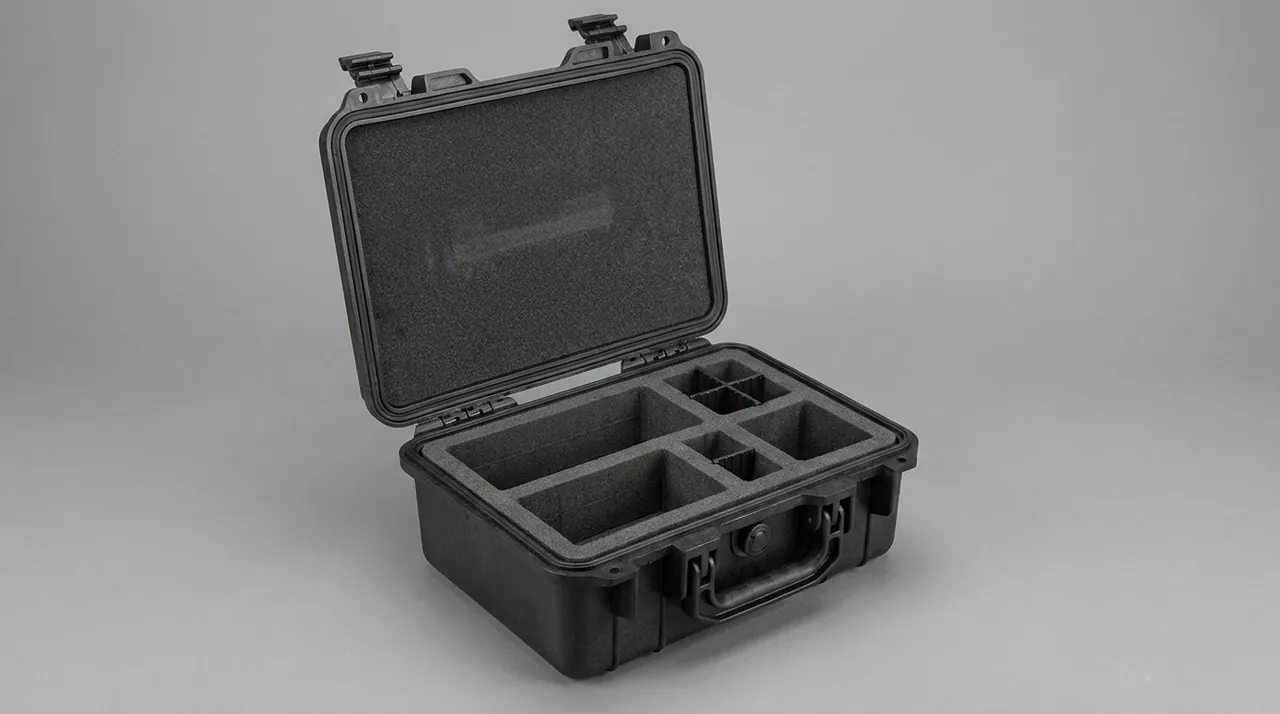
7. Insert and Locating Design: Supporting Impellers and Buckets
Impellers and buckets are the two component families that look easy to pack and are in fact the easiest to damage.
Impeller locating principle: hub as datum, blades fully free.
- Hub end-face seat ring. Fit an annular seat ring under the impeller matched to the hub end face so the impeller is carried by the hub. The seat ring must avoid the blade root weld zone.
- Bore location. Use the impeller shaft bore with a locating mandrel to restrain radial movement. The mandrel must be stiff enough not to deform itself.
- Blades free. Maintain a visible, roughly uniform clearance between blades and insert in every direction. Any design that loads a blade is wrong.
- Axial clamping. Apply moderate clamping to the upper hub face through the lid insert or a resilient block to restrain axial movement, with uniform adjustable force.
- Balance weight protection. Balance weights are non-functional attachments and need relief recesses so they are neither compressed nor rubbed.
Bucket locating principle: upright compartments, lips unloaded.
- One compartment per bucket, slightly wider than the bucket, so buckets cannot strike each other.
- Stand buckets upright or in their designed load orientation; never let the lip face down under load, which rolls the edge.
- Fit soft lip guards to prevent hard contact with the case wall or neighbouring buckets.
- Plastic buckets must not be stacked under load, especially at low transport temperatures.
Chain and belt: coil radius and layering. The coil radius must not be smaller than the minimum bend radius specified by the manufacturer. Fit padding between layers so links are not squeezed together. Pre-tension the chain in the insert so it cannot come loose in transit.
Support density for long shafts. Support spacing for drive and tension shafts should not exceed one third of the length in practice, with a low-stiffness elastic layer under the cradles to give a soft-pad plus hard-stop combination. Custom insert design and prototyping are described in custom foam inserts guide; for thin-wall and easily distorted parts see cushion liner design approach.
8. Dedicated Protection for Electrical Parts and Sensors
The control and instrumentation parts of a drying line are high value and low tolerance, and their packaging logic differs completely from that of mechanical parts.
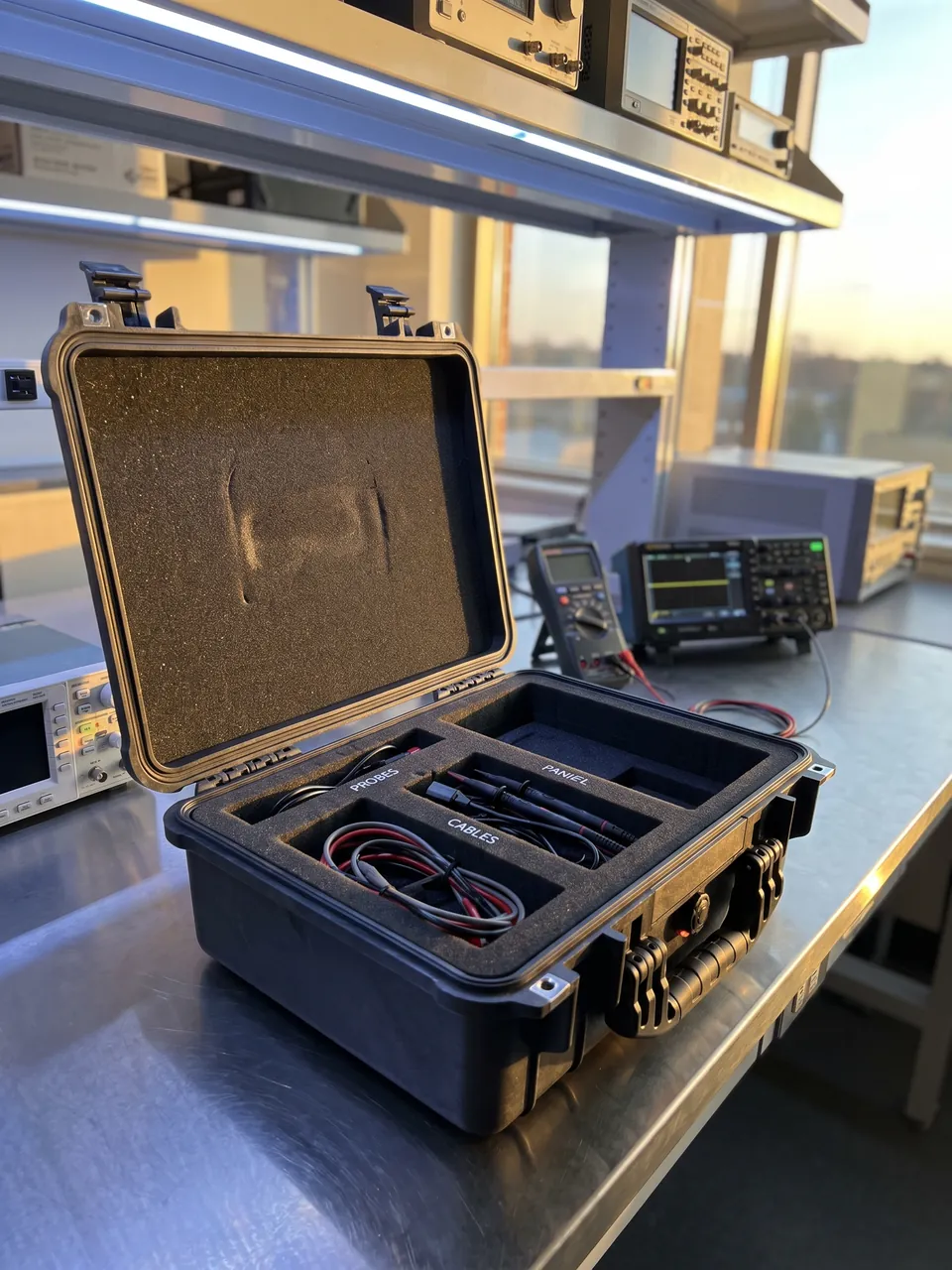
Online moisture meters and temperature and humidity sensors. These usually contain precision sensing faces and calibration parameters. Protection points include: fixing in an isolated small cavity away from heavy parts; using anti-static packaging bags; fitting desiccant to control internal humidity; and avoiding drops and impacts, which can shift internal structural zero points. Separated cavity and ESD thinking is covered in ESD shielding case applications.
VFDs and control modules. The main risk is moisture and condensation. A moisture barrier bag plus desiccant plus a damped base is recommended, with a humidity indicator card in the case. Terminal blocks should have protective covers so foreign objects cannot enter in transit.
Cables and connectors. Cables should be coiled and fixed without going below the minimum bend radius. Connectors should have dust caps so moisture and dust cannot reach the pin area.
Motors and encoder-equipped parts. Precision rotating parts such as encoders are shock sensitive. Avoid axial and radial impact, and fit shaft end sleeves.
| Electrical protection item | Requirement | Implementation |
|---|---|---|
| --- | --- | --- |
| Moisture control | Internal humidity controlled long term | Sealed case plus desiccant plus humidity indicator card |
| ESD protection | Sensitive parts never touch ordinary foam | ESD bags, conductive foam, earthing marking |
| Shock protection | No drops or hard impacts | Isolated cavity, conformal slots, damped base |
| Port protection | Terminals and connectors uncontaminated | Protective covers and dust caps |
| Calibration retention | No recalibration needed after transit | Impact avoidance, moisture control, original packaging marks |
Practical note: moisture damage to electronics is usually progressive. Rather than chasing drifting readings during commissioning, make the humidity indicator card a mandatory acceptance check at unpacking and keep a traceable record.
9. Rust Prevention and Grain Contact Hygiene Requirements
Where corrosion risk concentrates, and in what order to work. Corrosion risk in grain dryer parts concentrates at impeller welds and blade surfaces, bearing housing bores and registers, chain hinge joints, journals and keyways, and flange and thread faces. The correct order is: clean and degrease, dry thoroughly, apply rust prevention, then seal and pack.
The rust prevention stack. For steel parts the usual combination is a rust preventive oil film or removable rust preventive plus vapour corrosion inhibitor plus desiccant. Chain-type parts should use a penetrating rust preventive so hinge joints are protected internally. Impellers should use a thin removable rust preventive, since a heavy oil film pools between blades.
Grain contact hygiene. Parts that contact the grain stream directly, such as buckets, discharge wheels, hopper walls, and screens, must meet grain hygiene requirements. In China, GB 2715 sets food safety limits for grain and GB 13078 sets feed hygiene requirements; the corresponding equipment contact parts must not introduce contamination sources at the packaging stage. Practical measures include using packaging materials that do not shed debris, avoiding mould-prone wood or paper in direct contact with parts, keeping packing areas clean, and ensuring inserts carry no irritant odour. Where a packaging material such as an insert, divider, or bag could contact a part that touches the grain stream, the supplier should provide a declaration of conformity to the applicable food contact materials standards, such as the GB 4806 series general safety requirements and the corresponding material-specific standards, with migration test data where required and batch records retained for traceability and customer audits.
Cleaning and reuse. Cases and inserts must be fully cleaned and dried before each reuse so residue cannot become a starting point for mould or contamination; methods are described in how to clean a protective case. Overall hygiene thinking for grain and food packaging is covered in cold chain and food packaging case selection.
Mould awareness. Grain processing environments contain large amounts of organic dust and moisture, and packaging materials that stay humid for long periods can grow mould. Prefer materials with anti-mould treatment or inherently mould-resistant materials for inserts, and keep storage areas ventilated and dry.
10. Dust Explosion Awareness: What a Case Can and Cannot Do
Dust in grain drying, conveying, and storage presents an explosion hazard. In China, GB 17440 (safety code for dust explosion prevention in grain processing and storage systems) sets systematic requirements for work areas, dust collection systems, electrical equipment, hot work, and housekeeping. International projects commonly refer to ATEX directives and zone classification concepts.
The boundary must be stated clearly.
Scope of a case. A protective case isolates moisture, dust, contaminants, and mechanical damage during transport and storage; it is outer packaging protection. It is not a dust explosion prevention measure and cannot replace on-site explosion prevention management in a drying plant. Zoning and equipment selection must be assessed by a qualified body.
Practical points for packaging work. Opening cases inside a dust accumulation area should follow site work permits and hot work rules. Paper and wood packaging are combustible and should not be stored long term in dust accumulation areas. Debris from unpacking should be cleared promptly so it does not combine with grain dust into a combustible mixture. Where a case contains electrical or energy-carrying components, handle them separately under the applicable rules with compliant marking.
Explosion protection rating of electrical parts. One point deserves emphasis: a protective case does not change the explosion protection type or the permitted zone of the electrical equipment inside it. Where the site requires explosion-protected electrical equipment, products with the appropriate certification must be selected; the case only provides transport protection.
Safety note: never interpret "it is in a protective case" as permission to work or store freely inside a dust explosion hazard zone. Explosion prevention is a site process and equipment matter.
11. Sealing and Ingress Protection: An IEC 60529 and GB/T 4208 View
IEC 60529 and its Chinese equivalent GB/T 4208 define how IP codes are verified. Recommendations for grain dryer parts cases are as follows.
| Use scenario | Recommended rating | Notes |
|---|---|---|
| --- | --- | --- |
| In-plant circulation and covered short haul | IP54 | Dust protection is the priority |
| Domestic long-haul road freight | IP65 | Dust tight plus water jet protection |
| Export sea freight and open storage | IP67 | No ingress during short immersion; advisable given sea freight condensation risk |
| Electrical and sensor cases | IP67 recommended | Moisture and dust together |
| Storage in a humid drying plant | IP65 or better | Gasket must resist humid heat ageing |
The three critical sealing components are the gasket, the latches, and the hinges. An impeller case is a large case with a long sealing perimeter and high lid stiffness demand, so more latches and a multi-point clamping architecture are required; see case hinge and latch sealing structure. Gasket compression set and ageing under long-term humid heat is a key failure point; material selection is covered in case seal materials and sealing system selection. For cases opened frequently, a pressure equalization valve reduces opening force and gasket fatigue.
The division of labour between sealing and desiccant must be clear. Sealing stops external vapour from getting in; desiccant absorbs the initial vapour already inside. They are complementary. If the case seals poorly, the desiccant saturates very quickly; if there is no desiccant, even a well-sealed case develops internal condensation driven by the temperature swing.
12. Transport Vibration and Shock Validation: GB/T 4857 and ISTA
The GB/T 4857 series is China's transport package test method system. For balanced parts such as impellers, GB/T 4857.23 (random vibration) and GB/T 4857.5 (vertical impact drop) are the core validations, while GB/T 4857.2 (temperature and humidity conditioning) is especially important for the moisture control scheme; the system is explained in GB/T 4857 transport packaging standards.
The ISTA series provides procedures built around distribution chains. Export projects and door-to-door deliveries commonly reference ISTA 3A and 3E; selection guidance is in ISTA transport testing procedure selection. Where a complete parts case with control components must simulate a full distribution cycle, see ASTM D4169 distribution cycle testing.
| Test item | Reference standard | Applied condition (example) | Failure of interest |
|---|---|---|---|
| --- | --- | --- | --- |
| Temperature and humidity conditioning | GB/T 4857.2 | Hot humid plus cold cycling | Condensation, corrosion, sensor moisture damage |
| Random vibration | GB/T 4857.23, ASTM D4728 | Road and sea spectra converted by distance | Impeller movement, chain loosening, insert collapse |
| Drop | GB/T 4857.5, ISTA 1A | Height set by mass class | Case cracking, blade distortion, bucket fracture |
| Stacking | GB/T 4857.3, GB/T 4857.4 | Load and duration based | Case creep, bucket distortion under load |
| Combined environment | MIL-STD-810H (as an environmental test methodology reference only, not a military certification) | Temperature, humidity, vibration, shock combined | Overall robustness |
MIL-STD-810H provides a systematic environmental test methodology, and its humidity and vibration methods are particularly relevant to grain dryer parts validation. It must be stated clearly that referencing this standard is a test-method reference only; it does not represent a military certification or any defence procurement qualification. Wording practice is covered in MIL-STD-810H case environmental testing compliance.
Validating dynamic balance. After a packaging vibration test, inspect the impeller for blade twist, balance weight condition, and hub end-face flatness, and where necessary have the manufacturer re-check balance. Note that passing a packaging test does not mean the impeller is balanced; these are different levels of validation.
Insert flammability. Where a customer requires fire performance, ask the insert supplier for a UL94 flammability rating statement.
13. Labelling, Traceability and On-Site Unpacking
A labelling system should cover the project number and dryer model, case number, component name and specification (such as impeller diameter and rotation direction), quantity, gross and net mass, stacking limit, a warning that blades must not carry load, lifting marks, tamper evidence, a note to check shock and humidity indicators before opening, and the rust prevention validity period with the desiccant replacement date.
On-site unpacking should follow five fixed steps.
- Check before opening. Inspect shock indicator labels and humidity indicator cards. A changed humidity indicator card means the shipment reached a high humidity level, which is the key input for deciding whether extra drying treatment is needed.
- Photograph. Record the case before, during, and after opening to build an acceptance record.
- Remove in sequence. Follow the packing list. Impellers and head pulleys must be lifted from the hub or a dedicated lifting point; blades and spokes must never carry load.
- Inspect before reassembly. Check blade distortion, balance weight integrity, hub face and bore damage, bearing bore and register corrosion, chain hinge freedom, bucket cracking, moisture in sensors and control modules, and terminal and connector cleanliness. Record and stop on any anomaly.
- Return the case. Put inserts, dividers, desiccant, and accessories back and log them for reuse.
Where a project requires opening and sampling inspection, use custom case acceptance AQL sampling to define decision rules. For parts that must operate and be stored across extreme temperature ranges, see extreme temperature case design and sealed shock resistant structural design.

14. OEM/ODM Workflow, Acceptance and Reuse Management
A customization project typically runs through six stages: requirement input (parts list, drawings or physical measurement, dryer model and annual volume, transport chain and destination climate), concept design (case structure, insert layering, moisture control and sealing level), prototype validation (first-article fitting, clearance checks, and where needed pre-tests for temperature and humidity conditioning plus vibration and drop), pilot production, volume supply with batch traceability, and iterative optimization.
Supplier assessment should focus on structural design capability, insert machining accuracy, moisture control experience, ability to provide test documentation, and delivery stability; the methodology is set out in how to choose a protective case OEM factory. JUNZHJIA, manufactured by Kexin New Materials (Guangdong) Co., Ltd., supplies grain dryer manufacturers, grain depot and drying centre engineering departments, and grain machinery distributors with an integrated service from structural design and custom inserts to volume delivery. Cases can be supplied with matched gaskets and hardware by dryer model, and supporting test documents can be provided for tenders and acceptance.
Acceptance items should include appearance and dimensions, insert fit clearance, blade clearance condition, desiccant and humidity indicator configuration, gasket integrity, case sealing test records, labelling completeness, and the humidity indicator card reading recorded at unpacking.
Reuse management should maintain a case number register recording use count, repair history, and insert replacement cycle. Cases containing desiccant and VCI must have consumables replaced, be fully cleaned and dried, and have sealing re-assessed before every reuse. Wheeled case consumables are covered in case wheels and trolley handle configuration; where a project needs a one-way high-protection wooden or steel case, see custom case mould cost analysis to assess the investment.
Frequently Asked Questions
Q: What is the most common mistake when packing a fan impeller?
A: The most common and most serious mistake is making the blades carry load. An impeller is a balance-corrected body of revolution whose thin, long-overhang blades determine both air volume and balance state. Five wrong practices dominate: bedding a blade directly on the case floor or on foam so it carries the assembly weight; bundling a sling around a single blade during lifting; stacking several impellers so blades press on one another; packing wood or board between blades and forcing it tight, creating concentrated local load; and laying the impeller horizontally on its outer rim alone, so blades flex repeatedly under vibration. The resulting distortion may be only a fraction of a millimetre and invisible to the eye, yet enough to put dynamic balance out of tolerance; in service the symptoms are vibration, noise, reduced air volume, and abnormal bearing temperature rise. The correct approach is a hub end-face seat ring to carry the load, bore or mandrel location to restrain radial movement, blades fully free with a uniform visible clearance, resilient clamping on the upper face to restrain axial movement, and relief recesses for the balance weights.
Q: Why does a sealed case still need desiccant?
A: Because sealing and desiccant solve two different problems. Sealing stops external vapour from entering, while desiccant absorbs the vapour that is already inside. Every sealed case contains a certain amount of vapour at the moment it is closed, coming from internal air, moisture adsorbed by the insert material, and residual cleaning fluid and humidity on part surfaces. As transport temperatures swing between day and night, that vapour repeatedly evaporates and condenses inside the case: it turns to vapour as daytime temperatures rise, and at night the case walls and metal parts cool below the dew point first, so vapour condenses as liquid water on impellers, chains, and control boxes. The cycle repeats daily and the accumulated water is significant enough to cause corrosion and electrical moisture damage. Desiccant absorbs that initial vapour and holds internal relative humidity at a low, stable level, while the humidity indicator card confirms that moisture control worked throughout the journey. Sealing, desiccant, and humidity indicator cards must therefore be used as one integrated scheme: with a poorly sealed case the desiccant saturates quickly, and without desiccant even a well-sealed case develops internal condensation.
Q: How should elevator chains and buckets be handled in packaging?
A: Chains and buckets are different in nature and need separate treatment. A chain is a flexible long part with three packaging requirements: the coil radius must not be smaller than the manufacturer's specified minimum bend radius, so links are never permanently bent; padding must be fitted between layers so links are not squeezed or rubbed; and the coil must be pre-tensioned and fixed in the insert so it cannot come loose and tangle in transit. The rust preventive for a chain should be penetrating so hinge joints are protected internally, because once a hinge joint rusts, friction rises and pitch elongates, producing chain jump and tooth climb in service. Buckets are mainly at risk from impact, compressive load, and low temperature brittleness. Give each bucket its own compartment slightly wider than the bucket so they cannot strike each other; never let the lip face down under load, which rolls the edge; fit soft lip guards; and remember that plastic buckets lose impact toughness at low temperature, so winter shipments must avoid stacking loads and drop impacts. Because buckets contact the grain stream directly, packaging materials must not shed debris or support mould.
Q: What ingress protection rating should a grain dryer parts case use?
A: Set the rating from the worst case in the transport and storage chain. For in-plant circulation and covered short haul, IP54 is usually sufficient with dust protection as the priority. For domestic long-haul road freight and multi-stop distribution, IP65 is recommended for full dust tightness plus water jet protection. For export sea freight and open storage, IP67 is recommended, because the day-night temperature swing inside a sea container and cross-climate routing substantially increase condensation risk, and a higher sealing level reduces external vapour ingress. Electrical and sensor cases should be IP67 or better for the whole case, covering moisture and dust together. Where cases are stored long term in a humid drying plant, IP65 or better is advisable and the gasket should be a humid-heat ageing resistant formulation, since prolonged humid heat causes compression set and hardening that degrade sealing. Note also that the larger the case and the longer its opening perimeter, the harder it is to control sealing face flatness; simply thickening the gasket is usually ineffective and more latches, multi-point clamping, and higher case stiffness are needed. Verification follows IEC 60529 and GB/T 4208, and real performance depends on gasket material, compression, latch distribution, and case stiffness working together.
Q: What specific harm does transport vibration do to impellers, chains, and electrical parts?
A: For an impeller: first, a large thin-wall impeller has a low natural frequency and couples readily with the low-frequency band of transport vibration, so it migrates within its limits and repeatedly strikes the limit blocks; second, blades under repeated bending load can deform plastically and dynamic balance goes out of tolerance; third, balance weights can fall off if their fixing points fatigue, and the original weight position cannot be determined on site; fourth, the hub face and shaft bore wear and take brinell marks through micro-movement, damaging assembly accuracy. For chains: fifth, the chain whips and rubs repeatedly under vibration, wearing the links while the rust preventive film can be rubbed through and form local corrosion initiation points. For electrical parts: sixth, terminals and connectors micro-move and contact resistance rises; seventh, heat sinks and fixing screws on control modules can loosen; eighth, a sensor that takes an impact can shift its internal zero point and drift. For validation, domestic projects should use GB/T 4857.23 random vibration, GB/T 4857.5 drop, and GB/T 4857.2 temperature and humidity conditioning, while international projects can reference ASTM D4728 and the ISTA 3 series.
Q: What process should on-site unpacking follow?
A: Five fixed steps, with checking placed before opening. First, without opening the case, inspect shock indicator labels and humidity indicator cards. A changed humidity indicator card means the shipment reached high humidity, and that is the key input for deciding whether parts need extra drying treatment; once the case is opened the evidence cannot be restored. Second, photograph the case before, during, and after opening to create a complete acceptance record. Third, remove parts in packing list order, lifting impellers and head pulleys only from the hub or a dedicated lifting point; never use blades, spokes, or buckets as load paths, because distortion damage to a balanced part is usually irreversible. Fourth, inspect before reassembly: check blades for distortion, balance weights for integrity, hub faces and bores for damage, bearing bores and registers for rust, chain hinges for freedom of movement, buckets for cracking, sensors and control modules for moisture, and terminals and connectors for cleanliness. Record any anomaly immediately and stop. Fifth, return inserts, dividers, desiccant, and accessories to the case and log them for reuse. Where sampling inspection is required, use AQL sampling methods to establish decision rules.
Q: How can a moisture control scheme be validated?
A: Evidence is needed at three levels: documents, physical indicators, and readings. The first level is standard testing: run GB/T 4857.2 temperature and humidity conditioning to simulate hot humid and cold cycling, then open the case and inspect for condensation traces, corrosion, and electrical moisture damage; export projects can reference the ISTA 3 series and ASTM D4169 distribution cycle procedures. The second level is physical evidence: place desiccant in layers at different heights inside the case and fit observable humidity indicator cards, ideally with an inspection window or a card whose colour can be read before opening. The third level is readings and records: record the humidity indicator card reading, and any humidity logger data, in the acceptance record at unpacking and compare it with the factory record to form a traceable chain. Three engineering details also matter: desiccant quantity should be estimated from case volume, insert moisture uptake, part surface area and residual moisture, transit duration, climate zones crossed, and temperature swing amplitude, with margin added; desiccant must be a breathable pack fixed in an insert recess, never touching metal surfaces or precision fits; and insert materials should be low uptake and low outgassing, because hygroscopic materials absorb and release vapour as temperature changes and amplify humidity fluctuation inside the case.
Q: How do dust explosion requirements relate to a packaging case?
A: They operate at different levels, and the boundary must be clear. Dust explosion prevention addresses the work area and the equipment itself. Dust in grain drying, conveying, and storage presents an explosion hazard, and safety codes such as GB 17440 in China set systematic requirements for work areas, dust collection systems, electrical equipment, hot work, and housekeeping; international projects commonly refer to ATEX directives and zone classification concepts. These requirements are assessed by qualified bodies and implemented in site processes and equipment. A protective case is outer packaging protection whose job is to isolate moisture, dust, contaminants, and mechanical damage during transport and storage. It is not a dust explosion prevention measure and cannot replace on-site explosion prevention management. One further point deserves emphasis: a protective case does not change the explosion protection type or the permitted zone of the electrical equipment inside it, so where the site requires explosion-protected equipment, products with the appropriate certification must be selected. Practical points for packaging work include: opening cases in dust accumulation areas under site work permits and hot work rules; not storing paper and wood packaging long term in dust accumulation areas; and clearing paper and wood debris promptly after unpacking.
Conclusion & Related Reading
What a grain dryer parts case has to solve is a problem in which moisture control and vibration control must hold at the same time. The balance state of an impeller, the hinge joint accuracy of a chain, the mating faces of a bearing housing, and the calibrated zero point of a sensor are all assets that cannot be restored cheaply on site, and three simple things - sealing, desiccant, and a humidity indicator card - determine whether those assets arrive at the installation site intact.
The selection path can be reduced to one sentence: separate the design by part nature (balanced parts, precision shaft system parts, flexible long parts, electronic parts), then set sealing and moisture control levels from the transport chain and destination climate, and finally fix insert modularity, labelling, and unpacking process from the dryer model and project structure. For grain dryer manufacturers and grain machinery distributors that need custom inserts, model-matched volume supply, OEM/ODM production, or supporting test documents, JUNZHJIA provides an integrated service from structural design to volume delivery, and can supply sealing, temperature and humidity, and vibration test documentation to project requirements.
Related Reading