


The critical spare parts of a screw oil press and of hydraulic oil pressing equipment are concentrated in the press screw, the press bars, the squeeze rings, the press cage, and the hydraulic oil pump. The conclusion first: press screws and oil pumps combine a hardened helical surface, micron-level hydraulic clearances, and direct contact with edible oil. They must be shipped in sealed, moisture-controlled cases with roll-resistant rigid locating and port capping, on the precondition of food-grade rust prevention. Any residual oil sludge, moisture, or impact creates corrosion, food safety risk, and performance loss at the same time. Once a press screw helical surface wears or is dented, oil yield falls, cake thickness becomes uneven, and machine temperature behaves abnormally; there is no field repair, only replacement. The plunger and port-plate clearances in a hydraulic pump are typically measured in microns, and a rust spot or a particle of debris is enough to scrap the whole pump.
The transport pain points are very specific. A press screw is a slender helical body of revolution whose centre of gravity is off the axis of rotation, so it rolls easily in ordinary packaging and strikes hard items. Press bars and squeeze rings are numerous and dimensionally similar, so mixed packing makes them hard to identify, and installing the wrong one changes the press chamber clearance. Hydraulic pumps and valves are extremely sensitive to corrosion and contamination, and an oil processing plant is a humid environment full of oil mist. More importantly, all of these parts contact edible oil, so the rust preventives, insert materials, and residues involved in transport packaging are all constrained by food contact safety requirements. This article is written for oil press manufacturers, engineering departments of edible oil processing groups, grain and oil machinery distributors, and OEM/ODM buyers. It covers component grading, case and insert design, food-grade rust prevention and cleaning, sealing levels, standard validation methods, and on-site unpacking practice, and explains how JUNZHJIA supports custom inserts and volume supply.
Table of Contents
- 1. Why Press Screws and Oil Pumps Need a Dedicated Parts Case
- 2. Component List and Sensitivity Grading
- 3. Failure Modes: Helical Surface Wear, Press Chamber Clearance Change, Journal Damage and Hydraulic Clearance Failure
- 4. Oil Sludge, Rancidity and Residue: The Most Overlooked Corrosion Source
- 5. Size and Weight Boundaries: Packing Screws, Cages and Hydraulic Parts
- 6. Case Structure and Material Selection
- 7. Insert and Locating Design: A Roll-Resistant Solution for Helical Parts
- 8. Precision Protection for Oil Pumps and Hydraulic Components
- 9. Rust Prevention and the Food Contact Compliance Boundary
- 10. Protection Awareness in Dust and Oil Mist Environments
- 11. Sealing and Ingress Protection: An IEC 60529 and GB/T 4208 View
- 12. Transport Vibration and Shock Validation: GB/T 4857 and ISTA
- 13. Labelling, Traceability and On-Site Unpacking
- 14. OEM/ODM Workflow, Acceptance and Reuse Management
- Frequently Asked Questions
- Conclusion & Related Reading
1. Why Press Screws and Oil Pumps Need a Dedicated Parts Case
The value of oil press spare parts is concentrated in two things: surface geometry and clearance control.
First, the value of a press screw is in its helical geometry. After carburizing and hardening or nitrocarburizing, the screw surface is hard. The lead, pitch, and compression ratio of the thread together form the compression curve of the press chamber, and that curve determines how fast material advances, how far it is compressed, and where the oil escapes. Once the helical surface wears, scores, or takes a dent, the compression curve is broken, and the symptom is reduced oil yield, uneven cake thickness, more return material, and abnormal machine temperature. This class of damage cannot be repaired in an oil plant.
Second, the value of press bars and squeeze rings is in the gaps. The drainage slots between press bars and the clearances between squeeze rings form the oil escape path. Too large a gap raises residual oil in the cake; too small a gap blocks drainage and drives up temperature. Press bars and squeeze rings are matched sets that must be assembled in sequence; mixed packing followed by wrong assembly changes the press chamber curve.
Third, the value of an oil pump is in micron-level clearances. Plunger pumps and gear pumps on hydraulic presses build pressure through extremely small fits, typically measured in microns. Rust spots, contamination, or distortion cause internal leakage, so pressure will not build or hold, and the symptom is a press with no force.
Fourth, the food contact dimension. Press screws, press bars, and squeeze rings contact edible oil directly. Rust preventive residue, insert outgassing, wood splinters, and oil sludge all create food safety risk, which narrows the material choices far beyond those available for general industrial parts.
Practical note: the most common hidden loss in an oil plant is not the price of the spare part but a new press screw that still will not deliver the expected yield. This is often traceable to helical surface impact damage in transit or to wrongly sequenced press bars and squeeze rings, and troubleshooting usually means opening the machine more than once.
For oil press manufacturers and grain and oil machinery distributors, the parts case also acts as standard tooling. One insert architecture serves one press model, and matched press bar and squeeze ring sets are stored by sequence number, which reduces mis-assembly risk and simplifies storage and circulation. Reuse assessment methods are described in protective case service life and reuse years.
2. Component List and Sensitivity Grading
Score each part on three axes - forming-precision sensitivity, shock fragility, and moisture, cleanliness, and food safety sensitivity - to build the packing decision basis.
| Component | Typical material / structure | Critical sensitivity | Environment and hygiene | Recommended protection |
|---|---|---|---|---|
| --- | --- | --- | --- | --- |
| Press screw | Carburized or nitrocarburized alloy steel, hardened surface | Helical geometry, pitch, shaft ends, keyway or spline | Oil sludge rancidity, corrosion, contamination | Roll-resistant V cradles, journal location, food-grade rust prevention |
| Press bars | Alloy steel, multiple bar-shaped pieces | Drainage face, end faces, length consistency | Corrosion, mixed sequence | Sequenced slotted board, isolated cavity |
| Squeeze rings | Alloy or cast iron rings | Bore, end faces, thickness | Corrosion, distortion | Upright stacked seat, end-face padding |
| Press cage | Cast or welded assembly | Internal cavity, assembly faces | Corrosion, impact | Isolated cavity, bore guard ring |
| Cake discharge cone and adjusters | Alloy steel or bronze | Cone face, threads | Seizure, corrosion | Compartmented small-part box, removable rust preventive |
| Hydraulic oil pump | Plunger or gear pump | Plunger and port plate faces, gear flanks, ports | Corrosion, contamination, distortion | Port capping, isolated rigid cavity, desiccant |
| Hydraulic valves | Body plus spool | Spool fits, sealing faces | Corrosion, contamination | Port guards, compartments, desiccant |
| Cylinder and plunger | Barrel plus hard chrome plunger | Plating, bore wall | Scoring, corrosion | End caps, isolated support |
| High pressure hose and fittings | Rubber plus steel fittings | Hose ageing, fitting threads | Ozone ageing, corrosion | Flat with no bending, end sleeves |
| Seals (oil seals, O-rings) | Rubber or polyurethane | Lip, dimensions | Ozone, heat, oil | Original packaging, isolated cavity, never with heavy parts |
| Steam cooker paddles and shaft | Stainless or carbon steel | Paddle angle, shaft ends, welds | Hygiene, corrosion | Separated location, surface protection |
| Filter and centrifuge parts | Stainless plus screen | Screen mesh, sealing faces, bowl | Distortion, contamination | Flat support, screen guard plates |
The pattern is clear: press screws and the press bar and squeeze ring sets are the physical protection priority, pumps and valves are the precision and corrosion priority, seals are the chemical and ageing priority, and food safety requirements cut across every edible-oil-contact component.
3. Failure Modes: Helical Surface Wear, Press Chamber Clearance Change, Journal Damage and Hydraulic Clearance Failure
Helical surface denting and scoring. The advancing face of the screw thread carries load and is the part most easily struck by other hard items. A small dent impedes advance in that section, material dwells, local temperature rises, and the result is poor oil release and a rough cake surface.
Shaft end, keyway, and spline damage. The press screw connects to the gearbox or coupling through its shaft end and transmits torque. A damaged shaft end or distorted keyway causes eccentric assembly and runout, and vibration rises in service.
Mixed or wrongly sequenced bars and rings. This is a management failure but a very common one on site. Press bars are numerous and visually similar; one part installed out of sequence or omitted immediately shifts the clearance distribution, and yield and cake thickness deviate from design.
Press cage cavity and assembly face damage. The cage is a casting or weldment, and a local impact raises stress concentration, which can open into a crack in service.
Hydraulic pump clearance failure. Plunger-to-bore fits and the end and radial clearances of a gear pump are micron-scale. Rust spots, scoring, and contamination create internal leakage, showing up as low pressure, poor pressure holding, and reduced flow.
Cylinder plating scoring. Once a hard chrome plunger is scored, the plating becomes a corrosion initiation site, the seal lip is then damaged, and oil leakage plus further scoring form a loop.
Rubber seal ageing. Oil seals and O-rings are sensitive to ozone, ultraviolet light, heat, and oil. Long exposure causes hardening, cracking, and permanent set, and the assembly leaks as soon as it is installed.
Safety note: hydraulic ports must remain capped throughout packaging and handling. Dust and fibres that enter an open port travel with the oil into spools and plunger clearances on first start-up, and the resulting damage typically only appears during commissioning.
4. Oil Sludge, Rancidity and Residue: The Most Overlooked Corrosion Source
In oil equipment parts packaging, the greatest corrosion source is often not rain but the oil that was not cleaned off the part.
The rancidity and corrosion loop. Residual vegetable oil oxidizes and hydrolyses under air, moisture, and light, producing free fatty acids. Free fatty acids are acidic and react with steel surfaces to cause corrosion; the corrosion products then become new adsorption sites that hold more oil and moisture, forming a self-accelerating loop. The process develops quickly under hot and humid storage conditions.
Effect of sludge on precision. Dried oil sludge is thick enough to change the press bar clearances and the effective geometry of the helical surface. In hydraulic components, sludge and varnish retard spool movement, causing sluggish or seized operation.
Microbial and hygiene risk. A mixture of residual oil and meal debris is a substrate for microbial growth. For parts that contact edible oil, this is a direct food safety risk.
The correct sequence. It should be degrease and clean, dry thoroughly, apply rust prevention, then seal and pack. Skipping degreasing and spraying rust preventive straight onto an oily surface traps the sludge and moisture under the coating, which is equivalent to shipping the corrosion source inside the case.
Cleaning acceptance criteria. In practice the criterion is a white cloth test: no obvious oil mark, no metal chips or meal residue, no odour. Cleaned parts must be dried thoroughly, with particular attention to liquid trapped in thread roots, keyways, and blind holes.
Cleaning and reuse methods are described in how to clean a protective case; moisture uptake and outgassing behaviour of insert materials are compared in case foam material comparison.
5. Size and Weight Boundaries: Packing Screws, Cages and Hydraulic Parts
Press screw length and diameter vary with model. On medium presses the screw is typically in the 500 to 1200 mm length range and weighs from tens to over a hundred kilograms. Press cages and matched bar sets often ship as complete groups. Hydraulic pumps and valves are small or medium parts with a very high value density.
| Component type | Typical size | Recommended case | Locating method | Vibration demand |
|---|---|---|---|---|
| --- | --- | --- | --- | --- |
| Press screw | 0.5-1.2 m long | Long-part slotted case | V cradles on journals plus axial restraint | High |
| Press bar set | Multiple long bars | Sequenced slotted case | One slot per piece plus sequence marking | Medium |
| Squeeze ring set | Multiple rings | Upright stacked case | Bore location plus interlayer padding | Medium |
| Press cage | Medium to large casting | Isolated cavity heavy-duty case | Assembly face support plus wall restraint | High |
| Hydraulic pump | Small to medium | Isolated rigid cavity | Port capping plus flange location | High |
| Hydraulic valve | Small | Compartmented small-part box | Compartments plus port guards | High |
| Cylinder and plunger | Long parts | Long-part support case | V supports at both ends plus end caps | High |
| Seals and screens | Small or thin | Flat support case | Flat, unbent, isolated cavity | Very high |
Weight distribution principle. Press cages and screw sets are heavy, and should sit as low as possible and near the centre of gravity, with the load carried by the case base structure rather than by foam. Above a certain mass, a rigid load-bearing plate under the insert is recommended.
Slender and thin-wall principle. Thin-walled long parts such as cylinder barrels and plungers should be fixed on V supports at both ends with auxiliary mid restraint. Thin parts such as screens must be supported flat; bending and stacking under load are not acceptable.
6. Case Structure and Material Selection
Rotomoulded HDPE cases. Seamless, impact resistant, tolerant of low temperature and of oil contamination, with mature sealing architecture. Suitable for press screws, pumps, and valves where cleanliness and moisture control matter, and can be built with waterproof IP-rated construction.
Injection-moulded PP cases. High precision, batch consistency, and a dense easy-clean surface. Suitable for press bar and squeeze ring slotted cases and hydraulic small-part boxes, and easy to stack in production.
Aluminium frame cases. High stiffness and re-openable, suitable for press cages and long screws that must be opened and reassembled on site.
Steel-wood or steel-plastic pallet cases. High load capacity for very heavy sets, but wood moisture content, export quarantine rules, and wood splinter contamination must be managed. Where food-contact parts are involved, wood-free, heat-treated materials that do not shed debris should be preferred.
Selection order: establish load capacity and stiffness from mass and length, then set sealing, rust prevention, and cleanliness levels from part nature (helical surface parts, sequenced set parts, hydraulic precision parts, food contact parts), and finally set maintainability and insert replacement method from the number of reuse cycles.
7. Insert and Locating Design: A Roll-Resistant Solution for Helical Parts
Press screw packaging faces a classic problem: the screw is a helical body of revolution whose centre of gravity is not on the axis of rotation, so when laid horizontally it behaves like an eccentric roller and "finds its own position" by rolling. Flat foam cannot restrain it.
There are three proven engineering solutions.
Option one: V cradles on the journals. Fit V cradles at the journals at each end so the screw is located by its journals and the helical surface is suspended. A V form restrains radial movement in two directions and gives the best roll resistance.
Option two: Conformal half-cradle. Machine a conformal channel to the screw outline, keeping the channel floor away from the advancing thread face so contact occurs only on non-functional outer areas. Suitable for stable, high-volume models with regular thread forms.
Option three: End flange clamping. Fit clamp blocks on the end face or flange to restrain axial and rotational freedom, combined with V cradles to achieve full constraint. Suitable for shorter screws with a clear flange structure.
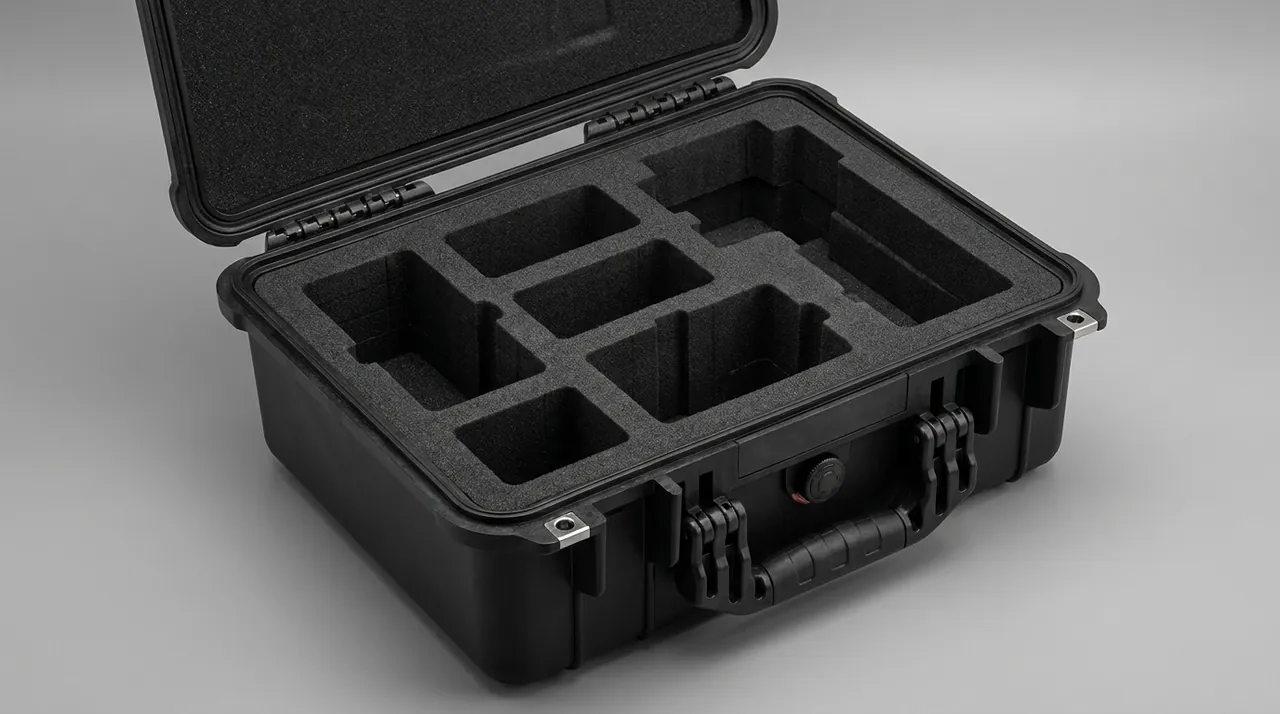
Sequenced storage for bars and rings. Use a numbered slotted board in which each slot corresponds to an assembly position number, marked on both the board and the part. This prevents impact damage and turns a management requirement - sequence - into part of the packaging structure. Removable divider systems allow one case to serve several specifications; design details are in removable divider system design.
Axial restraint for the screw. A long screw can migrate axially under vibration and strike the case end wall. Fit resilient limit blocks at both ends to restrain axial displacement without transmitting excessive shock.
Insert cleanliness. For parts that contact edible oil, inserts should be dense, non-shedding, and easy to clean; friable board materials should be avoided. Insert machining and deburring should take place in a clean area.
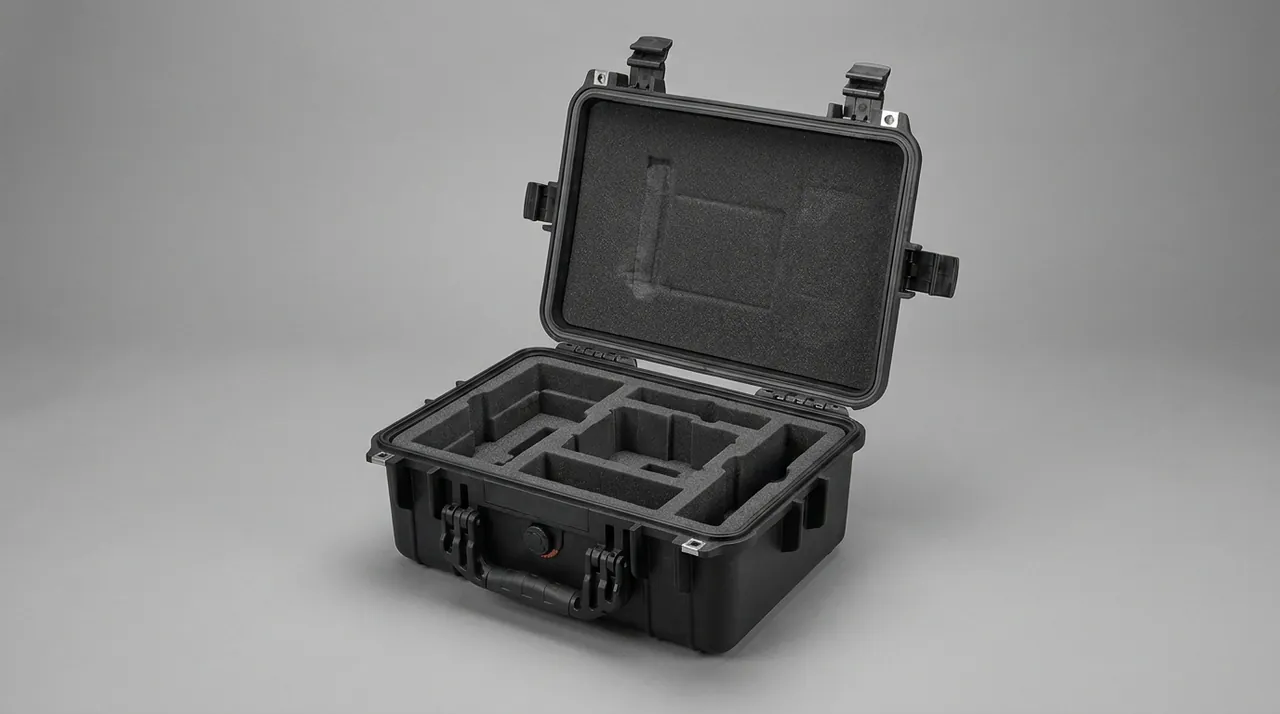
Damping. A long press screw has a low first bending natural frequency and couples readily with the low-frequency band of transport vibration. Support spacing in practice should not exceed one third of the screw length, with a low-stiffness elastic layer under the cradles to give a soft-pad plus hard-stop combination.
8. Precision Protection for Oil Pumps and Hydraulic Components
Hydraulic parts carry the highest value density in this kind of parts case, and they are the most frequently overlooked.
Cap every port. Pump inlet and outlet ports and all valve working ports must remain capped throughout packaging. Use purpose-made threaded or clamped port guards rather than paper plugs or tape. Once dust, fibres, or packaging debris enter, they travel with the oil into fits on first start-up.
Rust prevention for mating faces. Plungers, spools, and gear flanks are mirror-finished or ground surfaces, and a rust spot is dragged into a groove as soon as the part moves. The scheme should be a thin removable rust preventive plus vapour corrosion inhibitor plus sufficient desiccant, with the preventive removable in a way compatible with the system oil.
Rigid location. Precision parts must be restrained by rigid structures, not merely clamped by foam. Flange faces, mounting faces, and port planes are ideal datum surfaces and should have rigid limit blocks controlling displacement.
Separate cavities for bearings and seals. Precision bearings and rubber seals travel in cavities separate from heavy parts. Bearings stay in their original packaging to avoid false brinelling of raceways; seals must avoid compression, heat, and oil, and should be kept away from electrical components that generate ozone.
Spool protection in valves. On some valves the spool position during transport determines whether internal springs are loaded. Confirm the transport attitude required by the manufacturer and fit a transport lock where necessary.
Separated cavities for electrical parts and sensors. Pressure sensors and level switches are electronic parts sensitive to ESD and moisture. The reasoning behind separated cavities and ESD protection is covered in ESD shielding case applications.
| Hydraulic protection item | Requirement | Implementation |
|---|---|---|
| --- | --- | --- |
| Port protection | Capped throughout, no dust ingress | Purpose-made port guards plus dust film |
| Mating face rust prevention | No rust spots or grooves | Removable rust preventive plus VCI plus desiccant |
| Displacement control | Rigid limits, not foam dependent | Rigid location on flange or mounting face |
| Seal protection | No ozone, heat, or oil exposure | Isolated cavity plus original packaging |
| Cleanliness | No chips, fibres, or sludge | Degreasing plus clean assembly area |
9. Rust Prevention and the Food Contact Compliance Boundary
Rust prevention must satisfy both performance and hygiene, and that is what distinguishes oil equipment parts packaging from general industrial packaging.
Cleaning and drying come first. As explained earlier, rust prevention must follow degreasing, cleaning, and thorough drying. Liquid trapped in blind holes, thread roots, and keyways must be removed.
Selecting rust preventives. Parts that contact edible oil should use removable, low-odour products explicitly rated for food machinery. Heavy films that are difficult to remove, or products with irritating constituents, must be avoided, because residue becomes a carrier for material adhesion and microbial growth.
Suitability of VCI. Vapour corrosion inhibitors work well for steel in enclosed spaces, but compatibility with stainless steel, copper alloys, platings, and rubber seals must be confirmed, together with whether the product is acceptable for food contact scenarios.
Desiccant configuration. Desiccant should be a breathable pack fixed in an insert recess, never touching metal surfaces or precision fits. Sizing should be estimated from case volume, insert moisture uptake, transit duration, and climate zones crossed, with margin added.
Food contact compliance note. Where an insert, divider, or packaging material could contact edible oil, suppliers should provide a declaration of conformity to the relevant food contact materials standards, such as the GB 4806 series general safety requirements and the applicable material-specific standards, with migration test data where required. Related hygiene packaging thinking appears in cold chain and food packaging case selection.
Cleanliness and cross-contamination control. Packaging materials must not shed debris, support mould growth, or carry odour. Wooden supports require confirmed moisture content and quarantine compliance. Operators should wear gloves and avoid touching cleaned surfaces directly.
Compliance note: food contact compliance depends on the contacting material, the contact conditions, and destination regulations. This article provides an engineering path; the final judgement should be confirmed by the oil plant quality function and qualified compliance specialists, with supplier declarations and batch records retained.
10. Protection Awareness in Dust and Oil Mist Environments
An oil processing workshop contains two environmental factors at once: oilseed and meal dust, and oil mist with steam. These place three demands on packaging: sealing, oil resistance, and cleanability.
Dust environment note. Oilseed and meal dust falls within the combustible dust category. In China, GB 17440 (safety code for dust explosion prevention in grain processing and storage systems) and related codes set systematic requirements for work areas, dust collection systems, and work practices. International projects commonly refer to ATEX directives and zone classification concepts.
The boundary of what a case does must be stated clearly. A protective case isolates moisture, oil mist, dust, and mechanical damage during transport and storage; it is outer packaging protection. It is not a dust explosion prevention measure and cannot replace site explosion prevention management. Dust explosion zoning and equipment selection must be assessed by a qualified body.
Practical points for packaging work. Opening cases inside a dust accumulation area should follow site work permits and hot work rules. Paper and wood packaging are combustible and should not be stored long term in dust accumulation areas. Debris from unpacking should be cleared promptly. Where a case contains hydraulic accumulators, pressurized components, or electrical parts, handle them separately under the applicable rules with compliant marking; see hazardous goods transport case compliance.
Oil resistance and cleanability. Cases and inserts used in an oil workshop may pick up oil contamination. Choosing dense, wipeable case and insert materials significantly reduces cleaning effort and cross-contamination risk on reuse.
11. Sealing and Ingress Protection: An IEC 60529 and GB/T 4208 View
IEC 60529 and its Chinese equivalent GB/T 4208 define how IP codes are verified. Recommendations for oil press equipment parts cases are as follows.
| Use scenario | Recommended rating | Notes |
|---|---|---|
| --- | --- | --- |
| In-plant circulation and covered short haul | IP54 | Dust protection is the priority |
| Domestic long-haul road freight | IP65 | Dust tight plus water jet protection |
| Export sea freight and open storage | IP67 | No ingress during short immersion |
| Precision hydraulic parts case | IP67 recommended | Moisture, oil mist, and water ingress together |
| Storage in a humid, oil-mist workshop | IP65 or better | Gasket must be oil resistant |
The three critical sealing components are the gasket, the latches, and the hinges. Oil equipment parts cases add an oil resistance requirement to the gasket: ordinary rubber can swell or harden under long-term oil mist exposure, so an oil-resistant formulation should be specified. Selection guidance is in case seal materials and sealing system selection. Structurally, large long-part cases have a long sealing perimeter and high lid stiffness demand, so more latches and a multi-point clamping architecture are required; see case hinge and latch sealing structure. For cases opened frequently, a pressure equalization valve reduces opening force and gasket fatigue.
12. Transport Vibration and Shock Validation: GB/T 4857 and ISTA
The GB/T 4857 series is China's transport package test method system. For slender eccentric bodies of revolution such as press screws, GB/T 4857.23 (random vibration) and GB/T 4857.5 (vertical impact drop) are the core validations; the system is explained in GB/T 4857 transport packaging standards.
The ISTA series provides procedures built around distribution chains. Export projects commonly reference ISTA 3A and 3E; selection guidance is in ISTA transport testing procedure selection. Where a complete parts case with hydraulic and electrical content must simulate a full distribution cycle, see ASTM D4169 distribution cycle testing.
| Test item | Reference standard | Applied condition (example) | Failure of interest |
|---|---|---|---|
| --- | --- | --- | --- |
| Random vibration | GB/T 4857.23, ASTM D4728 | Road spectrum converted by distance | Screw rolling, insert collapse, rust film rupture |
| Drop | GB/T 4857.5, ISTA 1A | Height set by mass class | Case cracking, shaft end distortion, port guard loss |
| Stacking | GB/T 4857.3, GB/T 4857.4 | Load and duration based | Case creep, set distortion under load |
| Temperature and humidity conditioning | GB/T 4857.2 | Hot humid and cold cycling | Gasket ageing, condensation, corrosion |
| Combined environment | MIL-STD-810H (as an environmental test methodology reference only, not a military certification) | Temperature, humidity, vibration, shock combined | Overall robustness |
MIL-STD-810H provides a systematic environmental test methodology, and citing its methods improves validation completeness. It must be stated clearly that referencing this standard is a test-method reference only; it does not represent a military certification or any defence procurement qualification. Wording practice is covered in MIL-STD-810H case environmental testing compliance.
Insert flammability. Where a customer requires fire performance, ask the insert supplier for a UL94 flammability rating statement, and note that results at one thickness or density cannot be directly converted to another.
13. Labelling, Traceability and On-Site Unpacking
A labelling system should cover the project number and press model, case number, component name and specification (such as press screw model and length), sequence and quantity of set parts, gross and net mass, stacking limit, lifting marks, tamper evidence, a note to check shock and humidity indicators before opening, and the rust prevention validity period with the desiccant replacement date.
On-site unpacking should follow five fixed steps.
- Check before opening. Inspect shock indicator labels and humidity indicator cards to determine whether excess shock or moisture occurred during transit.
- Photograph. Record the case before, during, and after opening to build a complete acceptance record.
- Remove in sequence. Take out matched press bar and squeeze ring sets strictly by number. Heavy items such as screws and cages require dedicated lifting gear or symmetrical load points.
- Inspect before reassembly. Check the helical surface for dents and scoring, the shaft end and keyway, press bar drainage faces and squeeze ring end faces, hydraulic port guards, internal rust or contamination, and seal ageing. Record and stop on any anomaly.
- Return the case. Put inserts, numbered boards, desiccant, and accessories back and log them for reuse.
Where a project requires opening and sampling inspection, use custom case acceptance AQL sampling to define decision rules.
14. OEM/ODM Workflow, Acceptance and Reuse Management
A customization project typically runs through six stages: requirement input (parts list, drawings or physical measurement, press model and annual volume, transport chain), concept design (case structure, insert layering, rust prevention and cleanliness level), prototype validation (first-article fitting, clearance checks, and where needed pre-tests for vibration and drop), pilot production, volume supply with batch traceability, and iterative optimization.
Supplier assessment should focus on structural design capability, insert machining accuracy and cleanliness control, experience with food-grade rust prevention and cleaning, ability to provide test documentation, and delivery stability; the methodology is set out in how to choose a protective case OEM factory. JUNZHJIA, manufactured by Kexin New Materials (Guangdong) Co., Ltd., supplies oil press manufacturers, edible oil group engineering departments, and grain and oil machinery distributors with an integrated service from structural design and custom inserts to volume delivery. Cases can be supplied with matched gaskets and hardware by press model, and supporting test documents can be provided for tenders and acceptance.
Acceptance items should include appearance and dimensions, insert fit clearance, protective condition of helical and mating surfaces, port capping integrity, desiccant and indicator configuration, case sealing test records, labelling and sequence number completeness, and cleanliness measured against the white cloth criterion.
Reuse management should maintain a case number register recording use count, repair history, and insert replacement cycle. Cases containing desiccant and VCI must have consumables replaced, be fully cleaned and dried, and have sealing re-assessed before every reuse. Wheeled case consumables are covered in case wheels and trolley handle configuration; where a project needs a one-way high-protection wooden or steel case, see custom case mould cost analysis to assess the investment.
Frequently Asked Questions
Q: Why must a press screw be degreased and cleaned before packing?
A: Because residual vegetable oil on a press screw is itself a corrosion source, and the damage happens out of sight beneath the rust preventive layer. First, residual oil oxidizes and hydrolyses under air, moisture, and light to produce free fatty acids. These are acidic and react with steel surfaces to cause corrosion, and the corrosion products become new adsorption sites holding more oil and moisture, forming a self-accelerating loop that develops quickly in hot, humid storage. Second, dried oil sludge is thick enough to change press bar clearances and the effective geometry of the helical surface, so the actual press chamber compression curve deviates from design and yield and cake thickness are abnormal after installation. Third, a mixture of residual oil and meal debris is a substrate for microbial growth, and because the screw contacts edible oil directly this is a direct food safety risk. Fourth, spraying rust preventive onto an oily surface without degreasing traps sludge and moisture under the coating, so corrosion continues and is very hard to detect. The correct sequence is degrease and clean, dry thoroughly, apply rust prevention, then seal and pack. The usual acceptance criterion on site is a white cloth test with no oil mark, no chips or meal residue, and no odour.
Q: Why should press bars and squeeze rings be stored with sequence numbers?
A: Because they are not interchangeable pieces but matched components that together form the compression curve of the press chamber. The drainage slots between press bars and the clearances between squeeze rings set the oil escape area. If the gaps are too large, residual oil in the cake rises and yield falls; if too small, drainage is blocked, chamber temperature rises excessively, and material may carbonize. Matched press bar and squeeze ring sets are usually machined and ground together for one machine and have length and thickness consistency requirements, so fitting one bar of the wrong length changes local clearance. Press bars are numerous and visually similar, so manual sorting very easily mis-sequences or omits one, and such errors are invisible until yield becomes abnormal. Turning sequence into packaging structure is the cheapest solution: use a numbered slotted board in which each slot corresponds to an assembly position, marked on both the board and the part, so that removal, installation, and remaining-part checks all work by number. The compartments also prevent parts from striking one another.
Q: What are the three most critical actions for packaging hydraulic parts such as oil pumps?
A: Cap all ports throughout, apply removable rust prevention to mating faces, and use rigid location rather than foam clamping. Port capping comes first because the most dangerous damage to a hydraulic component comes from internal contamination: plunger-to-bore and gear-to-body clearances are typically micron-scale, and dust, fibres, or packaging debris that enters a port during transport travels with the oil into those fits on first start-up, causing scoring and internal leakage. That damage often only appears at commissioning, making responsibility difficult to establish. Use purpose-made threaded or clamped port guards rather than paper plugs or tape. For rust prevention, plungers and spools are mirror-finished or ground, and a rust spot is dragged into a groove as soon as the part moves, so a thin removable rust preventive combined with vapour corrosion inhibitor and desiccant is appropriate, and it should be removable in a way compatible with the system oil. For location, precision parts must be restrained on rigid datums such as flange faces, mounting faces, or port planes; foam absorbs vibration but cannot limit large displacement.
Q: What ingress protection rating should an oil press equipment parts case use?
A: Set the rating from the worst case in the transport and storage chain. For in-plant circulation and covered short haul, IP54 is usually sufficient with dust protection as the priority. For domestic long-haul road freight and multi-stop distribution, IP65 is recommended for full dust tightness plus water jet protection. For export sea freight, open storage, and terminal transfer, IP67 is recommended with no ingress during short immersion. For precision hydraulic parts cases, IP67 or better for the whole case is advisable, because hydraulic components are just as sensitive to moisture as to contamination. Where cases are stored long term in an oil workshop, remember that the atmosphere contains oil mist and steam, so the gasket must be an oil-resistant formulation; ordinary rubber can swell or harden under prolonged oil mist exposure and then fail to seal. Long-part cases also have a long sealing perimeter and high lid stiffness demand, so simply thickening the gasket is usually ineffective and more latches, multi-point clamping, and higher case stiffness are needed. Verification follows IEC 60529 and GB/T 4208, but real performance depends on gasket material, compression, latch distribution, and case stiffness, so whole-case validation of production units is recommended with records retained.
Q: What specific harm does transport vibration do to press screws and hydraulic parts?
A: For a press screw, the harm comes mainly from its geometry as an eccentric body of revolution. First, because its centre of gravity is off the axis of rotation, a screw lying horizontally creeps and rolls under vibration seeking a new equilibrium, repeatedly striking the case wall or neighbouring parts and damaging the helical surface and shaft ends. Second, a long screw has a low first bending natural frequency and couples readily with low-frequency transport vibration, so high-frequency fretting develops between the helical surface and its cradle and leaves rub marks. Third, without axial restraint the screw migrates axially and strikes the case end wall, distorting the shaft end. For hydraulic parts, the harm comes mainly from relative movement and contamination. Fourth, once foam clamping is lost, precision parts micro-move and fretting wear appears on mating faces. Fifth, port guards can work loose under vibration, letting dust in. Sixth, if the rust preventive film or VCI packaging ruptures, local failure points form and, with condensation, pitting begins. For validation, domestic projects should use GB/T 4857.23 random vibration and GB/T 4857.5 drop tests, while international projects can reference ASTM D4728 and the ISTA 3 series.
Q: What exactly must be confirmed for food contact compliance at the packaging stage?
A: The core task is to confirm that every material that could contact edible oil is compliant, and to retain traceable evidence. Four points apply. First, define the contact boundary: press screws, press bars, squeeze rings, and screens contact edible oil directly, so their rust preventives and packaging materials are the focus, while inserts, dividers, and bags that could touch part surfaces also need confirmation. Second, ask suppliers for declarations of conformity: food contact compliance typically relies on the GB 4806 series general safety requirements and the applicable material-specific standards, so suppliers should provide declarations of conformity and, where needed, migration test data. Third, select rust preventives carefully: prefer removable, low-odour products explicitly rated for food machinery, with a clearly stated removal method, so residue cannot become a carrier for material adhesion and microbial growth. Fourth, keep records traceable: batch numbers, incoming declarations, and cleaning and rust prevention records should be retained for quality traceability and customer audits. Note that compliance depends on the contacting material, contact conditions, and destination regulations, so the final conclusion should be confirmed by the oil plant quality function and qualified compliance specialists.
Q: What process should on-site unpacking follow?
A: Five fixed steps, with checking placed before opening. First, without opening the case, inspect shock indicator labels and humidity indicator cards to determine whether excess shock or moisture occurred; this step determines later traceability and liability, because once the case is open the evidence cannot be restored. Second, photograph the case before, during, and after opening to create a complete acceptance record. Third, remove matched press bar and squeeze ring sets strictly by number, and use dedicated lifting gear or symmetrical load points for heavy items such as screws and cages; never pass a wire rope through drainage slots or wrap it around the helical surface to lift a screw. Fourth, inspect before reassembly: check the helical surface for dents and scoring, shaft ends and keyways, press bar drainage faces and squeeze ring end faces, hydraulic port guards, internal rust and contamination, and seal ageing and distortion. Record any anomaly immediately and stop. Fifth, return inserts, numbered boards, desiccant, and accessories to the case and log them for reuse. Where sampling inspection is required, use AQL sampling methods to establish decision rules.
Q: What is the correct order for cleaning, drying, and rust prevention, and what goes wrong most often?
A: The correct order is degrease and clean, dry thoroughly, apply rust prevention, then seal and pack. None of the four steps may be reordered or omitted. Six errors are common. First, rust preventing before cleaning, which seals sludge and moisture under the coating so corrosion continues undetected. Second, insufficient drying after cleaning, since cleaning fluid collects in blind holes, thread roots, keyways, and helical roots, and residual moisture creates a high-humidity microclimate inside a sealed case and rust spots appear quickly. Third, using heavy hard-to-remove oil films, which trap dust and meal debris, support microbial growth, and increase cleaning work before installation. Fourth, incorrect desiccant placement, where desiccant touches metal surfaces or precision fits and becomes a local moisture or abrasion source. Fifth, under-sizing desiccant, which should be estimated from case volume, insert moisture uptake, transit duration, and climate zones crossed with margin added. Sixth, reusing old consumables in reused cases; both desiccant and VCI have shelf lives, so they must be replaced before every reuse, together with a re-check of gasket compression set and case sealing condition.
Conclusion & Related Reading
What an oil press equipment parts case has to solve is a compound problem: performance lives in surface geometry and micron-level clearances, and the parts must also satisfy edible oil contact safety. The helical surface of a press screw, the drainage faces of press bars, the end faces of squeeze rings, and the mating faces of pump plungers and valve spools are all assets that cannot be restored cheaply on site, while degreasing, thorough drying, and removable rust prevention determine whether a spare part can go straight onto the machine.
The selection path can be reduced to one sentence: separate the design by part nature (helical surface parts, sequenced set parts, hydraulic precision parts, food contact parts), then set sealing, rust prevention, and cleanliness levels from the transport and storage chain, and finally fix insert modularity, the numbering system, and the unpacking process from the press model and project structure. For oil press manufacturers and edible oil group engineering departments that need custom inserts, model-matched set supply, OEM/ODM production, or supporting test documents, JUNZHJIA provides an integrated service from structural design to volume delivery, and can supply sealing, vibration, and rust prevention test documentation to project requirements.
Related Reading