

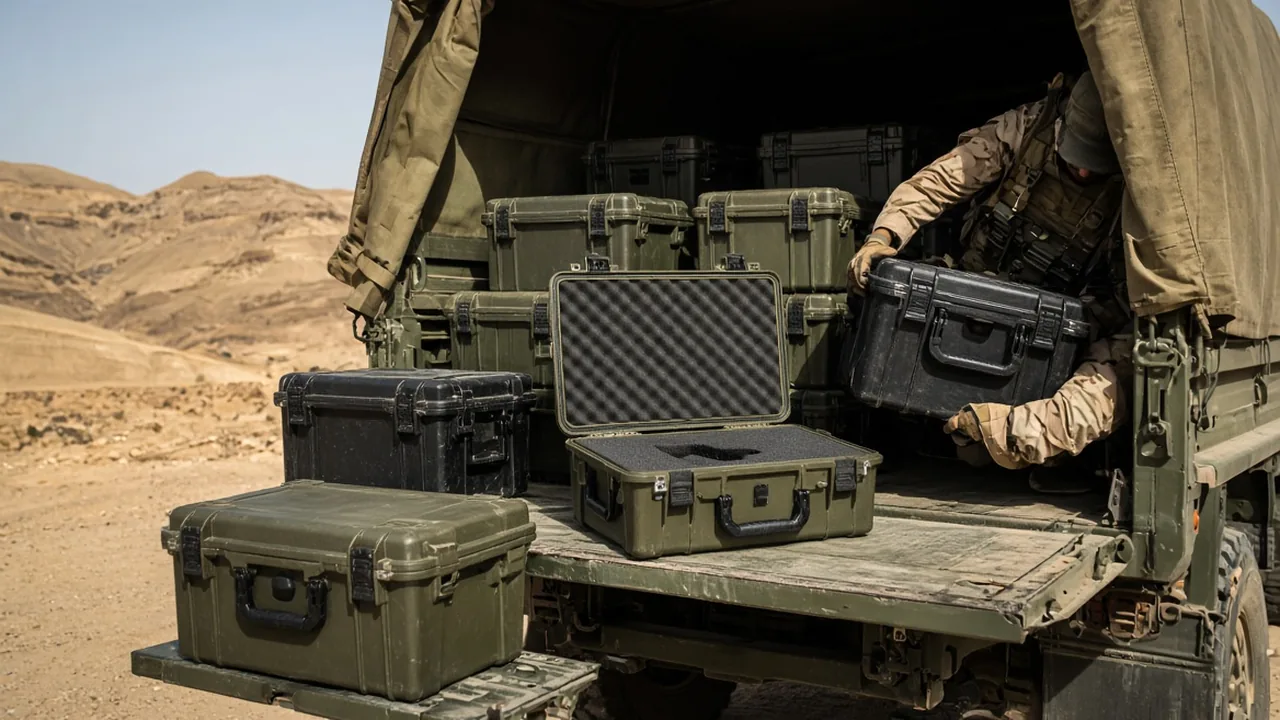
Survey and power-line inspection drone fleets, film and aerial photography crews, and emergency search-and-rescue drone teams all face the same reality: between missions the aircraft is exposed to vibration, rain, dust, and sudden temperature shifts. For a flight platform that can cost tens of thousands of dollars, a structurally sound, properly sealed, and well-fitted transport case is the first engineering line of defense that keeps transit damage low and mission launch time short. This article focuses strictly on the container itself - shell material, custom foam lining, IP67 sealing, isolated battery compartments, anti-vibration design, pressure equalization, latches and stacking, certification, and selection and maintenance - so that procurement and equipment managers can build a practical storage and transit plan without exposing the airframe, gimbal, or battery interfaces to avoidable mechanical risk during transfer.
1. What a Drone Transport Case Is and Why It Matters
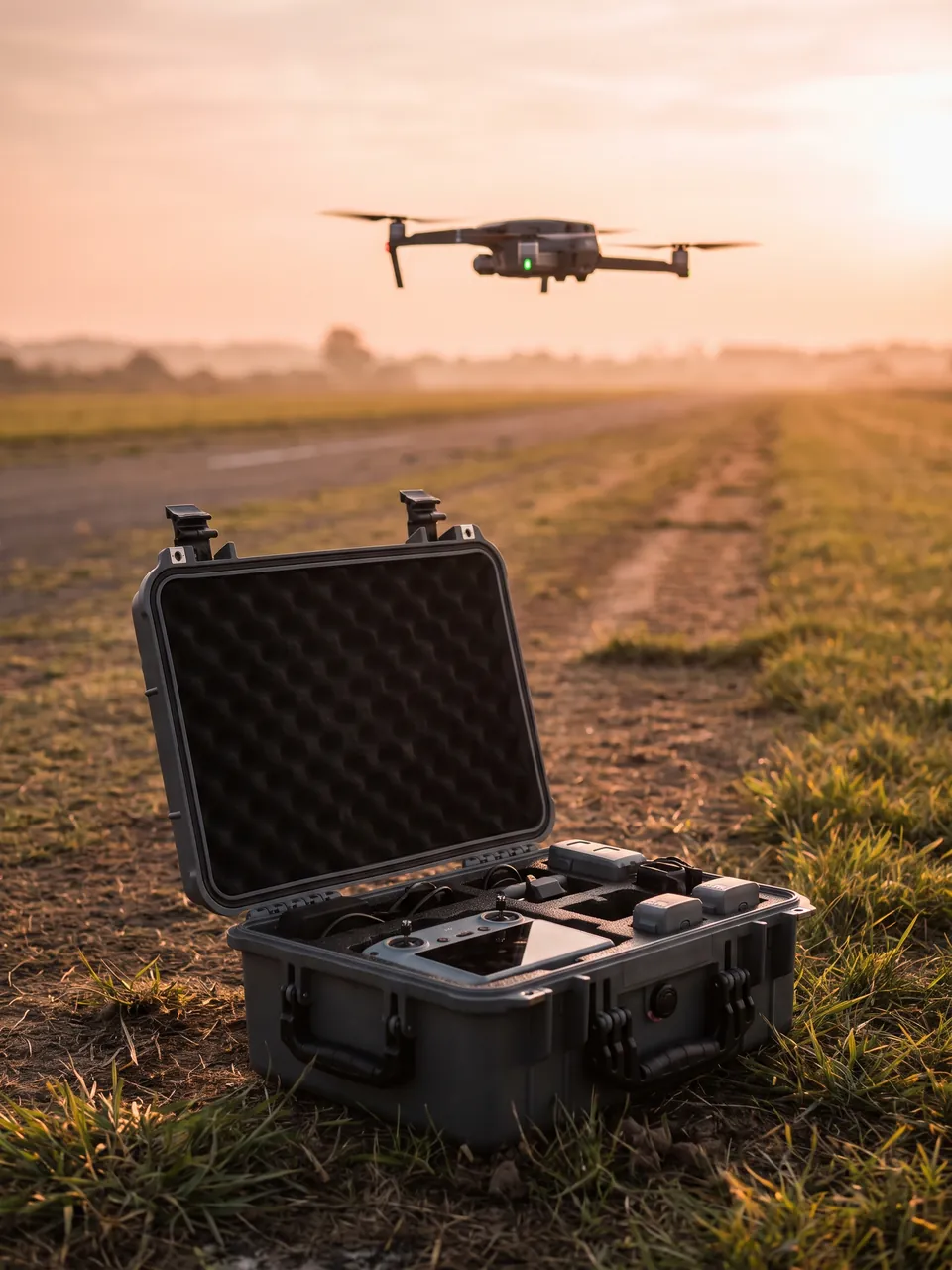
A drone transport case is a rigid protective container designed for multirotor, fixed-wing, and vertical-takeoff aircraft, used to protect the airframe, ground control station, spare batteries, chargers, and mission payloads during transfer, storage, and combined air-land logistics. Unlike a generic tool bag or soft backpack, this type of case uses a rigid shell as the skeleton and a custom foam liner cut to the exact three-dimensional data of the aircraft, holding every item in a dedicated cavity so that it cannot shift when dropped, squeezed, or shaken. For a mapping and inspection fleet, a qualified case means that after field work the gimbal, lens, and landing gear are stored safely and the aircraft is ready to fly the moment it reaches the next survey area. For a film crew, it moves quickly between city rooftops, islands, and plateaus while keeping camera gimbals and filters in a controlled environment. For a rescue team, it is the load unit that the team can carry and deploy for reconnaissance at any time.
In real operations the case performs three basic functions. First, physical protection: it resists impact, drops, and stacking pressure so that the carbon-fiber frame and folding mechanisms are not crushed. Second, environmental isolation: through a gasket and pressure-equalization valve it blocks rain, salt spray, dust, and condensation from entering the cavity, meeting field and nearshore needs. Third, organization: divided liners keep the aircraft, controller, batteries, and cables separate, preventing mutual damage and making pre-mission checks easy. It must be stressed that the case only handles storage and transit; it does not control flight and does not alter battery chemistry. Its entire value lies in reducing equipment risk during the non-flying phase. For cavity methods inside the case, see the guide on drone case foam insert design.
2. Shell Material and Structural Selection
The shell material of a transport case directly determines weight, stiffness, and weather resistance. Mainstream options include modified polypropylene (PP), acrylonitrile butadiene styrene (ABS), aluminum alloy, and engineering plastics blended from ABS and polycarbonate. Modified PP is formed by injection or rotational molding, offers good toughness, and resists embrittlement at low temperature, fitting cold-region inspection. ABS has high surface hardness and a crisp shape but loses impact resistance at very low temperature, suiting indoor or urban shooting. Aluminum cases provide extremely high stiffness and a baseline of electromagnetic shielding but are heavy and costly, mostly used for special carriers with strict protection needs. Blended engineering plastics strike a compromise between weight and strength and are the common choice for general cases.
The shell structure must meet several engineering constraints. Wall thickness should grow with case volume, typically in an empirical range of 2.5 to 4.0 millimeters; too thin reduces dent resistance, too thick adds needless weight. Inside the shell, reinforcing ribs in a grid pattern spread external impact across the whole body instead of concentrating it at one point. The interface between lid and base must leave uniform seal compression so that the gasket is squeezed evenly when closed, forming a continuous waterproof line. Corners should use rounded transitions, reducing stress concentration from transport impacts and lowering the chance of hurting handlers. For fleets that frequently fly or drive long distances, priority should go to UV-resistant, same-color inside-and-out formulations that slow discoloration and embrittlement after long outdoor use. For more material comparison, read the note on drone case material selection. Beyond the base resin, buyers should ask about the operating temperature window. Most engineering plastic shells perform from about minus twenty to plus sixty degrees Celsius in typical field use, but the exact figure depends on wall thickness and reinforcing design, so treat any single number as an empirical value rather than a guaranteed limit. If the fleet works in desert heat or polar cold, request a sample and run a simple left-in-vehicle test before committing to a batch. Recycling and regulatory aspects also matter for public-sector buyers, where end-of-life handling may be written into the tender; a supplier that documents material composition helps the fleet meet those clauses without extra research.
3. Custom Foam Liner and Equipment Zoning
The liner is the "second structure" of a transport case, holding the airframe, ground controller, spare batteries, charger, and propellers in dedicated cavities. Common foam materials include polyethylene (PE) foam, ethylene-vinyl acetate (EVA), and polyurethane (PU) open-cell foam, each with a different focus: PE foam is stable in rebound and resists shedding, fitting long-term shaping; EVA has a fine surface and can be thermoformed for a neater look; PU foam is soft and absorbs vibration well but is slightly less durable. Custom liners are usually cut by CNC routing or thermoforming based on real 3D scan data of the aircraft, so that every bump of the body, arm, gimbal, and controller has a matching support.
Zoning logic should follow "heavy at bottom, light at top, batteries isolated." The airframe and landing gear are heaviest and sit in the main bottom cavity on a solid foam base. The controller and tablet ground station go in a shallow upper slot, away from anything that could press on the screen. Spare batteries must occupy a separate compartment, physically isolated from the airframe, preventing battery movement from hitting the body and making labeling and retrieval per transport rules easy. Long items like propellers can use side slots to avoid bending. A good liner must not only "fit" but also "release": a gloved operator should locate each item within ten seconds and return it without forcing it against interference. For general liner craft, extend reading to the protective case foam lining guide. When budgeting liner cost, note that CNC-routed PE and thermoformed EVA differ in tooling. A one-off prototype is usually routed directly from a block, while a production run of hundreds may justify a thermoforming tool that lowers unit cost but adds lead time. The trade-off is between flexibility and economy: routed liners adapt quickly to a model change, formed liners are cheaper at scale but slower to revise. For a fleet that refreshes airframes every few years, keep the liner design modular so only the affected cavity is re-cut, preserving the rest of the investment.
4. IP67 Sealing and Water-Dust Design
IP67 is the most common rating marked on transport cases. Its meaning follows IEC 60529 and the corresponding national standard GB/T 4208: the first digit 6 means full dust protection, and the second digit 7 means withstanding immersion in one meter of water for thirty minutes under normal temperature and pressure without ingress. It must be clear that IP67 applies to the whole case when closed and latched; it does not mean the case can stay submerged long term, nor that it is safe under a direct high-pressure water jet. In practice, sealing relies on an elastic gasket in the lid groove, usually EPDM or silicone rubber, pressed evenly by the lid to form a continuous waterproof line.
Three factors affect sealing reliability. First, flatness of the sealing face; if the shell warps after molding, local gaps appear. Second, compression set; if the gasket loses rebound after long pressure, a leak path remains. Third, latch clamping force; a single latch often presses unevenly, while multiple latches with a surrounding strip are more stable. For coastal or rainy inspection, choose a salt-spray-resistant gasket formula and wipe the seal groove regularly with a lint-free cloth to clear sand and debris. If the task demands higher waterproofing, review the notes on drone case IP67 waterproof and IP67 protective case. It is worth adding that JUNZHIJIA matches the gasket to the actual shell profile so that compression is consistent across the batch, reducing local leakage caused by dimensional deviation.
5. Isolated Battery Compartment and Lithium Labeling
The battery is the highest-energy-density component of a drone system and the one most needing separate treatment in storage and transit. Inside the case, spare batteries must have their own compartment, physically separated from the airframe, controller, and flammable accessories. The isolated compartment serves three purposes: first, it prevents battery terminals from contacting metal items in the case and causing a short; second, if a single cell experiences thermal runaway, the wall gives some isolation, lowering collateral impact on neighbors; third, it makes it easy to label and count each battery per transport rules as a separate item. For fleets doing cross-city air-land transfer, the battery bay should also fit each cell's original insulating sleeve.
At the labeling level, UN38.3 and IATA rules are the basis for judging whether lithium batteries qualify for transport. The case itself does not need to rebuild the battery, but the outside of the battery bay should reserve a clear label area for battery model, rated energy, and prompts such as "lithium battery - carry separately, do not check." Note that this article cites UN38.3 and IATA only as context for in-case battery labeling and accompanying documents, and gives no instruction to modify, disassemble, or bypass battery safety design. For systematic requirements on lithium transport packaging, see lithium battery transport case and battery case guide.
6. Anti-Vibration and Cushioning Structure
Continuous vibration and occasional shock during transit are invisible killers of the gimbal, inertial navigation, and lens mechanism. A qualified transport case should dissipate energy on three levels: the shell absorbs macro impact, the liner absorbs micro vibration, and the equipment cavity limits relative displacement. When evaluating vibration and drop resistance, industry often references the vibration and drop procedures in MIL-STD-810H and the random vibration and drop flows in the ISTA series; these standards give test conditions and judgment frameworks, and specific products should obtain empirical values under corresponding conditions rather than promise absolute numbers.
In engineering, damping design has several key points. First, a density gradient in the liner: softer foam near the equipment absorbs high-frequency vibration, harder foam near the shell carries impact, creating "soft contact, hard support." Second, avoidance of weak parts: gimbal, antenna, and prop clamps need buffer margin and must not hard-contact the cavity. Third, centered center of gravity: heavy items sit near the geometric center to reduce swing inertia during handling and vehicle turning. For long vehicle transit, securing straps can connect the case to cabin anchors so it does not slide and hit during hard braking. For general transport test methods, extend reading to the ISTA test guide. A practical field check is to place a small fragile indicator, such as a chalk mark on a thin stem, inside the loaded case and drive a representative route; if the mark survives without break, the damping is plausibly adequate for that route. This is not a substitute for formal testing but gives fleets a cheap, repeatable sanity check between certified batches. Document the route, load, and result so that wear over seasons can be compared and the liner replaced before protection degrades below the accepted threshold.
7. Pressure Equalization Valve and High-Altitude Transit
When a transport case crosses a mountain pass by vehicle or enters an aircraft hold as baggage, outside pressure changes sharply, and the sealed air inside forms a pressure difference with the outside. At best the lid is sucked shut and hard to open; at worst micro-leakage occurs at weak points of the gasket. The pressure equalization valve (also called a breathing valve) exists for exactly this: it contains a membrane that vents gas but not water, allowing the inside and outside to equalize slowly and balance the difference while blocking liquid water and dust. In plateau transfer and air transit, this part is almost indispensable.
When selecting a pressure equalization valve, focus on three points. First, venting capacity, which should match case volume and pressure-change rate so balance finishes in reasonable time. Second, protection grade; the valve body itself should reach no lower than the case dust-water grade. Third, mounting seal; a reliable gasket between valve seat and shell opening prevents a new leak point. Note that the valve only balances gas pressure and cannot replace IP67 sealing, nor guarantee dryness when submerged. For fleets operating above three thousand meters or needing air transit, make the valve standard and clean its face regularly with a lint-free cloth to avoid dust blocking the membrane. For the selection principle of this part, see the protective case pressure equalization valve guide.
8. Latches, Wheels, and Stacking Structure
When a case cycles through the field and the airport, latches, handles, wheels, and stacking corners decide whether it is easy and durable to use. Latches should prefer multi-point linkage so that all sides receive force simultaneously when closed, giving more even seal compression; the latch surface should be corrosion treated, and coastal inspection must especially tolerate salt spray. Handles should balance grip and load; wide soft-grip handles spread hand pressure and ease long carries. For cases above twenty inches or heavy when loaded, fit quiet wheels and a telescopic handle so "carrying" becomes "pulling," sharply lowering crew fatigue.
The stacking structure refers to stacking ribs (or stacking corners) on the lid corners matching the case bottom, letting multiple cases stack stably without sliding. Design should calculate single-layer compression capacity; empirically, loaded stacking should not exceed three layers, and the total weight on the lower case should stay well below its rated stacking load. The side and front of the case can reserve nameplate slots or label areas for asset numbers, aircraft type, and responsible person, aiding fleet asset management. For cases checked at airports, if the latch faces aviation security, it should use an opening method that allows quick inspection. For general latch and handle selection, extend reading to protective case latch selection and protective case wheels and trolley handle.
9. Certification and Standards Checklist
A transport case for a professional fleet cannot be judged by appearance alone; it must rest on verifiable standards. Standards directly related to the case include: IEC 60529 and GB/T 4208 define IP ratings and test methods; MIL-STD-810H provides environmental adaptability test procedures for vibration, drop, high-low temperature, and humidity; the ISTA series simulates distribution vibration and drops; UL 94 evaluates the flame-retardant grade of shell material; the IK code (under IEC 62262) describes resistance to mechanical impact. In addition, products for the EU and global markets often involve CE, RoHS, and REACH compliance, stating material and environmental friendliness.
During procurement, require suppliers to provide test documents or declarations of conformity corresponding to these standards, rather than trusting grade labels on brochures. It must be stressed that different laboratories format reports differently; this article gives no specific pass numbers and only suggests using "typical values / empirical values" as reference, verified against your own conditions. JUNZHIJIA can, on delivery of custom cases, organize corresponding test files and material certificates per customer need, helping fleets build a compliance archive. For military environmental standards, extend reading to MIL-STD-810H case compliance; for flame rating, see UL 94 flammability rating cases. Do not confuse a marketing claim with a verified grade. A label that reads IP67 on the box is meaningless without a report that names the standard, the test house, and the sample configuration. Equally, a flame rating quoted as UL 94 V-0 should come with the thickness at which it was achieved, because the same material can rate differently at different wall thicknesses. Procurement should keep a single folder per case model that gathers all these documents, so that when a new region or contractor asks for proof, the answer is a file rather than a promise.
10. Customization Process and OEM/ODM Service
When off-the-shelf cases cannot fit a specific aircraft's folding shape, payload layout, or team-marking rule, customization becomes necessary. A typical process has five stages: requirement confirmation (aircraft list, device count, transport mode, temperature zone), 3D data capture (scan the aircraft and accessories or provide factory dimensions), liner design (zoning, cavities, buffer gradient), prototype and trial fit, then batch production and acceptance. A rule of thumb: the prototype must survive repeated open-close and a short road test with real equipment before batching, avoiding "paper fit" that fails in real handling.
At the OEM/ODM level, a mature supplier should design the liner from the customer's device list and also realize team-badge printing, asset barcode slots, and color visual management on the shell. JUNZHIJIA has the ability to customize liners and deliver OEM/ODM per aircraft type, and can replace different liner modules on one shell platform so a mixed fleet shares shells and splits liners, lowering spare-part variety. Note that customization is not "the more complex the better"; over-divided cavities raise return difficulty. Good customization balances "full protection" with "efficient access." For the trade-off between custom and standard, see custom foam inserts guide and protective case selection guide.
11. Selection Points and Procurement Checklist
For fleet batch procurement, a structured checklist should fix requirements and avoid being swayed by flashy parameters. First, list all devices to be stored with their 3D size and weight as liner-design input. Second, define transport mode: in-vehicle only, long vehicle transit, or including air and high altitude, which decides whether a pressure valve and aviation-compliance labels are needed. Third, define the environment grade: nearshore, rainy, or extreme cold, matching gasket formula and shell weather resistance. Fourth, set the protection floor; most outdoor work takes IP67 as the basic requirement. Fifth, agree on certification files, listing the required standard tests or declarations.
When comparing suppliers, put "can they give empirical values for the same condition" ahead of "can they claim the highest grade." A practical step is to ask candidates to send a sample case and have the fleet trial-fit real equipment, recording open-close count, post-road-test displacement, and seal-groove cleaning difficulty. Price should not be the only dimension; lifetime maintenance cost and spare-part availability matter equally. For procurement pitfalls, see drone case buying checklist and case procurement pitfall checklist. For differences between commercial and consumer airframes, also read consumer vs commercial drone case. Finally, plan for the whole life, not just the purchase. Ask about spare liners, replacement gaskets, and whether the shell can be re-lined for a future airframe; a case that supports a spare-parts list avoids a full repurchase when one component wears. Some fleets standardize on two or three shell sizes across all aircraft types, using interchangeable liners, which simplifies storage, training, and inventory. This platform thinking often lowers total cost of ownership more than chasing the lowest unit price on a one-off box.
12. Daily Maintenance, Cleaning, and Life Extension
A transport case is not "buy once and forget"; proper maintenance clearly extends service life. Before closing after each task, wipe sand and grass from the seal groove with a lint-free soft cloth to prevent debris from crushing the gasket or leaving a leak path next time. The shell surface can be wiped with a neutral cleaner; avoid strong solvents that accelerate plastic aging or strip printed marks. If the liner gets rained on, take it out and air-dry in shade before returning; never sun-bake, or the foam will deform and shed.
Latches, hinges, and the pressure valve are wear-concentrated parts; set periodic inspection: check latch smoothness, hinge looseness, and valve-face blockage. The gasket should be replaced by frequency; empirically, high-frequency field work can inspect yearly and replace on finding hardening, cracking, or permanent deformation. Store the case long term slightly open or closed without heavy load, avoiding extreme gasket compression. Refresh faded asset labels promptly for accurate fleet counting. With standardized maintenance, a quality case usually serves a fleet across multiple operation seasons of transfer and storage. For general cleaning, extend reading to protective case cleaning and maintenance. Beyond daily care, keep a small spare kit on hand: one spare gasket, a set of spare latches, and a spare liner module for the most-used aircraft. Storing these with the case means a field repair takes minutes instead of waiting for a shipment, which matters when a deployment window is tight. Tag each spare with the case model and the install date so rotation stays organized and nothing expires unnoticed. Some fleets also keep a thin foam-repair sheet and contact adhesive for minor liner scuffs, extending the liner life between full re-cuts. This low-cost readiness turns the case from a passive box into an active part of the mission supply chain.
FAQ
Q: Is a drone transport case fine as long as it fits the aircraft, since the appearance looks similar? A: That view carries hidden risk. "Fitting" is only the most basic requirement; what truly decides protection is whether the liner is cut for the model, whether the seal is even, and whether the shell can take transit shock. A generic box that merely holds the aircraft usually lacks fixed cavities, so on rough roads the body rattles against the wall and the gimbal and propellers take the hit first. The value of a professional case is exactly that it limits every item to a dedicated spot and absorbs vibration through a foam gradient. Therefore selection should center on "fit to the loaded aircraft" and "sealing grade," not just volume. For mixed fleets, prefer a platform case with swappable liner modules that balances protection with flexibility. A sample trial with real equipment remains the most reliable check before purchase, and it should be paired with a short written note recording fit, seal compression, and the road-test result so that later reorders stay consistent with the approved sample.
Q: Why must spare batteries have a separate compartment, can they share a cavity with the airframe? A: Storing batteries with the airframe creates multiple hazards, so the industry generally requires isolated battery compartments. First, if battery terminals touch metal tools or cable connectors inside the case, a short circuit and high heat can result. Second, several cells knocking together during movement accelerate shell wear and raise the chance of leakage or thermal runaway. Third, transport rules require spare lithium batteries to be labeled and counted separately, and mixed storage complicates security and compliance. The isolated compartment uses a physical wall to separate batteries from the airframe and controller, easing labeling and lowering collateral risk. Note that this article cites relevant transport rules only as context for labeling and documents and gives no battery modification instruction. A good battery bay also fits each cell's original insulating sleeve for cross-city air-land transfer, and a simple battery log on the lid listing cell count and rated energy further speeds both pre-flight checks and any airport security inspection.
Q: A case rated IP67 - does that mean it can stay submerged long term or be washed with a water jet? A: No, that is a misunderstanding. IP67 under IEC 60529 and GB/T 4208 means full dust protection and immersion in one meter of water for thirty minutes without ingress, applying to the case closed and latched, a short-term guard not long-term diving. A high-pressure jet may force water past the latch at pressures above the standard test, and long soaking accelerates gasket aging. The correct use is to treat IP67 as protection against rain, splashes, and short falls into water; wipe the seal groove dry after rain and rinse salt off after marine work. If the task needs higher waterproofing, state the condition at purchase and ask for the corresponding test file. Remember the rating covers the closed case only; an open or partly latched case loses the grade entirely, so always confirm full closure before exposure. A quick daily habit of checking that every latch is fully seated takes only seconds and protects the rating far more than any label printed on the shell.
Q: For the liner foam, is EVA or PE better, and is the difference large? A: They target different needs and should be judged by usage intensity. EVA has a fine surface and can be thermoformed for a neat look, fitting crews that open the case often or care about external image, but its rebound after long pressure is slightly weaker. PE foam is stable in rebound and resists shedding, more durable for frequent loading, fitting high-frequency inspection and rescue fleets. PU open-cell foam absorbs vibration well but is less durable and is mostly a buffer layer rather than the main cavity. Real schemes often combine "PE support with EVA facing" to get both shaping and feel. Whatever the choice, cut the liner to real 3D data of the devices, not estimated grooves, or cavity interference will make return difficult. A glove-friendly, ten-second pick-and-place is the practical test of a good liner, and asking the supplier for a spare liner quote at the first order is wise because the liner wears faster than the shell.
Q: When crossing mountains or flying, the case gets sucked shut and hard to open, even worry about water - what to do? A: This is exactly what the pressure equalization valve solves. High altitude or hold depressurization creates negative pressure inside that sucks the lid shut and may press the gasket. A qualified gas-venting, water-blocking valve lets inside gas equalize slowly with outside, eliminating the difference in reasonable time, easing opening and lowering leak risk at weak points. When selecting, check venting capacity, the valve's own protection grade, and mounting seal, and clean the valve face regularly against dust blockage. Remember the valve only balances gas pressure and cannot replace IP67 sealing; submerged, it still cannot guarantee dryness, so it must work with a reliable gasket. For fleets above three thousand meters or needing air transit, make the valve standard rather than optional. A pre-trip check of the valve face is a small habit that prevents big trouble, and noting its location in the crew handbook keeps new members from skipping it under deployment pressure.
Q: How to tell whether a factory's gasket truly matches the case, rather than just any rubber strip? A: Verify from three angles. One, compression: after closing, the gasket should be evenly squeezed all around; use a feeler gauge to check for hidden gaps. Two, material proof: ask the supplier to state the gasket material (such as EPDM or silicone) and provide weather and compression-set data. Three, whole-case water verification: ideally do an immersion or spray check after closing the sample and inspect inside. Suppliers like JUNZHIJIA that match the gasket to the shell profile ensure consistent compression across the batch and reduce local leakage from dimensional deviation. At purchase, write "seal verification" into the acceptance clause rather than trusting a grade label. A repeated open-close and short road test with real equipment remains the most convincing evidence that the seal truly fits, and when two samples tie on paper, choose the one whose gasket is easier to source as a spare, because a seal you cannot replace locally turns a small maintenance task into a long downtime during a field campaign.
Q: What test or compliance files should procurement ask a factory for, to avoid later audit problems? A: At least four types are suggested. First, the IP-grade test report or declaration of conformity based on IEC 60529 and GB/T 4208. Second, environmental adaptability files such as vibration and drop records referencing MIL-STD-810H and ISTA. Third, material compliance files, including UL 94 flame grade and RoHS and REACH declarations. Fourth, shell material and gasket specifications. This article gives no specific pass numbers and suggests using typical or empirical values as reference, verified against your own conditions. JUNZHIJIA can organize corresponding test files and material certificates on delivery of custom cases, helping fleets build a compliance archive for later audits or cross-region transport checks. Keep these files with the asset record and store them alongside the airframe manuals so any audit can be answered with documented evidence rather than verbal claims. A practical tip is to require the supplier to stamp each report with the case model and serial batch, which prevents mix-ups when the fleet later operates several case versions at the same time.
Q: How many years does a drone transport case usually last, and how to extend its service life? A: Life depends on usage intensity and maintenance, with no fixed number, but disciplined care clearly extends it. Empirically, for high-frequency field work inspect the gasket yearly and replace on finding hardening, cracking, or permanent deformation; latches, hinges, and the pressure valve, as wear-concentrated parts, should enter periodic checks. Before each close, clear sand from the seal groove, wipe the shell with neutral cleaner, and if the liner is wet, air-dry in shade rather than sun. Store long term slightly open or closed without heavy load to avoid extreme gasket compression. Refresh faded asset labels promptly. With these steps, a quality case usually accompanies a fleet across multiple operation seasons of transfer and storage. Treat the case as mission equipment, not packing, and schedule the inspection into the same routine as firmware and propeller checks so the case keeps paying back through fewer damaged airframes and faster launches. Make the yearly gasket inspection a fixed calendar event rather than a reaction to a failure, and the case will likely outlast the airframe it was bought to protect.