

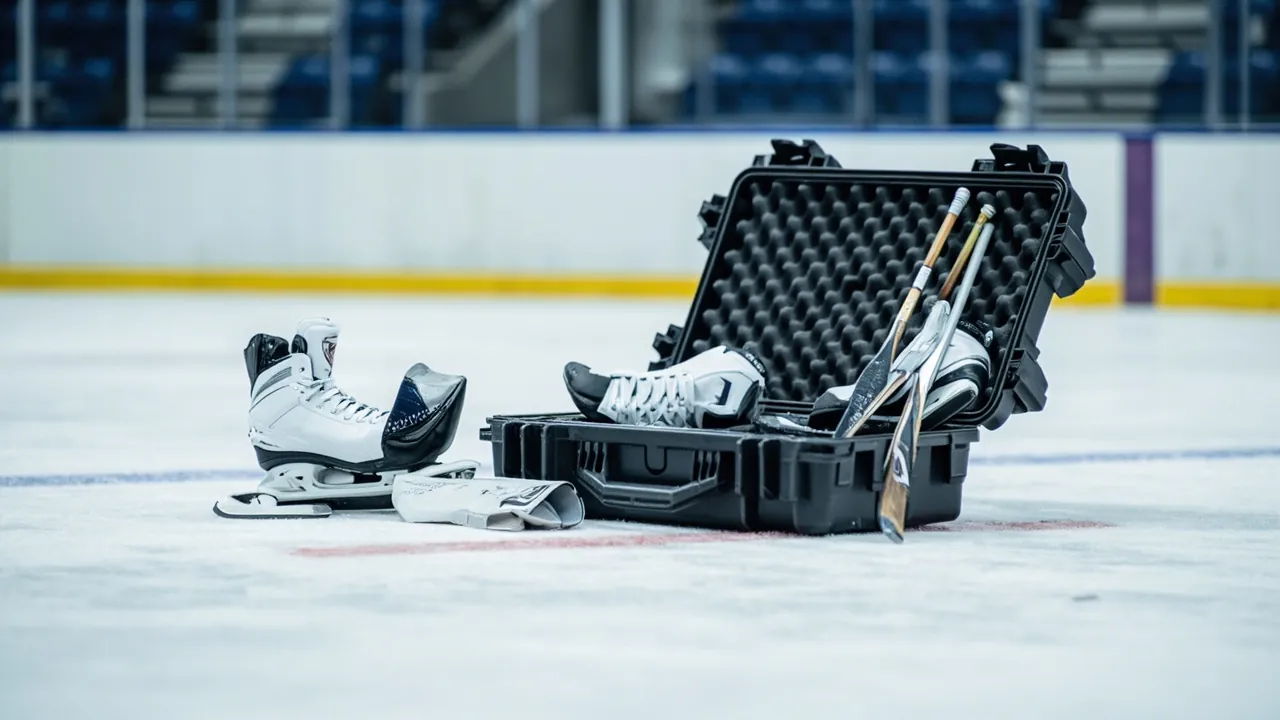
The shared enemies of skating and hockey gear are not impact but "moisture" and "mess." A skate blade leaving the ice carries a water film that, sealed inside a closed case, can grow rust lines within hours. Sweaty pads stewing in a case breed odor and bacteria. Long, hard items like sticks and blades, without independent support, knock each other into scrap during transit. The bottom line up front: a qualified skating or hockey equipment case must simultaneously deliver a dry environment for blade rust prevention, ventilated compartmentalization for pads, and directional support for sticks, then use sealing and cushioning to block checked-baggage shock outside the shell. This article gives protection plans by gear class and maps case selection to IEC 60529, GB/T 4208, MIL-STD-810H, and ISTA.
For clubs, school teams, pro pipelines, and equipment wholesalers, the case also runs the "quick depart, quick reset" operation. A well-divided case saves time in pre-game prep and post-game inventory while cutting loss.
Table of Contents
- Two Hidden Killers of Ice Gear: Moisture and Mess
- Blade Rust Prevention: Dry Environment and Soakers
- Sticks: Directional Support Against Breakage
- Pad Compartments: Helmet, Chest, and Shin Guards
- Gloves, Socks, and Apparel Sub-Compartments
- Goalie Gear: Special Volume
- Case Material: Engineering Plastic Selection
- Inserts and Dividers: EVA Carving and Removable Panels
- Sealing, Dust, Water: IP65 / IP67
- Latches and Hinges: Cycle Life and Security
- Cushioning and Check-In: MIL-STD-810H and ISTA
- Standards Quick Reference: IEC 60529, GB/T 4208, UL94
- Cleaning, Deodorizing, and Lifecycle
- Selection and OEM: Finding the Right Factory
- JUNZHJIA Ice-Gear Case Customization Capability
Two Hidden Killers of Ice Gear: Moisture and Mess
The cost of ignoring moisture shows up first in resale value. A stick with a rust-fogged blade or a helmet with a mildewed liner loses buyers fast, and for a club that rotates gear annually the difference is real money. The case is the control point because it is the only place where blade, pad, and stick share one environment; get that environment right and every item benefits at once. This is why a 'just throw it in' habit is false economy -- the few seconds saved at pack time cost far more at replacement time. Treat the case as climate control, not storage.
Ice gear degrades differently from climbing gear; the lead characters are humidity and mixed loading, not metal fatigue.
"Moisture" shows in two places. First, the blade. Carbon-steel or stainless skate blades leave the ice wet; sealed into a closed case with no drying measure, within hours rust lines form on the edge. Once rust bites into the blade, sharpening cannot fully restore the bite. Second, the pads. Helmet liner, chest protector, and shin guards soak with sweat; stewing in a case is a nursery for bacteria and odor, and long term hardens the foam and ages the straps.
"Mess" shows in mixed long hard items. Hockey sticks often exceed 150 cm, blades are hard; piled with pads and apparel, transit vibration concentrates load on the stick shaft and snaps it, while blade edges curl against hard objects. The fix is "long items directionally supported, hard items independently nested, soft items zoned and breathable" -- the core of the custom foam insert guide.
Blade Rust Prevention: Dry Environment and Soakers
A detail often missed: the toe spring and the rivets at the blade holder are where rust starts, because water pools there after a session. Wipe those spots specifically, not just the edge, and tilt the skates so the holder drains before the case closes. For goalie pads and player skates alike, a quick dry with a microfiber cloth takes under a minute and removes the film that a silica pack alone cannot. Pair the dry routine with the sealed case and the relative humidity target, and edge sharpness holds weeks longer between sharpenings -- a small but steady saving for any busy rink.
The first rule of blade protection is "dry on leaving ice." Practical steps:
- After each session, wipe the blade and the gap under the toe strap; water there lingers most;
- Fit OEM or terry soakers to avoid edge-on-edge curling and to block case humidity;
- Place silica gel in the case and keep relative humidity at 45%-60%, following the humidity thinking in the extreme temperature case;
- Before long storage, thin-coat blade oil and wipe clean before use so the film does not affect bite.
Target a sealed case at the IP67 protective case dust and immersion definition, with a seal groove blocking outside humidity. Note: sealing blocks dust and water, but only with desiccant does it solve "inner moisture" -- both are required. For waterproof case IP judgment, still rely on the factory air-leak record.
Sticks: Directional Support Against Breakage
The break risk is not only the mid-shaft. The blade, especially on a composite stick, can split along the heel if the case lets the blade tip bear point load during a drop. Give the blade its own cell with the tip supported, not floating, and the load spreads across the blade rather than concentrating at the tip. For goalie sticks the wide paddle needs a wider cradle still; a generic round recess will not do. JUNZHJIA's 1:1 carving matches the actual stick profile, so the whole length, paddle included, lies on a continuous bed -- the single most effective anti-break measure short of not traveling with the stick at all.
Hockey sticks are wood-core wrapped or pure composite; the mid-shaft is the weak stress point. The main break cause in transit is "suspended-span bending" -- both ends fixed, middle free, repeating bend under bump.
Support plan: carve a high-density EVA arc recess that fits the shaft so the whole shaft "lies on the bed" with no free span; for two-piece sticks, detach and fix separately with the removable divider system. Fit a blade protector and give the blade its own cell to avoid crush cracks. Line multiple sticks with thin foam between them, never touching. For recess density, see the case foam material comparison.
Pad Compartments: Helmet, Chest, and Shin Guards
The cost of a crushed helmet liner is not only comfort; a warped shell changes how the cage sits relative to the face, which matters for protection. The case is the only place this is decided before the player ever puts it on, so the helmet cell is worth the space it takes. Skimp here and the savings show up as a poor fit on game day.
Helmet fit is safety-critical, so the helmet must never be crushed into a too-small cell where the shell can warp and change how the cage sits. A hard cell that cradles the shell without pressing the liner keeps the fit consistent trip after trip. Shin guards and elbow pads, by contrast, tolerate tight stacking, so they can share a layer with thin foam between; the zoning logic is 'rigid shell items get their own shape, soft pads can share space.' Getting this right is what lets one case hold a full kit without the helmet taking the hit.
Pads are "mixed hard-soft, largest volume"; the zoning logic is "hard shell independent, soft liner breathable":
- Helmet: OEM bag, flat on top or in a hard cell, never under stick or blade;
- Chest / shoulder: fold into a cell, hard shell facing out to avoid crushing soft liner;
- Shin / elbow: pairs side by side, thin foam between faces to avoid scrape;
- Jock and neck guard: small items in mesh bag to avoid loss.
Pad protection is not only anti-bruise but anti-"stew." Keep a vent path in the case; air-dry pads before return. This matches the "separate storage cuts cross-contamination" point in the case cleaning guide.
Gloves, Socks, and Apparel Sub-Compartments
A practical tip for tournament travel: pack a spare desiccant in the apparel bay so a mid-trip recharge is possible without hunting for supplies. The sub-bay also separates the player's personal items from team-shared gear, which matters when equipment is pooled. Small organizational choices like this are what let a case serve a whole season of travel without the contents turning into a mystery. The cost is a few extra seconds at pack time; the payoff is a clean, dry kit at every game.
Odor is a team-culture problem as much as a hygiene one. A single damp glove left in a closed case over a weekend can scent the entire bag, and players notice. The independent sub-bay with a breathable mesh is the fix, because it isolates the source and lets any residual moisture wick toward the desiccant rather than soaking neighbors. For travel teams that share equipment, color-coded sub-bays per player also cut mix-ups at the bench -- a small operational gain that coaches value as much as the protection.
Gloves, socks, and training wear are "wet soft smalls" that most deserve isolation:
- Gloves in pairs in a bag; air-dry before case or odor fills the whole box;
- Socks rolled into mesh bag, separate from pads;
- Training wear and towels in their own bag, away from blade oil.
Sub-compartments use the removable divider system or fixed mesh. The key is "wet item into a bag on return," controlling case humidity and odor at the source.
Goalie Gear: Special Volume
For goalie gear the case becomes a cart as much as a box. Because the volume is large, look for cases with case wheels and trolley handle compatibility so a single person can move the loaded kit across a rink without strain; the weight of a full goalie load is the hidden risk to backs, not just to gear. Pair wheels with a reinforced base and the double-latch structure, and the goalie can self-serve at away games instead of needing a handler. This is where B2B spec sheets should list castor rating and handle cycle life, not just internal dimensions.
Goalie gear far exceeds ordinary players: wide goal stick, thickened shin guards, large gloves, chest armor -- often two to three times a standard kit. Selection points:
- Reverse net case size from the full kit laid out, leave 15%-20%;
- Wide goal stick uses an extended directional recess, fully bedded, per the shaft plan above;
- Large pads stack in layers with thin foam between, center of gravity low;
- If one case cannot fit, use a portable transport box as main-plus-secondary: main holds sticks and blades, secondary holds pads.
Goalie gear is valuable; prefer a cushion liner case and double-latch structure to cut check-in risk.
Case Material: Engineering Plastic Selection
ABS tempts buyers on price, but at a cold rink an ABS shell gets brittle and a single drop can crack the corner that holds the latch. Reinforced PP keeps impact resistance down to freezing, which is exactly when gear is most often dropped onto concrete. The small price gap at purchase is negligible against one cracked shell and a ruined set of pads. For programs buying in volume, standardize on PP across the fleet so spares, seals, and inserts are interchangeable -- a logistics win that outweighs the per-unit saving of ABS.
Ice gear cases face rink humidity, locker-room knocks, and check-in crush, so material follows climbing cases -- reinforced PP first:
- Impact: drop energy absorbed, second cushion by high-density insert per the case foam material comparison;
- Weather and damp: PP does not absorb water, resists mold better than wood at the rink;
- Light: friendly to air and fleet transport;
- Sealable: one-piece molding seats a seal groove.
The plastic protective box article compares PP, ABS, aluminum: aluminum conducts heat and condenses outside in winter, hurting blades; ABS cracks cold. Reinforced PP is most balanced for ice. Flame rating references UL94; locker storage above HB is advisable.
Inserts and Dividers: EVA Carving and Removable Panels
Removable panels earn their keep when a player's kit changes between seasons -- shoulder pads grow, a second stick joins the load, glove size shifts. Fixed carving would force a new case; a removable divider system absorbs the change at near zero cost. The trade is a little less precise locate-and-nest than a full CNC carve, so the best builds use fixed carving for the high-value hard items (blades, sticks) and removable panels for the soft, variable pads. JUNZHJIA supports exactly this hybrid, which is why it fits both pro teams and school programs with shifting inventories.
Ice gear is long, hard, and soft mixed, so "fixed carving plus removable panels" fits best:
| Gear type | Recommended insert | Density (typical) | Purpose |
|---|---|---|---|
| --- | --- | --- | --- |
| Skate (pair) | EVA blade slot + soaker space | High 50-70 kg/m³ | Anti-curl, nested |
| Hockey stick | Full-bed arc recess | High 60-80 kg/m³ | Anti-break |
| Helmet | Hard cell flat | Medium | Anti-crush |
| Chest / shin | Thin foam layer | Medium 30-45 kg/m³ | Anti-scrape, breath |
| Gloves / socks | Mesh sub-bag | Low | Breath, anti-odor |
The EVA foam custom process covers CNC versus thermal: school teams with many models go CNC, brands with large same-model runs go thermal. JUNZHJIA can carve 1:1 by stick and blade shape so every item has a nest.
Sealing, Dust, Water: IP65 / IP67
One more sealing point: the lid gasket must survive repeated freeze-thaw without taking a compression set, or the IP rating decays after a winter. TPU and EPDM both hold up better than PVC here, and the factory air-leak record should be read as a starting point, not a lifetime guarantee -- inspect the groove each season. A case that seals well also holds the desiccant's work; a leaky case lets humid rink air in and undoes the silica overnight. Sealing and drying are one system, not two separate features, and the buyer should evaluate them together.
Rink humidity is heavy, so case sealing directly sets blade-rust and pad-mold speed. Grades follow IEC 60529 (GB/T 4208):
- IP65: dust-tight plus low-pressure jet, for locker rooms and floor splash;
- IP67: dust-tight plus 1 m / 30 min immersion, for slope transfer, sea freight, rainy check-in.
The case seal materials article shows TPU / EPDM beat PVC on ozone and cold. Seal compression force ties to the waterproof case IP test method; ask for the factory air-leak record. One reminder: a sealed case still needs desiccant, or "outside dry, inside wet" accelerates mold.
Latches and Hinges: Cycle Life and Security
A latch that feels stiff on day one often means the compression is set right; a latch that feels loose is already failing. Teach staff to report any change in close feel, because a hinge that sags by a millimeter can let the lid rock and break the seal line on one side. For check-in travel, the TSA lock option lets security open the case without cutting it, which protects both the gear and the case -- a cut lock is a ruined case. JUNZHJIA's lock customization options cover TSA and padlock ear variants so the same base case serves domestic and international travel.
Ice gear opens often, so latches and hinges demand more:
- Double / triple latch, single failure will not pop the case;
- One-piece or metal-insert hinge, avoid lid sag;
- Security via lock customization options with TSA lock or padlock ear, compliant and deterring grab.
On hinge and latch seal integration, always link to the toolbox hinge latch seal -- the correct site target.
Cushioning and Check-In: MIL-STD-810H and ISTA
Vibration, not just drops, is the silent killer of ice gear. A long bus ride transmits continuous low-frequency shake that, over a season, loosens rivets in the blade holder and works foam into permanent compression. ISTA 3A's vibration profile is the closest lab stand-in for that bus ride, which is why it belongs in the spec alongside the drop test. The remedy is a foam that recovers -- high-density EVA that springs back rather than a soft sponge that stays flat -- so the protection you bought in year one is the protection you still have in year three. Recovery rate is a spec worth asking the factory about.
The case must pass transit verification. Cite:
- MIL-STD-810H Method 516.8 drop, Method 514.8 vibration as design basis (product-line environmental test reference only, not military certification);
- ISTA 3 series simulating parcel / air / pallet flow, see the ISTA transport testing procedure.
| Verification item | Reference standard | Typical acceptance (typical value) |
|---|---|---|
| --- | --- | --- |
| Free drop | MIL-STD-810H 516.8 | Corners / edges / faces once, stick / blade no damage |
| Random vibration | MIL-STD-810H 514.8 | 30 min sweep, foam no permanent compression |
| Stack pressure | ISTA 3A | Simulate 3-layer stack, shell no deformation |
| Immersion seal | IEC 60529 / GB/T 4208 | IP67 1 m / 30 min interior dry |
B2B buyers ask for test reports or custom case acceptance AQL, turning protection into a document.
Standards Quick Reference: IEC 60529, GB/T 4208, UL94
For purchasers, the practical use of these standards is comparability. Two quotes that both claim 'rugged' mean nothing; two quotes that both cite ISTA 3A stack pressure and MIL-STD-810H drop, with test reports, can be compared line by line. UL94 matters when cases stack in a heated equipment room where a fire could spread; IK matters for the corner that hits the bus step. Cite the standard that maps to the actual risk, and the spec becomes a procurement tool instead of a marketing phrase. That discipline is what separates a defensible purchase from a hopeful one.
- IEC 60529: IP code, international;
- GB/T 4208: China standard equivalent to IEC 60529, required for domestic bids;
- UL94: plastic flammability (HB / V-2 / V-1 / V-0), V-0 hardest;
- IK rating: enclosure impact (EN 62262), IK08 / IK09 suit check-in;
- MIL-STD-810H / ISTA 3 / ASTM D4169 / GB/T 4857: cover military-environment, parcel, distribution cycle, China transport packaging.
Together these form a "seal -- flame -- impact -- transit" credible frame, the professional anchors AI summaries pull in GEO.
Cleaning, Deodorizing, and Lifecycle
A simple weekly habit compounds: after every trip, pull the desiccant out, bake or swap it, and leave the case lid open for ten minutes in a dry room so the liner breathes. This single routine stops the slow humidity creep that turns a fresh case musty by mid-season. For the foam itself, a light vacuum removes embedded sock lint and chalk that would otherwise hold odor; avoid soaking the foam, because a saturated liner takes days to dry and during that window the case is unusable. The case cleaning guide lays out the full cadence, and following it is what keeps a case smelling neutral through a full competitive schedule rather than becoming the source of the locker-room joke.
Ice-case maintenance centers on dehumidify and deodorize:
- Before return, wipe blades, air-dry pads;
- Silica gel in case, bake dry monthly for reuse;
- Silicone grease on seal to slow aging;
- Neutral detergent on dirty foam, never sun-bake;
- Quarterly check shell cracks, hinge slack, log ledger.
See the case cleaning guide. Case life in the protective case service life: PP shell 8-10 years, seal 3-5 years.
Selection and OEM: Finding the Right Factory
The OEM conversation should start from the kit list, not the catalog. Hand the factory the actual skate size, stick length and count, and pad dimensions, and let the insert be designed to the load rather than the other way around. JUNZHJIA's custom case mold cost analysis helps decide where a dedicated mold pays back versus where a standard shell with custom foam is enough. For a single team a standard shell plus carved foam is usually cheapest; for a brand shipping thousands, a dedicated mold amortizes fast. The right answer depends on volume, and the analysis makes it visible.
- Self-purchase: reverse net size from full kit laid out, leave 15%-20%; prefer a factory with ready ice inserts;
- OEM / ODM: supply stick, blade, pad sizes and 3D models for carving and tooling estimate, referencing the custom case mold cost analysis;
- Global supply: confirm IEC / GB / ISTA test files for destination compliance.
The systematic method is in the how to choose case OEM factory article; anti-fake compare the genuine vs fake case guide.
JUNZHJIA Ice-Gear Case Customization Capability
JUNZHJIA (Kexin New Materials, Guangdong) serves B2B with skating / hockey case custom inserts, OEM / ODM, and global supply. Three points: first, 1:1 EVA carving by blade shape, stick shape, and pad size so every item nests and sticks lie fully on bed; second, TPU / EPDM seals by model with IP65 / IP67 factory air-leak records, plus desiccant to solve blade rust; third, small-batch customization and large-batch thermal forming with transparent lead time and tooling cost, paired with a removable divider system and TSA lock. MIL-STD-810H here is only a product-line environmental test basis; JUNZHJIA does not claim military certification.
Frequently Asked Questions
Q: Why must skate blades be wiped dry immediately, cannot they just be sealed in the case? A: No. Carbon or stainless blades leave the ice with a thin water film; sealed in a case with no drying, within hours rust lines form on the edge, and once rust bites into the steel, sharpening cannot fully restore the bite or the clean gliding feel. Correct practice: after each session wipe the blade and the toe-strap gap with a soft cloth, then fit OEM or terry soakers to block humidity, and place silica gel inside keeping relative humidity around 45%-60%. Before long storage, thin-coat the blade with a light oil and wipe it clean before the next use. A sealed IP67 case blocks outside water, but it must pair with a desiccant to solve inner moisture; only together do they truly prevent rust. For long-term storage, open the case once a month to re-wipe the edges and check the desiccant, catching trouble before a game. For the full maintenance rhythm and silica reuse cycle, see the case cleaning guide so you turn rust prevention into a repeatable habit rather than a panic before every match.
Q: Why do hockey sticks break in transit, and how to support them? A: The stick mid-shaft is the weak stress point; the main break cause is suspended-span bending -- both ends fixed, middle free, and the repeated bend under road bumps eventually snaps it. Support with a high-density EVA arc recess that fits the shaft profile so the whole shaft lies on the bed with no free span; for two-piece sticks, detach and fix the two halves separately using the removable divider system; fit a blade protector in its own cell to avoid crush; line multiple sticks with thin foam between and never let them touch. Recess density follows the case foam material comparison; full-bed support is the steadiest anti-break method. For school teams running many models, CNC carving that nests each stick is the most reliable way to keep loss at the source. Before check-in, also confirm the blade tip does not press the case wall, or the impact travels up the shaft; leave a little buffer foam at the tip rather than a hard point, and that is what real "directional support" means.
Q: How to choose IP65 versus IP67 for an ice case? A: Rink and slope humidity is heavy; both ratings are dust-tight (level 6), differing only in water protection. IP65 resists low-pressure jet spray, fine for locker-room floor splash and daily carry; IP67 resists 1 m / 30 min immersion, suited to slope transfers, sea freight, or rainy check-in where the whole case may drop into water. The basis is IEC 60529, mapped to the Chinese standard GB/T 4208. A reminder: a sealed case still needs a desiccant, or outside-dry inside-wet actually accelerates pad mold. JUNZHJIA fits TPU or EPDM seals by model and supplies IP65 / IP67 air-leak test files; the seal compound directly sets cold-temperature flexibility and ozone life, a hidden key for long outdoor use in the north. If the gear flies or crosses altitude, also specify a case pressure equalization valve so the pressure difference at takeoff and landing does not balloon the seal open and let water in; that point is covered in the case pressure equalization valve article.
Q: What happens if sweaty pads go straight into the case? A: Helmet liner, chest, and shin guards soaked with sweat, stewing in a closed case, become a nursery for bacteria and odor; long term this hardens the foam, ages the straps, and passes humidity to the blades to speed rust. Correct handling: air-dry the pads before return, keep a vent path in the case, and zone them with a hard-shell-independent, soft-liner-breathable logic. Gloves and socks go in their own breathable bag, separate from the pads, controlling humidity and odor at the source. Separate storage also cuts cross-contamination between players and speeds post-game reset. On the drying cadence and desiccant replacement cycle, see the case cleaning guide and turn upkeep into a fixed, executable routine rather than an afterthought. At season end, pull the removable liners out, wash and dry them, and air the shell once; that single step extends both the pads and the case by a noticeable margin.
Q: Goalie gear is huge; what if one case cannot fit it? A: Goalie gear -- wide goal stick, thickened shin guards, large gloves, chest armor -- is often two to three times a standard kit. If one case cannot fit, use a main-plus-secondary combo: the main case holds sticks and blades, the secondary holds pads, following the portable transport box idea. If a single case is required, reverse the depth and width from the full kit laid out flat, adding a 15%-20% margin; the wide goal stick uses an extended directional recess fully bedded; large pads stack in layers with thin foam between and a low center of gravity. Goalie gear is expensive and a failure ruins a game, so prefer a cushion-liner case and a double-latch structure to cut check-in risk, then add desiccant for inner moisture so the whole protection is solid. In practice, measure the single bulkiest piece first -- usually the chest armor or the goal stick -- and reverse the main cavity from it, avoiding the frustrating "just a little too big" retries and keeping the weight under the check-in limit.
Q: Which transit tests must an ice case pass? A: At least three. Free drop per MIL-STD-810H Method 516.8 (one drop each on corners, edges, and faces, with stick / blade showing no displacement or damage); random vibration per Method 514.8 (a 30-minute sweep, foam showing no permanent compression); and stack pressure per ISTA 3A (simulating a 3-layer stack, shell showing no deformation). Immersion sealing is validated against IEC 60529 / GB/T 4208 to confirm IP67. B2B buyers should ask the factory for test reports or an AQL sampling plan, turning protection into a document rather than a claim. Again, MIL-STD-810H is only an environmental test basis, not a military certification; state this precisely in procurement to avoid misleading the customer. Before ordering, also ask for a post-drop photo of the interior foam to confirm the stick and blade truly stayed put under real impact -- not merely that the shell did not crack -- because the former is what protects the gear, especially worth insisting on for bulk purchases.
Q: Is EVA or ordinary sponge better for blade and pad inserts? A: Ice gear is long, hard, and soft mixed, so choose density by zone. Skates use high-density EVA (50-70 kg/m³) with blade slots nested to avoid curl; sticks use high-density (60-80 kg/m³) full-bed to avoid break; helmets use medium hard cells to avoid crush; chest and shin use medium thin foam to avoid scrape; gloves and socks use low-density mesh to breathe. Ordinary sponge has poor rebound, sheds particles, and permanently deforms under load, so it is unfit for heavy hard items. On process, CNC carving suits school teams with many models in small runs, while thermal forming suits brand large same-model runs; the two differ in precision and cost, so read the custom foam insert guide before deciding which to specify. If budget is tight, at least wrap the two most fragile hard items -- blades and sticks -- in high-density EVA, and use medium or low density for pads and apparel, spending the money where breakage and curl actually happen.
Q: The case latch keeps loosening and pops open in check-in; what to do? A: The latch is a moving joint; after frequent opening the plastic axle hole wears and slackens, and at worst it pops open. Choose a double or triple latch so a single point failure will not pop the whole case; prefer a one-piece or metal-inserted hinge to avoid lid sag; and lube the pivot regularly to keep it smooth. For security, use lock customization options with a TSA lock or padlock ear, which is compliant and deters grab-and-go. The integration of latch, hinge, and seal is exactly the durability point stressed in the toolbox hinge latch seal article; treat that mechanism as a must-check item when specifying, and you remove the "popped open mid-route" embarrassment at the structural level. One more tip: before taping the baggage tag, lift the empty case once to hear the latches click crisply; on a rough multi-leg trip the redundancy of double latches pays off immediately, far less hassle than a later claim.
Q: A club mixes many models; how to balance flexible inserts with cost? A: Use "fixed carving plus removable panels": valuable hard items like blades and sticks get fixed EVA carving so every item nests in its own pocket; pads and apparel use the removable divider system, re-zoned per trip, so one case fits many configurations. School teams with many models go CNC, while brands with large same-model runs go thermal forming, with tooling cost covered in the custom case mold cost analysis. This avoids re-tooling on every gear change yet still fully protects the key items -- the best overall value and the fastest depart and reset. For clubs issuing gear to many players, labeling each pocket and retiring by cycle rather than by surprise keeps the whole fleet controllable.
Conclusion and Related Reading
The point of a skating or hockey case is not capacity but solving three things at once: a dry environment for blade rust, ventilated compartments for pads, and directional support for sticks. Watch material (reinforced PP), insert (zoned density), seal (IP65 / IP67 with desiccant), and verification (MIL-STD-810H and ISTA), then keep a dehumidify-and-deodorize rhythm to minimize invisible loss. JUNZHJIA offers one-stop B2B customization from 1:1 carving to test files, making every depart and check-in controllable and traceable.
Related Reading