

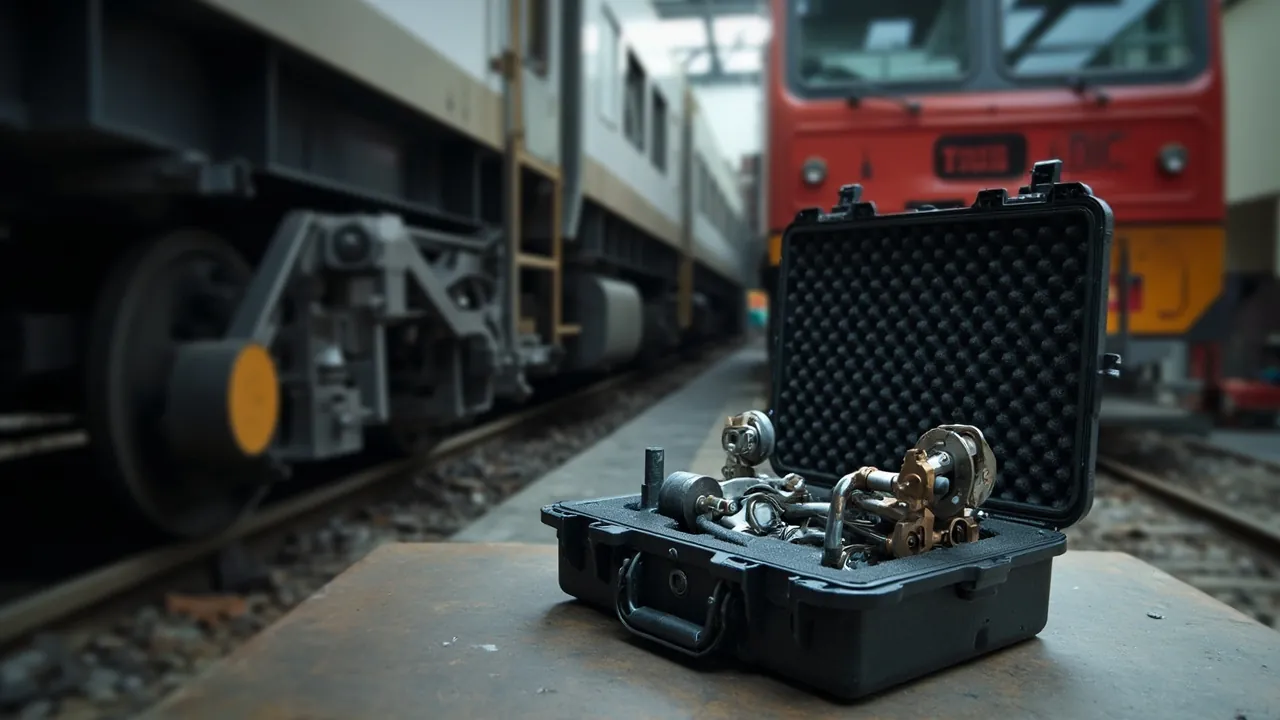
The job of a locomotive spare-parts case is not to hold parts, it is to deliver them thousands of kilometres later with their assembly geometry, cleanliness and insulation performance unchanged. Traction motor spares fail from micro-indentations on bearing raceways and relative movement of brush gear; brake spares fail from scratched sealing faces and aged elastomers; pins, bolts and fitted surfaces fail from thread damage and dimensional change caused by impact. All of these share one characteristic: the damage is invisible at goods-in inspection and only surfaces after the part is installed. A bearing that ran quietly on the bench develops abnormal noise after a few thousand kilometres. A brake valve weeps on its first brake cycle. Brushes wear abnormally during running-in. By then the traceability chain has usually broken, the failure is blamed on the part, and the real cause stays behind in the packaging stage.
Locomotive spares require a different protection philosophy from general industrial spares for three reasons. First, the vibration environment is severe and long-lasting: rail vehicle vibration and shock have a broad frequency content and repeat endlessly, and the rail industry describes it through GB/T 21563 and IEC 61373, which define shock and vibration levels for equipment mounted on car bodies, bogies and axles. The transport chain simply extends that severity into the packaging stage. Second, failure consequences are tied directly to running safety: traction and braking are safety-related systems, so a spare that arrives with latent damage costs more than a repair bill, it costs operational safety and service availability. Third, storage and circulation are distributed: locomotive spares move through depots, overhaul bases, parts warehouses and suppliers, and every unpacking, counting and repacking step is another exposure.
This article is written for rolling-stock manufacturers and overhaul companies, railway depot and vehicle department engineering staff, locomotive spare-parts traders and exporters, and the procurement and logistics teams of third-party maintenance providers. It covers transport protection for traction motor components, main transformer accessories, brake system spares, air brake valves, gearbox and axlebox bearings, including failure modes, retention and zoning design, moisture and salt-spray configuration, standards references, a selection comparison table, a packing standard operating procedure and goods-in verification methods. All figures quoted are typical industry values or empirical ranges; the drawing, the technical specification and the destination regulations always take precedence. JUNZHJIA provides part-specific partition inserts, heavy-part retention structures, sealing and moisture-control configurations, and OEM/ODM support with test documentation for this category.
Table of Contents
- 1. Why locomotive spares need a dedicated transport case
- 2. Category map and failure mode comparison
- 3. Traction motors: stator, rotor, brush gear and bearings
- 4. Main transformer and reactor accessories: insulation, oil circuits, bushings
- 5. Brake system spares: brake shoes, pads, discs and calipers
- 6. Air brake valves and pneumatic components: cleanliness and elastomers
- 7. Gearboxes, axleboxes and rolling bearings: cleanliness and rust prevention
- 8. Designing for high-vibration transport: lessons from GB/T 21563 and IEC 61373
- 9. Moisture, salt spray and sealing: IEC 60529, GB/T 4208 and ISO 9227
- 10. Partition inserts and heavy-part retention design
- 11. Transport test references: ISTA, GB/T 4857, ASTM D4169 and MIL-STD-810H
- 12. Packing SOP and goods-in verification
- 13. Procurement evaluation and the OEM/ODM path
- Frequently Asked Questions
- Conclusion & Further Reading
1. Why locomotive spares need a dedicated transport case
General industrial spares travel in a wooden crate with filler material, and the acceptance rule is simply that nothing looks broken. Locomotive spares cannot follow that logic, because the acceptance criterion is not visible appearance but invisible assembly geometry and cleanliness.
The first reason is the latency of failure. A tapered roller bearing that absorbs one axial shock in transit may take micrometre-scale indentations on its raceway and rollers. The indentation is too shallow to affect rotation. The bearing feels smooth on the bench, clearance measures within tolerance, and it runs perfectly for the first weeks in service. The indentation then becomes a stress riser, spalling begins, and noise and vibration climb until the bearing fails prematurely. Diagnosing this requires vibration spectrum analysis, so the site conclusion is usually "bad bearing". The same logic applies to gear tooth flanks, piston-rod plating, and valve spool-to-seat fits.
The second reason is that contamination is irreversible. Traction motors, gearboxes and air brake valves are extremely sensitive to particulate. Valve fits are measured in micrometres, and a single grain of sand, a metal chip or a fibre can cause sticking or leakage. If the packaging uses a material that sheds, or if fasteners and washers share a cavity with precision parts, cleanliness has already been lost. The difficulty is that such contamination cannot be found by visual inspection and cannot be fully removed before installation.
The third reason is transit duration and chain complexity. A locomotive spare typically travels factory, road, port, sea, destination port, road, depot warehouse, maintenance bay, with several handling, stacking and transhipment steps in between. The longer the chain, the longer the accumulated vibration time, the more humid-heat cycles, and the more the packaging performance degrades. Empirically, an export sea chain of 30 to 45 days does more harm to spares than any single shock event along the way.
A field observation worth recording: among goods-in complaints for locomotive spares, the proportion of "looks fine, fails early in service" is clearly higher than the proportion of "visibly damaged". The design target should therefore move from preventing breakage to preventing performance degradation, and the acceptance criteria should move from appearance to function and geometry.
These three points explain why locomotive spare cases need custom inserts, zoning, retention and humidity control. They are not premium options; they are the necessary configuration for this category. For the underlying mechanics, see shock and vibration damping case design and cushion liner and base plate interaction.
2. Category map and failure mode comparison
Locomotive spares span an enormous range, from gearbox housings weighing hundreds of kilograms to sealing rings weighing a few grams. The protection logic differs completely between them. The table below maps structure, vulnerable points and preferred protection measures by category, and can serve as a starting point for scheme design.
| Category | Typical weight class | Vulnerable points | Main failure modes | Preferred protection |
|---|---|---|---|---|
| --- | --- | --- | --- | --- |
| Traction motor stator and rotor | Heavy (hundreds of kg) | Winding insulation, core laminations, leads | Insulation abrasion, lamination shift, lead fatigue | Heavy-duty cradle, insulation barrier, axial retention |
| Brush gear and brush holders | Light | Brush end faces, springs, holder bores | Chipped faces, spring deformation, bore scoring | Separate compartments, face protection, moisture control |
| Motor and axlebox bearings | Medium (tens of kg) | Raceways, rollers, cages | Micro-indentation, cage distortion, corrosion | Axial retention, rust prevention, humidity control |
| Transformer bushings and insulation | Medium | Porcelain, epoxy bodies, sealing faces | Bushing cracks, epoxy impact damage | Surface-contact support, no sharp edges |
| Reactor and cooler accessories | Medium | Coils, oil ports, cooling fins | Bent fins, deformed ports | Separate compartments, port plugs, retention |
| Brake shoes and pads | Medium, dense | Friction face, backing plate flatness | Chipped friction face, bent backing plate | Flat stacking, interleaving, banding |
| Brake discs | Heavy | Friction ring flatness, mounting holes | Flatness deviation, chipped holes | Dedicated vertical or horizontal cradle |
| Brake calipers and brake cylinders | Medium | Piston rod, sealing faces, bore walls | Rod scoring, bore impact damage | Rod sleeve, port plugs, retention |
| Air brake valves | Light to medium | Spool and seat, diaphragms, ports | Sticking, leakage, diaphragm set | Separate compartments, clean packaging, humidity control |
| Gearboxes and housings | Heavy | Joint faces, bearing bores, gear flanks | Joint face damage, bore distortion | Heavy-duty cradle, joint face protector |
| High-pressure tubing and pipes | Medium | Tube ends, threads, bends | Deformed ends, thread damage | End caps, support rack, bend control |
| Elastomers and seals | Light | Elasticity, shelf life | Ageing, compression set, moisture | Shade and heat control, flat storage, shelf-life tracking |
| Fasteners and pins | Light | Threads, fitted surfaces | Thread damage, mixed parts | Compartmented boxes, numbering, weight check |
Two rules emerge from this table. The first is that heavy parts are protected by structure and light parts by compartmentalisation. Heavy items such as gearboxes, brake discs and motor components depend on load-bearing cradles, retention and lifting design. Light items such as brushes, valves, seals and fasteners depend on separate compartments, clean packaging and numbering. The second is that metal parts are protected against corrosion and elastomer parts against time. The long-term risk for metal is rust and salt spray; the long-term risk for elastomers is ageing and compression set. Both need explicit treatment in the packaging scheme and neither should be buried under the general heading of vibration protection.
3. Traction motors: stator, rotor, brush gear and bearings
Traction motors are among the highest-value and most precise items in the locomotive spare-parts catalogue. Their transport protection centres on insulation, fitted surfaces and cleanliness.
Stator and rotor components. Windings and cores are sensitive to both mechanical shock and contamination. Winding insulation abrasion is a latent defect: the surface may show only a faint scuff, but under high voltage and vibration it becomes the initiation point for partial discharge. The insert must therefore satisfy two conditions. It must be free of sharp edges, nail heads and exposed metal so that nothing bears directly on the winding, and it must provide surface-contact support, spreading the weight onto structural members rather than a few load points. Core laminations are vulnerable to relative shifting and burrs, so the load should be applied as uniform compression rather than local point pressure. Leads and terminal lugs should be individually restrained so they cannot swing freely inside the case and fatigue.
Brush gear and brush holders. These are light, numerous and easily mixed up, which makes them the category most often "tossed in". A chipped brush face where it contacts the commutator or slip ring raises sparking and causes abnormal wear after installation. A scored brush holder bore prevents the brush from sliding freely. A deformed spring changes contact pressure. The correct approach is one set per compartment, faces oriented up or sideways with a soft pad underneath, and holders packaged separately from brushes. Quantity verification must be done compartment by compartment, never by weight estimation.
Motor and axlebox bearings. Bearings are the classic latent-damage category in locomotive spares. There are four protection points. First, axial retention to stop the bearing shuttling back and forth along the case. Second, avoiding radial point contact, because the outer ring is a precision-ground surface and any hard point pressed against it leaves a mark under vibration. Third, leave the original bearing packaging intact; the manufacturer's rust-preventive wrap and inner packaging is a validated protection system and should only be opened at assembly. Fourth, humidity control, because on sea routes moisture is the dominant cause of bearing corrosion, so desiccant sized to the free volume and a humidity indicator card belong in every case.
Motor ancillaries. Temperature sensors, speed sensors, terminal boxes and cooling-duct components are small precision items and should be compartmentalised. Sensors with cable tails must not be repeatedly flexed or left under tension. For insert material selection logic see the custom foam insert design guide and EVA foam insert custom process.
4. Main transformer and reactor accessories: insulation, oil circuits, bushings
The main transformer is the core component of an electric locomotive, and its spares typically include bushings, insulation parts, cooler accessories, oil pumps and oil-circuit components. The keywords for this category are undamaged insulation, uncontaminated oil circuits, uncracked porcelain.
Bushings and porcelain parts. Porcelain is a classic brittle component: strong in compression, weak in bending and extremely weak in point contact. In transport, failures come almost entirely from local stress, whether a hard point in the insert pressing upward, adjacent parts knocking together, or a banding strap tightened directly across the porcelain. The correct approach is a custom contoured insert with surface-contact support, separate compartments, and no rigid component touching the porcelain surface. Keep the original factory packaging where available and fit protective caps over protruding sections.
Epoxy and composite insulation. These behave differently from porcelain. Rather than cracking visibly, they accumulate damage you cannot see: surface micro-cracks, loosened inserts, debonded interfaces. They should be protected from drops and shock, never lifted from a single point, and preferably not handled at low temperature, where material brittleness increases.
Oil circuits and cooling components. Oil pumps, pipes, coolers and cooling fins depend on port protection and internal cleanliness. Every oil port and connection must be fitted with a plug or cap during transport to keep foreign matter out. Aluminium cooling fins bend very easily, so the stowed attitude should avoid loading the fins or a protective plate should be fitted. Components shipped with residual oil should be assessed against dangerous goods rules; lubricating and insulating oils are not usually in the highest hazard classes, but declaration, packaging and marking still have to be confirmed against the current regulations and the carrier's requirements. The decision logic is described in hazmat transport case compliance.
Moisture protection for insulation. Transformer insulation such as pressboard, laminated wood and insulation cylinders is hygroscopic. Once it absorbs moisture, insulation resistance falls, drying is required before installation, and severe cases mean scrap. Sealing, desiccant, humidity indicator cards and the discipline of reading the indicator before opening the case are mandatory for this category, not optional.
5. Brake system spares: brake shoes, pads, discs and calipers
Braking is a safety-related system, and the geometric accuracy and surface condition of its spares feed directly into braking performance. Transport protection here focuses on friction surfaces, flatness, piston rods and sealing faces.
Brake shoes and pads. The critical parameters are friction coefficient and backing plate flatness. The usual transport damage is a chipped friction face, a bent backing plate from stacking pressure, and dust generation where sets rub against each other. The approach is interleaving sheets between friction faces, flat stacking of matched sets with corner protectors, and banding straps routed over corner protectors rather than directly across friction surfaces. Note that friction materials, particularly those with metal fibre or ceramic formulations, are extremely sensitive to oil contamination. Packaging materials must not contain migratable oil, and lubricated parts must not share a cavity.
Brake discs. The critical parameters are friction ring flatness and mounting hole accuracy. Flatness suffers most from point contact and stacking pressure, so discs should be held in a dedicated cradle, vertical or horizontal, rather than stacked in layers and pressed down with weight. Mounting and bolt holes need protection against chipping, which would make assembly difficult.
Brake calipers and brake cylinders. This is the most detail-sensitive sub-category. Piston rods usually carry a plated surface, and a single scratch destroys sealing integrity and causes leakage. Cylinder bores are sensitive to particulate. Sealing faces, whether flange faces or O-ring grooves, are sensitive to impact. The standard practice is to fit a protective sleeve over the piston rod or retract it into the cylinder and lock it as the manufacturer requires, plug every port, fit a protector over joint faces, and compartmentalise the assembly with axial retention. If the manufacturer supplies transport locking devices such as pins or straps, they must be used. If not, the insert must provide equivalent restraint.
Bellows, diaphragms and springs. Rubber bellows, diaphragms and spring elements are shape-sensitive parts. Prolonged compression causes compression set and changes their operating characteristics. They should be packed in the free or minimally compressed state, never flattened to save space and never stored under sustained load.
6. Air brake valves and pneumatic components: cleanliness and elastomers
Air brake valves, including distributor valves, relay valves, solenoid valves, check valves and filters, are physically small but among the most demanding categories in the locomotive spare range for cleanliness and sealing integrity.
Failure mechanism. The heart of a valve is the fit and seal between spool and seat, with clearances often measured in micrometres. Three classes of contamination therefore cause failure: particulate, which causes sticking and scoring; fibre, which prevents sealing; and moisture or oil, which can freeze and jam the valve at low temperature or swell the elastomer. Shock can displace the spool, shift springs or distort diaphragms, which shows up as drift in operating pressure or leakage.
Packaging practice. First, keep the factory inner packaging intact, typically a rust-preventive bag or vacuum bag, and do not open it early. Second, plug every port to keep foreign matter out. Third, compartmentalise with anti-vibration padding so parts never touch each other. Fourth, avoid shedding materials inside the case; paper filler, loose foam chips and wood wool are all high-risk. Fifth, control humidity with desiccant and an indicator card, which matters especially on sea routes. Sixth, avoid extreme temperatures: elastomers harden when cold and age faster when hot, so the case should not sit in direct sun.
Acceptance criteria for valves. Visual inspection has limited value here. The recommended acceptance routine is to verify model and serial number, check that port plugs are intact, look for obvious impact damage, perform a leakage or operating test where the manufacturer's instructions allow and the facility is equipped, and confirm that the factory packaging has not been opened prematurely. For any valve tied to running safety, a part in doubt should be functionally retested rather than installed and observed.
7. Gearboxes, axleboxes and rolling bearings: cleanliness and rust prevention
Gearboxes and axleboxes are heavy items where structural load-bearing dominates. Rolling bearings are precision items where retention and rust prevention dominate. The two frequently ship in the same case, so zoning must be explicit.
Gearboxes and housing components. There are three priorities. Joint face protection, because the split face on a gearbox is machined to high accuracy and any chipping leads to oil seepage. Bearing bore protection, because bore distortion makes bearing installation difficult and degrades coaxiality. Gear flank protection, because exposed flanks need rust prevention and must not contact hard objects. The approach is a timber or engineering-plastic cradle carrying the load, joint faces oriented upward or fitted with a protector plate, the housing restrained on all four sides, and strict avoidance of using a gear flank or joint face as a load-bearing surface.
Rust prevention for rolling bearings. Corrosion risk is closely tied to packaging. Bearing manufacturers normally ship with a combination of rust-preventive oil, rust-preventive paper and plastic film, with a stated shelf life. Transport packaging should extend rather than undermine that system: put the bearing into the case inside its original packaging, add desiccant and a humidity indicator card, and avoid bare storage after the inner packaging has been removed. Where a customer requires unpacking for inspection and repacking, this should be done under cleanliness conditions appropriate to bearings and resealed promptly. For a common framework when describing bearing damage from arrival inspection onward, the vocabulary of ISO 13313 for rolling bearing damage terminology and cause assessment is worth adopting, because it lets suppliers and depots describe findings in the same language.
Practical cleanliness control. Use only non-shedding insert materials such as closed-cell foam, EVA and non-woven fabric; never paper chips, wood wool or crumbled open-cell foam. Keep small metal parts out of precision cavities; fasteners, washers and pins belong in lidded compartment boxes. Keep the case cleanable and clean it between uses to remove chips and oil from the previous load, as described in protective case cleaning and maintenance. Finally, require gloved handling, because hand perspiration is a common corrosion initiation point.
8. Designing for high-vibration transport: lessons from GB/T 21563 and IEC 61373
From the factory gate to the vehicle, a locomotive spare is always in a vibrating environment. Road transport contributes low-frequency, large-displacement excitation; rail transport contributes mid- and high-frequency vibration; sea transport adds long-period roll and pitch along with high-frequency machinery vibration. Together these form broadband excitation. The rail industry uses GB/T 21563, on shock and vibration testing of rolling stock equipment, and IEC 61373 to define vibration and shock levels for equipment mounted on car bodies, bogies and axles. Both standards address in-service vehicle conditions rather than transport packaging, but their severity classification and test philosophy are highly relevant to packaging design.
Why on-vehicle levels cannot simply be copied. On-vehicle testing reflects years of continuous running. Transport conditions differ in duration and frequency: transit lasts tens of hours to tens of days, without the in-service temperature or electromagnetic environment. Applying on-vehicle severity directly leads to over-design, with heavier cases and runaway cost, while ignoring transport vibration characteristics leads to under-protection. The practical approach is to base the verification programme on transport standards such as ISTA, GB/T 4857 and ASTM D4169, and to use GB/T 21563 and IEC 61373 severity classes as a most-severe reference anchor for evaluating the worst-case route.
How the vibration types affect spares differently.
| Vibration type | Typical source | Effect on spares | Priority countermeasure |
|---|---|---|---|
| --- | --- | --- | --- |
| Low frequency, large displacement | Road roughness, rail curves and switches | Load shifting in the case, stack instability, strap loosening | Retention blocks, stacking plan, reinforcement straps |
| Mid-frequency | Wheel-rail excitation, engines | Fastener loosening, cable fatigue, connector fretting | Locking, cable restraint, surface-contact support |
| High frequency | Ship machinery, handling equipment | Fretting wear on precision surfaces, debris generation | Soft padding, clean packaging, no metal-to-metal contact |
| Shock | Handling drops, shunting impacts | Local plastic deformation, brittle fracture | Cushioning layers, drop height control, corner reinforcement |
| Long-period roll and pitch | Sea transport | Lateral stack instability, liquid movement | Lashing plan, low centre of gravity, anti-tilt structure |
Four practical design principles. First, retention before cushioning. Where impact energy is modest but the number of events is enormous, eliminating movement is more effective than adding cushion thickness, because movement generates continuous friction damage. Second, surface contact before point contact, spreading load across structural faces so that no hard point presses on a precision surface. Third, separation before reinforcement: placing heavy and precision parts in separate zones divided by structure rather than filler solves vibration and cleanliness at the same time. Fourth, verifiability before feel. A scheme must be provable by test data, not by how tight it feels by hand. For the test methods, see ISTA transport testing procedures.
9. Moisture, salt spray and sealing: IEC 60529, GB/T 4208 and ISO 9227
Corrosion and insulation degradation in locomotive spares rarely come from direct rain. They come from the combination of humidity, temperature differential and salt spray.
Humidity and condensation. A well-sealed case cannot vent internal moisture, so when the temperature drops at night the water vapour condenses on metal surfaces. Condensation is worse than liquid ingress in one respect: it is invisible and it leaves a persistent water film that becomes a corrosion initiation site. For cases holding bearings, valves, brush gear and electrical components, condensation is a more realistic threat than water entry. Three countermeasures apply. Estimate desiccant quantity from the case free volume, the hygroscopicity of the packaging materials, the transit duration and the target humidity, remembering that a 30 to 45 day sea shipment needs far more than a domestic short haul. Fit a humidity indicator card and enforce the rule of reading it before opening. And for routes with large temperature differentials, fit a pressure equalisation valve, which is more effective than raising the IP rating further; see pressure equalisation valve selection.
Choosing an IP rating. IP ratings are defined by IEC 60529, with GB/T 4208 as the Chinese equivalent. The practical meanings of common levels are as follows.
| IP rating | Dust | Water | Suitable locomotive spare scenario |
|---|---|---|---|
| --- | --- | --- | --- |
| IP54 | Limited dust protection | Splash resistant | Indoor warehouses, covered short-haul transport |
| IP65 | Dust tight | Jet resistant | Domestic road transport, open depot storage |
| IP67 | Dust tight | Temporary immersion | Sea freight, open transhipment, high-rainfall regions |
Select by actual exposure, not by "higher is better". A higher rating creates a larger internal-external pressure differential across temperature swings, which makes opening difficult and can suck the gasket out of shape, while demanding stricter gasket maintenance. For most locomotive spare scenarios IP65 covers domestic routes, and IP67 with a pressure equalisation valve suits sea freight and open storage. For gasket material differences between silicone, EPDM and TPE foam, and for cross-section design, see case seal material selection and case hinge, latch and seal selection.
Salt spray protection. Sea freight, coastal depots and port storage expose spares to salt spray. ISO 9227 neutral salt spray testing provides the evaluation method and severity levels. Three design points follow. The metal parts themselves need appropriate protection through plating, rust-preventive oil or vapour-phase corrosion inhibitor packaging. The case hardware, meaning hinges, latches, telescopic handles and caster axles, needs corrosion-resistant material or surface treatment, because these are the first items to fail in a salt-laden environment. And dissimilar metal contact must be managed, especially where stainless fasteners touch aluminium or carbon steel. For long-term service assessment see protective case service life.
Flammability of case materials. Where the customer or the installation environment imposes flammability requirements, for example on materials used inside rolling stock, UL94 provides the standard test method for flammability of plastic materials. It must be clear that UL94 rates the material itself; it is not a certification of the finished case and does not replace vehicle or site fire requirements. The applicable rating should follow the customer specification and procurement documents.
10. Partition inserts and heavy-part retention design
The insert is the technical core of a locomotive spare-parts case. It is not about adding softness; it is a structural system that cuts the load path, the shock path and the contamination path at the same time.
Four basic zoning rules.
- Stratify by weight. Heavy items such as gearboxes, brake discs and motor components sit low in the case directly on structural members or load-bearing cradles, with light and precision items above or in separate cavities. Never place a heavy item above a precision item, even with padding between them.
- Grade by cleanliness. Precision parts and small metal parts must be strictly separated. Small metal parts go into lidded compartment boxes. Powdery or fibrous materials must not enter precision cavities.
- Group by protection need. Items needing humidity control, such as bearings, valves and electrical components, are grouped in a relatively sealed cavity so desiccant acts where it is needed. Castings and structural parts that do not need humidity control can sit in open cavities.
- Position by circulation frequency. Frequently retrieved items such as fasteners, seals and brushes belong in the top layer or outer zone so the whole case does not have to be unpacked.
Heavy-part retention design points.
- Explicit load path. Weight must travel through cradles, blocks or case structure to the base; foam compression is not a load path.
- Axial and radial restraint. Limit both lateral movement and vertical lift. Cylindrical parts such as cylinders, bearings, pins and pipes need particular attention to their axial degree of freedom.
- Soft interface. Place a compliant pad between structure and part, but size the pad by load calculation rather than by how soft it feels.
- Lifting points and protrusions. Lifting lugs, flanges, protruding shaft ends and pipe stubs are the most likely impact targets and need relief cavities or protective caps.
- Reproducibility. The insert must be reproducible from a drawing, and inserts of the same part number must be interchangeable. "The experienced fitter packs it tight" is not an acceptance criterion.
Material selection. Common insert materials include XPE and IXPE cross-linked polyethylene foam, EVA, PU foam and moulded EPP. Selection depends on density, compression set, resilience, shedding tendency and temperature range. Heavy cavities suit high-density foam or moulded EPP cradles. Precision cavities suit closed-cell, non-shedding materials with a non-woven wrap. Cavities holding static-sensitive electronics may need conductive or dissipative materials, as discussed in ESD shielding case design. For a material comparison see case foam material comparison.
11. Transport test references: ISTA, GB/T 4857, ASTM D4169 and MIL-STD-810H
"Our case is solid" is not an acceptance statement. An acceptance statement reads: passed this test sequence under this standard, with this set of acceptance criteria.
ISTA. The International Safe Transit Association grades test procedures by package form and weight. Locomotive spares are usually palletised or case-packed heavy goods, so ISTA 3E for unitised loads and ISTA 3B for less-than-truckload are common; small spare cases may follow ISTA 3A or 2A. The value of ISTA lies in sequencing: preconditioning, shock and drop, vibration, temperature and humidity, then re-inspection, forming a complete chain that exposes cumulative effects a single test cannot reveal.
GB/T 4857. The Chinese series of basic test methods for transport packages covers vibration, shock, stacking, dropping and compression, and is the most frequently cited standard family in Chinese railway tenders and acceptance documents. See GB/T 4857 transport packaging in practice.
ASTM D4169. This standard assigns test intensity by distribution cycle and is widely used for packaging validation for North American export markets. See ASTM D4169 distribution cycle testing.
MIL-STD-810H. Its vibration, shock, temperature-humidity and low-temperature methods are often cited for environmental test design. It must be stated clearly that referencing MIL-STD-810H is a reference to environmental test methods only; it does not mean the product holds any military certification. See MIL-STD-810H environmental test compliance.
Suggested test matrix.
| Test type | Common standards | Example parameters | Significance for locomotive spares |
|---|---|---|---|
| --- | --- | --- | --- |
| Random vibration | ISTA 3E/3B, ASTM D4169, GB/T 4857.23 | PSD, duration | Bearings, fasteners, cabling |
| Shock and drop | GB/T 4857.5, ISTA | Drop height, peak acceleration | Porcelain, valves, case corners |
| Stacking | GB/T 4857.3 | Load, time, temperature and humidity | Case compression and insert collapse |
| Temperature-humidity cycling | MIL-STD-810H method 507 | Temperature range, cycles | Condensation, insulation, corrosion |
| Low temperature | MIL-STD-810H method 502 | Temperature, duration | Elastomer and gasket resilience |
| Salt spray | ISO 9227 | Concentration, duration | Case hardware and fasteners |
| Water ingress | IEC 60529 / GB/T 4208 | IPX5 / IPX7 | Open transhipment, wash-down |
| Vibration severity reference | GB/T 21563 / IEC 61373 | Category, frequency band | Anchor for worst-case route conditions |
On functional checks. Validation of a locomotive spare-parts case cannot stop at whether the case survived. After vibration and temperature-humidity testing, inspect: insert collapse or fracture; whether retention is still effective, judged by hand-push displacement staying within the allowed value; whether precision parts show new contact marks; whether metal parts show any corrosion; the humidity indicator card; and packaging integrity, meaning seals, plugs and protectors still in place. The acceptance criterion should centre on whether the spare still meets the geometric and cleanliness requirements of its technical specification.
On test documentation. The contract technical annex should state the test items, standard numbers, sample quantity, loading condition including actual mass, acceptance criteria, the issuing laboratory and the responsibility for corrective action and retest in the event of failure. Export customers additionally need clarity on whether reports must come from a third-party laboratory and whether English versions are required.
12. Packing SOP and goods-in verification
Packing SOP, formatted to be posted as a work instruction.
- Verify the scheme. Confirm part number, drawing number, quantity and insert revision, and that the correct case type and insert part number are being used. Confirm transport mode and destination.
- Incoming inspection. Check part appearance, factory packaging integrity, rust-preventive oil condition and port plugs. Photograph for the record.
- Clean and prepare. Remove surface dust, chips and moisture. Reapply rust-preventive oil as the manufacturer requires. Remove temporary labels and ties that would interfere with packaging.
- Pre-fit the insert. Install cradles, retention blocks and compartment boxes to drawing. Confirm nothing is misplaced or missing. First-article trial fitting should be recorded.
- Place heavy parts. Use suitable lifting equipment. Never lift from a single point and never drag. Confirm that joint faces, gear flanks and protrusions contact nothing hard.
- Retain and secure. Fit top clamps and axial and radial retention. Banding straps are secondary only and must be routed over corner protectors; never across machined faces, pipe ends or cables. Confirm by hand push that displacement stays within the practical limit of about 2 mm.
- Light and precision parts. Bearings stay in original packaging inside a humidity-controlled cavity. Brushes, valves and seals go into numbered compartments set by set. Fasteners go into lidded compartment boxes.
- Seal and dry. Add desiccant sized by free volume and transit duration plus a humidity indicator card. Check the gasket for damage or trapped foreign matter. Close latches evenly.
- Mark and record. Apply centre of gravity, this way up, keep dry, do not invert and precision item markings. Photograph the packed case and file it. Record the seal number and handover time.
Goods-in checklist, to be signed item by item.
- Case exterior: cracks, deformation, moisture traces; latches and hinges intact; seal number matching;
- Humidity indicator card: colour within the allowed range, checked before opening;
- Insert: collapse, fracture, contamination, shedding; compartment boxes intact with no missing cells;
- Precision parts: bearings, valves, brushes and porcelain free of impact marks, scoring and rust;
- Machined surfaces: joint faces, gear flanks, piston rods and bore walls free of new contact marks;
- Packaging integrity items: port plugs, protective caps and transport locking devices still in place;
- Quantity and numbering: counted compartment by compartment against the packing list;
- Documentation: test reports, packing photographs and seal records complete.
Field practice: use a three-point comparison. Record the key condition before packing, including photographs, functional reference values and factory packaging state. File the packing photographs after closing. Re-measure the same set of items on arrival. The three data sets form a complete chain of responsibility and reliably separate incoming quality problems from packaging problems and transport problems. For traction and braking spares tied to running safety, this step is worth far more than assigning blame after the fact.
Pre-installation preparation. On arrival and before installation: remove all packaging and clear the work area; remove every transport locking device and protective plug, since a missed item will cause abnormal operation; clean fitted surfaces and treat the rust-preventive layer as the manufacturer requires; re-measure critical dimensions such as flatness and fit clearance to the technical specification; and confirm part number, batch and calibration state where applicable. Electrical and braking-related work must be performed by qualified personnel.
13. Procurement evaluation and the OEM/ODM path
Locomotive spare-parts cases are a heavy-part-dominant category with many standards, long routes and a high safety class, so procurement strategy should focus on structural design capability and documentation completeness.
Seven supplier evaluation dimensions.
- Part capture and structural design. Can the supplier produce a load-bearing cradle and zoning scheme from physical parts or 3D data, and specifically solve three problems: an explicit load path for heavy parts, no hard point contact on precision parts, and relief cavities for protrusions.
- Insert process and consistency. Foam density and batch consistency, cutting accuracy, shedding tendency, and reproducibility so that inserts of one part number are interchangeable.
- Case structure and load capacity. Compression and impact resistance, corner and base reinforcement, compatibility with lifting and forklift handling, and the load rating of casters and telescopic handles, covered in case wheels and trolley handle selection.
- Sealing and moisture capability. Ability to size desiccant by free volume and transit duration, to integrate a pressure equalisation valve, and to offer different IP ratings with supporting test records.
- Corrosion and weather resistance. Surface treatment levels for hardware, isolation of dissimilar metals, and suitability for salt spray exposure.
- Compliance and documentation. Material declarations, test reports and English-language documents, plus packaging and marking schemes where oil-bearing parts or regulated goods are involved.
- Capacity and delivery flexibility. Locomotive spare orders are tied to overhaul schedules, so delivery stability and peak-season flexibility are real risks. For quality and sampling rules see custom case acceptance and AQL sampling.
The standardise-the-case, customise-the-insert strategy. Locomotive spares vary enormously in size, from gearboxes to sealing rings, and fully custom cases are uneconomical. The practical approach is to cover most of the size range with three or four standard case types, for example small-part, medium-part, heavy-part and heavy-duty cradle cases, and then adapt each with a custom insert. This amortises tooling cost while preserving flexibility as parts change. For tooling cost structure see case mould cost analysis.
Reuse and circulation management. Locomotive spare cases typically circulate repeatedly between depots and parts warehouses, so a maintenance regime is necessary. Before each reuse, inspect the case for cracks and deformation, the gasket condition, latch and hinge reliability, insert collapse and contamination, and compartment box integrity. Any failed item must be replaced before reuse. Number each case and keep a log of use count, purpose and inspection records. Life criteria are discussed in protective case service life.
Enquiry checklist. A practical enquiry should include the spare parts list with part numbers, names, unit weight, envelope dimensions and quantities; whether there are protrusions or fragile features; cleanliness and rust-prevention requirements; transport mode and route including transhipment and transit duration; destination climate and storage conditions; target IP rating and whether a pressure equalisation valve is needed; whether salt spray or flammability requirements apply; circulation count; marking and sealing requirements; test and documentation requirements; and annual volume with delivery rhythm. The more complete the input, the closer the scheme comes to being ready for production. For supplier selection see how to choose a protective case OEM factory.
JUNZHJIA works in this category as follows: accept 3D data or physical parts, produce a load-bearing cradle and partitioned insert scheme with retention recommendations and a desiccant sizing calculation, confirm with a first-article trial fit, then move to volume production with sampling, supplying material declarations and test documentation alongside. For long-term supply customers we maintain part-number dossiers so repeat orders reuse the existing scheme, and for customers with multi-level circulation we can supply a preventive replacement plan for gaskets, latches and inserts.
Frequently Asked Questions
Q: Why can locomotive spares not simply use the wooden crate and filler approach used for general industrial parts?
A: Because the acceptance criteria are different. General industrial parts are judged largely on appearance: if the surface is not visibly damaged and the part moves after installation, it passes. Locomotive spares are judged on whether assembly geometry, cleanliness and insulation performance have been preserved, and none of those can be established by visual inspection. Three layers of difference matter. First, failure latency: micrometre-scale indentations on bearing raceways, micropitting on gear flanks and fine scratches in piston rod plating are invisible at goods-in, and the part runs normally at first, only developing abnormal noise, leakage or premature failure after a period in service. Second, irreversible contamination: valve clearances and precision fits are measured in micrometres, and wood fibres, paper chips and crumbled open-cell foam all shed material that finds its way into those fits, causing sticking or leakage that cannot be fully removed before installation. Third, long and severe routes: locomotive spares commonly pass through road, sea and multiple warehouse transfers, accumulating vibration time and humid-heat cycles far beyond what a wooden crate with filler can withstand, with no humidity control at all, while bearings and valves are precisely the parts most vulnerable to corrosion. The packaging objective must therefore shift from preventing breakage to preventing performance degradation.
Q: What are the three most critical measures for protecting traction motor bearings in transit?
A: The first is axial retention. The most dangerous degree of freedom for a bearing inside a case is axial shuttling, because repeated micro-movement creates fretting wear and micro-indentation on raceways and rollers. This kind of damage is hard to detect at installation but leads to spalling once the vehicle is running. Fit retention blocks or pads on both sides of the bearing to keep axial displacement small, and make sure those restraints transfer load through structural members rather than pressing a hard point directly onto the bearing face or outer ring. The second is avoiding radial point contact. The outer ring is a precision-ground surface, so any hard protrusion, loose fastener or hard insert block touching it will leave a mark under vibration. Bearings should therefore be compartmentalised, with no small metal parts or shedding materials in the same cavity, and preferably kept inside their original inner and rust-preventive packaging. The third is humidity control and rust prevention. On sea routes and in hot humid climates corrosion is the leading cause of bearing scrap, so the case needs desiccant sized by free volume and transit duration plus a humidity indicator card, with a discipline of reading the indicator before opening. Transport locking devices and protective caps must also be used as the manufacturer specifies and removed and verified item by item on arrival. These details determine whether the protection loop is actually closed.
Q: What usually goes wrong when shipping brake calipers and brake cylinders?
A: The three most common problems are piston rod scoring, cylinder bore contamination and joint face impact damage. Piston rods normally carry a plated surface, and one scratch compromises the sealing surface, producing leakage on the first brake cycle or shortly after. That leakage is often not obvious at first and is only noticed when braking performance drops, which makes it a classic safety-related failure. Cylinder bore problems are mainly particulate contamination: shedding insert material, small metal parts sharing the cavity, or even shop dust entering the bore causes scoring and premature seal wear. Joint faces such as flange faces and O-ring grooves are vulnerable to local deformation from impact; once a sealing face develops a high spot or a dent, leakage follows after assembly. The standard practice is to fit a protective sleeve over the piston rod or retract it into the cylinder and lock it as the manufacturer requires, plug or cap every port and oil connection, fit a protector plate over joint faces, compartmentalise the assembly and apply axial retention. If the manufacturer supplies transport locking devices they must be used; if not, the insert must provide equivalent restraint. These parts should also never share a cavity with fasteners or tools, and shedding packaging materials must be avoided entirely.
Q: How does transport protection for brake shoes and pads differ from ordinary metal parts?
A: There are three main differences. First, the critical parameters for friction parts are friction coefficient and backing plate flatness, and transport damage feeds directly into braking performance. A chipped friction face causes uneven contact and brake judder, while a bent or out-of-flat backing plate causes poor seating and uneven wear. Friction parts should therefore be flat stacked with interleaving sheets, corner protectors fitted, and banding straps routed over the protectors rather than directly across friction surfaces. Second, friction materials are extremely sensitive to oil contamination. Once a metal fibre or ceramic formulation is contaminated with grease, the friction coefficient changes in an uncontrolled way and cannot be restored on site. Packaging materials must contain no migratable oil, friction parts must not share a case with lubricated components, oil-bearing bearings or oil pipes, and staff should work in clean gloves. Third, friction parts are usually dense and shipped as matched sets, so stacking and handling method determines the degree of damage; a dedicated rack with dividers is far better than simple stacking. Friction parts can also absorb moisture during prolonged storage, particularly non-asbestos organic formulations, so desiccant and a humidity indicator card belong in the case as well. On arrival, check specifically for chipped or indented friction faces, bent backing plates, and correct part numbers and batch codes.
Q: How should the IP rating be chosen for a locomotive spare-parts case? Is IP67 always the safest choice?
A: No. IP67 is not appropriate for every scenario, and selection should follow the actual exposure. IP ratings are defined by IEC 60529, with GB/T 4208 as the Chinese equivalent, and they describe combined dust and water protection. For indoor warehouse storage and covered short-haul transport, IP54 is usually sufficient. Domestic road transport and open depot storage suggest IP65. Sea freight, open transhipment, high-rainfall regions and locations close to ports or the coast suggest IP67. It is important to note that a higher rating does not automatically mean a better scheme. First, a higher rating creates a larger internal-external pressure differential across day-night temperature swings, which makes the case harder to open and can deform the gasket under negative pressure, shortening its life. Second, gaskets are wearing parts, and the higher the rating the stricter the maintenance requirement, while locomotive spare cases are frequently opened and closed by non-specialist staff during multi-level circulation. Third, an IP rating only addresses water and particulate entering from outside; it does nothing about internal condensation, which is the main cause of corrosion in bearings and electrical parts. For routes with large temperature differentials, a pressure equalisation valve combined with desiccant and a humidity indicator card is often more effective than simply raising the IP rating. Where a tender document specifies a rating, follow the document and require the supplier to provide the corresponding test record.
Q: Beyond choosing a case, what else matters for locomotive spares exported by sea?
A: At least five things deserve attention. First, desiccant quantity must be recalculated from the case free volume, the hygroscopicity of the packaging materials, the transit duration and the target humidity, and a 30 to 45 day sea voyage needs substantially more than a domestic short haul. Paper documentation, open-cell foam inserts and cardboard outer packaging all absorb moisture and must be included in the calculation. Second, condensation. Day-night temperature differentials on a container cause condensation inside the case, which is particularly harmful to bearings, valves and electrical parts; fit a pressure equalisation valve and enforce the rule of reading the humidity indicator card before opening. Third, salt spray. Deck carriage and port storage expose the case to salt, and hinges, latches, telescopic handles and caster axles are the first to fail, so corrosion-resistant materials or upgraded surface treatment are needed, along with attention to galvanic corrosion where stainless steel meets aluminium or carbon steel. Fourth, stacking and lashing. Sea freight usually involves higher stack heights, so compression strength must be checked against the worst-case stacking condition; heavy-part cases should carry a no-top-load marking and be positioned low or in a dedicated zone in the load plan, with proper lashing against tilt. Fifth, export wooden packaging must comply with ISPM 15 fumigation or heat treatment; plastic cases avoid that requirement but must still satisfy destination rules on recyclability and packaging waste. If oil-bearing parts or regulated goods are involved, declaration and marking must be confirmed against the applicable rules.
Q: How can latent damage in locomotive spares be verified on arrival? Is there a practical criterion?
A: Yes, and the core idea is to convert invisible damage into comparable data. Use a three-point comparison. Before packing, record the key state: appearance photographs, factory packaging condition, and critical dimensions or functional reference values such as brake cylinder stroke, valve leakage test results, and bearing feel and clearance records. After packing, photograph the closed case and record the seal number, the insert revision and the desiccant quantity. On arrival, re-measure the same set of items and compare against the pre-packing data, while inspecting for new contact marks. Three classes of evidence take priority in the assessment. The first is new contact marks: impressions in the insert that do not match the part shape, or bright marks and scratches on precision surfaces that did not come from the factory, indicating movement or point contact in transit. The second is geometric and functional deviation: flatness, fit clearance, operating pressure or stroke outside the tolerance in the technical specification. The third is environmental evidence: a humidity indicator card that has changed colour, corrosion on metal parts, or water and condensation traces inside the case. One important caution: visual inspection plus a passed self-test is not sufficient grounds for acceptance, because most latent damage produces neither visible abnormality nor a failed self-test. Turning these data into a signed acceptance form is the lowest-cost and most effective measure available.
Q: We buy heavy-part cases, precision-part cases and small-part boxes together. How can packaging cost be controlled?
A: The core approach is to standardise cases, customise inserts, zone and segregate, number for traceability, and manage reuse. First, divide cases into three or four standard types by internal volume and load rating, covering everything from gearboxes and brake discs down to valves and brushes, so that standard cases absorb size diversity and no tooling is needed per item. Second, customise inserts per part number or part family; because the case cavity is common, inserts remain interchangeable and upgradable. Heavy parts use load-bearing cradles, precision parts use closed cavities, small parts use lidded compartment boxes, ordered by insert part number. Third, apply zoning and segregation: separate clean precision items from structural items, and separate export circulation from domestic circulation, so cross-contamination and mixed use are avoided. Fourth, build a packaging dossier for each part number containing envelope data, insert drawing number, packing photographs, test records and reference values, so repeat orders reuse the existing scheme; this is the single most effective long-term cost measure. Fifth, include reuse cost in the calculation: gaskets, desiccant, inserts, compartment boxes, seals and humidity indicator cards are all wearing or consumable items. Annual consumption should be calculated from circulation count and covered by a preventive replacement plan, because the failure of a small component can damage an entire case of spares. Sixth, enforce the separation of small metal parts from precision parts without exception, since the rework and scrap cost of a single contamination event far exceeds the cost of a compartment box.
Q: Why is drop testing alone not enough to validate locomotive spare-parts packaging?
A: Because the dominant failure mechanism for locomotive spares is accumulated micro-movement and vibration, not single-event impact damage. A drop test verifies whether a case and its contents can survive one significant impact, which answers the question of whether something will break. It is a good measure for corner strength, cushion thickness and brittle components. The real risk, however, comes from long-duration, low-amplitude vibration: rolling elements fretting against raceways and producing micro-indentation, fasteners and connectors gradually loosening, cables and leads fatiguing under repeated flexing, and inserts compressing and collapsing so that retention stops working. None of these make a part visibly broken, but all of them mean the part ships with latent damage. Packaging validation should therefore treat random vibration as a core test and set intensity and duration from the actual transport mode: road and rail routes emphasise mid- and low-frequency vibration over long durations, while sea routes emphasise the combination of long-period roll and high-frequency machinery vibration. The programme should also include temperature-humidity cycling for condensation and insulation degradation, low-temperature testing for elastomer and gasket hardening, stacking for insert collapse and case deformation, and salt spray for sea and coastal scenarios. Acceptance criteria must be based primarily on geometric and functional indicators with appearance as a secondary check, supported by pre-packing reference values that form a comparison baseline. The contract technical annex should state the test items, standard numbers, intensity, acceptance criteria and the issuing laboratory.
Conclusion & Further Reading
The essence of locomotive spare-parts protection is protecting what cannot be seen: the geometry of a bearing raceway, the fit between valve spool and seat, the integrity of piston rod plating, the finish of a gear flank, the dryness of insulation, and the cleanliness of a precision cavity. None of these show up in an arrival inspection, yet all of them surface later as abnormal noise, leakage, drifting operating pressure and premature failure, by which point the traceability chain has usually broken.
A locomotive spare-parts case should therefore be designed along three parallel chains. Structure: load-bearing cradles and two-directional retention to cut the shock path into precision parts. Environment: sealing, desiccant, pressure equalisation and corrosion-resistant design to control humidity, condensation and salt spray. Management: zoning, segregation, numbering and three-point comparison to turn latent damage into auditable data. All three are required; a missing link degrades the effectiveness of the other two.
The implementation path compresses into five steps: define each part's vulnerable points and cleanliness class, design the load-bearing structure and partitioned inserts, close the loop with transport testing plus geometric and functional checks, build a chain of responsibility through numbering, seals and reference-value records, and sustain long-term performance with reuse inspection and preventive replacement. Doing these five things is what keeps the "arrives intact, fails in service" risk to a minimum.
If you need a load-bearing cradle and partitioned insert scheme for specific spares, recommendations for heavy-part retention structures, a desiccant sizing calculation, or a complete configuration that includes salt spray and humidity control requirements, provide the parts list with unit weights and envelope data, the transport route and the circulation scenario to JUNZHJIA. We will capture the parts, produce drawings and arrange a first-article trial fit, delivering a packaging scheme that can go straight into production.
Further Reading