


The core function of an ATM cassette transport case is to keep a cassette in a verifiably untouched state from the moment it leaves the self-service terminal until it enters the next stage of the cash cycle. What separates it from an ordinary tote is not wall thickness but the simultaneous presence of three properties: cassettes must not move inside the case, the seal on the outside must be verifiable, and the handover must be traceable. Remove any one of the three, and a cash discrepancy degrades from a locatable incident into an unresolvable dispute. For bank cash centres, outsourced cash-loading contractors and armoured couriers running self-service networks, a proper cassette transport case is essentially a container that converts the physical movement of cassettes into an auditable record.
The practical difficulty is familiar. A single loading run may cover a dozen branches and involve dozens of cassette handling events. Within six months cases show loose handles, cracked hinges and collapsed inserts. Worse, when a terminal reports a shortfall, the operator often cannot determine whether the cassette was under-filled, the case was opened in transit, or the counting at clear time was wrong. The root cause is rarely individual diligence. It is that the case does not provide the evidence positions the handover process requires - no fixed seal channel, no unique case serial, no slot marking that maps to a cassette serial. This article works along two tracks, engineering and process, covering structure, sealing, locks, insert location, dual-control handover, tracking and acceptance, and closes with a selection table that can be matched to terminal models.
Table of Contents
- 1. The Protection Problem in ATM Cassette Rotation
- 2. Typical Structure and Dimensional Matching
- 3. Three Damage Classes in Transit and Their Countermeasures
- 4. Inserts and Location: Retention, Anti-Tipping and Fast Loading
- 5. Sealing and Ingress Protection: Applying IEC 60529 and GB/T 4208
- 6. Dual-Control Handover: Loading, Return and Clear-Time Flows
- 7. Seals and Locks: Tamper-Evident Design for the Transport Leg
- 8. Tracking and Batch Verification: RFID Bulk Count and Vehicle Manifests
- 9. Structural Load, Stacking, Wheels and Handles
- 10. Environmental and Transport Testing: Drop, Vibration, Temperature
- 11. Selection Table Matched to Terminal Models
- 12. OEM/ODM Customisation: Working Backwards from the Cassette
- 13. Acceptance, Inspection and Life Management
- 14. Procurement Checklist and Common Cost Misjudgements
- Frequently Asked Questions
- Conclusion and Related Reading
1. The Protection Problem in ATM Cassette Rotation
To understand the design constraints on a cassette transport case, start with what a cassette actually is.
First, a cassette is a precision fit component, not a generic container. An ATM cassette must interface precisely with the note-picking mechanism, the lift platform and the locking mechanism. If the cassette shell deforms, if a guide rail is struck, or if the cassette door is displaced by compression, the result inside the terminal is a jam, inaccurate dispensing, or failure to lock into position. This means the protection priority is not "survive any drop" but restrict cassette movement and avoid concentrated local loading.
Second, cassette rotation is high frequency. A terminal typically holds several cassettes, and a city with hundreds of terminals implies thousands of load and unload events per week. Handles, hinges, latches and inserts all accumulate fatigue. A design that considers single-event strength but ignores fatigue life will produce a cluster of failures within six months.
Third, cassette rotation is segmented responsibility. The typical chain runs: cash centre preparation, loading into the transport case, vehicle transit, branch handling, opening the transport case, loading cassettes into the terminal, and return-leg reverse flow. Different parties own each segment, and the responsibility boundaries must be drawn by seals, serials and handover records.
Fourth, value is concentrated. A single cassette often carries high-denomination notes. If it is opened in transit, the loss is both large and difficult to recover.
Four basic design requirements follow:
| Design requirement | Engineering response | Process response |
|---|---|---|
| --- | --- | --- |
| Cassettes must not move | Per-cassette fitted insert cavities, retention blocks | Loading manifest maps one-to-one to physical slots |
| Opening must be verifiable | One-way seal channel, dual lock positions, anti-pry joint | Seal serial registration, retained cut seal |
| Responsibility must be segmentable | Unique case serial plate, batch label position | Node timestamps, two signatures |
| Fatigue reliability | Metal pin hinges, reinforced handle bosses, wear-resistant wheels | Inspection log, scheduled rotation |
Writing these four into a procurement document is far more effective than demanding a "high protection rating".
JUNZHJIA supplies cassette transport cases for self-service terminal operations with per-cassette locating cavities, a one-way seal channel and a unique case serial plate as the baseline configuration, because these three directly determine whether the downstream handover process can be audited.
2. Typical Structure and Dimensional Matching
Structural composition. A cassette transport case normally comprises: body shell, lid, metal pin hinges, dual lock positions or a single lock plus seal, continuous tongue-and-groove with gasket, cassette locating insert, handles and optional wheels with telescopic handle, and an external marking area.
Material selection. The mainstream options are copolymer polypropylene, modified ABS and glass-fibre-reinforced composite. The selection logic differs slightly from an ordinary protective case: because the case shuttles between indoor and outdoor environments many times a day, a combined balance of fatigue resistance and impact resistance matters more than maximum stiffness. Copolymer PP is a common choice for its toughness, low-temperature performance and stable repeated-impact behaviour. Modified ABS offers better stiffness and a flatter surface finish, but low-temperature embrittlement must be assessed. Glass-fibre composite costs more and suits large cases where weight and stiffness are simultaneously critical.
Three levels of dimensional matching. Dimensions must satisfy three constraints at once:
- Cassette level: internal dimensions must accommodate the planned number of cassettes with loading clearance. A practical rule is roughly 2 to 3 mm clearance on each side of each cassette, with the cavity base in full contact with the cassette underside.
- Facility level: the external form must not conflict with terminal installation space, branch handling routes or lift car dimensions. This is frequently overlooked, and cases are built that cannot physically be carried into the branch.
- Vehicle level: the external form should match the rack module of the loading vehicle to reduce wasted space and sliding.
Converting external to internal dimensions. A common procurement error is reading only the external size and ignoring internal dimensions. Two cases with identical external size can differ by more than twenty percent in usable internal volume depending on wall thickness, ribbing and insert design. The requirement document should state internal net dimensions and the target cassette format together, not external size alone.
| Item | Meaning | Common error |
|---|---|---|
| --- | --- | --- |
| Internal net dimensions | Determines how many cassettes fit | External size only, so cassettes do not fit |
| Loading clearance | 2 to 3 mm per side per cassette | Too tight leads to forced extraction |
| Cavity depth | Matched to cassette height or slightly shallower | Too deep forces digging under the cassette |
| Stacked height | Total height including handles | Ignoring handles means it will not fit the rack |
| Wheels and handle | Occupied volume when stowed | Ignoring stowed dimensions |
3. Three Damage Classes in Transit and Their Countermeasures
Transit damage to cassettes falls into three classes, each with a distinct countermeasure.
Class one: impact deformation. Symptoms are a dented cassette shell, a scored guide rail, a displaced cassette door. The root cause is that the cassette moves inside the case and collides hard with the case wall under braking or a drop. The countermeasure is confinement: insert cavities must restrict fore-aft and lateral movement, and the interior must contain no free travel that allows a cassette to accelerate before striking a wall.
Class two: localised crush damage. Symptoms are compression marks on the cassette top or base, and deformation around the hinge zone. The root cause is stacking load or improper stacking, where an upper case presses directly onto a weak point of a lower cassette. The countermeasure is load-path design: stacking loads must pass through the case walls and ribs, not through cassette bodies. Practical measures include raising support at the four corners of each cavity, adding locating ribs on the inside of the lid, and providing a stacking location feature on the case base that mates with the case lid top.
Class three: environmental damage. Symptoms are corrosion, mould spots, detached labels and contaminated sensor windows. The root cause is rain, condensation and dust. The countermeasure is sealing plus moisture management: a continuous tongue-and-groove with an elastomeric gasket for baseline protection, plus reusable desiccant or a breathable waterproof element where conditions demand it.
| Damage class | Typical symptom | Root cause | Countermeasure |
|---|---|---|---|
| --- | --- | --- | --- |
| Impact deformation | Dented shell, scored rail | Loose insert, excessive free travel | Per-cassette fitted cavities, no free travel |
| Localised crush | Compression marks on top, hinge zone deformation | Stacking load passing through cassettes | Corner support, stacking location features |
| Environmental | Corrosion, mould, detached labels | Rain, condensation, dust | Continuous joint sealing, moisture management |
| Fatigue failure | Loose handles, cracked hinges | High-frequency handling | Metal pin hinges, reinforced handle bosses |
| Wrong cassette placed | Cassette does not match branch | No slot marking | Slot labelling, batch check manifest |
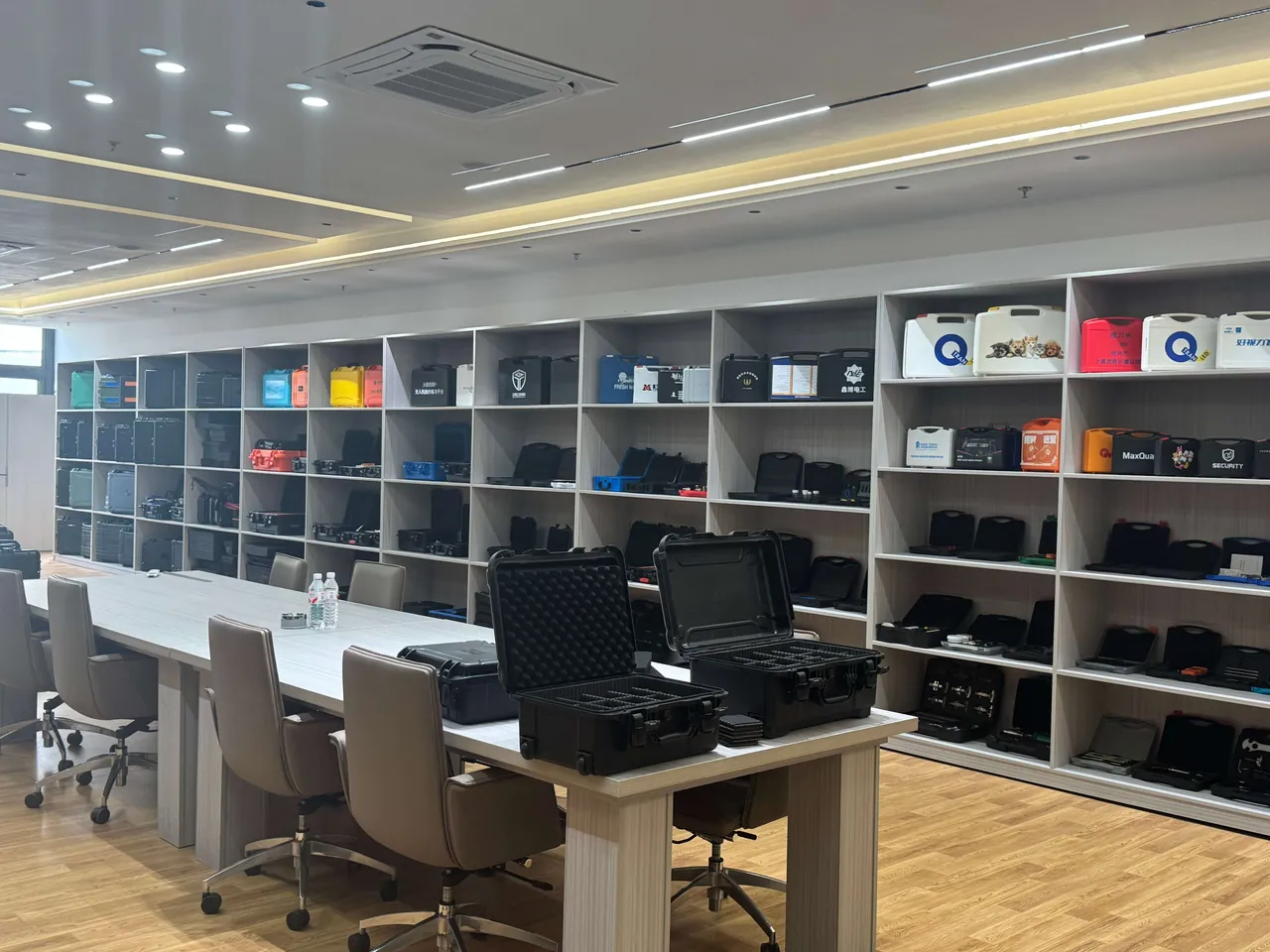
4. Inserts and Location: Retention, Anti-Tipping and Fast Loading
The insert is the most customised component in a cassette transport case, because it must mate with a specific cassette model.
Insert options. Four approaches are common:
- CNC-formed EVA insert: per-cassette fitted, high dimensional accuracy, suited to fixed cassette models and larger volumes. Higher weight and cost.
- Layered PE foam insert: good cushioning at lower cost, suited to lighter cassettes; tends to collapse under sustained compression and needs periodic replacement.
- Composite insert (EVA skeleton plus PE cushioning): combines locating accuracy with cushioning, suited to mixed loads or multiple cassette models.
- Adjustable divider system: slot-and-panel dividers allow zoning to be reconfigured, suited to operations with frequently changing models and low volumes. For implementation detail, see removable divider systems in protective cases.
Four details of location design:
- Full base support. Cassette weight is concentrated. Each cavity must provide a complete support surface so the cassette base is not left bridging or unsupported, which distorts the base.
- Four-corner retention. Beyond base support, raised retention at the cavity corners suppresses horizontal movement far more effectively than simply deepening the cavity.
- Finger access. Cassette handling requires space for fingers. Provide cut-outs or chamfers at the cavity sides so operators can grip securely. Missing finger access is the single largest cause of operator-damaged inserts.
- Anti-tipping compression. The inside of the lid should carry a compression element - a foam pad or locating rib - that lightly presses the cassette top when closed, preventing vertical bouncing in transit.
Balancing fast loading against retention. Loading runs are time-critical, and handling speed directly affects fleet turnaround. The engineering balance is a drop-to-locate, lift-to-release cavity: the cassette self-aligns on insertion via a chamfer lead-in, and lifts out without an undercut to overcome. Avoid retention features that require extra actions such as latches or straps, because in real operations they get skipped.
Slot labelling. Mark each cavity edge with a sequence number (1, 2, 3 and so on) and ensure the marking remains visible with the lid open. The loading manifest can then read "slot 1 corresponds to terminal X at branch Y", upgrading verification from counting quantity to confirming position. This change costs almost nothing and delivers high value in tracing errors. Full insert methodology is covered in custom foam insert design guide and EVA foam insert custom process; material comparisons are in case foam material comparison.
5. Sealing and Ingress Protection: Applying IEC 60529 and GB/T 4208
Whether a cassette transport case needs a high water protection class depends on its handling route.
| Handling route | Exposure | Suggested protection | Rationale |
|---|---|---|---|
| --- | --- | --- | --- |
| Cash centre to vehicle (underground garage) | Brief indoor-outdoor transition | IP5X dust protection | Keeps dust out of locks and slides |
| Vehicle to branch doorway | Possible rain | IP54 to IP55 | Rain and ground splash |
| Uncovered parking, long push distances | Sustained rain risk | IP65 | Jet spray and persistent rain |
| Humid regions, rainy-season operation | High humidity, condensation | IP65 plus moisture management | Prevents condensation accumulation |
| Cold-chain sites or unusual environments | Extreme | IP66 to IP67 | Assess against actual conditions |
IEC 60529 and China's GB/T 4208 (Degrees of protection provided by enclosures, IP code) correspond technically. It bears repeating that an IP rating covers only the ingress of solid objects and water; it does not cover impact, compression, chemical resistance or long-term fatigue. IP65 therefore cannot replace drop and stacking requirements. For a full reading of the IP code, see IP ratings and waterproof case selection.
Two practical sealing rules:
Rule one: sealing must not make the lid harder to open. Loading operations open and close the case dozens of times daily. If an over-compressed gasket makes opening laborious, operators develop the habit of levering the lid with a tool, and the joint is eventually destroyed. Use a low compression set silicone or EPDM gasket at a 20 to 30 percent compression ratio, and consider a pressure equalisation valve to eliminate the negative pressure caused by temperature differentials so opening force stays consistent. The principle is explained in the role of pressure equalisation valves.
Rule two: sealing failure must be visible early. Detecting a detached, cracked or hardened gasket is cheap; ignoring it leads to water ingress and mould. Specify a gasket colour that contrasts with the case, for example a light gasket on a dark shell, so defects are more readily found during inspection.
6. Dual-Control Handover: Loading, Return and Clear-Time Flows
Half the value of a cassette transport case lies in the container, and half in the procedure. The following sets out practical handover requirements for the three main flows.
(1) Loading flow (cash centre to terminal).
| Step | Owner | Key action | Record elements |
|---|---|---|---|
| --- | --- | --- | --- |
| 1 Load cassettes | Cash centre, two persons | Count, load cassette, close | Cassette serial, amount, two signatures |
| 2 Load case | Cash centre, two persons | Place into case by slot | Case serial, slot-to-cassette mapping table |
| 3 Apply seal | One applies, one transcribes | Thread one-way channel, pull tight | Seal serial, time, two signatures |
| 4 Load vehicle | Courier | Verify seal intact and manifest matches | Vehicle ID, departure time |
| 5 Arrive at branch | Courier and branch | Verify seal serial face to face | Arrival time, both signatures |
| 6 Cut seal | Both present | Cut in line of sight, retain seal | Cut time, retained seal |
| 7 Load terminal | Loading officer | Load by slot, verify each cassette | Cassette serial and amount per terminal |
(2) Return flow (terminal to cash centre). The risk profile differs, mainly because cassette states are mixed - full, empty and partial-recovery cassettes may travel together. Reserve a separate empty-cassette slot or status marking area in the case, and distinguish "full", "empty" and "recovery" states in the manifest, so that reconciliation on return is not a matter of guesswork.
(3) Clear-time flow (on-site maintenance). Clearing often accompanies fault handling and may be performed by a single maintenance engineer. Here the transport case provides temporary secure storage. The procedure should require that "any cassette removed during clearing must immediately be returned to the transport case and either resealed or logged as opened", preventing a temporary placement on site from becoming a responsibility vacuum.
The three-match principle. Every handover node must complete: match count (cases and cassettes agree with the manifest), match number (case serial, seal serial and cassette serial all correspond), and match seal (seal intact, no re-crimping, no cut-and-rethread evidence). A node missing any of the three is, in control terms, not a valid handover.
Conditions for effective dual control. Dual control only works when two people hold different opening credentials. The case uses two lock positions in series, so the lid cannot be lifted unless both are released; the two keys are carried by people in different roles and are never stored together. If one person holds both keys on behalf of the other, dual locks are functionally a single lock. The same principle governs cash-in-transit practice, covered in anti-tamper and handover management for cash-in-transit cases.
7. Seals and Locks: Tamper-Evident Design for the Transport Leg
First, distinguish tamper-evident from tamper-resistant. Tamper-resistant means "cannot be opened". Tamper-evident means "if it was opened, that will be obvious". A cassette transport case needs both, because opening is a normal part of operations.
Seal selection:
| Seal type | Numbering | Strength | Suitable scenario |
|---|---|---|---|
| --- | --- | --- | --- |
| Plastic pull-tight seal | Laser-marked | Moderate | Daily loading, short urban routes |
| Cable seal | Laser or stamped | High | Cross-district transfers, high-value loads |
| Wire lead seal | Stamped | High | Vault transfers, intercity transit |
| Bolt seal | Laser-marked | Very high | High-risk routes |
| Electronic seal | Digital ID plus timestamp | High | Operations needing electronic audit |
Seal channel design points. The channel must be one-way: easy to insert, resistant to reverse extraction. The bore must match the selected seal diameter; an oversized bore lets the seal wobble and makes a break point hard to identify. The channel should sit on an externally visible face that aligns naturally once the lid is closed, so the operator does not partially lift the lid to thread a seal. It must be integrally moulded; post-machined drilling brings burrs and dimensional scatter and is typical of low-grade supply.
Serial management is the core of the tamper-evident system. The seal itself does not prevent tampering; the one-to-one correspondence between seal serial and handover document does. Key practices: issue seals in numbered blocks and log them; retain voided seals and record the reason; have two people transcribe and read back the number at application; photograph the seal serial together with the case serial and file it with the handover record; require the receiving party to verify in the order case serial, seal serial, integrity, joint closure before cutting; and, if anything is anomalous, do not cut on site but transfer the whole case to security. Further analysis of seal materials and failure mechanisms is in seal materials and case sealing components.
Lock selection. Mechanical key locks are reliable and battery-free, suited to fixed routes. Combination locks remove the key but make individual accountability hard to trace. Electronic locks export unlock logs and suit scenarios requiring electronic audit. Specify different key cuts per case so a single key cannot open the entire fleet. For a detailed comparison of lock types and pry resistance, see case lock customisation options. Whatever the lock type, local wall reinforcement at the lock mounting position must be written into the specification, because it is the component most likely to fail early.
8. Tracking and Batch Verification: RFID Bulk Count and Vehicle Manifests
A loading vehicle managing dozens of cassettes cannot rely on manual counting for accuracy or speed. The goal of tracking is to turn quantity verification into batch verification.
| Approach | Read method | Environmental tolerance | Suitable use |
|---|---|---|---|
| --- | --- | --- | --- |
| Laser-engraved serial | Visual | Very high | Permanent case identity |
| QR or barcode label | Optical scan | Moderate | Single-case stocktaking, document binding |
| Passive RFID | RF bulk read | Moderate to high | Whole-vehicle batch verification |
| Active RFID or BLE | Active broadcast | Moderate, battery dependent | In-transit visibility |
| GNSS positioning | Satellite fix | Moderate, signal dependent | High-value routes |
Three implementation cautions for RFID:
- Currency inside cassettes is a dense dielectric and significantly degrades RF reads. Use metal-tolerant tags with the face pointing outward, or install a gate-style read tunnel for bulk stocktaking.
- Keep tags out of wear zones. Avoid the base, handle surroundings and stacking contact faces; prefer a recessed side face.
- Log reuse and replacement. Any tag replacement must record the old tag number and the reason, so tracking data never becomes detached from case identity.
Dual-layer identity as redundancy. Use a laser-engraved serial (non-removable) as the permanent identity, plus a barcode or RFID label for bulk reading. If the label wears, the number can still be read visually, so identity is not lost. This is a low-cost reliability feature.
How to write the batch verification manifest. Organise it hierarchically: vehicle, case serial, slot number, cassette serial, branch, terminal ID, amount. Have a different party sign at each node. When a terminal reports a discrepancy, the investigation can move immediately to the specific slot, cassette and stage. For high-value or valuables transit, see also high-value security for precious metal and jewelry transport cases.
9. Structural Load, Stacking, Wheels and Handles
Load path design. The stacking load path should run: upper case, lower case lid reinforcement, lower case side wall, lower case base, rack or floor. The load must not pass through cassette bodies. Ways to achieve this include support ribs on the inside of the lid aligned with cavity corners, raised support columns at insert corners, and stacking location recesses on the case base that mate with the lid top.
Stacking tiers versus wall thickness. For three-tier stacking, the bottom case carries roughly twice the single-case load when fully loaded. State the stacking tiers in the requirement document and specify wall thickness or ribbing accordingly, rather than writing "stackable" alone.
Handle design. Handles are the highest-frequency loaded component. Key points: the handle boss must have sufficient local wall thickness and should extend toward the main load-bearing face of the side wall; use a metal pin or reinforced bushing; shape the handle for a gloved grip; and verify with a static pull at twice rated load held for one minute, checking for deformation or pull-out.
Wheels and telescopic handles. For large, heavy cases, wheels and a telescopic handle materially reduce drop risk during handling. Selection points: consider wheel wear resistance and threshold crossing ability, since an undersized wheel jams on door thresholds and lift gaps; use a metal inner tube with multiple locking positions for the handle; and ensure the stowed state does not significantly increase overall height. Related guidance is in case wheels and trolley handles and portable transport box structure and selection.
Hinges. Specify a through metal pin with integrally moulded hinge bosses, avoiding self-tapping screws driven into polymer. During acceptance, physically attempt to extract the hinge pin. If the pin can be pulled out from outside, the entire lock and seal system is meaningless. Common hinge failure modes and design countermeasures are covered in toolbox hinges, latches and sealing structures.
10. Environmental and Transport Testing: Drop, Vibration, Temperature
Verification should cover the following tests, each with a stated basis and pass criterion.
(1) Drop test. Load to 100 percent of rated mass, with weights approximating the real cassette mass distribution, and drop from 1.0 to 1.2 m onto nine attitudes covering three corners, three edges and three faces. Pass criteria: no shell cracks, no significant joint misalignment, locks still operable, seal channel not deformed beyond accepting a seal, insert cavities not fractured. Empty-case drop testing has no reference value, because the real risk comes from internal mass transferring impact to the base and handles.
(2) Stacking test. Convert actual stacking tiers into load and hold for 24 to 72 hours. Judge that deformation is acceptable and latch engagement still functions.
(3) Vibration test. Reference the random vibration methods of the ISTA series or the GB/T 4857 series, with duration set to the longest single-leg transit time plus at least 50 percent margin. Judgement: inserts not collapsed, cassettes not migrated, seal channel not worn, locks not loosened. For the logic of choosing between transport package test regimes, see ISTA transport testing procedures explained and GB/T 4857 transport package testing; for full distribution cycle verification, see ASTM D4169 distribution cycle testing.
(4) Temperature and damp heat test. Loading vehicle interiors in summer can significantly exceed ambient temperature, and winter lows can embrittle polymer. Perform high-temperature storage, low-temperature storage, thermal cycling and damp heat tests, referencing the corresponding MIL-STD-810H methods. Note that MIL-STD-810H is an environmental test method standard, not a military certification; correct wording is "tested in accordance with the relevant MIL-STD-810H methods". Focus judgement on polymer embrittlement, gasket compression set, label detachment, and significant change in lock operating force. Interpretation is available in MIL-STD-810H environmental testing explained.
| Test category | Suggested basis | Key judgement |
|---|---|---|
| --- | --- | --- |
| Drop | GB/T 4857 series / ISTA | No cracks, joint not misaligned, locks operable |
| Stacking | GB/T 4857 series | Acceptable deformation, latch engagement normal |
| Vibration | ISTA random vibration spectrum | Inserts intact, cassettes not migrated |
| Temperature and damp heat | Relevant MIL-STD-810H methods (environmental basis, not military certification) | Polymer not embrittled, gasket not permanently deformed |
| Water and dust | IEC 60529 / GB/T 4208 | Target IP achieved, no internal standing water |
11. Selection Table Matched to Terminal Models
Selection must follow the principle of starting from the cassette specification, not from a case catalogue. The following configuration mapping supports requirement definition.
| Application | Cassettes per case | Suggested insert | Suggested lock and seal | Suggested handling |
|---|---|---|---|---|
| --- | --- | --- | --- | --- |
| Urban branch daily loading | Low to medium | EVA locating cavities | Single lock plus one-time seal | Hand-carried |
| Multi-branch round loading | Medium | EVA cavities plus slot labels | Dual lock positions plus plastic seal | Hand-carried with shoulder strap |
| Cross-district bulk loading | Medium to high | Composite insert | Dual lock positions plus cable seal | Wheels and telescopic handle |
| Vault to hub transfer | High | Composite insert plus corner support | Dual lock positions plus lead seal | Wheels, handle and pallet |
| High-risk routes | Medium | EVA locating cavities | Dual lock positions plus bolt seal | Wheels and telescopic handle |
| Mixed cassette models | Medium | Adjustable divider system | Dual lock positions plus seal | Hand-carried |
Four-step selection check:
- List cassette models and external dimensions, then check internal net dimensions and loading clearance for each;
- Determine loaded mass per case and compare against a safe single-person carrying limit; if exceeded, split across two cases;
- Check branch handling routes (lift car internal dimensions, doorway width, presence of steps);
- Check the loading vehicle rack module to decide whether stacking location features and wheels are required.
12. OEM/ODM Customisation: Working Backwards from the Cassette
Cassette transport cases are almost always customised, because cassette models are defined by the terminal manufacturer and the case must adapt to the cassette.
Seven-step customisation process:
- Specification input: cassette model, external dimensions, unit mass, quantity per case, branch route dimensional limits;
- Design proposal: internal dimensions, cavity layout, lock and seal channel positions, marking area positions;
- Functional prototype: build a fully functional prototype including locks fitted, seal channel present and insert formed, not a visual model;
- Functional verification: loaded drop, stacking, handle pull, open-close cycles;
- Field trial: at least one full loading shift in live use, observing where operators actually struggle;
- Corrective action and design freeze: record changes, produce drawings and a retained sample;
- Volume delivery and first-article approval: inspect the first batch against a sampling scheme.
The four most common prototyping problems:
- Seal channel to lid alignment: whether it aligns naturally when closed, or whether the lid must be forced to thread a seal;
- Insert tolerance: CNC-cut insert tolerance stacking against moulded case tolerance can make some cavities too tight;
- Lock mounting strength: whether the mounting position has sufficient local wall thickness and reinforcement;
- Handle load path: whether the handle is mounted on a thin wall that flexes outward under full load.
JUNZHJIA, the brand of Kexin New Materials (Guangdong) Co., Ltd., provides integrated capability from structural design and tooling development through insert forming. Given a customer's cassette model and branch route constraints, the company can complete internal cavity and slot design and deliver customised cases with unique serial plates, one-way seal channels and dual lock positions, supporting prototyping, functional verification and volume supply with inspection and test documentation as required. For tooling investment and amortisation logic, see custom case mould cost analysis; for supplier evaluation criteria, see how to choose a case OEM factory.
13. Acceptance, Inspection and Life Management
Incoming acceptance points:
| Check item | Method | Judgement |
|---|---|---|
| --- | --- | --- |
| Internal net dimensions | Measured | Meets drawing, cassettes load and extract normally |
| Cavities and labels | Check each cavity | Correct quantity, clear one-to-one labelling |
| Appearance and structure | Visual, whole case | No cracks, sink marks or burrs |
| Serial | Cross-check | Plate serial unique and matching the order |
| Locks | Operate each one | Smooth, no binding, correct key cut |
| Sealing | Visual joint plus sampled water test | Joint continuous, target IP achieved |
| Seal fit | Insert each seal | Inserts freely, resists reverse pull |
| Handles and wheels | Loaded pull, push test | No pull-out, no abnormal wear |
Daily inspection (per shift or before each use): new cracks or dents on the shell; hinges loose or noisy; locks operating smoothly and keys unworn; gasket detached or hardened; insert cavities deformed or labels illegible; serial plate legible; seal channel free of debris with no enlarged wear.
Periodic maintenance (monthly or quarterly): clean the gasket and check elasticity; tighten hinge and lock fasteners, avoiding over-torque that cracks polymer; check handle bosses and wheels for wear; verify tracking tags and log replacements; isolate faulty cases, tag them and route to repair or scrap.
Suggested scrap criteria. Scrap a case with any of: through-cracks or large structural deformation, joint wear preventing sealing, hinge boss pulled out or cracked, lock mounting damaged beyond repair, seal channel worn until a seal can be freely removed, or insert cavities collapsed enough to allow free cassette movement. Cleaning and care are covered in how to clean a protective case, service life assessment in protective case service life assessment, and counterfeit identification in identifying genuine versus counterfeit cases.
14. Procurement Checklist and Common Cost Misjudgements
A ready-to-use procurement requirement list:
Functional requirements - cassette models and quantities, rated mass per case, whether dual control is required, seal type, whether positioning or electronic tagging is required.
Structure and materials - shell material and colour, wall thickness and reinforcement requirements, hinge type (specify through metal pin), handle type and quantity including wheels and telescopic handle.
Sealing and protection - target IP rating and test basis, whether a pressure equalisation valve is required, gasket material requirements.
Insert - cavity count and layout, insert material, tolerance and loading clearance, slot labelling requirements.
Marking and tracking - case numbering rule and engraving method, label type and position, seal serial registration area.
Verification documents - drop, stacking, vibration, temperature and humidity, and water test requirements and reports, plus sampling scheme.
Delivery and service - first-article approval, packaging and shipping, warranty and spare parts, consistency assurance for repeat orders through retained sample control.
Three common cost misjudgements:
Misjudgement one: comparing unit price only, not lifecycle cost. Cheap cases tend to fail early at hinges and handles, and once repair, downtime and replacement are added, total cost is higher. Comparison should include expected replacement rates over the intended service life.
Misjudgement two: substituting a generic case for a custom one. A generic insert does not fit the cassette, allowing movement and impact, and the long-term cost in cassette repair and jam handling typically far exceeds the amortised tooling cost of a custom design.
Misjudgement three: skipping dimensional verification of the internal cavity. Some suppliers publish external dimensions that match the catalogue while internal dimensions differ because of wall thickness and ribbing. Ask for an internal net dimension drawing and verify with real cassettes at first-article stage.
Frequently Asked Questions
Q: What really separates an ATM cassette transport case from an ordinary protective case?
A: Three layers of difference. First, adaptation. A cassette is a precision fit component, so the transport case insert must fit a specific cassette model item by item, restricting movement and avoiding concentrated local loading, which a generic foam insert cannot do. Second, evidence chain. A cassette transport case needs a unique serial plate, a one-way seal channel and dual lock positions so that "was this opened" can be verified externally, whereas an ordinary protective case only needs to prevent damage. Third, handover support. The case must support documentation across the loading, return and clear-time flows, including slot labelling, batch manifests and retained cut seals - procedural features the case itself must enable. An ordinary protective case with a higher water rating still cannot be used for cassette rotation. Conversely, a cassette transport case may not require the immersion performance of a dedicated waterproof case, so selection should follow the actual route.
Q: Can I just carve cavities into a single block of foam for the insert?
A: Not advisable. Cavities carved into one soft foam block typically have soft walls and generous dimensions, so cassettes gradually migrate under vibration and braking and then collide hard with the case wall, scoring guide rails and displacing cassette doors. Extraction also tends to disturb neighbouring cassettes, increasing exposure time and the risk of picking up the wrong unit. A proper design uses per-cassette fitted cavities sized to the real external form, with cavity walls providing structural support, typically EVA or a composite construction. The cavity base must give full support, the four corners should have raised retention, and the sides should provide finger access for a secure grip. Tolerance matters equally: loose cavities allow migration, and tight cavities push operators to force contents out and damage the insert. Run a loaded trial fit and vibration verification with real cassettes at prototype stage rather than judging by feel.
Q: What water protection class does a cassette transport case need?
A: It depends on exposure along the handling route. If loading and unloading happen entirely in underground garages and indoors, dust protection (IP5X) and basic splash resistance usually suffice. For branch doorways and uncovered parking, IP54 to IP55 is appropriate. Where sustained rainfall or washdown occurs, IP65 or above can be considered. Remember that an IP rating describes only the ingress of solid objects and water; it does not cover impact, compression or corrosion resistance, so IP65 cannot replace drop and stacking requirements. Also, tighter sealing makes the lid harder to open, and loading operations open the case dozens of times a day. An unnecessarily high sealing class can push operators into levering the lid with a tool and damaging the joint. Choose a class matched to the real route and pair it with a pressure equalisation valve to keep opening effort consistent.
Q: What exactly must be recorded for dual-control handover to be valid?
A: Each handover node should complete the three-match principle and leave verifiable records. Match count: case quantity and cassette quantity agree with the manifest, with full, empty and recovery states distinguished. Match number: case serial, seal serial and cassette serial all correspond to the manifest, and the slot-to-cassette mapping table is the key to tracing errors. Match seal: the seal is visually intact with no cut marks and no re-crimping. Record elements should include at minimum case serial, seal serial, slot-to-cassette mapping, amount, time, and both signatures. Times should be system-generated or taken from a common time source to avoid contradictory handwritten entries. Policy should also state in advance the handling path and decision owner for four situations: anomalous seal, mismatched seal serial, damaged case, and quantity discrepancy.
Q: Why is it wrong to give both keys to the same person?
A: Because the core of dual control is not two locks but two independent accountable parties. If one person holds both keys, no opening can demonstrate that a second person was present, and dual locks are equivalent to a single lock for audit purposes. Effective implementation requires two lock positions in series logic, so the lid cannot be lifted unless both are released; the two keys carried by people in different roles, never stored in the same cabinet and never held on another's behalf; and handover records stating which lock was opened by whom rather than a generic "case opened". On shift change or departure, rekey the affected locks or move the case off high-risk routes. Finally, dual locks must be paired with seals: the locks prevent unauthorised opening, and the seal makes even authorised opening a matter of record.
Q: A loading run has to verify dozens of cassettes. How can that be made faster without reducing reliability?
A: Move verification from counting units by hand to batch verification plus position verification. Three measures help. First, add a laser-engraved unique serial to each case together with a barcode or RFID label, so bulk counting can use RF reads while a worn label can still be read visually, giving dual redundancy. Second, label the insert cavities with sequence numbers so the manifest reads "slot 1 corresponds to terminal X at branch Y" instead of "X cassettes"; position verification catches mis-loading far more readily than quantity counting. Third, structure the manifest hierarchically as vehicle, case serial, slot number, cassette serial, branch, terminal ID, amount, with a different party signing at each node. Note that currency inside cassettes is a dense dielectric that significantly degrades RF reads, so use metal-tolerant tags facing outward.
Q: Why do handles and hinges always fail first?
A: Because they absorb high-frequency loading outside the design envelope. Operators lift with one hand, drag sideways, or even use the handle to lever a loaded case, producing moments far greater than design assumptions. With dozens of open-close cycles per day, fatigue accumulates quickly at hinges and handle bosses. Engineering countermeasures include: a through metal pin hinge with integrally moulded bosses rather than self-tapping screws into polymer; additional local wall thickness and a metal pin or reinforced bushing at the handle boss; extending the handle boss toward the main load-bearing face of the side wall; and verification by a static pull at twice rated load held for one minute. During acceptance, physically attempt to extract the hinge pin - if it can be pulled out from outside, the lock and seal system is equally compromised.
Q: Can drop testing be performed on an empty case?
A: No. Empty-case drop testing has almost no reference value. With no internal mass, the drop response is dominated by elastic deformation of the shell, whereas the real risk comes from internal mass transferring impact to the base, walls and handles. Under a loaded drop, cassette inertia applies a large instantaneous force that can crack the base, fracture insert cavities, pull out handles and displace cassette doors. Load to 100 percent of rated mass with weights approximating the real cassette dimensions and mass distribution, and cover nine attitudes: three corners, three edges, three faces. Pass criteria should assess both structure (cracks, joint misalignment) and function (locks operable, seal threadable, cassettes loading and extracting normally).
Q: How often should cassette transport cases be replaced?
A: There is no universal interval. Use condition-based judgement as the primary criterion with service age as a secondary input. The decisive factors are usage frequency and handling intensity: a case opened dozens of times a day and lifted in and out of vehicles wears its hinges, locks and handle bosses far faster than a low-frequency unit. Define scrap criteria: through-cracks or large structural deformation, joint wear preventing sealing, hinge boss pulled out or cracked, lock mounting damaged beyond repair, seal channel worn until a seal can be freely removed, or insert cavities collapsed enough to allow free cassette movement. Maintain an inspection log recording every repair and part replacement, and use that data to derive a sensible service interval for the batch. For cases on high-risk routes, consider scheduled forced rotation rather than relying purely on condition assessment.
Conclusion and Related Reading
The selection logic for an ATM cassette transport case reduces to one sentence. Define the evidence from the process first, then define the structure from the evidence, and only then define the material from the structure. The wrong order is to pick a case from a catalogue that "looks sturdy" and then try to force it into an existing process. That approach survives a pilot, but once branch counts scale up, the problems surface together: errors become hard to trace, inserts do not match, and seals cannot be registered.
Four practical rules summarise the approach. Specify the insert from the cassette model and build slot labelling into it. Set the protection class from the exposure route rather than chasing a high IP number. Define seals and serials by responsibility segment and write the records into the handover form. Specify hinges, handles and wheels for high-frequency fatigue, and keep an inspection log. Done this way, case cost is a small share of overall operating cost, while the traceability of discrepancies and the security of cash that it delivers are hard to replace.
JUNZHJIA supplies ATM cassette transport cases to bank cash centres, self-service terminal operating contractors and armoured courier companies, supporting insert cavities designed to cassette models, unique serial plates, one-way seal channels, dual lock position structures, stacking location features and wheels with telescopic handles, together with inspection and test documentation and OEM/ODM service.
Related Reading