

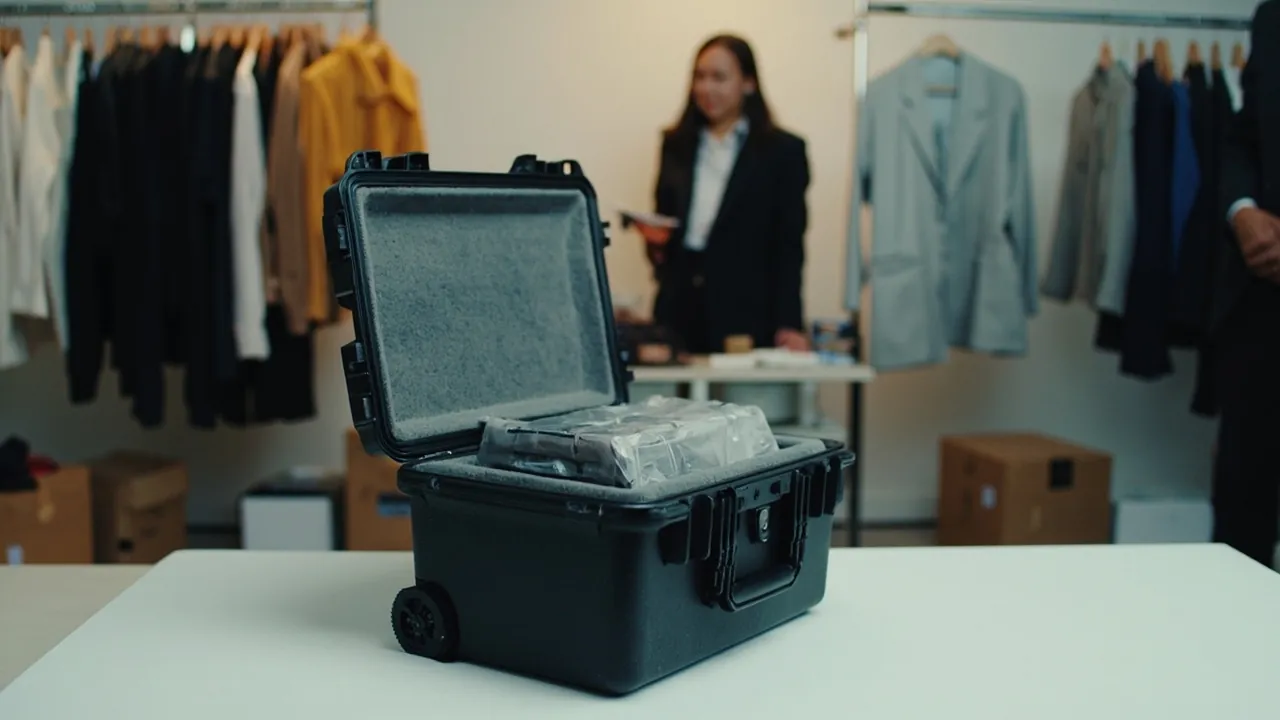
Garment transport protection is really about one thing: delivering "shape" and "surface" intact to the next stage of use. A sample has to arrive with its pattern and silhouette ready for a buyer's hands; a finished garment has to reach the store and the customer's unboxing moment with its front-of-house finish unmarked. Cartons, courier bags and fabric garment carriers solve "it fits", but they do not solve creasing, crush marks, moisture regain, mould spots or hardware scuffing. The correct answer for fashion and apparel is therefore not "find a bigger box" but "use a case with a rigid shell, controllable humidity and a purpose-built hanging or layering insert, so that warehousing, line-haul transport and retail turnaround form one reusable closed loop.
A competent garment transport case has to satisfy three engineering goals at the same time: the shell must not collapse under stacking and impact; the internal relative humidity must stay inside the comfort band for textiles and leather over long transit windows; and the insert must repeatedly transfer the load path away from "fold compression" onto "structural support". This article follows those three threads and gives materials, structures, ingress ratings, test references, load-factor arithmetic and acceptance methods, so that brand owners, OEM factories, buying offices and third-party logistics teams can turn "no creases, no mould, no rework" into a purchasable specification.
Table of Contents
- 1. Why Fashion and Garment Shipments Need Dedicated Transport Cases
- 2. Four Main Damage Classes in Garment Transport
- 3. Anti-Crease: Hanging, Rolling and Layered Support
- 4. Moisture and Mould: Relative Humidity Targets and How to Hit Them
- 5. Shell Materials and Structural Selection
- 6. Ingress Protection: Choosing Between IP65 and IP67
- 7. Environmental and Transport Test References
- 8. Insert, Hanging and Layering System Design
- 9. What Makes a Sample Case Different
- 10. Retail Turnaround Cases and Fast Replenishment
- 11. Brand Warehousing and Omni-Channel Fulfilment
- 12. Size Series and Load-Factor Optimisation
- 13. Gaskets, Hinges, Latches and Seals
- 14. Temperature and Climate Adaptation
- 15. Cleaning, Maintenance and Service Life
- 16. Custom Development, Acceptance and Cost Structure
- Frequently Asked Questions
- Conclusion and Further Reading
1. Why Fashion and Garment Shipments Need Dedicated Transport Cases
Apparel logistics grew up on a "fold, bag, carton" model. That model works acceptably in short fast-fashion loops, but it has stopped working in today's high-unit-value, multi-stage, globally distributed fulfilment environment. There are three reasons.
The first is rising value density. The factory cost of a cashmere coat, a tailored suit or a silk dress can equal dozens of basic cotton T-shirts. Once creasing or crush damage appears in transit, the store-side recovery cost - steaming, re-pressing, re-packaging, or markdown - goes straight against gross margin.
The second is a longer scenario chain. The same garment may pass through factory, brand warehouse, regional distribution, store, customer return and resale. Every handling step, every stack, every humidity swing is a damage opportunity. Cartons are single-use, so damage accumulates. Transport cases are reusable, so protection is sustainable.
The third is front-loaded brand perception. In live-commerce and social-media contexts the unboxing frame is itself a brand asset. A creased collar, a collapsed shoulder line or a silk pull caused by a metal trim will be magnified into a quality question inside a fifteen-second video.
Conclusion: garment transport protection should not be treated as "packaging cost" but as a hedge against brand inconsistency and rework cost. The test is simple - do the steaming rework, markdown handling and customer complaints avoided over the case's whole lifecycle exceed the purchase and amortisation cost of the case itself?
In real projects, Kexin New Materials normally decomposes the requirement along three axes: garment type, logistics chain and climate. Garment type determines insert geometry, the chain determines shell strength and stacking tier limits, and climate determines humidity control and ingress rating. Only once those three are fixed does it make sense to discuss size series and latch configuration.
2. Four Main Damage Classes in Garment Transport
To make protection targeted, damage must first be classified. In practice, garment transport damage falls into four classes, each mapping to a different engineering response.
| Damage class | Typical appearance | Primary cause | Primary countermeasure |
|---|---|---|---|
| --- | --- | --- | --- |
| Creasing and fold lines | Fold lines, collapsed shoulder, crushed hem | Fold compression, stacking load, long static compression | Hanging, rolling, layered support, stacking tier limits |
| Crush and deformation | Distorted collar, flattened shoulder pad, button imprints | Local point load, missing insert, garments pressing each other | Shaping modules, compartmented inserts, individual slots |
| Moisture regain and mould | Odour, white spots, oxidised metal, mouldy leather labels | Elevated relative humidity, condensation from temperature swings, poor ventilation | Desiccant bay, higher ingress rating, humidity indicator cards |
| Surface scuffing and snagging | Silk pulls, snagged yarn, coating wear, scratched hardware | Relative movement inside the case, hard protrusions, dust | Lint-free lining, restraint straps, divider panels, soft wrapping |
Among the four, moisture regain and mould are the most underestimated and the hardest to detect on arrival. Mould has a lag window of roughly 48 to 120 hours: humidity inside the case climbs during transit, the goods look normal on the day of receipt, and odour and spotting appear two or three days after put-away. At that point liability is hard to assign and the whole batch faces quarantine risk. Humidity control is therefore not a "premium option" for garment cases; it is baseline capability.
For how to build the underlying transport test path, see basic transport package testing and test intensity design and selecting and running ISTA transport test procedures. Fix the test profile first, then work backwards to case specification.
3. Anti-Crease: Hanging, Rolling and Layered Support
The core proposition of anti-crease design is preventing fabric from carrying sustained compression along a single line. Folding is, in essence, pressing a permanent set into the fabric along a fold line; the higher the pressure, the longer the time and the higher the temperature and humidity, the harder the crease is to recover. From that mechanism, three routes follow.
Route one: hanging. The case carries a crossbar or vertical rail, garments hang on hangers, the shoulder line is supported by the hanger and the hem falls freely. This route suits suits, coats, dresses and evening wear and produces almost no fold line. The price is vertical space: fewer pieces per case, and the case must solve the problem of swinging loads under transport vibration.
Route two: rolling. For knitwear, silk, chiffon and other soft fabrics, interleave with acid-free tissue or lint-free cloth and roll to a diameter of at least 60 to 80 mm. Rolling materially reduces fold marking and is space-efficient, but it does not suit structured tailoring.
Route three: layered support. Lay garments flat on tray levels with rigid divider panels between them, so stacking load transfers into the panels rather than the fabric. This is the most space-efficient route and suits shirts, T-shirts and denim.
The comparison is summarised below:
| Route | Suitable categories | Pieces per case | Crease risk | Structural complexity |
|---|---|---|---|---|
| --- | --- | --- | --- | --- |
| Hanging | Suits, coats, evening wear, dresses | Low (roughly half of layered) | Very low | Medium (rail plus restraints) |
| Rolling | Knitwear, silk, chiffon, scarves | Medium | Low | Low (cores and ties) |
| Layered support | Shirts, T-shirts, denim, loungewear | High | Medium (needs dividers and restraints) | Medium (tray and divider system) |
In practice the most common answer is a hybrid: an upper hanging zone plus a lower drawer-style layered zone, or a main hanging compartment plus a lid-side accessory compartment. The critical point in a hybrid is centre-of-gravity control - hang the heavy, structured pieces low and central, keep the C of G low, and prevent garments pressing on each other.
One reminder applies to every route: specify and label a maximum stacking tier count. A great many "anti-crease cases" fail not because the insert design is poor but because the site stacked them five or six high, well beyond the design load of the insert structure.
4. Moisture and Mould: Relative Humidity Targets and How to Hit Them
The target value depends on the material. In practice the comfort band for textile and leather goods is 45% to 55% relative humidity. Below 40% RH, natural fibres embrittle and static increases; above 60% RH, mould spores have the conditions to germinate; above 70% RH sustained for more than 24 hours, mould risk rises sharply.
| Relative humidity band | Material condition | Mould risk | Recommended action |
|---|---|---|---|
| --- | --- | --- | --- |
| Below 40% RH | Brittle natural fibres, noticeable static, cracking leather | Low | Limited humidification or shorter exposure |
| 45% to 55% RH | Stable moisture regain, normal hand feel | Low | Target band; maintain |
| 56% to 65% RH | Acceptable but persistently high | Medium | More desiccant, shorter storage cycle |
| 66% to 75% RH | Microbial activity begins | High | Raise ingress rating, add humidity indication |
| Above 75% RH | Mould spots, odour, oxidised metal | Very high | Treat as non-conforming; intervene |
There are four implementation paths, normally used in combination.
- Sealing. Use a shell rated IP65 or better to block moisture exchange with the outside. For the meaning of IP ratings and how they are tested, see IP ratings for waterproof protective cases explained and the technical boundaries of IP67 protective cases.
- Desiccant bay. Provide a dedicated desiccant compartment inside the case - not in direct contact with garments, which would create dust - and size the silica gel or molecular sieve charge by internal volume and target transit days. As a starting empirical value, 25 litres of net volume with a 30-day control target can be served by 100 to 200 g of silica gel, but the real charge must be calibrated against measured leakage rate.
- Humidity indication. Fit a readable humidity indicator card or a plug-in electronic temperature and humidity logger so the receiving party can *see* the internal state. This is also the key evidence for apportioning liability.
- Breathing and equalisation. Full sealing is not always optimal. On cross-climate routes, the pressure and temperature differential between inside and outside produces a breathing effect at the gasket. Pair the case with a pressure equalisation valve so that pressure equalises while water ingress protection is retained, avoiding hard-to-open lids and gasket fatigue.
5. Shell Materials and Structural Selection
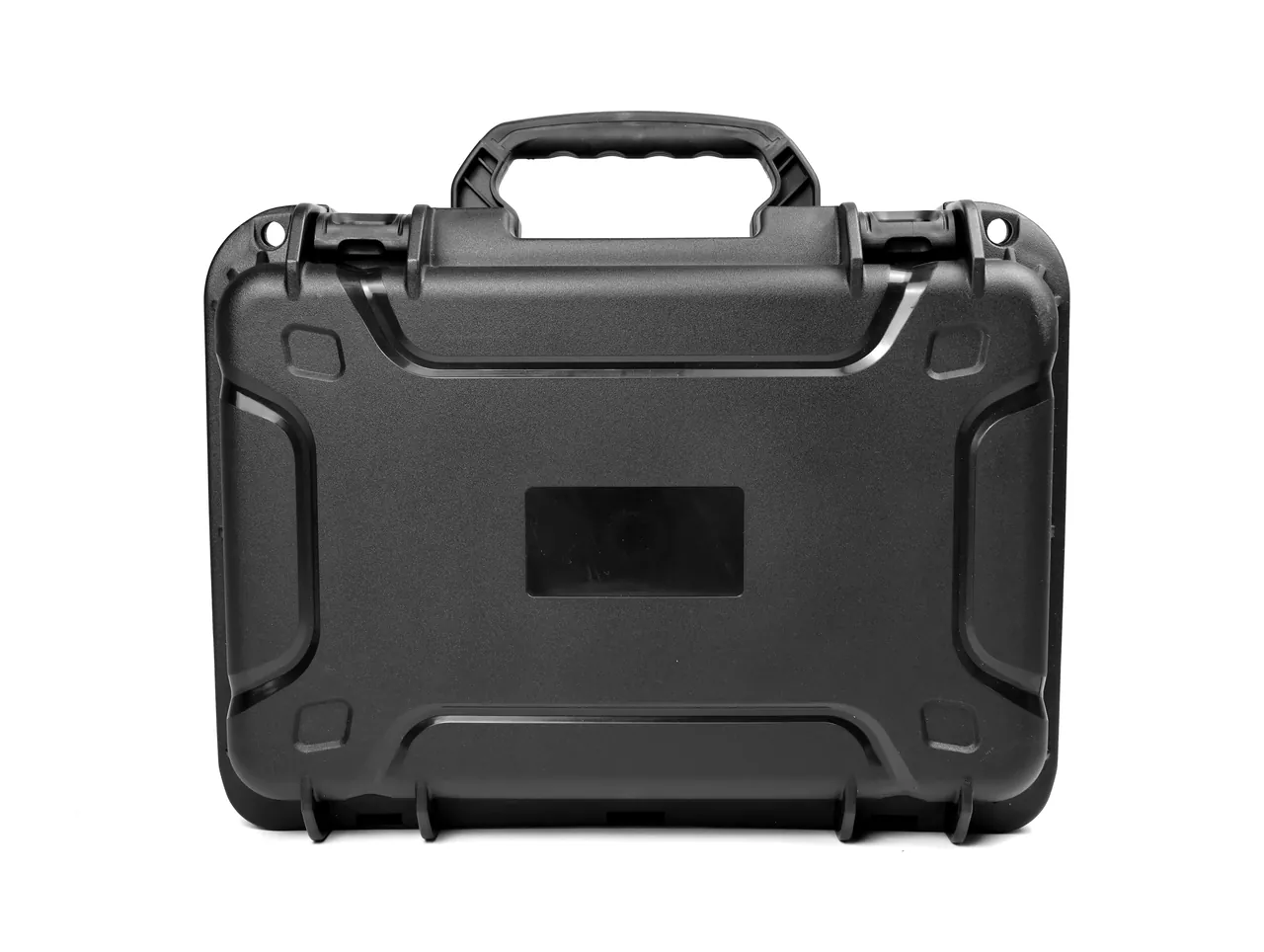
Three material families dominate garment transport cases: injection-grade polypropylene (PP), PP copolymer and high-density polyethylene (HDPE). The core trade-off is stiffness against toughness, weight and cost.
- PP homo- and copolymer. Good stiffness, smooth surface, good chemical resistance; well suited to shells and drawers. Low-temperature toughness is below HDPE, so the brittle transition temperature matters for cold-store and winter air-freight routes.
- HDPE. Outstanding toughness, better impact and low-temperature performance, but lower stiffness, so large shells need compensating ribs.
- Composite construction. Outer shell plus internal liner frame, or twin-wall blow-moulded construction, for large-volume and high-stack applications.
On the insert side, the usual materials are EVA foam, PE foam, XPE foam and lint-free flocked fabric. For the performance differences and selection logic, see protective case foam material comparison.
Key judgement: a thicker shell does not solve creasing, because creasing originates in the pressure distribution at the fabric level. Only routing the load through divider panels and frames is genuinely effective.
Structurally, five details deserve attention:
- The orientation and pitch of wall ribs, and whether they align with the stacking direction;
- Whether corners are radius-reinforced to reduce stress concentration;
- Whether the lid-to-body mating face has a tongue-and-groove lip that raises torsional stiffness;
- Whether rail and tray mounting points have moulded-in metal inserts, so repeated assembly does not strip plastic threads;
- Whether the base includes forklift pockets or caster mounting points, which determines on-site handling efficiency.
For garment projects, Kexin New Materials normally works insert-first: prototype the insert - rail positions, drawer compartments, restraint anchor points - against the client's actual garment forms and store workflow, then derive shell dimensions and latch configuration. This keeps the risk of "shell built, insert reworked" to a minimum.
6. Ingress Protection: Choosing Between IP65 and IP67
IEC 60529 and the equivalent GB/T 4208 define enclosure ingress protection using the IP code. For garment cases the meaningful digits are the first (dust and solid objects) and the second (water).
- IP65. Dust-tight, protected against low-pressure water jets from all directions. Suitable for indoor warehousing, retail turnaround and covered-dock loading.
- IP66. Dust-tight, protected against powerful water jets. Suitable for open docks and short-duration storm exposure.
- IP67. Dust-tight, protected against short-duration immersion under defined conditions (typically 1 m for 30 min). Suitable for water pooling on container floors, cold-chain defrost water and flood-season transfer.
What must be written into the purchase specification is this: an IP rating is a type-test conclusion, not a marketing adjective. Require a test report citing IEC 60529 or GB/T 4208, and verify that the sample size, gasket configuration and sealing method in the report match the mass-production version. A common industry failure is a well-sealed prototype paired with a production unit from a different gasket supplier. Batch acceptance should therefore include sampling inspection, as described in custom case acceptance and AQL sampling.
For the great majority of brand-warehouse and retail-turnaround scenarios, IP65 is sufficient. IP67 earns its extra cost only for long ocean routes, open-air transfer in high-rainfall regions, or secondary transfer by flatbed and barge. Chasing a higher rating can backfire: excessive sealing makes the case hard to open, so the site stops using it - a trap many projects have fallen into.
7. Environmental and Transport Test References
Case and insert specifications should not be set by intuition. They need a test basis that turns "protective capability" into a number. Four reference families are commonly used:
| Standard | Scope | How it is used in garment case projects |
|---|---|---|
| --- | --- | --- |
| GB/T 4857 series | Basic tests for transport packages (vibration, impact, stacking, drop) | Verifies whole-case tolerance on road and rail transport |
| ISTA series | Transport packaging test procedures, by mode and weight | Simulates the complete distribution cycle; closest to the real chain |
| ASTM D4169 | Performance testing of shipping containers and systems | Builds the distribution cycle profile, including drop, vibration, compression |
| MIL-STD-810H | Environmental engineering considerations and laboratory tests | Its temperature, humidity, vibration, shock and mould methodologies are borrowed; this is a methodology reference, not a military certification |
For the applicable boundaries of MIL-STD-810H and common misconceptions, see MIL-STD-810H environmental testing and protective case compliance. For distribution cycle profile design, see ASTM D4169 distribution cycle testing and case design.
One point must be stated plainly: these standards exist to create a repeatable, comparable and acceptable test language, not to attach a "military" label to a case. When briefing customers, the correct wording is "environmental testing was performed using the relevant MIL-STD-810H test methods", never "military certified".
8. Insert, Hanging and Layering System Design
The insert is the real functional layer of a garment case. The design logic breaks into four steps.
Step one: define the unit carrier. Every garment needs a carrier form - hanger, roll core, tray compartment or garment sleeve. The carrier defines the load path between garment and shell.
Step two: define the zones. Divide the internal volume into main compartment, accessory compartment, desiccant bay and tool or consumable bay. The clearer the zoning, the faster and less error-prone the on-site work. For removable divider approaches, see protective case removable divider systems.
Step three: define restraint. Relative movement in transit is the primary cause of scuffing and snagging. Restraint tools include elastic straps, hook-and-loop hold-downs, foam pads and stop panels. The principle is light constraint with full coverage - enough force to stop displacement, never enough to leave a pressure mark on fabric.
Step four: define ergonomics. The insert must let a store associate complete a pick or put-away in under thirty seconds, otherwise even a good design will be abandoned on the floor. Drawer-slide damping, rail height and handle shape all directly affect real-world adoption.
On materials and process, die-cut EVA suits regular geometry, cast or thermoformed inserts suit complex curves, and flocked facing suppresses dust and friction. For tooling and prototyping workflow on custom inserts, see EVA foam insert custom process and the custom foam insert design guide.
9. What Makes a Sample Case Different
Samples are the highest-value, lowest-count and most frequently moving items in the apparel chain. They serve designer review, buyer order sessions, customer sign-off and pre-production reference at the same time, so the design goals of a sample case differ substantially from a production garment case.
Difference one: individual slots and traceability. A sample case typically carries 6 to 20 pieces, each with its own reference and status - which revision, what changes, confirmation state. The insert needs an individual slot per piece plus a label position. The value shows up as reduced search time at an order session: a buyer hunting for one specific colour among thirty samples is generating damage while searching.
Difference two: stricter anti-crease requirements. Samples are worn on models or laid flat for photography at the review venue, so any fold line appears in stills and video. Sample cases should therefore prefer hanging, with soft support at cuffs and hems.
Difference three: frequent opening and short chains. A sample case may be opened more than ten times a day, so hinge and latch durability becomes a key metric. For hardware selection and maintenance, see toolbox hinges, latches and sealing structures.
Difference four: carry-on character. Sample cases frequently travel with designers and buyers, so weight, casters and telescopic handles are high-priority; the selection logic is covered in case casters and trolley handles.
| Metric | Production garment case | Sample case |
|---|---|---|
| --- | --- | --- |
| Pieces carried | 20 to 60 | 6 to 20 |
| Insert form | Layered trays plus dividers | Hanging plus individual slots plus label positions |
| Weight target | Optimised for load factor | Lightweight first, with casters |
| Hardware durability | Medium (1 to 3 opens per day) | High (10+ opens per day) |
| Identification need | Batch or store | Style, colour, revision, status |
10. Retail Turnaround Cases and Fast Replenishment
The core requirement of retail turnaround is "arrive and shelve": once the case reaches the store, staff should move goods to display as fast as possible and minimise back-of-house dwell time. This imposes three design requirements.
First, opening efficiency. Lid opening angle and insert locating method - whether a whole tray must be lifted out or a single piece can be extracted directly - determine replenishment speed. A common answer is a drawer-style insert with a front-opening lid, so staff can pull pieces one by one without moving the whole case.
Second, alignment with display logic. The compartment order in the insert should match the store's display order - by colour family, by size, by category - so that pick order equals shelving order and no secondary sort is needed.
Third, empty-case return. Retail turnaround is bidirectional; empty cases must return to the brand warehouse or DC. The case should therefore support nesting or collapsing, compressing empty volume to 30% to 50% of the loaded state and cutting return freight cost significantly.
An overlooked detail: an unrestrained empty return will deform the insert. Provide a dedicated insert cover, or design the insert as a removable module that can be shipped separately.
A second benefit of turnaround cases is reduced single-use packaging. As carton cost, waste-disposal cost and ESG disclosure requirements rise together, the cost per trip of a reusable case typically falls below a single-use carton after 8 to 15 cycles. The exact crossover depends on round-trip distance and how well the return loop is managed.
11. Brand Warehousing and Omni-Channel Fulfilment
The challenge in brand warehousing is not single-case protection but scale, standardisation and information consistency.
Scale requires case dimensions to match racking, pallets and sortation lines. A common practice is to derive a size series from two or three base footprints - for example a 600 x 400 modular series - so cases stack cleanly on standard pallets and load factor improves by 10% to 20%. For general selection logic, see general-purpose transport protective case selection guide.
Standardisation requires that cases of the same size be identical in load count, insert configuration and latches, so that the floor never encounters "looks the same but will not work". This in turn demands stable mould and process control from the supplier.
Information consistency requires identifiable marking. Reserved RFID pockets, barcode label areas, colour-coded latch zones or electronic tag compartments all affect warehouse management system throughput. In brand-warehouse projects, Kexin New Materials normally reserves label positions and RFID cavities at the mould stage, avoiding later label loss or abrasion.
Omni-channel fulfilment adds the ship-from-store scenario: online order, store stock dispatch. The turnaround case may then participate directly in last-mile delivery, which makes case appearance, cleanliness and unboxing experience part of brand perception. That is why premium brands increasingly specify dark matte shells with custom inserts rather than industrial blue or grey.
12. Size Series and Load-Factor Optimisation
Size design offers the best return on engineering effort in a garment case project. Three principles apply.
Principle one: use the pallet as the modular datum. Taking a 1200 x 1000 mm standard pallet as the datum, base footprints of 600 x 400, 400 x 300 or 600 x 300 mm drive pallet surface utilisation above 90%.
Principle two: derive the cavity from the contents. Start from the longest piece - usually a coat or dress, which can measure 1200 to 1400 mm when hanging - derive the net internal length, add insert thickness and tolerance, and only then fix the external envelope. Many projects fail because the case size is fixed first and the garments are fitted afterwards.
Principle three: limit the number of variants. Every additional size step raises tooling, inventory and floor-management cost. A brand warehouse should hold garment cases in three or four size steps, with oversized items handled by adjustable inserts.
A representative load-factor optimisation is shown below; the figures are empirical references and must be calibrated against actual garment forms.
| Scenario | Pieces per case | Cases per pallet | Pieces per pallet | Relative load factor |
|---|---|---|---|---|
| --- | --- | --- | --- | --- |
| Unoptimised (mixed sizes) | 30 | 8 | 240 | 100% (baseline) |
| Standardised sizes | 30 | 10 | 300 | +25% |
| Standardised plus adjustable inserts | 34 | 10 | 340 | +42% |
| Standardised plus nesting return | 34 | 10 outbound / 18 empty return | 340 | Return freight cost falls sharply |
The gains from load factor compound: fewer vehicle trips, fewer handling cycles, less handling damage and less storage footprint. In a purchase negotiation, the size and insert solution usually deserves more engineering attention than the unit price of the case.
13. Gaskets, Hinges, Latches and Seals
Hardware and gaskets determine long-term usability. Garment cases are opened and closed more often than most equipment cases, so hardware failure translates directly into case scrapping.
Gaskets. Common materials are EPDM, silicone and foamed polyurethane. EPDM offers good weathering resistance at moderate cost and is the usual choice for outdoor and ocean routes. Silicone covers a wider temperature range and suits cross-climate routes. Foamed polyurethane seals well but is less durable. For material and compression-set selection logic, see protective case gasket material selection. Replacement intervals should be judged by compression set and appearance - cracking, hardening, flattening - rather than by a fixed number of years.
Hinges. Full-width metal hinges outperform segmented plastic hinges, especially on sample cases opened many times a day. The hinge pin should be captive, and the lid should hold position at any angle under load.
Latches and locks. Typical options include two-action draw latches (resistant to accidental opening), key locks, combination locks or TSA-compatible locks. Lock choice must match the workflow: for warehouse staff opening cases in bulk, a combination lock actually reduces throughput. For customisation options, see protective case lock customisation options.
Seals. Where cases carry high-value samples or cross ownership boundaries, a security seal is the lowest-cost anti-tamper and liability-apportionment tool. The seal point should be a metal eyelet or reinforced plastic eyelet, so that pulling the seal cannot split the shell.
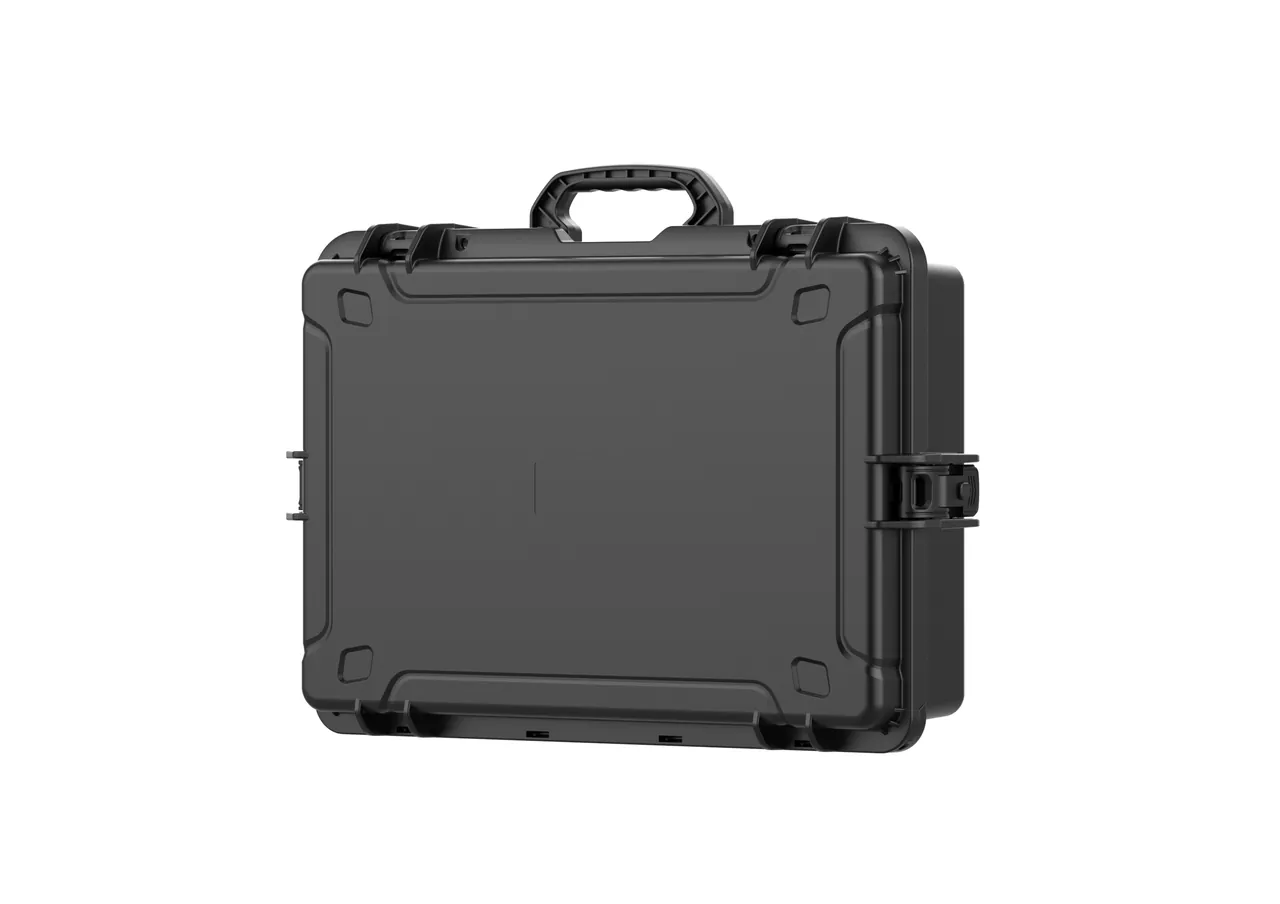
On maintenance, lubrication of hinges and latches, cleaning and replacement of gaskets, and routine case washing all materially extend service life. See how to clean a protective case and protective case service life and replacement criteria.
14. Temperature and Climate Adaptation
Temperature affects garments through three pathways.
Pathway one: direct material effects. Heat accelerates leather ageing, coating yellowing and elastane fatigue; cold embrittles some synthetic coatings so they crack when folded. For case design in extreme-temperature scenarios, see extreme temperature protective cases.
Pathway two: condensation. This is the more destructive pathway. When a case moves quickly from a cold environment - a winter container, a cold store, an aircraft belly hold - into warm humid air, water vapour inside the case condenses on garment surfaces and internal walls, creating localised high humidity and even liquid water. This is the leading cause of mould in ocean and cross-climate air shipments.
Pathway three: cycling fatigue. Repeated day-night temperature swings subject the gasket to repeated compression and recovery, accelerating ageing.
Three countermeasures apply. First, raise the ingress rating and fit a pressure equalisation valve so internal and external pressure equalise slowly and breathing intake is reduced. Second, apply a thermal buffer - phase-change material (PCM) or an insulating liner - to slow the rate of temperature change. Third, in handling procedures, avoid opening a case immediately after extreme temperature transitions; allow 30 to 60 minutes in a transition zone first.
For more on cross-climate and cold-chain practice, see cold-chain food transport case temperature control design; the sections on phase-change materials and temperature loggers apply equally to garment cases.
15. Cleaning, Maintenance and Service Life
The hygiene level of a garment case directly affects the fabric inside. Dust, fibre debris or mould accumulating in the case will contaminate the next load. Cleaning is therefore not optional; it is part of the operating procedure.
Daily cleaning. Wipe internal walls and inserts with a mild detergent and a soft cloth. Avoid strong solvents, which can damage flocked facing and gaskets. Empty the desiccant bay at every turnaround and check for caking.
Deep maintenance. Every 6 to 12 months, or every 50 to 100 turnarounds, check gasket compression set, hinge clearance, latch engagement and insert stitching. A slightly hardened gasket can be extended with silicone oil treatment; a cracked one must be replaced.
Service-life judgement. Case life is measured in structural integrity, not calendar years. Scrapping criteria normally include through-wall cracks, broken ribs, cracked hinge mounts, gasket-groove deformation that prevents the original IP rating being met, and insert collapse that defeats restraint.
| Component | Inspection interval | Replace or scrap criteria |
|---|---|---|
| --- | --- | --- |
| Gasket | Every 20 turnarounds | Hardening, cracking, compression set beyond limit |
| Hinge | Every 50 turnarounds | Visible axial play, captive pin failure |
| Latch | Every 50 turnarounds | Reduced holding force, will not stay closed |
| Insert | Every 30 turnarounds | Collapse, delamination, restraint failure |
| Shell body | Every 100 turnarounds | Through cracks, broken ribs, deformed gasket groove |
Kexin New Materials supplies replaceable gaskets and insert modules, separating consumable items from structural items and pushing whole-case replacement much further out. It is also why we recommend writing spare-part availability into the supply contract at the purchase stage.
16. Custom Development, Acceptance and Cost Structure
A six-step process is recommended for garment transport case development.
- Requirement clarification. Garment list (longest piece, heaviest piece), chain description (distance, mode, handling conditions), climate, target load factor, identification and traceability needs.
- Solution design. Size series, insert form, ingress rating, latches and accessories, colour and marking scheme.
- Prototyping and verification. Insert prototyping should precede shell tooling; use real garments to verify restraint and anti-crease performance.
- Testing. Run stacking, vibration, drop and rain or immersion tests against the profile defined by GB/T 4857, ISTA or ASTM D4169, and where necessary reference MIL-STD-810H methods for temperature, humidity and mould testing (not a military certification).
- Pilot production and field trial. Run two to four weeks in one or two stores or warehouses and collect handling efficiency and damage-rate data.
- Mass production and acceptance. Apply an AQL sampling plan to appearance, dimensions, sealing, hardware function and marking.
On implementation, JUNZHJIA can support a project from requirement clarification through insert prototyping, gasket and hardware configuration to mass-production acceptance, and can prepare test-plan recommendations and a test document list so that a brand owner's internal acceptance standard and the supplier's delivery standard are aligned.
On cost structure, the total cost of ownership of a garment case should include at least the following:
| Cost item | Notes | Order of magnitude (empirical) |
|---|---|---|
| --- | --- | --- |
| Tooling and development | One-off, by size step and insert form | 5% to 15% (amortised by volume) |
| Case procurement | By quantity and configuration | 45% to 60% |
| Inserts and accessories | Hanging and drawer modules, straps, desiccant bay | 15% to 25% |
| Freight and return | Outbound plus empty return | 10% to 20% |
| Maintenance and spares | Gaskets, insert replacement | 5% to 10% |
| Cleaning and sanitising | Per industry hygiene requirements | 3% to 8% |
For tooling cost amortisation and typical mould cost ranges, see custom protective case mould cost analysis; for supplier assessment, see how to choose a protective case OEM factory.
Negotiation tip: do not compare unit prices alone. Ask suppliers for a three-year or five-year TCO amortisation that includes spare-part prices and replacement intervals, so that offers become genuinely comparable.
Frequently Asked Questions
Q: What actually separates a garment transport case from an ordinary logistics tote, and why can we not just use plastic totes?
A: The differences sit in three layers. First, structural stiffness. Ordinary totes are designed to hold contents and stack; walls are thin, there is no gasket and no insert frame, so stacking load passes straight into the garments. A garment case uses ribs, a tongue-and-groove lip and an insert frame to route load into structure, which greatly reduces pressure on fabric. Second, humidity control. Ordinary totes are open, so relative humidity follows ambient, and during rainy seasons or ocean transit readings above 70% RH are not unusual, which raises mould risk sharply. A garment case can achieve IP65 or better and, with a desiccant bay and humidity indication, hold internal RH at 45% to 55%. Third, insert matching. Ordinary totes have no carrier or restraint shaped for garments, so relative movement in transit produces snagging and hardware scuffing. If the cargo is high-value apparel or samples, an ordinary tote is simply the wrong tool, and the purchase cost saved up front usually returns as steaming rework, markdowns and complaints.
Q: We mostly sell domestically through e-commerce with short delivery chains. Do we really need transport cases?
A: It depends on two decision lines. The first is unit value. If average order value is high, return rates are high, and negative reviews frequently mention creases or odour, the payback period for protective investment is usually inside one quarter. The second is reuse count. If your chain is short and recoverable, such as central warehouse to regional warehouse to courier station, the cost per trip of a reusable case quickly falls below cartons. If instead you ship one-off from a single warehouse directly to scattered consumers, case recovery is impractical and the economics fail; a better answer there is an optimised carton plus an inner anti-crease element. The pragmatic middle path is tiered deployment: high-value styles, samples and store replenishment go in reusable transport cases, while low-value basics use optimised single-use packaging. We do not recommend a blanket rule, but we do recommend putting crease complaint rate and rework hours into the decision as measured indicators.
Q: Does a hanging insert reduce load factor, and how do you balance anti-crease against loading efficiency?
A: Yes, it does. A hanging solution typically achieves only 50% to 60% of the load factor of a layered solution, because the hem needs vertical space; that is physics, not design weakness. There are three ways to balance. First, hybrid inserts: hang suits, coats and evening wear, and put shirts, knitwear and T-shirts into lower drawer layers, combining both approaches in one case. Second, task-based allocation: use hanging-heavy cases for store launches and buyer order sessions, and high-load-factor layered cases for regional warehouse transfers. Third, optimise hanging density: use offset rails or double-level rails, with short pieces on the upper level and long pieces below, to raise the piece count per unit of rail length. In practice a hybrid solution usually reaches about 80% of the load factor of a purely layered solution while cutting crease rework to a low level, which makes it the best value compromise. The final decision should compare rework cost per garment times rework probability against the price difference per case, rather than resting on preference.
Q: What relative humidity should we target inside the case, and how much desiccant do we need?
A: The empirical comfort band for textile and leather goods is 45% to 55% RH. Below 40% RH, natural fibres become brittle, static is noticeable and leather may crack; above 65% RH sustained over time, mould spores can germinate. There is no universal desiccant formula because three variables drive it: net case volume and leakage rate, target transit days, and the external temperature and humidity profile. A usable starting point is 100 to 200 g of silica gel for 25 litres of net volume over a 30-day control target, then calibrate by measurement: place a temperature and humidity logger inside, run one real route, and check whether the RH curve stays inside the target band before adjusting the charge. Two cautions apply. Desiccant should sit in a separate compartment so dust cannot contaminate fabric; and saturated desiccant stops working or even releases moisture back, so it must be replaced or regenerated on schedule. For cross-climate ocean routes or rainy-season long hauls, add humidity indicator cards so the receiving party can judge visually.
Q: Should we choose IP65 or IP67, and is a higher ingress rating always better?
A: No, higher is not automatically better. IP65 means dust-tight and resistant to low-pressure water jets from all directions; IP67 means protected against short-duration immersion under defined conditions, typically 1 m for 30 minutes. For indoor warehousing, covered docks, retail turnaround and ordinary road transport, IP65 is entirely sufficient. IP67 adds real value only for long ocean routes, open-air storage, flood-season transfer and immersion in cold-chain defrost water. Raising the ingress rating has costs: higher case price, greater opening and closing effort, more frequent gasket replacement, and a more pronounced breathing effect across temperature differentials, which can make cases hard to open or fatigue the gasket. We have seen projects choose IP67 purely for the specification sheet, only to have store staff abandon the cases because they were hard to open, so effective protection actually fell. The sound approach is to rate to the harshest genuine scenario and pair it with a pressure equalisation valve to manage breathing. Always require a test report citing IEC 60529 or GB/T 4208, and verify that the reported sample matches the production version.
Q: Which metrics matter most for a sample case?
A: Four priorities. First, individual slots and traceability: each sample needs its own slot and label position, ideally with the ability to extract a specified piece without removing others. Second, anti-crease performance: samples appear on models, in photography and on the review floor, so prefer hanging with soft support at cuffs and hems. Third, hardware durability: a sample case may be opened more than ten times a day, so hinge and latch fatigue life matters more than the shell itself; full-width metal hinges and two-action draw latches are recommended. Fourth, portability: sample cases travel with designers and buyers, so weight, casters and handles directly affect willingness to use them; swivel casters and a telescopic handle are usually standard. We also recommend a seal point for cross-party handover. At Kexin New Materials, sample case projects normally start by prototyping the insert against real garment forms and test-hanging them, and only fix shell dimensions after confirming no pressure marks, which avoids the classic rework of a finished case that will not hang the samples.
Q: When is a reusable case more economical than a single-use carton?
A: The core variables are reuse count and return-loop efficiency. In practice, on fixed closed loops with a recovery mechanism - central warehouse to store, factory to brand warehouse, buying office to order session - a reusable case typically falls below single-use cartons in cost per trip after 8 to 15 cycles, and the advantage widens as cycles accumulate. If the chain is one-off direct-to-consumer, recovery is essentially impossible, the economics do not hold, and effort should shift to optimising carton structure. The decision formula can be simplified to: case purchase price divided by expected cycles, plus return freight and cleaning cost per cycle, compared against carton cost per trip. Carton hidden costs are also easy to miss - re-packing labour, waste-disposal fees, whole-batch write-off from rain damage, and brand loss from a poor unboxing experience. These often never appear in the carton cost sheet but are eliminated by a case programme. When building an TCO comparison, always put both cost families in the same table.
Q: How do we prevent mould on garments during cross-climate ocean shipments?
A: Ocean mould results from high humidity plus temperature differential plus long duration, especially on routes leaving a temperate port, crossing tropical waters and opening in a hot humid discharge port. Prevention has four parts. First, pre-load control: goods must be thoroughly dry, because fabric above the moisture regain limit is a continuous internal moisture source, and any cargo that has previously been damp must be segregated and treated. Second, internal humidity control: use an IP67-class sealed case with a desiccant bay, and place an independent moisture-absorbing layer in the insert so desiccant never contacts fabric directly. Third, thermal buffering: fit a temperature logger and phase-change material liner to slow the rate of temperature change and reduce condensation, and avoid opening a case immediately after it moves from hot to cold conditions. Fourth, verifiability: fit a temperature and humidity logger and internal humidity indicator cards so that the humidity history of the whole chain is traceable, which supports both early warning and liability attribution. For standards, reference the damp-heat test methods in the GB/T 4857 series and draw on MIL-STD-810H mould test methodology, which is cited here as an environmental test method rather than a military certification.
Q: What steps does a custom garment case project go through from kick-off to mass production?
A: Typically six. The first is requirement clarification: garment list including longest and heaviest pieces, transport chain covering distance, mode and handling conditions, climate, target load factor, and identification and traceability needs. The second is solution design: size series, insert form, ingress rating, latches and accessories, colour and marking. The third is prototyping and verification, where insert prototyping should precede shell tooling so that real garments can validate restraint and anti-crease performance and most design problems surface early. The fourth is testing against the profile defined by GB/T 4857, ISTA or ASTM D4169 for stacking, vibration, drop and water resistance, with MIL-STD-810H methods referenced where temperature, humidity or mould testing is needed. The fifth is pilot production and a field trial in one or two stores or warehouses for two to four weeks, collecting handling efficiency and damage-rate data. The sixth is mass production and acceptance, applying an AQL sampling plan to appearance, dimensions, sealing, hardware function and marking. Tooling and development cost is a one-off investment whose amortisation depends on volume, so expected total quantity should be stated at quotation stage to let the supplier judge whether a new mould is justified.
Conclusion and Further Reading
The value of a fashion and garment transport case ultimately shows up in three tables: the crease rework hours table, the store replenishment efficiency table, and the cross-climate damage-rate table. As long as the specification is defined along the three axes of garment type, logistics chain and climate, protective capability can be measured, accepted and continuously improved. If instead the case is treated as "a container that holds things", no specification sheet will prevent the site from abandoning it because it is hard to open and loads poorly.
Three practical recommendations for procurement and engineering colleagues:
- Define the insert first, then the shell. The insert determines anti-crease and restraint performance, so shell dimensions should follow the insert and the garment forms, never the reverse.
- Prove the loop with one or two size steps, then expand the series. Extending a size series has high marginal cost; validating load factor and handling efficiency with a small series first is safer.
- Write testing and acceptance into the contract. Reference the GB/T 4857, ISTA or ASTM D4169 test profile and an acceptance sampling plan explicitly, turning protective capability from an adjective into a clause.
Kexin New Materials (Guangdong) Co., Ltd., under the JUNZHJIA brand, provides custom development, insert prototyping, gasket and hardware configuration, OEM/ODM manufacturing and volume supply of garment and sample transport cases, together with selection support, test-plan advice and batch acceptance assistance for brand owners, OEM factories and third-party logistics providers.
Related Reading