


The value of fencing equipment concentrates in a few critical parts: the blade (foil, epee, sabre), the mask with its metal mesh and bib, and the electric body cord that links the fencer to the scoring machine. What actually decides whether the gear reaches the piste ready to compete is rarely the look of the case, but the point-to-point support accuracy of the interior foam and the vibration isolation during transit. A foil or epee blade is made of high-carbon spring steel: very stiff, yet vulnerable to lateral bending and vibration fatigue. A mask that is crushed or whose mesh is deformed will be rejected by the referee on sight. A body cord kinked repeatedly will break internal strands and drop the connection mid-bout, costing points. Therefore the core job of a fencing case is to lock every item into its own cavity with a custom insert, and to resist rain-shelter dust, cargo-hold moisture and condensation with a seal built to IEC 60529 / GB/T 4208. JUNZHJIA can deliver OEM/ODM solutions with model-specific cut foam for this category, and the following sections walk from damage sources through support structure, material choice and procurement acceptance.
The most common mistake made by fencers and club buyers is to equate "it fits" with "it is protected". A soft bag is acceptable for short hand-carried trips with no checking, but the moment gear enters a tournament bus luggage bay, a gap on a high-speed train or airline checked baggage, stacking, drops and resonance amplify the risk. This article targets equipment managers, club purchasers and event logistics, and focuses on quantifiable selection parameters, citable protection standards and actionable packing steps, so you can build a compliant and durable fencing transport system.
Table of Contents
- Sources of Transport Damage to Fencing Gear
- Blade Vibration Isolation and Rigid Support
- Mask Load Bearing and Deformation Prevention
- Body Cord Kink Prevention and Tangle Control
- Separate Storage for Clothing and Gloves
- Insert Selection: EVA versus Sponge
- Dust and Water Sealing with IP Ratings
- Environmental Test Basis: MIL-STD-810H and ISTA
- Pressure Equalization Valve and Altitude Transit
- Hinges, Latches and Case Structure
- Wheels, Trolley Handle and Venue Mobility
- Custom Inserts and OEM/ODM Service
- Cleaning, Maintenance and Service Life
- Common Selection Mistakes
- Procurement and Acceptance Checklist
Sources of Transport Damage to Fencing Gear
Transport damage to fencing gear falls into four categories: bending fatigue, crush deformation, tangle abrasion, and environmental corrosion. Bending fatigue attacks the blade and the body cord, both of which hate repeated small-radius bends. Crush deformation happens to masks and plastrons under stacked loads. Tangle abrasion affects cords and clothing from free movement inside the case. Environmental corrosion is the combined effect of dust, water, salt spray and condensation, which over time rusts metal parts and makes foam sticky. Understanding these four sources lets you translate protection into concrete structure.
From a mechanics standpoint, the blade's bending stiffness is high, but vibration fatigue is the hidden killer. Random vibration from a vehicle on a rough road, if the blade is not rigidly supported inside, makes the blade "bounce" in its channel, and every bounce induces alternating stress at the root where the blade meets the grip. The standard approach is to secure the blade along nearly its full length in a contoured channel, leave only micro-movement at the tip, and fix the grip with a limit block. For vibration and drop verification methods, see the ISTA transport testing procedure.
Environmental corrosion is often underestimated. Many events take place under outdoor shelters or in humid venues; gear moved from an air-conditioned room to a hot, humid environment causes condensation inside the case. If the seal is inadequate, rain and dust enter directly. Here the ingress rating and the weather resistance of the foam matter, and later sections combine IP rating with material selection.
Blade Vibration Isolation and Rigid Support
The first principle of blade support is "full-length contact, local constraint". Foil, epee and sabre differ in length and center of mass, so the foam channel should be cut per weapon rather than sharing one wide slot. Ideally the blade mid-section rests on a contoured EVA or PE support, the root and the guard have hard limit blocks preventing axial shift, and the tip points to a wall cushion to avoid impact.
In material terms, the support face should use medium-density EVA or cross-linked PE foam at 35–55 Shore C: enough support without scratching the blade coating. A hard plastic channel will abrade the blade paint under vibration; ordinary soft sponge cannot provide rigid support. For buffer coefficients and use cases of different foams, compare the case foam material comparison.
For clubs carrying several blades, a drawer-style partitioned layout with a removable divider system is recommended so empty bays can be filled and remaining blades cannot collide. JUNZHJIA can produce one-to-one inserts by CNC routing or die-cutting from the weapon list and dimension drawings you provide, a precision a generic soft bag cannot match.
Mask Load Bearing and Deformation Prevention
A mask consists of a metal mesh, an insulating shell and a neck bib; the mesh is most afraid of local point pressure. Once the mesh shows a dent or a weld crack, it is considered failed. A soft bag cannot resist the concentrated load of baggage stacked above, so the mask must sit in a "load-isolated zone" with rigid liner panels above and below, spreading the closing force into a surface load.
The recommended structure: the mask occupies its own bay, framed by high-density EVA on all sides, with only the neck bib folded away; a 3–5 mm PP or ABS thin plate covers the bay to distribute the lid closing force evenly to the frame instead of onto the mesh. When several items stack, place the mask bay near the geometric center, away from the high-pressure zone near the latches.
The metal mesh also needs protection from salt spray and sweat corrosion. Wiping dry after bouts and placing desiccant inside are basic steps; the case's own corrosion resistance and sealing can be reviewed in the IP67 protective case structure note. Note that a mask is personal protective equipment, and any visible deformation should be retired per event rules; the case only works to prevent it, not to replace regular inspection.
Body Cord Kink Prevention and Tangle Control
The body cord is the most delicate component. It is built from multiple fine copper strands inside a jacket, with a plug at one end and the fencer's body wiring at the other. Repeated bends below a 5 cm radius fatigue the internal copper and cause intermittent signal loss in a bout. The core of cord storage is large-radius coiling plus independent fixation; never cinch it tight into a small loop with a rubber band.
Recommended practice: give the body cord its own channel or box, coil at a diameter of at least 15 cm, and fix both plugs with hook-and-loop or clips; separate multiple cords with dividers to avoid tangling. If space is tight, coil the cord and place it in a separate foam cavity of a cushion liner case, physically isolated from the blade and mask, preventing both kinks and crushed plugs.
From a materials perspective, the bend life of the cord jacket relates directly to bend radius. A useful rule of thumb is that doubling the coil radius improves fatigue life several-fold (typical experience value, not formal test data). So the insert should reserve a sufficiently large cord channel rather than sacrifice cord life for space. For club-volume procurement, the general method of planning cavities by equipment list is in the custom foam inserts guide.
Separate Storage for Clothing and Gloves
Fencing clothing (jacket, breeches, mask bib), gloves and plastron are bulky but not pressure-sensitive, so they fit in edge zones or independent soft compartments. The key is separation and ventilation: damp clothing mixed with metal gear without airflow accelerates rust on mask and blade. Put clothing in a breathable mesh bag, then into a reserved soft bay, separated from hard gear by a layer of EVA.
The glove has a rigid protection plate on the palm, should not be folded, and should lie flat or slightly rolled in a shaped foam cavity. The plastron is a single Kevlar/polyester layer, afraid of puncture by sharp objects, so it should be sandwiched between two soft foam layers. For clubs with multiple kits, a removable divider system can further subdivide the clothing bay by member number or size for quick pre-bout access.
One warning: the clothing bay must not encroach on the rigid support space of hard gear. Many low-cost cases give most volume to clothing, leaving blade and mask to be "stuffed in", which is putting the cart before the horse. Correct volume allocation gives hard gear precise support first, with clothing as filler and buffer consuming the remaining space.
Insert Selection: EVA versus Sponge
Common fencing-case foams are EVA (ethylene-vinyl acetate), PU sponge, cross-linked PE foam and EPP. They trade off differently:
| Material | Hardness / Support | Resilience | Weathering | Cut Precision | Typical Use |
|---|---|---|---|---|---|
| --- | --- | --- | --- | --- | --- |
| Medium EVA | Medium | Medium | Good | High (CNC/die) | Blade support, mask frame |
| PU sponge | Low | High | Fair | Medium | Clothing buffer, fill |
| Cross-linked PE | Med-High | Low | Excellent | High | Limit blocks, durable support |
| EPP | Medium | High | Excellent | Medium | Impact layer |
In short, use EVA or cross-linked PE where precise support is needed (blade, mask frame), and PU sponge or EPP where shock absorption is needed (fill layers). For finer density, compression set and temperature range, compare the parameter table in case foam material comparison against your actual load. JUNZHJIA can combine soft and hard dual-layer inserts by equipment characteristic, avoiding the one-material-fits-all trap.
Dust and Water Sealing with IP Ratings
Sealing is the hard metric against dust and water. The international rating is defined by IEC 60529, with the Chinese equivalent GB/T 4208. Take IP65 and IP67: IP65 means full dust protection plus resistance to low-pressure water jets; IP67 means full dust protection plus immersion to 1 m for 30 minutes without ingress. For a fencing case, IP65 already handles shelter dripping and cargo dust, while IP67 is advised for frequent wading transit or sea freight.
Sealing is achieved by an elastic gasket around the lid and the compression structure of the case. The gasket material, cross-section and compression set directly decide seal life. For gasket material and replacement, see case seal materials; for the whole-case waterproof structure, see waterproof case IP. Note that the rating is measured with the lid correctly closed and latches compressed; an unlatched lid destroys the seal.
A common confusion: IP rating covers dust and water only, not shock and vibration. The vibration isolation a blade needs comes from foam, not IP. A qualified protection plan is always the combination of seal plus insert plus structure; looking at one metric alone is biased.
Environmental Test Basis: MIL-STD-810H and ISTA
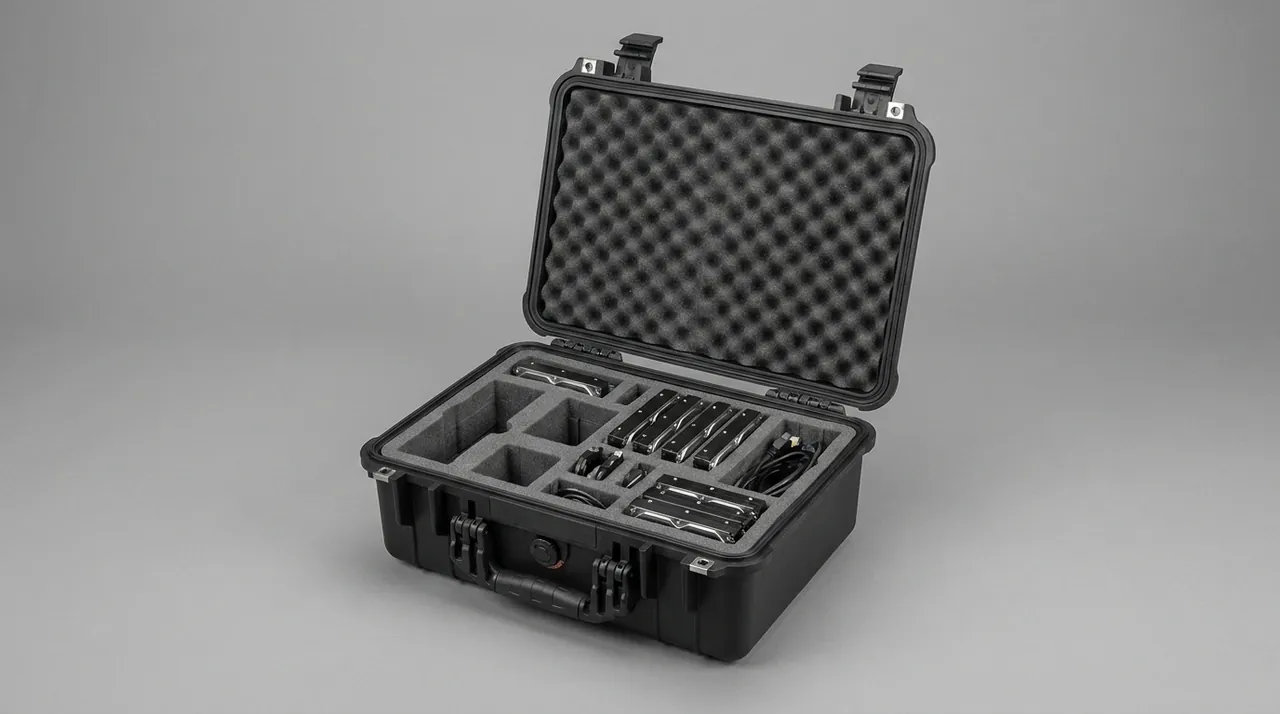
To prove to buyers that a case survives real transit, the industry uses two families: MIL-STD-810H and ISTA. MIL-STD-810H is a US Department of Defense environmental engineering test method covering vibration, drop, temperature shock, humidity and low pressure; ISTA (International Safe Transit Association) focuses on distribution, e.g. ISTA 3A for small parcels, 3B for unitized loads.
It must be clear: MIL-STD-810H is used in the protective-case field only as an environmental test basis for the product line, to verify reliability under vibration, temperature, humidity and low pressure; it is not a "military certification", and the product does not claim military qualification. JUNZHJIA can cite such environmental test methods in R&D and outgoing inspection, and can provide corresponding test or inspection documents in the commercial phase to help B2B customers pass supplier audits.
For fencing cases, the most relevant test items are vibration (random/sine) and drop. Review the method boundaries in MIL-STD-810H case compliance, and design a "fully loaded case" simulated transit test referencing the ISTA transport testing procedure, which is closer to real risk than an empty-case test.
Pressure Equalization Valve and Altitude Transit
Aircraft holds, high-altitude buses or mountain venues create pressure differences inside and outside the case. A sealed case may bulge or strain its latches at low pressure; descending from altitude can "suck" the lid tighter, making it hard to open. The solution is a pressure equalization valve (breathing valve): it lets air move slowly to balance pressure while an internal membrane blocks liquid water.
The pressure valve is a common standard feature of IP67 cases. For its structure and selection, see case pressure equalization valve. For fencing cases that fly checked or attend plateau events across provinces, make the valve a must-have; for city-only short trips, a valve-less seal saves cost.
Emphasize that the valve's waterproofing relies on the internal ePTFE membrane, which fears oil and sand clogging. Cleaning debris around the valve on the lid after events is basic maintenance, covered later in cleaning.
Hinges, Latches and Case Structure
Case open-close life and the risk of "accidental opening" in transit depend mainly on hinges and latches. Poor cases let latches loosen under drop impact, scattering the gear. Choose integrated hinges and latch structures that accept padlocks; this is the baseline of transport safety. For the combined design of hinge, latch and seal, see toolbox hinge latch seal (use this correct slug to avoid a dead link on the site).
Fencing cases commonly use two shell materials: injection PP (polypropylene) and engineering ABS alloy. PP is tough, impact resistant and less brittle at low temperature, suited to frequent checking; ABS is rigid, surface-hard and lighter, but slightly more brittle when cold. Wall thickness and rib layout decide dent resistance. For clubs that check often, prefer PP shell plus hard-foam support; for players who mostly hand-carry at venues, ABS is lighter.
Latches should also consider "no accidental opening in transit". Latches with a safety lock hole, personal padlock or TSA customs lock are easier for cross-border event checking. For lock customization and compliance options, see case lock customization options.
Wheels, Trolley Handle and Venue Mobility
Fencing gear is heavy: several blades plus multiple masks plus clothing. A case with wheels and a retractable trolley handle markedly reduces venue-movement fatigue. But wheels and handles must survive checking impacts, or "easy to move" becomes "wheel falls off en route". For wheel and handle selection, see case wheels and trolley handle.
When selecting, prefer dual-row large-diameter PU wheels for smoother threshold and carpet transit; the trolley should be aluminum inner tube with outer-tube lock to avoid wobble. If the load is heavy (10+ blades plus several masks), put the heavy gear in the bay near the wheels so the center of gravity sits close to the axle for stable towing.
For provincial teams or clubs shuttling between venues frequently, the lightweight and ergonomic design in portable transport box is worth comparing.
Custom Inserts and OEM/ODM Service
Fencing gear dimensions vary widely by weapon, brand and year, so generic cavities rarely fit point-to-point. Truly high-protection fencing cases almost always go custom: the customer provides an equipment list and key dimensions (blade length, guard diameter, mask outline, cord length), and the maker routes the foam and confirms a prototype. This is exactly JUNZHJIA's strength — from a single sample to volume OEM/ODM, with model-specific seals, model-specific foam, and provided inspection documents.
Customization's value is not only "fit" but fixing the optimal layout of many item types in a limited volume. For example, three weapons side by side, mask centered, body cord coiled in a side bay, clothing filling corners — the whole-case center of gravity and access order are determined at design stage. For customization cost and tooling logic, see custom case mold cost analysis; for selecting a reliable factory, see how to choose a case OEM factory. In low-volume prototyping, EVA foam insert custom process offers a fast iteration cycle.
Cleaning, Maintenance and Service Life
A protective case is not "buy and use, replace when broken". Regular maintenance extends life significantly: after events, wipe debris from the lid seal groove and around the pressure valve; dry sweat off mask and blade before storing; place and periodically replace desiccant; before long storage, remove the foam to air out and avoid sticky foam. Specific steps are in how to clean a protective case.
For service life, PP/ABS shells at normal temperature and routine use can last several years; the gasket is usually the wear part and should be replaced when it hardens, cracks or takes a permanent flat. For an experience range of overall service life, see protective case service life years. Buyers should also learn to distinguish good from bad to avoid substandard products; see identify genuine vs fake case.
Common Selection Mistakes
Mistake one: "the harder the case the more protection". Hardness only solves crushing, not vibration; a hard case without foam lets gear slam against hard walls even harder. The correct approach is hard shell plus soft-hard combined foam.
Mistake two: "a soft bag is enough". It may suffice for short hand-carry, but any checking, bus bay or shared transport leaves mask and blade at high risk without rigid support and crush isolation.
Mistake three: "coil the body cord any way". Small-radius cinching is a cord killer; large-radius coiling with independent fixation is mandatory.
Mistake four: "only look at IP rating". IP covers dust and water only; vibration and drop depend on foam and structure, see the combined thinking in seal shock case.
Mistake five: "stuff several blades in one slot". Blades rubbing each other scratch paint and roots; one slot per blade.
Procurement and Acceptance Checklist
A procurement checklist for clubs and event logistics: first, list all gear with key dimensions as the custom basis; second, define transit scenarios (hand-carry/check/air) to set IP rating and whether a pressure valve is needed; third, require the maker to provide a foam prototype and a fully loaded simulated transit test (ISTA thinking is fine); fourth, confirm replaceability of wear parts like latches, wheels and valve; fifth, check the sampling standard in custom case acceptance AQL to avoid batch quality swings.
At acceptance, do three practical checks: close the empty case, invert and shake gently to hear rattles (judge if foam is loose); after loading, do a short drop (about 0.5–1 m corner drop, experience value) to observe latches and foam; after rain or water spray, open and check the interior is dry. Only when all three pass should the case enter event transport.
Frequently Asked Questions
Q: Must a fencing case be waterproof, and how to choose between IP65 and IP67? A: Whether waterproofing is mandatory depends on your transit environment. If gear is only hand-carried indoors between venues on short trips, with no rain or checked-baggage dust, then basic dust resistance and simple splash protection may suffice, and a formal IP rating is not strictly necessary. But fencing events often happen under outdoor shelters or in humid sports halls, and bus bays, train gaps and airline checked baggage are full of dust and accidental water ingress, so at least IP65 (full dust protection, low-pressure water jet resistance) is advised. If you involve sea freight, wading transit or long-term storage in high-humidity regions, IP67 (immersion to 1 m for 30 minutes without ingress) is recommended. Remember the IP rating is valid only with the lid correctly closed and latches compressed; an open latch destroys the seal. The seal relies on the elastic gasket around the lid and the compression structure, so review both the seal material and the waterproof design notes together to hit the rating stably.
Q: Can different weapons (foil, epee, sabre) share one foam slot? A: It is not recommended to share one wide slot. The three blades differ in stiffness, center of mass and guard size, so a shared slot means none is precisely supported, and in transit vibration they collide and rub inside the slot, lightly scratching paint or, worse, accumulating alternating stress at the root leading to hidden fatigue. The correct approach is to route per weapon, one slot per blade: the mid-section rests on a contoured support, the root and guard have hard limit blocks preventing axial shift, and the tip faces a cushion. Clubs with many blades can use a drawer-style partitioned layout with removable dividers to fill empty bays and stop remaining blades from colliding. JUNZHJIA can produce one-to-one inserts by CNC routing or die-cutting from the weapon list and dimension drawings you provide, a precision a generic soft bag cannot match.
Q: How should the body cord be stored so it does not break? A: The body cord's enemy is repeated small-radius bending. It is built from multiple fine copper strands in a jacket, and once those strands fatigue, the symptom is intermittent signal loss mid-bout. Correct storage is large-radius coiling with independent fixation: coil at a diameter of at least 15 cm, fix both plugs with hook-and-loop or clips, and separate multiple cords with dividers; or coil and place in a separate foam cavity of a cushion liner case, physically isolated from blade and mask, preventing both kinks and crushed plugs. A useful rule of thumb is that doubling the coil radius improves fatigue life several-fold (not formal test data). The insert should reserve a sufficiently large cord channel rather than sacrifice cord life for space. After events, wipe the metal plug faces to prevent sweat corrosion and poor contact.
Q: Why does a mask still get crushed inside a case? A: Most "crushed" cases come from two points: the shell itself lacks compression resistance, or the mask bay has no load isolation. The mask mesh fears local point pressure, and a soft bag cannot resist the concentrated load of baggage stacked above. The correct structure gives the mask its own bay, framed by high-density EVA on all sides with only the neck bib folded away, and a 3–5 mm PP or ABS plate above the bay distributes the lid closing force evenly to the frame instead of onto the mesh. When several items stack, place the mask bay near the geometric center, away from the high-pressure zone near latches. Also, a mask is personal protective equipment, and any visible deformation should be retired per event rules; the case only works to prevent it, not to replace regular inspection.
Q: What transit tests should a fencing case pass to prove reliability? A: The two most used bases are MIL-STD-810H and ISTA. MIL-STD-810H is a US DoD environmental engineering test method covering vibration, drop, temperature shock, humidity and low pressure, used to verify reliability under harsh conditions; ISTA focuses on distribution, e.g. 3A and 3B for different transit forms. It must be clear that MIL-STD-810H in the protective-case field is only an environmental test basis for the product line, not a military certification, and the product does not claim military qualification. For fencing cases the most valuable items are vibration and drop: do a fully loaded random vibration and corner drop, which is closer to real risk than an empty-case test. JUNZHJIA can cite such methods in R&D and outgoing inspection and provide corresponding test or inspection documents in the commercial phase to help customers pass supplier audits.
Q: Should the shell be PP or ABS? A: PP (polypropylene) is tough, impact resistant and less brittle at low temperature, suited to clubs that check frequently and meet drops and temperature swings; ABS is rigid, surface-hard and lighter, but slightly more brittle when cold, better for individual players who mostly hand-carry at venues and rarely check. Beyond material, wall thickness and rib layout decide dent resistance, so do not judge merely by the nominal material. If you check by air or transit across provinces often, prefer PP shell plus hard-foam support; for city-only short trips, ABS can save weight. Either way, the interior must have precisely supported foam, or the hard shell makes gear slam harder against hard walls, equally important as material choice.
Q: Will the case bulge or refuse to open because of pressure difference when flying checked? A: A sealed case at low pressure (aircraft hold, high altitude) can indeed bulge and strain latches, or "suck" the lid tighter and make it hard to open when descending. The solution is a pressure equalization valve (breathing valve): it lets air move slowly to balance pressure while an internal membrane blocks liquid water, a common feature of IP67 cases. If you fly checked or attend plateau events often, make the valve a must-have; for city-only short trips a valve-less seal saves cost. Note the valve's waterproofing relies on the internal ePTFE membrane, which fears oil and sand clogging, so cleaning debris around the valve on the lid after events is basic maintenance.
Q: What information should I give the maker for a custom insert? A: For a high-fit custom insert, the maker needs a "gear list plus key dimensions plus special requirements" package. The gear list includes weapon classes and counts, mask outline dimensions, body cord length and plug type, clothing and protector volumes; key dimensions are best annotated on a sketch or photo with length, width, height and irregular contours; special requirements such as "mask must be centered with load isolation", "independent large-radius cord channel", "partition by member number". JUNZHJIA can route by list and confirm a prototype, from low-volume samples to volume OEM/ODM, with model-specific seals and provided inspection documents. In low-volume prototyping, the EVA foam insert custom process allows fast iteration, and confirming before volume production is safer.
Q: How long does a protective case last, and which parts fail first? A: PP or ABS shells at normal temperature and routine use typically last several years; the first part to age is usually the gasket, which under long compression, sunlight and temperature swings hardens, cracks or takes a permanent flat and should be replaced when it loses sealing. The EVA insert also slowly accumulates compression set under frequent handling and heavy pressure, but generally much slower than the gasket. For an experience range of overall service life, see the protective case service life years note; actual life also depends on checking frequency and environment. To extend life: wipe the seal groove and valve debris after events, dry sweat off mask and blade before storing, place and replace desiccant, and remove the foam to air out before long storage. At procurement, confirm wear parts are replaceable individually to avoid scrapping the whole case for a small failure.
Conclusion and Related Reading
The essence of a fencing equipment case is to minimize the transit risk of blade, mask and body cord through "precise insert plus reliable seal plus rational structure". For clubs and event logistics, rather than repeatedly replenishing gear after damage, it is better to make support precision, IP rating, pressure valve and custom insert hard indicators at the procurement stage. JUNZHJIA can provide a full-chain solution from prototyping to volume OEM/ODM by equipment list, with inspection and acceptance documents, helping B2B customers land the project steadily.
Related Reading