

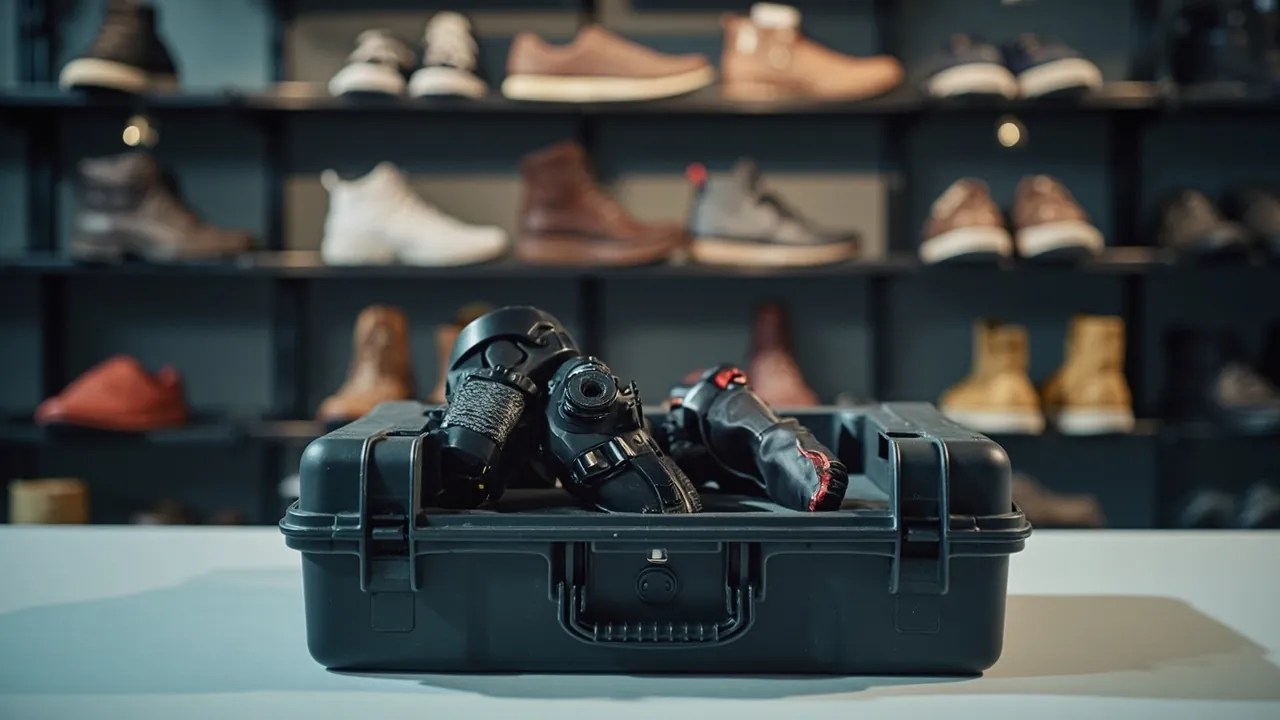
Footwear samples are the most delicate cargo in the shoe business: low in count, high in unit value, constantly in motion, and required to appear in front of a customer in saleable condition. If a sample shoe arrives with a collapsed toe box, a transverse crease across the vamp, adhesive colour migration between midsole and upper, a yellowed white outsole, or mould spots from moisture, it stops being persuasive the moment the order session begins. The core job of a footwear sample case is therefore not "it fits" but ensuring that every sample leaves the case with the same last shape, colour and cleanliness it had when it went in - which requires a case combining crush rigidity, controllable humidity and a last-shaped insert built around size and shoe type.
Compared with garment cases, footwear sample cases carry three distinctive constraints. First, a shoe is a three-dimensional formed body, not a flexible item: it does not fear folding, it fears collapse - once load sits on top of the toe box, the upper will not spring back. Second, footwear materials are highly sensitive to humidity and temperature: PU midsoles hydrolyse and crumble under high humidity and heat, rubber outsoles yellow faster when hot, and leather uppers crack in dry air. Third, sample sets are usually displayed as singles from a pair - one shoe for display, one for try-on - so the insert must support split-pair control rather than simply one slot per pair.
This article follows the three threads of forming, moisture control and delivery, and provides materials, structures, ingress ratings, test references, insert design, load-factor arithmetic and acceptance methods, so that brand owners, trading companies, OEM factories and trade-show teams can turn "the sample still looks new when the customer opens the case" into a purchasable, acceptable specification.
Table of Contents
- 1. Why Footwear Samples Need Dedicated Transport Cases
- 2. Six Damage Classes in Footwear Sample Transport
- 3. Forming and Crush Resistance: From Last to Insert Structure
- 4. Humidity and Mould: RH Targets and Material Sensitivity
- 5. Yellowing and Blocking: Special Risks in Rubber, EVA and PU
- 6. Shell Materials and Structural Selection
- 7. Ingress Protection: Choosing Between IP65 and IP67
- 8. Environmental and Transport Test References
- 9. Insert Design: Forming Slots, Size Coding and Labelling
- 10. Trade-Show Transport: Booth Turnaround and On-Site Display
- 11. Order Samples and the Buyer Session Floor
- 12. Size Series and Load-Factor Optimisation
- 13. Gaskets, Hinges, Latches and Seals
- 14. Temperature and Cross-Climate Transport
- 15. Cleaning, Maintenance and Service Life
- 16. Custom Development, Acceptance and Cost Structure
- Frequently Asked Questions
- Conclusion and Further Reading
1. Why Footwear Samples Need Dedicated Transport Cases
Footwear sample logistics has long relied on the combination of original shoe box, carton and bubble wrap. That combination is just about workable for short-distance, low-volume, one-off movements, but it fails quickly during trade shows, buyer sessions and cross-region sample circulation, for three reasons.
First, a shoe box is not a protective structural element. Its design intent is display and brand presentation; its compression resistance comes from the interaction of internal support and outer wall, and once it is opened, dampened or handled repeatedly, the wall softens and collapses. Once the box collapses, stacking load transfers directly into the shoe, and the toe box and heel counter are the first parts to suffer.
Second, sample cases must be reused. A single sample pair may attend three to eight order sessions in a season and be tried on and photographed by 20 to 60 buyers. A carton is scrapped after one cycle, while the sample has to hold its condition across all cycles, which means every re-pack is another opportunity for damage.
Third, footwear samples carry very high information density. One order session may display 120 to 400 sample shoes across multiple lines, colourways and size steps. Without a fixed position-to-size-to-style mapping inside the case, finding a shoe becomes the task itself: repeated rummaging causes upper scuffing, lost accessories such as laces, insoles and charms, and materially longer set-up time.
The purchase criteria for a footwear sample case should therefore cover three tables: sample arrival condition pass rate, order-session set-up time, and total cost of ownership over the case lifecycle. A solution only stands up when all three improve together.
In real projects, Kexin New Materials normally defines the specification along three axes: shoe type, size step and transport chain. Shoe type - formal, athletic, boots, children's - determines forming-slot geometry, size step determines the cavity size gradient, and the chain determines shell strength, ingress rating and whether casters are needed.
2. Six Damage Classes in Footwear Sample Transport
The damage mechanisms for footwear samples differ from garments and need separate classification before insert and shell design can be targeted.
| Damage class | Typical appearance | Primary cause | Primary countermeasure |
|---|---|---|---|
| --- | --- | --- | --- |
| Toe box and heel collapse | Vamp creasing, sunken toe, distorted heel counter | Stacking load, point pressure, no forming support | Forming insert, toe cradle modules, stacking tier limits |
| Transverse vamp creasing | Instep fold line, cracked leather finish | Vertical compression, insert too soft, shoes pressing each other | Rigid compartments, single-shoe location, shoe trees |
| Midsole hydrolysis and crumbling | Soft midsole, powdering, poor rebound | Long exposure to heat and humidity (PU hydrolysis) | Humidity control, insulating liner, shorter heat exposure |
| Outsole yellowing and oxidation | White outsole turning yellow, clear parts clouding | UV, heat, oxygen and ozone | Light-blocking, temperature control, antioxidant barrier layers |
| Blocking and colour migration | Sole adhering to insert, dye transfer | Plasticiser migration, under-cured coatings, incompatible insert material | Barrier layers, plasticiser-free inserts, cure-cycle management |
| Mould and odour | White spotting, musty smell, oxidised metal trim | Elevated relative humidity, condensation, damp packaging | Sealing, desiccant bay, humidity indication, pre-load drying |
Among the six, midsole hydrolysis and blocking are the most invisible. PU hydrolysis is a time-dependent reaction that rarely appears on the day of receipt; instead, the sample softens and powders two to six weeks after put-away. Blocking is usually discovered when the customer opens the case and pulls the shoe out, by which time the sole surface is already marked and liability is hard to assign. For both classes, protection has to be moved upstream into material selection, insert contact surfaces and humidity control.
For how to build the overall transport test path, see basic transport package testing and test intensity design and selecting and running ISTA transport test procedures.
3. Forming and Crush Resistance: From Last to Insert Structure
The fundamental difference between a footwear sample case and a garment case is this: it protects shape, not surface. Once shape is lost, the shoe is no longer that shoe. Forming is therefore the first principle of insert design.
Four forming routes exist, each with its own boundaries.
Route one: last-replica support. Insert a support body scaled from the original last into the shoe cavity - moulded plastic, EVA block or inflatable support - so the upper gains internal vertical support and resists collapse. This route works best for formal leather shoes, loafers and boots and is the first line of shape defence.
Route two: shell cradle. The insert is cut to the external outline of the shoe, with the cavity floor carrying the sole and the cavity walls wrapping the sides, so that load passes through the walls rather than the upper. This suits athletic and thick-soled shoes, and cut accuracy is the making or breaking of it.
Route three: side-load and suspension. Shoes stand on their side or hang, so the toe and heel carry no vertical load. This suits tall boots and high-tops and greatly reduces toe pressure marks, but demands more careful centre-of-gravity and restraint design.
Route four: layered trays. Shoes lie flat on trays with rigid divider panels between levels, so stacking load passes into the panels. This gives the highest load factor and suits casual shoes and children's footwear.
| Route | Suitable shoe types | Pieces per case | Shape retention | Structural complexity |
|---|---|---|---|---|
| --- | --- | --- | --- | --- |
| Last-replica support | Formal shoes, loafers, boots | Medium | Very strong | Medium (needs last series) |
| Shell cradle | Athletic, thick-soled | Medium | Strong | High (accurate cutting) |
| Side-load / suspension | Tall boots, high-tops | Low | Strong (needs restraint) | High |
| Layered trays | Casual, children's | High | Medium | Medium |
In practice the most common answer is a combination: shell cradles in the lower body for classic styles and layered trays in the upper for casual styles, or a main compartment for paired samples with an accessory compartment in the lid for laces, insoles, charms and care kits. The success of a hybrid depends on centre of gravity and stacking tier: heavy shoes low, a clearly marked stacking direction, and a stated tier limit.
Note that forming capability and load factor are in direct conflict. Where a company needs both high shape retention and high load factor, the correct answer is two case types for two scenarios, not one case that half-satisfies both - the latter usually fails at both ends.
4. Humidity and Mould: RH Targets and Material Sensitivity
Footwear is a multi-material composite, and the tolerance for humidity varies widely between materials, so the control target must be set by the boundary of the most sensitive material.
| Material | Low-humidity risk (below 40% RH) | High-humidity risk (above 65% RH) | Recommended band |
|---|---|---|---|
| --- | --- | --- | --- |
| Natural leather | Cracking, loss of oils, hardening | Mould, salt bloom, colour loss | 45% to 55% RH |
| PU synthetic leather | Brittle coating, crazing | Faster hydrolysis, delamination | 40% to 55% RH |
| Textile uppers | Static, fibre embrittlement | Mould, odour | 45% to 55% RH |
| EVA midsole | Minimal | Minimal (heat still ages it) | 40% to 60% RH |
| PU midsole | Minimal | Hydrolysis, powdering, rebound loss | 40% to 50% RH, lower is better |
| Rubber outsole | Minimal | Minimal | 40% to 60% RH |
| Paper and wood shoe trees, packaging ancillaries | Deformation, embrittlement | Mould, softening (becomes a moisture source) | 45% to 55% RH |
The practical conclusion is that 45% to 52% RH is a safe band for almost all footwear samples. This sits slightly lower than the garment band because PU is acutely sensitive to hydrolysis, while the penalty of low humidity on PU is much smaller than the penalty of high humidity.
The implementation path resembles garment cases, but footwear projects have two peculiarities.
- Desiccant must not be placed inside the shoe cavity. If desiccant is pushed into the shoe or pressed against the upper, it can create a localised over-dry zone that strips oils from leather. The correct approach is a separate desiccant bay, with whole-case humidity control achieved through internal air circulation.
- Packaging ancillaries must be dried first. Shoe trees, paper inserts, tissue and leaflets all absorb moisture. If they are loaded damp, they become a continuous internal moisture source. This is a frequent cause of mould in footwear samples and is very often overlooked.
For how to judge IP ratings and water resistance, see IP ratings for waterproof protective cases explained and the technical boundaries of IP67 protective cases. For pressure equalisation on cross-climate routes, see the role and selection of pressure equalisation valves.
5. Yellowing and Blocking: Special Risks in Rubber, EVA and PU
Yellowing is the most common complaint on white and light-coloured outsole samples. Its causes stack: ultraviolet exposure, heat, oxygen and ozone, and depletion of antioxidants in the rubber compound. Four countermeasures apply.
- Light blocking. Use an opaque shell or dark insert so samples are not exposed to light during storage and transport.
- Temperature control. Avoid leaving cases on sun-exposed vehicle decks, docks or the top of containers; add an insulating liner where unavoidable.
- Oxygen exclusion. Wrap individual samples in a low-permeability inner layer such as aluminium foil laminate to reduce oxygen and ozone contact.
- Shorter exposure. Reducing the time samples spend in hot environments in the process flow is more effective than any packaging measure on its own.
Blocking is surface adhesion between sole and insert, or between sole and sole, caused essentially by plasticiser migration and incompletely cured coatings. Countermeasures include:
- Insert contact material must be chemically compatible with the shoe material. Plasticised flexible PVC against rubber or PU outsoles carries elevated risk; switch to EVA, PE or flocked plasticiser-free materials. For foam performance differences and compatibility, see protective case foam material comparison.
- Add a barrier layer between individual samples - acid-free tissue or PE film - so soles never touch directly.
- Give adhesive bonding enough cure time in the internal process, with the finished product resting fully before packing.
- Cap the internal temperature, because plasticiser migration accelerates with temperature.
| Risk | Trigger conditions | Consequence | Main countermeasure |
|---|---|---|---|
| --- | --- | --- | --- |
| Rubber outsole yellowing | Light plus heat plus ozone | Cosmetic downgrade, unsaleable | Opaque shell, temperature control, oxygen barrier |
| PU midsole hydrolysis | Heat plus humidity plus time | Softening, powdering, shortened life | Control to 40% to 50% RH, thermal insulation |
| Sole-to-insert blocking | Plasticiser migration plus heat | Marked soles, rework | Plasticiser-free insert, barrier layers, temperature control |
| Adhesive colour migration | Under-cured coating plus pressure | Dye transfer, cosmetic defect | Cure-cycle management, barrier layers, less pressure |
6. Shell Materials and Structural Selection
Shell material options match general protective cases: injection-grade polypropylene (PP), PP copolymer and high-density polyethylene (HDPE). The difference is that footwear sample cases prioritise stiffness, because their main enemy is collapse under stacking load rather than drop impact.
- PP homo- and copolymer. High stiffness, good dimensional stability and a smooth surface, well suited to precisely cut cradle inserts. Low-temperature toughness must be assessed, particularly for winter air freight and cold-store transfers.
- HDPE. Tough and low-temperature resistant, suited to drop and handling impact, but lower stiffness, so large shells need dense ribbing.
- Twin-wall and composite construction. For high-capacity display cases or where the case must integrate with a booth, balancing stiffness and weight.
Structurally, five details matter for footwear sample cases:
- Whether wall ribs run continuously along the stacking direction, avoiding "locally strong, globally soft";
- Whether the lid-to-body mating face has a tongue-and-groove lip, which raises torsional stiffness - important because sample cases are often used as display trays with the lid open;
- Whether insert mounting points have moulded-in metal inserts, so repeated assembly does not strip threads;
- Whether a quick-open structure is provided for the show floor, such as a front-opening or lift-off lid;
- Whether caster mounting points are reserved, since show sample cases are generally heavy and casters are the key to on-site efficiency.
For general selection logic, see general-purpose transport protective case selection guide.
On footwear sample projects, Kexin New Materials normally prototypes the insert against the customer's last series and validates cradle position and extraction motion with real sample shoes before fixing shell envelope and cut parameters. This avoids the classic rework where a finished case has a slot off by 2 mm and the upper ends up under load.
7. Ingress Protection: Choosing Between IP65 and IP67
IEC 60529 and the equivalent GB/T 4208 define enclosure ingress protection through the IP code. For footwear sample cases both digits matter, because footwear materials are sensitive to dust as well as water.
- IP65. Dust-tight, protected against low-pressure water jets from all directions. Suitable for indoor warehousing, exhibition halls, store turnaround and covered docks.
- IP66. Dust-tight, protected against powerful water jets. Suitable for open docks and short storm exposure.
- IP67. Dust-tight, protected against short-duration immersion under defined conditions (typically 1 m for 30 min). Suitable for water pooling on container floors, flood-season transfer and cold-chain defrost water.
The key judgement for footwear samples is this: on ocean routes or through high-humidity regions, humidity control matters more than water resistance, and sealing is the precondition for humidity control. Ocean shipments should therefore use at least IP65 with a dedicated desiccant bay, stepping up to IP67 only where immersion risk exists.
What belongs in the purchase specification is that an IP rating is a type-test conclusion, not a marketing adjective. Require a test report citing IEC 60529 or GB/T 4208 and verify that the sample size, gasket configuration and sealing method match the production version. For batch acceptance sampling methods, see custom case acceptance and AQL sampling.
One further reminder: over-sealing makes cases hard to open, and hard-to-open cases get abandoned on site. A show floor may involve dozens of open-close cycles a day; if a case needs two people to press shut, staff will switch to an ordinary tote within a day. The rating and the opening feel must therefore be validated together in a real trial.
8. Environmental and Transport Test References
Footwear sample case capability needs to be quantified. Four reference families are commonly used.
| Standard | Scope | How it is used in footwear sample case projects |
|---|---|---|
| --- | --- | --- |
| GB/T 4857 series | Basic tests for transport packages (vibration, impact, stacking, drop) | Verifies whole-case tolerance on road, rail and ground air freight |
| ISTA series | Transport packaging test procedures, by mode and weight | Simulates the full distribution cycle; closest to show and sample routing |
| ASTM D4169 | Performance testing of shipping containers and systems | Builds the distribution cycle profile (drop, vibration, compression) |
| MIL-STD-810H | Environmental engineering considerations and laboratory tests | Borrows its temperature, humidity, vibration, shock and mould methodologies; a methodology reference, not a military certification |
For the applicable boundaries of MIL-STD-810H and common misconceptions, see MIL-STD-810H environmental testing and protective case compliance. For distribution cycle profile design, see ASTM D4169 distribution cycle testing and case design.
Two additional application-specific validations are recommended for footwear sample projects.
- Shape-retention test. Load to the target stacking tier - say five or seven levels - hold for 24 to 72 hours, then open and inspect toe and heel deformation. This test is cheap and highly informative and will usually expose insert design weaknesses directly.
- Accelerated yellowing and blocking test. Place sample and insert material combinations at elevated temperature and humidity - for example 40 C and 75% RH - for 7 to 14 days and look for dye transfer or surface adhesion. This cannot substitute for real time, but it screens out incompatible insert materials quickly.
It should be stated plainly that these standards and tests exist to create a repeatable, comparable and acceptable test language, not to attach a military label to a case. The correct wording to customers is "environmental testing was performed using the relevant MIL-STD-810H test methods", never "military certified".
9. Insert Design: Forming Slots, Size Coding and Labelling
The insert is the functional core of a footwear sample case. The design logic breaks into six steps.
Step one: define the slot unit. Decide between one slot per pair and one slot per shoe. Where split-pair control is needed - display shoe plus try-on shoe - use individual slots and mark left and right on the insert.
Step two: define the size gradient. A sample case typically covers several size steps, for example EU 36 to 46. If every slot is cut to the largest size, small sizes rattle; if all are cut to the smallest, large sizes will not fit. A workable answer is three gradient steps with elastic padding: L, M and S slot sizes plus interchangeable soft shims for fine adjustment.
Step three: define the forming method. Choose from the four routes in section 3, and allow combinations within one case.
Step four: define the labelling system. Every slot should have a replaceable label position for style, colourway, size and status. Labels should be insert-slot type rather than adhesive, so sample revisions can be tracked. For related structural design, see protective case removable divider systems.
Step five: define accessory bays. Laces, insoles, charms, care kits and comparison (competitor) samples all need dedicated bays. Lost accessories are one of the most common problems on a show floor.
Step six: define ergonomics. Buyers at order sessions usually view standing and flick through quickly, so the insert must support one-handed extraction and one-handed return. That calls for appropriate draft angles in the slots and finger clearance.
On materials and process, die-cut EVA suits regular shoe geometry, thermoformed or cast inserts suit complex curves, and flocked facing suppresses dust and friction. For custom insert tooling and prototyping workflow, see EVA foam insert custom process and the custom foam insert design guide.
10. Trade-Show Transport: Booth Turnaround and On-Site Display
Trade shows impose requirements that differ fundamentally from ordinary transport: the case must not only deliver the shoes but also carry part of the display and access function on the show floor.
Requirement one: open and display. Booth build windows are typically only 4 to 12 hours, so the case must support open, stand up, onto the display. Workable designs include a lid that flips fully and locks at 90 to 110 degrees, an insert that lifts out as a complete display tray, and a case exterior that matches the booth aesthetic.
Requirement two: high-frequency access. The floor may involve 20 to 50 sample retrievals per day, making hinge and latch durability a key metric. For hardware selection and maintenance, see toolbox hinges, latches and sealing structures.
Requirement three: mobility. Show sample cases commonly weigh 15 to 35 kg each, so casters and handles directly determine build efficiency and staff fatigue; see case casters and trolley handles.
Requirement four: security and mix-up prevention. Show floors are crowded and sample loss or mis-collection is a real risk. Seal points, latches and colour coding materially reduce it; for latch options, see protective case lock customisation options.
| Show phase | Main risk | Case capability required |
|---|---|---|
| --- | --- | --- |
| Inbound build transport | Compression, drop, rain | Stacking rigidity, IP65 or better, casters |
| Booth build | Time pressure, mis-handling | Quick opening, insert lifts out whole, casters |
| Show period display | Frequent access, loss, rummaging damage | One-handed access, labelling system, latches and seals |
| Strike and re-pack | Omission, mixed packing, wrong packing | Slot mapping chart, accessory bays, checklist position |
| Return transport | As inbound, plus empty-case mixing | Nesting design, insert protective cover |
11. Order Samples and the Buyer Session Floor
The core requirement of order samples and buyer sessions is fast comparison: buyers need to see different colourways of the same style, differences between adjacent styles, and competitor comparisons in the shortest possible time. This imposes three specific requirements.
Requirement one: series grouping. Samples from the same line should sit together in one case, arranged along colourway and size gradient to form a visually comparable sequence. That means insert compartments must align with the product line structure rather than being arbitrary size divisions.
Requirement two: fast pick and return. After a buyer extracts a sample, it must go back quickly. Every slot should therefore carry clear visual locating cues - colour rings, numbering, outline graphics - and slot drafts should run smoothly.
Requirement three: traceable status. Samples move through confirmation states during an order session: confirmed, pending, revised, dropped. Replaceable status labels on the insert let sample managers complete a full-floor status count in about 30 seconds, which matters greatly for revision control.
A practical warning: the biggest loss with order samples is usually not crush damage but lost revision information. When a sample returns to the office and nobody knows which design revision it represents, the sample has lost all its value. Labels and traceability are therefore not a bonus feature but a necessity.
For sample protection against yellowing and soiling, see the insert and case cleaning sections in how to clean a protective case. For cross-climate transfer concepts, see the phase-change material and data logger sections in cold-chain food transport case temperature control design.
12. Size Series and Load-Factor Optimisation
Size design offers the best return on engineering effort in a footwear sample case project. Three principles apply.
Principle one: use the pallet as the modular datum. With a 1200 x 1000 mm standard pallet as the datum, base footprints of 600 x 400 or 400 x 300 mm drive pallet surface utilisation above 90%. Large show cases may use 800 x 600, but aisle width and actual handling method must be assessed.
Principle two: derive the cavity from the shoe forms. The largest sample dimension is usually set by boots, where the shaft can reach 250 to 400 mm and the foot length up to 320 mm. Determine the longest and tallest samples first, add insert thickness and tolerance, and only then fix the envelope. Many projects fail because case size is fixed first and the shoes are fitted afterwards.
Principle three: limit the number of size steps. Each additional step raises tooling, inventory and floor-management cost. A sample case series should hold three or four size steps, with oversize items handled by adjustable inserts.
| Scenario | Pieces per case | Cases per pallet | Pieces per pallet | Relative load factor |
|---|---|---|---|---|
| --- | --- | --- | --- | --- |
| Unoptimised (mixed original boxes) | 12 | 8 | 96 | 100% (baseline) |
| Standardised sizes | 16 | 10 | 160 | +67% |
| Standardised plus forming insert | 16 | 10 | 160 | +67% (much better shape retention) |
| Standardised plus side-load and suspension mix | 14 | 12 | 168 | +75% |
| Standardised plus nesting return | 16 | 10 outbound / 18 empty | 160 | Return freight cost falls sharply |
One qualification: the value of a footwear sample case should not be judged by load factor alone. Because sample counts are small and unit values high, the freight saving from a better load factor may be far smaller than the commercial value of a better shape-retention pass rate. Sample arrival condition should be the first metric, with load factor second.
13. Gaskets, Hinges, Latches and Seals
Hardware and gaskets determine long-term usability. Footwear sample cases are opened far more often than most equipment cases, especially during shows and order sessions.
Gaskets. Common materials are EPDM, silicone and foamed polyurethane. EPDM offers good weathering resistance at moderate cost and suits outdoor and ocean routes. Silicone covers a wider temperature range and suits cross-climate routes. Foamed polyurethane seals well but is less durable. For material selection and compression-set judgement, see protective case gasket material selection.
Hinges. Full-width metal hinges are recommended, with the ability to hold the lid at any angle, which is particularly useful for show display. Hinge pins should be captive.
Latches and locks. Typical options include two-action draw latches, key locks, combination locks and TSA-compatible locks. On the show floor, a two-action draw latch for accidental-opening resistance plus a seal point is preferable to a pure combination lock, which slows bulk opening considerably.
Seals. Where sample cases cross ownership boundaries - trading company to customer, head office to branch - a security seal is the lowest-cost anti-tamper and liability-apportionment tool. The seal point should be a metal eyelet or reinforced plastic eyelet so that pulling the seal cannot split the shell.
On maintenance, lubrication of hinges and latches, cleaning and replacement of gaskets, and routine case washing all materially extend service life. See how to clean a protective case and protective case service life and replacement criteria.
14. Temperature and Cross-Climate Transport
Temperature affects footwear samples through three pathways.
Pathway one: accelerated material ageing. Heat markedly accelerates rubber yellowing, PU hydrolysis and adhesive ageing. As an empirical rule, the ageing rate of most polymers roughly doubles for every 10 C rise, following an Arrhenius-type relationship. Two days in a sun-exposed vehicle can therefore be equivalent to weeks at ambient temperature.
Pathway two: condensation. When a case moves quickly from a cold environment - a winter container, a cold store, an aircraft belly hold - into warm humid air, water vapour condenses on uppers and internal walls. Condensation not only spikes humidity but can leave water marks on leather. It is the leading cause of mould and water staining in cross-climate transport.
Pathway three: gasket fatigue. Repeated day-night temperature swings subject the gasket to repeated compression and recovery, accelerating hardening and compression set.
Three countermeasures apply: raise the ingress rating and fit a pressure equalisation valve so internal and external pressure equalise slowly; apply a thermal buffer with phase-change material (PCM) or an insulating liner to slow the rate of change; and, in process terms, avoid opening cases immediately after extreme temperature transitions, allowing 30 to 60 minutes in a transition zone first.
For case design in extreme-temperature scenarios, see extreme temperature protective cases.
15. Cleaning, Maintenance and Service Life
The hygiene level of a footwear sample case directly affects the shoe materials inside. Dust, fibre debris and mould accumulating in a case transfer to uppers, especially on light-coloured and suede finishes. Cleaning belongs in the operating procedure, not in improvisation.
Daily cleaning. Wipe internal walls and inserts with mild detergent and a soft cloth. Avoid strong solvents, which can damage flocked facing, gaskets and some insert materials. Empty the desiccant bay at each turnaround and check for caking.
Deep maintenance. Every 6 to 12 months, or every 50 to 100 turnarounds, check gasket compression set, hinge clearance, latch engagement and the dimensional stability of the insert slots, since EVA can take a permanent set under sustained load.
Service-life judgement. Case life is assessed by structural integrity plus insert shape retention, not by calendar years. Scrapping criteria normally include through-wall cracks, broken ribs, cracked hinge mounts, gasket-groove deformation that prevents the original IP rating being met, and slot collapse that lets samples move.
| Component | Inspection interval | Replace or scrap criteria |
|---|---|---|
| --- | --- | --- |
| Gasket | Every 20 turnarounds | Hardening, cracking, compression set beyond limit |
| Hinge | Every 50 turnarounds | Visible axial play, captive pin failure, will not hold position |
| Latch | Every 50 turnarounds | Reduced holding force, will not stay closed |
| Forming slots | Every 30 turnarounds | Wall collapse, sample movement, cradle failure |
| Shell body | Every 100 turnarounds | Through cracks, broken ribs, deformed gasket groove |
Kexin New Materials supplies replaceable gaskets and insert modules, separating consumables from structural items and pushing whole-case replacement considerably further out. It is also why we recommend specifying spare-part availability and replacement intervals at the purchase stage.
16. Custom Development, Acceptance and Cost Structure
A six-step process is recommended for footwear sample case development.
- Requirement clarification. Shoe list (longest, tallest, heaviest samples), size step range, transport chain (trade shows, air, ocean, store), climate, load target, labelling and traceability needs.
- Solution design. Size series, forming route (last-replica, cradle, side-load, layered), ingress rating, latches and accessories, colour and marking.
- Prototyping and verification. Insert prototyping should precede shell tooling. Use real sample shoes to validate cradle position, extraction motion and deformation after stacking.
- Testing. Run stacking, vibration, drop and water tests against the profile defined by GB/T 4857, ISTA or ASTM D4169; add hot-humid compatibility testing for yellowing and blocking risk; reference MIL-STD-810H methods where needed (not a military certification).
- Pilot production and field trial. Run one or two order sessions, or two to four weeks of store turnaround, and collect sample arrival pass rate and on-site handling time.
- Mass production and acceptance. Apply an AQL sampling plan to appearance, dimensions, insert cut accuracy, sealing, hardware function and marking.
On implementation, JUNZHJIA can support a project from requirement clarification through forming insert prototyping, gasket and hardware configuration to mass-production acceptance, and can prepare test-plan recommendations and a test document list, so that feedback from the order-session floor feeds directly into the next revision of the specification.
On cost structure, the total cost of ownership of a footwear sample case should include at least the following.
| Cost item | Notes | Order of magnitude (empirical) |
|---|---|---|
| --- | --- | --- |
| Tooling and development | One-off, by size step and forming solution | 8% to 18% (amortised by volume) |
| Case procurement | By quantity and configuration | 42% to 58% |
| Inserts and forming modules | Forming slots, shoe-tree parts, barrier layers, labelling | 18% to 28% |
| Freight and return | Outbound plus empty return | 8% to 18% |
| Maintenance and spares | Gasket and insert module replacement | 5% to 10% |
| Cleaning and sanitising | Per hygiene requirements | 3% to 8% |
For tooling cost amortisation and mould cost ranges, see custom protective case mould cost analysis; for supplier assessment, see how to choose a protective case OEM factory.
Negotiation tip: price differences between footwear sample case offers usually come from the insert forming solution rather than the shell. Ask for itemised pricing across shell, insert, forming modules and accessories, so that any later optimisation can target the right cost driver.
Frequently Asked Questions
Q: What fundamentally separates a footwear sample case from an ordinary shoe box or tote?
A: Three things. The first is the load path. In an ordinary shoe box, the shoe pushes against the wall and the wall pushes back, so load still reaches the shoe; a dedicated sample case uses cradle slots and rigid compartments to route stacking load into the case structure, leaving the shoe carrying only its own weight. The second is humidity control. A shoe box is open paper, absorbs moisture itself and follows ambient conditions; internal RH above 70% is easy to reach during rainy seasons and on ocean routes, and PU midsole hydrolysis accelerates markedly under those conditions. A sample case can achieve IP65 or better and, with a separate desiccant bay, hold internal RH at 45% to 52%. The third is reuse and information management. A shoe box is single-use, so every re-pack is another damage opportunity, and it cannot carry a fixed style-colour-size-revision mapping, whereas an insert with compartments and label positions lets a full-floor sample count be completed in minutes. If the cargo is order-session samples or development samples kept for long periods, the shoe box looks cheaper but the loss in arrival condition and revision information usually far outweighs the price difference.
Q: Our sample shoes keep arriving with collapsed toe boxes. Which solution works best?
A: Collapse is fundamentally a lack of vertical support in or around the upper. The most effective approach combines internal support and external cradle. Internal support means inserting a body scaled from the original last into the shoe - a moulded forming part, EVA block or inflatable support - so the upper gains compressive resistance from inside. External cradle means cutting the insert to the shoe outline, with the cavity walls wrapping the sides and the cavity floor carrying the sole, so stacking load passes through the walls into the case. Combined, the load reaching the toe box becomes very small. Beyond that, the stacking tier must be controlled and labelled, because many anti-crush case failures happen when the site stacks above the design tier. Finally, once the forming solution is fixed, run a retention test: load to the target tier for 24 to 72 hours, then open and inspect deformation. That test is inexpensive and extremely informative about whether the design is right.
Q: White-soled samples turn yellow after two months in storage. Can a sample case prevent this?
A: It can slow it substantially but cannot eliminate it, because yellowing is a chemical process that can be retarded but not reversed. Yellowing has four drivers: ultraviolet light, heat, oxygen and ozone, and antioxidant depletion in the rubber. A case can control the first three. Measures include an opaque shell or dark insert so samples are not lit during storage and transport, avoiding cases left on sun-exposed vehicle decks, docks or container tops, and wrapping high-value light-coloured samples in a low-permeability inner layer to reduce oxygen and ozone contact. There is also a fourth and often overlooked countermeasure that is the most effective of all: reducing heat exposure time. Moving samples from a sun-exposed vehicle to a shaded location generally gains more than changing the packaging material. One caveat: if the sample itself has insufficient antioxidant or the compound was poorly mixed, no packaging will stop yellowing. The root cause then lies in the compound, not the case.
Q: What internal humidity should we target for footwear samples, and why lower than for garments?
A: In practice 45% to 52% RH is safe for almost all footwear materials. The reason for setting it slightly below the garment band of 45% to 55% is that PU in footwear is acutely sensitive to hydrolysis. PU midsoles hydrolyse under high humidity and heat, showing softening, reduced rebound and powdering, and the process is irreversible, so the sample is effectively scrapped once it happens. Low humidity, by contrast, has little effect on PU; its main impact is on natural leather through loss of oils and cracking, which becomes visible below about 40% RH. Tilting the band towards lower humidity therefore buys significant PU protection at very low cost. Two implementation notes: desiccant must sit in a separate bay rather than inside the shoe cavity, to avoid creating a localised over-dry zone, and all packaging ancillaries such as shoe trees, paper inserts, tissue and leaflets must be thoroughly dried before loading, because otherwise they become a continuous internal moisture source. That is the most common and most overlooked cause of mould in footwear samples.
Q: How do we choose between IP65 and IP67, and how much ingress protection does a footwear sample case need?
A: For footwear sample cases, start by recognising that the protection goal is mould prevention rather than water exclusion, because the real enemy of footwear materials is vapour rather than liquid water. As long as the case seals well and can hold internal RH inside the target band, IP65 already covers the great majority of scenarios, including indoor warehousing, exhibition halls, store turnaround and covered docks. IP67 adds value in three specific situations: long ocean routes with water pooling on container floors, open-air transfer during flood or rainy seasons, and any step involving wash water or defrost water immersion. Where cases travel by ocean or through high-humidity regions, use at least IP65 with a separate desiccant bay and humidity indication. Be aware that over-sealing has side effects: greater opening resistance, more frequent gasket replacement and a stronger breathing effect across temperature differentials. On a show floor with dozens of open-close cycles a day, a case that needs two people to press shut will be replaced by an ordinary tote within a day, and effective protection drops. Validate the opening feel with a real trial before locking the specification.
Q: Which metrics matter most for a trade-show case?
A: Four priorities. First, open-and-display capability: a lid that flips and locks at 90 to 110 degrees, an insert that lifts out as a complete display tray, and a case appearance that matches the booth. Booth build windows are often only 4 to 12 hours, so these details decide whether the booth opens on time. Second, hardware durability under frequent access: the floor may see 20 to 50 retrievals per day, so full-width metal hinges and two-action draw latches are baseline. Third, mobility: show sample cases typically weigh 15 to 35 kg, so casters and telescopic handles directly affect build efficiency and staff fatigue. Fourth, security and mix-up prevention: show floors are crowded, and seal points, latches and colour coding materially reduce sample loss and mis-collection. We also recommend a slot mapping chart and a checklist position on the case, so strike packing is verified slot by slot; that is the most effective process control against samples being left behind.
Q: Will the insert material stick to shoe soles?
A: It can, and it is one of the most common rework causes in footwear samples. Blocking arises from plasticiser migrating from a soft material into an adjacent surface, and from surface adhesion while adhesive coatings are not fully cured. Risk depends on the chemical compatibility of insert material and shoe material. Plasticised flexible PVC against rubber or PU outsoles carries clearly elevated risk, so EVA, PE or flocked plasticiser-free materials are preferable. Beyond material choice, three further countermeasures apply: a barrier layer such as acid-free tissue or PE film between individual samples so soles never touch directly; adequate cure time for adhesive bonding in the internal process, with finished goods resting fully before packing; and a cap on internal temperature, since plasticiser migration accelerates with heat. We recommend an accelerated compatibility test at solution freeze stage: hold the insert material and sample combination at roughly 40 C and 75% RH for 7 to 14 days and look for dye transfer or surface adhesion. It cannot substitute for real time, but it quickly screens out incompatible combinations.
Q: Is a higher load factor always better for a sample case?
A: No. Footwear samples follow different decision logic from production shoes: counts are small and unit values high, so the freight saving from a better load factor is usually far smaller than the commercial loss from a lower shape-retention pass rate. Assess sample arrival condition as the first metric, order-session set-up time as the second, and load factor as the third. The real risk is sacrificing forming support to raise load factor: removing cradle slots in favour of flat laying, replacing dividers with soft padding, or stacking boots that should travel on their side. These raise the piece count in the short term, but once a toe box collapses or a vamp creases, the sample has lost its display value. A sound approach allocates by scenario: high shape retention with lower loading for design review and order sessions, high loading for store turnaround and internal circulation, and interchangeable insert modules so one shell can switch between the two modes.
Q: What steps does a custom footwear sample case project go through from kick-off to mass production?
A: Typically six. The first is requirement clarification: the shoe list with longest, tallest and heaviest samples, the size step range, the transport chain covering trade shows, air, ocean and store turnaround, climate conditions, the load target, and labelling and traceability needs. The second is solution design: size series, forming route, ingress rating, latches and accessories, colour and marking scheme. The third is prototyping and verification, where insert prototyping should precede shell tooling; real sample shoes validate cradle position, extraction motion and deformation after stacking, and most design problems surface here early. The fourth is testing against a profile defined by GB/T 4857, ISTA or ASTM D4169 for stacking, vibration, drop and water resistance, plus hot-humid compatibility testing for yellowing and blocking risk, with MIL-STD-810H methods referenced where needed, cited as environmental test methods rather than a military certification. The fifth is pilot production and a field trial across one or two order sessions, or two to four weeks of store turnaround, collecting sample arrival pass rate and on-site handling time. The sixth is mass production and acceptance, applying an AQL sampling plan to appearance, dimensions, insert cut accuracy, sealing, hardware function and marking. Tooling and development cost is a one-off investment whose amortisation depends on volume, so state expected total quantity at quotation stage.
Conclusion and Further Reading
The value of a footwear sample transport case can be tested with three tables: sample arrival condition pass rate, order-session set-up time, and total cost of ownership over the case lifecycle. As long as the specification is defined along the three axes of shoe type, size step and transport chain, forming capability, humidity control and information management can be measured, accepted and continuously improved. If instead the case is treated as "a container that holds shoes", no level of protective specification will stop the site from abandoning it because it is hard to open or hard to search.
Three practical recommendations for procurement and engineering colleagues:
- Define the insert forming solution first, then the shell. Cradle slots, shoe-tree parts and the labelling system determine shape retention and on-site efficiency, so shell dimensions should follow the insert and the shoe forms, never the reverse.
- Prove the loop with one or two size steps, then expand the series. Footwear sample specifications are highly dispersed, so validating shape retention and handling efficiency with a small series first is safer.
- Write testing and acceptance into the contract. Reference the GB/T 4857, ISTA or ASTM D4169 test profile and an AQL acceptance plan explicitly, and agree spare-part availability and replacement intervals, turning protective capability from an adjective into a clause.
Kexin New Materials (Guangdong) Co., Ltd., under the JUNZHJIA brand, provides custom development, forming insert prototyping, gasket and hardware configuration, OEM/ODM manufacturing and volume supply of footwear sample transport cases, together with selection support, test-plan advice and batch acceptance assistance for brand owners, trading companies, OEM factories and trade-show teams.
Related Reading