

Most transport damage to home appliance samples is not "dropped and broken" - it is one of four invisible failures: a scratched panel, a crushed display window, damp-damaged control electronics, and a missing accessory. The panel (tempered glass, acrylic, brushed stainless steel, painted or film-laminated parts) is the face of the machine, and a single rub leaves a scratch that cannot be polished out. Control boards and display modules are sensitive to electrostatic discharge, moisture and vibration: a board exposed to damp air can test perfectly on arrival and only corrode into failure weeks later. Accessories (knobs, shelves, remote controls, power cords, mounting brackets, documentation) are numerous, small and easily lost between transit, counting and unpacking. Above all, a prototype is usually one unit or a handful, built to a tooling state and finish that cannot be replicated - a single damaged sample can push back an entire round of customer evaluation, certification or exhibition planning. JUNZHJIA supplies custom compartment inserts, upright panel slots, accessory compartments and OEM/ODM programmes for appliance sample logistics.
The second defining trait of appliance sample shipping is that the route is short in distance but long in handoffs. A sample travels from R&D centre to test laboratory, from factory to brand customer, from headquarters to an overseas trade show, passing through express couriers, air freight, exhibition-hall handling and live unpacking, and it is re-packed at every stage. The design target is therefore not one-shot protection but a case that can be opened and re-packed repeatedly without any loss of protection level. This article is written for R&D, quality, marketing and supply chain staff at appliance manufacturers, as well as buyers at test houses, exhibition contractors and brand agents. It covers protection requirements by component type, case selection, test evidence and inspection methods. All figures quoted are typical industry values or rules of thumb; actual requirements should follow product technical files, applicable standards, destination regulations and customer acceptance specifications.
Table of Contents
- 1. Core Risks in Appliance Sample Logistics: Panels, Electronics and Irreplaceability
- 2. Prototypes, Panels and Accessories: Critical Zones and Failure Modes
- 3. Panel Components: Glass, Acrylic, Brushed Metal and Painted Surfaces
- 4. Control and Display Components: ESD, Moisture and Vibration
- 5. Accessories and Documentation: Completeness Management
- 6. Case Structure Selection: Plastic, Wooden and Hybrid Systems
- 7. Component-to-Case Selection Table
- 8. Insert and Cushioning Material Comparison
- 9. Sealing, Moisture Control and IP Ratings: IEC 60529 and GB/T 4208
- 10. Transport Test Evidence: ISTA, GB/T 4857, ASTM D4169 and MIL-STD-810H
- 11. Packing SOP and Arrival Inspection
- 12. Export Compliance, Lithium Batteries and Exhibition Tour Logistics
- 13. OEM/ODM Customisation and Supplier Evaluation
- Frequently Asked Questions
- Conclusion and Related Reading
1. Core Risks in Appliance Sample Logistics: Panels, Electronics and Irreplaceability
To design protection for appliance samples properly, you have to abandon the intuition that "the case just needs to be strong enough" and adopt three more accurate perspectives.
Perspective one: the primary value of a sample is its cosmetic condition, not its function. In sample submission, certification, trade shows and customer trials, the first thing an evaluator sees is the panel. A chipped edge on a glass panel, fine scratches on acrylic, a polished-out rub mark on brushed stainless steel, or a chipped painted corner will be judged an appearance failure outright. That judgement costs far more than a functional anomaly, because a functional anomaly can be re-tested and explained away, while a cosmetic defect cannot be argued around. The first design objective is therefore to deliver the cosmetic surfaces intact to the moment of unpacking - and those cosmetic surfaces are precisely the areas most exposed to rubbing and to contact with hard insert edges.
Perspective two: control electronics fear static, moisture and long-term micro-vibration far more than they fear force. Main boards, inverter modules, display assemblies, touch keypads, sensors and connectors in appliances actually tolerate mechanical shock better than they tolerate environmental exposure. Electrostatic discharge can puncture a CMOS input stage without leaving a visible burn mark. Moisture causes electrochemical corrosion of solder joints and pins and oxidation of connector contacts, and the result is a unit that powers up normally on arrival and develops intermittent faults weeks later. Transport vibration loosens board fixing screws, generates fretting wear in ribbon-cable connectors, and imposes repeated alternating stress on compressor tubing and suspension structures. None of these three problems is visible during unpacking, and together they account for most "we cannot explain why it failed" returns.
Perspective three: a prototype's irreplaceability forces single-unit customisation. Production packaging can be amortised across a moulding tool serving thousands of units. A prototype's dimensions may shift every revision, its colour may be hand-sprayed, its panel may be a small-batch sample, and its housing may be 3D printed or CNC machined. The practical answer is a universal case body with a custom insert: a small number of standard case sizes covers most models, while the insert is cut to the actual geometry of the current sample, keeping tooling and tooling cost under control.
Four design principles follow from these three perspectives.
Principle one: partition by surface grade, not by weight. Cosmetic faces, electronic faces and structural faces need completely different contact materials. Cosmetic faces need soft, non-shedding, plasticiser-free material; electronic faces need ESD protection and dryness; structural faces can carry load directly.
Principle two: panels must travel upright, fully supported, and out of contact with anything hard. Large flat parts such as glass panels, acrylic panels and decorative plates have their highest bending stiffness in the upright orientation, and lie flat only to bend and suffer point contact. Upright panel slots must be sized to the panel and must offer full-surface or full-length support, with a physical gap between adjacent panels.
Principle three: accessories must be compartmentalised, labelled and listed. The failure mode for accessories is a missing or mixed part, not breakage. Compartments plus labels plus a packing list is the only reliable answer, and it costs almost nothing.
Principle four: the case must be restorable to its packed state. The insert must go back in place, accessories must return to their numbered slots, and panel slots must not drift. This demands an insert that does not collapse, crumble or delaminate after repeated use.
A common misconception: wrapping the whole unit in stretch film a few times and dropping it in a box counts as protection. For glass and acrylic panels, grit and hard debris trapped between film and panel are pressed in during packing and then rubbed repeatedly under transport vibration, producing large areas of fine scratching. For painted and film-laminated parts, some plasticiser-containing films left in prolonged contact cause tackiness and discolouration. Film is a dust barrier, not a substitute for protection.
2. Prototypes, Panels and Accessories: Critical Zones and Failure Modes
| Component Class | Typical Zones | Main Failure Modes | Triggers | Priority Countermeasures |
|---|---|---|---|---|
| --- | --- | --- | --- | --- |
| Tempered glass panel | Edges, corners, printed ink layer, cut-outs | Chipping, cracking, ink-layer scuffing, spontaneous shatter | Edge loading, point load, hard-object rubbing, thermal gradient | Upright slots, edge protectors, full-surface film, gap separation |
| Acrylic / PC panel | Viewing face, screen print, mounting lugs | Fine scratches, hazing, stress cracking, print lift-off | Rubbing, solvent contact, assembly preload | Low-tack film, clean contact layer, no solvent exposure |
| Brushed / mirror stainless panel | Grain face, chamfers | Polish marks, fingerprint corrosion, pitting | Rubbing, hand sweat, chloride, sulphur-bearing packaging | Protective film, consistent orientation, sulphur-free materials |
| Painted / laminated panel | Corners, clip positions, logo print | Chipped paint, scratches, discolouration, tackiness | Impact, rubbing, plasticiser migration, UV | Corner guards, non-migrating contact layer, light blocking |
| Display module / touch panel | Cover glass, ITO layer, ribbon cable | Cover cracking, touch failure, cable crushing | Point load, pinching, bending | Relief cavity, support plate, cable restraint |
| Main board / inverter module | Components, solder joints, connectors | ESD puncture, corrosion, cracked joints, oxidised contacts | ESD, moisture, vibration, thermal cycling | ESD shielding, desiccant, board restraint |
| Motor / compressor / fan | Rotor, tubing, anti-vibration mounts | Tube fatigue, mount displacement, rotor rub | Random vibration, drop shock, attitude change | Transit bolts, attitude constraint, damping insert |
| Drum / inner tub assembly | Suspension springs, counterweights, bearings | Suspension deformation, false brinelling | Vibration, axial shock | Transit bolts, axial restraint, upright transport |
| Hardware and structural parts | Door hinges, rails, shelves, screws | Deformation, loosening, loss | Impact, vibration, disassembly | Demount, individual packing, compartments, labelling |
| Small accessories | Knobs, remotes, hoses, seals | Loss, mixing, compression set | Counting steps, stacking | Compartments, labels, packing list, individual bagging |
| Documentation and labels | Manuals, energy labels, warranty cards | Creasing, moisture damage, fading, missing pages | Compression, moisture, light | Flat rigid document pouch, desiccant, light blocking |
| Power cords and adapters | Plug, cable body, transformer | Cable indentation, bent pins | Stacking, tension | Separate compartment, loose coiling, no cinching |
The twelve failure classes in the table reduce to one sentence: panels fear rubbing and point loads, electronics fear static and moisture, moving parts fear vibration and attitude, small accessories go missing, and documents fear damp. The five solutions are completely different, which is why an appliance sample case has to be designed in components, compartments and layers.
| Protection Layer | Protected Object | Typical Approach | Key Requirements |
|---|---|---|---|
| --- | --- | --- | --- |
| Contact layer | Panels, screen print, painted faces | Low-tack film, non-woven fabric, clean EVA facing | Non-shedding, no plasticiser migration, no residue |
| Cushion layer | Corners, protrusions, display window | Corner guards, edge strips, soft pads | Absorbs impact, does not detach, leaves no marks |
| Load-bearing layer | Appliance base, large panels | Full support plate, upright slot, full-length battens | Good flatness, even loading, no point contact |
| Locating layer | Unit and accessories | Compartments, stops, straps | Controlled movement (rule of thumb 2 mm), no pinching |
| Environment layer | Internal atmosphere | Desiccant, humidity indicator card, ESD bags | Dose calculated from volume and duration |
| Case layer | Whole assembly | Plastic, wood or hybrid | Crush resistant, rain resistant, re-openable |
3. Panel Components: Glass, Acrylic, Brushed Metal and Painted Surfaces
The panel is the most expensive, least replaceable and most easily damaged-in-invisible-ways part of an appliance sample. The four mainstream panel materials fail by completely different mechanisms and must be handled separately.
Tempered glass panels: the edge is the weakness, not the face. Tempered glass has high compressive strength on its face, but its vulnerable zones are the edges and cut-outs. Tempering leaves a compressive stress layer at the edge; once a chip breaks that balance, the panel can shatter with no further external load. Cut-outs for knobs and buttons are also stress raisers. In addition, the printed ink layer on the back of the panel (the masking and graphic layer) can be rubbed away, showing up as uneven light transmission or a washed-out graphic. The countermeasures are:
- Transport upright, with slots matched to the panel's long edge and full-surface or full-length support at the bottom; two-point support that induces bending is not acceptable.
- Add soft edge strips at edges and corners, using a material that does not detach or harden with age.
- Keep a physical gap between panels. Adjacent glass panels must never touch; a rule of thumb is a gap of at least 5 mm with soft separators.
- Apply full-surface protective film of the low-tack type, verified not to leave residue after prolonged contact.
- Avoid abrupt temperature gradients, direct sunlight and proximity to heat sources.
Acrylic (PMMA) and PC panels: low hardness, vulnerable to scratching and solvents. Acrylic surfaces are far softer than glass, so ordinary rubbing produces visible fine scratches, and some organic solvents cause stress cracking that initiates at assembly preload points or corners. Therefore:
- Contact materials must be clean and solvent-free; do not place an insert that was wiped with an organic solvent directly against an acrylic face.
- Film must be low-tack and removable in one piece, so that removal does not stretch or distort the panel or leave adhesive residue.
- Screen-printed graphics such as touch icons have lower adhesion than the substrate; increase contact softness over these zones and avoid rubbing.
- Mounting lugs and screw bosses are stress raisers; avoid adding preload there during packing.
Brushed and mirror stainless steel: directional rubbing and chloride. The grain on brushed stainless is directional: rubbing along the grain is comparatively easy to disguise, while rubbing across it produces the most conspicuous polish mark. Mirror-finish stainless is even less forgiving, since any contact leaves a hazy mark. In addition:
- Salts and acids in hand sweat cause pitting, so handling must use clean gloves; bare-hand contact with mirror surfaces should be prohibited.
- Chloride (coastal environments, sea-freight salt fog, residues from some cleaning agents) accelerates pitting and coating corrosion.
- Packaging materials must be sulphur-free (some rubber compounds release sulphur species), otherwise decorative surfaces may discolour.
- Panels should be oriented consistently so that adjacent grains do not rub across each other.
Painted, laminated and moulded plastic panels: impacts, migration and UV. Painted parts usually fail first at corners and clip positions - corner impact produces chipped paint plus a substrate dent, while clip positions lose paint as they are repeatedly levered during disassembly. Laminated parts such as PET films and IMD surfaces can delaminate at the interface. Three compatibility problems deserve specific attention:
- Plasticiser migration - soft PVC or plasticiser-bearing foam left in contact with painted or laminated surfaces leaves oily marks or causes tackiness.
- UV degradation - direct sunlight fades or yellows certain pigments and laminate layers, so the outer case should not be transparent material left in long-term exposure.
- Adhesive creep and pseudo-bonding - protective film left on in hot, humid conditions can soften and deform the surface on removal.
Practical note: evaluate panel protective film on four dimensions - tack, thickness, weather resistance and residue behaviour - rather than price alone. Experience points to low tack for clean removal, medium thickness to cushion fine particles, and a weather-resistant backing that does not soften at high temperature as the best combination for short-to-medium-term appliance panel shipping. Specific grades and parameters should follow the film supplier's technical data.
4. Control and Display Components: ESD, Moisture and Vibration
Control electronics are the most underestimated protection target in an appliance sample case, because their failures frequently do not appear at the moment of power-up.
ESD: the invisible killer. Electrostatic discharge damages semiconductors in two ways: catastrophic failure, where the device simply fails and testing catches it, and latent failure, where device parameters degrade so that the part passes factory test but fails prematurely in service. A person moving in a dry environment can accumulate several thousand volts, while a CMOS input stage may be damaged by a few tens of volts. The more susceptible points in appliance samples include the main MCU, inverter and power modules, touch-key controllers, sensors and display drivers.
Engineering countermeasures include:
- Package removed or spare control boards and display modules in ESD shielding bags (metallised shielding bags or conductive foam), not ordinary polyethylene bags.
- Equip pack and unpack areas with ESD work surfaces, wrist straps and grounding.
- Choose insert foam with a controlled volume resistivity rather than ordinary insulating foam.
- Cover exposed terminal blocks with insulating boots or ESD bags.
- System-level requirements are described in standards such as IEC 61340-5-1 (protection of electronic devices from electrostatic phenomena - general requirements); the applicable level should follow the company's ESDS control plan. See ESD shielding case design.
Moisture: it starts at the contacts. The second source of appliance electronics failure is moisture. Water vapour forms a thin liquid film on solder joints, pins and connector contacts; under bias and with ionic contamination present, electrochemical corrosion follows. The corrosion products raise contact resistance, which shows up as intermittent failure to start, unresponsive touch, or flickering display. The dangerous feature is the delay: corrosion initiated in transit does not affect function immediately and may only surface weeks later. Countermeasures:
- Control internal humidity using desiccant with a humidity indicator card, keeping the case interior dry. Dose by internal free volume, packaging hygroscopicity, transit days and target humidity.
- Block external moisture with a case sealed to IP65 or better.
- Control internal moisture sources. Wooden inserts, paper fillers and undried cleaning residue are all internal sources; confirm thorough drying before packing, and prefer closed-cell foam for high-value samples.
- Avoid condensation. In a sealed case on a route with large day-night temperature swings, internal moisture can condense on cold surfaces. For air freight, high-altitude and high-seasonal-swing routes, fit a pressure equalisation valve to equalise pressure while limiting vapour exchange.
Vibration and attitude: mechanisms suffer, not circuits. Moving parts inside appliance samples experience a combination of long-duration low-amplitude random vibration and occasional high-amplitude shock. Typical consequences include:
- Tube fatigue - copper tubing in air conditioners, dehumidifiers and refrigerators flexes repeatedly and can develop fatigue cracks.
- Anti-vibration mount displacement - compressor rubber mounts and motor suspension springs can shift out of position.
- Screw loosening and fretting wear - board fixing screws and ribbon connectors loosen or fret.
- False brinelling - rolling bearings subjected to vibration while stationary develop contact-point damage, a common reason equipment becomes noisier after prolonged transport and storage.
The primary countermeasure is the transit bolt. For appliances with compressors, drums or suspension structures, production packaging rigidly couples the moving assembly to the shell with transit bolts, and sample logistics should retain or add the same restraint, with an explicit instruction to remove all transit bolts before power-up. Attitude constraint matters equally: specify the permitted tilt angle (a rule of thumb is no inverted transport; the authoritative limit is in the product technical file) and mark it graphically on the case.
5. Accessories and Documentation: Completeness Management
Accessories and documentation fail by going missing, getting mixed up, absorbing moisture or creasing - which makes this an information management problem as much as a packaging problem.
Why accessories go wrong so often. Accessories are numerous (a single appliance may ship with knobs, shelves, rails, gaskets, hoses, a remote control, batteries, a power cord, mounting brackets and levelling feet), small, irregularly shaped and low in value share but high in consequence when missing. Meanwhile, the counting step sits exactly where pressure is highest: a sample is often rushed to a customer immediately after design freeze, packing time is compressed, accessories are dropped in loose, and "one remote control short on arrival" happens again and again.
The three-part answer: compartments, labels, list. Group accessories by function, give each group its own compartment, number each position, and enclose a packing list giving the number, name, quantity and corresponding position on the unit. Unpacking then proceeds by number, and re-packing returns each item to its slot. The benefit is twofold: fewer missing parts, and fewer mis-assemblies on re-pack.
Three special handling rules for accessories.
- Demountable hardware - knobs, handles, trim, feet - should be removed and packed separately. Left on the unit, these protrusions are the first points to take load during transit and they transfer that load into the panel and housing joints. Removing them protects both panels and hardware.
- Remote controls and battery-powered accessories need their own compartments so they are not crushed against hard items such as metal brackets and expansion bolts. Accessories containing lithium batteries also carry air-freight compliance requirements; see Section 12.
- Flexible items - hoses, gaskets, power cords - should be coiled loosely or laid flat, never cinched tight. Flexible items take permanent compression set under sustained load, and rubber gaskets in particular lose elasticity and sealing performance after prolonged compression.
Documentation is part of the technical deliverable, not an afterthought. Manuals, installation drawings, energy labels, certification marks, warranty cards, calibration certificates and factory inspection reports are all required deliverables in sample submission and certification, and their condition directly affects acceptance. Protection requirements:
| Document Type | Main Failure Modes | Protection Approach |
|---|---|---|
| --- | --- | --- |
| Manual / installation guide | Creasing, curling, moisture | Flat in a rigid document pouch, never rolled or weighted |
| Installation / wiring drawings | Fold-line cracking, fading | Lay flat, avoid repeated folding along the same line |
| Energy label / certification mark | Fading, adhesive failure, scuffing | Light blocking, no rubbing, no heat |
| Warranty card / calibration certificate | Moisture, illegible print | Individual waterproof pouch plus desiccant |
| Factory inspection report | Moisture, dog-earing | Rigid document pouch, flat support |
A cheap, high-return practice: put the accessory and document checklist both inside the case lid and on the accompanying document pouch. Whoever unpacks sees the list immediately, and whoever re-packs sees it again before closing the lid - missing items are usually caught at the packing step.
6. Case Structure Selection: Plastic, Wooden and Hybrid Systems
The case format for appliance samples depends on sample size and weight, the number of handoffs, the transport mode and compliance requirements.
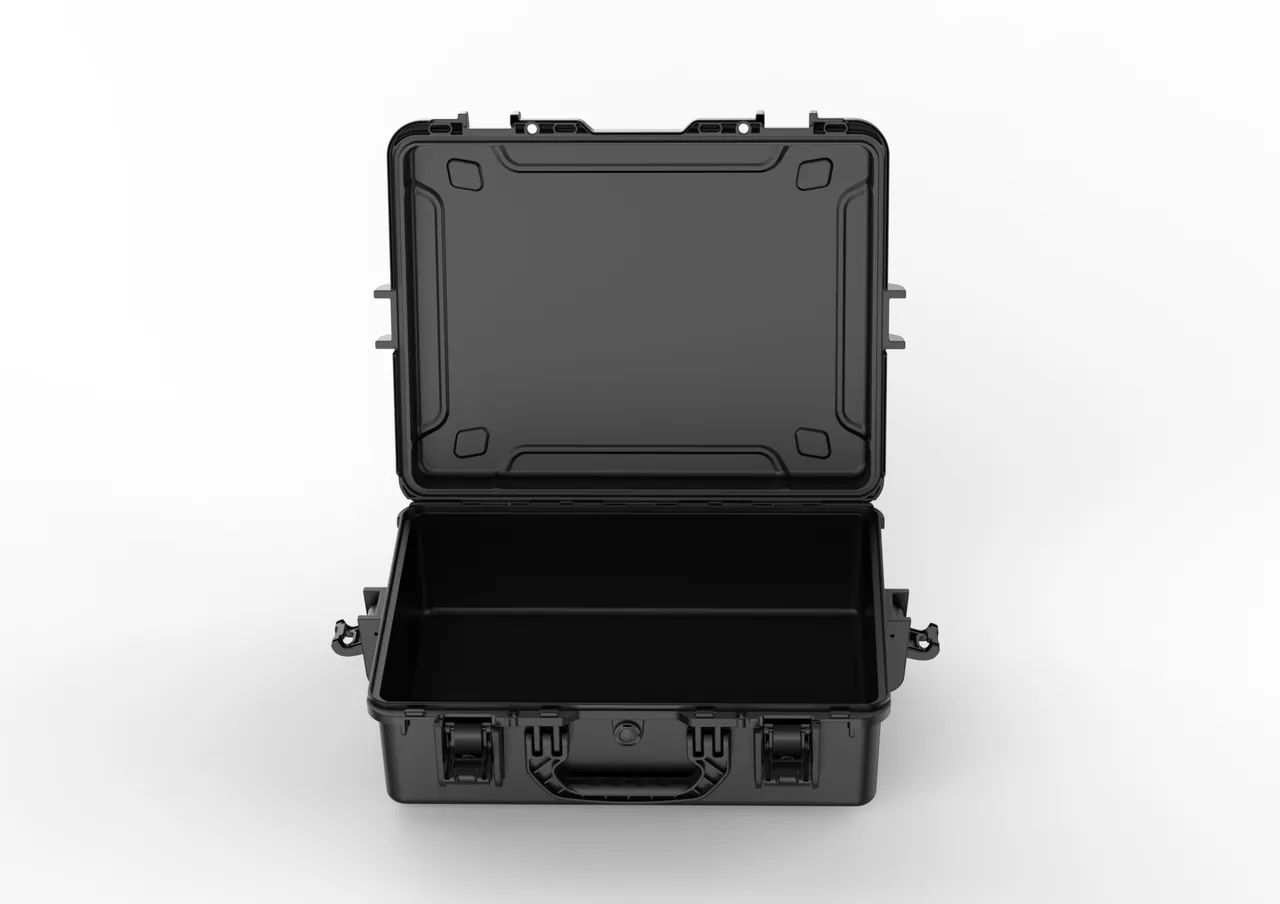
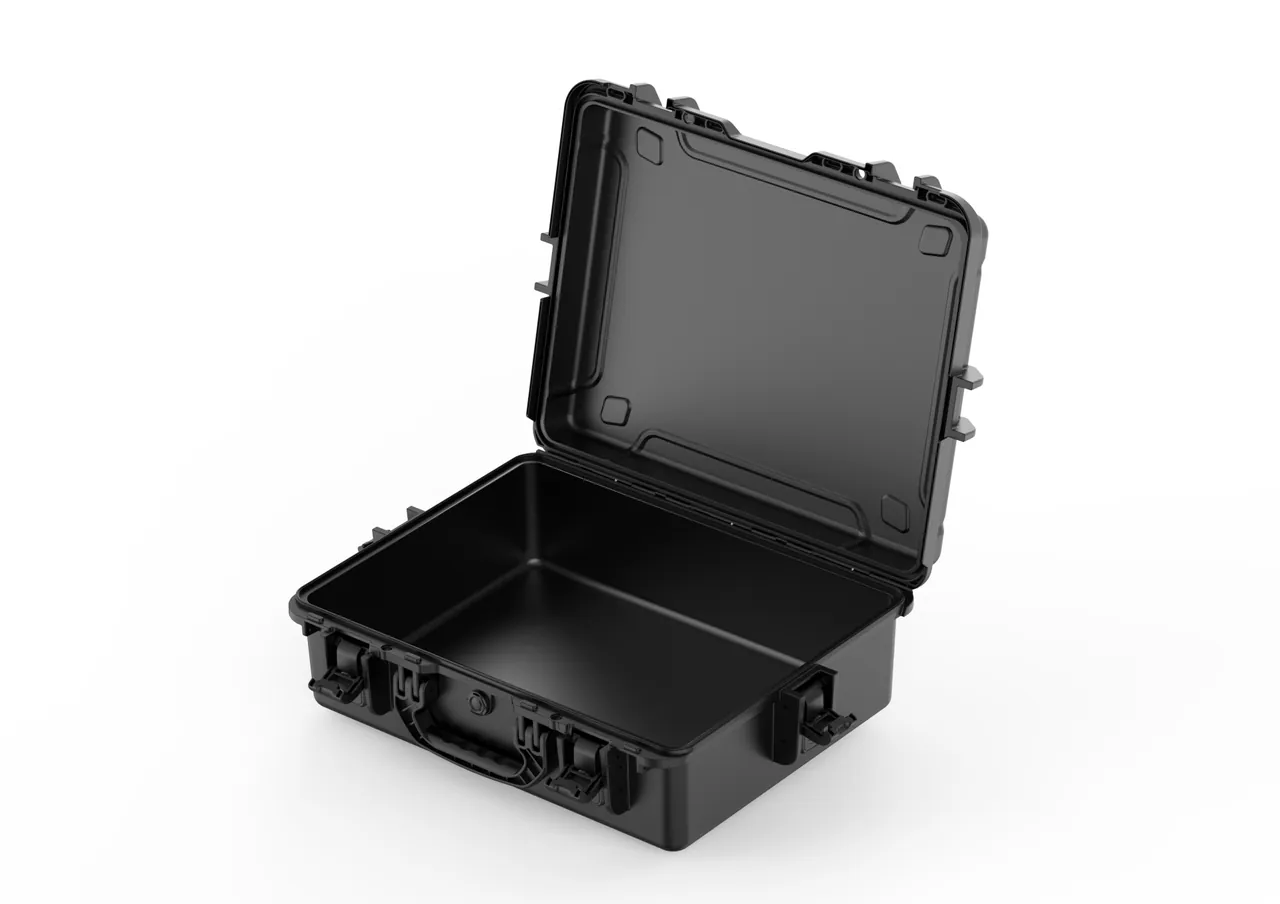
Plastic transport cases (HDPE/PP structure). The advantages are clear: a smooth, non-shedding interior that is friendly to panels and painted surfaces; sealable to IP65/IP67 with gaskets; replaceable gaskets, latches and hinges supporting long-term reuse; no plant-quarantine treatment because it is not wood packaging; and colour coding by model or project. The drawbacks are higher tooling cost, size limits on very large units, and the stiffness and latch count required when the lid area is large. For cosmetic-critical samples that will be opened repeatedly, a plastic case is usually the first choice. See plastic protective case structure and selection and IP67 case design essentials.
Wooden transport cases. The advantages are dimensional flexibility, high load capacity, suitability for very large or heavy units (complete refrigerators, floor-standing air conditioners, large ovens), and low initial cost. The drawbacks are equally real: the interior may carry nail heads, splinters and burrs that scratch panels directly; wood absorbs moisture and then becomes an internal moisture source, which is a risk for electronics; export wood packaging must meet the heat-treatment or fumigation requirements of ISPM 15 (International Standards for Phytosanitary Measures No. 15) and carry the corresponding mark; and repeated opening and closing degrades the structure and screw holes.
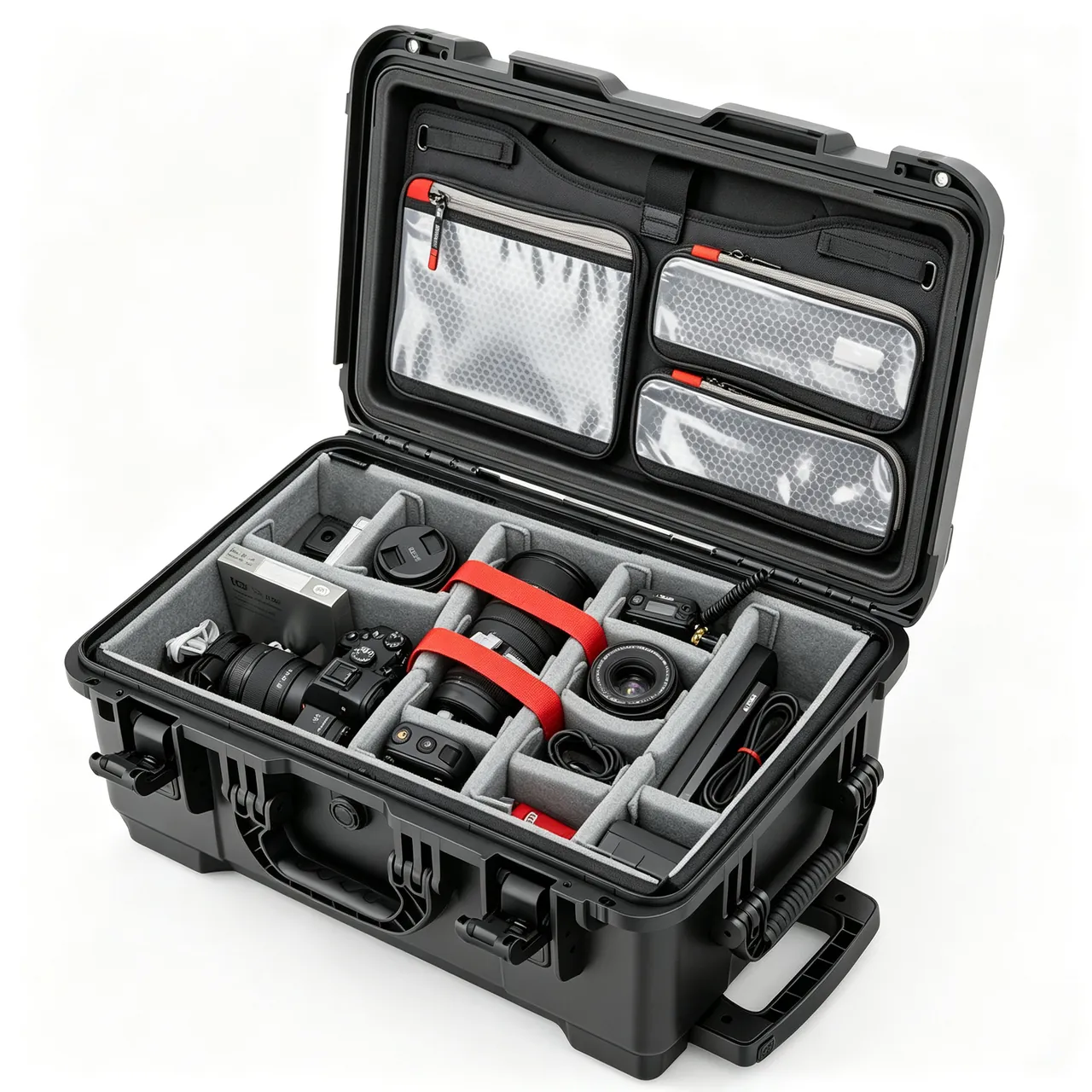
Hybrid: plastic case plus custom insert plus accessory compartment box. This is the most practical combination for appliance samples today. The plastic case provides moisture resistance, a non-shedding interior, reusability and an IP rating; the custom insert provides shape-matched support and eliminates point loads; the separate accessory box provides completeness. Whichever body material is chosen, the outcome depends on the insert - the insert determines whether panels see point contact, whether electronics are protected and whether accessories get mixed up. Insert design methods are covered in custom foam insert guide and EVA foam insert custom process.
Oversized samples. For units too large for a complete case (double-door refrigerators, integrated kitchen appliances, commercial display cabinets), the accepted approach is:
- A full-footprint pallet with a frame surround, using vertical posts to resist lateral displacement.
- Local reinforcement for panels, doors, handles and display windows.
- Overall wrapping with a rain cover or barrier film, plus desiccant.
- Forklift and lifting marks identifying pick-up points, with an explicit prohibition on lifting from the panel or door.
Is more sealing always better? It needs nuance. For panels, electronics and documents, sealing keeps out moisture and contaminants. But a fully sealed case whose internal moisture sources are uncontrolled can condense moisture as temperatures cycle. The workable approach is zoning: electronics and documents get high-barrier inner packaging plus desiccant; the unit sits in a case with basic sealing; routes with large temperature swings get a pressure equalisation valve; and high-value samples get a humidity indicator card.
7. Component-to-Case Selection Table
| Sample / Component | Typical Weight | Insert and Protection Plan | Case Format | Key Constraints |
|---|---|---|---|---|
| --- | --- | --- | --- | --- |
| Small kitchen appliances (blender, coffee machine) | 3-12 kg | Relief cavity, panel film, accessory compartments | Portable plastic case | Zero panel contact with hard surfaces |
| Mid-size kitchen appliances (microwave, combi oven) | 12-35 kg | Relief cavity, door support, separate glass tray compartment | Mid-size plastic case | No load on door, no glass tray stacking |
| Portable AC / dehumidifier | 20-60 kg | Full support plate, tube relief, upright transport | Mid-size case plus pallet | Upright; tubing kept free of stress |
| Refrigerator / freezer sample | 50-150 kg | Pallet, door restraint, transit bolts | Wooden or framed case | No inverted transport; no load on doors |
| Front-load washer sample | 50-100 kg | Transit bolts, axial restraint, upright attitude | Wooden case plus pallet | No power-up before bolts removed |
| Large TV / monitor sample | 8-40 kg | Upright slot, edge protectors, full-surface film | Upright case | No flat transport, no edge loading |
| Built-in appliances (oven, dishwasher) | 25-60 kg | Interface-face protection, panel film, relief | Custom plastic or wooden case | Zero damage to mating faces |
| Control board / display module (spares) | Under 3 kg | ESD shielding bag, compartments, desiccant | Compartment box / attache | ESD and moisture protection |
| Accessories and small parts | Under 5 kg | Compartments, labels, packing list | Compartment box | Complete, not mixed, not crushed |
| Documentation | Under 1 kg | Rigid waterproof pouch, laid flat | Lid pouch | No creasing or curling |
| Complete unit with accessories | - | Main case plus accessory box plus document pouch | Modular multi-case | Matching numbers and lists |
Three rules of thumb: first, any large flat part - panel, glass, screen - travels upright with full-surface or full-length support, never flat and never on two points; second, where hardware or demountable parts protrude, prefer removal over reinforcement; third, where export and wood packaging are involved, confirm ISPM 15 treatment and marking requirements at the quotation stage.
8. Insert and Cushioning Material Comparison
| Material / Structure | Typical Density | Load and Cushioning Behaviour | Surface and Cleanliness | Suitable Zones | Notes |
|---|---|---|---|---|---|
| --- | --- | --- | --- | --- | --- |
| EVA (medium-high density) | 60-120 kg/m3 | Good load capacity, moderate cushioning | Closed cell, non-shedding, can be faced | Relief cavities, panel slots, locating blocks | Slightly softens when hot |
| Low-rebound EVA / memory foam | 40-90 kg/m3 | Good vibration absorption | Closed cell | Protrusion cushioning, vibration damping | Needs structural parts to carry load |
| ESD EVA / PE | 50-110 kg/m3 | Medium-high load capacity | Closed cell, controlled resistivity | Board and display compartments | Confirm surface resistance data |
| PU foam | 25-60 kg/m3 | Low-medium load capacity | Open cell, can absorb moisture | Interior filling, corner cushioning | May collapse under long compression |
| EPE (pearl cotton) | 20-40 kg/m3 | Good cushioning, low load capacity | Closed cell, soft | Panel outer wrap, painted parts | Not suitable alone for load bearing |
| XPE / IXPE | 30-80 kg/m3 | Low load capacity | Closed cell, flat surface | Interlayer pads, planar isolation | Not for load bearing |
| Structural foam (cross-linked PVC/PE) | 60-300 kg/m3 | High load, low deflection | Closed cell, machinable | Load blocks, upright slot bases | Contact faces need a soft layer |
| Non-woven / flock fabric | - | No load capacity | Very soft, non-shedding | Brushed, mirror and painted contact layers | Must be clean and mould resistant |
| Metallised shielding bag | - | No load capacity | Shielded, moisture barrier | Control boards, display modules | Use with desiccant |
| Corrugated / honeycomb board | - | Medium | Flat, absorbs moisture | Large flat separation, interlayers | Hygroscopic; needs moisture protection |
| Aluminium-laminate barrier film | - | No load capacity | High barrier, low WVTR | Electronics and document inner wrap | Use with desiccant |
| Foam-in-place insert | 20-60 kg/m3 | Shape-matched, good cushioning | Closed cell | Irregular housings, 3D printed parts | Verify material compatibility |
Selection logic: partition by surface grade, layer by function. Insert selection should follow the division of labour in which the contact layer must be soft, clean and non-shedding; the cushion layer must absorb shock and damp vibration; the load layer must be flat and stiff; the shielding layer must control static; and the barrier layer must keep out moisture. A single sample often needs several materials at once: low-tack film plus a soft contact layer on panels, EVA relief cavities and structural foam load blocks for the body, anti-static foam and shielding bags for electronics, compartment boxes for accessories and a rigid pouch for documents.
Material compatibility is a frequent problem with appliance samples. Three patterns stand out. First, plasticiser migration, where plasticiser-bearing soft materials left in contact with painted, laminated or acrylic surfaces cause tackiness, discolouration or hazing. Second, sulphur and halogen contamination, where compounds released by certain rubbers and low-grade foams discolour metal finishes and corrode contacts. Third, shedding and fibres, where low-density open-cell foam and poor-quality non-woven shed debris that lodges in panel and housing gaps and becomes a rubbing source under vibration. For high-value samples, request composition and migration data for packaging materials and verify compatibility at critical contact points. Material comparisons are covered in case foam material comparison.
9. Sealing, Moisture Control and IP Ratings: IEC 60529 and GB/T 4208
The dust and water resistance of an appliance sample case determines whether panels, electronics and documents survive rain-time loading, open-air exhibition halls and sea freight intact.
What the IP code means. IEC 60529 defines the IP code as two digits: the first for solid-particle protection (0-6) and the second for liquid protection (0-9K). China's equivalent standard is GB/T 4208. Typical configurations for appliance sample cases:
- IP54: limited dust protection and splash resistance; suitable for domestic short-haul, box-truck transport and indoor transhipment storage.
- IP65: dust-tight and water-jet resistant; suitable for most domestic and near-sea appliance sample shipping and covered platform storage.
- IP67: dust-tight and resistant to short-term immersion (typically 1 m for 30 minutes); suitable for sea freight, open-air exhibition set-up and high-humidity rainy regions.
- IP68: continuous immersion; only needed in extreme scenarios such as temporary storage areas that may flood.
For selection trade-offs see choosing the IP rating of a waterproof case.
Reminder one: an IP rating verifies that outside water does not get in; it does not mean condensation will not form inside. In a sealed case with day-night temperature swings, internal moisture cannot escape and can condense on panel glass, metal finishes and control boards. Condensation leaves water marks and edge whitening on glass, can pit metal finishes, and is a direct corrosion risk for electronics. Use the combination of sealing, desiccant and a humidity indicator card, and fit a pressure equalisation valve on routes with large temperature swings.
Reminder two: moisture control is not only about keeping outside water out; it is also about controlling internal moisture sources. Wooden pallets, paper fillers, undried cleaning residue and a unit straight out of a hot, humid production hall are all internal moisture sources. Packing a unit with residual surface moisture into a sealed case is the most common and most expensive mistake in this category.
Sizing desiccant. Dose by internal free volume, packaging hygroscopicity, transit duration and target humidity. Appliance sample cases are distinctive in having many internal moisture sources (wood components, paper documents, insert materials) while electronics demand lower humidity, so the dose should generally exceed that of an equivalent-volume structural parts case. For sea freight of 30-45 days, increase the dose further. For high-value samples, add a humidity indicator card so that unpacking reveals at a glance whether the internal humidity peak exceeded the limit.
Gaskets and latches. Gasket materials are commonly silicone, EPDM and TPE foam, and the profile must match the case groove. Gaskets are wear parts: prolonged compression, repeated closure, UV and ozone harden them and cause permanent compression set, so they belong on the spare parts list with defined replacement criteria. Latch count should match lid stiffness - as a rule of thumb, a lid edge longer than 800 mm should carry at least three latches to produce continuous clamping force. See case hinges, latches and gasket selection, case seal material analysis and protective case service life assessment.
Where flame-retardant materials apply. UL94 is a classification standard for the burning behaviour of plastic materials, used to rate the case plastic parts, insert foams and gaskets themselves; it is not a fire certification for the appliance or the packaging system. Note that a UL94 rating must always be quoted together with material and thickness, because the same material can achieve different ratings at different thicknesses. Where a customer (a commercial kitchen, hotel project or public transport application, for example) requires flame retardancy, specify the material and thickness combination at the enquiry stage.
10. Transport Test Evidence: ISTA, GB/T 4857, ASTM D4169 and MIL-STD-810H
Verification of appliance sample cases usually draws on four families of standards. These sit at a different level from the performance and safety standards for the appliance itself (electrical safety, energy efficiency, electromagnetic compatibility) and should not be confused with them.
ISTA series. The International Safe Transit Association's procedures are graded by package format and weight. Appliance samples commonly use ISTA 2A (single package, up to 68 kg) and ISTA 3A (parcel delivery); unitised loads follow ISTA 3E and less-than-truckload shipments ISTA 3B. Their value lies in sequencing: preconditioning, then shock and drop, then vibration, then re-inspection, reproducing the main mechanical events of a real route in one test. See ISTA transport test procedures explained.
GB/T 4857 series. China's basic test methods for transport packages cover vibration, shock, stacking and drop, and are heavily cited in domestic tenders and acceptance. Appliance packaging also frequently cites GB/T 13384, General technical conditions for packaging of mechanical and electrical products, which sets out packaging classes, protection requirements and test item selection - probably the most directly applicable Chinese reference for appliance sample cases. See applying GB/T 4857 to transport packaging.
ASTM D4169. This assigns test intensity by distribution cycle and is widely used for packaging validation for North American markets; its DC series covers parcel, LTL and full-truckload movements. See ASTM D4169 distribution cycle testing.
MIL-STD-810H. Frequently cited for its vibration (Method 514), shock (Method 516), temperature-humidity (Method 507) and salt fog (Method 509) environmental test methods. It must be stated clearly: MIL-STD-810H is used here as a source of environmental test methods and does not mean the product holds any military certification. See MIL-STD-810H environmental test compliance note.
| Test Type | Common Standards | Example Parameters | What It Verifies for Appliance Samples |
|---|---|---|---|
| --- | --- | --- | --- |
| Random vibration | ISTA 3A/3E, ASTM D4169, IEC 60068-2-64 | PSD, RMS acceleration, duration | Panel slot stability, board fixing, tubing and mounts |
| Shock / drop | ISTA, GB/T 4857 | Drop height, peak acceleration, cycles | Corner guards, panel edges, accessory compartments |
| Stacking | GB/T 4857.3 | Load, duration, temperature-humidity | Case crush resistance, insert collapse resistance |
| Incline / tip-over | Tip test in ISTA procedures | Incline angle, cycles | Tip resistance of upright panel cases |
| Temperature-humidity cycling | MIL-STD-810H Method 507 | Temperature range, cycle count | Condensation risk, film and insert stability |
| Salt fog | ISO 9227 / ASTM B117 | Concentration, duration | Stainless panels, hardware, latches |
| Dust and water | IEC 60529 / GB/T 4208 | IP rating, test duration | Effectiveness of case sealing |
| Flammability (material) | UL94 | Rating at material and thickness | Case plastics and insert foams |
| ESD susceptibility | IEC 61340-5-1 system requirements | Protected area, packaging, marking | Electronics protection plan |
11. Packing SOP and Arrival Inspection
Multi-leg routes and the sample chain. An appliance sample typically travels R&D centre to factory to brand customer or certification body to exhibition or experience centre, with several express and air-freight legs in between. Every handoff is a re-packing, so the procedure must be reproducible by whoever is on shift, not dependent on one person who knows the sample.
Standard operating procedure (SOP).
- Verify and prepare. Confirm model, sample serial number, accessory list and document list; confirm the unit is clean, dry and free of oil or cleaning residue; confirm demountable hardware and protrusions have been removed, packed separately and labelled.
- Panel treatment. Clean the panel, apply low-tack protective film over the full face, and fit soft edge strips at edges and corners. Confirm no bubbles or creases, since creases transfer as pressure marks.
- Electronics treatment. Place removed boards and display modules in ESD shielding bags with compartments; confirm bags are undamaged and sealed.
- Moving-part restraint. Fit transit bolts or restraints per the product technical file; record their positions and count, and enclose a "remove before power-up" notice.
- Insert installation. Confirm relief cavities match the unit with no point contact; insert upright panels into slots with gaps between them; confirm the insert is free of debris and offcuts.
- Accessories and documents. Compartmentalise and label accessories by number with an enclosed list; lay documents flat in a rigid waterproof pouch, unrolled and unweighted.
- Moisture control and sealing. Calculate the desiccant dose from volume, duration and internal moisture sources; add a humidity indicator card; check the gasket for debris and deformation before closing; close all latches and confirm continuous compression around the perimeter.
- Marking and records. Apply this-way-up, fragile, keep-dry, do-not-invert and centre-of-gravity marks; photograph the packing (panel film, insert condition, accessory compartments, document position) and file the images.
Arrival inspection (unpacking check). Work through the following sequence:
- Outer packaging: case, corner guards and latches intact; no through damage, rain marks or crushing; humidity indicator card within the acceptable band.
- Panels: inspect under grazing light for fine scratches and pressure marks, since direct frontal lighting hides a large proportion of them; check glass edges and corners for chipping; check screen print and ink layers for wear.
- Metal finishes and hardware: check for polish marks, fingerprint corrosion and pitting; verify the count and appearance of demountable parts.
- Mechanisms: before power-up, confirm all transit bolts have been removed per the list; check doors, lids, rails and shelves for deformation and misalignment; check door seals and gaskets for compression marks.
- Electronics and display: check that connectors are fully seated; power up and test touch, display, sensors and communications item by item.
- Accessories and documents: verify quantity and numbering against the list; check documents for creasing, moisture and illegible printing.
Inspection note: cosmetic inspection of appliance samples must be done under light that can be angled across the surface, and critical areas (panel, door, edges, logo) should be photographed for the record. Most arrival disputes arise not because a great deal was actually damaged, but because the light and viewing angle at inspection failed to reveal fine scratches that were found later.
12. Export Compliance, Lithium Batteries and Exhibition Tour Logistics
Wood packaging and ISPM 15. Where wood packaging materials are used for export (wooden cases, pallets, bearers, bracing), they must meet the requirements of ISPM 15, normally through heat treatment or fumigation with an applied identifying mark. A plastic case avoids wood packaging quarantine requirements, but if a wooden pallet is used with it, that pallet is still wood packaging. Specific requirements and mark formats should follow the destination country's quarantine rules and the carrier's requirements; no compliance conclusion is drawn here.
Product compliance documents travel with the sample. In sample submission and certification, the accompanying documents are themselves deliverables: energy efficiency labels and test reports, electrical safety conformity documentation, electromagnetic compatibility information, hazardous substance restriction declarations and destination-specific label artwork. The requirements for these documents should follow destination regulations and certification body rules. Pack them flat, dry and protected from light.
Samples with built-in lithium batteries. A large share of appliance samples now contain lithium cells (remotes, cordless vacuums, robot vacuums, rechargeable small appliances). Equipment containing lithium batteries falls under dangerous goods rules for air freight, involving UN numbers (for example the UN 3481 series for lithium ion batteries contained in equipment), state-of-charge limits, packaging strength, marking and documentation requirements. The applicable provisions should follow the currently effective air and sea dangerous goods regulations and carrier requirements. In practice: (1) remove the battery and ship it separately where the design allows; (2) where the unit must ship assembled, ensure it is protected against accidental activation (guarded switches, locked controls); (3) use compliant packaging and prepare the required documents. If the sample also carries other dangerous goods characteristics, such as alcohol-based cleaning accessories or pressurised components, confirm requirements in advance using the guidance in hazmat transport case compliance design.
Exhibition tour logistics: the high-intensity use case. Trade show samples typically go through at least two complete load-unload cycles within a week (set-up and tear-down), and the cases then travel to the next show. This imposes three extra requirements:
- Repeatable opening and closing: hinge and latch life must be assessed in cycles, and gaskets should be replaceable on site without tools.
- Fast re-packing: inserts need clear numbering and locating marks, and the accessory box to checklist mapping must be obvious.
- Stackability and handling: provide stacking registers and sensible handle positions, and add wheels and telescopic handles on heavy cases to reduce manual handling damage.
Reuse criteria for repeated tours. Keep a log of case number, number of trips and inspection records, and check six items: case cracks or deformation (especially corners and forklift contact points); gasket hardening, cracking, adhesive failure or permanent compression set; latch and hinge closure and load bearing; insert collapse, crumbling, facing delamination or missing compartments (insert collapse changes the load path and turns full-surface support into point contact); panel slot deformation that allows panel movement; and ESD bag and desiccant replacement needs. Cleaning and care methods are covered in protective case cleaning and maintenance.
13. OEM/ODM Customisation and Supplier Evaluation
The customisation strategy: universal case, custom insert, modular compartments. Appliance samples belong to the category of single-unit customisation with frequently changing geometry and low volumes. Tooling a case body for every sample is unaffordable. The workable approach is to use a small number of standard case sizes graded by maximum panel size and unit volume; to cut inserts to the actual sample geometry (from drawings, 3D data or physical pattern-taking); and to make panel slots, accessory compartment boxes and corner guards a modular series that can be combined. This spreads tooling cost across many projects; see case mould cost analysis and removable divider systems.
JUNZHJIA's normal workflow for appliance samples is: accept drawings, 3D data or a physical pattern; produce a compartment insert and panel slot proposal; confirm with a first-article trial fit including panel film and accessory compartment layout; move to volume production with sampling; and supply gasket specifications plus test and inspection documentation. For export projects, gaskets can be matched to the model and the corresponding test records issued.
Six dimensions for evaluating a supplier.
- Engineering capability: can they produce relief-cavity designs matched to the unit's geometry, offer upright slot and full-surface support solutions for large panels, run first-article trial fits, and handle the irregular geometry of 3D printed and CNC machined prototypes?
- Materials and process: density and batch consistency of insert materials; whether facing materials shed or contain migrating plasticisers; whether anti-static materials come with surface resistance data; fit accuracy and weathering performance of corner guards and edge strips.
- Test capability: can they provide vibration, drop, stacking, incline/tip-over, IP and salt fog records, and temperature-humidity cycling capability?
- Lead time and capacity: sample projects are measured in days, so the ability to slot in urgent work and produce fast prototypes is a core metric.
- Quality system: sampling rules and non-conforming product handling; see custom case acceptance and AQL sampling.
- Traceability and service: spare parts supply for gaskets, inserts and hardware, and the ability to keep reuse records against case numbers.
Enquiry checklist. A practical enquiry should include: sample model and overall dimensions (with 3D data or reference photographs); weight and centre of gravity; panel size, material and finish (tempered glass, acrylic, brushed stainless, painted or laminated); the list of parts to be removed and packed separately; the accessory and document list; transport modes and route (including whether air freight and whether lithium batteries are involved); storage duration and environment (including open-air exhibition); whether repeated tours are required and the expected number; target IP rating and internal humidity requirements; whether ESD protection is required; test requirements; marking and unpacking instruction requirements; and project quantity with delivery milestones. The more complete the input, the closer the supplier's proposal will be to a production-ready design. Supplier selection methods are covered in how to choose a protective case OEM factory.
Frequently Asked Questions
Q: Why can't an appliance sample panel simply be wrapped in ordinary stretch film before boxing?
A: Because stretch film addresses dust, not rubbing or point loads, and it can even introduce a new rubbing source. Packing areas inevitably carry dust and hard debris, and film traps them between film and panel during wrapping; under transport vibration those particles roll and rub inside the film, producing large areas of fine scratching that cannot be repaired on tempered glass or mirror stainless steel. On painted, laminated and acrylic panels, some plasticiser-containing films left in prolonged contact cause tackiness, discolouration and hazing, and if the adhesive softens, removal can locally stretch or distort the surface. Film also does nothing about the failure mode panels fear most - edge loading, which is where almost all glass chipping and spontaneous shatter begins. The correct approach is: apply low-tack protective film over the full face as the contact layer, fit soft edge strips at edges and corners, stand the panel upright in a slot matched to its dimensions with full-surface or full-length support, and keep at least a 5 mm gap between adjacent panels using soft separators. Stretch film can be used on the outside as a dust and movement barrier, but never as the primary panel protection.
Q: Why are display windows and touch panels more often crushed than dropped?
A: Because their failure mechanism is point load and pinching, and pinching is exactly what is hardest to avoid during packing. Display modules usually have a thin display stack and support beneath the cover glass, so their frontal crush capacity is limited, while the ITO conductive layer and ribbon cable on a touch panel are sensitive to bending and local pressure. When other goods are stacked on top of the unit, when an accessory box sits directly over the display area, or when the insert provides only a shallow recess instead of a genuine air cavity, pressure transfers through the cover glass into the internal structure and produces cracking, touch failure or cable crushing. Crucially, this damage may not present as broken glass: it may appear as reduced touch sensitivity in one region or a discoloured patch on the display, which is easily missed at unpacking. The design requirements are therefore three: first, the display area needs a genuine relief cavity, not a shallow groove; second, nothing should be stacked above it and accessory boxes must avoid the display area; third, the ribbon cable needs independent restraint and relief and must never be pinched between panel and insert. A simple check works well: after the insert is loaded, press down on the display area and confirm that no force reaches the panel.
Q: Why do appliance sample electronics need ESD packaging, and what is wrong with an ordinary plastic bag?
A: An ordinary plastic bag is an insulator: it accumulates static charge readily through friction and cannot dissipate it, effectively sealing the board inside a container of trapped charge. As the board is inserted into or withdrawn from the bag, the potential difference between the operator and the bag can discharge through device pins, causing two classes of damage. Catastrophic failure destroys the device outright and testing will find it. Latent failure degrades device parameters so that the part passes factory test but fails prematurely in service. The second is especially troublesome for samples: the unit may work perfectly during submission and fail only weeks later in the customer's hands, with the root cause sitting in the transport step and effectively untraceable to the packaging. Use packaging with shielding or dissipative capability - metallised shielding bags, anti-static foam, conductive tote boxes - and control the handling environment with ESD work surfaces, wrist straps and grounding. The overall programme should be documented; system requirements are described in standards such as IEC 61340-5-1. Note that ESD packaging suppresses charge accumulation and discharge; it does not replace the electrical safety design and factory testing of the appliance itself.
Q: Why must refrigerators and washing machines have transit bolts fitted, and why must they be removed before power-up?
A: Because compressors, drums and suspension structures experience repeated alternating loads in transit, and without restraint the moving assembly swings substantially relative to the shell. There are three consequences. Tube fatigue: copper tubing flexes repeatedly and can develop fatigue cracks at welds or bends, causing refrigerant loss. Suspension and damper displacement: drum suspension springs, counterweights and dampers can move out of position under shock, causing severe vibration or the drum striking the outer tub. False brinelling: when a rolling bearing is stationary but vibrating, contact-point damage develops between rollers and raceways, showing up later as increased running noise - and none of it is detectable before power-up. Production packaging ties the moving assembly rigidly to the shell with transit bolts, and sample logistics should retain or add the same restraint. In the unpacking procedure, confirm the full bolt list and remove every bolt before energising. Print the warning in three places - inside the case, on the unit and in the manual - and record bolt positions and count in the packing record so that a single missed bolt does not cause running abnormalities.
Q: Should an appliance sample case be plastic or wooden?
A: It depends on sample size and weight, the number of handoffs, the transport mode and export requirements. Plastic cases (HDPE/PP structure) offer a smooth, non-shedding interior friendly to panels and painted surfaces; IP65/IP67 sealing with replaceable gaskets, latches and hinges; support for long-term reuse; and no plant-quarantine treatment because they are not wood packaging. Their drawbacks are higher mould cost, size limits on very large units, and the stiffness and latch count required for large lids. Wooden cases offer dimensional flexibility, high load capacity, suitability for very large or heavy units and low initial cost, but the interior may carry nail heads and splinters that scratch panels directly, the wood absorbs moisture and becomes an internal moisture source that endangers electronics, the structure degrades with repeated opening, and export requires ISPM 15 heat treatment or fumigation with the appropriate mark. In summary: where cosmetic surfaces dominate and the case will be opened or handed off repeatedly, a plastic case is usually first choice; for very large, very heavy or one-off shipments, wood or a framed case is more economical. Most projects are best served by a hybrid: a plastic case for sealing, cleanliness and reuse, a custom insert for fit and point-load elimination, and separate compartment boxes for accessory completeness - remembering that any wooden pallet used alongside must still meet wood packaging quarantine requirements.
Q: How can you tell whether an appliance sample has been damaged by moisture in transit?
A: There are two layers: preventive evidence and post-event inspection. Preventive evidence comes from a humidity indicator card placed inside the case; it changes irreversibly above a set threshold, so unpacking immediately reveals whether the internal humidity peak exceeded the limit, and high-value samples should also carry a recording hygrometer. Post-event inspection should focus on four areas. Control boards and connectors: look for whitish, greenish or dark corrosion products on solder joints and pins and for oxidised contacts, especially near the case opening and at the bottom. Metal parts and hardware: look for rust spots and pitting on stainless finishes, screws and latches. Glass and mirror surfaces: look for water marks, edge whitening or hazy patches, which are direct evidence of condensation. Paper documents and labels: look for wavy distortion, ink bleeding or adhesive failure - paper is the most moisture-sensitive material and usually the earliest indicator. One caution: the consequences of moisture in electronics are delayed. A board may power up normally on arrival and develop intermittent contact faults weeks later, so if the indicator card shows an exceedance, dry the unit thoroughly and retest functions rather than declaring it risk-free because it powered up once.
Q: How do you decide whether a sample case can still be reused after several trips?
A: Keep a log of case number, trip count and inspection records, and check seven items. First, the case body: cracks, deformation and through damage, focusing on corners, forklift contact points and latch mountings. Second, the gasket: hardening, cracking, adhesive failure, permanent compression set or local loss - a failed gasket means the actual IP protection level has already dropped even if the case looks intact. Third, latches and hinges: reliable closure and continuous clamping force, with no local lid lift. Fourth, the insert: collapse, crumbling, facing delamination, slot wear and missing compartments - insert collapse changes the load path and turns full-surface support into point contact, the classic case of something that looks fine but has already failed. Fifth, panel slots: panels must insert firmly without movement. Sixth, ESD bags and desiccant: replace if damaged, punctured or saturated. Seventh, wheels and handles where fitted. Any failed item should be replaced before further use. One further rule applies to appliance samples: clean the insert and case interior thoroughly before reuse, because panels and mirror surfaces are extremely sensitive to debris. Cleaning methods are covered in protective case cleaning and maintenance.
Q: If a sample has no panel, or the panel is plastic, is careful protection still necessary?
A: Yes. Panel material determines the protection method, not whether protection is needed. Plastic panels such as painted ABS, laminated parts and acrylic are usually less scratch resistant than glass, so fine scratches are more visible and harder to disguise - and they bring a problem glass does not have: compatibility with packaging materials. Plasticiser-bearing soft foam, solvent residues from cleaning and compounds released by some rubber materials can cause tackiness, discolouration, hazing or even stress cracking when left in contact with plastic panels, and these effects often appear days after unpacking. Even without a glass panel, the requirements remain: contact materials must be clean and free of migrating components; panels should carry low-tack film over the full face; edges and corners need guards; panels should not share a compartment with hard accessories; and light and heat should be avoided. Beyond cosmetics there are three further protection lines that matter just as much: electronics need ESD and moisture protection, moving parts need transit restraints, and accessories and documents must be complete and verifiable. None of those depends on panel material, yet together they determine whether the sample passes submission and certification.
Q: Which transport tests should an appliance sample case undergo - is more always better?
A: More is not better; tests should match the actual route. The purpose is to reproduce the mechanical and environmental events the sample will really encounter, not to accumulate the longest possible report. A sensible approach defines the route first and then selects items. Domestic short-haul parcel routes involving repeated sorting and handling call for drop and random vibration testing per ISTA 2A/3A. Mixed LTL and full-truckload routes call for ISTA 3B/3E and the corresponding ASTM D4169 distribution cycles. Sea freight and open-air exhibition routes should add temperature-humidity cycling, salt fog and IP verification, drawing on MIL-STD-810H Methods 507 and 509 (as environmental test methods only - this implies no military certification whatsoever) and on IEC 60529 / GB/T 4208 IP testing. Domestic tenders and acceptance should prioritise the GB/T 4857 series and GB/T 13384, General technical conditions for packaging of mechanical and electrical products, because they are the most applicable references in bid evaluation and acceptance. Appliance samples should also add two targeted verifications: panel protection verification, checking that film and slots do not themselves cause scratches or pressure marks after real vibration, and electronics protection verification, checking that shielding and desiccant still meet requirements after temperature-humidity cycling. More tests mean longer schedules and higher cost, so decide on route coverage rather than on the number of standards cited.
Conclusion and Related Reading
Designing an appliance sample case is fundamentally a question of cosmetic surface management and environmental management, not of making the box thicker. Panels fear rubbing and point loads, electronics fear static and moisture, moving parts fear vibration and attitude, accessories go missing, and documents fear damp. What these five failure classes share is that they may be completely invisible at the moment of unpacking, or misread as normal during a power-up test, only to emerge during customer evaluation, certification re-testing or a live demonstration - and because a prototype cannot be replicated, the cost of remediation is very high.
The path to implementation compresses into six steps: first partition the sample by surface grade (cosmetic face, electronic face, structural face, accessories and documents); then define the upright attitude and full-surface support path for panels; then handle point loads and corners with relief cavities, guards and slots; then control the environment with ESD packaging, desiccant and humidity indicator cards; then restrain moving parts with transit bolts and locating hardware; and finally close the loop with transport tests matched to the route and grazing-light inspection. Get these six steps right and the sample will far more reliably arrive ready to submit and ready to re-ship after re-packing. Where a compartment insert and slot design is needed for a specific sample geometry, panel material and transport route, supply the drawings, 3D data or a physical pattern to JUNZHJIA and we will produce the design and arrange a first-article trial fit.
Related Reading