

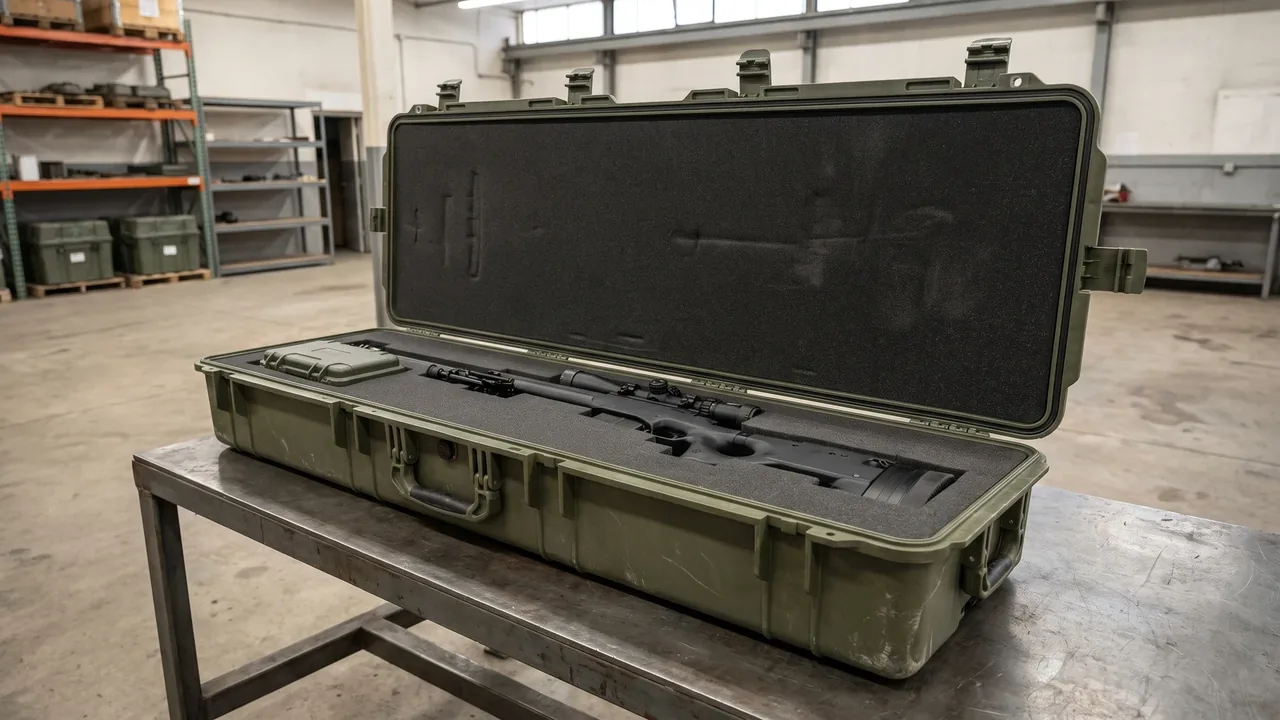
Construction and surveying sites expose precision instruments to a hostile mix of airborne dust, continuous vibration, splashing mud, and wide temperature swings. Total stations, levels, prisms, controllers, and GNSS receivers lose accuracy or fail outright when these factors are allowed to reach the instrument itself. This guide focuses strictly on the protective case as a product: its sealing, cushioning, shell, latches, labeling, and maintenance. The key conclusion comes first: a qualified surveying and construction instrument case must keep instruments at zero shift, with no water ingress and no abrasion, under both dusty and vibrating field conditions, because that protection is the precondition for trustworthy field data. The parameters, standards, and tables below are expressed as typical or experience-based values for procurement and equipment managers, not as guaranteed test results for any specific unit.
1. Site Role of the Surveying and Construction Instrument Case
On roads, bridges, tunnels, subways, buildings, and water projects, surveying instruments travel repeatedly between the depot and the work face. Earthwork, crushed stone, cement dust, and machine vibration at the work face are the main external causes of accuracy loss. The first duty of a surveying and construction instrument case is to physically isolate the instrument from these harmful factors, keeping it in a controlled micro-environment during handling, storage, and short stops. Unlike a common tool box, the design priority of an instrument case is not "carry more" but "protect better", and every structural choice should serve shock reduction, dust sealing, water resistance, and compression resistance.
From the equipment system view, this case is a sub-category of field operation cases. It shares the functional goal of the general surveying instrument case, but the construction scenario places stronger emphasis on impact and dust resistance, and the interior often has to hold the host, tripod sections, prism set, charger, and recording terminal together. When preparing a purchase list, follow the scenario-matching method in the instrument case selection guide: first fix the three inputs of instrument size, daily handling frequency, and site dust grade, then derive case volume and liner scheme, instead of chasing large capacity at the expense of portability.
A frequently overlooked issue is the "turnaround rhythm" of the case. A crew may move one case from the warehouse to the pit edge in the morning and back in the afternoon, and frequent opening accelerates gasket aging. Durability therefore depends not only on factory quality but also on whether the access path is planned reasonably and whether quickly replaceable seals are provided. Treating the case as a "consumable protective asset" rather than "one-time packaging" is the first step toward a longer field service life.
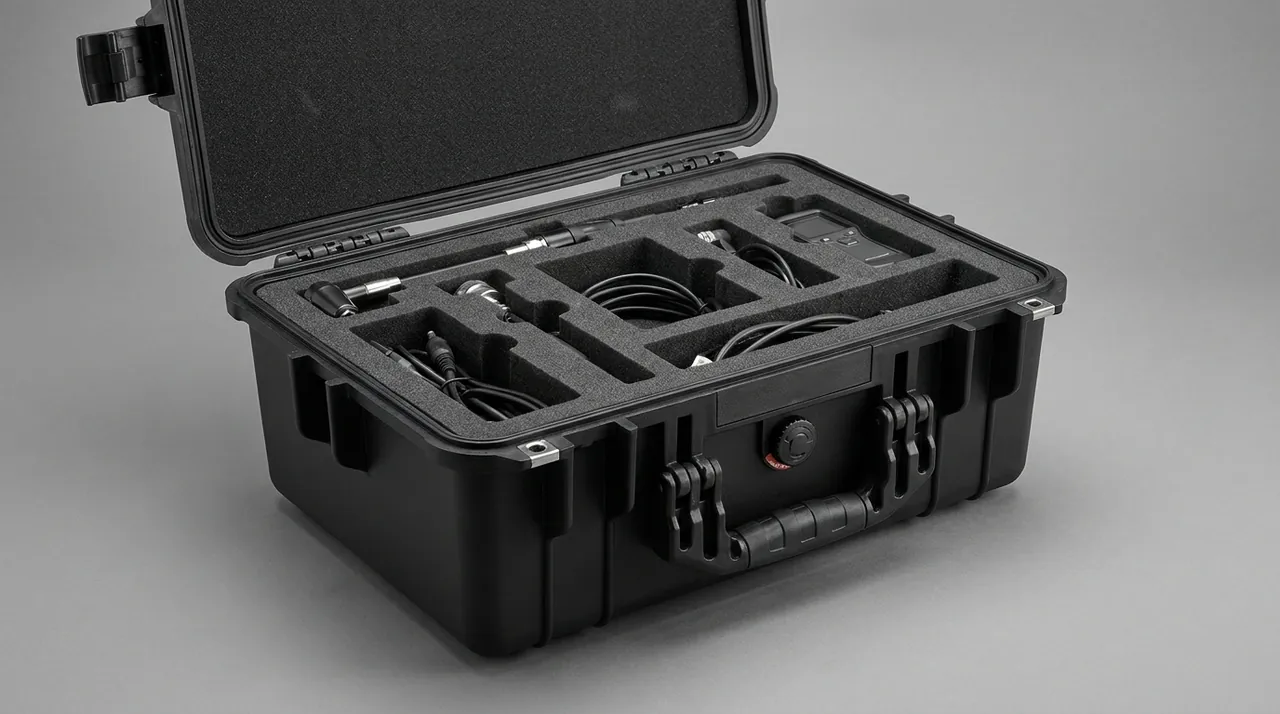
2. Dustproof Sealing Structure: Continuous Barrier from Lid to Gasket
Dustproofing means building a continuous, compressed, and unbroken barrier between inside and outside. Under IEC 60529 and GB/T 4208, the first digit of the code denotes solid-ingress protection, where IP5X means dust-protected with limited ingress and IP6X means dust-tight with no ingress. For construction sites, IP5X is the minimum, while conditions near mixing stations, crushing yards, or tunnel faces should be designed to IP6X. Water resistance is expressed by the second digit, and IPX7 keeps water out during typical one-meter-depth immersion for thirty minutes; combined with dust protection this yields the commonly used IP67 grade.
The material and compression of the seal decide dustproof success. Experience shows that EPDM rubber has good weathering and ozone resistance, while silicone rubber keeps stable rebound across a wide temperature range, and both suit long-term outdoor use. After the gasket is seated in the lid groove, a compression deformation of about fifteen to thirty percent should be maintained when closed; too low fails to seal tightly and too high accelerates permanent set. The lid-to-body interface should use a continuous sealing groove rather than point seals, with arc transitions at corners to avoid local weak sealing from stress concentration. For quantified grading details, extend reading to the protective case IP rating and outdoor case dustproof design topics.
Dustproofing and waterproofing are often confused. In fact, being waterproof does not automatically mean dustproof, because water pressure pushes particles away while dry dust slowly seeps through tiny gaps. A construction instrument case should therefore form a "positive-pressure" fit after closing: when slight internal negative pressure arises from temperature differences, the external gasket should auto-rebound to compensate rather than rely on repeated manual pressing. This is also why the pressure equalization valve and the gasket must be designed together, which we address later.
3. Vibration Isolation and Cushioning System: Zero Shift of Instruments
"Zero shift" of the instrument inside the case is the core metric of vibration design, achieved by two parallel mechanisms. The first is positioning, using cut foam to lock the host, lens, and accessories in fixed cavities. The second is energy absorption, placing a sufficiently thick elastic layer between the case wall and the instrument to convert transport shock and vibration energy into material deformation. Neither alone is enough; with only absorption and no positioning, the instrument still slides and collides inside, while with only positioning and no absorption, impact transfers directly to the instrument body.
Cushioning materials generally have three tiers. Low-density polyethylene (EPE) pearl cotton is low cost and resilient, suited to light accessories and partitions. Ethylene-vinyl acetate (EVA) has adjustable density and can be thermo-formed, suited to contoured cavities. Polyurethane (PU) sponge has a gentle absorption curve, suited to high-value hosts. Experience suggests the bottom cushion under the host should be no less than twenty millimeters thick, with extra corner protectors at edges. For a total station with a precise compensator, a layer of felt or flannel on the cavity wall reduces micro-abrasion during access. The custom cutting method is detailed in the custom foam lining for protective cases guide.
Another meaning of vibration protection is decoupling "shell vibration" from "instrument vibration". Advanced schemes leave an air gap between the inner wall and the liner, or add an independent floating tray at the bottom, so high-frequency ground vibration is first absorbed by the shell and then attenuated a second time by the cushion. Following the random-vibration logic of MIL-STD-810H Method 514, a field instrument case should reduce the acceleration transmitted to the instrument below a typical safety threshold within the normal transport frequency band. For stricter needs, compare the floating structure and foam schemes of the shockproof case and choose by budget.
4. Case Shell Materials and Molding Process: Impact and Weathering
The shell carries drops, stacking loads, sunlight, and knocks, and is the main load-bearing part of the protection system. Mainstream materials are engineering plastics, rotomolded polyethylene, and aluminum alloy. Modified polypropylene (PP) and acrylonitrile-butadiene-styrene (ABS) injection cases are light and dimensionally stable, suited to small and medium instrument cases. Rotomolded polyethylene (PE) has uniform walls and strong impact tolerance, with high forgiveness for corner impacts. Aluminum cases offer high rigidity and shielding potential but cost more and need anti-corrosion care. The choice should balance weight, strength, and cost rather than maximize a single index.
The molding process decides whether the shell has weak weld lines. Injection cases are integral and precise but large thin-wall parts may show sink marks. Rotomolded cases have no weld seam and good integrity, better withstanding drops and tumbles. Aluminum usually uses sheet bending plus friction stir welding, strong but the weld sealing must be watched. Regardless of process, internal stiffening ribs improve bending stiffness and large corner radii spread impact stress. For a systematic comparison of shell structure and materials, consult the case shell guide, which gives the relationship among wall thickness, ribs, and load.
Weathering also matters. Under long-term ultraviolet exposure, ordinary plastic surface chalking and toughness loss appear, so outdoor cases should use UV-resistant compounds or surface coatings. Experience suggests that salt-spray and humid-heat environments should prefer rotomolded PE or anodized aluminum, with dacromet or similar anti-corrosion treatment on metal parts. Units needing export or long-term field use can set a reasonable salt-spray hour threshold at acceptance by following the logic of the salt spray test guide, writing weathering requirements into the technical agreement.
5. Latches and Hinges: Pressure and Theft Resistance
The latch is the "last kilometer" security component of the instrument case. Construction sites have mixed personnel, and an unlocked or easily pried case can lead to host loss in a moment. Common locking types are butterfly latch, press latch, and compression latch. The butterfly latch closes fast and accepts a padlock, suited to frequent opening. The press latch is operable with one hand, suited to gloved work. The compression latch presses the lid down on closing, adding extra seal compression, and is preferred for dustproof and waterproof conditions. Whatever the type, latch count should match case length, with at least dual points on long cases.
Hinge life decides whether the lid opens and closes stably over the long term. Experience shows metal piano hinges carry more load and last longer, suited to heavy instrument cases, while integral injection hinges are light but need attention to their cycle limit. Latch and hinge materials should be stainless steel or properly surface-treated alloys to avoid rust seizing in mud and water. For latch selection and material comparison, see the parameter table in the case latch guide. It must be stressed that a latch only deters opportunists, not a theft-proof safe, and high-value instruments should still be caged or guarded when unattended.
For pressure resistance, when multiple cases are stacked for transport, the weight of upper cases transmits through latches and lids to lower cases. Thus besides theft resistance, the latch must withstand stacking shear without loosening. At acceptance, simulate stacking with repeated open-close and pressurization tests to confirm no obvious plastic deformation of the latch tongue. Including "latch life" in routine inspection is more economical than replacing the whole case later.
6. Pressure Equalization Valve: Sealing under Altitude and Temperature Swings
Construction instruments often shuttle between mountains, pits, and plains, where altitude and temperature swings create pressure differences inside and outside the case. If the case is fully sealed, low pressure may "suck" the lid shut and make it hard to open, or continuous high pressure may push the gasket open and let water or dust in. The pressure equalization valve auto-conducts when the differential exceeds a threshold, balancing internal and external pressure, while an internal hydrophobic breathable membrane blocks water and dust. It is the key component that moves a dustproof and waterproof case from "passive seal" to "active balance".
Experience suggests the valve should be on the side rather than the bottom to avoid backflow from standing water, and the breathable membrane should be PTFE-type material balancing air flow and pore interception. On Gobi or plateau sites with large day-night temperature differences, the valve also slows moisture condensed inside by the "breathing effect", indirectly lowering humidity. Its structure and selection logic are compared in the case pressure equalization valve and outdoor case pressure valve notes.
A misconception must be clarified: the pressure equalization valve should not be "the more sensitive the better". An over-sensitive valve conducts prematurely during immersion and breaks waterproofing. Therefore the opening differential should be set by the site altitude range and verified with the overall IP grade. Typically under IP67, the opening differential is controlled within a typical safe band, ensuring daily pressure balance without failing during short immersion.
7. Internal Zoning and Custom Cavity Cutting: Precise Positioning by Model
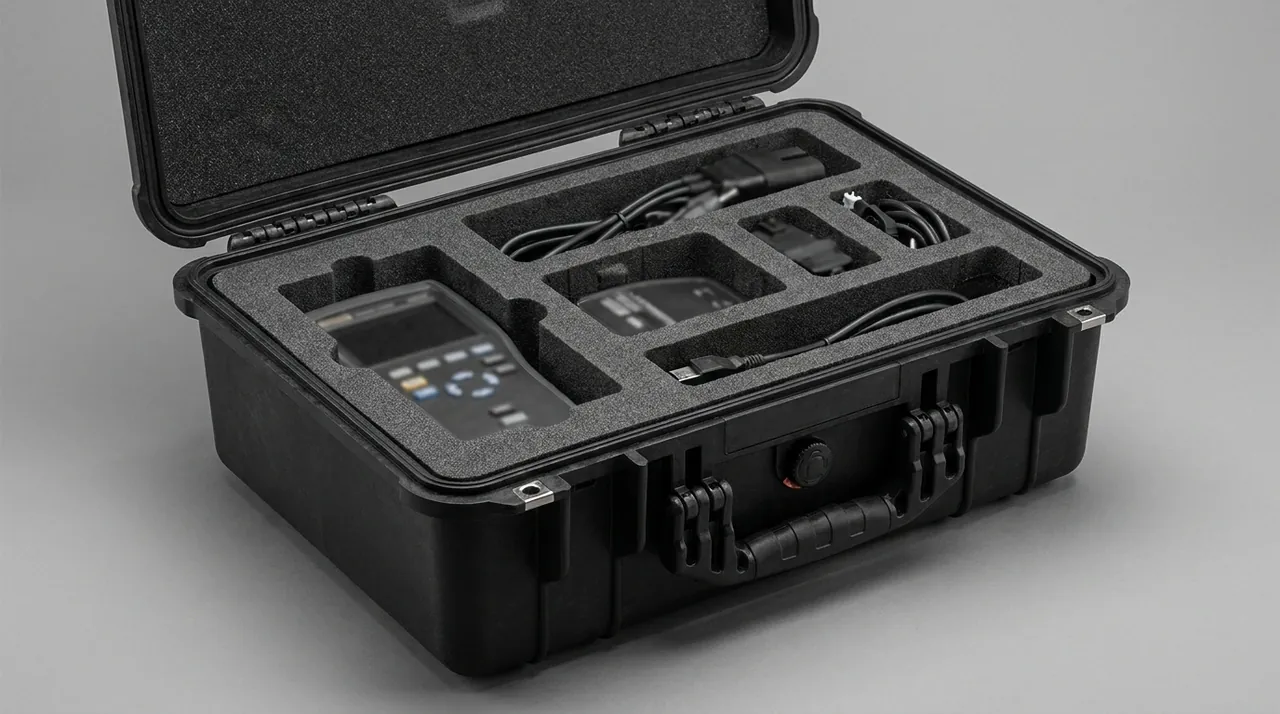
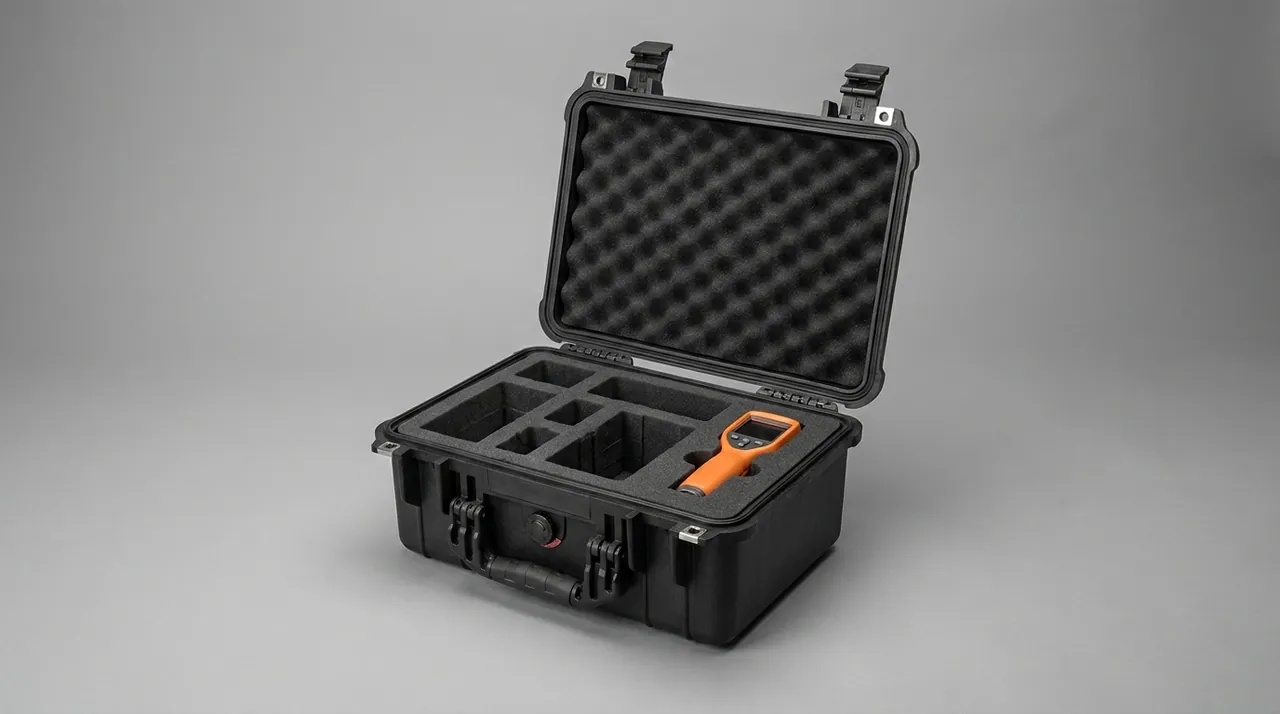
The internal layout of an instrument case decides both access efficiency and protection. A sound zoning usually follows "host in center, accessories around, cables separate": the total station host occupies the central positioned cavity, batteries and charger sit in side pockets, tripod sections lie along the case length, and data cables and prisms get independent small grids. This makes the open lid self-explanatory, reduces search time, and avoids hard objects pressing each other. For crews with multiple instrument sets, color-coded cavities further lower mis-pick probability.
Custom cavity cutting is the method to make the instrument fit tightly. The practice uses CNC carving or hot-knife cutting of foam to dig negative space following the instrument's physical outline, so the instrument embeds with zero clearance on all sides. JUNZHIJIA has mature processes for model-matched seals and custom liners, and can machine cavities that fully fit the host, lens, and handle from the customer's dimension drawings, realizing "one instrument, one cavity". This OEM and ODM capability is especially important for mixed-model loading or imported instruments, significantly reducing micro-wear during transport. For cutting and foam process details, extend reading to the custom foam lining guide.
Zoning must also consider re-configurability. Construction projects are short and instrument combinations change often, so fully fixed cavities may sit idle after a project ends. A compromise is "fixed host cavity plus adjustable divider": the host is locked by cut foam while the accessory zone uses hook-and-loop dividers for flexible adjustment. This keeps core safety and leaves room for change. If the liner is crushed or damp, replace it in time; the judgment method is referenced in the case foam lining guide.
8. Stacking and Transport Adaptation: Strength for Site Turnaround
Instrument cases on site are rarely placed alone; they are often stacked in multiple layers to save depot and vehicle space. Stacking safety relies on three elements: top-surface flatness, four-corner stacking reinforcement, and latch stability under compression. Experience suggests the four corners should have interlocking stack ribs so the upper and lower cases are less likely to shift, and the top lid should have evenly distributed stiffeners to avoid mid-span collapse pressing the instrument. For stacking corner structure and load, consult the case stacking corner guide.
Transport is divided into "short haul" and "long haul". Short haul means internal site or same-city transfer, where buffeting is low-frequency and large-amplitude, and the focus is anti-drop and anti-topple. Long haul means cross-city road or rail, where vibration is mid-to-high frequency, and the focus is anti-resonance. Following the distribution-simulation logic of ISTA series and GB/T 4857, the instrument case should be verified for typical transport-spectrum vibration and drop before leaving the factory. The stacking compliance judgment is extended in the protective case stacking test and protective case stacking guide.
Two loading details also matter: first, leave gaps or use separators between cases to avoid hard contact; second, do not place high-center-of-gravity cases at the bottom to prevent the whole stack from tipping. If palletizing, fix the cases on the pallet before wrapping, rather than loose stacking. JUNZHIJIA can provide corresponding stacking reinforcement and palletizing advice by transport mode, and deliver typical-condition test documentation at handover for the buyer's archive and acceptance.
9. Protection Ratings and Standards: IP/IK/MIL-STD
In selection, translating vague needs into standard language avoids the two sides talking past each other. The table below summarizes common protection and test standards for construction instrument cases for cross-reference.
| Dimension | Standard / Code | Focus | Typical value |
|---|---|---|---|
| --- | --- | --- | --- |
| Dust and water | IEC 60529 / GB/T 4208 | Solid and liquid ingress | IP65 to IP67 |
| Impact | IK code | Enclosure impact | IK08 and above |
| Environment | MIL-STD-810H | Vibration, drop, temp-humid | Method 514 / 516 |
| Transport | ISTA / GB/T 4857 | Distribution environment | Series 1A / 2A |
| Flammability | UL 94 | Plastic burning | V-0 or V-2 |
| Chemical | RoHS / REACH | Hazardous substances | Limit compliant |
The IK code measures the enclosure's resistance to external mechanical impact, the higher the safer, and construction instrument cases are suggested to be no lower than IK08, raising the requirement near lifting or crushed-stone zones. Although MIL-STD-810H originates from military standards, its vibration and drop methods are also useful references for civilian heavy transport, helping enterprises build a "test-improve-qualify" loop. For the landing path of military-standard compliance, read the protective case MIL-STD-810H compliance and protective case IK rating articles.
It must be stressed that standards give "methods" rather than "pass lines", and the specific threshold should be set against the tolerance the instrument maker provides. For example, if a total station maker states the host survives a zero-point-five-meter drop, then the case drop design should aim at "the case drop does not transfer impact to the host" rather than simply applying a uniform number. Evaluating the instrument tolerance and the case protection value together is the responsible way to select.
10. Humidity Control and Desiccant Management: Synergy against Moisture
Beyond dust and vibration, moisture is the "slow killer" of field instruments. Concrete curing, tunnel seepage, and rainy-season work all raise ambient humidity; long-term high humidity corrodes circuits, molds foam, and degrades seals. The case's own sealing delays moisture entry but cannot fully stop the trace water vapor brought by the breathing effect, so desiccants and humidity indicator cards are needed for synergy. Experience suggests keeping relative humidity inside the case within a typical safe band and checking the indicator card after every long-distance shipment.
Common desiccants are silica gel and montmorillonite; the former is regenerable by drying and the latter is low cost and stable. Place them away from the instrument heat vent and lens, fixed in a small cloth bag on the lid inside or in an independent grid, to prevent powder leakage contaminating the instrument. VCI film can form a molecular-level protective film on metal surfaces, suited to long-term stored hosts and accessories. For sealing and post-return cleaning, see the humidity chapter in the protective case maintenance guide.
A common mistake is "put desiccant once and never care again". Desiccants have a saturation limit and release water if overdue. A replacement ledger is suggested: set the cycle by shipment frequency, shorter in rainy season and longer in dry season. If instruments need cross-season long-term storage, use a better-sealed case plus humidity monitoring, and configure a reusable electronic humidity record card when necessary, turning "moisture protection" from an experience action into a verifiable data action.
11. Labeling and Asset Tracking: QR Codes and Color Marks on the Case
When dozens of instrument cases circulate on a site, management efficiency depends on clear marking. Case-face marking generally includes three types of information: asset number, instrument model, and responsible person. The asset number is suggested as a QR code, which on scan calls up purchase date, calibration cycle, repair records, and current project, avoiding paper labels that stain and drop. Color marks classify quickly: red for pending calibration, green for in use, yellow for repair, readable at a glance on site.
The durability of case-face marking must match case life. Silk-screen and etching resist mud and water better than stickers, and JUNZHIJIA can provide multiple printing processes for case-face logo and number, keeping marks clearly readable after repeated outdoor use. For the systematic practice of QR and asset tracking, extend reading to the case asset QR code tracking article. Note that marking should not cover the sealing surface or weaken the case structure; the position should be on the flat area of the top lid.
Asset management also involves a "borrow-return loop". Case in and out of storage should register open-lid checks: is the gasket intact, is the liner shifted, is the desiccant saturated, are accessories complete. Printing these checks inside the lid or writing them into the QR page greatly reduces the probability of "going to work sick". For large construction units, bringing instrument cases into a unified asset system is more reliable than memory, and can quickly present calibration and maintenance evidence during audit.
12. Selection Parameter Checklist: Matching Configuration to Scenario
Converging the above points into an executable selection checklist helps procurement align needs quickly. The suggested check items and targets below can be cited when preparing a technical specification.
| Selection dimension | Suggested target | Acceptance point |
|---|---|---|
| --- | --- | --- |
| Dust grade | No lower than IP5X | Dust test per GB/T 4208 |
| Water grade | IPX7 preferred | One-meter immersion thirty minutes |
| Vibration liner | Host zero shift | No instrument shift after drop-vibration |
| Shell material | PP / PE / Al by need | Wall thickness and rib check |
| Latch | Dual-point compression | No loosening after repeated open |
| Equalization valve | With ePTFE membrane | Smooth lid open at altitude |
| Internal zoning | One instrument one cavity | No abrasion on access |
| Marking | QR code plus color mark | Scan for traceability |
In execution, first define the "harshest condition" rather than the "average condition". For example, if most time is on flat ground but occasionally enters a tunnel, set the dust and water lower limit by the tunnel condition. If a unit manages many instruments, follow the protective case selection guide for serialized configuration, covering most instruments with a few standard case types and reducing spare-part and training cost. JUNZHIJIA can provide a mix of standard and custom cases by model and deliver matching seal and liner drawings.
Finally, selection should not look only at unit price. Mold fee, liner replacement fee, repair-part availability, and life should be included in total cost of ownership before comparing long-term economy of different schemes. For high-volume construction units, a custom dedicated case has higher upfront cost but is often more economical over the use cycle because of high fit and low loss. Upgrading selection from "buy a box" to "build a protection system" steadily supports field surveying quality.
13. Maintenance and Service Cycle: Extending Field Service Life
An instrument case is not "buy and use, discard when broken"; proper maintenance significantly extends its field service life. A three-level maintenance rhythm is suggested: daily check of gasket for debris and marks, weekly cleaning of lid-groove dust and mud, and quarterly seal sampling and latch function test. In rainy or high-dust periods, increase frequency; if the gasket hardens, cracks, or loses rebound, replace it immediately. For specific cleaning and seal care steps, see the protective case cleaning guide.
Seal replacement is the maintenance focus. Experience shows EPDM in strong outdoor sunlight develops surface cracks after several years, and silicone lasts longer but still needs regular checks. When replacing, choose a cross-section size matching the original groove, clean the groove bottom before bonding, and ensure continuity without breaks. JUNZHIJIA can supply model-matched seals and provide seal specifications and replacement notes with the case, enabling the user unit to self-maintain without relying on the original factory on site, shortening downtime.
Storage also affects life. Long-unused cases should be opened for ventilation, with liners taken out and air-dried in shade, to avoid foam molding in a closed high-humidity environment; the case should lie flat, avoiding long-term one-side compression causing deformation. If instruments need over-winter or cross-year storage, place sufficient desiccant inside and mark the sealing date. Linking maintenance records with the asset QR code to form a complete "purchase-use-maintain-scrap" archive is a practical step for construction-unit equipment management to move toward standardization.
FAQ
Q: What is the core difference between a surveying construction instrument case and a common tool box? A: The core difference lies in the design goal. A common tool box prioritizes storage capacity and access convenience, with lower requirements for dust, vibration, and water protection. A surveying and construction instrument case takes protecting instrument accuracy as its first goal, emphasizing continuous sealing, positioned liner, and energy-absorbing cushioning so that total stations and levels keep zero shift, no water ingress, and no abrasion under dusty and vibrating conditions. Shell material, latch pressure resistance, pressure equalization valve, and internal zoning all serve "protect better" rather than "carry more". Therefore, even if they look similar, the two types are not interchangeable in structure and acceptance standards, and selection cannot replace protection metrics with price or volume alone. Site managers should first confirm the IP grade, liner positioning method, and drop verification result, then decide by budget. As a practical step, request the supplier's test documentation for the relevant IP and drop standards before purchase, because a written report is the only reliable proof that the case meets its stated protection level in the field, and verbal claims alone should never close a procurement decision.
Q: How should I choose between IP5X and IP6X dust grades? A: IP5X is the dust-protected grade, allowing very little dust to enter under specific conditions without affecting operation, while IP6X is the dust-tight grade that completely blocks dust ingress. If the construction site is near a mixing station, crushing yard, tunnel face, or severely wind-eroded Gobi, IP6X is directly suggested because continuous dust slowly seeps through any tiny gap and accumulates to contaminate the lens and circuit over time. If used only on hardened pavement or around indoor warehouses for short periods, IP5X is usually enough, but still requires good gasket maintenance. Note that dust and water must be confirmed separately; achieving IPX7 does not automatically mean IP6X. Acceptance should run the corresponding test per GB/T 4208 and write the grade into the technical agreement to avoid disputes and rework from verbal promises. When in doubt, choose the higher grade, because the marginal cost of moving from IP5X to IP6X is small compared with the cost of a contaminated lens or corroded board. Also keep a routine of wiping the lid groove before closing, since even a dust-tight rating cannot compensate for grit trapped in the seal during forced closing.
Q: Is thicker vibration cushioning always better? A: Not necessarily; thickness must balance energy absorption and positioning. Over-thick foam occupies volume, increases case size, and may lose positioning under over-compression, causing the instrument to shake inside. Experience suggests a bottom cushion under the host no less than twenty millimeters with corner protectors is a sound starting point, but the specific value should be set against instrument weight and transport vibration spectrum. More important than mere thickness is "positioning", namely locking the instrument on all sides with a cut cavity plus a bottom absorption layer. For a total station with a precise compensator, add flannel on the cavity wall to reduce abrasion. For higher vibration needs, verify following the MIL-STD-810H vibration method and determine thickness by test data rather than intuition. In practice, also reserve a small clearance above the instrument so the lid does not pre-load the cushion when closed, because permanent compression reduces the liner's service life. Pair the bottom layer with side walls of the same density to build a closed cradle, and record the liner thickness in the asset file so future replacements match the original design intent without guesswork.
Q: Will the pressure equalization valve break waterproof performance? A: A properly designed valve will not break waterproofing; on the contrary, it improves reliability. Its principle is to conduct when the internal-external differential exceeds a threshold to balance pressure, while the internal hydrophobic breathable membrane intercepts water and dust. The key is the valve opening differential setting: too low conducts prematurely during immersion, too high loses the balance function. Typically under IP67, the opening differential is controlled within a typical safe band, handling the breathing effect from plateau and day-night temperature swings without failing during short immersion. The valve should be on the case side rather than the bottom to avoid backflow, and the membrane should be PTFE-type. At selection, ask the maker for the valve opening parameters and membrane pore size, and verify both high-altitude opening and immersion at acceptance. Field crews should also include the valve in the pre-trip check, because a clogged membrane loses its balancing function and may force the lid to seal harder than designed. If the case works near continuous standing water, favor a side-mounted valve with a protective cap and confirm the cap rating matches the box rating.
Q: How do I judge whether the seal needs replacement? A: Judging seal replacement can start from three aspects: appearance, touch, and function. On appearance, surface cracking, hardening, missing corners, or local shedding means replacement. On touch, loss of elasticity or slow rebound after pressing also signals aging. On function, if the lid has a gap under light press after closing, or water traces appear inside after immersion, the seal has failed. Experience shows EPDM in strong sunlight outdoors begins to degrade after several years, while silicone lasts longer but still needs quarterly sampling. When replacing, choose a cross-section size matching the original groove, clean the groove bottom, and bond continuously without breaks. JUNZHIJIA can supply model-matched seals with replacement notes, enabling the user unit to self-maintain and reduce waiting downtime. A useful habit is to photograph the cross-section of the old seal before removal, so the new part is ordered to the exact profile and hardness; a wrong section size changes the compression and can void the whole sealing line. Store spare seals away from direct sunlight to avoid premature aging before they are installed on the case.
Q: Can I repair a damaged internal foam cavity by myself? A: Minor damage can be handled in-house, but with measured limits. If only a single dent or small block is missing, restore positioning with a same-density EVA or EPE patch. If the cavity is overall deformed, cracked in multiple places, or can no longer fix the instrument, replacing the whole liner or re-cutting is suggested to avoid instrument shift in transport. Self-repair should use neutral adhesive to avoid corroding foam and instrument surfaces, and after repair do a simulated shake check to confirm the instrument does not loosen. For mixed-model loading or imported precision instruments, the safer approach is to contact the original factory for a model-based custom liner to guarantee fit. Whether self-repaired or redone, record the replacement date in the asset archive for later traceability and cycle management. Note that a patched cavity should be re-validated with a short drop test before the instrument returns to heavy use, because adhesive joints can soften in high heat. Where the instrument mix changes often, consider a modular liner with removable blocks so small damages are fixed by swapping a block rather than re-cutting the entire sheet.
Q: How can the liner be both safe and flexible across multiple projects? A: A "fixed host cavity plus adjustable divider" hybrid is recommended. The host is locked by CNC-cut foam to guarantee core safety, while the accessory zone uses hook-and-loop dividers for flexible adjustment to fit different project instrument combinations. This avoids frequent replacement of the whole liner and allows quick reconfiguration at project switches. If projects are very short and instrument combinations vary greatly, an independent inner bag can also be used: put the whole instrument set into a soft inner bag and then into the case, reducing dependence on fixed case cavities. Either way, confirm instrument return and accessory completeness on every lid opening, and include liner status in weekly inspection to prevent protection decline from crushing or dampness. For mixed fleets, keep a printed cavity map inside the lid so any crew member can restore the correct layout after a project switch without guessing. When buying new instruments mid-project, ask the case maker to extend the existing liner rather than design a new box, which preserves spare-part commonality and training consistency across the whole team.
Q: Besides unit price, what long-term costs should procurement watch? A: Beyond unit price, include mold fee, liner replacement fee, repair-part availability, life, and scrap cost into total cost of ownership. A custom dedicated case has higher upfront cost but is often more economical over the use cycle because of high fit and low loss, while a standard case is cheaper upfront yet may increase instrument micro-wear and spare management cost through poor fit. Also confirm whether the maker can supply seals and latches as long-cycle consumables, and whether typical-condition test documentation is delivered with the case for archive acceptance. For high-volume construction units, serialized configuration with a few standard case types covering most instruments reduces training and spare complexity. Upgrading selection to "build a protection system" steadily supports field surveying quality and standardized equipment management. Track these costs in a simple spreadsheet from the first purchase, because the gap between a cheap standard box and a fitted custom case often reverses after two or three field seasons once rework and instrument damage are counted. Involve the instrument users in the selection review, since they are the first to notice when a liner no longer holds the instrument steady during transport.