

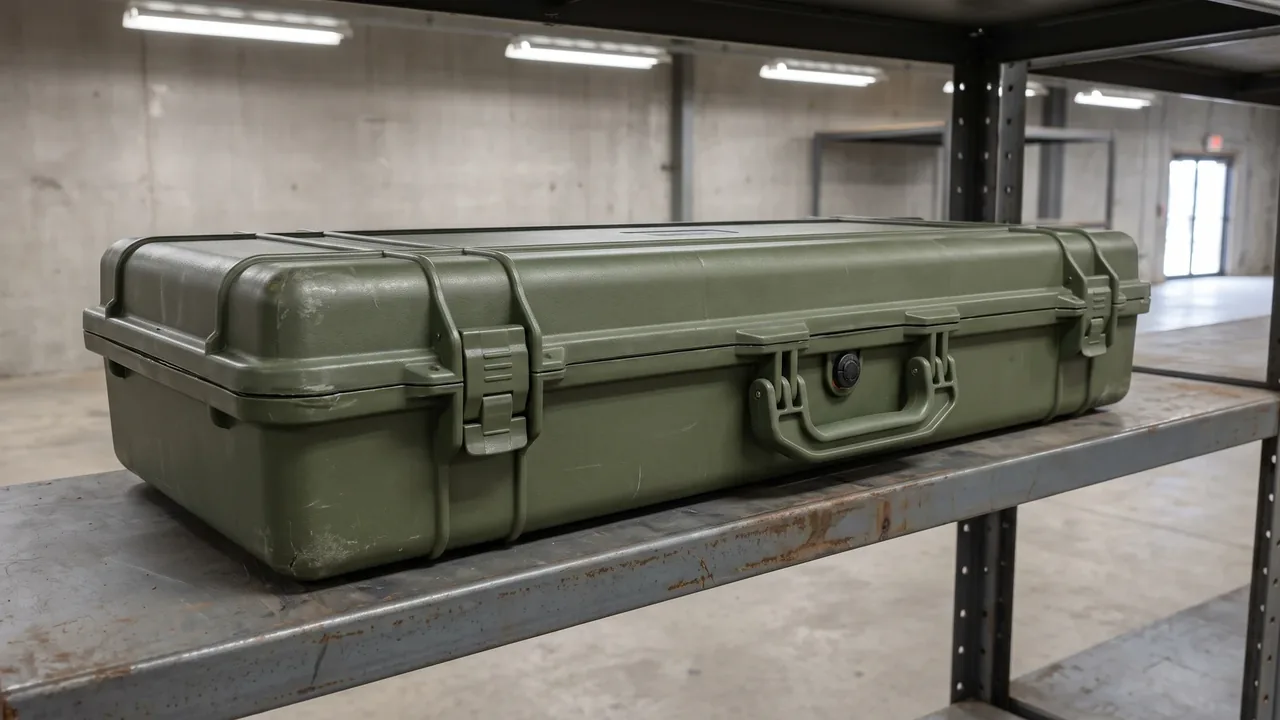
Field storage, nearshore operations, flood rescue, and emergency response routinely expose equipment to short or sustained liquid immersion. For a protective case that must keep its interior dry while fully submerged, an IP68 rating means its sealing capability has been verified by a third party to withstand continuous immersion at a declared depth and duration, a more demanding requirement than IP67. This article focuses on the case itself and systematically covers the definition basis of IP68, the sealing structure, material selection, verification testing, and maintenance, so that procurement and engineering staff can build practical selection and acceptance criteria. The standards referenced include IEC 60529, GB/T 4208, and MIL-STD-810H method 512. Readers may consult the IP rating guide and the protective case IP67 versus IP68 comparison alongside this text. A protective case is not made waterproof by a single part; it is the coordinated result of shell, lid, gasket, latches, and pressure valve working together, and understanding this principle underlies every selection and acceptance task that follows.
1. Definition and Test Basis of the IP68 Rating
The IP (Ingress Protection) code uses two characteristic digits. The first digit indicates protection against solid foreign objects, including dust. The second digit indicates protection against water. In IP68, the "6" means dust-tight: no harmful dust can enter the case. The "8" means the equipment can withstand continuous immersion under conditions agreed between the manufacturer and the certifying laboratory. This classification is drawn directly from the international standard IEC 60529, with the domestic equivalent GB/T 4208; the two are technically aligned and differ mainly in numbering. It must be clear that IP68 is not a single fixed "how deep can it sit" number. Instead, the standard authorizes the manufacturer to declare the immersion depth and time, for example "1 meter for 30 minutes" or "1.5 meters for 60 minutes", and a laboratory issues a report against precisely those conditions. As a storage and transport container, a protective case follows the same logic: the more explicit the declared conditions, the stronger the basis for site acceptance. Engineering practice recommends writing the IP68 declared conditions into the technical agreement as the reference for later sampling and claims. For a general overview, see the waterproof case overview. A label that simply states IP68 without a verifiable test report carries very limited meaning in real procurement.
2. The First Digit 6: Dust-Tight Meaning and Verification
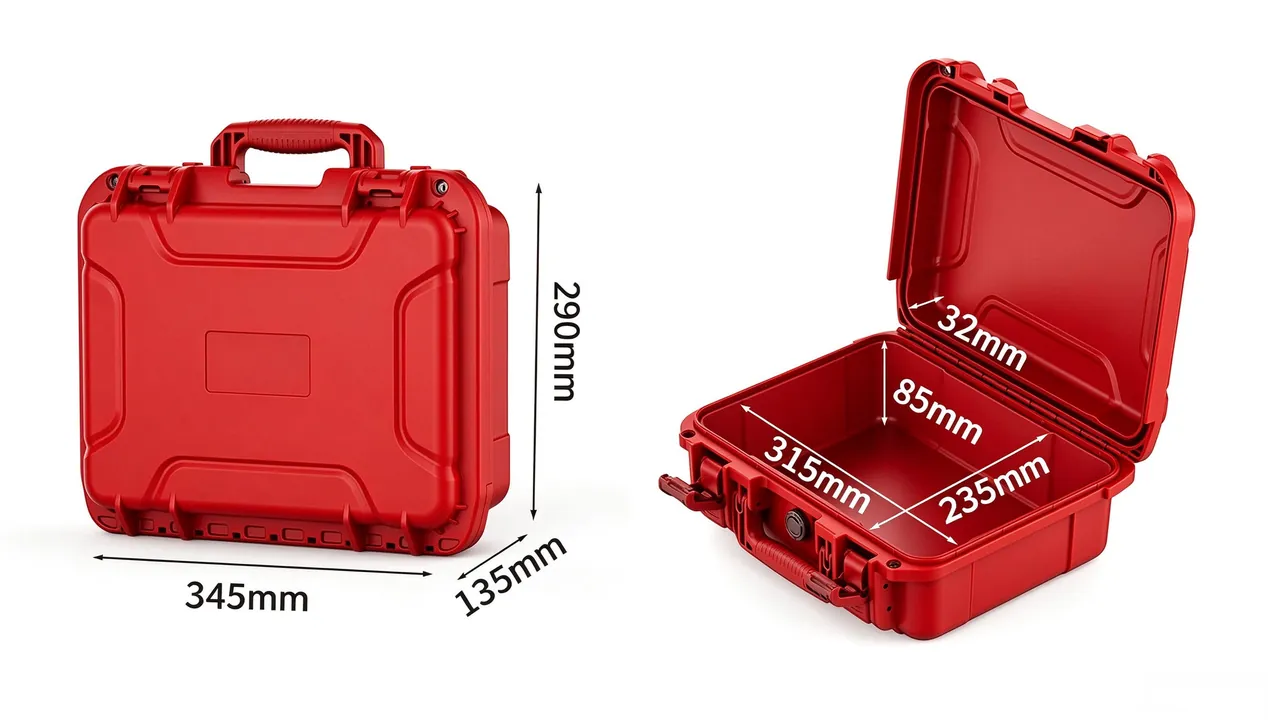
The dust protection scale runs from 0 to 6, and digit 6 corresponds to "dust-tight", the highest level in the dust sequence. The test is typically run in a negative or positive pressure dust chamber, where talcum powder of a specified particle size is blown continuously for several hours, after which the case is opened and inspected for any perceptible dust deposit inside. For a protective case, dust and water protection share the same sealing interface, so a dust failure often also signals a water risk. In high-dust environments such as deserts, mines, and cement plants, a dust-tight rating significantly reduces the chance that precision contents - sensors, lenses, circuit boards - are contaminated by abrasive particles. It is worth noting that the dust test does not apply pressurized water; it examines the continuity and fit of the sealing interface. A gasket that performs well in the dust test can still leak in the water immersion test if its cross-section or compression is poorly designed, so both tests should be part of the IP68 declaration and must not substitute for one another. In the case shell selection guide, flange flatness is repeatedly stressed because it affects both the dust and water boundaries. Engineering may also combine the dust rating with an internal dust-control structure, for example adding a replaceable filter near the valve, to further slow dust buildup in high-risk settings.
3. The Second Digit 8: Immersion Conditions and Manufacturer Customization
Unlike the fixed "1 meter, 30 minutes" condition of IPX7, the depth and time of IPX8 are negotiated between the manufacturer and the laboratory and may exceed 1 meter. This is precisely what distinguishes IP68 from ordinary splash- and rain-proof cases: it targets extreme duty where the whole case may be submerged, such as flood rescue, overboard mounting on vessels, and auxiliary diving transport. Common declarations read "IP68 (1.5 m, 60 min)" or "IP68 (2 m, 30 min)". Buyers should require the supplier to state the bracketed content rather than merely writing "compliant with IP68". Different depths impose markedly different forces on the case: shallow versus deep immersion place different demands on latch clamping force, gasket compression and rebound, and shell rigidity. Experience suggests that deep immersion duty should favor a thicker-walled case and a wider cross-section gasket, with an agreed leakage criterion in the contract, for example no free-standing water at the bottom of the inner liner after opening. For the boundary between shallow and deep immersion, see the IP67 protective case selection guide. The manufacturer-customized immersion condition must appear in the test report and in the nameplate or manual; site acceptance should re-test against that condition so the IP68 value is actually realized rather than asserted.
4. Core Differences Between IP68 and IP67 and Their Use Cases
Both IP67 and IP68 require dust level 6; the entire difference lies in the second digit. IP67 is "1 meter, 30 minutes of short-term immersion"; IP68 is "negotiated depth, longer-duration continuous immersion". Simply put, IP67 addresses accidental dropping into water and brief rain pooling, while IP68 addresses duty where the equipment must be submerged together with the case. For most field storage, IP67 is sufficient; but when the case must submerge with a ship, assault boat, underwater robot, or diver, or when it sits long-term in low-lying areas that may flood, IP68 becomes necessary. A caution is warranted: some marketing treats IP68 as a synonym for "can sit in water indefinitely", which is not rigorous. IP68 remains a conditional pass, and the gasket degrades with aging, impact, and temperature cycles. Selection should work backward from the real duty depth and time rather than blindly chasing a higher number. For a systematic comparison, consult the protective case IP67 versus IP68 comparison. In engineering practice, also include immersion frequency, water temperature, and whether sand is present in the variables, so a single grade number does not mask a complex duty profile.
5. Case Sealing Structure: Cooperation of Lid, Gasket, and Latches
Waterproofing a protective case is not achieved by a single part but by a sealing system formed jointly by the lid, gasket, latches, and the shell flange. When the lid closes, the latch uses leverage to amplify clamping force and presses the silicone or rubber gasket into the sealing groove of the shell flange, forming a continuous, unbroken seal line. Any break point - for example excessive latch spacing causing insufficient mid-span contact, burrs in the sealing groove, or poor corner radius transition - becomes a water ingress path. Therefore, evaluating an IP68 case requires looking beyond gasket material to latch count and distribution, shell flange flatness, groove cross-section, and compression. Engineering commonly uses "compression ratio" to describe the gasket working state; a typical silicone gasket in the 20% to 35% compression range both seals and avoids excessive creep. For the structural parts themselves, see the discussion of flange and latch-point layout in the case shell selection guide; latch force checking is equally a design priority. In practice, the number of latches and their spacing should be derived from the contents mass and stacking layers so that the entire seal line is loaded evenly, avoiding locally under-pressed weak points that would leak first under buoyancy.
6. Performance Comparison of Common Gasket Materials
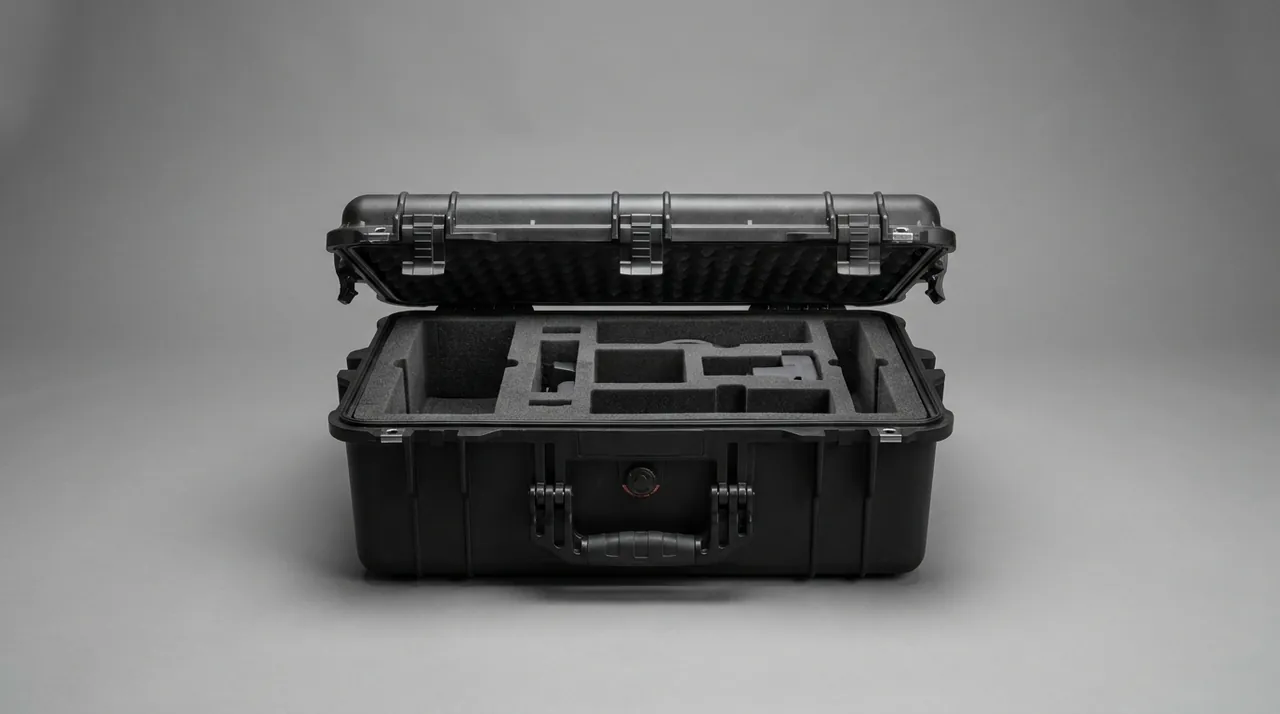
Gasket material directly determines the long-term reliability of IP68 in storage and transport. Silicone offers a wide operating temperature range (typical value about -50 C to 200 C), low compression set, and food-grade options, suiting wide-temperature and clean environments. EPDM (ethylene propylene diene monomer) excels in ozone, weather, and UV aging resistance, fitting long-term outdoor sun exposure. Nitrile rubber (NBR) resists oil well, suiting storage with fuel and hydraulic equipment, but its weather resistance is weaker than the former two. The three trade off on hardness (Shore A 50 to 70 common), rebound, and cost. The table below summarizes typical orientations:
| Material | Temp range | Key strength | Main weakness | Typical use |
|---|---|---|---|---|
| --- | --- | --- | --- | --- |
| Silicone | -50 C to 200 C | Low compression set | Moderate strength | Wide-temp clean |
| EPDM | -40 C to 130 C | UV and ozone resist | Poor oil resist | Long-term outdoor |
| Nitrile | -30 C to 110 C | Good oil resist | Weak weather | Fuel-related gear |
Selection should also consider compression set: the lower this value, the better the case maintains sealing force after repeated opening and long-term compression. For a more systematic comparison, see the case seal material selection and case gasket and O-ring materials articles. In immersion duty, prefer silicone or fluorosilicone with compression set below 25%, and verify hardness, rebound, and chemical compatibility with the actual contents before committing to a batch.
7. Role of the Pressure Equalization Valve in Immersion
As a protective case experiences altitude changes or sharp temperature and humidity swings, the air volume inside changes and creates a pressure differential that can push the gasket open or make the lid hard to open. A Gore-type membrane valve (the pressure equalization valve) blocks liquid water entry while allowing slow gas exchange to balance internal and external pressure. In immersion scenarios, a qualified pressure equalization valve must share the IP68 rating of the case; its membrane pore size is far smaller than a water droplet and relies on hydrophobic and oleophobic properties to "breathe but not admit water". Note, however, that the valve is one of the waterproof weak points: if the membrane is covered with oil, sand, or mechanically damaged, the waterproof grade drops. Therefore immersion-grade cases often make the valve a replaceable module with a marked maintenance interval. For principles and selection, see the case pressure equalization valve guide and the case pressure equalization valve article. Before deployment on a vessel, sample-check the membrane contact angle and flow rate. The mounting location should avoid the likely-first-wet bottom and corners; placing it high on the lid reduces the chance of sand coverage and direct hydrostatic shock, and eases quick removal during maintenance.
8. Effect of Shell Material and Wall Thickness on Sealing Durability
The shell material of an IP68 case directly affects the rigidity and long-term stability of the sealing interface. Engineering plastics such as modified PP, ABS, PC, and their alloys, formed by injection or rotational molding, keep flange flatness while remaining light; metals (aluminum alloy, stainless steel) provide stronger deformation resistance but cost more in flange welding and machining. Wall thickness is another key parameter: too thin a wall can locally dent under latch clamping and break the seal line; too thick adds weight and enlarges the mold. Experience places rotational-molded wall thickness around 3 to 5 mm and injection-molded around 2.5 to 4 mm, to be checked against contents mass and stacking layers. For long-term immersion, a finite element stress analysis at the design stage is recommended to confirm that deformation near latch points and corners stays controllable. Relevant structural strength checks can be compared with the case shell selection guide. In coastal or salt-spray environments, metal shells also need consideration of galvanic corrosion and surface treatment, such as anodizing or anti-corrosion coating, to avoid flange-face unevenness and consequent leakage near latch points caused by corrosion.
9. Influence of Latches and Hinges on Seal-Line Continuity
A latch is not only for theft deterrence and fixation; it is the "force source" of the seal line. Dual or multi-point latches distribute lid force more evenly, avoiding one side relaxing while the other is over-tight. Latch lever ratio, spring return force, and salt-spray resistance are all evaluation points; in marine environments, prefer stainless steel or corrosion-treated alloys. The hinge determines lid open-close life and alignment precision - if the hinge loosens, repeated opening shifts the lid relative to the shell and the seal line drifts periodically, eventually leaking. Engineering commonly uses a "fatigue life" metric for latches and hinges, for example requiring sealing performance to hold after 5000 open-close cycles. For latch selection, see the case lock customization options and case latch selection articles. Hinge replacement is covered in the case hinge replacement guide. In custom projects, configure 2 to 4 latches according to case size and add auxiliary compression points at corners, so that the mid-span of long sides also receives adequate compression and the risk of local unsealing from buoyancy during immersion is reduced.
10. Liners and Cushioning as Auxiliary Protection Under Immersion Shock
Even with an IP68 case, precision contents still need liners and cushioning to withstand collision, vibration, and hydrostatic squeeze during immersion. Common liner materials include EVA, PE foam, polyurethane (PU) foam, and pre-cut foam; the case pre-cut foam and case pick-and-pluck foam suit rapid shaping, while the custom foam lining guide targets contour fitting of complex equipment. In immersion duty, also consider liner water absorption: highly absorbent foam gains weight after exit and may breed mold, so prefer closed-cell foam with water absorption below 5%. For electronic equipment, the liner can reserve a desiccant bay and humidity indicator card, forming a "seal plus desiccant" double safeguard. Liner logic matches the case internal foam types article. When customizing the liner, keep an even cushion gap between the equipment and the case wall so that floating during immersion does not push the equipment directly against the lid interior and indirectly affect the seal; the liner should also not block the valve or drainage path, keeping maintenance and inspection convenient.
11. IP68 Verification Test: Tank, Depth, Duration, and Judgment
IP68 verification is normally run in an immersion tank: the closed case is fully submerged in fresh or simulated seawater at the declared depth, held for the declared duration, then removed and opened to check for internal water. The pass criterion should be agreed in advance, for example "no visible standing water on the liner or inner surface, electronic bay dry" counts as pass. Before the test, confirm the lid is closed at the specified torque, the valve is intact, and the groove is free of debris. For credibility, have a third-party laboratory issue a report per IEC 60529 / GB/T 4208, noting water temperature, water type, immersion depth, and duration. For batch supply, adopt "first-article full inspection plus periodic sampling", with sampling ratio per AQL or the mutual agreement. For apparatus and procedure, see the water immersion test guide and airtight leak testing article. Note that the salinity of the immersion medium affects long-term gasket aging; if the real duty is seawater, validating with simulated seawater (such as 3.5% sodium chloride solution) brings the test closer to use and avoids the bias where fresh water passes but salt water fails.
12. Factory and Site Sampling Seal Methods
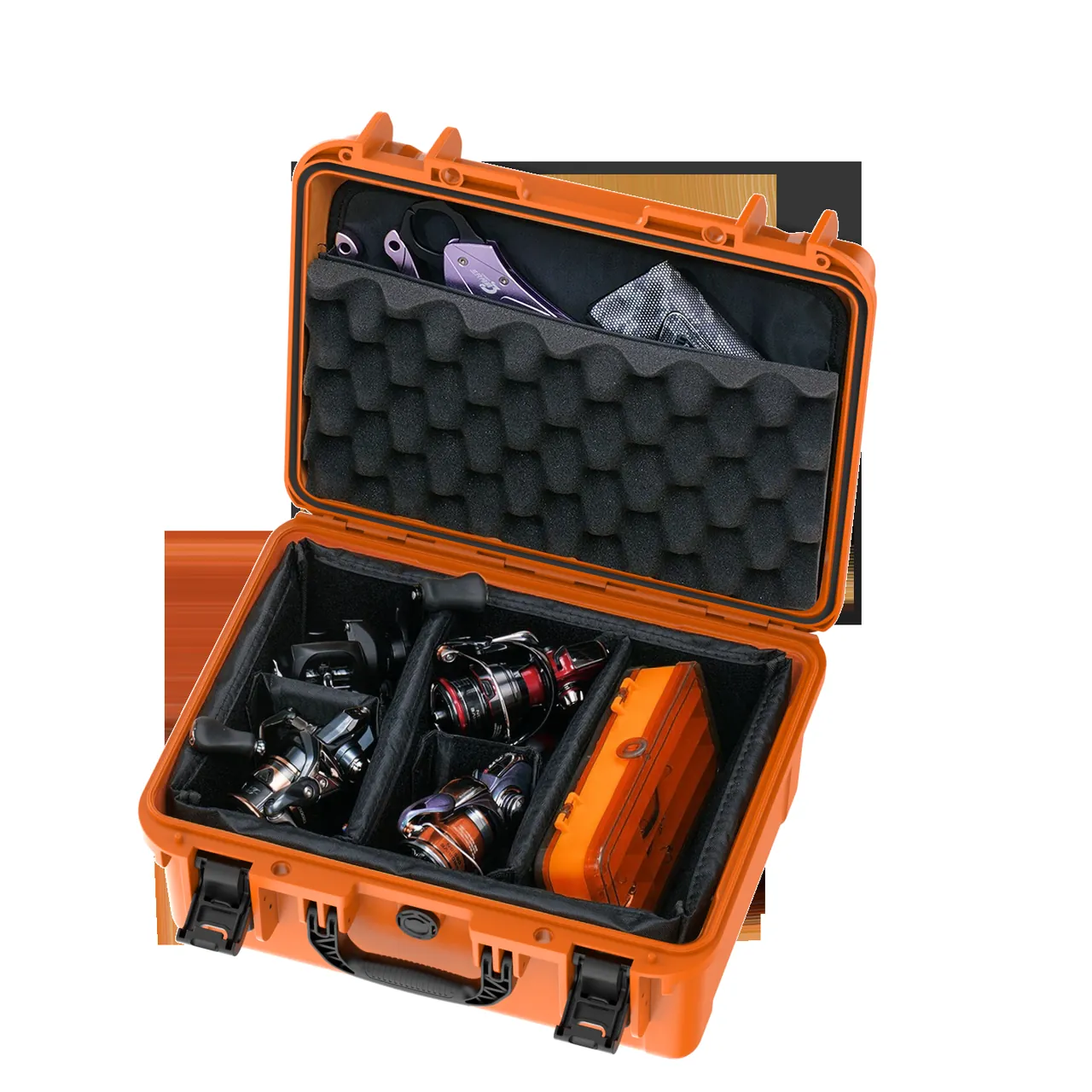
Beyond full immersion, the production line can use pressure leak testing, vacuum suction, and dye tracing for 100% factory inspection at low cost. The pressure method fills the case with slight positive pressure and watches pressure decay or applies soapy water to find bubbles. The vacuum method extracts internal air and submerges to watch for bubbles. The dye method coats the outer sealing interface with a colored liquid and checks for inward penetration after opening. All three quickly locate seal breaks without deep immersion, fitting high-volume flow. At goods receipt, buyers can re-test per the incoming inspection waterproof test and, where needed, verify report authenticity against the logic in verify IP67 certification. Emphasize that factory quick tests do not replace full immersion certification; they should form a "quick test controls process, certification controls compliance" partnership. For cases used in critical missions, add one extra full immersion sample at goods receipt and file the result in the supplier performance record as the basis for later order allocation and claims.
13. Daily Maintenance and Gasket Life Management for IP68 Cases
IP68 is not a "set and forget" label; gasket aging, impact deformation, and embedded debris quietly lower the rating. Daily maintenance should: visually inspect the groove for cleanliness and absence of sand or hair before each use; avoid yanking the lid so the gasket does not pop out; apply a little silicone oil to the seal face before long storage to slow aging; and replace the gasket on a cycle (typical value 12 to 24 months) depending on frequency and environment. If the case has been dropped or crushed, re-run an immersion sample before returning it to critical duty. For marine-use cases, periodically clean salt spray and lubricate latches. Maintenance can follow the protective case cleaning and maintenance and case seal aging articles. Gasket replacement interval and steps are detailed in the case seal strip replacement guide. To make maintenance real, build a per-case log recording open-close count, immersion count, gasket replacement date, and sample results, so the IP68 grade is sustained to the end of the product life rather than resting only on the factory label.
14. Labeling, Stacking, and Transport Compliance for IP68 Cases
Reaching an IP68 rating does not end the responsibility at the design stage; several compliance points in delivery and logistics are often overlooked and can quietly defeat the paper grade in the field. The first is product labeling. The case should display the actual declared IP68 condition in a visible location, for example "IP68 (1.5 m, 60 min)", together with the production batch, the recommended gasket replacement interval, and the manufacturer identity, so that users do not mistake short-term immersion for indefinite submersion. Clear labeling also reduces communication cost across teams, letting warehouse, transport, and field users share a consistent understanding of the protection boundary and lowering the chance of misuse-induced water ingress during real operations.
The second point is stacking and load. Where stacks must be tall, consider interposing rigid spacers so the load is carried by the shell corners rather than the lid, preserving the seal geometry under compression and avoiding the mid-span lift that lets water creep in. Buoyancy markers also help if the case is dropped from a vessel, because a floating, visible case is far easier to recover than one that sinks with the payload still inside, and a quick recovery prevents a long uncontrolled soak that the rating was never meant to survive. Although an IP68 case is sealed as a whole, excessive stacking layers impose large static pressure on the bottom cases; under long-term compression the latch metal may fatigue and the gasket may creep, so that sealing force is insufficient at the next immersion. Engineering should calculate the maximum stacking layers from the case rated stacking load and the gross mass per case, and mark the height limit clearly on the outer case. For the stacking structure itself, consult the case stacking structure and case stacking corner guides, and use palletized transport when appropriate to distribute the load and avoid local overload that would distort the flange and break the seal line during a later submerged deployment.
The third point is transport traceability and emergency readiness. If the contents are controlled or high-value equipment, attach a copy of the third-party immersion verification report, the packing list, and a unique traceability barcode, so that every case can be traced to its production batch and verification result. For marine or flood-exposed transport, add reflective tape or a buoyancy marker on the case exterior to aid night search and recovery after accidental dropping into water. Storage environment also matters: even a sealed case should not be stored in direct, sustained sunlight or against a hot deck, because UV and heat accelerate gasket aging and can warp thin shells; a shaded, ventilated, dry area with periodic rotation by batch extends the effective life of the whole fleet.
The final point is training. Field crews should be briefed on how to close latches to the specified torque, how to inspect the groove before each use, and what to do if the case was dropped or crushed. A verification checklist attached to the case turns individual knowledge into a repeatable procedure. Only when labeling, stacking, traceability, storage, and training are managed together does the IP68 rating deliver its promised protection across the whole lifecycle rather than only at the test bench. A managed program also feeds back into supplier evaluation: cases that repeatedly pass immersion sampling build trust, while those that fail trigger corrective action before a critical mission depends on them. In short, IP68 is a system property, not a sticker, and the logistics and training discipline around the case is what converts the laboratory pass into field reliability.
At the acceptance stage, write the IP68 declared condition, the immersion medium, the sampling ratio, and the pass criterion into the procurement technical agreement, and treat the first-article full inspection report as a precondition for batch release. This converts a marketing claim into an enforceable contract clause rather than a slogan on the box. For fleets that need recurring deployment, pair the case with a stock of spare gaskets and a scheduled re-validation calendar so that protection does not silently decay between missions. The cost of one extra immersion sample per quarter is trivial compared with the cost of a flooded payload, and the data it produces is exactly what a continuous-improvement loop needs to catch a drifting process early.
Lifecycle cost should also enter the selection review. A case with reliable sealing and convenient maintenance may carry a slightly higher unit price, yet it amortizes that premium through a longer gasket life, fewer water-ingress repairs, and less lost equipment, so its total cost of ownership is often lower than a cheap case that is replaced repeatedly. Procurement teams that score suppliers on verified immersion performance, spare-part availability, and documented maintenance guidance tend to see fewer surprises in the field. In practice, organizations that treat IP68 as a managed process rather than a one-time rating consistently report lower failure rates and a more predictable budget across the service life of the equipment they protect. For organizations procuring at scale, asking the supplier to bundle model-specific seal kits, custom liners, and test documents from the first unit turns the labeling, traceability, and maintenance requirements into physical deliverables instead of paper promises, which is the most reliable way to keep the rating meaningful over many years. A practical habit is to photograph the label at goods receipt and store the image with the batch record, so that years later the exact declared condition is still known without opening the archive, and new staff can be trained from real examples rather than from memory.
FAQ
Q: Does IP68 mean the protective case can sit in water forever? A: No. IP68 is a conditional pass achieved under manufacturer-declared "depth plus duration" immersion conditions; it is not a promise of permanent waterproofing. The gasket degrades with aging, impact, temperature, and repeated opening, and long soaking accelerates material fatigue. Engineering should treat IP68 as "reliable sealing within that duty window" and write the immersion depth, duration, and pass criterion into the technical agreement; beyond the agreed range there is no guarantee. Daily practice should replace gaskets on a cycle and run sampling to sustain protection. Blindly believing "permanent waterproof" often causes equipment water damage during critical missions. The correct approach binds the grade number to a maintenance system and forms a closed loop. Without that loop, the label loses practical meaning and the real protection level silently declines with each field cycle, which is exactly the failure mode procurement teams must avoid through disciplined inspection. A practical control is to re-verify a sample from each shipment and keep the result on file so trends are visible before a field failure occurs.
Q: How do I read the IP68 declared conditions a supplier writes? A: Insist that the supplier state the bracketed values in the report and technical file, for example "IP68 (1.5 m, 60 min)" or "IP68 (2 m, 30 min)", rather than merely "compliant with IP68". Because the depth and time of IPX8 are negotiated between maker and lab, different numbers represent completely different protection. Buyers should compare that number with the real duty - such as overboard mounting depth or possible flood depth - and, where necessary, require a third-party report per IEC 60529 / GB/T 4208, agreeing sampling method and leakage criterion in the contract. Only then is there a basis if disputes arise, and vague marketing is avoided. The report should also state whether the test medium was fresh or simulated seawater, which directly affects the usability of the conclusion. Treat the declared condition as the acceptance reference for every incoming lot so the specification is enforced rather than decorative. Asking for the simulated seawater note in the same report removes ambiguity when the real duty is marine and prevents a fresh-water-only pass from being accepted by mistake.
Q: Can the pressure equalization valve become the weak point of IP68? A: It can. The pressure equalization (membrane) valve relies on a pore far smaller than a droplet plus hydrophobic and oleophobic properties to "breathe but not admit water", and under immersion it is itself a waterproof weak point. If the membrane is covered with oil or sand, or is scratched or aged and cracked, the waterproof grade drops. Therefore immersion-grade cases usually make the valve a quick-replace module with a marked maintenance interval; before launch or submersion, sample-check the contact angle and flow rate separately. At selection, confirm the valve grade matches the case at IP68, rather than only the shell passing while the valve is a lower grade. Only then is the whole seal chain complete and reliable across the duty cycle. The mounting position should also be high to reduce the chance of sand coverage, and the membrane should be inspected each time the case is exposed to contaminated water before the next immersion. A simple pre-dive visual check of the membrane for scratches or sand bridging is far cheaper than discovering a leak during a submerged operation far from support.
Q: How should I choose the gasket material to be safe? A: The mainstream choices are silicone, EPDM, and nitrile. Silicone has a wide temperature range and low compression set, suiting clean and wide-temperature settings. EPDM resists UV and ozone aging, suiting long-term outdoor sun. Nitrile resists oil, suiting fuel-related contents, but weathers less well. For immersion duty, prefer silicone or fluorosilicone with compression set below 25%, and watch hardness (Shore A 50 to 70 common). Whatever you choose, ensure the groove cross-section and compression are reasonable, with a typical 20% to 35% compression ratio. Specific trade-offs are covered in the gasket material and O-ring material articles, which also discuss cost and chemical compatibility for harsh contents. In seawater environments, additionally evaluate salt-spray and hydrolysis resistance, because the same compound that performs well in fresh water may degrade faster under continuous saline exposure and pressure cycling during repeated dives. Documenting the chosen compound in the maintenance card helps the next technician order the correct replacement rather than a generic gasket that may not survive the same duty.
Q: Is a thicker IP68 case wall always better? A: No. Wall thickness must be checked against contents mass, stacking layers, and immersion depth, not simply maximized. Too thin a wall can locally dent under latch clamping and break the seal line; too thick adds weight, enlarges the mold, and may warp from internal stress. Experience places rotational-molded walls at 3 to 5 mm and injection-molded at 2.5 to 4 mm, with deep immersion or heavy contents warranting finite element analysis to confirm controllable deformation near latch points and corners. At selection, ask the supplier for structural strength justification rather than judging quality by wall thickness alone. Balance weight, cost, and verified rigidity instead of chasing the largest number on the spec sheet. For metal shells, also consider weld flange flatness and anti-corrosion treatment, because a corroded flange face can leak even when the wall itself is thick enough to resist deformation. When in doubt, request the supplier's finite element report and compare the predicted deflection at rated stack height against the allowed seal compression tolerance before committing to a large order.
Q: Besides full immersion, how do I quickly find seal problems daily? A: The line and site can use pressure leak testing, vacuum suction, and dye tracing - three low-cost methods. The pressure method fills the case with slight positive pressure then watches decay or applies soapy water for bubbles. The vacuum method extracts air and submerges to watch for bubbles. The dye method coats the outer interface with a colored liquid and checks for inward penetration after opening. These locate seal breaks quickly without deep immersion, fitting high-volume flow and goods-receipt sampling. They do not replace full immersion certification, however, and should form a "quick test controls process, certification controls compliance" partnership; critical lots still deserve standard full immersion verification. At goods receipt, also cross-check against the incoming inspection list and record quick-test results in the supplier file so trends are visible before a field failure occurs during an actual submerged deployment. Pairing the quick test with the occasional full immersion sample gives both speed on the line and confidence in the field without doubling the inspection cost.
Q: How should I set the maintenance interval for an IP68 case? A: The interval depends on use frequency and environmental severity. Generally, visually inspect the groove for cleanliness and absence of sand or hair before each use, and avoid yanking the lid so the gasket stays seated. Before long storage, apply a little silicone oil to the seal face to slow aging, and replace the gasket on a 12 to 24 month cycle, shortened for marine or high-frequency use. If the case was dropped or crushed, re-run an immersion sample before returning it to critical duty. Maintenance can follow cleaning and seal-aging topics, with gasket replacement interval and steps in the dedicated replacement guide. Managing maintenance in a log book is what actually sustains the IP68 level to the end of the product life cycle. A practical habit is to attach a maintenance card to each case at delivery, so users can execute inspection and replacement on schedule and keep the verified protection level intact through every field cycle. Treat the card as a legal and warranty record as well, since a logged replacement history is the easiest way to prove the case was maintained as rated.