

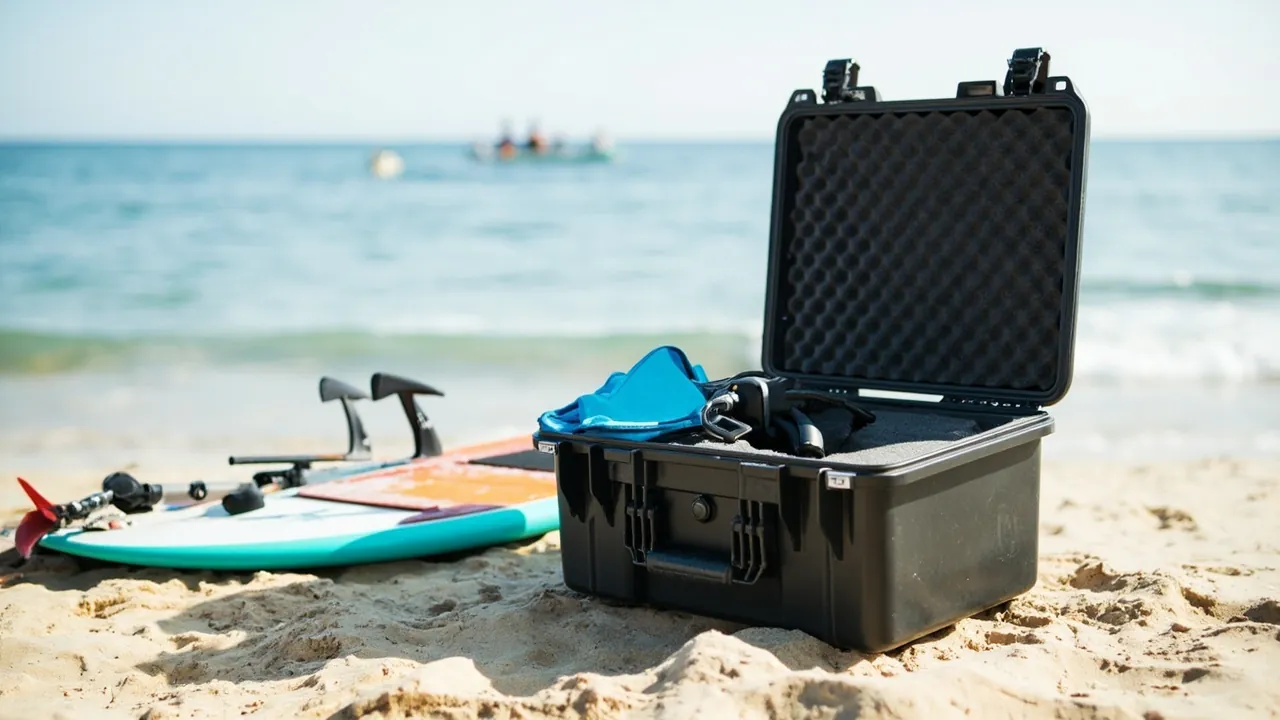
The transport difficulty of surfing and paddleboard (SUP) gear concentrates on the long, fragile board and the easy-to-lose, easy-to-crush leash, fins and paddle blade. The board is mostly an EPS foam core with fiberglass/carbon skin; the surface fears scratches, the rails fear impact, and the nose and tail fear bending. The leash and fin are small but critical; losing or crushing them ruins a whole trip. An adjustable paddle's blade and shaft need anti-bend and anti-scratch care. What truly decides whether the gear arrives intact across cities and flights is the "rigid-chamber support" precision of the case for the board, plus the partitioned fixation ability for loose accessories like leash, fin and blade. Supported by a seal built to IEC 60529 / GB/T 4208 to resist salt spray and dock dust-water, and rinsed with fresh water after every session. JUNZHJIA can deliver custom foam and OEM/ODM cases by board model and accessory list, and the following sections go from damage sources through per-item protection, material choice and procurement acceptance.
The most common mistake by surfers and SUP clubs is to use a "soft board bag" for everything. A soft bag is acceptable for short hand-carry and flat car layout, but once it enters airline checked baggage, a long-distance bus luggage bay or dock handling, stacking, drops and hard-object impact perforate the skin and chip the rails. This article targets water-sports logistics, club purchasers and gear dealers, focusing on quantifiable parameters, citable standards and actionable steps to build a system that protects the board and organizes accessories.
Table of Contents
- Transport Damage Sources for Surf and SUP Gear
- Rigid-Chamber Protection for the Board
- Partitioned Support for Paddle Blade and Shaft
- Leash, Fin and Accessory Loss and Crush Prevention
- Wetsuit and Snorkel Accessories
- Insert Selection and Anti-Scratch Treatment
- Dust and Water Sealing with IP Ratings
- Environmental Test Basis MIL-STD-810H and ISTA
- Pressure Equalization Valve and Altitude Transit
- Hinges, Latches and Case Structure
- Wheels, Trolley Handle and Beach Mobility
- Custom Inserts and OEM/ODM Service
- Cleaning, Maintenance and Service Life
- Common Selection Mistakes
- Procurement and Acceptance Checklist
Transport Damage Sources for Surf and SUP Gear
Board-gear transport damage falls into four categories: skin scrape-through, rail chipping, accessory loss, and salt aging. Skin scrape-through happens when the board surface is cut through the fiberglass/carbon layer by hard objects (sand, baggage clips, other gear), and once water enters the EPS core foams and expands, the whole board is scrapped. Rail chipping comes from point impacts at the nose, tail or rail edges, especially without rigid-chamber support. Accessory loss means small parts like leash, fin, fin screws and blade caps sliding out and getting lost in a soft bag. Salt aging is residual seawater slowly corroding hardware and foam.
Understanding these four sources lets you translate protection into structure. The board needs "rigid chamber plus soft liner" dual protection; accessories need partitioned fixation and loss-prevention bags; salt aging needs sealing and rinsing. For distribution simulation, see the ISTA transport testing procedure and test the "fully loaded case" as the object, closer to real risk.
Note: extra-long boards (longboard, race SUP) often need a dedicated extended board case or bag; the "rigid-chamber protective case" discussed here suits shortboards, fish boards and medium plans that store board plus accessories together. Very long boards should be handled with a dedicated board case.
Rigid-Chamber Protection for the Board
The first principle for the board is "contour rigid chamber plus soft liner". The rigid chamber is a support structure inside the case molded to the board's planar contour (including nose/tail curves and rail thickness), embedding the board rather than leaving it suspended; the soft liner pads EVA or PU sponge between chamber and board surface to absorb transit vibration and prevent scratches. The nose and tail are stress-concentration zones, so the chamber should thicken there with cushioning liner.
For boards with removable fins, detach the fin before transit and store it separately (see accessory section) to avoid the fin root puncturing the skin inside the case. For multiple boards side by side, insist on "one board per chamber" separated by a removable divider system to stop mutual abrasion. JUNZHJIA can CNC-route one-to-one rigid chambers from the board drawings you provide, far more precise than generic foam.
For support and rebound trade-offs of different foams, compare the case foam material comparison. Before stowage, always rinse the board with fresh water and air-dry in shade to avoid sand grains wearing the surface inside the chamber long-term.
Partitioned Support for Paddle Blade and Shaft
An adjustable paddle consists of blade, shaft (often hollow carbon or aluminum) and adjustment lock; in transit it fears bending, scratching and the two sections colliding after the lock loosens. Protection structure: give the blade its own cavity, face the blade surface toward a soft PU sponge isolation layer against scratches; support the shaft along a long channel to avoid suspended bending, and fix the adjustment lock with a limit block against axial shift; for multiple paddles side by side, "one paddle per bay".
Carbon shafts fear point pressure and hard-object impact, so chamber edges should be rounded and lined with foam; aluminum shafts resist impact but the connection threads fear nicks, so cap the adjustment lock with a protector. For SUP clubs with multiple paddles, a removable divider system can subdivide the paddle bay and label it. For customization process, see EVA foam insert custom process.
The blade is a high-value scratch-prone part; any obvious deformation or edge chip should be evaluated for replacement per safety guidelines; the case only works to prevent it.
Leash, Fin and Accessory Loss and Crush Prevention
The leash, fin, fin screws, blade cap, wax block and repair tools are "small but critical" accessories that fear two things: sliding out and getting lost in a soft bag, and being crushed by the board or heavy objects. The protection core is "partitioned fixation plus loss-prevention bag".
Practice: after removing the fin, put it in a hard plastic small box then into a foam cavity to avoid the fin tip puncturing other gear; coil the leash in a large-radius channel and fix the plug to avoid small-radius kinks causing internal rubber fatigue; put fin screws and tools in a zippered loss-prevention bag and label; give wax its own cavity to avoid softening and sticking under heat. Loose electronics (action camera, waterproof watch) go into a separate foam cavity of a cushion liner case. The overall loading layout is planned in the custom foam inserts guide.
Coiling the leash at too small a radius fatigues the internal elastomer; by experience, doubling the coil radius improves fatigue life several-fold (not formal test data), so the liner should reserve a sufficiently large channel rather than sacrifice life for space.
Wetsuit and Snorkel Accessories
The wetsuit, swim goggles, nose clip and buoyancy vest are bulky but not pressure-sensitive, suited to edge soft compartments. The key is partition and ventilation: a wet suit mixed with the board without airflow accelerates moisture on skin and foam. Put the wet suit in a breathable mesh bag then into a reserved soft bay, separated from hard gear by a layer of EVA.
The wetsuit is elastic neoprene, fearing heat exposure and sharp puncture, so lay it flat or slightly rolled in a contoured foam cavity, never folded long-term. For clubs with multiple kits, a removable divider system can subdivide the soft bay and label by member number for clear access.
Reminder: the soft bay must not encroach on the board's rigid-chamber space. Many low-cost cases give volume to clothing, leaving the board only "stuffed in", which is backwards. Correct volume allocation gives the board precise rigid chamber first, with clothing as filler and buffer consuming remaining space.
Insert Selection and Anti-Scratch Treatment
Board-case foam uses EVA, cross-linked PE, PU sponge and EPP in combination, same logic — rigid chamber with cross-linked PE/EVA molding, soft pad with PU/EPP energy absorption — with extra anti-scratch emphasis:
| Component | Recommended Insert | Anti-Scratch Point |
|---|---|---|
| --- | --- | --- |
| Board skin | Cross-linked PE chamber + EVA pad | Contour fit, soft isolation |
| Nose and tail | Thickened EVA cushion | Stress zone thickened |
| Paddle blade | PU sponge isolation layer | Soft blade face, anti-impact |
| Fin | Hard plastic box + foam cavity | Anti-puncture, anti-loss |
| Leash | Large-radius channel + fixation | Anti-kink, anti-loss |
Another anti-scratch key is rinsing sand off the board before stowage and giving the chamber surface a flannel or fine-grain EVA treatment to avoid coarse surfaces scratching the skin paint. For finer material parameters, compare case foam material comparison. JUNZHJIA can combine soft-hard dual-layer inserts by board model and accessory list and add numbered silk-screen on foam for pre-session checks.
Dust and Water Sealing with IP Ratings
Board gear is used on beaches, docks and open water, where salt spray and dust-water are dense. The sealing rating follows IEC 60529 / GB/T 4208: IP65 handles shelter dripping and cargo dust, IP67 survives immersion to 1 m for 30 minutes without ingress, steadier for dock wading transit and deck splash. Sealing is achieved by an elastic gasket around the lid and the compression structure; gasket material and compression set decide life, detailed in case seal materials and waterproof case IP.
Reminder: the rating is valid only with the lid correctly closed and latches compressed. Board cases open on sand, so gaskets easily pick up sand and salt; clean the groove before every closure or the seal breaks and may scratch the lid. Latches should also support personal padlocks or TSA customs locks for cross-border inspection, options in case lock customization options.
The IP rating covers dust and water only; vibration and drop depend on foam and structure, not substitutes for each other. The combined thinking references seal shock case.
Environmental Test Basis MIL-STD-810H and ISTA
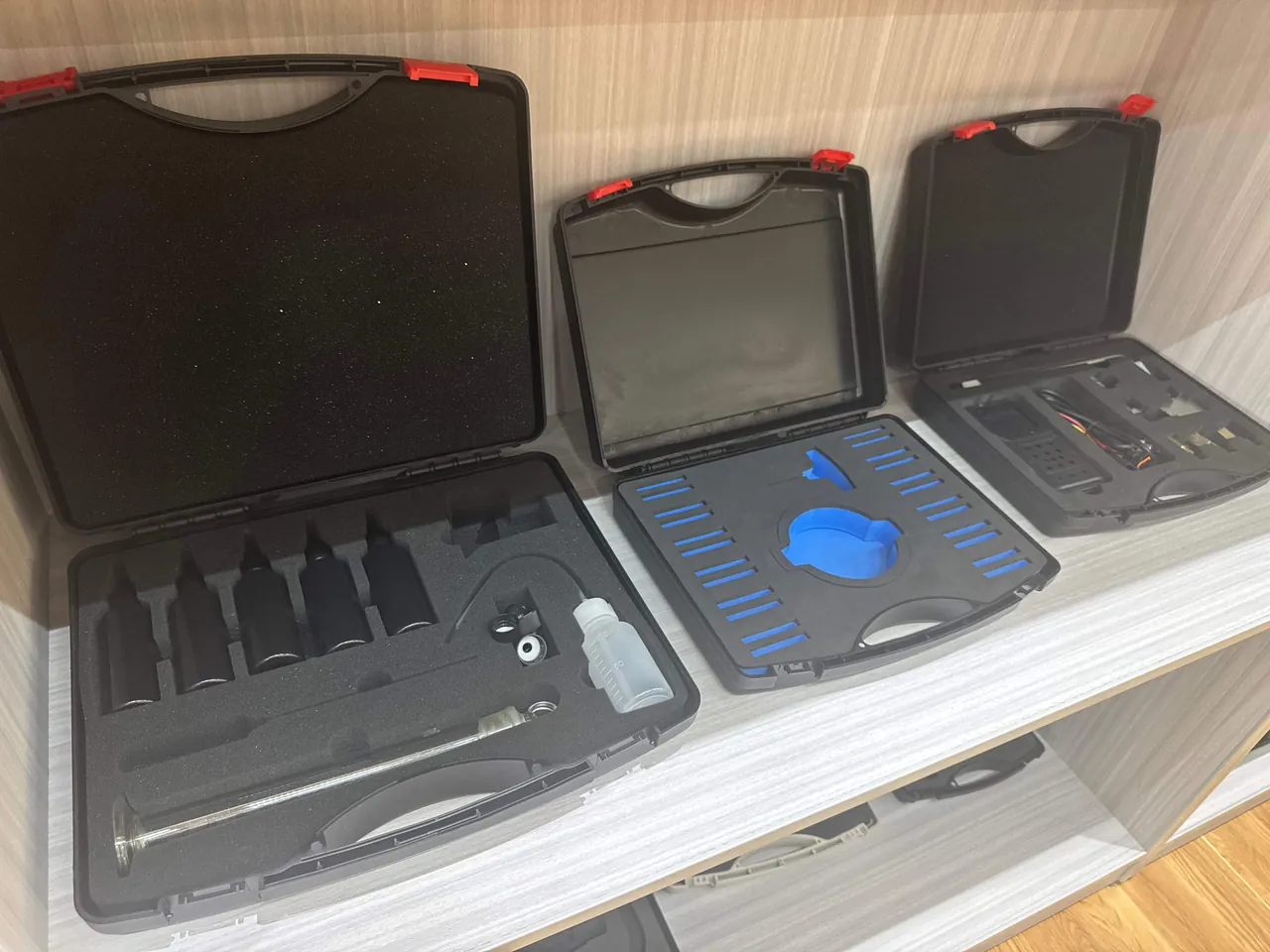
To prove case reliability to buyers, board cases can also cite MIL-STD-810H and ISTA. MIL-STD-810H is a US DoD environmental engineering test method covering vibration, drop, temperature shock, humidity and low pressure; ISTA focuses on distribution simulation.
It must be clear: MIL-STD-810H in the protective-case field is only an environmental test basis for the product line, used to verify reliability under vibration, temperature, humidity and low pressure; it is not a "military certification", this product does not claim military qualification, and does not imply suitability for any military or law-enforcement use. JUNZHJIA can cite such methods in R&D and outgoing inspection and supply corresponding test or inspection documents commercially to help B2B customers pass supplier audits, premised on civilian/recreational water-sports compliant transport.
For board cases the most valuable items are vibration, drop and humid-heat: do a "fully loaded case" random vibration, corner drop and humid-heat cycle, closer to real risk than an empty case. Method boundaries are in MIL-STD-810H case compliance, simulation flow in ISTA transport testing procedure.
Pressure Equalization Valve and Altitude Transit
Airline checked baggage or plateau/island altitude differences create pressure differences; a sealed case may bulge, strain latches or "suck" tight on descent. A pressure equalization valve (breathing valve) lets air move slowly to balance pressure while an internal membrane blocks liquid water, a common IP67 feature. Structure is in case pressure equalization valve.
For surfers who fly checked or do cross-climate trips, make the valve a must-have; for local short trips a valve-less seal saves cost. Note the valve's waterproofing relies on the internal ePTFE membrane, which fears oil and sand clogging; cleaning salt and sand around the valve after sessions is basic maintenance.
For extra-long boards shipped in a dedicated board case, also verify pressure equalization and sealing to avoid hard-opening or interior condensation from altitude differences.
Hinges, Latches and Case Structure
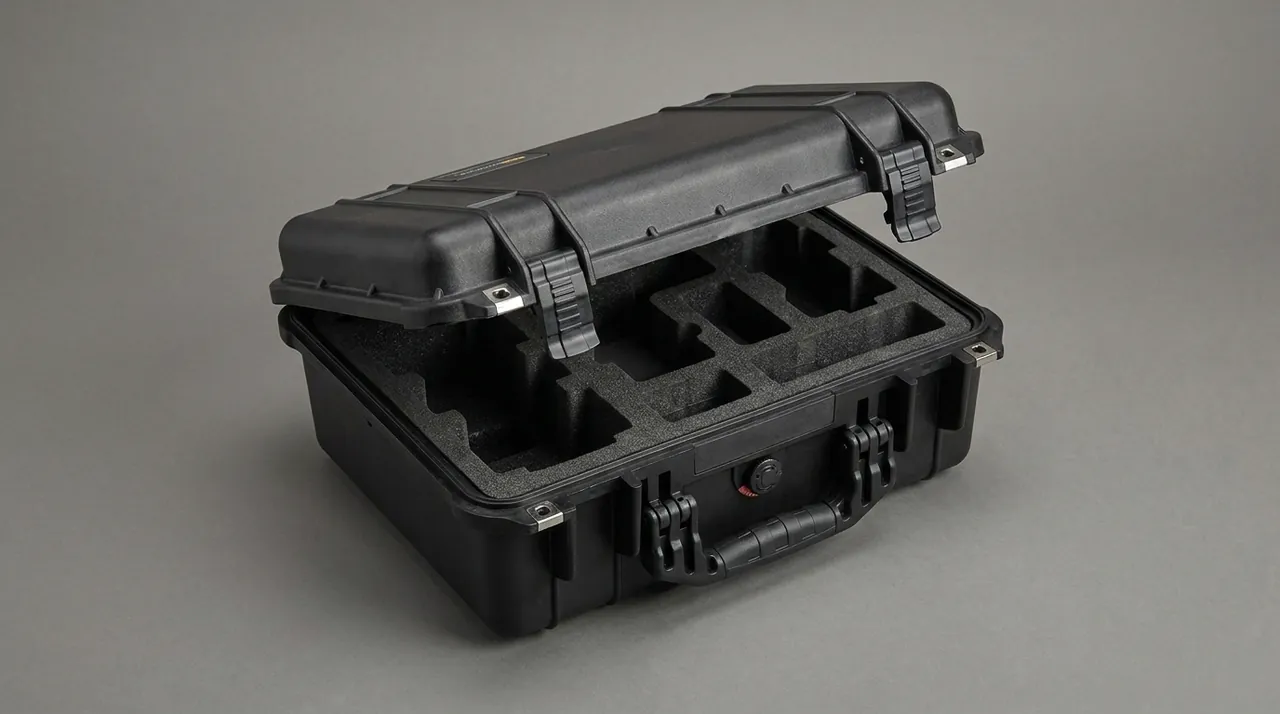
A board case's "transit safety" shows in latches and hinges. Board cases are large and often checked; poor latches loosen under drop impact and let the board slide out damaged, and the seawater environment accelerates hardware corrosion. Choose integrated hinges and latch structures that accept padlocks; latches should also support personal padlocks or TSA customs locks. Combined design is in toolbox hinge latch seal (use this correct slug to avoid a dead link).
Case material trades off between PP and ABS: PP is tough, less brittle cold and relatively better against seawater corrosion, suited to frequent checking; ABS is lighter but slightly more brittle cold, suited to mainly short-trip hand-carry. Wall thickness and ribs decide dent resistance; for clubs that check often, prefer PP shell plus rigid chamber; for holiday short trips, ABS saves weight.
The seawater environment corrodes metal more strongly, so case hardware should be stainless steel or corrosion-treated, wiped dry before each stowage to extend life. For overall shell strength, see the plastic protective box shell design note.
Wheels, Trolley Handle and Beach Mobility
Board cases are large with high total weight of board plus accessories; a case with wheels and a retractable trolley handle markedly reduces movement burden between dock and beach. But wheels and handles must survive checking and sand vibration, or a dropped wheel adds trouble. Selection is in case wheels and trolley handle.
Prefer dual-row large-diameter PU wheels for smoother sand and dock gaps; the trolley should be aluminum inner tube with outer-tube lock against wobble. The board should sit in the rigid chamber near the wheels so the center of gravity stays close to the axle for stable towing. Moving multiple cases in a train, the lightweight design of portable transport box eases single-case load, and color or number coding distinguishes board case from accessory case.
Custom Inserts and OEM/ODM Service
Board dimensions vary widely by board type (shortboard/fish/longboard/SUP) and year, so generic cavities rarely fit. High-protection plans almost always go custom: the customer provides board drawings, key dimensions and an accessory list, and the maker molds the rigid chamber by contour and confirms a prototype. JUNZHJIA's strength is exactly from a single sample to volume OEM/ODM, with model-specific seals, model-specific foam and provided inspection documents.
Customization's value is fixing the optimal layout of the board and many accessories in a limited volume: board rigid chamber centered, paddle blade side bay, leash channel, fin small box, wetsuit soft bay — the whole-case center of gravity and access order set at design stage. Tooling cost logic is in custom case mold cost analysis, factory selection in how to choose a case OEM factory. Low-volume prototyping with EVA foam insert custom process iterates quickly.
Cleaning, Maintenance and Service Life
Board-case maintenance focuses on salt. After every session: rinse board and accessories with fresh water and air-dry in shade before stowage; wipe debris from the lid seal groove and around the pressure valve; before long storage remove foam to air out and avoid sticky salt-laden foam. Steps are in how to clean a protective case.
For service life, PP/ABS shells at normal temperature and routine use can last several years; the gasket is the wear part and ages faster in salt environment, so replace when it hardens, cracks or takes a permanent flat. An experience range is in protective case service life years. Buyers should learn to distinguish good from bad to avoid substandard products; see identify genuine vs fake case.
Common Selection Mistakes
Mistake one: "a soft board bag is enough for checking". Hard-object impact from airline checking and dock drops perforates the skin and chips rails inside a soft bag; rigid-chamber support is needed.
Mistake two: "just stuff the board anywhere". The board needs a contour rigid chamber plus soft pad; otherwise suspended vibration damages skin and rails.
Mistake three: "leave the fin on". Not removing the fin in transit, the fin root easily punctures the skin inside the case; detach and store in a hard box.
Mistake four: "only look at IP rating". IP covers dust and water only; vibration and drop depend on chamber and structure, see seal shock case.
Mistake five: "small accessories do not matter". Leash, fin and screws lost means a ruined trip; partitioned fixation plus loss-prevention bag are mandatory.
Procurement and Acceptance Checklist
A procurement checklist for water-sports clubs and gear dealers: first, provide board drawings, key dimensions and an accessory list as the custom basis; second, define transit scenarios (hand-carry/check/air/island) to set IP rating and pressure valve; third, require the maker to provide a rigid-chamber prototype and a fully loaded simulated transit test (ISTA thinking is fine); fourth, confirm replaceability of wear parts like latches, wheels, valve and corrosion treatment of hardware; fifth, check the sampling standard in custom case acceptance AQL.
Three acceptance checks: close the empty case, invert and shake to hear rattles (judge foam looseness); after loading, short corner drop (about 0.5–1 m, experience value) to observe latches and chamber; after spray or rain, open and check interior dry. Only when all three pass should the case enter checking and island trips. Also confirm in writing whether extra-long boards need a dedicated extended board case.
Frequently Asked Questions
Q: Must a surfboard be transported in a hard case, or is a soft board bag not enough? A: Whether a hard case is mandatory depends on the transit scenario. If the board only lays flat in a car for short trips or is always hand-carried under supervision, a soft board bag with enough foam padding may suffice. But a surfboard is mostly an EPS foam core with fiberglass/carbon skin; the surface fears scratches, the rails fear impact, and the nose and tail fear bending. Once it enters airline checked baggage, a long-distance bus bay or dock handling, stacking, drops and hard-object impact perforate the skin and chip the rails inside a soft bag, and water ingress can scrap the whole board. Therefore, whenever checking, shared transport or unattended segments are involved, at least a "contour rigid chamber plus soft liner" rigid-chamber case is advised. The chamber is molded to the board contour to embed it rather than suspend it, and the liner absorbs vibration and prevents scratches. JUNZHJIA can CNC-route one-to-one rigid chambers from board drawings, far more precise than generic foam.
Q: How does the board rigid chamber protect the skin from being scraped? A: The rigid chamber protection core is the dual structure of "contour rigid chamber plus soft liner". The rigid chamber is a support structure inside the case molded to the board's planar contour (including nose/tail curves and rail thickness), embedding the board and limiting its sliding and flipping in transit; the soft liner pads EVA or PU sponge between chamber and board surface to absorb random vibration and avoid hard surfaces directly scraping the skin paint. The nose and tail are stress-concentration zones, so the chamber thickens there with cushioning liner. The chamber surface should also get a flannel or fine-grain EVA treatment to avoid coarse surfaces scratching. Before stowage, rinse the board with fresh water and air-dry to remove sand, or sand grains trapped in the chamber wear the surface long-term. For multiple boards side by side, insist on one board per chamber with removable dividers to stop mutual abrasion. This combination truly prevents scratches rather than merely "fitting".
Q: Why must small accessories like fin and leash be stored carefully too? A: The leash, fin, fin screws, blade cap, wax block and repair tools are "small but critical" accessories that fear two things: sliding out and getting lost in a soft bag, and being crushed by the board or heavy objects. If the fin is not removed, its root easily punctures the skin in transit causing water ingress; coiling the leash at too small a radius fatigues the internal elastomer, and by experience doubling the coil radius improves fatigue life several-fold (not formal test data). The correct practice removes the fin into a hard plastic box then a foam cavity to avoid the tip puncturing other gear; coils the leash in a large-radius channel and fixes the plug; puts screws and tools in a zippered loss-prevention bag and labels; gives wax its own cavity to avoid heat softening and sticking. Loose electronics go into a cushion liner case separate foam cavity. The overall loading layout is planned in the custom foam inserts guide. Losing small accessories may ruin a whole trip, so partitioned fixation plus loss-prevention bag are mandatory.
Q: How should the paddle blade and shaft be placed to avoid bending or scratches? A: An adjustable paddle consists of blade, shaft (often hollow carbon or aluminum) and adjustment lock; in transit it fears bending, scratching and the two sections colliding after the lock loosens. Protection structure: give the blade its own cavity, face the blade surface toward a soft PU sponge isolation layer against scratches; support the shaft along a long channel to avoid suspended bending, and fix the adjustment lock with a limit block against axial shift; for multiple paddles side by side, one paddle per bay. Carbon shafts fear point pressure and hard impact, so chamber edges should be rounded and lined with foam; aluminum shafts resist impact but the connection threads fear nicks, so cap the adjustment lock with a protector. For SUP clubs with multiple paddles, a removable divider system can subdivide the paddle bay and label it. The blade is a high-value scratch-prone part; any obvious deformation or edge chip should be evaluated for replacement per safety guidelines, and the case only works to prevent it. The customization process is in the EVA foam insert custom process.
Q: Is MIL-STD-810H a military certification that I can put in marketing? A: You cannot present it as a military certification. MIL-STD-810H is a US DoD environmental engineering test method; in the protective-case field it is only an environmental test basis for the product line, used to verify reliability under vibration, temperature, humidity and low pressure. It is not a "military certification", this product does not claim military qualification, and does not imply suitability for any military or law-enforcement use. JUNZHJIA can cite such methods in R&D and outgoing inspection and supply corresponding test or inspection documents commercially to help B2B customers pass supplier audits, but all of this is premised on civilian or recreational water-sports compliant transport. If marketing mentions this standard, state factually that "reliability is verified by referencing MIL-STD-810H environmental test methods", not "military-grade certified" or similar implication, to avoid compliance risk and misleading customers.
Q: Flying checked with a board case, will it bulge or refuse to open from pressure difference? A: A sealed case at low pressure (aircraft hold, high altitude) can indeed bulge and strain latches, or "suck" the lid tighter and make it hard to open on descent. The solution is a pressure equalization valve (breathing valve): it lets air move slowly to balance pressure while an internal membrane blocks liquid water, a common IP67 feature. If you fly checked or do cross-climate island trips often, make the valve a must-have; for local short trips a valve-less seal saves cost. Note the pressure valve must not be seen as any "concealment" structure; it only serves transit safety and easy opening. Also, the valve's waterproofing relies on the internal ePTFE membrane, which fears oil and sand clogging, so cleaning salt and sand around the valve after sessions is basic maintenance. For extra-long boards in a dedicated board case, also verify pressure equalization and sealing.
Q: Should the surfboard case be PP or ABS? A: PP (polypropylene) is tough, impact resistant and less brittle at low temperature, and relatively better against seawater salt-spray corrosion, suited to clubs that check frequently and meet dock drops and sand vibration; ABS is rigid, surface-hard and lighter, but slightly more brittle when cold, better for mainly holiday short-trip hand-carried recreational players. Beyond material, wall thickness and rib layout decide dent resistance, and a large board case should weight this more. The seawater environment corrodes metal more strongly, so case hardware (hinges, latch tongues) should be stainless steel or corrosion-treated, wiped dry before each stowage to extend life. Either way, the interior must have a contour rigid chamber and precise liner, or the hard shell makes the board slam harder against hard walls. Frequent checkers prefer PP plus rigid chamber; short trips can choose ABS to save weight.
Q: How long does a protective case last, and which parts fail first? A: PP or ABS shells at normal temperature and routine use typically last several years; the first part to age is usually the gasket, which in the sandy high-salt high-humidity environment ages faster than general scenes, and under long compression, sunlight and temperature swings hardens, cracks or takes a permanent flat and should be replaced when it loses sealing. The EVA insert also slowly accumulates compression set under frequent handling and heavy pressure, but generally much slower than the gasket. For an experience range of overall service life, see the protective case service life years note; actual life also depends on checking frequency and salt corrosion degree. To extend life: after every session rinse board and accessories with fresh water and air-dry before stowage, wipe seal groove and valve salt-sand, and remove foam to air out before long storage. At procurement, confirm wear parts are replaceable individually to avoid scrapping the whole case for a small failure; hardware corrosion treatment and gasket replaceability should be acceptance items.
Q: Can extra-long boards (longboard/race SUP) also use this rigid-chamber case? A: Extra-long boards (longboard, race SUP) often need a dedicated extended board case or reinforced board bag because their length exceeds regular cases; the "rigid-chamber protective case" discussed here suits shortboards, fish boards and medium plans that store board plus accessories together. For very long boards, adopt a combination of "dedicated extended board case plus internal rigid chamber/foam support": still follow contour support, soft pad anti-scratch, and partitioned fixation for accessories, only the case is proportionally extended and its wheels and trolley reinforced to bear the larger bending moment from total length. At procurement, confirm in writing whether the extra-long board needs a dedicated extended board case, and require the maker to prototype by the actual board drawing to verify chamber fit before volume production. JUNZHJIA can customize by board model and accessory list, from prototyping to volume OEM/ODM.
Conclusion and Related Reading
The essence of a surfing and paddleboard transport case is to minimize the transit risk of board, leash and accessories through "contour rigid chamber plus reliable seal plus rational structure", and to keep salt spray and dust-water outside the case. For water-sports clubs and gear dealers, rather than repeatedly replenishing after board skin perforation, it is better to make rigid-chamber precision, IP rating, pressure valve and custom insert hard indicators at procurement, while choosing a regular rigid-chamber case or a dedicated extended board case by board length. JUNZHJIA can provide a full-chain solution from prototyping to volume OEM/ODM by board model and accessory list with inspection documents, helping B2B customers land the project steadily.
Related Reading