

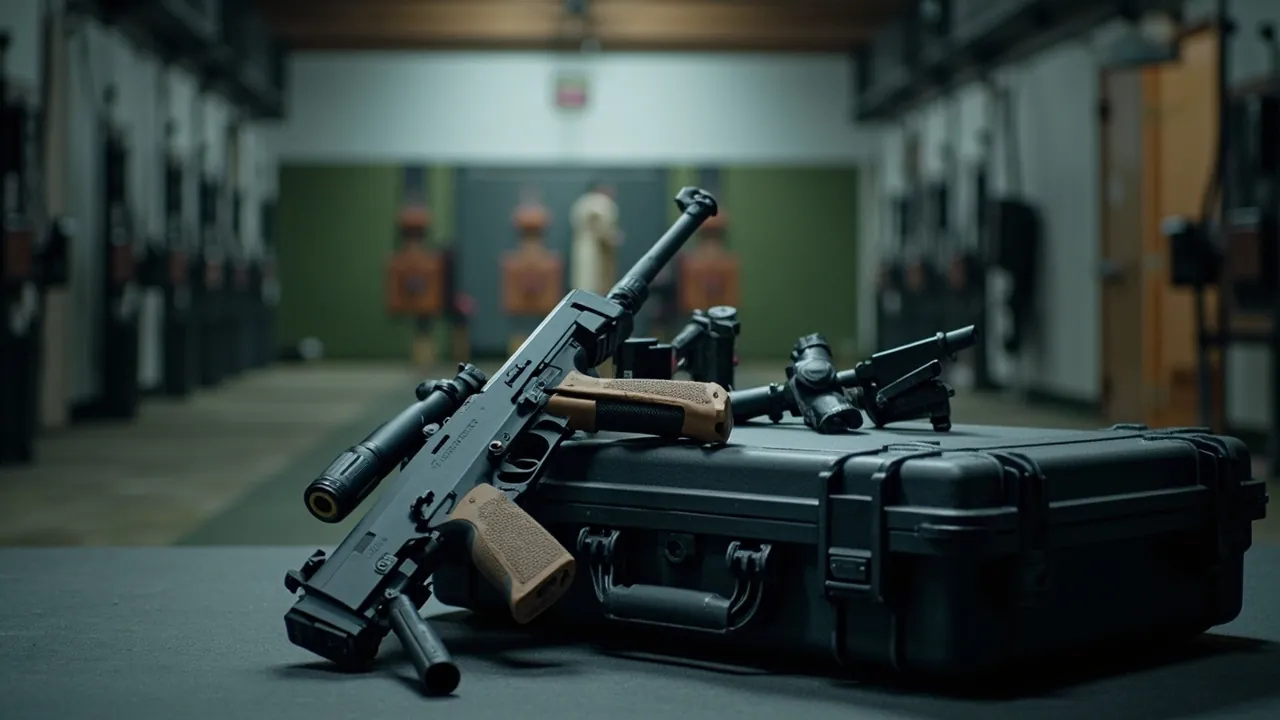
Transporting competitive shooting equipment (such as 10 m air rifle, air pistol and certain match pistol classes) is first about compliance and safety, not about "fitting it in". Before any protection design, one baseline must be clear: the firearm (including match air rifles and pistols) and the ammunition must travel in separate cases, separate bays and individually locked, and the entire movement must obey the laws and event rules of origin and destination. The protective case here plays a dual role: it must lock the rifle, optics, magazine and air cylinder into point-to-point foam cavities with rigid inserts to avoid zero-shift and impact from transit vibration, and it must offer a lockable, labelable and traceable structure that meets compliant handling. Ammunition needs an independent sealed bay, humidity control and anti-static design for electronic-primer or electronic components. JUNZHJIA can deliver custom foam and OEM/ODM cases by equipment list and supply inspection documents commercially, but any transport must treat local law as the highest authority. The following sections go from the compliance baseline through separation principles, support structure and procurement acceptance.
The most common mistake by clubs, teams and dealers is to mistake "a protective case" for "a transport permit". No matter how tough the case, it cannot replace statutory transport formalities and the firearm-ammunition separation rule. This article targets logistics managers, purchasers and event organizers, focusing on quantifiable parameters, citable standards and actionable steps to build a compliant and durable competitive-shooting transport system, and it offers no advice to evade regulation.
Table of Contents
- Compliance Baseline for Competitive Shooting Transport
- Firearm and Ammunition Separation Principle
- Support Structure for Air Rifle and Pistol
- Independent Sealed Bay and Climate Control for Ammunition
- Insert Selection and Impact Protection
- Dust and Water Sealing with IP Ratings
- Environmental Test Basis MIL-STD-810H (Not Military Certification)
- Applicable Transport Regulations and Documents
- Pressure Equalization Valve and Altitude Transit
- Hinges, Latches and Transit Safety
- Wheels, Trolley Handle and Venue Mobility
- Custom Inserts and OEM/ODM Service
- Cleaning, Maintenance and Service Life
- Common Compliance Mistakes
- Procurement and Acceptance Checklist
Compliance Baseline for Competitive Shooting Transport
For any cross-location transport of competitive shooting gear, the order must be "legal formalities first, protective case second". Whether you use an air rifle, air pistol or other match firearm, before transport confirm: whether a transport permit is required, whether firearm-ammunition separation is mandatory, whether a specified container type is required, and whether escort or reporting is needed. The case maker (including JUNZHJIA) is only responsible for the physical protection and compliant structure (such as padlock-ready, labelable), and never replaces nor implies any bypass of statutory transport requirements.
Making compliance the first priority also matters because non-compliant transport carries consequences far beyond equipment loss: administrative penalties or even criminal liability. Therefore every structural suggestion here assumes the premise "transport qualification legally obtained and firearm-ammunition separation strictly observed". For the basic selection logic of firearm-class cases, see the gun case buying guide, but always defer to local law.
Finally, this article discusses only "protective cases and carry structure under a compliant premise", and does not discuss any modification, concealment or regulatory evasion. If you are unsure about a regulation, consult a qualified legal or regulatory body rather than relying on case-maker advice.
Firearm and Ammunition Separation Principle
Firearm-ammunition separation is the core red line of competitive shooting transport, with three layers in common practice: separate case, separate bay, separate lock. Separate case means the firearm and ammunition each use an independent case; separate bay means when same-case transport is allowed by law (short trip only), the two sit in physically isolated, mutually inaccessible bays; separate lock means each bay is independently locked with keys held by different people. Even where law allows a relaxed case, risk control recommends persisting with separate case and separate lock.
The point of separation is to reduce accident coupling: if the case suffers a drop or accidental opening, the ammunition cannot form an "immediately usable" combination with the firearm, and risks in fire or impact extremes are more contained. The ammunition bay should sit geometrically far from the firearm bay and receive extra anti-static and cushioning treatment. For a general compliance framework on dangerous-goods and ammunition logistics, see the ADR/IMDG hazmat transport case thinking (note this is a general dangerous-goods view; defer to firearm-ammunition law).
A special note: across countries and regions the definitions of "whether an air gun counts as a firearm" and "how ammunition is defined" differ enormously. This article's separation principle is general industry safety practice and cannot replace legal judgment. Before departure, check each item of the destination regulation item by item and obtain written permission when necessary.
Support Structure for Air Rifle and Pistol
A competitive air rifle (e.g. 10 m class) consists of barrel, wood/engineering-plastic stock, precision optics, air cylinder or CO₂ reservoir and trigger group; it most fears zero-shift from transit vibration and micro-bending of the barrel. The first support principle is again "full-length contact, local constraint": the barrel mid-section embeds in a contoured medium-density EVA or cross-linked PE channel, the trigger and optics are wrapped in softer foam against pressure, and the cylinder interface gets a limit block against axial shift.
Pistol-class (including match air pistol) items are compact with protruding grip and slide; the foam should be routed for their shape, slide and muzzle toward a buffer wall to avoid metal-on-metal impact. For multiple firearms side by side, insist on "one firearm per bay" separated by a removable divider system to stop mutual abrasion. JUNZHJIA can produce one-to-one inserts by CNC routing from the firearm list and dimension drawings, far more precise than generic foam.
Optics (scope, electronic sight) are fragile high-value parts and deserve a separate cavity with a dust cap; a zeroed firearm should not have its optics removed for transit to avoid cumulative error from repeated mounting. For support and rebound trade-offs of different foams, compare the case foam material comparison.
Independent Sealed Bay and Climate Control for Ammunition
Ammunition is sensitive to temperature, humidity and static. Under compliance, ammunition should sit in an independent, lockable bay with a sealing gasket, physically isolated from the firearm, with desiccant inside to control relative humidity and avoid primer moisture or cartridge-case oxidation. For special ammunition or equipment with electric primers or electronic components, use anti-static foam (conductive foam or anti-static bag) and avoid friction with metal parts that generates static.
For temperature, ammunition should avoid prolonged high heat (e.g. summer cabin baking) and sharp thermal swings. Across climate zones, the case material and foam temperature range need margin; see the extreme temperature case thinking. Sealing performance is compared against the IP67 protective case structure to keep the ammunition bay water- and dust-tight.
Again: the ammunition bay design must obey regulation (whether accompaniment is allowed, capacity caps, labeling). The case only provides physical protection and confers no transport legality. Any loading plan must follow the compliant process confirmed by the license holder.
Insert Selection and Impact Protection
Competitive shooting case foam again uses EVA, cross-linked PE, PU sponge and EPP, with the same combination logic as a fencing case — hard support with EVA/cross-linked PE, energy absorption with PU/EPP:
| Component | Recommended Insert | Reason |
|---|---|---|
| --- | --- | --- |
| Barrel mid-section | Medium EVA contoured channel | Rigid fit, anti zero-shift |
| Optics / trigger | Low-density PU sponge wrap | Soft pressure, anti-scratch |
| Cylinder interface | Cross-linked PE limit block | Durable, axial-force resistant |
| Ammunition bay lining | Conductive/anti-static foam + desiccant | Anti-static, humidity control |
| Empty bay fill | EPP or PU fragment cavity | Energy absorption, fixing |
For selection detail, compare the custom foam inserts guide and the EVA foam insert custom process. JUNZHJIA can combine soft-hard dual-layer inserts by firearm and ammunition characteristics and add numbered silk-screen on the foam surface for quick pre-match loading checks against the list.
Dust and Water Sealing with IP Ratings
Ranges are mostly outdoor or semi-outdoor, with common dust, rain and mud; cargo bays during transit are also full of dust-water risk. The sealing rating again follows IEC 60529 / GB/T 4208: IP65 handles shelter dripping and dust, IP67 suits wading transit or humid regions. Sealing is achieved by an elastic gasket around the lid and the compression structure; gasket material and compression set decide life, detailed in case seal materials and waterproof case IP.
Emphasis: in compliant transport, the case's "lockable" and "labelable" traits often draw more regulatory attention than the IP rating. Latches must not only prevent accidental opening but also support personal padlocks or TSA customs locks for compliant inspection without breaking seals. Lock customization options are in case lock customization options.
The IP rating covers dust and water only; vibration and drop depend on foam and structure, and the two cannot substitute for each other. The combined thinking is in seal shock case.
Environmental Test Basis MIL-STD-810H (Not Military Certification)
To prove case reliability to buyers, competitive shooting cases can also cite MIL-STD-810H and ISTA. MIL-STD-810H is a US DoD environmental engineering test method covering vibration, drop, temperature shock, humidity and low pressure; ISTA focuses on distribution simulation.
It must be clear: MIL-STD-810H in the protective-case field is only an environmental test basis for the product line, used to verify reliability under vibration, temperature, humidity and low pressure; it is not a "military certification", this product does not claim military qualification, and does not imply suitability for any military or law-enforcement use. JUNZHJIA can cite such methods in R&D and outgoing inspection and supply corresponding test or inspection documents commercially to help B2B customers pass supplier audits, but all of this is premised on civilian/competitive compliant transport.
For competitive shooting cases the most relevant test items are vibration and drop: do a "fully loaded case" random vibration and corner drop, closer to real risk than an empty case. Method boundaries are in MIL-STD-810H case compliance, and the simulation flow is in ISTA transport testing procedure.
Applicable Transport Regulations and Documents
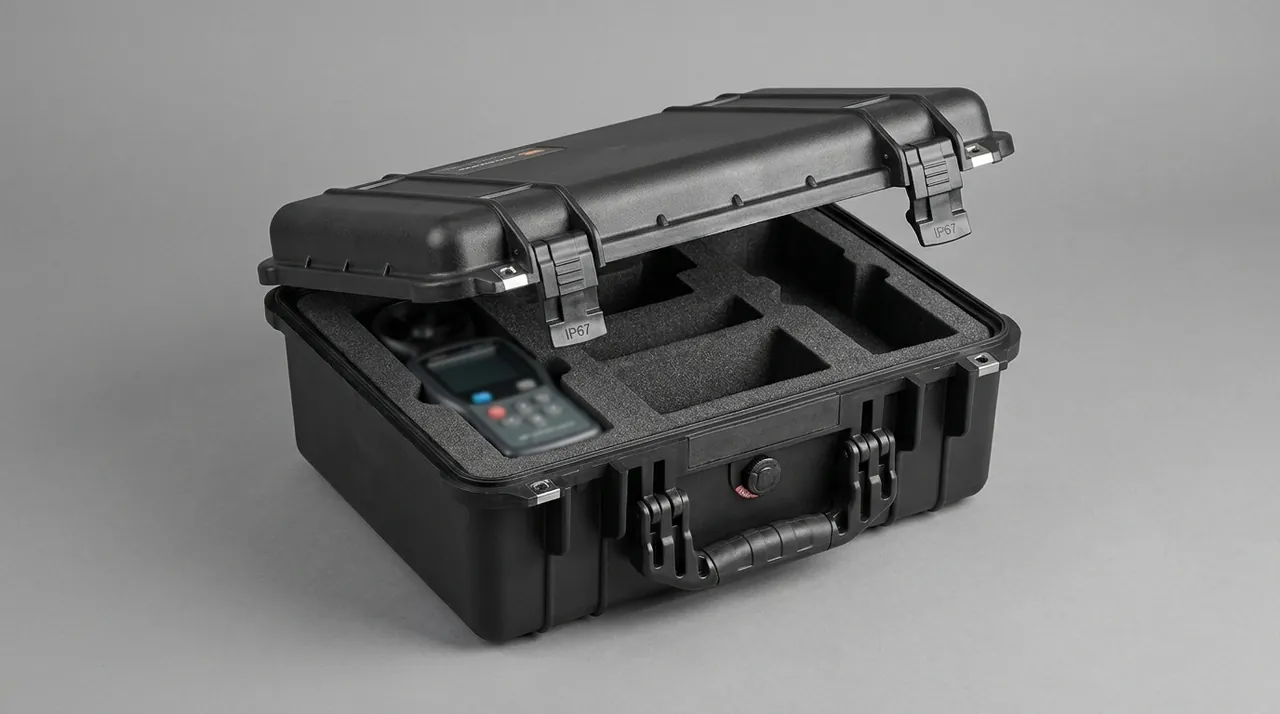
Competitive shooting transport touches multiple regulation layers that vary by place; this article lists only "categories to verify", not legal conclusions:
- Permit class: whether cross-location transport needs an authority permit, specified container type and escort count.
- Separation class: whether firearm and ammunition must be separate case, separate bay, separate lock, and how keys/persons are split.
- Container labeling class: whether the case needs hazard/firearm labels and an attached list with license proof.
- Cross-border class: whether international transport is bound by destination firearms/ammunition law and customs declaration.
For a general dangerous-goods logistics framework (not firearm-specific), see ADR/IMDG hazmat transport case; for general domestic transport packaging test methods, see GB/T 4857 transport packaging case and ASTM D4169 distribution cycle case. All are methodology references; execution must follow the regulation confirmed by the license holder.
Recommended documents with the case: equipment list (with serial numbers), permit copy, firearm-ammunition separation statement, and contact information. Bind compliant documents to the case's traceable serial so inspection can self-verify quickly.
Pressure Equalization Valve and Altitude Transit
Airline checked baggage or plateau events create pressure differences; a sealed case may bulge, strain latches or "suck" tight on descent. A pressure equalization valve (breathing valve) lets air move slowly to balance pressure while an internal membrane blocks liquid water, a common IP67 feature. Structure is in case pressure equalization valve.
For teams that fly checked or attend plateau events across provinces, make the valve a must-have; for city-only short trips a valve-less seal saves cost. Note the valve's waterproofing relies on the internal ePTFE membrane, which fears oil and sand clogging; cleaning around the valve after events is basic maintenance.
From a compliance view, the pressure valve must not be seen as a "concealment" structure — it exists for transit safety and easy opening, unrelated to any evasion purpose. Case design always follows transparent, inspectable and lockable principles.
Hinges, Latches and Transit Safety
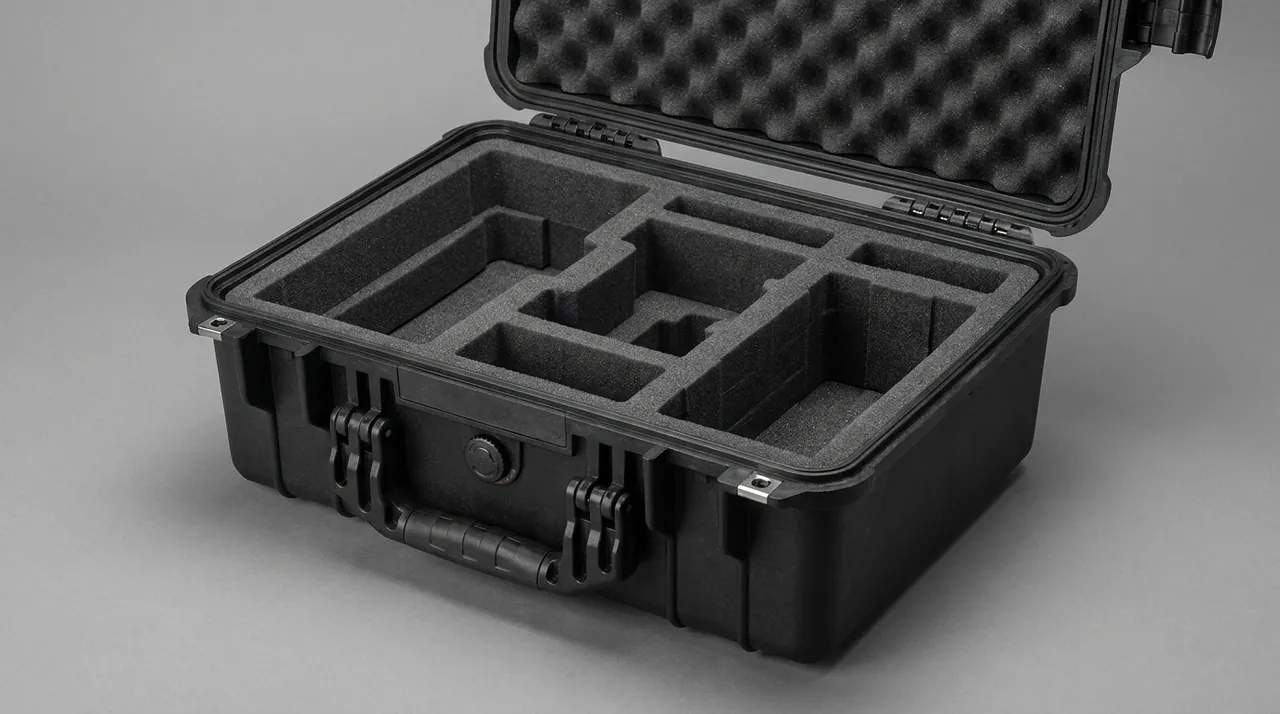
The "transit safety" of a competitive shooting case shows first in latches and hinges. Poor latches loosen under drop impact, scattering gear or even opening accidentally. Choose integrated hinges and latch structures that accept padlocks; latches should also support personal padlocks or TSA customs locks for compliant inspection. Combined design is in toolbox hinge latch seal (use this correct slug to avoid a dead link).
Case material again trades off between PP and ABS: PP is tough and less brittle cold, suited to frequent checking; ABS is lighter but slightly more brittle cold, suited to mostly hand-carried players. Wall thickness and ribs decide dent resistance. For teams that check often, prefer PP shell plus hard foam; for venue hand-carry, ABS is lighter.
In compliant transport, configure independent locks for firearm bay and ammunition bay with keys held by different responsible persons to implement "separate lock". Lock customization and compliance options are in case lock customization options.
Wheels, Trolley Handle and Venue Mobility
Competitive shooting gear includes firearm case, ammunition case and accessory case, total weight high; a case with wheels and a retractable trolley handle markedly reduces venue-movement fatigue. But wheels and handles must survive checking impacts, or a dropped wheel adds trouble. Selection is in case wheels and trolley handle.
Prefer dual-row large-diameter PU wheels for smoother threshold and carpet; the trolley should be aluminum inner tube with outer-tube lock against wobble. Moving multiple cases in a train, the lightweight design of portable transport box eases single-case load, and color or number coding distinguishes firearm case from ammunition case to avoid confusion.
Emphasis: mobility convenience cannot sacrifice compliance. A wheeled case moving in public areas must stay locked, and firearm case and ammunition case must be escorted by different persons, never the non-compliant same-person-same-vehicle-same-open scenario.
Custom Inserts and OEM/ODM Service
Competitive shooting gear dimensions vary widely by firearm class and match level, so generic cavities rarely fit. High-protection plans almost always go custom: the customer provides a firearm list, ammunition spec and key dimensions, and the maker routes foam and confirms a prototype. JUNZHJIA's strength is exactly from a single sample to volume OEM/ODM, with model-specific seals, model-specific foam and provided inspection documents — but all customization is premised on "transport qualification legally obtained and strict firearm-ammunition separation".
Customization's value is fixing the optimal layout of many item types in a limited volume: firearms side by side, optics in independent cavities, ammunition in an independent sealed bay, accessories filling corners — the whole-case center of gravity and access order set at design stage. Tooling cost logic is in custom case mold cost analysis, factory selection in how to choose a case OEM factory. Low-volume prototyping with EVA foam insert custom process iterates quickly.
Cleaning, Maintenance and Service Life
Regular maintenance extends life: after events wipe debris from the lid seal groove and around the pressure valve; clean and oil the firearm per manufacturer instructions before storing; replace ammunition-bay desiccant periodically; before long storage remove foam to air out. Steps are in how to clean a protective case.
For service life, PP/ABS shells at normal temperature and routine use can last several years; the gasket is the wear part and should be replaced when it hardens, cracks or takes a permanent flat. An experience range is in protective case service life years. Buyers should learn to distinguish good from bad to avoid substandard products; see identify genuine vs fake case.
From compliance, after every transport check latches, seals and labels for integrity, and replace worn parts promptly so the next transport still meets traceable and lockable requirements.
Common Compliance Mistakes
Mistake one: "a tough case means I can transport". A hard case only solves compression, not statutory formalities or separation; non-compliant transport consequences far exceed equipment loss.
Mistake two: "firearm and ammunition in one case is convenient". This is the core red line; separate case, bay and lock are mandatory, and even legally allowed special cases still recommend persistent separation.
Mistake three: "MIL-STD-810H is a military certification". It is only a product-line environmental test basis, not military certification, and the product does not claim military qualification.
Mistake four: "locked is enough". Locks must be compliantly inspectable; cross-border needs TSA-class locks for opening, and firearm/ammunition locks should be held by different persons.
Mistake five: "trust the maker's advice". The case maker only handles physical protection; legal judgment must consult the license holder or regulator.
Procurement and Acceptance Checklist
A procurement checklist for teams and dealers: first, confirm legal transport qualification and a clear firearm-ammunition separation plan; second, list firearm classes, ammunition specs and key dimensions as the custom basis; third, define transit scenarios (hand-carry/check/air) to set IP rating and pressure valve; fourth, require the maker to provide a foam prototype and a fully loaded simulated transit test (ISTA thinking is fine); fifth, confirm independent firearm/ammunition locks and replaceability of wear parts; sixth, check the sampling standard in custom case acceptance AQL.
Three acceptance checks: close the empty case, invert and shake to hear rattles (judge foam looseness); after loading, short corner drop (about 0.5–1 m, experience value) to observe latches and foam; after rain or spray, open and check interior dry. Also verify accompanying documents (list, permit, separation statement) are complete. Only when the three structural checks and one document check all pass should the case enter compliant transport.
Frequently Asked Questions
Q: Can a protective case replace statutory transport formalities for competitive shooting gear? A: Absolutely not. A protective case (whether JUNZHJIA or another brand) is only responsible for the physical protection and compliant structure of the equipment (such as padlock-ready, labelable, traceable); it confers no transport legality and implies none. Before any cross-location transport you must first legally confirm whether a transport permit is required, whether firearm-ammunition separation is mandatory, whether a specified container type is required, and whether escort or reporting is needed, strictly following the laws and event rules of origin and destination. The consequences of non-compliant transport far exceed equipment loss and may include administrative penalties or even criminal liability. Every structural suggestion in this article assumes the premise "transport qualification legally obtained and strict firearm-ammunition separation observed". If unsure about a regulation, consult a qualified legal or regulatory body rather than relying on case-maker advice. No matter how tough the case, it cannot replace statutory formalities or the separation rule.
Q: How must firearm and ammunition be separated to be compliant? A: Firearm-ammunition separation is the core red line of competitive shooting transport, with three layers in common practice: separate case, separate bay, separate lock. Separate case means the firearm and ammunition each use an independent case, the safest approach; separate bay means when law allows same-case transport, the two sit in physically isolated, mutually inaccessible bays; separate lock means each bay is independently locked with keys held by different responsible persons. Even where some situations allow relaxed law, risk control recommends persisting with separate case and separate lock. The point of separation is to reduce accident coupling: if the case suffers a drop or accidental opening, the ammunition cannot form an immediately usable combination with the firearm, and fire or impact extremes are more contained. The ammunition bay should sit far from the firearm bay with anti-static and cushioning treatment. Again, definitions of air guns and ammunition differ enormously across regions; the separation principle is general safety practice and cannot replace legal judgment, so check the destination regulation item by item before departure.
Q: Why does an air rifle lose its zero in transport, and how does the case prevent it? A: A competitive air rifle consists of barrel, stock, precision optics, air cylinder and trigger group; transit vibration induces alternating stress at the barrel and optic mounting surfaces, shifting the previously adjusted "zero" so the point of impact drifts in match. The case prevents drift through "full-length contact, local constraint": the barrel mid-section embeds in a contoured medium-density EVA or cross-linked PE channel for rigid support, trigger and optics are wrapped in softer foam against pressure, and the cylinder interface gets a limit block against axial shift; a zeroed firearm should not have optics removed in transit to avoid cumulative error from repeated mounting. Multiple firearms side by side insist on one firearm per bay, separated by removable dividers to stop mutual abrasion. JUNZHJIA can produce one-to-one inserts by CNC routing from the firearm list and dimension drawings, far more precise than generic foam. After loading, do a short corner-drop test to verify the foam is not loose before trusting it for match transport.
Q: What special treatment does the ammunition bay need? A: Under compliance, ammunition is sensitive to temperature, humidity and static, so the bay design addresses three points. First, independent lockable sealing: ammunition sits in an independent, lockable bay with a sealing gasket, physically isolated from the firearm, with desiccant inside to control relative humidity and avoid primer moisture or case oxidation. Second, for special ammunition or equipment with electric primers or electronic components, use anti-static lining (conductive foam or anti-static bag) and avoid friction with metal parts that generates static. Third, temperature control: avoid prolonged high heat and sharp thermal swings, leaving margin in case and foam temperature range. Sealing performance compared against the IP67 case structure keeps the bay water- and dust-tight. It must be emphasized that the ammunition bay design must obey regulation (whether accompaniment is allowed, capacity caps, labeling); the case only provides physical protection and confers no transport legality, so any loading plan follows the compliant process confirmed by the license holder.
Q: Is MIL-STD-810H a military certification that I can put in marketing? A: You cannot present it as a military certification. MIL-STD-810H is a US DoD environmental engineering test method; in the protective-case field it is only an environmental test basis for the product line, used to verify reliability under vibration, temperature, humidity and low pressure. It is not a "military certification", this product does not claim military qualification, and does not imply suitability for any military or law-enforcement use. JUNZHJIA can cite such methods in R&D and outgoing inspection and supply corresponding test or inspection documents commercially to help B2B customers pass supplier audits, but all of this is premised on civilian or competitive compliant transport. If marketing mentions this standard, state factually that "reliability is verified by referencing MIL-STD-810H environmental test methods", not "military-grade certified" or similar implication, to avoid compliance risk and misleading customers.
Q: Will the case bulge or refuse to open from pressure difference when flying checked? A: A sealed case at low pressure (aircraft hold, high altitude) can indeed bulge and strain latches, or "suck" the lid tighter and make it hard to open on descent. The solution is a pressure equalization valve (breathing valve): it lets air move slowly to balance pressure while an internal membrane blocks liquid water, a common IP67 feature. If you fly checked or attend plateau events often, make the valve a must-have; for city-only short trips a valve-less seal saves cost. Note the pressure valve must not be seen as any "concealment" structure; it exists for transit safety and easy opening, unrelated to evasion. Case design always follows transparent, inspectable and lockable principles. The valve's waterproofing relies on the internal ePTFE membrane, which fears oil and sand clogging, so cleaning around the valve after events is basic maintenance.
Q: Should the competitive shooting case be PP or ABS? A: PP (polypropylene) is tough, impact resistant and less brittle at low temperature, suited to teams that check frequently and meet drops and thermal swings; ABS is rigid, surface-hard and lighter, but slightly more brittle when cold, better for individual players who mostly hand-carry at venues and rarely check. Beyond material, wall thickness and rib layout decide dent resistance, so do not judge merely by the nominal material. For teams that fly checked or transit across provinces often, prefer PP shell plus hard foam; for city-only short trips, ABS can save weight. Either way, in compliant transport configure independent locks for firearm bay and ammunition bay with keys held by different responsible persons to implement "separate lock", and the case in public areas must stay locked with firearm case and ammunition case escorted by different persons, never the non-compliant same-open scenario.
Q: What compliance points need attention for cross-border match shipping? A: Cross-border is the most complex and must obey both destination firearms/ammunition law and customs declaration; check each item before departure. General points: whether a destination transport permit and advance declaration are required; whether firearm and ammunition may enter, with type and capacity limits; whether the case needs hazard/firearm labels with an attached list and license proof; whether customs inspection locks support TSA-class locks for opening without breaking seals. For a general dangerous-goods logistics framework (not firearm-specific) see the ADR/IMDG hazmat transport case thinking; domestic packaging test methods are in GB/T 4857 and ASTM D4169, but these are methodology only, with execution following the regulation confirmed by the license holder. Recommended documents with the case: equipment list (with serial numbers), permit copy, firearm-ammunition separation statement and contact information, bound to the case's traceable serial for quick self-verification in inspection.
Q: How long does a protective case last, and which parts fail first? A: PP or ABS shells at normal temperature and routine use typically last several years; the first part to age is usually the gasket, which under long compression, sunlight and temperature swings hardens, cracks or takes a permanent flat and should be replaced when it loses sealing. The EVA insert also slowly accumulates compression set under frequent handling and heavy pressure, but generally much slower than the gasket. For an experience range of overall service life, see the protective case service life years note; actual life also depends on checking frequency and environment. To extend life: wipe seal groove and valve debris after events, clean and oil the firearm per manufacturer instructions before storing, replace ammunition-bay desiccant periodically, and remove foam to air out before long storage. From compliance, after every transport check latches, seals and labels for integrity and replace worn parts promptly so the next transport still meets traceable and lockable requirements. At procurement, confirm wear parts are replaceable individually to avoid scrapping the whole case for a small failure.
Conclusion and Related Reading
The essence of a competitive shooting equipment case is, above the insurmountable baseline of "legal compliance", to minimize the transit risk of firearm, optics and ammunition through precise inserts, reliable seals and lockable structure. For teams and dealers, the protective case is forever the "physical protection layer" of a compliant process, never a substitute for a transport permit. JUNZHJIA can provide a full-chain solution from prototyping to volume OEM/ODM by equipment list with inspection documents, but any transport must treat local law as the highest authority.
Related Reading