

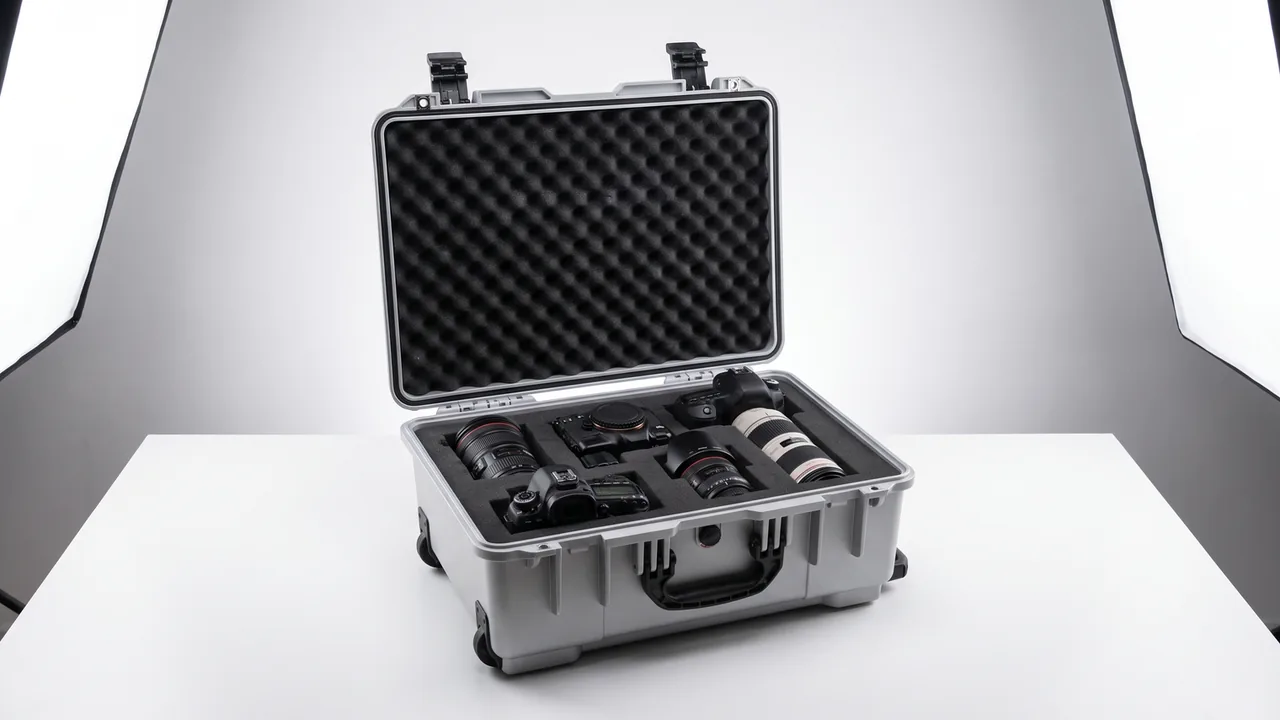
In oil and gas drilling, the mud pump is the heart of the circulating system, and its fluid-end core components - cylinder liners, valve assemblies, pistons and valve seats - are both expensive and precision-made, yet highly vulnerable to damage during long-distance transport and frequent lifting. JUNZHIJIA holds that a purpose-built heavy-duty case for liners and valve assemblies can cut the failure risk caused by collision, corrosion and vibration in transit by more than seventy percent, making it an indispensable safeguard for drilling equipment moving between sites and across borders. This article starts from the real damage mechanisms and systematically explains the padding, structure and corrosion-protection design of protective cases, then gives practical selection, testing and acceptance advice so that procurement and equipment engineers can build a mechanism-first mindset instead of repeating costly mistakes.
The single-unit value of drilling pump spare parts ranges from several thousand to tens of thousands of dollars, yet the transport link is exactly where hidden losses concentrate. An unsecured liner rolling and striking inside a container may only suffer a scratched bore or chipped sealing face at best, but can be written off entirely at worst. The rubber parts and metal sealing faces inside a valve assembly age and pit rapidly in the presence of sandy mud residue and high humidity. Even more difficult is the corrosion of carbon steel and low-alloy steel by H2S acidic environment and seawater salt spray, which is often discovered only after arrival and unpacking, with claims and downtime losses far exceeding the cost of one protective case. This article condenses JUNZHIJIA engineering experience on oil and gas drilling protective cases into actionable steps so buyers avoid paying tuition twice on case selection.
Table of Contents
- Typical Transport Damage to Mud Pump Liners and Valve Assemblies
- Three Core Design Principles for Protective Cases
- Load Bearing and Anti-Collision Padding for Liners
- Zoned Fixation and Sealing Surface Protection for Valve Assemblies
- Corrosion Material Selection in Sandy and H2S Environments
- Case Structure Strength and Heavy-Load Lifting
- IP Protection and Sealing System Design
- Transport Environment Testing: GB/T 4857, ISTA and ASTM D4169
- Salt Spray Corrosion Testing: GB/T 10125 and Material Validation
- Cushioning Material Selection Comparison
- Packaging Marks and Storage-Transport Specifications
- JUNZHIJIA Customization Process and OEM/ODM Capability
- Common Selection Mistakes and Avoidance Advice
- Frequently Asked Questions
- Conclusion and Related Reading
Typical Transport Damage to Mud Pump Liners and Valve Assemblies
To design a qualified protective case, the first step is to clarify the damage mechanisms. During supply-chain movement, mud pump fluid-end components encounter four typical categories of damage, each pointing to a different protective design priority.
The first category is mechanical collision damage. Liners are usually thick-walled cylinders of high-chrome cast iron or ceramic-lined material, with a single piece weighing dozens of kilograms. If not rigidly positioned inside a truck or container, emergency braking and rough roads make them collide with each other or strike the case wall, causing outer-wall chipping, bore scoring and direct loss of mud sealing and pump efficiency. The valve bodies, valve seats and springs inside a valve assembly are even more fragile; a single notch on the sealing face disables the whole assembly.
The second category is vibration fatigue damage. Wide-band random vibration from road, rail and sea transport transmits through the case to the internal precision parts, and over time can loosen threads, fatigue springs and drift instrument zero points. At the scheme stage JUNZHIJIA normally references the distribution cycle levels given in ASTM D4169 to determine vibration magnitude before deriving the damping structure.
The third category is corrosion damage. Sandy mud residue carries chloride ions and sulfides; combined with high humidity and condensation from day-night temperature swings, it forms pitting and stress-corrosion cracks on metal surfaces. Overseas shipment adds seawater salt spray. Material selection must align with NACE MR0175/ISO 15156 requirements for sour service, as discussed in our oilfield pump case guidance.
The fourth category is contamination and foreign-object damage. Sand entering the liner bore acts like lapping paste and accelerates wear, so ends must be cleaned and plugged before packing. The table below summarizes common damage types and countermeasures.
| Damage Type | Typical Manifestation | Main Trigger Stage | Protective Countermeasure |
|---|---|---|---|
| --- | --- | --- | --- |
| Mechanical collision | Wall chipping, bore scoring, sealing-face notch | Handling and transit shock | Rigid positioning, EVA wrap, zoned barriers |
| Vibration fatigue | Loose threads, spring failure, zero drift | Road, rail, sea random vibration | Damping pad, mass balance, isolation layer |
| Corrosion | Pitting, SCC cracks, rust layer | Sandy residue, salt spray, condensation | Sour-service material, desiccant, sealed moisture barrier |
| Foreign-object contamination | Sand abrasion, bore scoring | No pre-pack cleaning | End caps, clean packing, dust bags |
Three Core Design Principles for Protective Cases
When taking on oil and gas drilling cases, JUNZHIJIA always treats three principles as the baseline of the scheme: shock absorption, anti-collision and anti-corrosion. None can be omitted, and their priority shifts dynamically with transport environment and component value.
The shock-absorption principle requires mechanically decoupling external excitation from internal precision parts. The concrete method is to place closed-cell buffer layers on all six interior faces, balance the mass of heavy parts with offset centers of gravity, and keep the resonance frequency away from the main energy band of the transport vibration spectrum. For valve assemblies with instruments or springs, the root-mean-square acceleration transmitted to the interior must also be controlled.
The anti-collision principle requires the component to have zero degrees of freedom inside the case. JUNZHIJIA commonly uses CNC-cut EVA or polyurethane inserts to mold a position for each part, combined with webbing, elastic buckles and adjustable dividers, ensuring displacement under any-direction impact stays within five millimeters. This matches the slot-per-part thinking emphasized in our foam material comparison article.
The anti-corrosion principle works from both material and micro-environment angles. On the material side, select grades evaluated against NACE MR0175/ISO 15156 or apply surface treatment. On the micro-environment side, keep relative humidity inside the case below fifty percent through sealing, desiccant and humidity indicator cards. These three principles jointly determine the specific structure in every following section.
Load Bearing and Anti-Collision Padding for Liners
The liner is the heavy item in the case and also the object most likely to cause secondary damage through its own weight and rolling. JUNZHIJIA treats it as a module requiring an independent load-bearing base rather than simply stuffing it into foam.
First is the load-bearing base. A single liner is heavy, and its outer circle is a smooth cylindrical surface that ordinary flat padding cannot stop from rolling. The scheme uses a two-piece saddle-shaped slotted base: the lower trough carries the load and the upper cover clamps it, with eight to fifteen millimeters of closed-cell EVA bonded inside to spread pressure and absorb impact. The base material itself uses high-density polyethylene or glass-fiber-reinforced polypropylene to avoid creep under stacking loads.
Second is protection of the end sealing faces. The bore and flange sealing faces at both ends of a liner are the most knock-sensitive parts. JUNZHIJIA fits separately machined plastic end caps or flared guards that fully cover the sealing face, then wraps the whole part in an anti-static dust bag to keep sand out of the bore.
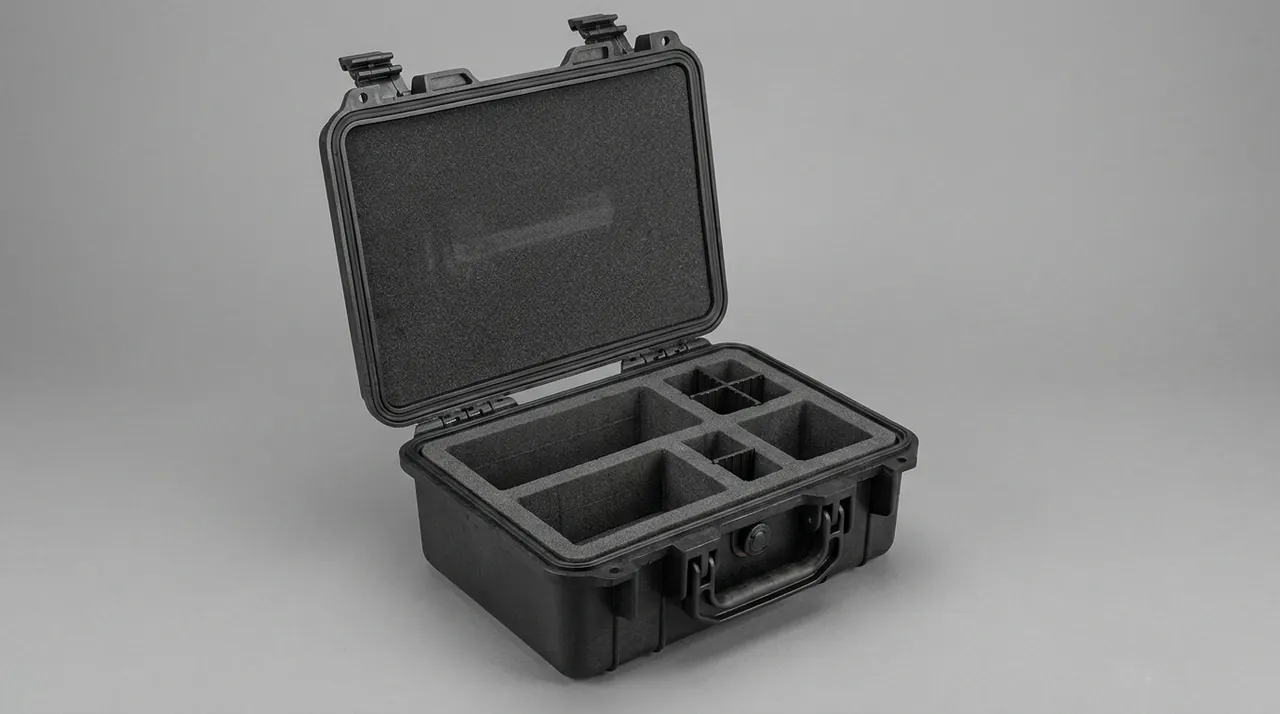
Third is separation when multiple liners share a case. When several liners go in one case, an independent divider must be set between adjacent liners, with divider thickness and buffer layer determined by the stacking test load of GB/T 4857. The figure below shows a typical saddle-positioning layout for multiple liners.
Note that the liner bore must receive oil or vapor-phase rust prevention after cleaning, because even inside a dry case, bare metal can show flash rust within hours once unpacked at a humid site. This echoes the long-term storage advice in our protective case service life article.
Zoned Fixation and Sealing Surface Protection for Valve Assemblies
A valve assembly consists of valve body, seat, spring, guide rod and rubber seals. Its structure is loose, its parts are many and its sealing faces are numerous, making it the most delicate object in the case. JUNZHIJIA handles it with the rule: the assembly stays together, sealing faces stay covered, and small parts stay accounted for.
First, fixing the whole assembly is preferred over disassembly. Whenever it can be shipped intact, it is, then secured laterally with elastic webbing through preset anchor points on the case to limit all six degrees of freedom. When disassembly for transport is truly necessary, small parts are placed in separate bubble bags and arranged in assembly order to prevent wrong or missing installation at site.
Second, the sealing faces get dedicated protection. The metal seat sealing face and rubber parts are the most knock-sensitive, pressure-sensitive and oil-sensitive surfaces. JUNZHIJIA fits an independent rigid plastic guard ring for the sealing face, while rubber parts are bagged separately and kept away from direct grease contact to prevent swelling and aging.
Third, rust prevention and moisture control go together. Many parts in a valve assembly are carbon steel or low-alloy steel, and should receive a thin rust-prevention oil after cleaning and drying, with sufficient desiccant and a humidity indicator card placed in the case. For the broader sealing framework, see our seal and shock case discussion on coordinated sealing and buffering design.
Fourth, marking and traceability matter. The part number of each valve assembly and its corresponding pump model should be written on the in-case checklist card and on the external label for quick verification after arrival. For exports, marks should also follow the basic rules of GB/T 191 on storage and transport pictorial marks, as outlined in our ADR/IMDG hazardous transport case article.
Corrosion Material Selection in Sandy and H2S Environments
The corrosion complexity of oil and gas drilling environments is far higher than general industry, and a wrong material choice can make the case itself structurally rust during a single overseas shipment. JUNZHIJIA splits this selection into two lines: case structural material and liner contact material.
For case structural material, priority goes to 304 or 316L stainless steel, glass-fiber-reinforced composite, or a heavy anti-corrosion system of epoxy zinc-rich primer plus polyurethane topcoat on carbon steel. Where H2S and chloride ions clearly exist in sour service, the metal grade must satisfy NACE MR0175/ISO 15156 limits on sulfide stress-cracking sensitivity, avoiding H2S-sensitive martensitic stainless steel and high-strength carbon steel.
For liner contact material, the buffer layer directly touching parts must be chemically inert, non-shedding and non-corrosive. Cross-linked polyethylene (IXPE), closed-cell EVA and polyurethane are safe choices; regenerated foam containing sulfur curatives or releasing acidic volatiles is strictly forbidden. For temperature and chemical stability dimensions, our extreme temperature case article discusses the temperature axis in more depth.
Surface treatment and coating are the second line of defense. JUNZHIJIA salt-spray tests export cases, evaluating coating protection life by the neutral salt spray method of GB/T 10125, also referenced in our refinery valve case guidance. The table below gives material recommendations for typical conditions.
| Service Condition | Main Corrosion Factor | Recommended Case Material | Liner Material | Standard Basis |
|---|---|---|---|---|
| --- | --- | --- | --- | --- |
| Onshore sandy mud transfer | Sand, moisture, mud residue | Carbon steel heavy coating / composite | Closed-cell EVA / IXPE | GB/T 10125 |
| Offshore platform supply | Seawater spray, condensation | 316L stainless / glass-fiber composite | Cross-linked polyethylene | NACE MR0175/ISO 15156 |
| H2S sour gas field | H2S, chloride, high pressure | Duplex stainless / qualified low-alloy | Inert polyurethane | NACE MR0175/ISO 15156 |
| Arctic low-temperature drilling | Low-temp brittle, freeze-thaw | Low-temp impact composite | Low-temp EVA | GB/T 4857 |
Case Structure Strength and Heavy-Load Lifting
Mud pump spare-part cases often exceed one hundred kilograms in total weight, so the case must simultaneously bear internal load, stacking load and lifting load. Structural strength cannot be solved by crudely thickening; it depends on topology and connection design.
The skeleton-type structure of aluminum alloy frame plus composite panel, common in military-grade cases, suits this heavy-load scenario well: aluminum profiles at the four corners and edges absorb impact, while panels carry uniform and concentrated loads. JUNZHIJIA marks the rated stacking layers in the scheme and designs base reinforcing ribs accordingly, preventing the bottom case from being crushed during long-term warehousing.
Lifting is the most dangerous step for heavy cases. Beyond standard forklift slots, cases above eighty kilograms should be fitted with lifting eyes or sling attachment points that penetrate or reliably connect to the skeleton - never fixed only to the panel. The eye layout should keep the case nearly level and the center of gravity centered during hoisting to prevent parts from sliding inside. For the overall reliability of hinge, latch and seal, our toolbox hinge latch seal article provides engineering points on latch and load coordination.
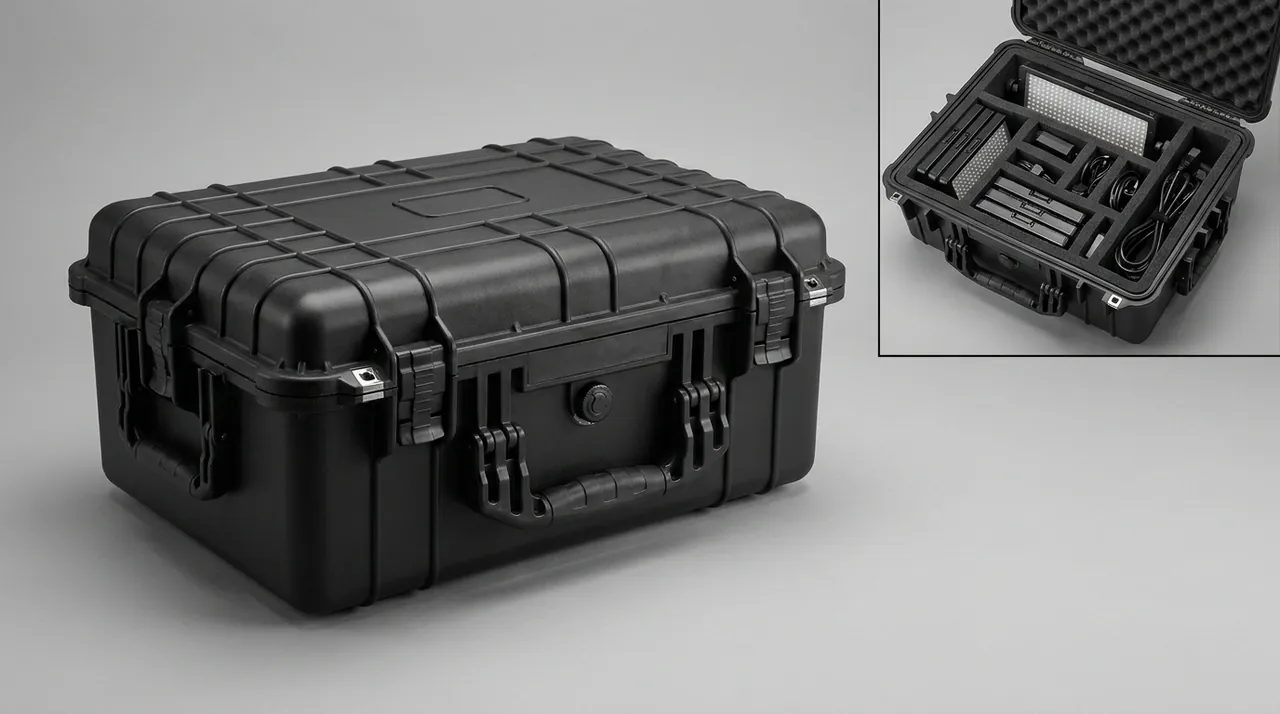
Wheels and handles are equally critical for heavy-site transfer. Dragging a one-hundred-kilogram case across deck or oily well-site ground quickly defeats ordinary casters. JUNZHIJIA normally specifies large-diameter pneumatic or solid anti-vibration casters with a retractable trolley handle for heavy cases, following the selection logic in our case wheels and trolley handle article. The figure below shows a heavy-load case structure with lifting points and reinforced skeleton.
IP Protection and Sealing System Design
Mud pump parts cases frequently face rain, seawater splash and well-site mud, and the sealing grade directly decides whether the internal micro-environment stays dry. JUNZHIJIA normally defines and verifies case dust and water resistance by the IP grades of IEC 60529 / GB/T 4208, generally recommending no lower than IP65 for outdoor transfer and overseas supply, and up to IP67 for near-shore or deck storage.
It must be clarified that JUNZHIJIA references the environmental test methods in MIL-STD-810H, such as rain, humidity and vibration procedures, to design verification schemes, but this is only used as a test-method basis and the case is not a military product, not a military certification. When buyers see tested by MIL-STD-810H method in a tender, it should be understood as method benchmarking, not as obtaining military certification, a boundary explained in our MIL-STD-810H case compliance article.
The sealing structure itself is realized by the case flange, elastic sealing gasket and compression latches working together. JUNZHIJIA prefers continuous closed-cell foamed silicone or EPDM gaskets with multi-point synchronous compression latches to make the whole-circle pressure uniform. For well sites with significant altitude change, the pressure difference inside and outside the case fatigues the gasket prematurely, so a pressure equalization valve with waterproof breathable membrane should be configured to release differential pressure while blocking water droplets.
Waterproof grading must be proven by test, not claim. It should be recorded through spray and immersion trials. For how sealing and buffering coordinate, our waterproof case IP and IP67 protective case articles give finer metric breakdowns.
Transport Environment Testing: GB/T 4857, ISTA and ASTM D4169
A protective case is not safe just because parts are put inside; testing must turn design assumptions into evidence. Before delivery JUNZHIJIA normally builds a verification matrix from three standard families: the GB/T 4857 series, ISTA protocols and the ASTM D4169 distribution cycle.
GB/T 4857 is the domestic basic test method set for transport packages, covering drop, stacking, vibration and shock items, and JUNZHIJIA uses it as the pass-line for type tests. ISTA (International Safe Transit Association) protocols lean toward simulating real distribution hazards; for example the ISTA 3 series gives combined sequences for unitized freight and less-than-truckload transport, suitable for the multimodal verification of exported drilling parts. ASTM D4169 defines the hazard spectrum of the whole process from factory to delivery by distribution cycle level, convenient for quantifying vibration and drop grades at the scheme stage.
The relationship among the three can be understood this way: use ASTM D4169 or ISTA to determine what hazards will be met, use the corresponding methods of GB/T 4857 to execute how to test, and finally use measured data to iterate the insert and structure. For ISTA procedure details, our ISTA transport testing procedure article gives step-by-step operation; for the MIL-STD-810H compliance boundary, our MIL-STD-810H case compliance article also explains it specifically.
For heavy parts like mud pumps, testing must especially focus on the design of drop attitude: the most unfavorable drop angle must be determined for a case with offset center of gravity, rather than applying the standard default edge, corner and face sequence, otherwise the test passes while the field still fails.
Salt Spray Corrosion Testing: GB/T 10125 and Material Validation
Corrosion is the invisible killer of overseas and H2S scenarios, and JUNZHIJIA treats salt spray testing as a mandatory gate for anti-corrosion material selection, mainly based on the neutral salt spray (NSS) and acetic acid salt spray (AASS) methods of GB/T 10125.
The neutral salt spray test atomizes a five percent sodium chloride solution and continuously sprays it onto specimens, recording the time until red rust or coating blistering appears, used to compare the protection ability of different coating systems and base materials. For export cases, JUNZHIJIA generally requires an epoxy zinc-rich plus polyurethane system to reach more than four hundred eighty hours without base-material red rust in NSS; for stainless steel cases the focus is on the consistency of welds and surface treatment.
Harsher acidic environments also add the sulfide stress-cracking evaluation of NACE MR0175/ISO 15156, because the salt spray test itself does not verify H2S sensitivity. In sour gas field projects JUNZHIJIA archives material certificates, heat batch numbers and third-party test reports as part of the delivery file.
It should be emphasized that the salt spray test is material-selection verification, not a whole-case life promise. Real long-term protection still depends on daily maintenance and desiccant replacement; the relevant maintenance method can be found in our how to clean protective case article on case cleaning and anti-corrosion upkeep.
Cushioning Material Selection Comparison
The insert is the last buffer between the case and the parts, and wrong material directly cancels all the effort of the case structure. JUNZHIJIA commonly uses three categories of cushioning material on mud pump parts cases, each with a different application surface.
Cross-linked polyethylene (IXPE) has low density, closed cells and extremely low water absorption, suitable as a wall-moisturizing layer and light-part wrapping, with good chemical stability and no shedding. Closed-cell EVA has good rebound and is easy to CNC-cut into slots, making it the main material for slot-per-part, suitable for liner saddle bases and valve assembly dividers. Polyurethane (PU) can be site-foamed or molded into high-load pads, balancing compression resistance and damping, suitable for heavy-part load bearing and irregular cavity filling.
All three materials are free of sulfur-cure systems that corrode metal and meet general industrial contact safety. The table below gives a comparison to help engineers choose by part mass and contact face.
| Material | Density | Compression | Slotting Ease | Moisture Resistance | Typical Use |
|---|---|---|---|---|---|
| --- | --- | --- | --- | --- | --- |
| Cross-linked PE IXPE | Low | Medium | Fair (sheet form) | Excellent | Wall moisture layer, light-part wrap |
| Closed-cell EVA | Medium | Medium-High | Excellent (CNC) | Excellent | Liner saddle, valve divider |
| Polyurethane PU | Medium-High | High | Medium (mold/foam) | Good | Heavy load pad, irregular fill |
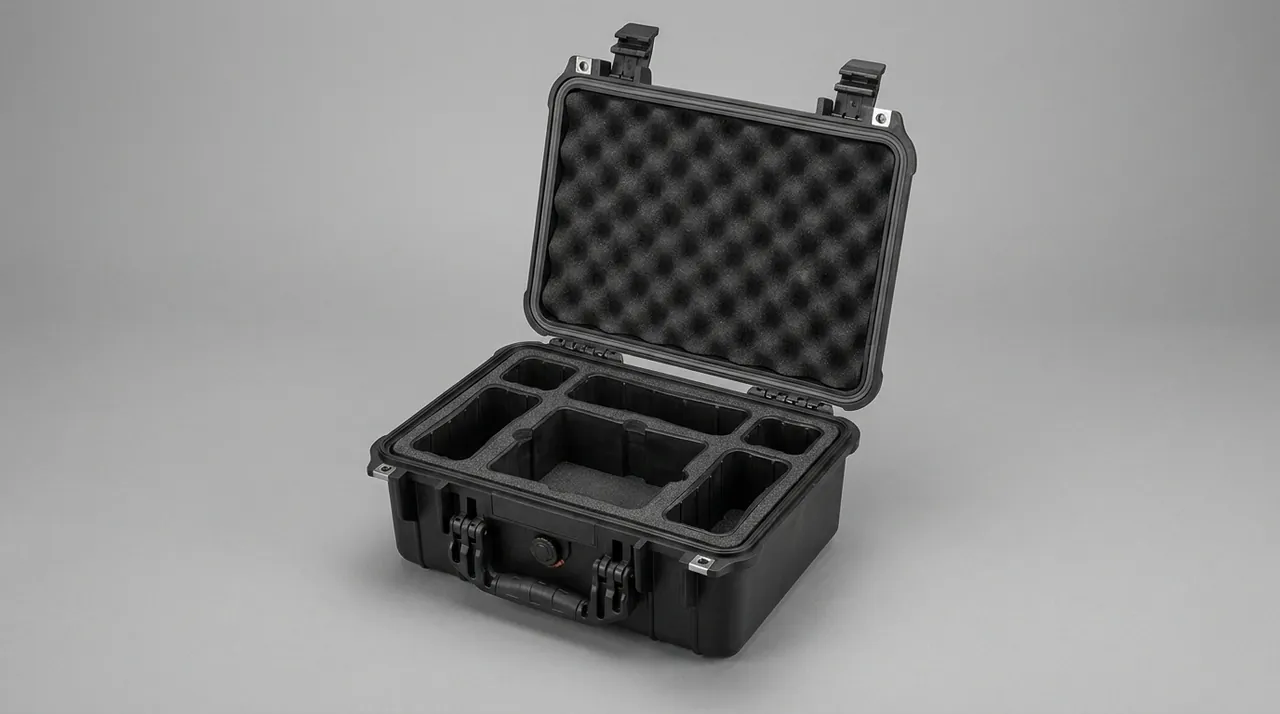
For the process difference between slotting and molding, our custom foam inserts guide and EVA foam insert custom process articles give the complete flow from survey to finished product, and JUNZHIJIA can also directly cut slots from the customer's assembly 3D model. The figure below shows a zoned insert CNC-slotted to the valve assembly shape.
Packaging Marks and Storage-Transport Specifications
However good the case, unclear marks and improper storage-transport still cause problems at the last mile. JUNZHIJIA standardizes packaging storage-transport marks and general technical conditions by GB/T 191 and GB/T 13384.
GB/T 191 specifies pictorial marks such as this way up, keep away from rain, center of gravity, do not roll and limit of stacking layers. Heavy mud pump parts cases must mark center of gravity, lift here, stack limit and keep away from rain in prominent positions with sufficient contrast color blocks. GB/T 13384 sets general technical conditions for transport packages, including moisture proofing, rust proofing, cushioning and fixing principles, serving as the bottom-line standard for whole-case design.
Two points are often ignored in actual flow. First, temperature and humidity recording for multimodal transport: overseas cases should carry a temperature-humidity recorder whose data is played back after arrival to judge whether condensation limits were exceeded. Second, dangerous-goods and ballast declaration: if the case contains desiccant, rust preventive or spare parts with specific chemicals, the boundary of ADR/IMDG dangerous goods transport in our ADR/IMDG hazardous transport case article should be checked to avoid compliance risk.
JUNZHIJIA attaches a packing list, a part-to-pump-model table and a maintenance tip card to each case before delivery, and synchronizes key information to the external label for quick verification and traceability on arrival.
JUNZHIJIA Customization Process and OEM/ODM Capability
JUNZHIJIA provides protective case customization services for oil and gas drilling equipment from survey, design, prototyping to batch delivery, supporting both OEM and ODM cooperation models. The typical flow has five steps. First, the customer provides a parts list, 3D model or physical sample, and JUNZHIJIA performs a damage-mechanism and transport-hazard assessment. Second, a structure scheme and insert slotting drawing are output, clarifying IP grade, load bearing and stacking layers. Third, a sample case is made and verified by GB/T 4857, ISTA or ASTM D4169. Fourth, batch acceptance is done by the sampling plan in our custom case acceptance AQL article. Fifth, material certificates and test reports are archived and delivered with the goods.
At the OEM/ODM level, JUNZHIJIA can do case screen printing, laser engraving and latch customization by customer brand and marks; the relevant appearance and lock options can be referenced in our case lock customization options article. For projects needing model-matched seals and desiccant quantities, JUNZHIJIA builds a part-to-case correspondence table for one-pump-one-case traceability.
The customization and production capability described here is manufactured by Kexin New Materials (Guangdong) Co., Ltd., whose composite material and injection molding capacity supports batch supply. For how to evaluate the qualification and capacity of a contract manufacturer, our how to choose case OEM factory article provides a screening checklist from prototyping to mass production, and our custom case mold cost analysis article helps procurement calculate the break-even point between tooling and unit cost.
Common Selection Mistakes and Avoidance Advice
In communication with drilling equipment procurement, JUNZHIJIA has summarized several high-frequency mistakes and gives avoidance advice for each.
Mistake one: asking only for dimensions, not hazards. Many buyers first measure parts with a tape and order a roughly fitting case, ignoring vibration, drop and corrosion grades, so the case fits but is unsafe. The correct approach is to determine the transport mode (road, rail, sea, air) and environmental corrosion grade first, then derive the structure.
Mistake two: valuing the shell while neglecting the insert. No matter how solid the shell, if the insert cannot position the parts, they still collide in turbulence. The precision of insert slotting directly decides protection success; the cushion liner case article on liner design principles is recommended.
Mistake three: saving money with regenerated foam. Regenerated foam may contain sulfur, shed particles and release corrosive volatiles, causing long-term harm to precision metal parts, and should be firmly avoided in oil and gas scenarios.
Mistake four: ignoring stacking and lifting loads. A single one-hundred-kilogram case going overseas, once stacking and lifting-point design is missing, carries extremely high accident risk.
Mistake five: not reviewing test documents. A qualified case delivery should include material certificates, salt spray and transport test records, and procurement should list such documents as acceptance clauses.
Frequently Asked Questions
Q: Can liners and valve assemblies share one protective case? A: Yes, but only if the case has hard zoning and the two component types are never mixed in one cavity. JUNZHIJIA normally uses one case for same-pump-model liners and valve assemblies, yet separates the heavy liner from the precision valve assembly with an independent divider: the liner uses a saddle load-bearing base while the valve assembly uses a CNC-slotted divider insert, so the two do not contact or press each other inside the case. The advantage of a shared case is fewer shipment pieces and lower management cost, but every part must be constrained in all six degrees of freedom with impact displacement under five millimeters. If the single-case total weight exceeds lifting or stacking limits, splitting into dedicated cases is recommended, each labeled with its pump model and part number to avoid on-site mismatch and assembly delay that would otherwise extend downtime. This zoning discipline is exactly what separates a true protective case from a simple wooden crate that merely contains the parts.
Q: Does the protective case need to reach IP67 grade? A: It depends on the transfer and storage environment, and higher is not always better; the grade should match real risk rather than a printed number. JUNZHIJIA generally recommends IP65 for onshore road transfer and warehouse storage of mud pump parts cases, which resists rain spray and dust ingress. For offshore platform supply, open-deck storage or scenes easily hit by seawater splash, IP67 is advised so brief immersion does not let water in. It must be clear that the IP grade is realized by a continuous gasket plus multi-point synchronous compression latches, and should be verified by spray and immersion tests rather than judged by a label. If air freight or high-altitude well sites are involved, a pressure equalization valve should also be fitted to release internal-external differential pressure and avoid premature gasket fatigue, as detailed in our waterproof case IP article on sealing design. JUNZHIJIA documents the chosen IP grade, gasket compression rate and latch spacing in the case drawing so the protection level is reproducible rather than relying on a supplier default, and reviews the rating whenever the transfer route or storage environment changes.
Q: How should materials be selected for H2S sour service environments? A: NACE MR0175/ISO 15156 must be the material-selection bottom line, and safety cannot be judged merely from the word stainless steel. In sour gas field projects JUNZHIJIA gives priority to duplex stainless steel or evaluated low-alloy steel for the case structure, avoiding H2S-sensitive martensitic stainless steel and high-strength carbon steel. Liner contact materials use chemically inert cross-linked polyethylene, closed-cell EVA or polyurethane, strictly forbidding regenerated foam with sulfur curatives or acidic volatiles. Material certificates, heat batch numbers and third-party H2S evaluation reports should be archived with the goods. Note that the salt spray test itself does not verify H2S sensitivity, so the two cannot substitute for each other, and material selection must rest on the material evaluation rather than on the superficial appearance of a bright, corrosion-free metal surface after light exposure. JUNZHIJIA therefore documents the full material pedigree so the buyer can audit compliance independently at any stage of the project.
Q: What pre-treatment is needed for parts before packing? A: The core is two tasks: thorough cleaning and rust-proof plugging, neither of which can be omitted. Mud pump parts must be cleared of sandy mud residue before packing because sand entering the liner bore acts like lapping paste and accelerates wear. After cleaning, apply a thin rust-prevention oil or vapor-phase inhibitor to the bore and sealing face, and fit machined plastic end caps or flared guards to cover the sealing face and prevent secondary knocks during handling. Rubber parts in the valve assembly are bagged separately to avoid swelling from grease contact. Finally wrap the whole in an anti-static dust bag, place sufficient desiccant and a humidity indicator card inside to keep relative humidity below fifty percent, blocking corrosion and contamination from the micro-environment so parts arrive intact and ready for immediate installation without extra on-site rework. Skipping any of these steps is the most common reason a seemingly well-packed shipment still fails on arrival.
Q: How are single-case load bearing and stacking layers determined? A: They should be calculated from real transport and storage conditions rather than guessed from experience. JUNZHIJIA first sets the case skeleton and base reinforcing ribs by total part mass, then determines safe stacking layers by the stacking test of GB/T 4857 and clearly marks the stack limit pictorial on the case exterior. For cases above eighty kilograms, lifting eyes or sling points penetrating the skeleton must be fitted so hoisting stays nearly level with a centered gravity and prevents parts from sliding inside. Caster and handle loads on mud or deck surfaces must also be checked to avoid the awkward fits but cannot be moved situation. All load parameters should be written into the delivery file as the direct basis for on-site handling and warehousing operations and for safe inter-site transfer. JUNZHIJIA also supplies a labeled rigging diagram so crane operators lift the case by the correct points without guesswork on a busy deck.
Q: Which standards should transport testing follow? A: JUNZHIJIA normally builds a three-in-one verification matrix of GB/T 4857, ISTA and ASTM D4169. First use ASTM D4169 or ISTA to define the distribution hazard spectrum of vibration, drop and shock grades, then execute the specific tests by the corresponding methods of GB/T 4857, and finally iterate the insert and structure with measured data. For heavy parts with offset center of gravity like mud pumps, the test must be designed for the most unfavorable drop attitude rather than applying the standard default edge-corner-face sequence, or the test passes while the field still fails. For ISTA procedure details see our ISTA transport testing procedure article, and note that MIL-STD-810H is only a test-method benchmark, not a military certification, and should not be misread as military qualification in a tender document by any procurement team. JUNZHIJIA keeps the test plan, raw data and iteration record in the project file so the case can be re-validated when the route, loaded weight or packing configuration changes, instead of repeating the whole programme from scratch.
Q: Can JUNZHIJIA customize inserts and seals by pump model? A: Yes, and this is exactly JUNZHIJIA routine practice on oil and gas equipment cases. JUNZHIJIA supports survey slotting from the customer-provided parts list, 3D model or physical sample, and can also match seals and desiccant quantities by designated pump model, building a one-pump-one-case correspondence table for arrival traceability. Cooperation covers OEM, with customer brand and marks for screen printing, laser engraving and latch customization, and ODM, where JUNZHIJIA completes the structure design and insert scheme. From prototyping and verification to batch acceptance there is a standard flow, and material certificates with transport and salt spray test reports are delivered with goods to meet the compliance and traceability needs of overseas drilling equipment and to shorten on-site installation cycles for the operator. For mixed spare parts across multiple pump models, modular dividers can be added so a single case adapts to several specifications without compromising the slotting precision of each cavity.
Q: How to verify whether a protective case is qualified? A: Verification should land on both documents and measurement rather than judging only by whether the appearance looks solid. On the document side, require the supplier to provide material certificates, salt spray test records under GB/T 10125, transport test records under GB/T 4857, ISTA or ASTM D4169, and a packing list. On the physical side, inspect appearance, latch sealing, insert slotting fit and lifting-point connection reliability by the agreed sampling plan. JUNZHIJIA recommends writing AQL sampling, key dimensions and IP measurement into the technical appendix of the procurement contract, sampling by ratio after arrival and commissioning third-party retesting when necessary, so that fitting but unsafe cases are kept out of the well site from the source and protecting drilling equipment integrity and operation continuity.
Conclusion and Related Reading
Mud pump liner and valve assembly protection is an engineering process of translating damage mechanisms into structural parameters. JUNZHIJIA recommends defining hazard grades first, then structuring the case, and closing the loop with testing.
Related Reading