

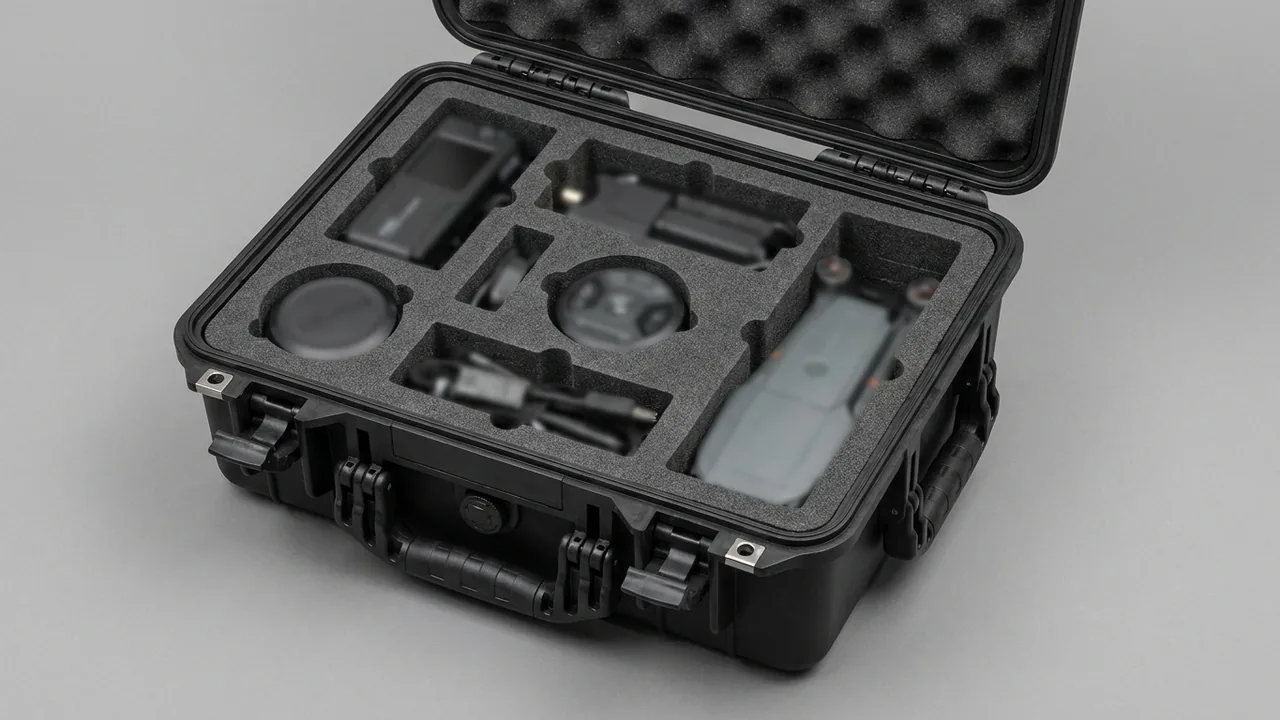
The prong holding a diamond in an eighteen karat setting is often under 0.4 mm thick. The nacreous layer that gives a pearl its luster is a few micrometers deep. Items like these do not fail the way a machine fails. They shrug off impact energy and then lose their value through surface contact, long-term fretting and chemistry. One careless storage decision can put visible hairlines on a ring shank, blacken silver within two weeks, or strip a pearl of its luster. Spotlights in a display case, pieces knocking together in a drawer, and the continuous low-amplitude vibration of a delivery van are the real failure environments. JUNZHIJIA builds jewelry cases around contact control rather than impact resistance: cavity geometry removes piece-to-piece collision, surface-compatible materials remove abrasion and chemical contamination, and humidity management slows tarnish, so every piece leaves the case exactly as it entered.
A jewelry case has to do three jobs at once: store, display and transport. Storage wants density and visibility, display wants fast access and visual presentation, and transport wants positive location and environmental isolation. Those requirements do not align. Storage prefers small, dense cells; transport prefers thick, compliant cushioning; display prefers a tray that lifts out as one unit. Reconciling that tension is the core of jewelry case design. This article works through the whole problem, from the failure spectrum and quantified duty cycle to shell and liner interaction, cavity geometry, material compatibility, tarnish control, display integration, test validation and the custom build path.
Table of Contents
- Failure Spectrum of Jewelry Cases: Three Damage Mechanisms in Metals, Gemstones and Finish
- Quantifying the Jewelry Duty: Mass Range, Contact Stress and Fretting Wear
- Shell and Liner Working Together: Stiffness, Appearance and Opening Feel in Small Hard Cases
- Cavity Geometry and Location: Ring Slots, Necklace Channels and Earring Grids
- Liner Materials and Surface Compatibility: Velvet, Microfiber, IXPE and Low Emission
- Tarnish Control and Humidity Management: Silver Sulfidation, Pearl Moisture and Sorbents
- Locks, Hinges and Theft Resistance: Closing Design for Display and Travel
- Integrated Display and Storage: Trays, Drawers, Stacking and Showcase Interfaces
- Sealing, Dust Protection and Scratch Prevention: Long-Term Cleanliness at the Counter
- Transport and Carry Constraints: Travel, Parcel Shipping and Cabin Size Limits
- Testing and Acceptance Criteria: Drop, Vibration, Abrasion and Color Fastness
- Selection Checklist and Custom Build Path: From Jewelry List to Volume Delivery
- Frequently Asked Questions FAQ
- Conclusion and Related Reading
Failure Spectrum of Jewelry Cases: Three Damage Mechanisms in Metals, Gemstones and Finish
Jewelry fails by mechanisms that have little in common with conventional industrial products. Industrial design asks whether a structure breaks; jewelry asks whether a surface has been altered. Grouped by mechanism, there are three families: mechanical contact damage, chemical tarnish and aging, and loss caused by structural failure.
Mechanical contact damage is by far the most common. Precious metals are soft: fine gold measures roughly 25 to 40 HV, platinum 40 to 60, sterling silver 60 to 90, and eighteen karat gold, alloyed for hardness, reaches 150 to 250. Two rings knocking together a few dozen times in a drawer leave marks at the contact points. Diamond sits at 10 on the Mohs scale and scratches any metal effortlessly, so diamond pieces must never share a cavity with anything else. Hardness gaps among gemstones are just as destructive: pearl is only 2.5 to 4.5, amber 2 to 2.5, opal 5.5 to 6.5, while sapphire and ruby sit at 9. A single sapphire can permanently mark a pearl.
Chemical change is the second family. Silver reacts with hydrogen sulfide to form black silver sulfide, and even trace concentrations blacken pieces within weeks. Pearls carry 2 to 4 percent water and crack and dull if dried out; opals behave the same way. Emeralds are routinely oiled, and solvents or ultrasonic cleaning destroy the filling. The third family is loss through structural failure: earring backs and necklace clasps are tiny, and once they detach they usually vanish at the moment the case is opened, a loss far larger than a scratch.
| Failure family | Typical symptom | Main trigger | Design countermeasure |
|---|---|---|---|
| --- | --- | --- | --- |
| Mechanical contact damage | Hairlines on shanks, scratched pearls, bent prongs | Piece-to-piece collision, abrasion against hard liners | One item per cavity, hardness zoning, soft facing |
| Chemical tarnish and aging | Blackened silver, dull or crazed pearls, crazing opals | Hydrogen sulfide, dry air, solvent residue | Sorbents, humidity control, low emission liners |
| Setting and structural damage | Loose stones, deformed prongs, failed clasps | Point loading, sustained compression | Floating location, avoid point loads |
| Small part loss | Missing earring backs, clasps, screws | No fixed position, scatter on opening | Dedicated small part cavity, magnetic or slotted retention |
| Display face soiling | Velvet shedding, fingerprints, dust | Low grade fabric, bare hand contact | High color fastness fabric, finger reliefs |
Quantifying the Jewelry Duty: Mass Range, Contact Stress and Fretting Wear
The mechanical input to a jewelry case is far gentler than to an industrial case, but the precision demanded is far higher. A single piece typically weighs 2 to 200 g and a fully loaded case rarely exceeds 5 kg, so impact energy in a drop is small. The real challenges sit in three other quantities: contact bearing stress, fretting wear and cycle count.
Contact bearing stress is contact force divided by contact area. A 50 g brooch resting on a flat surface may touch only at a few points including the pin tip, so local stress easily reaches tens of kilopascals, while allowable contact stress for soft metals and organic gems is very low. The first rule of jewelry location is therefore to put the load on a non-display surface: support a ring through the inner band or the side of the shank, never through the stone tip.
Fretting wear is specific to jewelry. Continuous low-amplitude vibration in transit lets a piece slide by tens of micrometers inside its slot, and after a hundred thousand cycles that produces visible wear marks. The fix is interference grip plus a low friction interface: the liner applies light elastic pressure so relative sliding cannot start, and a low friction facing minimizes damage from any residual movement.
Cycle count is the most underestimated figure. A counter case opens more than ten times a day, over three thousand times a year, far more than any shipping case. Hinges, latches and tray slides should therefore be specified for ten thousand cycles or more rather than the five thousand typical of transport cases.
| Quantity | Typical jewelry case value | Industrial case comparison | Design elements affected |
|---|---|---|---|
| --- | --- | --- | --- |
| Mass per item | 2 to 200 g | Hundreds of grams to tens of kilograms | Location by geometry, not cushioning |
| Loaded case mass | 0.5 to 5 kg | 15 to 60 kg | Thinner shell, easy center of gravity |
| Local contact stress | Several to tens of kPa | Sized from cushion curves | Hardness zoning, floating location |
| Fretting amplitude | Tens of micrometers | Millimeters | Interference grip, low friction facing |
| Cycles per year | Over 3000 | Tens | Hinge and latch life at ten thousand cycles |
| Environmental focus | Humidity, sulfides, light | Temperature, salt fog, rain | Sorbents and humidity window |
Shell and Liner Working Together: Stiffness, Appearance and Opening Feel in Small Hard Cases
Jewelry cases usually fall between 300 and 600 mm, placing them in the small hard case category. They do not need the corner-drop capacity of an industrial case, but they demand far more in stiffness, perceived quality and opening feel. Three shell routes dominate.
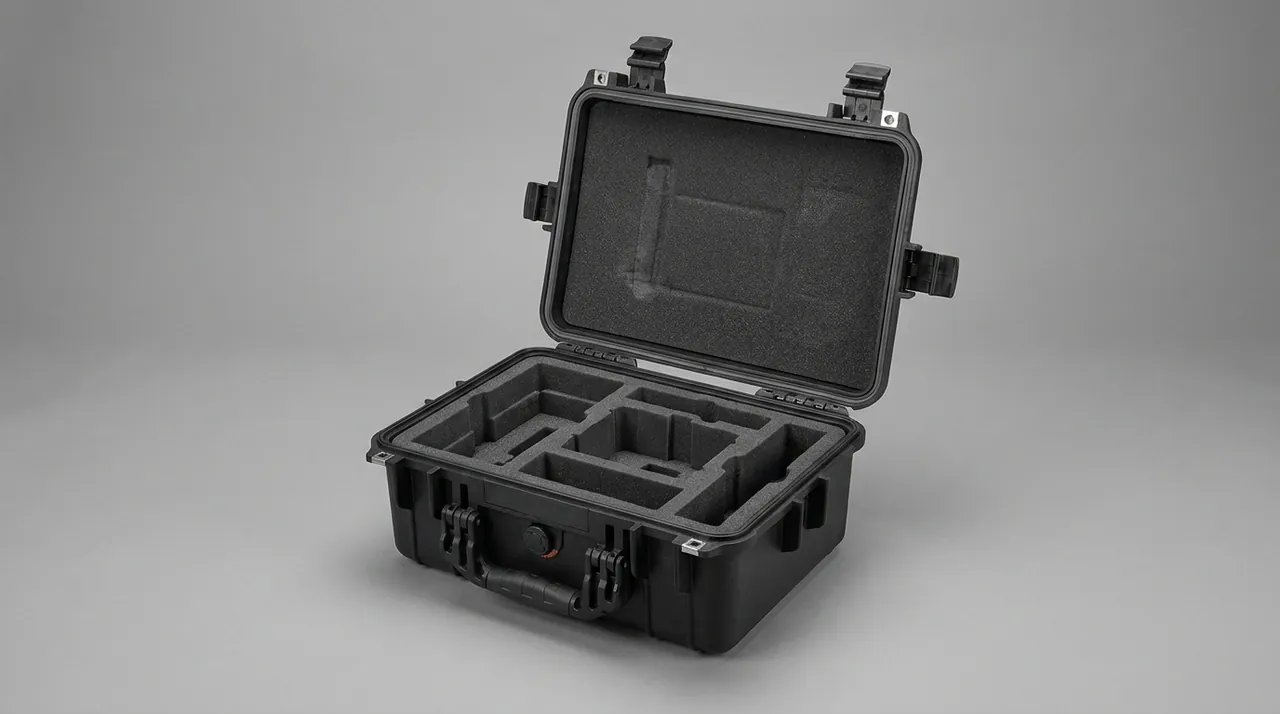
Aluminum is the mainstream choice for display: an extruded frame with panels gives high stiffness, moderate weight, and surfaces that take anodizing or brushing well, while readily accepting drawer slides and tray structures. Thin sheet actually resists denting better at small sizes because spans are short and support is dense, though corner joints remain the weak point. Injection molded ABS or polypropylene costs less and supports fine snap fits and texturing, suiting high volume travel jewelry boxes and personal organizers. Rotomolded polyethylene is largely unsuitable: the wall is too thick and the surface too coarse for a jewelry context, and it only makes sense as a bulk outer shipper. Selection guidance is in Aluminum Case Construction, Common Toolbox Types and Selection and Plastic Functional Box Design.
Liner and shell must be designed together. A jewelry liner does not absorb energy through thickness; it locates through geometry, so its job is grip and separation rather than cushioning. The typical build has three layers: a rigid substrate of ABS board, fiberboard or molded plastic tray; a resilient middle layer of low density EVA or PE foam supplying clamping force; and a contact facing of velvet, microfiber or suede. A workable proportion is four parts substrate, three parts resilient layer, one part facing. Bond the facing with a low emission adhesive, because solvent residue attacks precious metal. Broader liner thinking appears in Cushion Liner Protective Cases.
Opening feel matters too: the lid should hold at any angle so it cannot fall back on fingers or jewelry, with hinge damping sized by lid mass. Latch opening force should sit between 20 and 40 N, well below industrial values, because counter staff open these cases constantly. Hardware detail is covered in Toolbox Hinge, Latch and Seal Construction.
Cavity Geometry and Location: Ring Slots, Necklace Channels and Earring Grids
Cavity geometry is core to jewelry case design because it decides whether pieces move relative to one another. Six rules apply: one item per cavity, display surfaces never touching anything hard, hardness zoning, unobstructed removal paths, load on non-critical surfaces, and a fixed place for small parts.
Ring slots are the canonical geometry. The standard approach is a through slot lined with velvet on both faces, with the ring inserted vertically so the band is gripped elastically on both sides and the stone floats without contact. Slot width is ring outer diameter plus 0.5 to 1.0 mm, depth at least two thirds of the outer diameter, and spacing at least 20 percent of the largest ring diameter so neighbors never touch. Wide shanks or shaped rings may need angled slots or individual square cells.
Necklaces are governed by tangle risk. Use a channel with fixed endpoints: a serpentine or straight channel 8 to 15 mm wide carries the chain along its full length, and a removable pin or small clip secures the tail so the chain cannot migrate in transit. The pendant gets its own slightly larger recess, floating, so it never presses against the chain.
| Jewelry type | Recommended location | Key dimensions | Prohibited practice |
|---|---|---|---|
| --- | --- | --- | --- |
| Rings | Vertical slot, grip on both band sides | Slot width = outer diameter plus 0.5 to 1 mm | Flat stacking, multiple rings per slot |
| Necklaces | Serpentine channel with end retention | Channel width 8 to 15 mm | Coiling into a ball, pendant pressing chain |
| Earrings | Grid cells with pin holes | Cell side 25 to 40 mm | Pairs mixed together, loose backs |
| Bangles | Arc cradle supporting inner radius | Cradle radius matched to inner diameter | Stacking under weight |
| Brooches | Laid flat with pin tip in soft recess | Recess depth at least pin length | Pin tip loaded, stacking |
| Pearl and opal | Individual soft cavity, no hard contact | One piece per cavity | Sharing with diamond or other hard gems |
Earrings suit a grid of small cells, one pair per cell, with two small holes in the cell floor to accept the posts and a neighboring small-parts cavity for the backs. Bangles and necklaces need arc cradles profiled to the inner radius so load spreads over the arc rather than concentrating at two points. Brooches lie flat with the pin tip embedded in a soft recess, never carrying the weight. Use Removable Divider Systems for Cases where zoning must be adjustable and formed liners where the assortment is fixed; the trade-off is analyzed in Dividers versus Foam Inserts, with rapid prototyping via Pick and Pluck Foam Case Liners.
Liner Materials and Surface Compatibility: Velvet, Microfiber, IXPE and Low Emission
The liner facing is the part of a jewelry case that has to deal with chemistry. It must satisfy five conditions at once: no abrasion of the jewelry, no shedding or color transfer, no harmful emissions, no mold growth, and a hand and look appropriate to the brand.
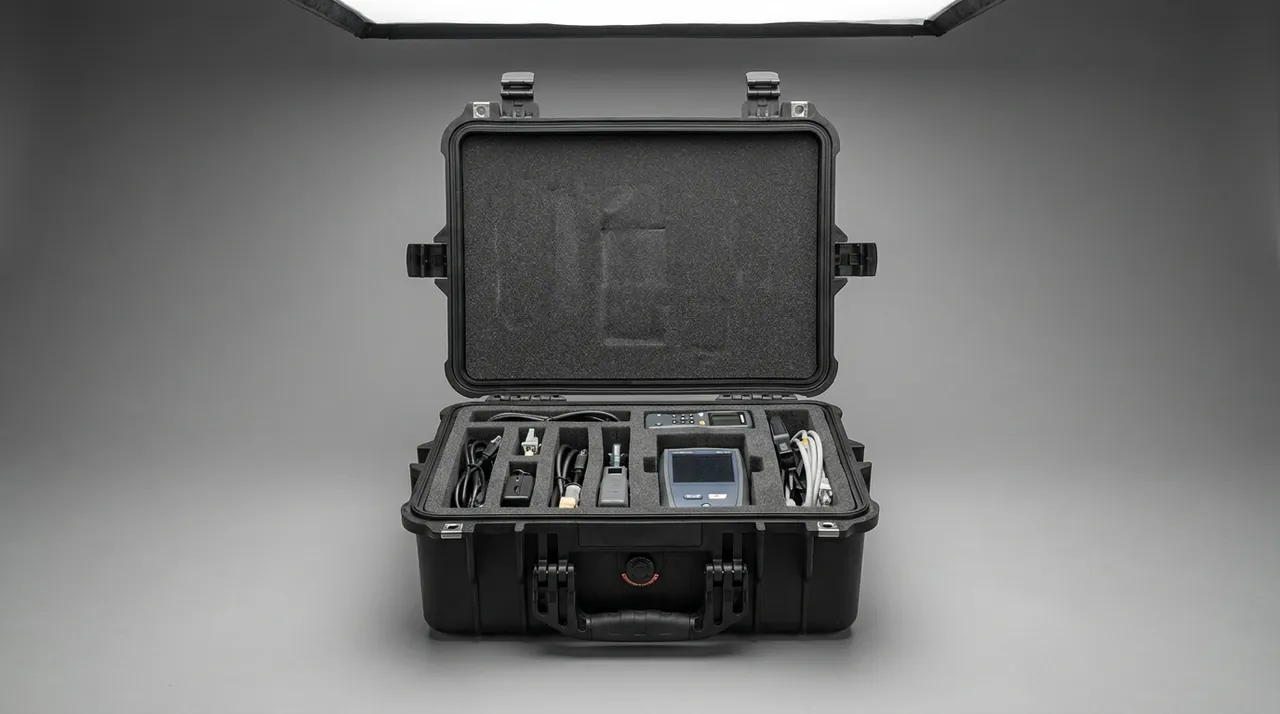
Four facing families are common. Nylon and viscose velvet feel soft and plush, read as expensive, cost less and come in many colors, making them the traditional choice for premium display cases; their weaknesses are shedding short fibers, inconsistent rubbing fastness, and the classic complaint of dark velvet transferring color onto light metal or pearls. Microfiber PU has a dense surface that does not shed, resists abrasion and wipes clean with a slightly damp cloth, giving the best durability, with a slightly dry hand suited to high frequency counter access. Direct IXPE or EVA facing is cheapest and washable but lowest in perceived quality, better suited to utility storage than display.
Three parameters must be written into the purchase specification. The first is color fastness to rubbing per GB/T 3920, with both dry and wet ratings no lower than grade 4, verified especially on dark shades. The second is shedding and pilling, assessed after Martindale abrasion or per GB/T 21196, requiring no obvious fuzzing after several hundred cycles. The third is low emission, meaning the fabric and adhesive must not use sulfur bearing, chlorine bearing or strong solvent systems, since sulfur directly accelerates silver tarnishing and is the most common hidden defect. Water based acrylic or hot melt adhesives are preferred, followed by a seven day closed jar odor check.
| Facing | Shedding | Color fastness | Abrasion | Perceived quality | Best use |
|---|---|---|---|---|---|
| --- | --- | --- | --- | --- | --- |
| Nylon velvet | Medium | Medium | Medium | Medium | General storage |
| Viscose velvet | Medium | Medium low | Medium | Medium | General storage |
| Microfiber PU | Very low | High | High | Medium high | High frequency counter access |
| Suede | Low | Medium | Medium | High | Premium display |
| IXPE facing | None | High | High | Low | Utility storage |
For the resilient middle layer, compare options in EPE versus EVA Foam Toolbox Liners. Jewelry service favors low density grades with low compression set, because the case grips continuously rather than absorbing a single impact, and holding rebound over three years is what matters. The formed liner workflow is in EVA Foam Insert Custom Process.
Tarnish Control and Humidity Management: Silver Sulfidation, Pearl Moisture and Sorbents
Chemical protection for jewelry comes down to three tasks: control humidity, remove sulfides, and avoid solvents.
Silver tarnishing is the most widespread problem. Silver reacts with atmospheric hydrogen sulfide to form black silver sulfide, and above roughly 60 percent relative humidity, in the presence of sulfur sources such as rubber, wool or certain adhesives, visible darkening appears within weeks. Four countermeasures apply. Hold internal humidity between 40 and 50 percent, since humidity accelerates the reaction. Use dedicated anti-tarnish media such as silver scavenger paper, activated carbon or molecular sieve, dosed at 5 to 10 g per liter of internal volume. Specify sulfur-free liner materials, banning sulfur cured rubber, some dark sulfur dyes and low grade foam. And make sure pieces are dry and clean before storage, because perspiration and cosmetic residue accelerate tarnish markedly.
Pearls and opals run the other way. Pearls hold 2 to 4 percent water and opals 3 to 10 percent; a persistently dry environment causes water loss, with pearls losing luster and opals crazing. Organic gems should not be sealed long term in a fully dried case. Keep relative humidity no lower than 45 percent and avoid direct sun or close-range spotlights, since the interior of a case under a display spotlight can run more than 10 C above ambient.
Humidity management has three implementations: the simplest is a desiccant sachet replaced quarterly, suitable where dryness is wanted; a two-way regulator or a silica plus humectant combination suits mixed assortments; and a premium approach embeds a small humidity indicator card that changes color when limits are exceeded. Cabinet-level moisture thinking is in Outdoor Rain and Humidity Case Design and Purpose of Dustproof Cases.
Locks, Hinges and Theft Resistance: Closing Design for Display and Travel
Closing requirements split by scenario. Counter display cares about casual removal and accidental opening; travel and parcel shipment care about vibration release and prying.
Three lock types cover small cases. Concealed push latches look clean and open fast, suiting high frequency counter access. Pin tumbler locks allow master key management across many cases. Combination locks remove key handling entirely and suit travel, and where flights are involved the lock should meet customs inspection requirements. Specify bolt engagement of at least 3 mm and bolt material in zinc alloy or stainless steel rather than plastic, which embrittles in the cold.
On theft, the weak point of a small case is rarely the lock; it is the hinge side. Exposed hinges can be pried or their pins pulled, so jewelry cases should use concealed hinges or at least make pins impossible to withdraw from outside. A rebated joint between lid and base prevents thin tools from being inserted. For high value contents, provide a cable lock eyelet or fixing holes so the case can be secured inside a showcase.
Travel also demands protection against accidental opening, because vibration can trigger a push latch; use a latch with a secondary safety catch. Hardware selection detail is in Toolbox Hinge, Latch and Seal Construction, with durability verification in Toolbox Durability and Load Testing.
Integrated Display and Storage: Trays, Drawers, Stacking and Showcase Interfaces
The hardest part of jewelry case design is that it must be both a storage container and a display prop. The standard answer is tray-based construction: one or more trays lift out as complete units, each carrying the full cavity layout, so the tray goes straight into a showcase or onto a counter without handling individual pieces.
Three tray design points matter. Removal path first: leave finger reliefs or a pull strap around the tray, aligned with the center of gravity so pieces cannot slide out as the tray tilts. Inter-layer clearance second: leave at least 8 mm between the underside of an upper tray and the tallest piece below, more where lower pieces such as brooches have points. Tray stiffness third: a fully loaded tray must not visibly bow when lifted, or cavity distortion releases grip; use a floor at least 3 mm thick or add ribs.
Drawer construction suits fixed counters: the case acts as a carcass holding multiple drawers, each fitted with stops so it cannot be pulled fully out and dropped. Where cases must stack, provide interlocking top and bottom features; see Stackable Case Construction. Interfacing with a showcase requires the internal clear dimensions and lighting positions in advance, sizing trays 5 to 10 mm under the showcase clear opening. Display-oriented thinking continues in Jewelry Display Case Design and Jewelry Making Equipment Cases.
Sealing, Dust Protection and Scratch Prevention: Long-Term Cleanliness at the Counter
Dust in a counter or window display harms jewelry chronically. Particles held on velvet become abrasive during handling, producing fine hairlines on precious metal over time, and they dull gemstone brilliance, forcing frequent cleaning. The sealing goal for a jewelry case is therefore dust exclusion and internal cleanliness, not water exclusion.
On ratings, IP5X dust protection generally covers counter and window conditions. Move to IP54 or IP65 for outdoor markets, open-air fairs or ocean parcel shipment. Note that maximum airtightness is not automatically desirable. A fully sealed case exchanges no moisture with its surroundings, which works with desiccant but works against pearls and opals, and opening against a pressure differential feels unpleasant and at altitude can be difficult. Group by type instead: precious metal and diamond cases pursue dry and dust-tight, organic gem cases retain moderate breathability.
Structurally, small cases usually use a rebated joint with a seal strip at 40 to 60 Shore A compressed 20 to 30 percent. The compound must be sulfur free, with silicone or EPDM preferred. Two to three latches suffice for a small case provided corners are clamped. Rating differences are explained in IP54 versus IP65 Ratings and IP65, IP66 and IP67 Differences, with system thinking in System Level IP67 Design and Outdoor Case Seal Ring Design.
Two details also prevent scratches. Provide a finger relief of at least 10 mm on both sides of every cavity so hands cannot graze neighbors during handling. And ensure external feet and pulls are non-marking, so the case never scratches glass or stone counter tops.
Transport and Carry Constraints: Travel, Parcel Shipping and Cabin Size Limits
Jewelry moves in three ways: internal transfer between counters, travel for exhibitions or shoots, and parcel shipment between warehouses and stores. The constraints differ completely.
Internal transfer is short and frequent, with the main risks being rolling and accidental lid opening, so the emphasis is on latches and handles rather than extra packaging. Travel splits into carry-on and checked. High value pieces should travel as carry-on, which constrains the case to cabin baggage limits, commonly a sum of dimensions no greater than 115 cm with no single side above 55 cm. Where checked transport is unavoidable, add a rigid outer case with cushioning and never mark the outside as containing jewelry; see Travel Case Construction Essentials and Industries for Trolley Cases.
Parcel shipment is the harshest. Single parcels moving by express carrier fall under ISTA 3A programs covering drop, random vibration and concentrated impact, so use a corrugated outer with the jewelry case as inner packaging and a 20 to 30 mm cushioning layer between them. Where the case itself ships as the transport unit, check the shell against 0.8 to 1.0 m drop and 0.4 to 0.6 Grms random vibration, and confirm liner retention as described in Custom Case Acceptance and AQL. Two more points: never use sulfur-bearing cushioning such as some recycled rubber, and pack anti-tarnish paper at 5 to 10 g per liter.
| Transport case | Main risk | Recommended practice | Verification focus |
|---|---|---|---|
| --- | --- | --- | --- |
| Counter transfer | Rolling, accidental opening | Full latch engagement, two side handles | Latch reliability |
| Travel carry-on | Crushing, size limits | Carry on, control external dimensions | Dimensional compliance |
| Checked baggage | Rough sorting, loss | Rigid outer case, no markings | Outer cushioning, theft resistance |
| Parcel shipment | Drop, vibration, concentrated impact | Corrugated outer with cushion layer | ISTA 3A equivalent validation |
Testing and Acceptance Criteria: Drop, Vibration, Abrasion and Color Fastness
Jewelry case validation adds three tests to the usual drop, vibration and stacking set: facing abrasion, color fastness and anti-tarnish behavior.
Drop testing is graded by loaded mass; jewelry cases under 5 kg are tested at 0.8 to 1.0 m over one corner, three edges and six faces. The criterion is not that the shell survives but that jewelry does not shift, pieces never touch each other, and no new scratch appears. Random vibration runs at 0.4 to 0.6 Grms for 60 to 120 minutes per axis, watching for visible movement or wear marks inside slots, which directly validates the fretting design. Stacking applies 1.4 times the actual stacked load for 24 hours, with trays showing no visible bow and no piece being pressed.
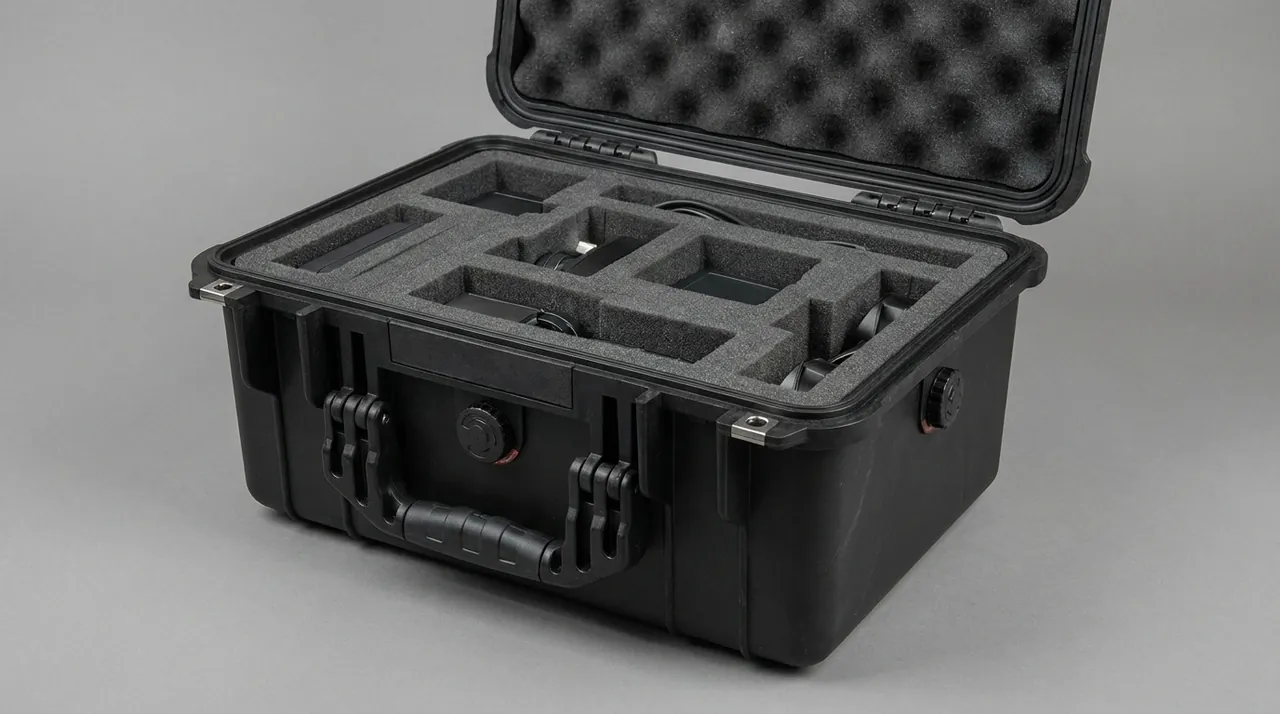
The three fabric tests are run at incoming inspection or sent out. Color fastness to rubbing follows GB/T 3920 with dry and wet ratings at grade 4 or better. Abrasion follows GB/T 21196 or Martindale, requiring no obvious fuzzing or pilling after several hundred cycles. Anti-tarnish is checked by accelerated sulfidation, placing a silver coupon together with the candidate fabric in a sealed vessel containing hydrogen sulfide; the coupon must show no visible discoloration within the specified time. Compression set of the resilient layer follows GB/T 7759, staying under 25 percent at 70 C for 22 hours.
| Test item | Reference method | Typical parameters | Pass criteria |
|---|---|---|---|
| --- | --- | --- | --- |
| Drop | GB/T 4857.5, ISTA 3A | One corner, three edges, six faces, 0.8 to 1.0 m | No piece shift, no new surface scratch |
| Random vibration | GB/T 4857.7 | 0.4 to 0.6 Grms, 60 to 120 min | No visible movement or wear marks in slots |
| Stacking | GB/T 4857.3 | 1.4 times actual load, 24 h | Trays not visibly bowed, pieces not pressed |
| Color fastness | GB/T 3920 | Dry and wet rubbing | Grade 4 or better |
| Abrasion | GB/T 21196 | Several hundred cycles | No obvious fuzzing or pilling |
| Anti-tarnish | Accelerated sulfidation | Sealed sulfide atmosphere, set duration | No visible silver discoloration |
| Compression set | GB/T 7759 | 70 C, 22 h | 25 percent or less |
Lot sampling follows Custom Case Acceptance and AQL. Appearance criteria deserve to be stricter: skipped stitches, shade variation and adhesive marks on velvet are glaring under counter spotlights, so set appearance items at an acceptance quality limit of 1.0 or zero defects, inspected at 300 mm under a standard light source.
Selection Checklist and Custom Build Path: From Jewelry List to Volume Delivery
The full selection runs in ten steps. Compile a jewelry list with type, external dimensions, weight, material and whether organic gems are present. Zone by hardness and material, separating diamond and sapphire from pearl and opal. Fix internal clear dimensions and the cavity plan. Choose the shell process and surface finish. Select facing, resilient layer and adhesive system. Define the humidity management approach. Produce 3D models and a prototype. Run drop, vibration and anti-tarnish validation. Fix color, markings and case documents. Deliver volume and archive documentation.
On schedule, programs built on an existing shell platform with a new liner are fastest, prototyping in two to three weeks. New injection or aluminum extrusion tooling runs four to eight weeks, and programs including fabric laboratory testing and accelerated sulfidation should add one to two weeks, because fabric testing is rarely the critical path but often queues. Costs typically split roughly 40 percent shell and hardware, 40 percent liner fabric and assembly, and 10 to 20 percent testing and certification, with premium fabric and hand fitting driving most of the variance. Supplier assessment is covered in How to Choose a Case OEM Factory, scheduling in Custom Case Prototyping Timeline, and finish options in Protective Case Color Customization.
Frequently Asked Questions FAQ
Q: Should a jewelry case liner use velvet or microfiber?
A: The answer depends on handling frequency and brand positioning, so there is no universal winner. Nylon or viscose velvet feels soft, has a rich pile, reads as expensive on a display counter, costs less and comes in the widest color range, which is why it remains the traditional choice for premium presentation. Its weaknesses are shedding short fibers, inconsistent rubbing fastness, and the single most common customer complaint: dark velvet transferring color onto light metal or pearls. Velvet is also hard to clean. Microfiber PU has a dense surface that does not shed, resists abrasion and wipes clean with a slightly damp cloth, so it lasts significantly longer; its hand is slightly dry but friction during handling is well judged, making it the better choice where a counter case is opened ten or more times a day. Suede reads most luxurious but marks easily and is the hardest to maintain. Whichever is chosen, write three things into the specification: rubbing fastness of grade 4 or better dry and wet per GB/T 3920, no obvious fuzzing after abrasion, and sulfur-free low-odor fabric and adhesive.
Q: Silver stored in a case blackens after a while; is the case responsible?
A: Very often it is, or at least it is a major contributing factor. Blackening is silver reacting with hydrogen sulfide to form black silver sulfide, and the reaction rate depends heavily on relative humidity and on whether a sulfur source is present. A case influences this in three ways. First, whether the liner contains sulfur: certain dark sulfur dyes, sulfur cured rubber pads, low grade foam and some adhesives release sulfides continuously, effectively placing a sulfur source inside a small sealed space. Second, internal humidity: above roughly 60 percent relative humidity sulfidation accelerates sharply, so hold the interior between 40 and 50 percent. Third, whether sorbents are fitted: anti-tarnish paper, activated carbon or molecular sieve actively capture sulfides and moisture, dosed at 5 to 10 g per liter of internal volume and replaced periodically. Beyond the case, pieces must be dry and clean before storage, since perspiration and cosmetic residue accelerate tarnish considerably. Verify with an accelerated sulfidation test: place a standard silver coupon with the candidate fabric in a sealed vessel containing hydrogen sulfide and require no visible discoloration within the specified time.
Q: Can pearls and opals share a case with other jewelry?
A: In principle no. They need individual soft cavities, ideally in a separate case or a fully isolated zone away from hard gems. The reason is the hardness gap: pearl sits at 2.5 to 4.5 on the Mohs scale and opal at 5.5 to 6.5, while diamond is 10 and sapphire and ruby are 9, so any close contact causes permanent damage that cannot be repaired. There is a second, opposite requirement as well. Pearls and opals are water-bearing organic gems, with pearls holding 2 to 4 percent water and opals 3 to 10 percent, and a persistently dry environment removes that water, dulling pearls and crazing opals. That runs directly counter to the dry condition precious metal cases aim for, so simply adding desiccant is the wrong move: keep relative humidity no lower than 45 percent and avoid direct sun and close-range spotlights, since a case under a display spotlight can run more than 10 C above ambient. In practice, give organic gems their own small case or isolated compartment fitted with a humidity indicator card.
Q: Necklaces always tangle; how should the case be built to stop it?
A: Tangling happens because the chain has free length inside the cavity and no fixed endpoints, so transport vibration keeps reshaping it until sections hook each other. The structural answer is a channel with fixed endpoints. Cut a straight or serpentine channel 8 to 15 mm wide so the chain travels its full length and the free length is broken into segments. Fit a removable pin or small clip at the channel end to lock the tail so the chain cannot migrate as a whole under vibration. Give the pendant its own slightly larger floating recess so it never presses on the chain and cause local compression and wear. Very long chains may need a double or folded-back channel to gain capacity. Handling matters as much as geometry: lay the chain in along the channel rather than pushing a bundle in, or even a good channel will fail. Where many necklaces of different lengths are stored, use adjustable dividers so each chain gets its own channel and neighbors cannot hook each other during access.
Q: Does a jewelry case need a high waterproof rating?
A: Usually not. The priority is dust exclusion and internal cleanliness rather than water exclusion. Dust in a counter or window display settles on velvet and becomes abrasive, wearing fine hairlines into precious metal during handling and dulling gemstone brilliance, so dust protection matters more than water protection, and IP5X generally covers counter conditions. Chasing maximum airtightness has two downsides. A fully sealed case exchanges no moisture with its surroundings, which suits desiccant but works against pearls and opals, and the pressure differential makes the lid unpleasant to open, sometimes difficult at altitude. Group by type instead: precious metal and diamond cases pursue dry and dust-tight conditions while organic gem cases keep moderate breathability. On the seal itself, specify a sulfur-free compound, silicone or EPDM, at 40 to 60 Shore A with 20 to 30 percent compression, and make sure corners are clamped even on a small case. Where a case is carried as hand luggage, the same check should also cover the hinges, since a lid that has gone out of alignment will hold the gasket off its seat on one side. Q: Counter cases open many times a day; how should hardware be specified?
A: A counter case exceeds three thousand cycles a year, far more than the tens typical of a shipping case, so specify hinges, latches and tray slides for at least ten thousand cycles rather than the five thousand standard for transport cases. On hinges, prefer damped or friction types that hold the lid at any angle, which prevents the lid falling back onto fingers or onto the jewelry and also reduces shock loading on the hinge itself. Where contents are valuable, use concealed hinges or at minimum make the pins impossible to withdraw from outside, because on a small case the hinge side rather than the lock is usually the prying entry point. On locks, concealed push latches open fastest and look cleanest for high frequency access, pin tumbler locks suit master key management across a fleet, and combination locks remove key handling entirely. Set opening force between 20 and 40 N, well below industrial values. Require bolt engagement of at least 3 mm in zinc alloy or stainless steel, never plastic, and back the lock body with a metal plate rather than screwing into a plastic wall.
Q: What extra validation is needed to ship the jewelry case itself as the parcel?
A: Three additional checks apply when the case ships as the transport unit. First, drop testing graded by loaded mass, 0.8 to 1.0 m for cases under 5 kg across one corner, three edges and six faces, where the criterion is not shell survival but no piece shift, no piece-to-piece contact and no new surface scratch. Second, random vibration at 0.4 to 0.6 Grms for 60 to 120 minutes, watching for visible movement or wear marks inside slots, which is the direct test of the fretting design. Third, stacking at 1.4 times the actual stacked load for 24 hours, requiring no visible tray bowing and no pressed pieces. If a corrugated outer is used, validate the whole assembly to an ISTA 3A parcel program with a 20 to 30 mm cushioning layer between outer and case. Two things are easy to forget: never use sulfur-bearing cushioning such as some recycled rubber, and pack anti-tarnish paper at 5 to 10 g per liter of internal volume before closing.
Q: How long does a custom jewelry case program take, and where does the cost go?
A: Timing depends on whether new tooling is cut and whether fabric testing is included. Programs on an existing shell platform with a redesigned liner are fastest, prototyping in two to three weeks and delivering volume two to four weeks after approval. New injection or aluminum extrusion tooling typically runs four to eight weeks for design and manufacture, plus prototype and correction, putting the program at six to twelve weeks. Where fabric color fastness, abrasion and accelerated sulfidation testing are included, add one to two weeks; fabric testing is rarely the critical path but frequently queues at the laboratory. Cost typically splits around 40 percent for shell and hardware, 40 percent for liner fabric and assembly, and 10 to 20 percent for testing and certification, with premium fabric and hand fitting driving most of the variance between suppliers. As a practical rule, start eight to twelve weeks ahead and freeze the jewelry list early, because cavity geometry depends entirely on piece dimensions and a changing list is the most common cause of slips.
Conclusion and Related Reading
Jewelry case engineering is about contact, humidity and chemistry, not impact. Get the cavities right, pick a facing that neither sheds nor emits sulfur, and hold humidity steady. JUNZHIJIA provides cavity design, fabric selection, prototyping and volume production.
Related Reading